






Abstract
With the development of artificial intelligence technologies, robotic training partner is becoming a reality, which is a substitute for human training partner. Socially anxious individuals feel uncomfortable in front of unfamiliar people or when being observed by others. Playing with robotic training partners can avoid face-to-face interaction with other people. It is unclear whether social anxiety affects the adoption of robotic training partners. This study investigates the effect of social anxiety on the adoption of robotic training partners among university students. Study 1 confirmed that university students with higher social anxiety are more likely to choose robotic training partners than human training partners. Mediation analysis in Study 2 supported the mediating role of sense of relaxation with robotic training partner in the positive effect of social anxiety on the adoption of robotic training partner. This study shows that developing training partner robots is a meaningful thing for corporate profits and the health of socially anxious people.
Introduction
With the development of artificial intelligence technologies, more and more industries, such as hotels, restaurants, and sports, are developing intelligent physical robots to replace human beings.1,2 In the field of sports, the table tennis robot named Forpheus developed by Omron is able to practice table tennis with amateurs and help professional athletes to improve their levels by playing on a real table tennis table. It can remember the characteristics of players and judge the player's table tennis level by the accumulated body information, the way of swinging the racket and the ball track information of the player, and then changing its way of returning the ball to choose a more suitable way to match the level of the player. In the badminton field, there is already a badminton robot named Kengoro developed in Japan and a badminton robot named Robomintoner developed in China. These sports require at least two people to play together before the advent of a robotic training partner. The advent of robotic training partners enables people to do the same physical exercises in the absence of other people.
Socially anxious individuals are shy and feel uncomfortable when they are in the presence of unfamiliar people or observed by other people. 3 They often avoid face-to-face interactions to escape their social fears. 4 Taking playing table tennis as an example, when playing it with a human training partner, socially anxious individuals may feel their table tennis skills checked by unfamiliar people, which may reduce their interest in playing table tennis. Robotic training partners allow them to play table tennis without other people, which may be a useful tool to reduce social anxiety and increase exercise. However, previous studies show that many people have low willingness to accept robots for the subjective perception of robots lacking emotion5,6 and the feeling of discomfort with humanoid robots.7,8 Knowledge about the effect of social anxiety on the adoption of robotic training partners is scarce.
This study aims to examine whether social anxiety will affect the adoption of robotic training partners. Taking part in physical exercise is an effective way to keep healthy and relax. More and more enterprises are investing in the development of intelligent sports robots. If playing with robotic training partners could promote the physical exercise of people with social anxiety, it is meaningful to develop training partner robots for the benefit of enterprises and the health of people with social anxiety.
Literature Review and Hypotheses
Social anxiety and the adoption of robotic training partner
Social anxiety has received considerable attention in social psychology and personality research. Social anxiety is “a state of anxiety resulting from the prospect or presence of interpersonal evaluation in real or imagined social settings.”9(p67) Anderson and Harvey suggest that social anxiety may originate from unpleasant social experiences with peers during childhood and adolescence. 10 Studies have shown that socially anxious individuals focus on the “observer's perspective” on themselves and want to create a positive self-image in others along with a lack of confidence in self-presentation, which triggers a fear of negative evaluation and then forms anxiety.11,12
Because anxiety is an uncomfortable experience, socially anxious people have motivation to minimize their anxiety. As nonverbal cues in face-to-face interactions that usually attract their attention frequently trigger social anxiety,13,14 those with social anxiety are afraid of face-to-face interactions, which leads to them often avoiding face-to-face interactions to escape social fears.4,15 As such, novel technologies that can help avoid face-to-face interactions have been welcomed by people with social anxiety. For example, Papacharissi and Rubin find that those with social anxiety tend to use the Internet more as the medium of social interactions, while those who like face-to-face interactions tend to use the Internet more as the tool of information searches. 16 Valkenburg and Peter show that online communications decrease social anxiety by avoiding the nonverbal cues of face-to-face interactions. 17 Becker and Pizzutti find that consumers with higher social anxiety are more satisfied with C2C interaction in online shopping than offline shopping. 18 Lin et al. show that social network sites positively affect the recovery of people with high social anxiety after social exclusion, but hinder the recovery of people with low social anxiety. 19
Robotic training partner is another novel technology to help players avoid face-to-face interactions. The difference between the robotic training partner and the abovementioned Internet, online communications, online shopping, and social network technologies is that the latter is only a medium between socially anxious people and other people, while the former is a substitute for other people. As a substitute, it is not clear whether people with social anxiety are willing to use it. As the need to decrease anxiety motivates those with social anxiety to minimize the chances of being observed by others 20 and playing with robotic training partners can avoid being observed by human training partners, this study proposes that socially anxious people are more likely to use sparring robots. The hypothesis is as follows:
Sense of relaxation with robotic training partner as a mediator
Socially anxious individuals want to build a positive self-image in others and fear negative evaluation.11,12 They feel uncomfortable when they are in the presence of unfamiliar people or observed by others. 3 Taking playing table tennis as an example, those with social anxiety may be afraid of negative evaluation from human training partners on their skills and performance, which may decrease their interest in playing table tennis. Making socially anxious individuals feel relaxed is an effective way to reduce social anxiety.21,22 When the training partner is a robot rather than an unfamiliar person, as a robot is a machine lacking in feeling, even if they have poor performance while playing table tennis, they may feel more relaxed playing with a robotic training partner than with a human training partner. Their anxiety of a negative evaluation from the partner will be mitigated. As the sense of relaxation can help reduce the social anxiety that prevents them from playing table tennis, they may be more likely to choose a robotic training partner. Therefore, this study proposes that the sense of relaxation with robotic training partner makes socially anxious people more willing to adopt a robotic training partner than a human training partner. The hypothesis is as follows:
Study 1
The purpose of Study 1 is to test whether people with higher social anxiety are more likely to choose a robotic training partner in the presence of human and robotic training partner.
Research design
Given that university students more easily accept new technology and social anxiety is common among them, 23 the participants were 100 university students recruited by using a professional online survey site in China with monetary reward. They filled in an online questionnaire on the site. The participants were aged between 18 and 25 years (M = 22) and 69% of them were females.
The participants first read a paragraph of background material about the development of artificial intelligence technologies and the advent of various table tennis robots with some dynamic pictures of human/robot playing table tennis. Next, they were asked to read the second material: “Please imagine that: you have signed up for a table tennis program at a training center to keep healthy. The program can provide each player with a separate indoor room and a sparring partner. This is a professional training center that offers human and robotic sparring partners. The robotic sparring partner introduced by the center has been in operation for 6 months. Professional assessment and customer reviews indicate that the robotic sparring partner is as professional as human sparring. Professionalization means that training partner can change the way of returning the ball to choose a more suitable way to match the level of the player, so that players can enjoy playing. Before starting the project, you need to choose the type of sparring partner.”
After reading the material, attention tests were taken. Next, the participants were asked to fill in a questionnaire about the measurement items of choice intention, social anxiety, table tennis liking, gender, and age. Six participants who failed the attention test were excluded, and the effective sample was 94.
Measurement
Choice intention
Choice intention was measured with a scale adapted from Phau et al. 24 The scale included three items, such as “I prefer to choose human training partner/robotic training partner” and “I want to choose human training partner/robotic training partner.” The participants were asked to choose between human training partner and robotic training partner on a 7-point scale. The option of human training partner was on the far left and the option of robotic training partner was on the far right of the scale.
Social anxiety
Social anxiety was measured by the scale developed by Apaolaza et al. 25 It includes six items that focus on interpersonal concern in actual interactions from the Social Anxiousness Scale,9,26 such as “I often feel nervous even in causal get-togethers” and “I often feel nervous when calling someone on the phone I don't know very well.” The items of social anxiety were tested by using a 7-point Likert scale with 1 = very rarely and 7 = very often.
Descriptive statistics and the Cronbach's alpha value of the two variables are shown in Table 1. The Pearson correlation coefficients among choice intention, social anxiety, table tennis liking, and gender are shown in Table 2.
Variables and Measurement Items of Study 1 and Study 2
Pearson Correlation Coefficients in Study 1 and Study 2
p < 0.05, **p < 0.01, ***p < 0.001.
“Choice intention” in Study 1.
Result
As this study predicted, participants with higher social anxiety would be more likely to adopt robotic (vs. human) training partner, a linear regression analysis with social anxiety as the independent variable, choice intention as the dependent variable, and table tennis liking and gender as the control variables were used to test the influence of social anxiety on choice intention toward a robotic training partner. The result showed that social anxiety had a significantly positive effect on the choice intention of robotic training partner (β = 0.337, p = 0.001), while the control variables of table tennis liking (β = −0.125, p > 0.1) and gender (β = −0.156, p > 0.1) had no significant effect (Table 3). By averaging the items of social anxiety and taking the mean value higher than four as the high social anxiety group and the others as the low social anxiety group, a one-way analysis of variance (ANOVA) confirmed that the high social anxiety group had higher intention to choose a robotic training partner than the low social anxiety group [Mhigh = 4.60, SD = 1.54; Mlow = 3.33, SD = 1.41; F(1, 92) = 11.407, p = 0.001].
Regression Analysis for Choice/Adoption Intention Toward Robotic Training Partner
p < 0.01, ***p < 0.001.
n, not significant.
The results of Study 1 show that university students with higher social anxiety are more likely to adopt a robotic training partner. Hypothesis 1 was supported.
Study 2
The purpose of Study 2 was to test whether people with higher social anxiety are more likely to adopt robotic training partners because they think playing with robotic training partners makes them have a sense of relaxation when exercising.
Research design
There were 150 university students recruited by using a professional online survey site in China with monetary reward. The participants were aged between 18 and 25 years (M = 22) and 72% were females. First, the participants' social anxiety was tested. Next, the participants were asked to read the same background material about the introduction of artificial intelligence technologies and table tennis robots and the table tennis program material used in Study 1. After attention tests, the participants were asked to fill in the measurement items of robotic training partner adoption intention, sense of relaxation with a robotic training partner, table tennis liking, gender, and age. Twenty-three participants who failed the attention tests were excluded, with a valid sample of 127.
Measurement
Social anxiety
Social anxiety was measured with the six items used in Study 1.
Adoption intention
Adoption intention was measured with a scale adapted from Zhu et al. 27 The scale included three items, such as “The likelihood of adopting a robotic training partner is (very low/very high)” and “My willingness to adopt a robotic training partner is (very low/very high).” The items were tested by using a 7-point Likert scale with 1 = very low and 7 = very high.
Sense of relaxation with robotic training partner
Sense of relaxation with a robotic training partner was measured with a scale developed by the current study. The scale included three items, such as “Playing with a robotic training partner helps me allay fears about my table tennis skills” and “Robotic training partner makes me feel at ease with playing table tennis.” The items were tested by using a 7-point Likert scale with 1 = strongly disagree and 7 = strongly agree.
Descriptive statistics and the Cronbach's alpha value of the three variables are shown in Table 1. The Pearson correlation coefficients among adoption intention, sense of relaxation with robotic trainer partner, social anxiety, table tennis liking, and gender are shown in Table 2.
Result
Adoption intention
As this study predicted, social anxiety positively affects the adoption of robotic training partner, a linear regression analysis with social anxiety as the independent variable, adoption intention as the dependent variable, and table tennis liking and gender as the control variables were used to test the influence of social anxiety on the adoption intention of robotic training partner. The result showed that social anxiety had a significantly positive effect on adoption intention toward a robotic training partner (β = 0.233, p = 0.009), while the control variables of table tennis liking (β = −0.008, p > 0.1) and gender (β = −0.045, p > 0.1) had no significant effect (Table 3). A one-way ANOVA confirmed that the high social anxiety group had the higher adoption intention of robotic training partner than the low social anxiety group [Mhigh = 5.38, SD = 0.73; Mlow = 3.24, SD = 0.74; F(1, 125) = 176.526, p < 0.001]. Hypothesis 1 was supported again.
Sense of relaxation with robotic training partner as the mediator
A one-way ANOVA showed that the high social anxiety group had a higher sense of relaxation with a robotic training partner than the low social anxiety group [Mhigh = 5.37, SD = 1.30; Mlow = 4.45, SD = 1.80; F(1, 125) = 8.769, p = 0.004]. To examine whether the sense of relaxation with a robotic training partner would mediate the relationship between social anxiety and adoption intention, the mediation analysis procedure (model 4) recommended by Hayes 28 was used. The mediation effect was tested using 5,000 bootstrap samples, with social anxiety as the independent variable, sense of relaxation with robotic training partner as the mediator, adoption intention as the dependent variable, and table tennis liking and gender as covariates. As predicted, the 95% confidence interval (CI) did not include zero (0.396, 95% CI [0.2136, 0.5825]), which demonstrated that sense of relaxation with robotic training partner mediates the relationship between social anxiety and adoption intention (Fig. 1).
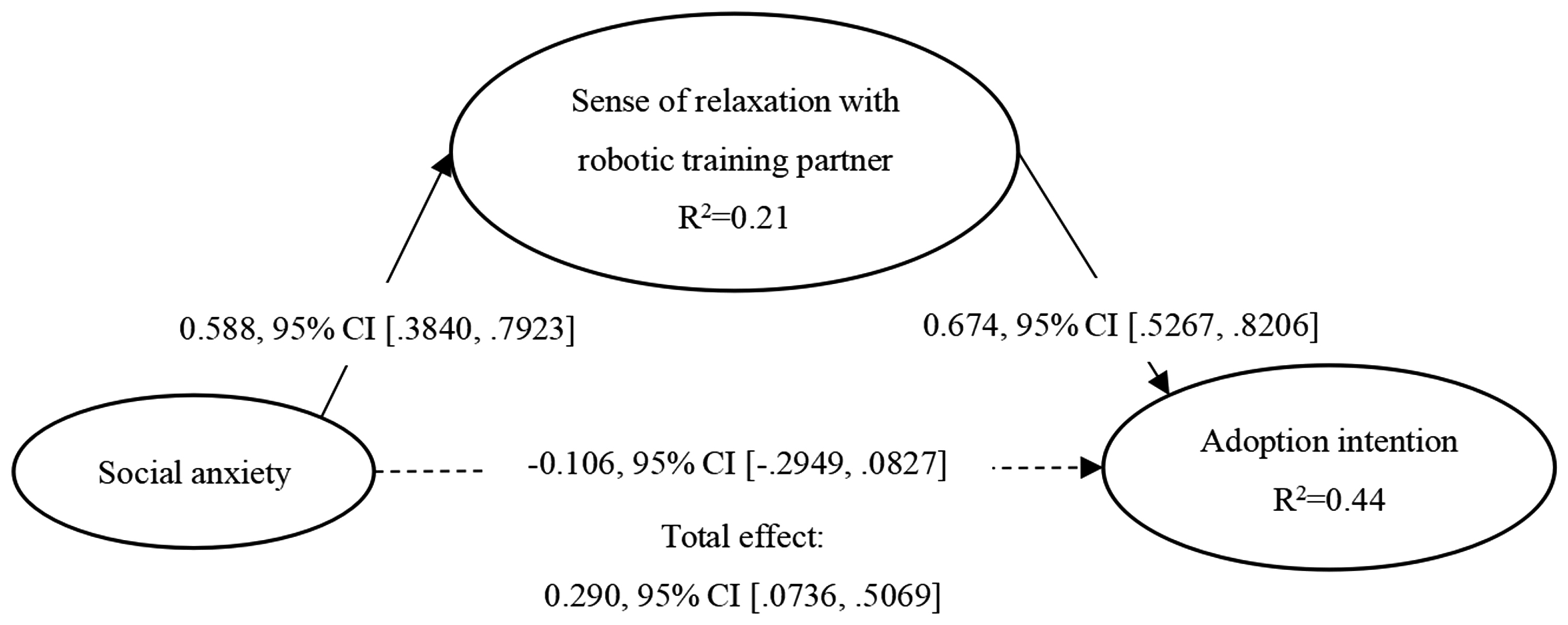
The mediating effect test.
Discussion and Implications
This study verified that socially anxious individuals are more likely to adopt a robotic training partner and the sense of relaxation with robotic training partner is the mediator. Social anxiety stems from people's fear of face-to-face interactions. 3 Robotic training partner is a substitute for human training partner and it is essentially a machine lacking in feeling. Hence, socially anxious people can feel relaxed when doing physical exercise with a robotic training partner. As such, socially anxious individuals are more likely to adopt a robotic training partner. The findings suggest that a robotic training partner is a useful new technology that can help socially anxious people reduce social anxiety and take part in physical exercise.
This is the first study to investigate the effect of social anxiety on the adoption of robots. Previous studies show that many people have a low willingness to accept robots.5–8 On the contrary, this study finds that people with social anxiety have a high willingness to adopt robots and reveals that the effect is mediated by the sense of relaxation with robots, which expands the literature about social anxiety and technology use. Another contribution of this study is to pay attention to the training partner robots. Previous studies mainly focused on social robots and health care robots.2,29 Although it has great use value, there is little research on training partner robots in scientific literature. This study expands the types of robots in the literature on robotics.
In practice, the findings of this study suggest that the commercialization of sports robots aimed at servicing amateurs can take those with social anxiety as an important part of key customers. Meanwhile, robotic training partner programs should be aware that it is necessary to offer a separate room for those with social anxiety to avoid being observed by other people. In addition, besides sports robots, robot companies can also design and develop other types of robots by targeting socially anxious people.
This study also has implications for public policy makers. Obesity is an important public health problem in many countries. 30 Obese people are more likely to suffer from social anxiety. 31 Taking part in physical exercise is an effective method to keep fit and relaxed. Therefore, public policy makers can build public health gymnasiums and separate rooms equipped with training partner robots to help obese people relieve their psychological pressure of doing exercises with others.
This study has some limitations. First, this study focused on student samples. Although students and nonstudents with social anxiety share a common characteristic of avoiding face-to-face interaction, future studies will need to replicate this study in nonstudent samples to enhance the robustness of the conclusions. Second, limited by the commercial development of robotic training partner at the present stage, this study adopted the scenario-based investigation method. Future research should investigate the real users of robotic training partners. Third, moderating variables should be examined in future studies, such as high-technology preference and the anthropomorphic characteristics of robotic training partner.
Footnotes
Author Disclosure Statement
No competing financial interests exist.
Funding Information
This work was supported by the National Natural Science Foundation of China (Grant Nos. 71972080 and 71720107004).