






Abstract
Abstract
The study contributes to the ongoing debate about the “privacy paradox” in the context of using social media. The presence of a privacy paradox is often declared if there is no relationship between users' information privacy concerns and their online self-disclosure. However, prior research has produced conflicting results. The novel contribution of this study is that we consider public and private self-disclosure separately. The data came from a cross-national survey of 1,500 Canadians. For the purposes of the study, we only examined the subset of 545 people who had at least one public account and one private account. Going beyond a single view of self-disclosure, we captured five dimensions of self-disclosure: Amount, Depth, Polarity, Accuracy, and Intent; and two aspects of privacy concerns: concerns about organizational and social threats. To examine the collected data, we used Partial Least Squares Structural Equation Modeling. Our research does not support the presence of a privacy paradox as we found a relationship between privacy concerns from organizational and social threats and most of the dimensions of self-disclosure (even if the relationship was weak). There was no difference between patterns of self-disclosure on private versus public accounts. Different privacy concerns may trigger different privacy protection responses and, thus, may interact with self-disclosure differently. Concerns about organizational threats increase awareness and accuracy while reducing amount and depth, while concerns about social threats reduce accuracy and awareness while increasing amount and depth.
Introduction
C
We contribute to this research in the following three ways: first, the self-disclosure construct often used in privacy and self-disclosure research mostly captures depth and/or breadth of disclosure, while omitting other dimensions of self-disclosure 9 : accuracy, intention, and polarity. Second, privacy concerns are often examined without separating organizational and social threats (with few exceptions10,11). We examine the relationship between privacy concerns and self-disclosure using all five dimensions of self-disclosure and two separate constructs of privacy. The distinction recognizes that social media users may be concerned about data misuse by organizations or other social media users. Thus, we ask the following:
Third, prior research often asks respondents about social media use without indicating whether the disclosure occurs on private or public accounts; as a result, we ask respondents to report their disclosure in accordance with their own privacy boundaries and report whether their accounts are primarily private or primarily public. This is an important distinction as the notions of “private” and “public” are not binary, but contextual and user specific.12–14 Furthermore, even within a single platform, there may be different levels and expectations of privacy.15,16 To understand the role of public and private uses of social media, we ask the following:
Literature Review and Hypotheses
To understand what influences people's privacy concerns and inform organizations how they can minimize risks and reduce negative perception, scholars have examined factors contributing to people's concerns associated with information privacy. Smith, Milberg, and Burke's Concern for Information Privacy (CFIP) 17 identified four fundamental factors that influence privacy concerns in response to organizations' use or potential use of personal information: collection, unauthorized secondary use, improper access, and errors in personal information. Stewart and Segars refined CFIP as a multidimensional construct comprising the four variables. 18 CFIP has been validated in various contexts such as internet use, 19 mobile use, 20 m-commerce, 21 and instant messaging. 22 By applying CFIP to social media use, Osatuyi developed the Concern for Social Media Information Privacy (CFSMIP) measurement scale. 23 In addition, Krasnova proposed the Concern about Social Threats scale (CST) to measure concerns about social threats from other users potentially misusing their information or posting embarrassing content about them.24,25
Self-disclosure refers to a social process of sharing private information with another. 9 Although the concept originally focused on disclosure between two people, it is also useful in the context of sharing private information with more than one person on social media. 26 As proposed by Wheeless, 9 self-disclosure expands across five dimensions: Intent: the disclosure is intentional or not; Amount: length and frequency of disclosure; Polarity: positive or negative valence; Depth: level of intimacy; and Accuracy: level of truthfulness. All five dimensions are important as they may be influenced by one's privacy concerns, but at different levels.
This study contributes to the ongoing debate about the “privacy paradox”. 27 The presence of a privacy paradox is declared if there is no relationship between users' privacy concerns and their online participation.28,29 However, prior research has produced conflicting results that may be due to different study populations, contexts, and platforms, or may be explained by the operationalization of privacy concerns and self-disclosure.
To interrogate the presence of the privacy paradox, we first turn to work on Information Privacy-Protective Responses (IPPRs). When a user perceives a threat to their privacy, they engage in IPPR, which may include information provision, private action, or public action. 30 For example, a user may choose not to post information, thus reducing the amount and depth of self-disclosure. Thus, we hypothesize the following:
Self-disclosure accuracy and polarity relate to how people manage their online identity. According to Leary and Kowalski's impression management work, 31 people post accurate information about themselves if they feel that others may validate such information. This process has been observed in the context of online dating, as well as in a more general case of Facebook use, where users were more likely to choose not to post certain information rather than posting inaccurate information about themselves.24,32 This may be especially applicable on social media where other users are in a position to verify one's posted information. 33 People may also recognize that third parties can use the information to make decisions about them (e.g., social media screening of job applicants 34 ). Thus, we hypothesize the following:
People may choose to engage in “selective self-presentation” 35 to enhance their online image and present themselves in a socially desirable manner. 36 For example, Facebook users post positive emotional words in their public status updates as a strategy to manage their self-presentation on the platform. 37 In our work, we want to explore to what extent such positive self-disclosure may be linked to one's privacy concerns. Although we did not find a direct link in the literature, we hypothesize that a strategy of posting favorable content or using positive statements may be an IPPR. To test this, we pose the following:
Prior research suggests that privacy concerns have a negative relationship with intention to disclose.38,39 However, since intent captures one's awareness of self-disclosure, this dimension is aligned with the Conscious Control construct, 24 rather than the future intention to share information. Krasnova et al. 24 found that concerns about social threats made participants (primarily students) more aware of their self-disclosure in social media, but interestingly, the organizational information privacy concerns did not have the same impact on self-disclosure intent (conscious control). We want to disentangle a nuanced relationship between privacy concerns and user's awareness of their self-disclosure by testing the following:
The final two hypotheses investigate the nature of self-disclosure in public or private uses of social media. Previous work 40 evidences that the perceived publicness of a social networking site has a negative relationship with the amount and depth of self-disclosure. This suggests a stronger role of privacy concerns on users' self-disclosure through public versus private accounts. Considering that social media users may share more intimate information on their private accounts that third parties are less likely to access, we expect that concerns about threats from other users would be more pronounced than threats from third parties when disclosing on a private account; thus, we hypothesize the following:
Materials and Methods
Data collection
We collected data using a cross-national survey among Canadians based on Research Now's Internet panel population. In total, we collected 1,500 responses that were census balanced by age, gender, and location, but in this study, we only examined the subset of 545 people who had at least one public account and one private account (Table 1). The online survey was open from June 1 to July 15, 2017, and hosted by Qualtrics.
Instrument design
The measurement items used in this research have been validated by other researchers as outlined below (Appendix Tables A1–A3).
Following Lai and Yang, 26 and Leung, 41 we captured five dimensions of self-disclosure: Amount (SDAm), Depth (SDD), Positive/Negative Valence or Polarity (SDPN), Accuracy (SDAc), and Intent (SDI). Originally proposed by Wheeless, 9 these items have been adapted to the social media context.41–43
To measure privacy concerns, we relied on two constructs: concerns about social and organizational threats. Following Stewart and Segars, 18 Concern for Information Privacy (CFIP) assesses concerns for information privacy in response to organizations' potential use of their personal information, across four dimensions: collection (COL), errors (ERR), secondary use (SUS), and unauthorized access (UAC). We use the CFSMIP instrument developed by Osatuyi. 23 The second privacy construct, Concern about Social Threats, represents people's concerns related to other users' potential misuse of their information. Following Krasnova et al., 24 this construct was measured using three indicators (CST1–3) related to other users posting embarrassing content or misusing information posted by this person on social media.
Data analysis
To examine the collected data, we used Partial Least Squares Structural Equation Modeling (PLS-SEM). PLS-SEM is the preferred method to analyze complex models when the aim of the analysis is prediction, making no assumption about data distribution. 44 Furthermore, PLS models can generate predictions and prediction intervals for manifest items both in-sample and out-of-sample, 45 and perform model comparisons between two groups through multigroup analysis. 46 As there is no consistency as to whether CFIP/CFSMIP should be conceptualized as reflective-reflective or reflective-formative, we ran a confirmatory tetrad analysis, which supported the definition of the second-order construct as reflective-formative. We consider a formative measurement model specification 44 as both of the measurement model's nonredundant tetrads are significantly different from zero.
We then followed a recommended two-step procedure: (a) examining reliability and validity of the measurement model and (b) analyzing the structural model. 47 We used the repeated indicator approach using a factor weighting scheme to examine the hierarchical structural model, and the bootstrapping procedure implemented in SmartPLS 3.2.6 with 5,000 iterations to assess the significance of paths.
The general rules for assessment follow Hair et al.44,48 The comparative nature of the study requires measurement model assessment and, before structural model assessment, a measurement invariance assessment. Thus, the analysis includes a measurement model assessment—of both reflective and formative variables—for each group, and then a measurement invariance (configurational, compositional, and scalar invariance) assessment. See Appendix Tables A4–A7 for more details. Figure 1 presents the results of the structural model assessment.
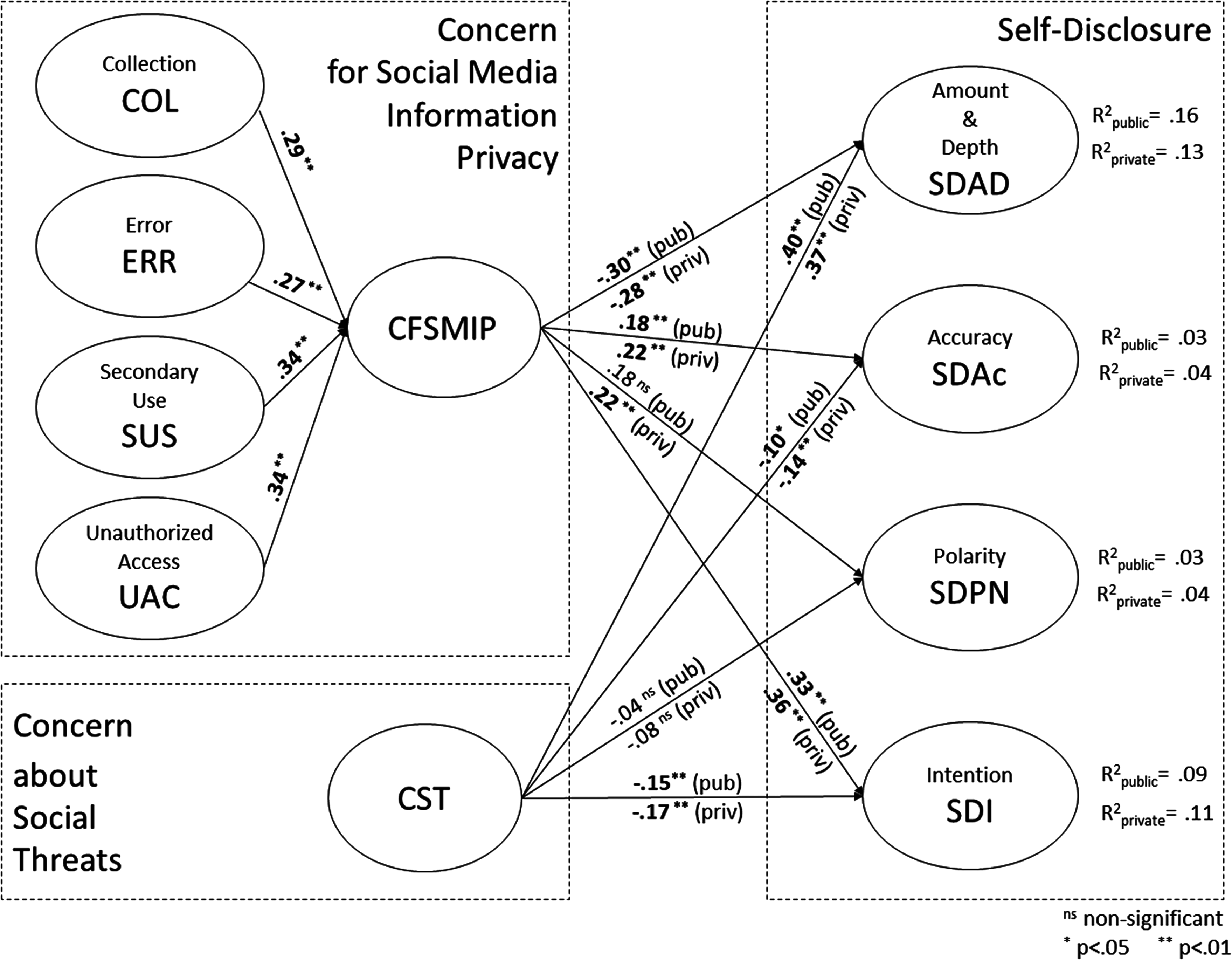
Results of the structural model assessment.
Results
These surprising results contradict H1b–3b and H5b, which suggest that concerns about social threats have an opposite relationship with self-disclosure practices compared to organizational information privacy concerns. A possible explanation is that people might be employing different IPPR depending on whether the perceived threats are from organizations or individuals. For example, users may choose to withhold information, post anonymously, share inaccurate information, or report privacy concerns to regulators.5–8 Similarly, Alashoor et al. found a negative relationship between students' privacy concerns and their accuracy of self-disclosure in social media. 49
Conclusion
The study extends the privacy paradox research from studying predominately private sharing behavior to examining users' privacy expectations in the context of public sharing. Our research does not support the presence of a privacy paradox as we found a relationship between privacy concerns from organizational and social threats and most of the dimensions of self-disclosure (even if the relationship was weak). There was no difference between patterns of self-disclosure on private versus public accounts. In other words, users regulate their disclosure in accordance with their privacy concerns in a similar way, regardless of whether they share content using their private or public account. A broader implication of this finding is that even if information is publicly available on social media, users may still have expectation of privacy.
Furthermore, we found that different privacy concerns may trigger different IPPRs and, thus, may interact with self-disclosure differently. For example, concerns about organizational threats increase accuracy and awareness while reducing amount and depth, while concerns about social threats reduce accuracy and awareness while increasing amount and depth. Although this study does not provide qualitative data to explain a peculiar relationship between social threats and the amount and depth of self-disclosure, the results broadly support the idea behind PCT that users are rational actors who recognize different privacy-related threats and adjust what and how they share information on social media accordingly. In future work, we would like to examine how different types of heuristic rules and biases that users might have27,50 may interact with the process of risk-benefit assessment when disclosing online.
Interestingly, we only found partial support for the idea that people are engaged in selective self-presentation 35 on social media to develop a socially desirable online identity. 36 Specifically, positive valence or polarity was only predicted by privacy concerns from organizational threats and only in the context of private accounts. This finding suggests that sharing information with positive valence is likely guided not just by the goal of selective self-presentation but also by other reasons, such as strengthening social ties or simply expressing one's positive internal states.37,51
From a practical perspective, organizations should recognize that social media users with both private and public accounts are concerned with all four dimensions of CFSMIP. Social media platforms that collect personal information should develop clear data stewardship policies and practices that account for people's reticence toward third parties' unauthorized access, collection, and use of their data. If such data collection and use is happening, organizations should ensure that users' data is error free and accurate. As our research suggests, failure to address users' privacy concerns may result in users sharing less information, which, in turn, may negatively impact users' overall engagement. Since our model showed there is no perceived difference in the level of self-disclosure on both public and private accounts, organizations that rely on publicly available social media data should use the same level of privacy protection and ethical consideration as if they are handling data from private accounts.
Social media platforms should also recognize that users may be concerned with the misuse of their data by other users. As our model suggests, concerns about social threats do not necessarily make people less active on social media, but they may reduce the accuracy of information shared on their public and private social media accounts. In turn, the lack of accurate information about users may reduce the usefulness of various automated recommendations and filtering features offered by most social media platforms.
From a theoretical perspective, CFSMIP and CST alone are not strong explanatory variables for some dimensions of self-disclosure; additional variables should be considered in future work. For example, we need to consider not just person-based variables (such as privacy concerns) but also demographics, system-based and environmental factors. 1 Depending on the platform and users, benefits of using social media may outweigh one's privacy concerns, as such future research can embrace a uses and gratification approach to include why people use social media. 26 Finally, as this research focused on people who have both private and public accounts, our future work will analyze the privacy concerns and self-disclosure behavior of people who only have public accounts versus those with only private accounts.
Footnotes
Acknowledgments
This research is supported through a five-year initiative on “Social Media Data Stewardship” funded by the Canada Research Chairs program (2015–2020; Principal Investigator: Gruzd, A).
Author Disclosure Statement
No competing financial interests exist.
Appendix
| Public | Private | PLS-MGA | ||||
|---|---|---|---|---|---|---|
| β | f 2 | β | f2 | βdiff | p | |
| COL→CFSMIP |
|
— |
|
— | 0.00 | 0.52 |
| ERR→CFSMIP |
|
— |
|
— | 0.00 | 0.53 |
| SUS→CFSMIP |
|
— |
|
— | 0.00 | 0.47 |
| UAC→CFSMIP |
|
— |
|
— | 0.00 | 0.49 |
| CFSMIP→SDAc |
|
0.03 |
|
0.04 | 0.04 | 0.30 |
| CFSMIP→SDAD |
|
0.09 |
|
0.08 | 0.02 | 0.36 |
| CFSMIP→SDPN | 0.18 a | 0.03 |
|
0.05 | 0.05 | 0.33 |
| CFSMIP→SDI |
|
0.10 |
|
0.12 | 0.03 | 0.35 |
| CST→SDAc |
|
0.01 |
|
0.02 | 0.03 | 0.69 |
| CST→SDAD |
|
0.16 |
|
0.13 | 0.03 | 0.74 |
| CST→SDPN | −0.04 a | 0.00 | −0.08 a | 0.01 | 0.04 | 0.63 |
| CST→SDI |
|
0.02 |
|
0.03 | 0.02 | 0.63 |
| R 2 | SRMR | |||||
|---|---|---|---|---|---|---|
| Public | Private | Saturated | Estimated | |||
| CFSMIP | 1 | 1 | Public | Private | Public | Private |
| SDAc | 0.03 | 0.04 | 0.10 | 0.10 | 0.12 | 0.13 |
| SDAD | 0.16 | 0.13 | ||||
| SDPN | 0.03 | 0.04 | ||||
| SDI | 0.09 | 0.11 | ||||
Note: The VIF values are below 3 in all cases (except for SDAc4, at 3.23 in the private group); therefore, the results discard potential collinearity issues. The values of R 2 are relatively low (0.03–0.16) with higher variance explained of self-disclosure amount and depth, and intent. Furthermore, the SRMR may indicate a poor fit (between 0.097 and 0.128 for the saturated and estimated models, respectively), which suggests that the model might not be sufficient to explain self-disclosure behaviors in private or public social media platforms. Finally, a blindfolding procedure with a distance omission of 7 returns positive values of Q 2 , which confirms the predictive relevance of the model.
ns, nonsignificant.
p < 0.05; **p < 0.01.
PLS-MGA, partial least squares multigroup analysis.