






Abstract
Abstract
As the rise of tablets and smartphones move the dominant interface for digital content from mouse or trackpad to direct touchscreen interaction, work is needed to explore the role of interfaces in shaping psychological reactions to online content. This research explores the role of direct-touch interfaces in product search and choice, and isolates the touch element from other form factor changes such as screen size. Results from an experimental study using a travel recommendation Web site show that a direct-touch interface (vs. a more traditional mouse interface) increases the number of alternatives searched, and biases evaluations toward tangible attributes such as décor and furniture over intangible attributes such as WiFi and employee demeanor. Direct-touch interfaces also elevate the importance of internal and subjective satisfaction metrics such as instinct over external and objective metrics such as reviews, which in turn increases anticipated satisfaction metrics. Findings suggest that interfaces can strongly affect how online content is explored, perceived, remembered, and acted on, and further work in interface psychology could be as fruitful as research exploring the content itself.
Introduction
T
The past decade has seen fundamental changes in the devices used to access online content. Recent data suggest that tablets and smartphones are now responsible for 60% of online traffic when app traffic is included, 5 and even when metrics are limited to traditional search and Web pages, mobile devices drive more than 20% of online traffic. 6 Industry data show that 47% of online consumers in the United States own tablets and 80% own smartphones, 7 and those numbers are rapidly growing globally. On Black Friday 2014, the largest American shopping day of the year, 49% of online traffic and 27% of online sales came from smartphones and tablets, 8 with people more likely to browse on their smartphone versus tablet (34% vs. 14% of Web traffic), but more likely to make purchases on their tablet versus smartphone (16% vs. 11% for tracked sites).
Yet, research on the effects of smartphones and tablet usage in computing has largely focused on how to make online search easier on mobile devices,9,10 demographic factors influencing adoption, 11 or physical aspects such as screen size.12–14 One key difference between traditional computers and mobile devices that has gone relatively unexplored is the psychological difference in interfaces. Moving from desktops and laptops to tablets and smartphones has seen a fundamental shift in interface from mouse and trackpad to a direct-touch interface where users are touching images of objects directly on the screen rather than touching the mouse or trackpad. This interface shift is important to explore, as interfaces fundamentally change the experience of the content they are used to access. 15
Touch interfaces and online behavior
Touch in online behavior is a recent area of inquiry. Research in human–computer interaction on touch interfaces has focused largely on “usability” issues, such as designing more efficient kiosk interfaces 16 or how user emotion can be predicted based on touching patterns. 17 While marketing research has explored the role of product haptics in product selection and evaluation,18,19 most traditional marketing research on touch focuses on touch-imagery, interpersonal touch, or touching products. 20
So how might exploring information online through a direct-touch interface be different from using a mouse interface? Touching an object on a screen is a direct visual metaphor for the act of touching content itself, similar to touching an object in the real world, when compared to the more indirect touch of using a mouse or trackpad to control screen content. Merely imagining touching an object activates imagery processing, which in turn cues mental simulation of that object's behavior 21 ; in essence, simulated or imagined touch generates effects highly similar to actual touch. Indeed, touch interfaces in online shopping have been shown to activate levels of psychological ownership and endowment similar to the effects of touching actual products, 22 even when interface device (tablet vs. desktop) and ownership are explicitly controlled.
In addition, object interactivity increases the vividness of mental product images, 23 and imagery vividness increases ownership perceptions 24 and mental simulation. 25 The act of directly touching content on a screen is a more direct analog of interacting with objects in the real world, so it suggests that touchscreen images may make sensory information within online content more vivid and salient. This increased salience and vividness would, in turn, increase cognitive processing of the vivid informational elements such as the images.26,27 This could manifest in an increased reliance on imagery over text in online decision making, and a bias toward sensory information over abstract information in product evaluation.
Interestingly, touch devices such as tablets and smartphones have a more direct association with a consumer's extended self, 28 and feel more a “part” of them than traditional laptops and desktops. Even when viewed in a relationship role rather than as part of an extended self, relationship bonds with touch devices appear more intense than with other forms of computing technology. 29 These two findings suggest that information received through touch interfaces may be trusted more when compared with information explored via mouse, as the perceived source of the information is either closer to us or from a more strongly connected partner.
In sum, it is proposed that the act of reaching out to touch a product image is a more direct visual metaphor for choosing a product than indirect touch with a touchpad or mouse. Based on prior research in mental simulation and vividness, it is predicted that the use of touchscreen interfaces biases attention toward sensory data and elevates the importance of tangible attributes over intangible ones. Touchscreen interfaces should also bias attention toward graphical elements over textual elements, and due to greater perceived ownership and transparency may cause consumers to trust their own feelings and instincts over more objective external ratings of product quality. To explore this, a study was conducted using mouse versus direct-touch control of a tablet computer where participants searched for and chose a hotel in Paris.
Method
Participants
A total of 63 participants (59% female) were recruited from the undergraduate body of a large university in the United States, and were compensated with a $10 gift certificate to a leading online retailer for their participation. They were randomly assigned to one of two interface conditions described below.
Procedure
Participants entered the laboratory, signed informed consent, and were seated at a table. This research was conducted on a tablet, as it allowed us to compare a more traditional mouse interface directly with a touch interface on the same device, keeping other device variables such as screen size, resolution, and processing power constant. A 10.5 inch Android Galaxy Tab tablet was used because, unlike the Apple iPad, the Android tablet allows a connection for a mouse. The tablet, placed in a stand, was already open on the home page of Imagine that you and your friends have decided to go to Paris for a vacation during this upcoming spring break. You know there are many hotel rooms in Paris, so you go to a travel review Web site to help you select a room. Feel free to take as long as you want exploring this site to help you decide what hotel you'd like to stay at during your vacation. Please inform me once you've made your choice.
Participants randomly assigned to the direct-touch interface condition (32 participants) were instructed to use the tablet as normal (holding the tablet in-hand and using the touchscreen), while participants randomly assigned to the mouse condition (31 participants) were told to use the provided Bluetooth mouse to control the tablet and leave the tablet in the stand. TripAdvisor displays hotels for a given city in a vertical, clickable list. Once a hotel is selected it opens a new page; a horizontal menu across the top of the page switches between various tabs such as user reviews, photos, location, and amenities for the selected hotel. While the participants were using TripAdvisor to select their hotel, the experimenter recorded the number of pages they visited and the overall time it took them to choose.
Measures
After the participants had indicated that they had made their choice, they completed a traditional survey. They were first asked to record general reactions to the choice process and Web site, along with anticipated room satisfaction on 7-point Likert scales. Participants were then asked to free-response record what attributes or aspects of the room led to their selection. These free responses were coded as “tangible” when the attribute had clear physical and haptic dimensions (bed sheets, room décor, etc.), “intangible” when the attribute had no physical or haptic dimension (WiFi service, employee demeanor, etc.), or “other” when the attribute was larger than the room, or dealt with both physical and nonphysical aspects simultaneously (location, building history, etc.).
Following this, they completed 7-point Likert scale questions on the importance of “gut feel,” “instinct,” “user reviews,” and “star ratings” in making their choice. Participants then rated the importance of the room pictures and the descriptive texts. Finally, the experimenter noted the average room price of the hotel the participant selected.
In addition, participants were matched to their responses on a series of general tablet usage questions collected in a prior exploratory survey battery to ensure that the general level of touchscreen familiarity and comfort was not different between the two conditions. These measures recorded whether they owned a tablet, the number of hours per week they estimated that they used tablets, and their familiarity and comfort (both 7-point Likert scales) with touchscreen interfaces. There were no significant differences on sex, age, and the ownership and usage measures between participants randomly assigned to the touchscreen condition and participants randomly assigned to the mouse condition, and when demographics were included as covariates in the main analysis, no significant changes emerged to the pattern of effects. The mean tablet familiarity rating was more than six out of seven, with no difference between conditions, and the average hours of tablet usage per week was more than 4 hours, regardless of tablet ownership. When tablet usage, ownership, and familiarity measures were included as covariates in analysis, no significant effects on the dependent variables emerged, so they are not discussed further.
Results
Web site behavior
While both direct-touch and mouse participants spent roughly the same amount of time on the site before making their choice (Mtouchscreen=4.5 minutes vs. Mmouse=4.7 minutes, n.s.), direct-touch interface participants felt as if they spent longer on the task when asked to recall how long the task took (Mtouchscreen=7.8 minutes vs. Mmouse=6.2 minutes; t(61)=2.21, p<0.05, Cohen's d=0.5). Touchscreen users visited more hotel Web pages (Mtouchscreen=7.1 hotels vs. Mmouse=4.4 hotels; t(61)=4.92, p<0.001, Cohen's d=1.1) and, perhaps because of this extra searching, reported higher satisfaction with the choice process itself (Mtouchscreen=5.8 vs. Mmouse=5.1; t(61)=2.09, p<0.05, Cohen's d=0.03). Chosen room cost, however, was not significantly different between the two conditions (Mtouchscreen=$289 vs. Mmouse=$270, n.s.). The two interfaces also did not differ in how involved the participants felt with the choice process, the degree to which the Web site was easy to use, or their satisfaction with the information presented (all comparisons n.s.). When measures of prior tablet usage and touchscreen familiarity were introduced as covariates in a multivariate analysis of variance, the only effect to emerge was that for participants in the touchscreen condition, those reporting higher prior familiarity with touchscreen interfaces opened more pages (partial η2=0.24).
Decision attribute importance
Direct-touch participants were nearly twice as likely as mouse participants to mention tangible elements of the room as instrumental in making their decision (56% of touchscreen responses vs. 32% of mouse responses, χ2p<0.01). In contrast, mouse users were nearly twice as likely as touchscreen participants to mention intangible elements as instrumental in making their decision (37% of mouse responses vs. 19% of touchscreen responses, χ2p<0.05; see Fig. 1). This focus on the more tangible attributes of the room engendered by the touchscreen, combined with the higher choice process satisfaction, appears to translate into increased anticipated satisfaction with the room experience (Mtouchscreen=6.1 vs. Mmouse=5.0; t(61)=2.36, p<0.05, Cohen's d=0.6).
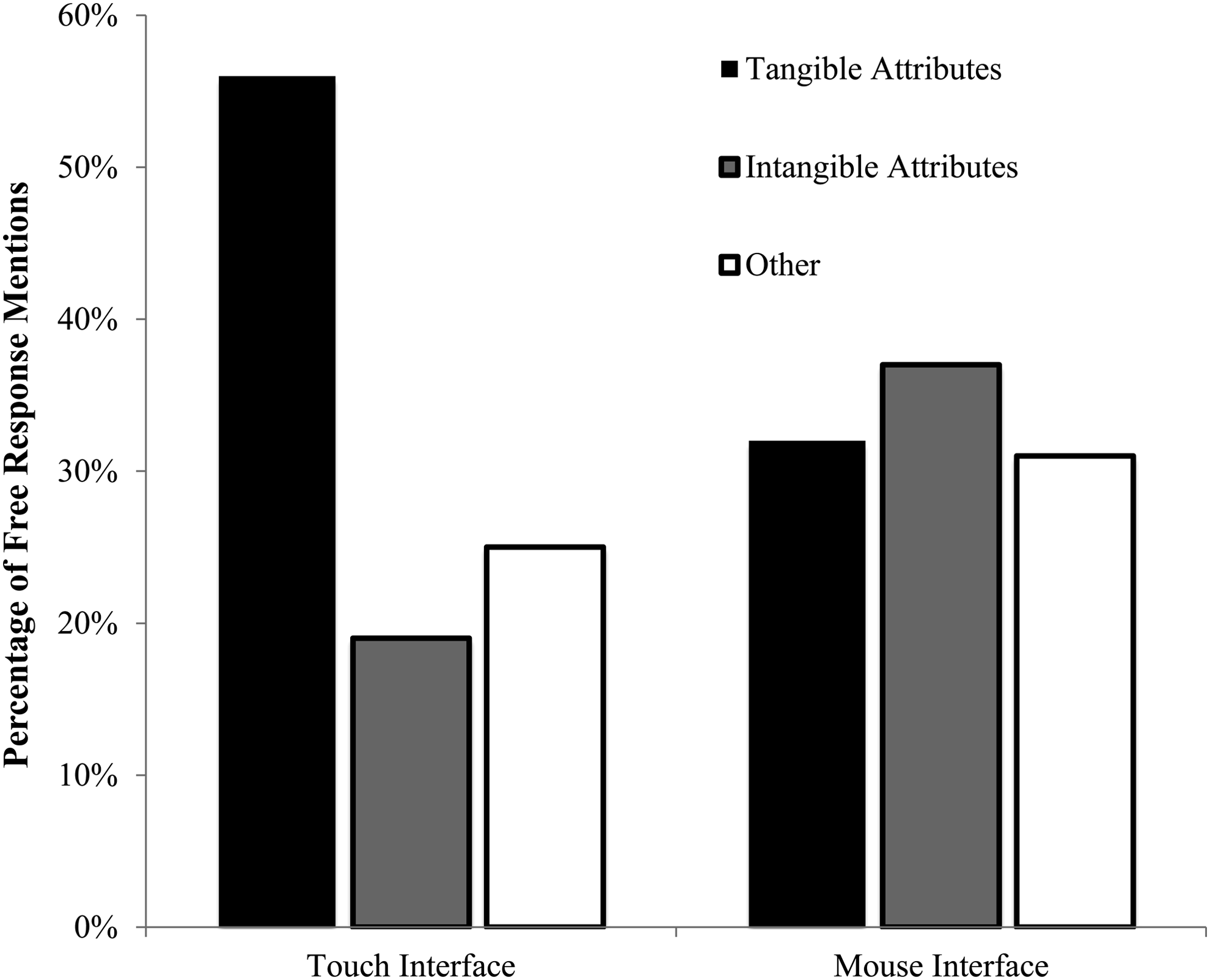
Free response recall of attributes used to make hotel decision.
Information source usage
The two “internal” information sources (gut feel and instinct) were combined into a construct (α=0.94), and the two “external” information sources (user reviews and star ratings) were combined into a construct (α=0.87). Results show that direct-touch participants rated internal information sources as significantly more important than mouse participants (Mtouchscreen=5.3 vs. Mmouse=4.2; t(61)=2.33, p<0.05, Cohen's d=0.05), while mouse participants rated external information sources as significantly more important than touchscreen participants (Mmouse=5.4 vs. Mtouchscreen=4.6; t(61)=2.10, p<0.05, Cohen's d=0.2; see Fig. 2). Consistent with a bias toward sensory information engendered by a touch interface, touchscreen participants also rated images as significantly more important in their decision making process than the mouse participants (Mtouchscreen=6.2 vs. Mmouse=5.4; t(61)=2.12, p<0.05, Cohen's d=0.04), while the two groups did not differ on the importance of the descriptive text (Mmouse=5.0 vs. Mtouchscreen=4.7; n.s.). When measures of prior touchscreen familiarity and usage are included as covariates in the analysis, no significant effects emerged, suggesting the main effects are robust across a wide range of user experience.
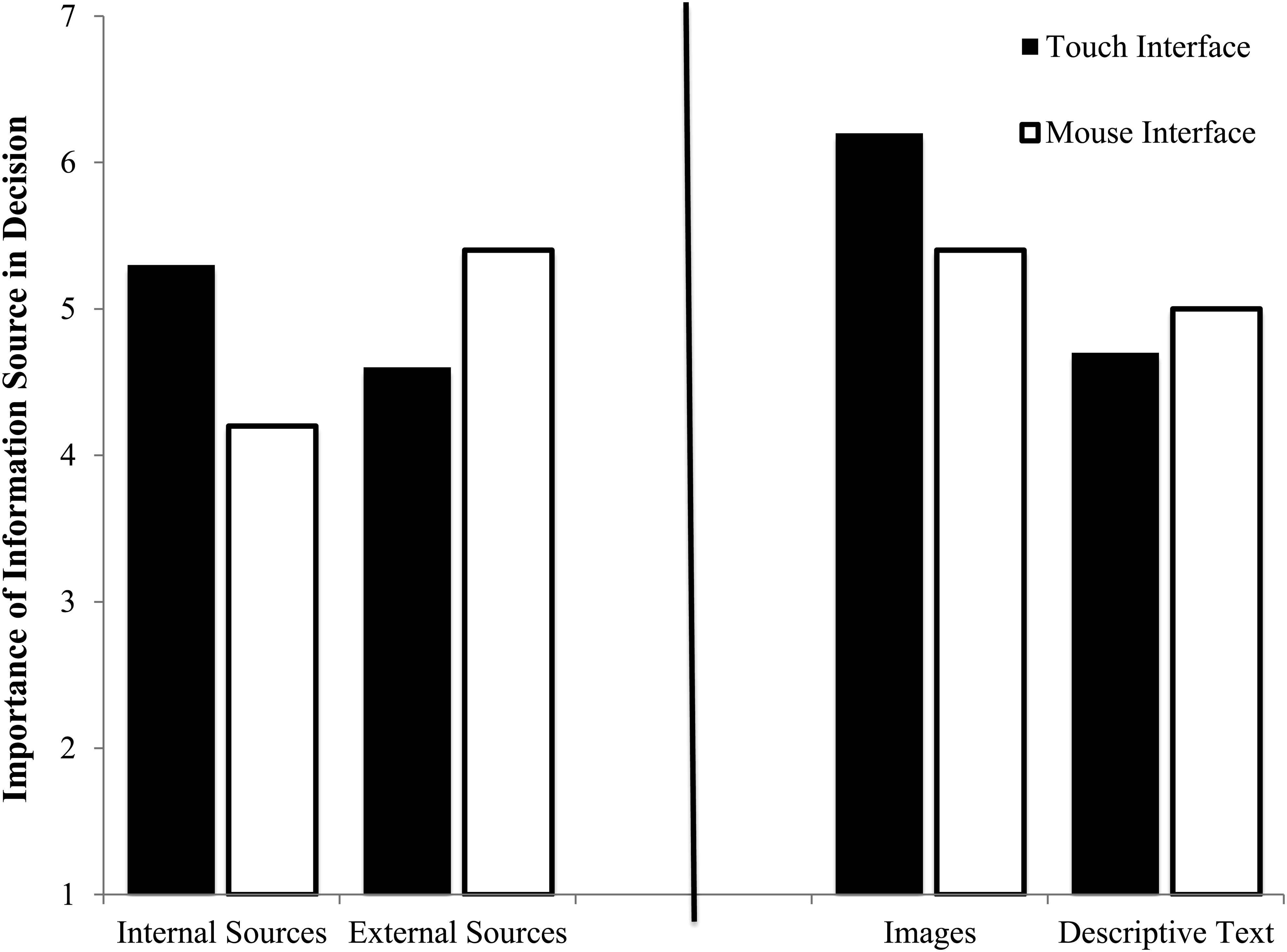
Rated importance of information source in hotel choice.
Discussion
As tablets and smartphones become the modal device used to access online content, from consumers 30 to educators 31 to doctors, 32 the role of touch interfaces in online psychology is going to continue to grow. An important issue is whether changing the interface modality used to access identical content changes the way that content is processed, 15 such as the current shift from indirect mice and trackpads to direct touchscreen interfaces. Results from a lab study where participants searched for hotels on a travel review Web site using a tablet either with a touchscreen or a mouse interface reveal that interface modality creates sizable differences in psychological reactions to online content. Direct-touch interface users had higher levels of anticipated satisfaction, were more likely to mention tangible attributes as driving their decisions, and rated instinct as more important in the choice process than their mouse-using counterparts. In comparison, mouse users were more likely to mention intangible attributes, and felt that user reviews were more important than their touchscreen-using counterparts.
These findings provide a ground-level exploration of how the shift from mice to touchscreens may affect online behavior. A connected research question is whether the touchscreen shift in attribute focus to more tangible dimensions can be moderated by environmental variables. The product category chosen for this study (hotel rooms) has both haptic and nonhaptic dimensions. Would the effects look similar in product categories where either tangible (such as sweaters) or nontangible (such as cellphone service) attributes were dominant? Prior work in offline product selection has focused on concrete products with clear haptic dimensions, 3 so work exploring the role of touch in abstract service selection could provide a unique contribution. Does the increased salience of sensory information engendered by touchscreen interfaces go away when there is little sensory information to be had, or does the mind elevate the importance of cursory tangible dimensions to compensate?
Future work may also explore the “holding the device” aspects that traditionally accompany touch interfaces. While prior work has shown that touch interface effects remain strong even when the touch device is not held, 22 and touchscreen interfaces are increasingly incorporated into nonheld devices such as laptops, future work may explore what role holding the device plays in self-incorporation of touch devices.
The results of the present study show an increased reliance on “internal” sources of judgment validation over more objective external sources. When combined with increased feelings of endowment that tablets have the potential to generate, 22 consumers shopping on tablets or other touchscreen devices may be especially susceptible to biases in their online search and purchasing behavior. Future research might explore ways to moderate or control for these biases, or research ways to harness these biases to increase consumer welfare.
In conclusion, moving from a mouse to a touchscreen changes online user behavior, decision attribute salience, and sources of satisfaction judgments. This work highlights the role that interfaces play in shaping reactions to online content, and further work in this area could yield significant contributions. As alternative interfaces such as voice, eye, and gesture control proliferate, the importance of interface psychology will only continue to grow.
Footnotes
Author Disclosure Statement
No competing financial interests exist.