






Abstract
Genetic similarity is a measure of the genetic relatedness among individuals. The standard method for computing these matrices involves the inner product of observed genetic variants. Such an approach is inaccurate or impossible if genotypes are not available, or not densely sampled, or of poor quality (e.g., genetic analysis of extinct species). We provide a new method for computing genetic similarities among individuals using phylogenetic trees. Our method can supplement (or stand in for) computations based on genotypes. We provide simulations suggesting that the genetic similarity matrices computed from trees are consistent with those computed from genotypes. With our methods, quantitative analysis on genetic traits and analysis of heritability and coheritability can be conducted directly using genetic similarity matrices and so in the absence of genotype data, or under uncertainty in the phylogenetic tree. We use simulation studies to demonstrate the advantages of our method, and we provide applications to data.
1. Introduction
The computation of genetic similarities among samples (or taxa, or subjects, or individuals) is a key step in the analysis of quantitative genetic traits and in estimating the heritability of traits through variance component approaches (Chen and Witte, 2007; Tzeng and Zhang, 2007; Malo et al., 2008). For example, linear mixed models (LMMs) are popular methods for genome-wide association studies, and matrix-variate normal methods are popular for heritability and coheritability analyses. Both of these approaches demand efficient methods to determine genetic relatedness among samples (Kang et al., 2010; Lippert et al., 2011; Listgarten et al., 2013). The genetic relatedness among samples is usually specified through a genetic similarity matrix (Patterson et al., 2006; Thompson, 2013) derived empirically from genetic sequences, or from a kinship matrix (Boyce, 1983; Kirkpatrick et al., 2019) derived from a pedigree. Genetic sequences are often described by a series of genome locations at which mutations may be observed in the ancestry of the subjects. We consider single-nucleotide polymorphisms (SNPs), locations at which a single DNA base pair can appear with more than one form (or, allele). The most common form is known as the major allele, and the less common forms are the minor alleles. We refer to the matrix resulting from the inner products of genetic sequences as the empirical genetic similarity matrix. This matrix is formed according to the following definitions. For the SNP at locus m, let Gm denote the column vector of alleles. The genetic similarity between samples i and j for a haploid sample is defined as follows:
Here
The computation of genetic similarity among samples using Equation (1) requires genotyped sequences, and several challenges may arise in the computation. First, the genetic sequences may not be readily available. This may be the case when extinct species are examined. Second, it is hard to assess the uncertainty for empirical genetic similarities in cases for which the genotyped sequences have low quality, or are homoplastic. This case may arise when examining bacterial genomes or de novo sequences. These challenges motivate us to propose an approach that does not involve genetic sequences.
In this article, we develop a method for estimating expected values for the entries of a genetic similarity matrix using a phylogeny [i.e., a closed form for the expected value of Eq. (1), conditioned on a tree]. Our proposed approach does not require that the sequences for individuals be genotyped (or measured). Our method allows analysis based on Equation (1), such as analysis using fixed effects models, to proceed for situations in which genotypes are not available but an approximation of the molecular phylogeny is, or for situations in which there is uncertainty in Equation (1) stemming from low-quality genotyping or short genomes. For example, in some studies of extinct species, genotypes might not be available but an approximate molecular phylogeny, based on morphological data and geological dates, might be. Instead of requiring individual genotypes, we assume that a phylogeny is given.
The relatedness among samples is computed by integrating over all mutations occurring in the branches of a tree, under the assumption of an infinite sites model (Ma et al., 2008), with a constant mutation rate for the evolutionary process. The infinite sites model is a popular and simple model for mutations in genome evolution, and it is a reasonable model when the genome is large. The infinite sites model postulates that new mutations are always at novel loci (and not re-entrant). Genetic recombination among samples is not considered in this approach (however, the approach for samples with recombination is clear), as we mainly consider genetic similarities at the species level. We numerically demonstrate that our proposed expected genetic similarity matrix is asymptotically equivalent to the empirical genetic similarity matrix, with an infinite number of genotyped loci (provided that the tree is correct).
The main application of our work is to provide a correspondence between phylogenetic trees and the normalized genetic similarity matrices (Patterson et al., 2006) that are standard in LMMs and heritability analysis. Often, many sampled molecular phylogenies are provided conditioned on genotypes (e.g., with the Bayesian Evolutionary Analysis Sampling Trees (BEAST) software; Drummond and Rambaut, 2007). Our work allows computation of the expected value of the standard and normalized genetic similarity matrix (Patterson et al., 2006) for each of the sampled trees. These matrices can then be used to average over LMMs applied to each sample (respecting the uncertainty in the genetic similarity matrix), or they can be used in Bayesian models extending the usual LMM paradigm. In contrast, work based on computing Equation (1) directly from genotypes provides a point estimate of the genetic similarity matrix (without respecting the uncertainty implied by the genotypes).
In our simulations, the expected genetic similarity matrix is invariant to the number of samples and to the mutation rate in the infinite sites models. Our approach is more accurate than the multidimensional scaling (MDS) approach implemented in the software package pyseer (Lees et al., 2018) and Gaussian distance similarity matrices (Ickstadt et al., 2005; González-Recio et al., 2008). The MDS approach for genetic similarity matrix estimation also operates on phylogenies, but is not based on integration over all mutations.
We use our approach to compute the genetic similarity matrix for a set of ancient hominin species, with the phylogeny found using BEAST on the set of morphological phenotypes used in Dembo et al. (2016). Genetic similarity matrices are often used to partition the covariance matrix into additive components that arise from genetic, environmental, or random factors (Wang et al., 2011; Dahl et al., 2016). Given this estimated genetic similarity matrix, we compute the component of genetic covariance that is inherited along the tree (before and after speciation events) for the heights of the ancient hominin species. In particular, we apply an LMM (Yang et al., 2011) to compartmentalize the covariance matrix of the heights of the species, such that the genetic component is a scaled version of our estimate for the genetic similarity matrix. This demonstrates how our estimate can be used to determine genetic aspects without access to measured genotypes (instead, with access to a tree that we assume approximates the correct phylogeny). In addition, we apply our algorithm to evaluate the uncertainty of genetic similarities among hominin species.
1.1. Related work
Genetic similarity is a basic aspect of many approaches in genetic analysis. IBD (Whittemore and Halpern, 1994) is a popular measure for genetic similarity, based on the identification of stretches of genetic sequences that have identical ancestral origin. Kinship coefficients describe the probability that two random alleles from a pair of individuals are IBD, and these coefficients are commonly used to measure genetic similarity between a pair of individuals. There are several ways to compute kinship coefficients, including from genetic data, and also based on pedigree graphs (Maruyama and Yasuda, 1970). The idea of using trees to define similarity matrices (for use as fixed effects) is explored in Housworth et al. (2004). However, that work uses estimates of similarity matrices based on pedigrees (and does not use the definition of genetic similarity as a normalized inner product of genetic sequences, as is standard in applications of LMMs to genome-wide association studies; Listgarten et al., 2013). Similarly, in Abney (2009), a novel graphical algorithm for computing the kinship coefficients using graph traversal is developed: “kinship graph,” and in Thornton et al. (2012) a robust method “REAP” is developed, to estimate IBD-sharing probabilities and kinship coefficients for admixtures. However, neither of these methods is designed to estimate the normalized inner product of genetic sequences [Eq. (1)].
Computational concerns for kinship matrices have also been considered: Kirkpatrick et al. (2019) propose a fast algorithm for calculation of kinship coefficients for individuals in large pedigrees. Our work provides an algorithm with similar computational complexity.
In further lines of research, if genetic sequences are observed, a variety of measures have been used to compute genetic similarities using categorical data clustering (Ickstadt et al., 2005; González-Recio et al., 2008) by creating dissimilarity scores for genotypes and then converting the dissimilarity scores to similarity scores. For example, Murray et al. (2017) present the k-mer weighted inner product, an assembly-based estimator of computation of genetic similarities among individuals that is also alignment-free. The pairwise similarity is obtained from k-mer counts. In contrast, less work has been done in assessing the statistical relationship between phylogenetic trees (rather than pedigrees or alignment-free methods) and genetic similarity matrices. The most similar approach is based on MDS, which has been applied to the control of LMMs (Lees et al., 2018). This MDS approach also provides a deterministic function that outputs a similarity matrix given a fixed tree. In typical protocols, the fixed tree used in the production of the similarity matrix may be produced from genotypes using BEAST.
2. Methods
Let T be an unrooted binary tree with leaves
In computational genetics, the infinite sites model is commonly used to model genetic variation (Kimura, 1969). In this model, we assume that polymorphism arises by single mutations of unique sites at locations within the genetic sequence, with all mutations occurring at different positions, implying that all genetic variants are biallelic. Let
Here Gi is a random variable giving the genotype of a marker placed at a random location of the tree, and
To compute Equation (2), we integrate the location of the marker over the tree, noting that expectation splits linearly over the union of the domain of integration. Assuming a neutral model with a constant mutation rate, the values of Gi are completely determined by the location of the marker, and they are constant over each edge of the tree. So, Equation (2) can be rewritten as a weighted sum over edges of the tree. The weights are given by
The values
Let c0 and c1 be the bipartition of taxa induced by segregation over edge ed in the unrooted tree T. Figure 1 shows an example of this operation. Without loss of generality, we assume that the number of leaves in c0 is greater than or equal to that of c1. This means that each leaf in c0 will have the major allele, and each leaf in c1 will have the minor allele.
Bipartition of taxa induced by an unobserved genetic variant on edge ed. Only the membership of each taxon in the bipartitioned set is needed in the computation of the expected mean 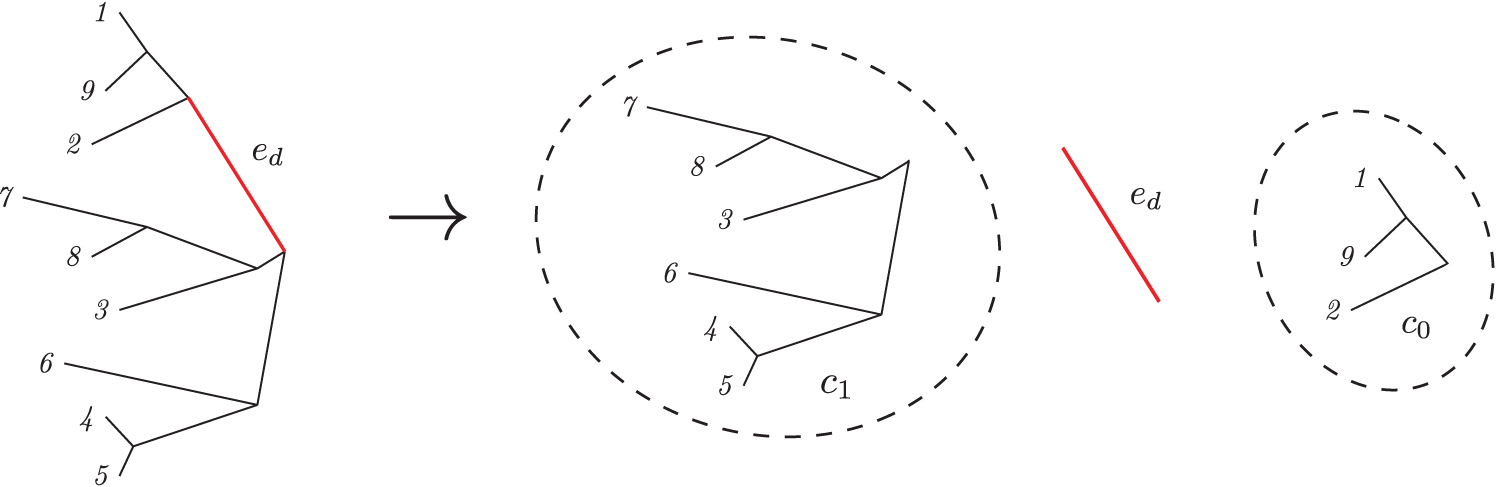
The genotype
The mean
Note that if c0 and c1 are the same size, then  algorithm (Algorithm 1) for computing the expected genetic similarity matrix, given the tree T. In this algorithm,
3. Experiments
In our numerical experiments, we use the ms software (Hudson, 2002) to simulate binary trees and genetic variation (ms is a coalescent simulator that generates genetic samples under the assumption of the neutral model and the infinite sites assumption). We also assume constant effective population size N. The branch lengths are thus in units of
3.1. Simulation 1
In this simulation study, we numerically demonstrate the consistency of our algorithm. We simulate data sets for three scenarios: A, B, C. In scenario A, we simulate 100 trees, with N = 20 samples (or subjects, or taxa) for each tree. Also, for each tree, we simulate two sets of genetic sequences, each with
For each scenario, we compute the empirical genetic similarity matrix using the simulated genotypes to form a ground truth. Then, we compute the expected genetic similarity matrix using Algorithm 1 and the simulated tree. Figure 2 displays scatter plots comparing our method for computing genetic similarity matrices to the ground truth [the ground truth is found by applying Equation (1) to the simulated genotypes]. Figure 2 shows that for a higher value of M, the correlation among the entries of the genetic similarity matrices computed from trees and from genotypes may be stronger than it is for low values of M (the number of loci). This figure also shows that even a small number of samples may produce unbiased estimates of the genetic similarity matrix. We also show that for situations with small numbers of samples, the estimates may still improve for higher values of M.
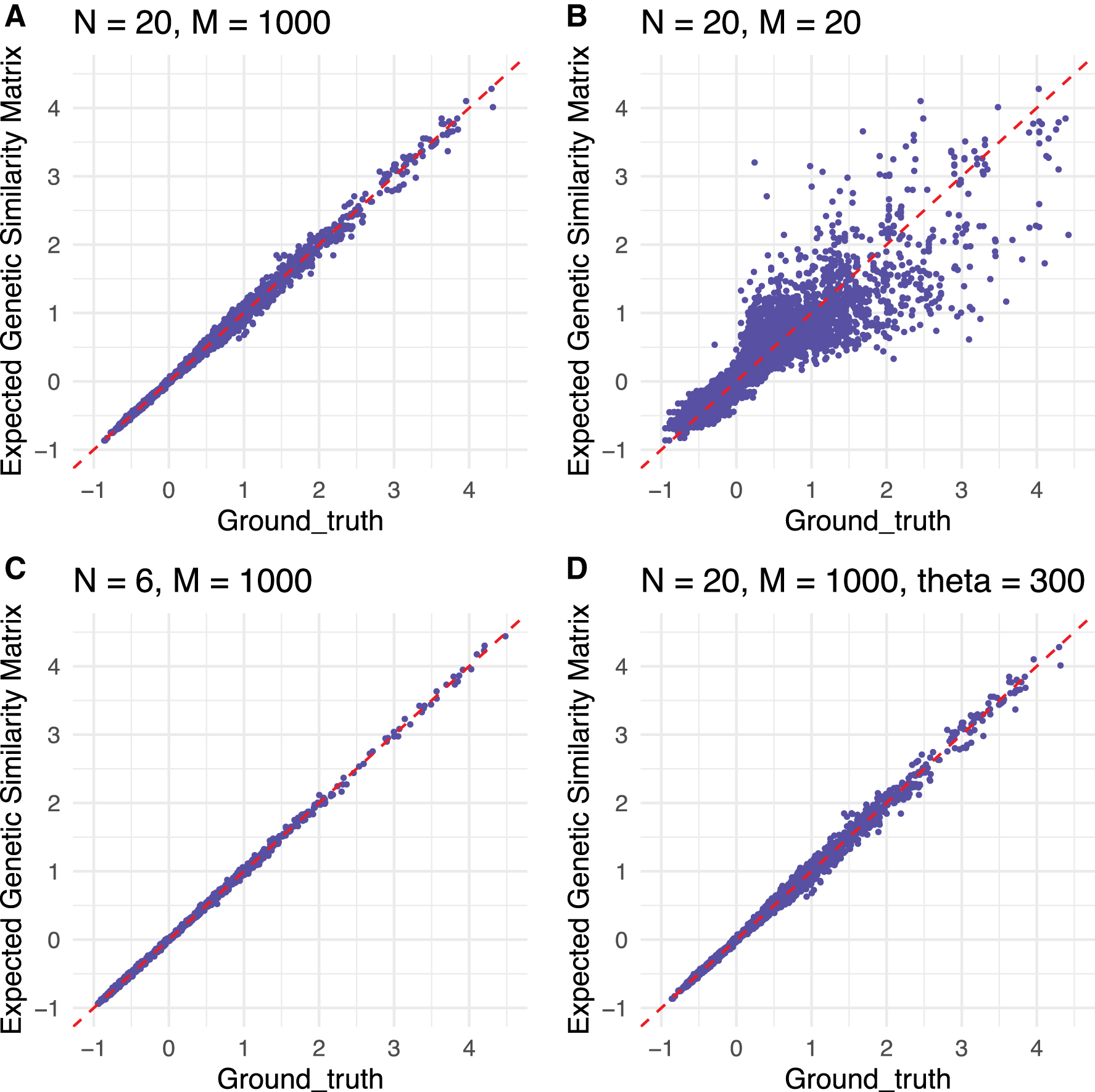
Comparison of simulated genetic similarity matrices from trees and genotypes. Scatter plots are provided for entrywise differences between the genetic similarity matrices produced by our method and the ground truth [from Equation (1), applied to the simulated genotypes]. The top left and top right panels show the entrywise differences for the two conditions for scenario
The entries of genetic similarity matrices computed from trees and genotypes become closer together as we increase M on the genotype from 20 to 1000, providing evidence for consistency of our methods over the range of M considered. In addition, these simulations suggest that the expected genetic similarity matrix is invariant to the number of individuals and the neutral mutation rate.
We conduct an additional set of experiments to investigate the difference between entries of the expected genetic similarity matrix and the ground truth as (A): a function of number of loci for each sequence; (B): a function of number of samples (or subjects, or taxa). For (A), we simulate 100 trees, with
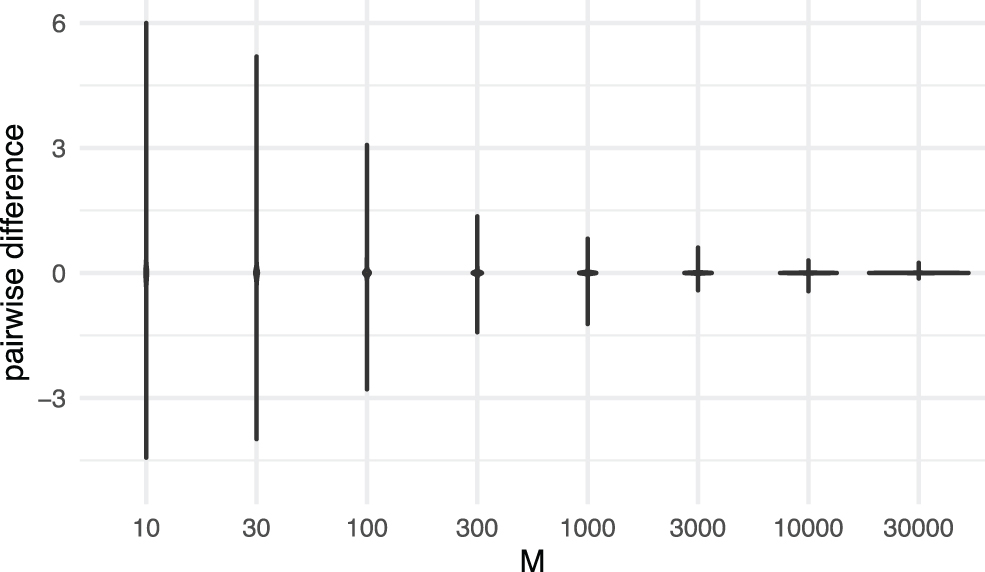
Comparison of simulated genetic similarity matrices from trees and genotypes. The violins are provided for entrywise differences between the genetic similarity matrices produced by our method and the ground truth.
For (B), we simulate six sets of trees, each with
Comparison of Simulated Genetic Similarity Matrices from Trees and Genotypes As a Function of Number of Taxa
The summary statistics (mean, SD, 2.5%, 25%, 50%, 75%, 97.5% quantiles) for entrywise differences between the genetic similarity matrices produced by our method and the ground truth are close. This observation is further supported in Supplementary Appendix SA2.
SD, standard deviation.
3.2. Simulation 2
In our second simulation study, we compare our tree-based genetic similarity matrix approach with other approaches that measure genetic similarities using phylogenies. The first approach we compare with is a Gaussian distance similarity matrix (González-Recio et al., 2008; Ickstadt et al., 2005), in which we first compute the distance between two samples
We simulate 100 trees, with N = 20 taxa in each tree. For each tree, we simulate genetic sequences with M = 1000 loci. We compute the genetic similarities via
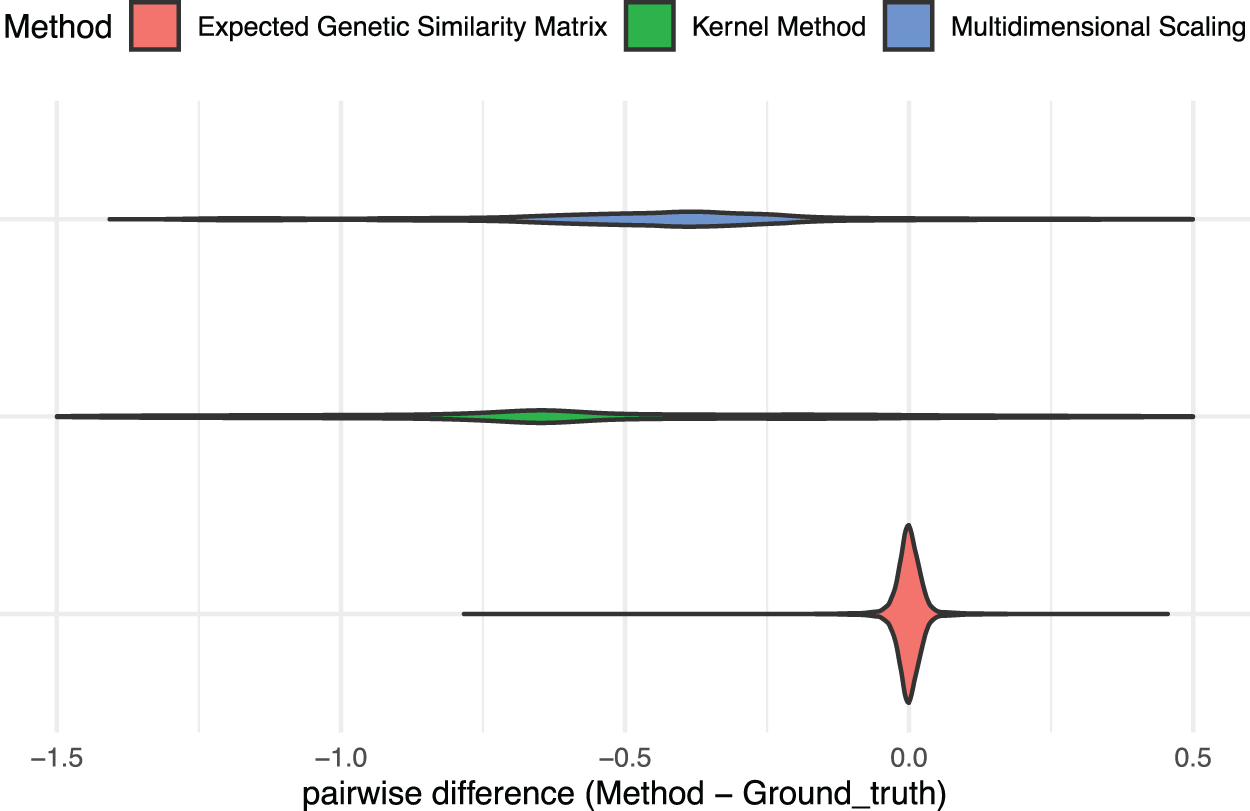
Comparison of expected genetic similarity matrix approaches:
Note that the simulation conditions of the comparison between our method and the empirical genetic similarity matrix are the same as the upper left panel of Figure 2. For the
3.3. Ancient hominin data
We consider two experiments on ancient hominin data. In the first experiment, we apply our method to compute the genetic similarities between eight hominin species. Fossil remains of a previously unknown ancient hominin species (Homo naledi) were discovered in South Africa (Berger et al., 2015) and the DNA of this ancient hominin species remains unsequenced. While some ancient hominin species have been sequenced, often geological, paleontological, morphological, or anthropological observations are used to assess the evolutionary relationships among extinct species (Dembo et al., 2016). In this way, a tree approximating the molecular phylogeny can still be constructed. We assume that the branch lengths of the molecular phylogeny are proportional to the phylogeny inferred from paleontological dates (and in experiments described later in this section we assume that molecular phylogeny is proportional to morphological trees). Recent work in hominin phylogeny suggests that morphological trees broadly match molecular phylogeny (Wiens, 2004; Wood and Boyle, 2017). However, convergent evolution and high substitution rates modulate the validity of this assumption (Berger et al., 2017; Scally et al., 2012). Our method allows us to compute genetic similarity matrices that could then be used in the analysis of heritability or coheritability (as is done in Dahl et al., 2016), in the absence of any genetic sequences.
We use our proposed approach to compute the expected genetic similarity matrix for Homo sapiens and seven extinct cousins or ancestors of humans (Homo habilis, Homo rudolfensis, Georgian Homo. erectus, African Homo erectus sapiens, Asian Homo erectus sapiens, Homo antecessor, and Homo neanderthalensis). The phylogenetic tree for the species that we consider is provided and computed in Dembo et al. (2016) using geological dates. While Dembo et al. (2016) reconstruct the phylogenetic tree of 24 species, we consider the 7 hominin species most closely related to humans, as well as humans themselves (yielding 8 species). Figure 5 shows the heatmap for the expected genetic similarity matrix for the eight hominins considered in this article. The genetic similarities between H. rudolfensis and Georgian H. erectus, H. rudolfensis and H. habilis, and Georgian H. erectus and H. habilis are larger than the rest.
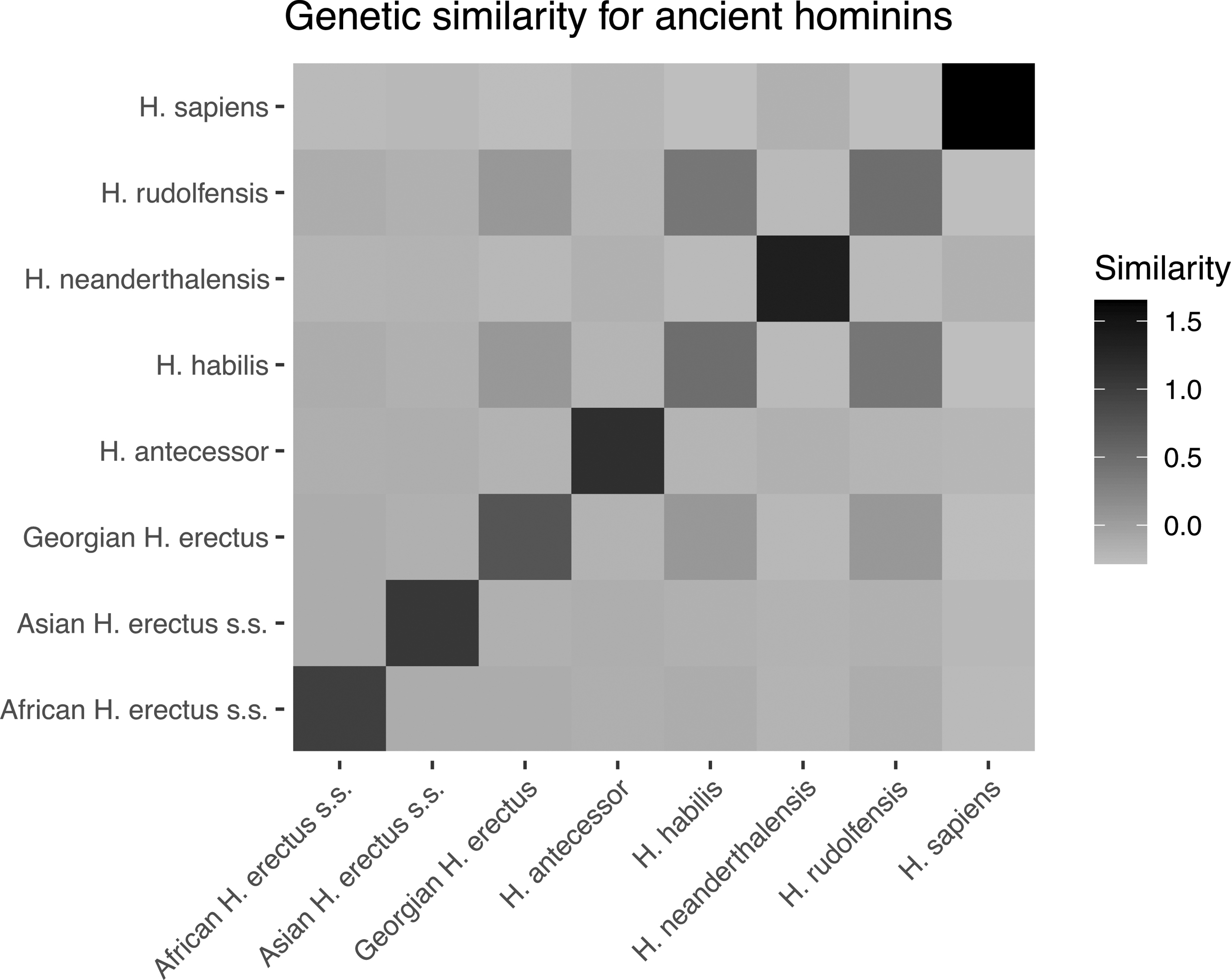
Genetic similarity matrix for eight hominin species as a heat map, computed using geological dates and Algorithm 1.
We also provide the specific values of the heatmap in Figure 5 of the similarities in Supplementary Table S1 of Supplementary Appendix SA3. This table could be used in conjunction with models such as Dahl et al. (2016) to conduct heritability or coheritability analysis on traits of the species considered. To that end, we consider a heritability analysis on the average heights of genetic males in the eight hominin species. We gather these average heights of ancient hominins from the following references: Carretero et al. (1999); Helmuth (1998); Lordkipanidze et al. (2007); and McHenry and Coffing (2000). We estimate variance components from an LMM (a standard model for methods such as genome-wide complex trait analysis; Yang et al., 2011). The form of this model is as follows:

Here  encodes the environmental effect.
Narrow sense heritability, denoted h2, is the fraction of the variance of y due to the genetic component. This quantity is defined as follows:
We fit the LMM with KT (our expected genetic similarity matrix) computed earlier in this section. We conducted inference using Markov chain Monte Carlo (Gibbs sampling) (MCMC) for the parameters of the LMM, using 10,000 iterations, of which the first 5000 are discarded for burn-in. Figure 6 shows the MCMC trace plots of
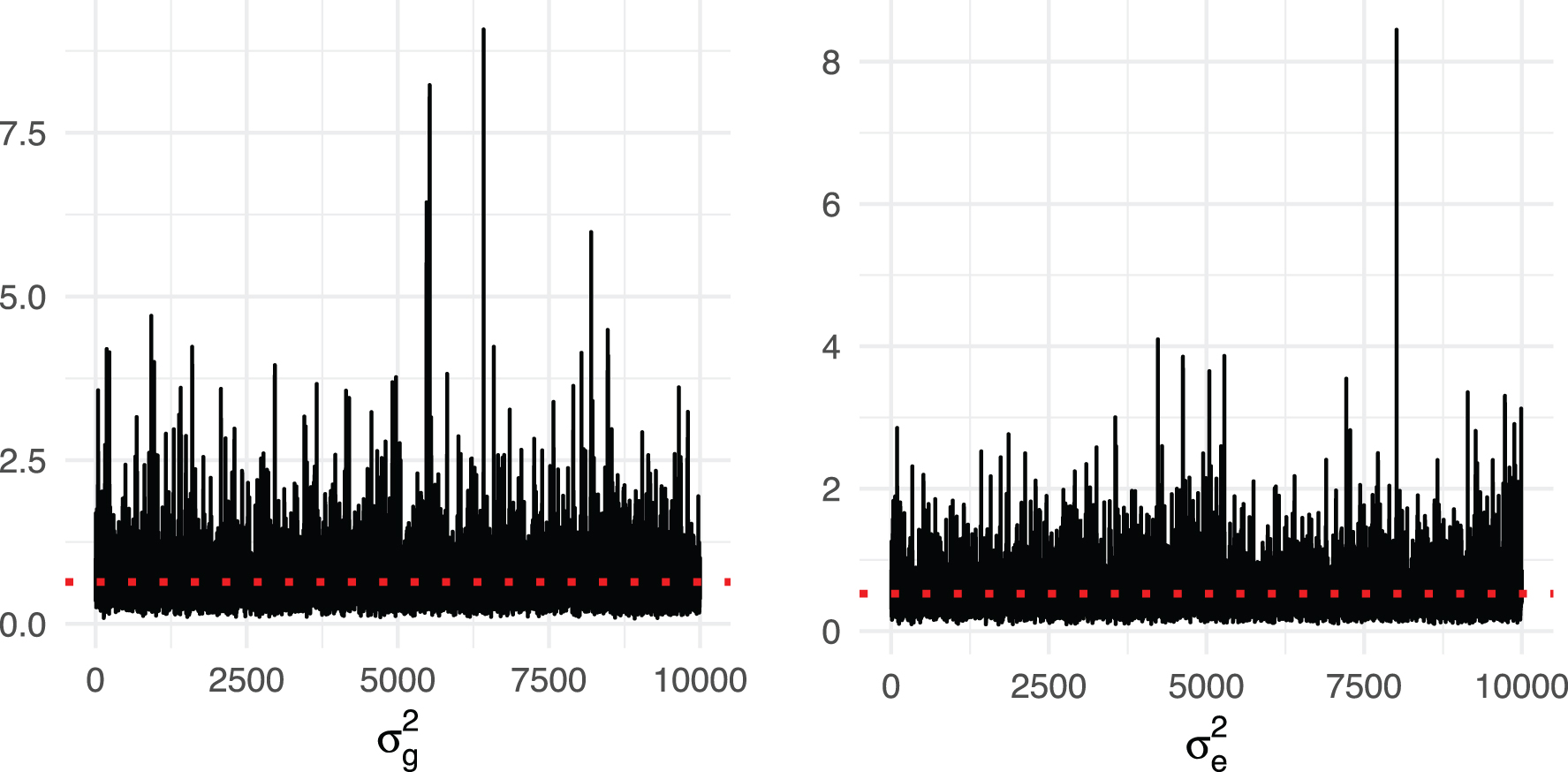
MCMC trace plots of
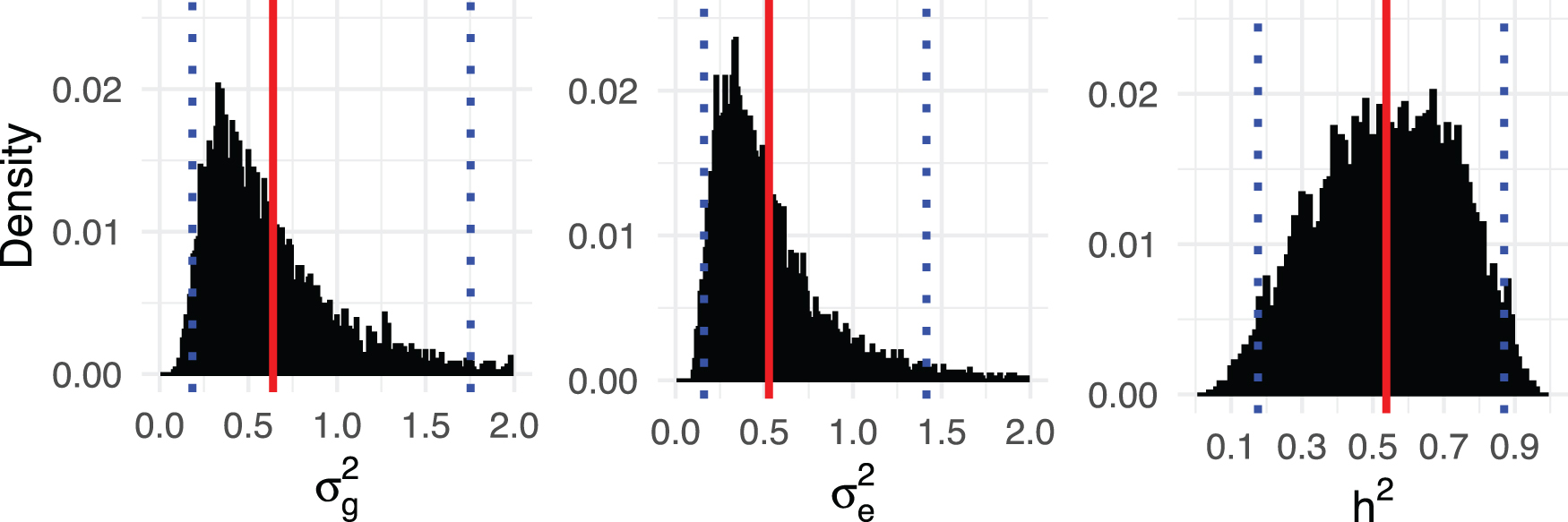
Histograms for posterior samples of
We obtain posterior means and 95% credible intervals
3.4. Uncertainty assessment in hominin species
In this section, we present a second experiment on hominin data. We apply our approach to evaluate the uncertainty for genetic similarities for 24 hominin species. The DNA sequences of some hominin species remain unavailable (e.g., Sahelanthropus tchadensis). We compute the genetic similarity matrix for a posterior sample of phylogenetic trees for the hominin species. We used 10,000 posterior tree samples (after thinning) created through MCMC with BEAST2 (Bouckaert et al., 2014). Details of the BEAST2 run are provided in Supplementary Appendix SA4. The morphological data used are provided in Dembo et al. (2016), but BEAST2 was used rather than Mr. Bayes 3.2.4 (Ronquist et al., 2012).
The resulting matrices represent the uncertainty of genetic similarities among the hominin species. Figure 8 displays the uncertainty of genetic similarities between Ardipithecus ramidus and Australopithecus anamensis, Gorilla gorilla and Pan troglodytes, Parantropus robustus and Homo naledi, and P. troglodytes and Australopithecus afarensis. We refer readers to Supplementary Appendix SA5 (Supplementary Figs. S2–S4) for the posterior mean and the 95% credible interval for a heatmap of the genetic similarity matrix for all 24 hominin species.
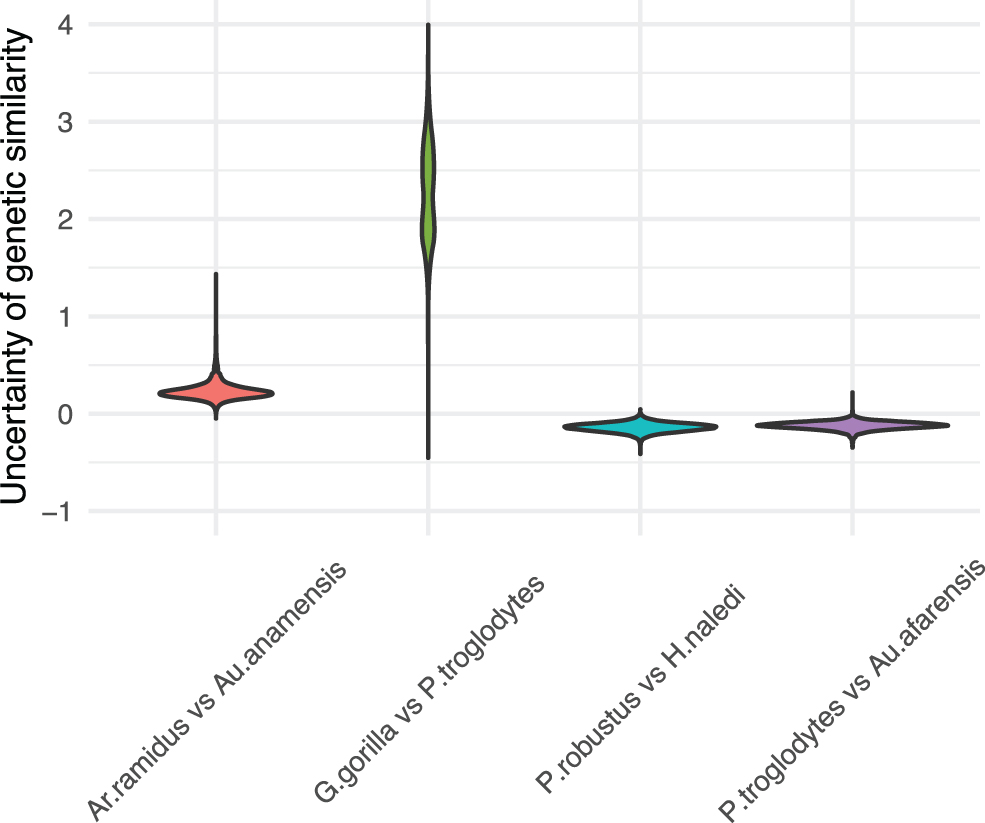
Uncertainty of genetic similarities between Ardipithecus ramidus and Australopithecus anamensis, Gorilla gorilla and Pan troglodytes, Parantropus robustus and Homo naledi, and P. troglodytes and Australopithecus afarensis.
4. Discussion
We provide an unbiased estimate for the genetic similarity matrix of samples, conditioned on a phylogenetic tree. This can be used to perform heritability and coheritability estimates based on models such as Dahl et al. (2016), and can be used as a building block for LMM-like models in which uncertainty about inferred trees is modeled jointly with LMM regression parameters. As a proof-of-concept, we provide estimations of the genetic component for human and ancient hominin heights. To our knowledge, this is the first work to describe the integrals and expectations involved. The assumptions include haploidy (and no recombination), neutral models of evolution, and the infinite sites model. These assumptions can be challenged by data in which samples undergo nontree-like evolution, incomplete lineage sorting, hybridization, or homoplasy. However, these assumptions are appropriate for evolutionary timescales with limited lateral transfer (e.g., in hominins, where lateral transfer such as from Neanderthal to humans accounts for only a small proportion of the modern human genome; Sánchez-Quinto et al., 2012), or for trees derived from highly clonal bacteria such as tuberculosis.
Our numerical experiments demonstrate consistency between the empirically calculated genetic similarity matrix and our proposed algorithm. We also apply our method to compute genetic blue for eight hominin species, based on phylogenetic trees inferred from geological dates. Although our methods are based on the expected value of genetic similarity (i.e., molecular phylogeny), we assume that geological dates are proportional to molecular phylogeny. Our method can be used to provide genetic similarity matrices for heritability analyses (Dahl et al., 2016) in cases for which genotypes are not available. We also conduct a heritability analysis on the average heights of genetic males for hominin species. Even though the evolution of hominin species involves recombination and some lateral transfer, which is not accounted in our analysis, the main effects in molecular phylogeny at evolutionary timescales involve mutation at the species level.
In cases where genotypes are available, our work can be applied if phenotypes or geography suggests a mismatch between phylogeny and genotype. This can happen in application of LMMs for multivariate genome-wide association studies with low-quality or low-coverage genotypes. This can also happen when genetic variation is low, but the examined phenotype is still under selection, causing homoplasy, which could bias estimates of a similarity matrix based on genotypes. When multiple samples of the phylogeny are available (e.g., after running MCMC inference for the phylogeny), our algorithm can be used to compute the expected genetic similarity matrix for each posterior sample. The resulting matrices represent the uncertainty of genetic similarities among species, and could be combined with LMMs to better identify population stratification and correct for spurious association.
Our current approach is limited to the computation of genetic similarities among species, or samples without recombination. One future direction for this work would be to consider genealogies with recombination events. The ancestral recombination graph (ARG) describes the coalescence and recombination events among individuals (Rasmussen et al., 2014). The ARG is composed of a set of coalescent trees separated by break points. To compute the expected genetic similarity matrix for samples given an ARG, we could first compute the expected genetic similarity matrices for each of the coalescent trees in the ARG, and then compute weighted average for those expected genetic similarity matrices. The weights would be proportional to the number of loci between each consecutive pair of break points. This would constitute a straightforward extension of our method. Another future direction would be to incorporate more advanced evolutionary, mutation, or selection models (relaxing the infinite sites and neutral assumptions). Finally, there are strong similarities between genetic and linguistic evolution (Cavalli-Sforza, 1997; Colonna et al., 2010). These two subjects both involve evolution and variation in a similar manner, and phylogenetic methods have been applied to construct trees for language data (Atkinson and Gray, 2005; Jordan, 2007). Our work could be extended to compute similarities for languages using linguistic trees.
Footnotes

References
Supplementary Material
Please find the following supplemental material available below.
For Open Access articles published under a Creative Commons License, all supplemental material carries the same license as the article it is associated with.
For non-Open Access articles published, all supplemental material carries a non-exclusive license, and permission requests for re-use of supplemental material or any part of supplemental material shall be sent directly to the copyright owner as specified in the copyright notice associated with the article.
