






Abstract
Abstract
Background:
A parent's perception about their child's overweight status is an important precursor or determinant of preventative actions. Acknowledgment of, and concern for, overweight may be moderated by the parent's own weight status whereas engaging in healthy behaviors at home may promote healthy weight status. It is hypothesized that normal weight parents are more likely to engage in healthy behaviors and acknowledge overweight in their own children whereas heavier parents may report more concern about child weight.
Methods:
A total of 1745 parents of first- through fifth-grade students completed a questionnaire assessing reactions to a school BMI report and perceptions about BMI issues. Specific items included perceptions of child's weight status, concern for child weight status, and preventive practices. Parents also provided information about their own weight status. Relationships between measured child weight, perceived child weight, parent weight, parent concern, and healthy behaviors were examined.
Results:
Overweight parents were more likely to identify overweight in their child and report concern about their child's weight. Concern was higher for parents of overweight children than of normal weight children. Normal weight parents and parents of normal weight children reported more healthy behaviors.
Conclusions:
Results support the hypothesis that normal weight parents are more likely to engage in healthy behaviors and that overweight parents are more likely to report concern about child weight. However, overweight parents are also more likely to acknowledge overweight status in their own child. Future research should examine links between parent concern and actual pursuit of weight management assistance.
Introduction
The epidemic of obesity has been widely publicized, yet many parents have inaccurate perceptions of their own child's weight status. Studies have documented that anywhere from 30% to 89% of parents fail to recognize their child as being overweight, even when they are objectively classified as such using national and international definitions.1–9 Previous research has also shown that 81% of parents with overweight children do not express specific concern about their child's weight. Elevated weight status does not appear to cause alarm or concern in parents unless their child struggles to keep up with their peers during physical activity (PA) or experiences weight-based teasing. 10 Parents of elementary children have been shown to be more likely than parents of adolescents to recognize their child as being overweight and implement preventive behaviors,11,12 so this is a prime time period to promote preventive parenting practices.
Many school districts have implemented coordinated school-based BMI screening (SBMIS) programs to help increase parental awareness of child BMI status and promote preventive strategies to reduce risk of obesity. In most SBMIS programs, parents receive an annual or biannual report with information about their child's BMI status. The inherent, and well-intentioned, rationale is to promote awareness about child weight status and encourage actions (if appropriate) to prevent or reverse weight gain. However, some parents may view these reports (and the associated feedback) as outside the domain or purview of a school. There are many examples of schools that have been forced to revisit or change policies based on parent concerns about SBMIS. High-profile cases have led to increased attention about SBMIS in the media.13,14
A related, but opposite, concern of SBMIS is that reports could lead parents to be unnecessarily or overly concerned. Indeed, heightened parental concern without parental understanding of preventive behaviors may be equally problematic. For instance, parents may implement overly restrictive practices or put their child on extreme diets in response to heightened weight concern.11,15,16 One study showed that overweight boys and girls who were encouraged to diet, or restrict food and caloric beverage consumption (owing to parental concern), were 2–3 times more likely to be overweight 5 years later, compared to children not encouraged to diet. 17 Thus, there is a clear need to find an appropriate balance between levels of concern and parenting practices aimed at helping prevent childhood obesity. Despite the importance of this issue, there is little information available on the relationship between parent perception of child weight, concern for weight status, and parenting behaviors related to obesity prevention.
The present study fills this gap by evaluating factors that may influence parent concerns about their child's weight. The study specifically evaluated the accuracy of parent perceptions of child's weight status (relative to their actual weight status), as well as the extent to which parent weight status and parent perceptions of their child's weight moderate parent concerns and parent behaviors related to obesity prevention. Previous studies have shown that parents who are themselves overweight express more concern for their child being overweight; thus, we directly examined the hypothesis that overweight parents will have more concern about their child's weight status than normal weight parents. We hypothesized that normal weight parents would be more likely to perceive their child as overweight and engage in healthy parenting behaviors than overweight parents. We further hypothesized that concern for child weight would increase with higher child BMI and that healthy parenting behaviors would be associated with lower child weight status. The findings from this study offer potential to improve the utility and effectiveness of SBMIS programs and youth obesity prevention strategies.
Methods
The data for the present study were obtained as part of a large state-wide surveillance study evaluating the impact of school-based BMI screening in the state of Pennsylvania (NIH 5R21HD067803). The state-mandated SBMIS in Pennsylvania is coordinated through school nurses who collect BMI information and then share information with parents though printed reports. Procedures for the Growth Screening Program for Pennsylvania's School-age Population are available online (www.dsf.health.state.pa.us). Paper-and-pencil surveys were sent to parents of first-, third-, and fifth-grade students in 31 school districts across the state to obtain information about parent perceptions of their child's BMI. Data from 2 years of surveys (2010 and 2011) were combined into one data set for this report, but cases were excluded in 2011 if they also completed a form in 2010. This ensured that the data reflected independent cases. The survey asked parents to report the child's actual height and weight as shown on the SBMIS report as well as their perception of their child's weight, their concern about weight issues, and parenting behaviors related to weight status.
Parent perception of their child's weight status was assessed using a 5-point rating scale with choices ranging from “very underweight, a little underweight, about right, a little overweight, or very overweight.” Parents also classified their own weight using these same categories. Parent concern was measured by responses to three items: “How concerned are you about each of the following issues: Your child eating too much when you are not around him/her; Your child having to diet to maintain a desirable weight; Your child becoming overweight.” Responses were scored on a 5-point Likert scale ranging from “Not at all concerned” to “Very concerned.” Responses were averaged to obtain an overall indicator of parent concern for the analyses. Parenting behaviors were assessed by responses to five items. Items assessed the degree to which parents reported limiting the use of sugar-sweetened drinks, offering fruits and vegetables with meals and as snacks, limiting screen time (television, video games, and iPod/iPad), helping their child get enough PA, and helping their child get enough sleep at night. Response options were “Not currently doing this,” “Occasionally doing this,” and “Regularly doing this.” Responses to the five items were averaged to obtain an overall indicator of parental behavior for the analyses.
Height, weight, gender, and age were converted to BMI-for-age z-scores and percentiles using available SAS codes from the CDC. Weight categories were defined as: underweight (≤5th percentile); normal weight (5th–85th percentile); overweight (85th–95th percentile); and obese (≥95th percentile). Descriptive analyses focused on calculating the percentages of parents of overweight and obese children who correctly identified the weight status of their child. For these calculations, the categories of “a little underweight” and “about right” were combined into a “normal weight” category.
The primary research questions focused on the impact of parent weight status on child perception of weight, parent concern, and parenting behaviors. These analyses were conducted with a series of two-way (child weight status×parent weight status) analysis of variance (ANOVA) analyses on each outcome. For these analyses, the categories of “very underweight” and “a little underweight” were combined with the “normal weight” category into a single “underweight/normal weight” category. This allowed for clear distinctions between normal weight, overweight, and obese for the analyses. Responses from the same geographical area were expected to be closer than two responses from different areas, so schools were used as blocks. Regression analysis was also performed to examine the independent effects of child age, gender, and BMI and parent weight status on parental concern. All analyses were performed using SAS software (version 9.3; SAS Institute Inc., Cary, NC).
Results
A total of 1745 parents from 31 schools returned surveys. Surveys that did not include needed information to compute child BMI z-scores were excluded from analysis, leaving 1469 subjects. Response rate by school ranged from 3.9% to 22.8%, with an average response rate of 12.4%. Table 1 contains complete demographics for the full study population. Child ages ranged from 5 to 12 years. Approximately 51% of the sample was female and 88% was white/Caucasian. Survey respondents were primarily mothers or female guardians (91.3%). Based on BMI classification, approximately 15% of students were overweight and 15% were obese. Parent reports of SBMIS results were slightly lower than state-wide rates in 2010–2011, where 15.9% of students were overweight and 16.7% were obese. 18 Nonetheless, nearly one third of children were overweight or obese, but far fewer (∼18%) parents reported that their child was “a little overweight” or “very overweight.”
Subject Demographics
Table 2 shows a classification matrix for parent perception of BMI classification compared to actual classification. The overall classification accuracy (calculated as the percent of correct classification on the diagonal) was 84%. In almost all cases (88%), misclassification involved parents underestimating weight status. Distinguishing between overweight and obesity was particularly difficult given that only 37% of parents (80 of 215) of overweight children (85th–95th percentile) correctly identified their child as overweight (“a little overweight”) and only 16% of parents (36 of 219) of obese children (≥95th percentile) correctly identified their child as obese (“very overweight”).
Perceived and Objective BMI Category Distributions
Parent Perception of Child Weight
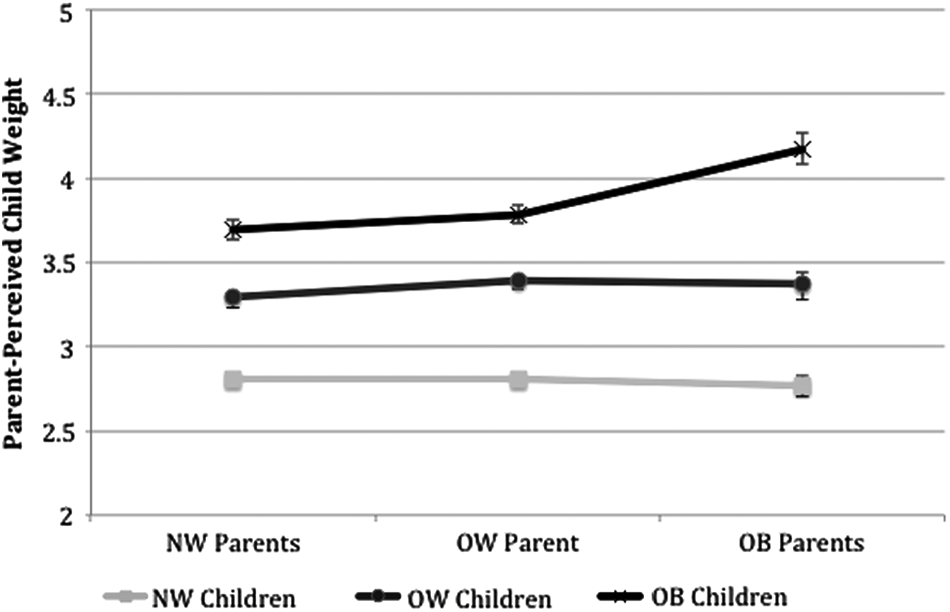
The ANOVA analyses examining the impact of parent weight status on parent perception yielded significant effects (F(1, 8)=89.29; p<0.0001). Significant main effects were observed for both child (p<0.0001) and parent weight status (p=0.0105). Parents of overweight children were more likely to identify their children as overweight. Likewise, overweight parents were more likely to describe their children as overweight. A significant interaction was observed between child and parent weight status for perception of child weight (p=0.0012), with heavier parents more likely to classify their children in heavier weight categories with increasing child weight (see Fig. 1).
Parent Concern
The ANOVA results for parent concern yielded significant effects (F(1, 8)=89.68; p<0.0001). Significant main effects were specifically evident for child (p<0.0001) and parent weight (p<0.0001). Parents of heavier children reported higher levels of concern for their child eating too much, becoming overweight, and having to diet to maintain a desirable weight. Level of concern was independently impacted by parent weight status. Parents who reported themselves as being above desired weight were more likely to report increased concern. This difference was significant across all categories of parent weight. However, similar to the previous analyses, there was also an interaction between child and parent weight (p=0.0461), with heavier parents reporting more rapidly increasing levels of concern as their child's weight increased (see Fig. 2).
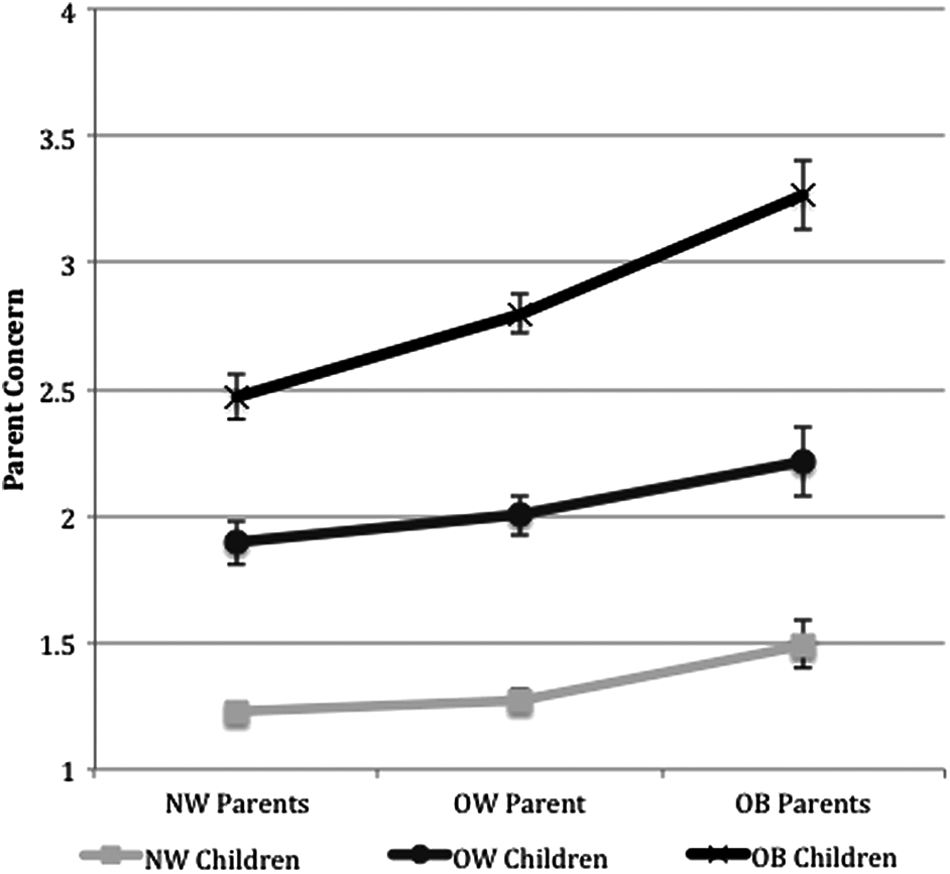
Regression analysis showed significant impact of gender and child BMI on parent concern (p<0.001; R2=0.208), with parents more likely to be concerned for girls than for boys. When parent weight status was entered into the model, it was a significant factor, but did little to enhance the model (p=0.0384; R2=0.216). Parent weight concerns were more strongly correlated with perceived weight (r=0.59) than with actual BMI percentile (r=0.47).
Parent Behavior
The ANOVA for healthy behaviors yielded a significant overall effect (F(1, 8)=3.75; p=0.0002). Significant main effects were found for child (p=0.01) and parent weight status (p=0.0214). Parents of heavier children were less likely to limit sugar-sweetened drinks, offer fruits and vegetables, limit screen time, and ensure child PA and sleep. However, significant differences were limited to comparisons between normal weight and obese children (p<0.05). There was also a significant main effect for parent weight status, with parents who describe themselves as normal weight being more likely to report promoting healthy behaviors than those who describe themselves as a little or very overweight. There was no interaction between actual child and parent weight (p=0.6975) to predict parenting behaviors.
Discussion
The results revealed the expected under-reporting of child overweight status by parents. Nearly one third of the current sample was classified as overweight or obese, according to school measurements, but less than 18% of parents perceived their child as overweight. We found a significant interaction between child BMI and parent weight status for parent perception of child weight. However, contrary to our hypothesis, parents who perceived themselves to be overweight were more likely to acknowledge their own child as being overweight than were those who classified themselves as normal weight. This finding contrasts with those of Carnell and colleagues, 19 who found no effect of parent weight on perception of child weight in a sample of 3- to 5-year-old children. Others have found that overweight parents are more likely to identify their normal weight child as underweight and less likely to identify their child as overweight.5,20 However, these studies included objectively measured or self-reported parent height and weight, whereas the current questionnaire asked for parents to categorize their perception of their own weight, which may have introduced bias.
Consistent with our central hypothesis, we observed significant impacts of both child (heavy) and parent weight (heavy) on parents' level of concern about the need to diet or restrict caloric intake and future weight issues. Previous studies have shown that although parents may not acknowledge their child as being overweight, they may still be concerned about their child's current weight and/or future weight issues.19,21 Parkinson and colleagues found that mothers began classifying their children as overweight at a mean BMI of 21.3, but reported concern about weight at a mean BMI of 17.1. 20 Similarly, our results also showed that parent concern was more tightly correlated with perceived child weight status than with actual BMI percentile, which would suggest that parents do not become concerned about weight unless they first perceive their child as overweight. A concern of SBMIS is that it can unnecessarily heighten parent concern about their child's weight, but our findings suggest that parent concern is primarily related to their own perception, rather than school measurements. Further research is needed to better understand the interplay between child BMI, parent perception of child weight, and parent concern.
Parent concern was also independently associated with parent weight given that parents who perceived themselves to be overweight tended to report higher levels of concern. Regression analysis showed parent weight to be a significant predictor of parent concern, but this factor did little to enhance the regression model. This is likely owing to the well-documented22–25 relationship between parent and child BMI, which was already included in the model. To our knowledge, this is the first study to examine the impact of parents' own weight on their level of concern for their child being overweight. Heavier parents may draw on personal experiences of hardships related to overweight and obesity when assessing their level of concern for weight issues for their children. Given that heavier parents are concerned about their child's weight, particularly when they perceive them as heavy, healthcare and public health professionals should take steps to engage these parents in discussions about their child's weight with appropriate attention to the sensitive nature of the topic. Likewise, family approaches to prevention and weight management may be indicated in these situations.
Parental concern was higher for female children than males. This finding differs with that of Crawford and colleagues, 1 who found no difference in perception of weight status or level of concern between parents of boys and girls in a sample of 5- to 12-year-olds. Carnell and colleagues 19 also found no effect of gender on parent concern. However, Levi and colleagues did find a higher likelihood of parents to recognize overweight in girls (54% of overweight girls correctly classified) than in boys (27%), and acknowledgement of overweight may increase concern. 26 These findings have two implications. First, parent concern was associated with a need for the child to diet; thus, educational efforts that focus on healthy parenting practices may be particularly beneficial for concerned parents of girls. Second, lower parental concern for boys' BMI in the context of low acknowledgement of actual BMI results may suggest a need for clinicians and public health professionals to strengthen discussion of BMI, body composition, and related health risk.
Finally, these results provide support for the promotion of a number of healthy parenting practices. Limiting the use of sugar-sweetened drinks, offering fruits and vegetables with meals and as snacks, limiting screen time, helping children get enough PA, and helping children get enough sleep at night were associated with lower weight status in children. These findings are consistent with our hypothesis and earlier work that demonstrated correlations between parenting practices and child BMI. 27 This study adds to previous knowledge by finding that a significantly higher proportion of normal weight parents reported these habits than overweight parents. However, owing to the cross-sectional manner of the study, the cause-and-effect relationship between these parameters cannot be established. Parents and their children may be lighter because they practice these healthy habits, but thinness in parents may also be caused by other healthy behaviors that reflect an overall higher concern for health.
The subjective measure of parent weight and perceived child weight with single-survey items is a limitation of the analyses. In particular, parent weight may be strongly correlated with their perception of child weight because they are using the same standards and references to gauge weight status in their children as they use in themselves. For example, parents who are more accepting of overweight may not acknowledge excess weight in their children or in themselves, incorrectly perceiving both as “about the right weight.” Additional research with more-objective indicators of weight status may help further explicate the complex interactions among parent weight status and parent concern about child weight status.
Conclusions
Implications and Future Directions
Parental acknowledgement of overweight, concern for overweight, and healthy parenting behaviors are all related to child and parent weight status. Overweight parents are more likely than normal weight parents to express concern for their child's weight status, but less likely to engage in healthy parenting behaviors. Therefore, the policy of SBMIS has the potential to raise parent awareness of child weight status and be particularly useful for overweight parents who may be most likely to benefit from educational or referral resources that accompany the SBMIS report. Given the discrepancy between parent concerns for perceived child weight versus actual BMI percentile, there is a need for clinical and public health education about the body composition and related health risks to perhaps mitigate shifting social norms so that overweight can be prevented, assessed, and treated. Future research should investigate the role that parents' knowledge of healthy behaviors plays in moderating the relationship between parent concerns and parenting practices that may help correct overweight.
Footnotes
Acknowledgments
All phases of this study were supported by an NIH grant (5R21HD067803). The authors thank the staff of the Social and Behavioral Research Services group at Iowa State University (Ames, IA) for their assistance in design, collection, and compilation of survey measures.
Author Disclosure Statement
No competing financial interests exist.