






Abstract
Background:
Cancer-derived exosomes facilitate chemoresistance by transferring RNAs, yet their role in exosomal microRNA-221-3p (miR-221-3p) regulation of adriamycin resistance in breast cancer (BC) remains unclear.
Methods:
Adriamycin-resistant BC cells were developed from MCF-7 and MDA-MB-231 cells by incremental adriamycin exposure. The miR-221-3p levels were quantified by quantitative reverse transcription-polymerase chain reaction. Subsequently, exosomes were isolated and incubated with BC cells, and exosome-mediated adriamycin sensitivity was evaluated using Cell Counting Kit-8, colony formation, and flow cytometry assays. Sensitive cells were cocultured with miR-221-3p inhibitor-treated cells to assess adriamycin resistance. Moreover, the interaction between miR-221-3p and phosphoinositide-3-kinase regulatory subunit 1 (PIK3R1) was validated using a dual luciferase reporter gene assay. Mimics and inhibitors were used to determine the effects of miR-221-3p on adriamycin resistance.
Results:
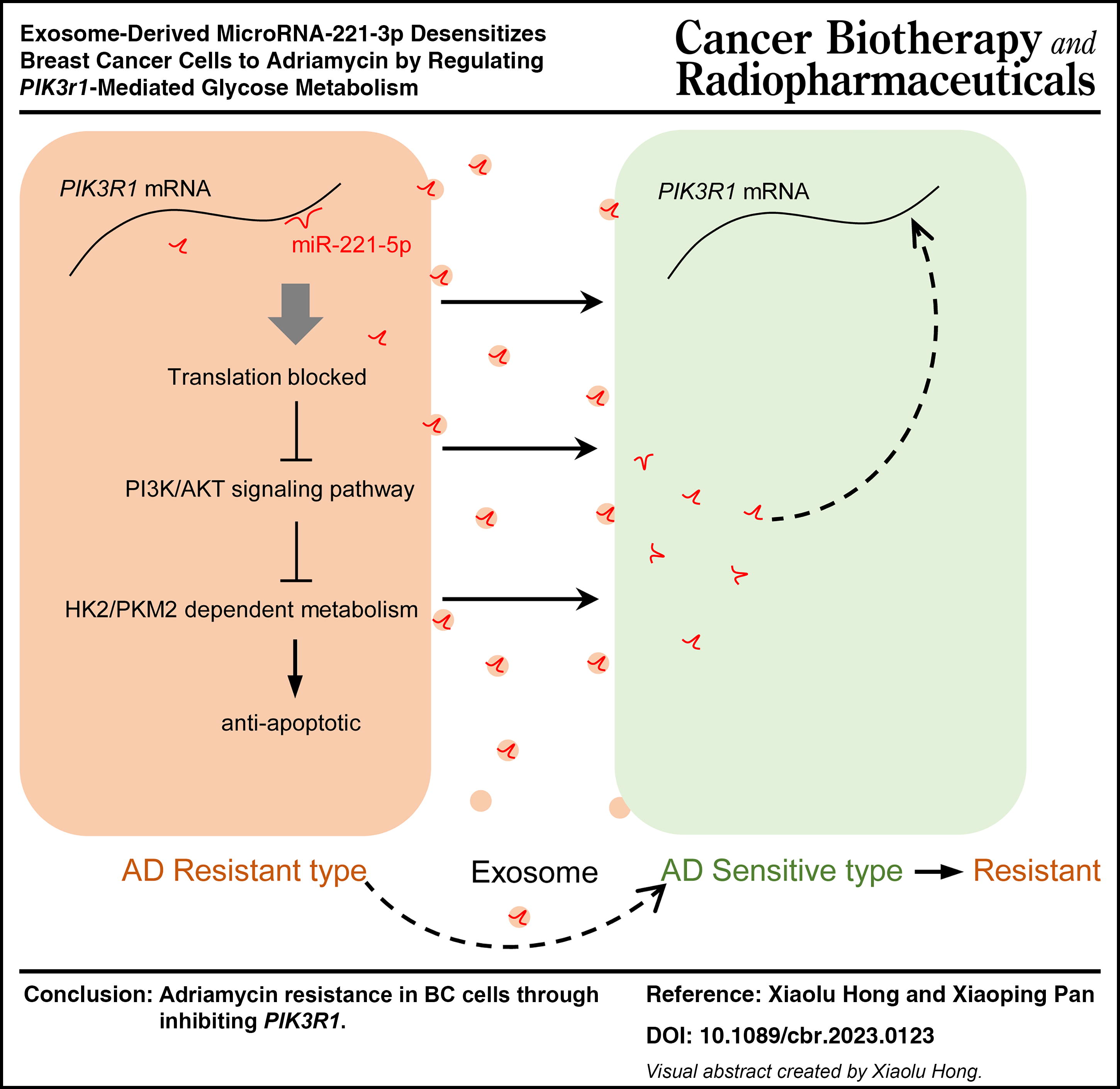
Elevated levels of miR-221-3p expression were observed in adriamycin-resistant BC cells and exosomes. Sensitive cells were cocultured with exosomes from resistant cells, resulting in increased half-maximal inhibitory concentration value and proliferation, and reduced adriamycin-induced apoptosis. However, the effects of coculturing sensitive cells with adriamycin-resistant cells were significantly weakened by miR-221-3p inhibitor transfection in adriamycin-resistant cells. PIK3R1 was found to be a target of miR-221-3p, and miR-221-3p mimics enhanced adriamycin resistance in sensitive cells. miR-221-3p inhibitors increased the expression of PIK3R1, p-AKT, c-Myc, HK2, and PKM2, decreased FOXO3 expression, and weakened the adriamycin resistance in resistant cells.
Conclusions:
miR-221-3p can be transferred between BC cells through exosomes. High levels of miR-221-3p were found to target PIK3R1 and promoted adriamycin resistance in BC cells.
Get full access to this article
View all access options for this article.
References
Supplementary Material
Please find the following supplemental material available below.
For Open Access articles published under a Creative Commons License, all supplemental material carries the same license as the article it is associated with.
For non-Open Access articles published, all supplemental material carries a non-exclusive license, and permission requests for re-use of supplemental material or any part of supplemental material shall be sent directly to the copyright owner as specified in the copyright notice associated with the article.
