






Abstract
Local treatment of unresectable tumors is challenging, particularly with radioactivity. Current practice relies on external beam irradiation or on a variety of medical devices for brachytherapy. Both approaches proved useful in controlling tumor growth, but are characterized by poor compliance of the patient, significant side-effects, high costs, and technological complexity, which hamper widespread use. The authors recently described a novel form of radionuclide therapy based on the oxidized form of avidin that, chemically reacting with tissue proteins, can secure radioactive biotin within the injected tissue, either when precomplexed or when taken from the blood stream after intravenous administration. AvidinOX-pretargeted 177Lu-biotinDOTA (177Lu-ST2210) is currently under clinical investigation for the treatment of liver oligometastases from colorectal cancer (clinicaltrials.gov/NCT02053324). In the present work, the authors show that injected AvidinOX can link tissues of various natures such as prostate, kidney, breast, or brain and can react by contact with scraped tissues such as skin or urinary bladder. AvidinOX injected into human OSC19 tongue cancer masses orthotopically transplanted in nude mice takes up intravenously administered 90Y-ST2210, which exerts significant antitumor activity, while preserving the integrity and functionality of the tongue. Present data confirm that AvidinOX-based radionuclide therapy is an innovative and promising approach for the local treatment of inoperable tumors.
Introduction
There is a need to locally treat certain unresectable primary and metastatic tumor lesions. Moreover, there is an emerging awareness that local treatment of tumors is useful, even in the case of systemically spread diseases, because of the beneficial effects derived from the reduction of tumor burden that, in turn, leads to diminished protumorigenic cross-talk signals (i.e., exosomes). 1 –3 An agreement is also building up on the concept that irradiation of tumor sites is useful to locally activate systemically acting tumor-specific immune responses, a so-called abscopal effect. 4 –8
The authors recently described AvidinOX, the oxidized derivative of avidin, which proved to be a stable receptor for radioactive biotin within injected tissues.
9
–11
This product is currently under clinical investigation in a protocol aiming at the delivery of radioactive biotinDOTA
12
(177Lu-ST2210) to inoperable liver oligometastases from colorectal cancer (
The aim of the present study is to further explore the applicability of AvidinOX for targeted delivery of radionuclide therapy to different tissues and organs, with particular focus on tongue cancer.
Materials and Methods
AvidinOX® (registered brand of Sigma-Tau) is prepared by Areta International in the lyophilized form according to previously described methods. 9 After reconstitution with water for injection, the protein is a 3.0 mg/mL solution in a 0.1 M sodium acetate buffer pH 5.5 with 10 mg/mL mannitol and 0.2 M NaCl.
BiotinDOTA (ST2210; Sigma-Tau) was labeled with 111Indium (111In), 90Yttrium (90Y), 86Gallium (86Ga), or Gadolinium (Gd) according to a method previously described. 12
Animal studies
All studies involving animals were conducted in accordance with European Directives No. 86/609 and with Italian Legislation (D.L. 116, Art. 6, January 27, 1992).
Tissue residence and biotinDOTA uptake
For tissue residence studies, 40–80 kBq of 111In-ST2210 was mixed with AvidinOX (3.0 mg/mL solution) before injection. BALB/c mice (Harlan) and rabbits (Harlan) were divided into experimental groups (5 and 3 animals/group, respectively), and 15 μL or 1.0 mL of the complex 111In-ST2210-AvidinOX was slowly injected in the indicated mouse or rabbit tissues, respectively. Mouse brain injection was performed in one quadrant by convection-enhanced delivery (CED) 15 using a pump at an injection rate of 0.5 μL/minute, 20 μL in total. Animals were sacrificed after 1 or 5 days, and the tissues were collected and their radioactivity quantified in a gamma counter (Wizard 1470; Perkin Elmer). Data were expressed as a percentage of injected activity (% I.A.) in the tissue/organ.
For biotin uptake studies, mice were shifted to a biotin-free diet (Mucedola) at least 72 hours before start of the study. Rabbits and pigs stayed on their standard diet. Volumes of 3.0 mg/mL AvidinOX were slowly injected in the target tissues or put in contact with indicated organs. After 24 hours, mice, rabbits, and pigs received intravenously 1, 5, and 800 μg of labeled ST2210, respectively. Mice (5/group) were sacrificed after 3 hours, and the injected tissues were collected, weighed, and their radioactivity quantified in a gamma counter (Wizard 1470; Perkin Elmer). To estimate the ratio between the AvidinOX-treated tongue and untreated organs, data were expressed as a percentage of injected activity per gram of tissue (% I.A./g). Three rabbits received 0.5 mL of AvidinOX in the tongue before intravenous Gd-ST2210. Imaging was performed after 6 hours by magnetic resonance (Ambulatorio Veterinario Monteverde). Pig study was performed at the Aarhus University Hospital, Denmark. Domestic female pigs (Sus scrofa domestica) from a commercial source, ∼4 months of age, 40 kg (range 39.5–40.5 kg) in body weight, and clinically healthy and naive for biologicals, were used. Two pigs were anesthetized and prepared with arterial and venous cannulation. Six injections of 0.5 mL of 3 mg/mL AvidinOX solution were performed in the tongue, and three bladder lesions were applied by an experienced surgeon with the aid of a cystoscope, followed by intrabladder infusion of 100 mL of 3.0 mg/mL AvidinOX solution in a 100 mM sodium acetate buffer at pH 5.5. The AvidinOX solution was allowed to interact for 1 hour, followed by flushing with saline. After 24 hours, pigs were anesthetized, positioned supinely inside the PET/CT scanner, injected with 150–250 MBq 68Ga-ST2210 intravenously, and simultaneously scanned by dynamic PET (Siemens Biograph 64). Bladder imaging data were processed with PMOD software, version 3.204 (PMOD Technologies). Tongue imaging data were processed with the ROVER software package (ABX GmbH) using an automatic segmentation routine.
Intraprostatic injection of AvidinOX in dogs was performed at Accelera, Milan. Two mature male beagle dogs received a single dose of 2 mL administered in eight fractions. Necropsy was performed 24 hours postdosing, and prostate samples were processed for immunohistochemistry.
Histology and immunohistochemistry
Analyses were performed on paraffin-embedded sections. Hematoxylin/eosin staining was performed according to standard methods. 16
AvidinOX localization in dog prostate, mouse tongue, and tongue tumors was evaluated by immunohistochemistry with the anti-avidin rabbit polyclonal antibody (Abnova #PAB9917) followed by ImmPRESS reagent anti-rabbit Ig peroxidase (Vector #MP7401) and DAB substrate. Images were acquired by digital camera DMX1200F connected to the Nikon Eclipse 80i microscope (software ACT-1 Ver2.63).
Radionuclide therapy study
Twelve-week-old athymic nude mice (Harlan) were orthotopically transplanted with 4.0×10⁵ OSC19 human tongue carcinoma cells (JCRB Cell Bank). The mice were maintained on a biotin-free diet (Mucedola) 72 hours before AvidinOX injection. Three weeks after the transplant, the mice were randomized in groups of 20, and AvidinOX or related solvent (0.1 M sodium acetate pH 5.5) was injected intratumorally (25 μL/tumor). After 48 hours, 15 or 30 MBq of 90Y-ST2210 in 200 μL of saline (1.0 μg ST2210/mouse) was injected intravenously. The effect of pretargeted radionuclide therapy was monitored by survival, body weight, and tumor score (objective evaluation of tumor presence and size by caliper and edema performed by two independent observers). Scoring was between 0 and 5, with 0 corresponding to no tumor lessions (no evident disease [NED]) and 5 corresponding to terminal disease (TD) when the tongue was completely infiltrated by the tumor (size >200 mg), discouraging food consumption and, thus, requiring sacrifice for weight loss.
Statistical analysis
The log-rank test for survival and ANOVA or Kruskal–Wallis for comparison of treatment groups were used.
Results
AvidinOX for targeting tissues with radiolabeled biotin
Aldehydes of injected AvidinOX have been previously shown to react with protein amino-groups. 9 –11 Taking into account that tissues might be very different in their chemical composition/amino-group accessibility, the residence of 111In-ST2210-AvidinOX complex was tested in different mouse tissues, 24 hours after injection. Highest amounts were found in the muscle (limb and tongue) and kidney compared to the spleen and liver. Liver and spleen injection was associated with significant bleeding, possibly explaining poorer linkage. Scraped skin, but not intact eye, bound deposited 111In-ST2210-AvidinOX complex, suggesting that tissue proteins must be exposed to be able to react with AvidinOX aldehydes by contact (Fig. 1A). Significant binding of 111In-ST2210-AvidinOX complex to the brain was found upon CED, and localization was restricted to the injected quadrant with no distribution out of the brain (Fig. 1B). High AvidinOX tissue residence was also found in rabbit breast and limb muscle, and consistent with previously published data from this group, 9,11,13 the amount of tissue-bound AvidinOX was confirmed to be much higher than native avidin (Fig. 1C). Intraprostatic injection of AvidinOX was evaluated in dogs, and immunohistochemical staining confirmed the presence of AvidinOX in the injected upper lobes of the gland (Fig. 1D) with a most consistent localization in the interstitial stroma and with variable intensity in the lumen of glandular acini and acinar epithelial cells (Fig. 1E). An additional study was performed in surgically treated pigs to simulate the resection of superficial bladder carcinoma. Uptake of 68Ga-ST2210, injected intravenously 24 hours after perioperative intrabladder administration of AvidinOX, was observed by PET in the bladder lesions 1 hour thereafter (Fig. 1F). PET scans at later time points indicated that the lesion uptake is compatible with irreversible trapping, with the proviso that the observational period was limited to 5 hours. Scanning time per frame was adapted, such as the lesion image intensity of the last frames was ∼35% of the lesion image intensity at 1 hour postinjection, based on physical decay.
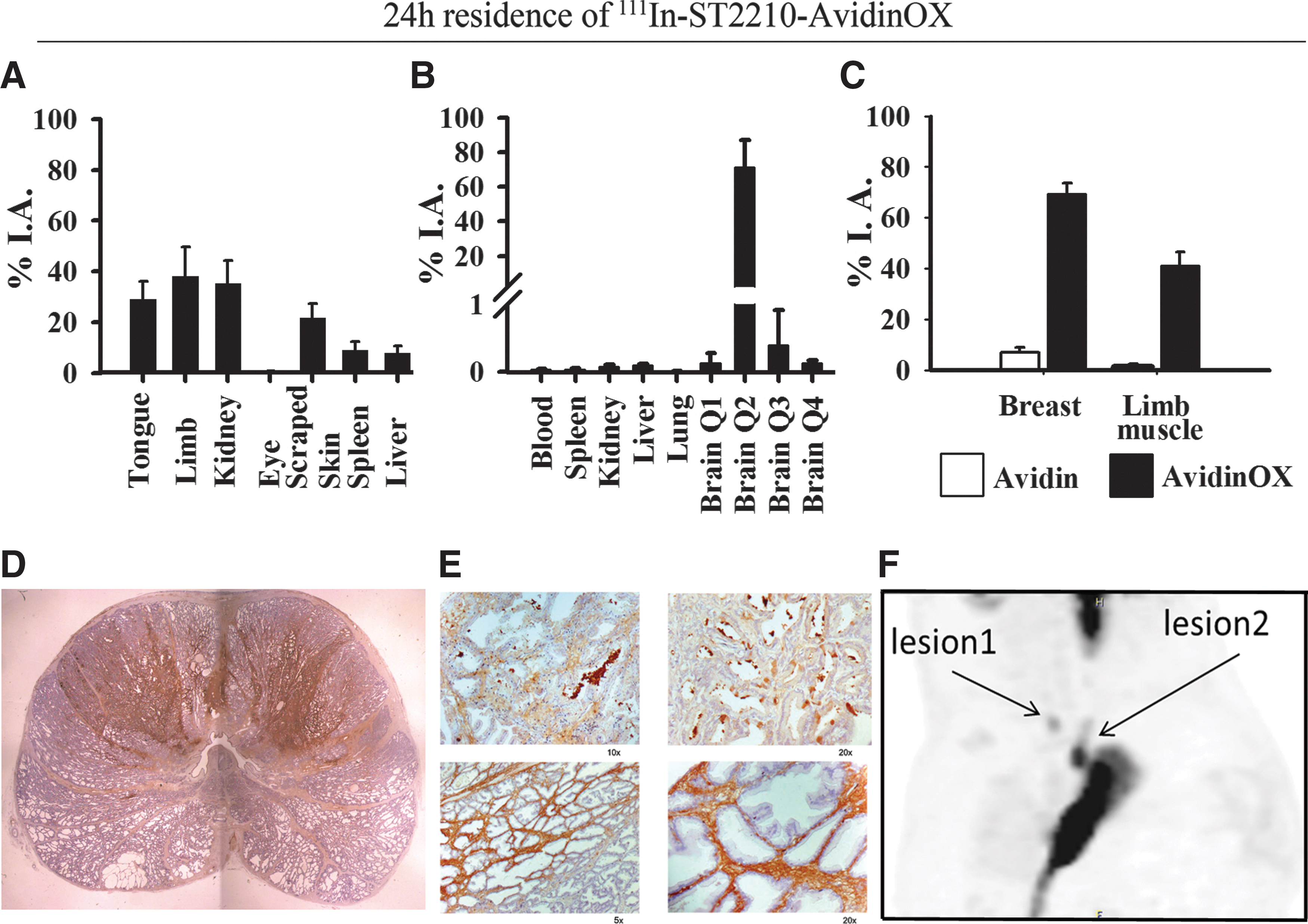
AvidinOX binds to different injected tissues and takes up intravenous radioactive biotin.
AvidinOX-injected tongue is targeted by radiolabeled biotin
Immunohistochemistry of AvidinOX-injected mouse tongue showed moderate to strong staining of interstitial and perivasal connective tissue. Papillary derma was also stained, and the intensity of the staining was comparable in samples collected 24 hours or 7 days after injection, confirming the high tissue stability of AvidinOX (Fig. 2A). Uptake of intravenously injected biotin in AvidinOX-treated tongue was then addressed in larger size animals. Gadolinium- and 68Gallium-labeled ST2210 (Gd-ST2210 and 68Ga-ST2210, respectively) were found to localize in rabbit (Fig. 2B) and pig (Fig. 2C) tongue by magnetic resonance and PET imaging, respectively. Quantitative evaluation of intravenous 111In-ST2210 distribution was performed in mice pretreated with AvidinOX in the tongue. Data in Table 1 indicate that the uptake of radioactive biotin in the AvidinOX-treated tongue is very efficient and highly selective.
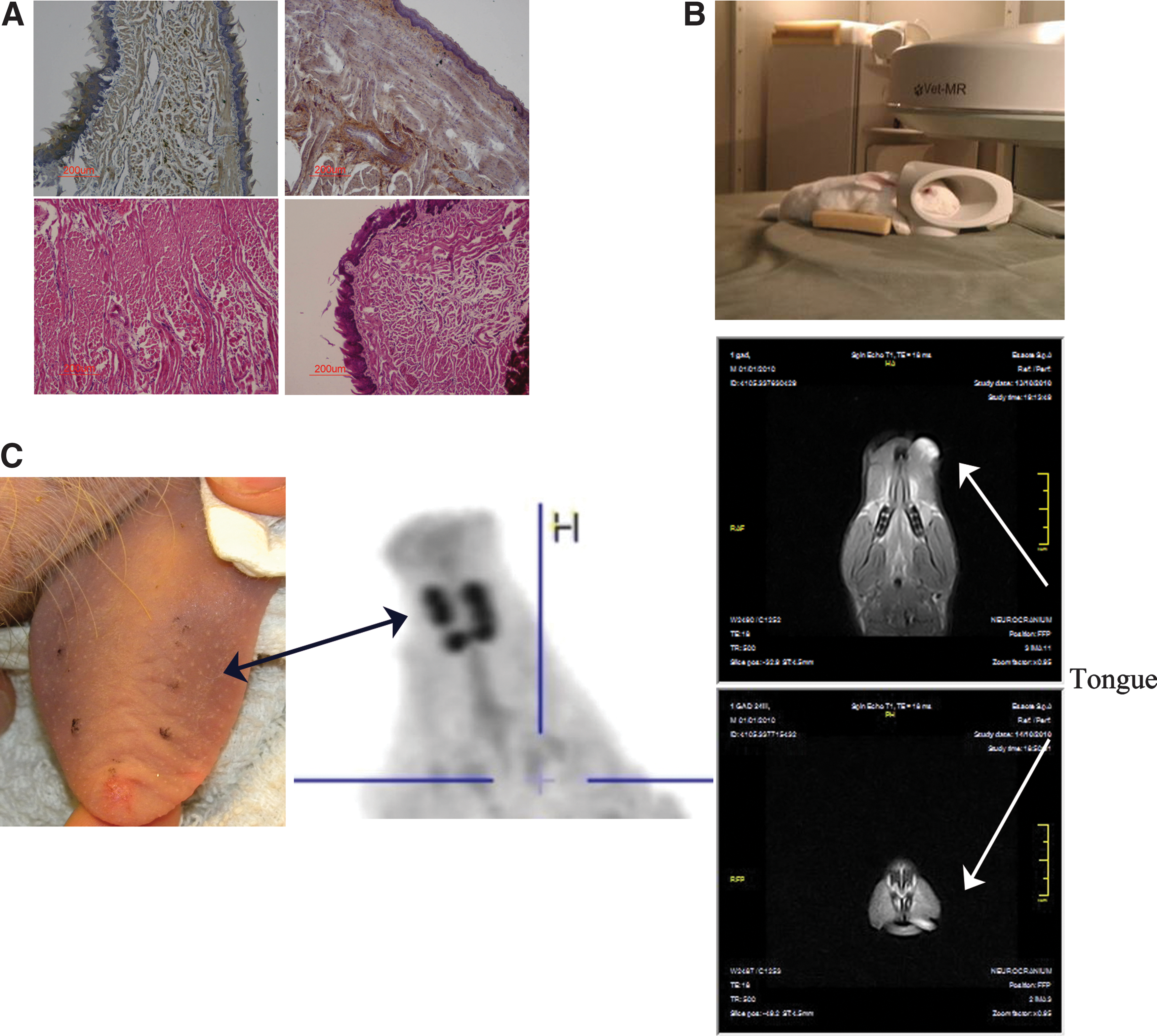
Injected AvidinOX binds to mouse, rabbit, and pig tongue and takes up intravenous radioactive biotin.
Mice were injected with AvidinOX in the tongue and received 35 kBq 111In-ST2210 intravenously 24 hours thereafter. Mice were sacrificed after 3 hours, and their organs and blood samples were weighed and counted in a gamma counter. Data are expressed as percentage of injected activity/gram of tissue (% IA/g) and are the mean±SD of 5 mice/group.
Statistical analysis by ANOVA, p<0.001 versus all other organs.
Therapeutic efficacy of AvidinOX-targeted 90Y-BiotinDOTA in tongue cancer model
An orthotopic model of squamous cell carcinoma of the tongue was established in nude mice by injecting human OSC19 cells that produced masses with a typical structure of a highly aggressive and infiltrating tumor (Fig. 3A left panel). Immunostaining confirmed AvidinOX presence within the tumor 24 hours postinjection (Fig. 3A right panel). Tumor residence of 111In-ST2210-AvidinOX complex was about 4% and 2% of the injected activity/mg 1 and 5 days, respectively, without significant difference among smaller and larger tumor masses (Fig. 3B).
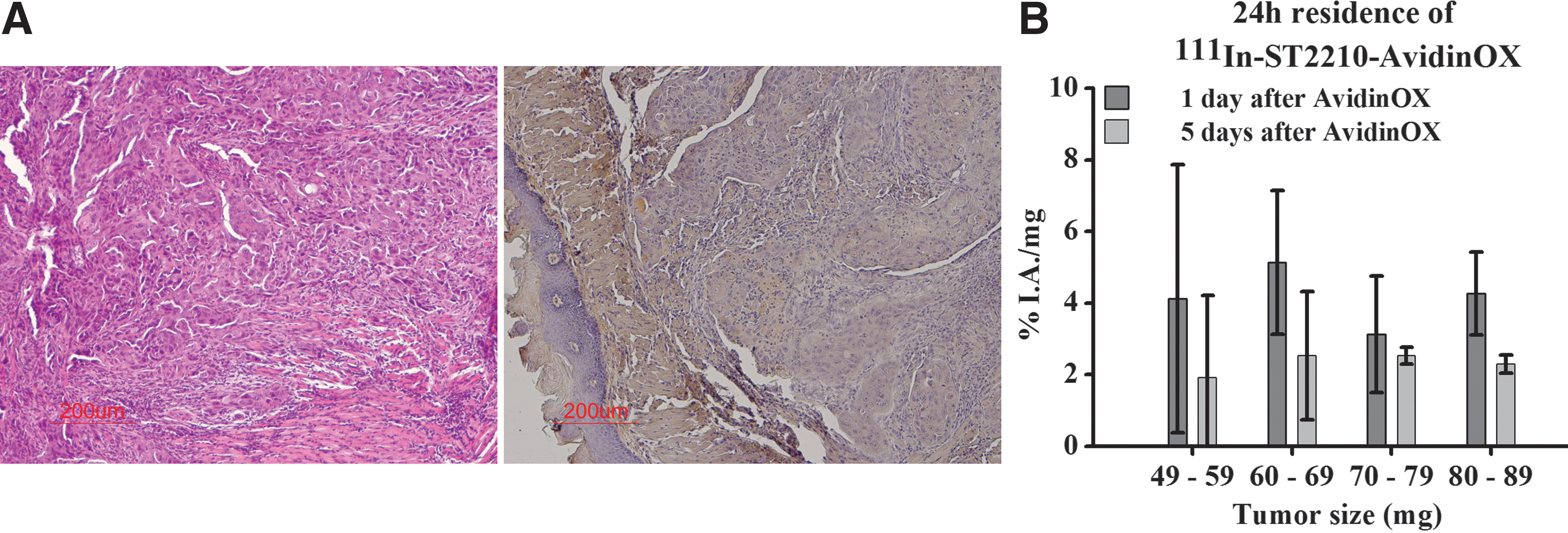
Injected AvidinOX binds OSC19 human tongue carcinoma xenografts.
Antitumor efficacy of intravenous 15 or 30 MBq 90Y-ST2210 was then evaluated in human OSC19 xenotransplanted nude mice. Tongue-implanted tumors were preinjected with AvidinOX or vehicle at about 20% of their estimated volume. Data in Figure 4A indicate that the animals treated with AvidinOX-targeted radioactive biotin exhibit significantly higher dose-dependent survival compared to control groups (radioactive biotin after intratumor vehicle, vehicle or AvidinOX without radioactive biotin). These results correlated with higher body weight (data not shown) and higher number of animals with NED in the AvidinOX pretargeted groups compared to the other groups, paralleled by a lower number of animals with TD throughout the study (Table 2). Interestingly, the cured tongues appeared to be normal at both objective (Fig. 4B) and histological (Fig. 4C) observations.
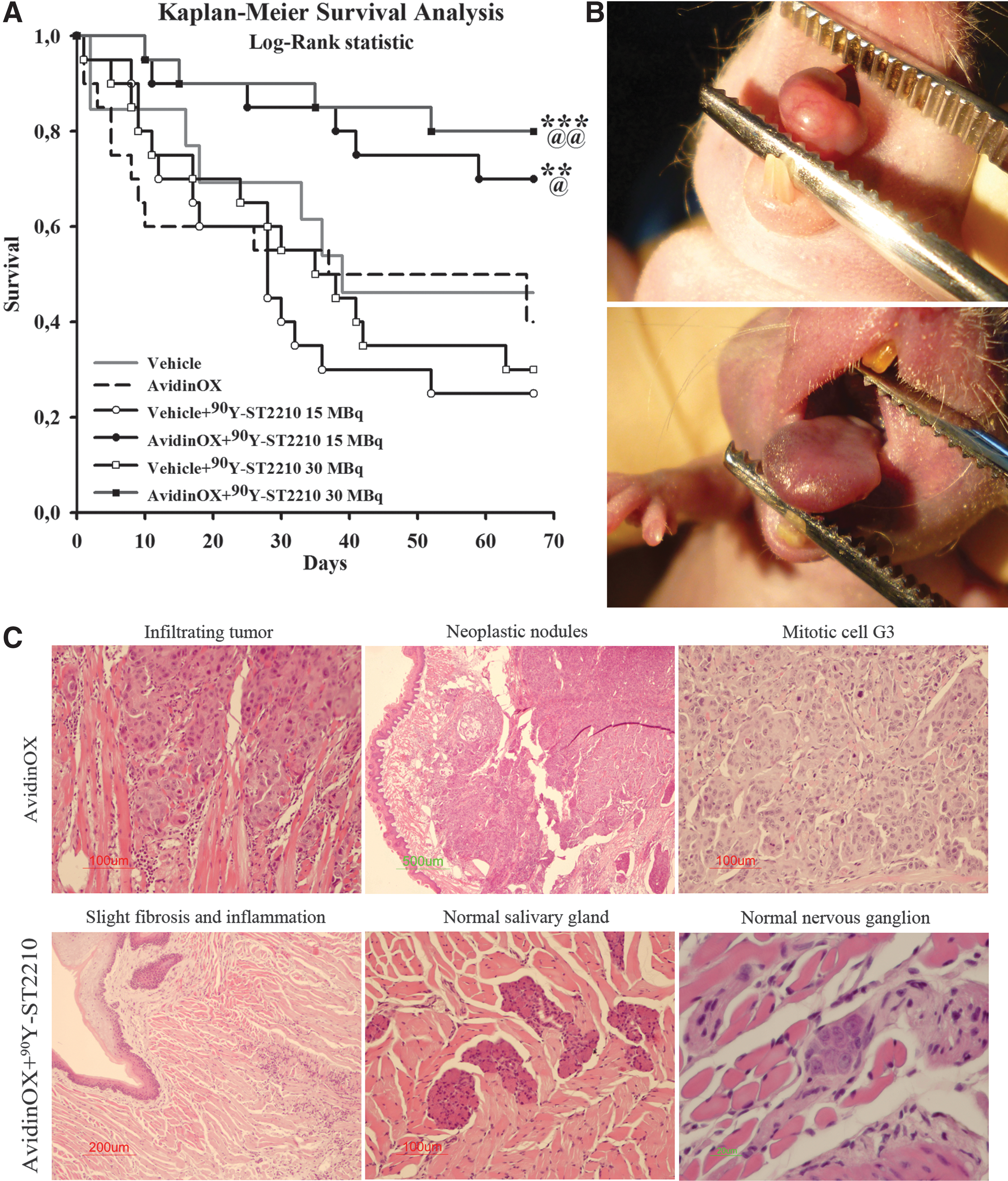
AvidinOX-targeted 90Y-ST2210 is effective against OSC19 tongue cancer.
Mice were monitored for tumor presence/growth twice a week for 12 weeks: NED, mice without tumor lesions; TD, mice with tumor masses >200 mg. Data are the average±SD of the percentage of mice with NED or TD recorded at each observation point.
Statistical analysis by Kruskal–Wallis (GraphPad Prism 5), p<0.05 versus vehicle.
Statistical analysis by Kruskal–Wallis (GraphPad Prism 5), p<0.001 versus vehicle.
TD, terminal disease.
Discussion
There is a need to treat locally cancer lesions derived from or residing within tissues/organs that might be very different in terms of stromal composition, vascularization, density, and so on. AvidinOX has been previously proven to form Schiff's bases with tissue proteins of injected muscle. 9 AvidinOX linkage and long tissue residence are also found in injected liver metastases as indicated by selective and consistent uptake of intravenous 177Lu-ST2210 administered 1 and 11 days after AvidinOX in the ongoing clinical trial (ClinicalTrials.gov NCT02053324, data not shown). Present results from different animal species reinforce the concept that radioactive biotin can be selectively delivered to different AvidinOX-injected tissues/organs that might host primary or metastatic neoplastic lesions. This strategy appears to be particularly appealing in those cases where surgery is not an obvious option, such as the treatment of tongue cancer or when perioperative interventions are necessary. For example, management of superficial bladder carcinoma by transurethral resection requires perioperative radio/chemotherapy treatments to prevent relapses, 17 and present data provide a proof of principle on the use of AvidinOX to target radioactive biotin to the operated bladder. Tongue cancer is a clinical condition currently treated by surgery, external beam radiotherapy and/or brachytherapy, as well as adjuvant systemic chemotherapy. The selection of single or combined treatment modalities is based on various considerations that include disease control probability, tumor resectability, the patient's general condition, and the expertise of the hospital. For resectable tongue cancer, the mainstay of treatment is surgery, while brachytherapy may be considered as postoperative adjuvant or salvage treatment 18,19 or as a sole modality for unresectable or early small primary tumors. 20 Nevertheless, several critical issues in clinical brachytherapy still need to be addressed to increase antitumor efficacy and reduce side-effects. 21 Previous and present data from this group show the feasibility of using AvidinOX for driving the delivery of radiolabeled biotin to a variety of normal and tumor tissues and antitumor efficacy of the treatment. Presently, the authors show that injected AvidinOX links to different tissues and it can be used either precomplexed (intratumor injection of the complex AvidinOX-radioactive biotin) (Fig. 1A) or in two-step pretargeting procedures (AvidinOX is injected first and radioactive biotin is systemically administered days thereafter) (Table 1 and Figs. 2 and 4) in small and large animals. The first approach offers the advantage of needing significantly lower amounts of radioactivity compared to the second that, in turn, might be more convenient in those cases where patient or logistic issues might impose a delayed administration of radioactive biotin. AvidinOX-based radionuclide therapy exhibits several competitive advantages compared with brachytherapy or external beam irradiation. In fact, this approach allows to separate the two steps of tumor pretreatment and radiopharmaceutical injection; thus, exploiting the specific skills of the related operators (i.e., interventional radiologist and nuclear medicine doctors), it allows to conform therapy to the tumor shape by simple intratumor injection without the use of sophisticated equipment and finally exhibits great flexibility in the selection of the best radionuclide for each clinical indication.
The long tissue residence of AvidinOX as well as that of AvidinOX/biotinylated agent complex occurs in normal and neoplastic tissues, with strong and homogenous localization evidenced by immunohistochemistry. This property paves the way to the use of this product for both perioperative radioactive boosting (prevention of tumor relapses) and salvage radionuclide therapy alone or in combination with radiosensitizing treatments. The use of AvidinOX extends far behind tumor targeting of radioactive biotin. In fact, the authors recently published results indicating the possible use of nebulized AvidinOX as an anchoring agent for nebulized biotinylated monoclonal antibodies (i.e., cetuximab) for the topical treatment of lung cancer. Surprisingly, the in vitro potency of biotinylated cetuximab is improved when linked to AvidinOX on the cell surface of tumor cells, and low-dose nebulized biotinylated cetuximab in mice, pretreated with nebulized AvidinOX, delays mortality in a metastatic A549 model. 22 In addition, the authors previously showed that AvidinOX might be useful for tissue targeting biotinylated cells. In fact, biotinylated myocytes were shown to bind to AvidinOX in vitro and proliferate and differentiate into muscular fibers. Moreover, intravenously injected biotinylated bone marrow cells were found to reside at least 5 days in a muscle treated, 48 hours earlier, with AvidinOX. 23 In conclusion, extensive previous and present preclinical data and early clinical observations support the use of intratumor injection of AvidinOX for driving the delivery of radioactive boosts to unresectable tumors. BiotinDOTA (ST2210) adds flexibility to treatment options, allowing to select the most suitable radionuclide among a variety of DOTA binders differing for energy, half-life, or pharmacokinetic properties. For example, in the ongoing clinical trial where the regular liver metastases are easy to conform with AvidinOX, the short path 177Lu (about 2 mm) was selected to minimize damage of the surrounding healthy liver. On the other hand, for very irregular tumors such as head and neck where conformation of treatment is more challenging and surrounding tissue is less critical, the use of long path radionuclides such as 90Y (about 10 mm) might be a more convenient option.
Indeed, the present data provide a proof of concept on the utility of the AvidinOX-based therapeutic platform for the therapy of tongue cancer with 90Y-ST2210.
Footnotes
Disclosure Statement
C.A., B.L., A.R., and R.D.S. are employees of Sigma-Tau SpA, which is the applicant of patents on AvidinOX and ST2210. For the remaining authors, no competing financial interests exist.