






Abstract
This article focuses on social media and interactive challenges for emergency organizations during a bioterrorism or agroterrorism incident, and it outlines the dual-use dilemma of social media. Attackers or terrorists can use social media as their modus operandi, and defenders, including emergency organizations in law enforcement and public and animal health, can use it for peaceful purposes. To get a better understanding of the uses of social media in these situations, a workshop was arranged in Stockholm, Sweden, to raise awareness about social media and animal bioterrorism threats. Fifty-six experts and crisis communicators from international and national organizations participated. As a result of the workshop, it was concluded that emergency organizations can collect valuable information and monitor social media before, during, and after an outbreak. In order to make use of interactive communication to obtain collective intelligence from the public, emergency organizations must adapt to social networking technologies, requiring multidisciplinary knowledge in the fields of information, communication, IT, and biopreparedness. Social network messaging during a disease outbreak can be visualized in stream graphs and networks showing clusters of Twitter and Facebook users. The visualization of social media can be an important preparedness tool in the response to bioterrorism and agroterrorism.
The technological revolution in life sciences and IT has generated new methods for preparedness. However, the risks of these new technologies also must be considered; the term “dual-use” refers to research whose purpose is to advance the understanding of a particular subject, but these methods or results can simultaneously bear the potential for malicious or unintended use. 5 The “dual-use dilemma” refers to research that can be used for both good and harmful purposes, and a dual-use technology is a technology that has both peaceful and military/antagonistic applications. For example, life sciences can also be used for making biological weapons. 6 The confusing aspects of the dual-use dilemma must find a scientifically acceptable global solution in order to reduce the future risk of bioterrorism. 7
Another example of dual-use technology is internet-assisted social networking. For instance, risk related to cybersecurity and hackers is crucial to obtain preparedness measures. 8 Therefore, it is especially important to analyze social software security and make an initial net assessment (ie, to use widely available data to create strategic insights). 9 Terrorists are making use of internet-assisted technologies in Scandinavia. Two terrorism actions have recently taken place in which the attackers used Facebook sites: the jihadist suicide bomber Taimour Abdulwahab in Stockholm, Sweden, in December 2010, 10 and the lone wolf, right-wing terrorist Anders Behring Breivik's bombing in Oslo and shootings at Utøya, Norway, on July 22, 2011. 11 Therefore, for the future it is important to study how the virtual world can trigger people to commit some of the horrendous crimes that are written about in the blog community and to understand that social media is a dual-use technology. 12
In 2010 it was estimated that there were about 100,000 extremist and terrorist websites, including virtual world sites, social networking sites, blogs, and forums that included thousands of videos and other multimedia formats. 13 This information is gathered in the Dark Web collection at the Artificial Intelligence lab of the University of Arizona. The Dark Web collection is an open source information collection for the academic world, and researchers can have graded access. It refers to terrorism informatics, which can be defined as the application of advanced methodologies and information fusion and analysis techniques to acquire, integrate, process, analyze, and manage the diversity of terrorism-related information for national/international and homeland security–related applications. 14
Today, the internet has changed how people communicate and consume data. Social media, such as YouTube, Twitter, and Facebook, are integrated into daily life. Social media are used by authorities and organizations in crisis management but also by terrorists. The internet is now a staple in providing youth with entertainment, connectivity, and interaction. Youth internet usage thrives on the ability to be involved with online content and communicate their opinions to the creators.
Terrorist groups have recognized this dynamic and have begun to reach out to youth using the same platforms and modes in an attempt to indoctrinate youth with radical messages. 15 The internet is an important tool for terrorists and extremists; it is a tool for propaganda in the radicalization process. 16 The use of social media tools by individuals and organizations to radicalize people for political and social change has become increasingly popular. 17 Studies report that almost 90% of online terrorist organizational efforts are conducted using social media. Social media leave no paper trail and allow groups to gather in online forums without ever having to meet in person, a tremendous tactical advantage. The ability to digitally “meet” online allows terrorist operatives to leverage worldwide access to potential recruitment targets (with “friend” requests or video clips) who would have previously been impossible to reach. Immobility no longer cripples terrorist operations. Operational activities can be planned in minute detail without ever leaving the safety of a hideout. 18
Creating an overview of activities on the blogosphere is time-consuming and difficult to interpret but can be crucial for the development and outcome of a bioterrorist attack or a crisis. Social media are an important capability in surveillance of food terrorism. 19 Situational awareness and an understanding of how the public seeks information related to bioterrorism is vital. 20 Social media make up a vast field that is in continuous flux, with increased importance in knowledge sharing and building of relations, but social media can also be used as a tool in crisis management and emergencies. The public is no longer waiting for information from authorities and agencies; they are expecting rapid communication in the form of a dialogue.
For this reason, communication officers and public health officials must improve awareness among decision makers of how to use available social media in an appropriate manner, how to communicate with the public in emergencies, and how to collect useful information, as a listener, from the public in order to integrate the information in emergency management organizations. 21 Consequently, there is a need for future research on computer security with regard to interactive social media concerning the role of being a “listener” to obtain collective intelligence from the public for emergency management organizations. 22
In this article, we present results from a workshop on social media including experiences from crowd sourcing, tools in crisis management, and results from the EU project AniBioThreat.
Workshop
On September 22, 2011, a workshop entitled “Social Media and Its Dual Use in Biopreparedness—New Visualization and Communication Tools in Crisis Management” was held at Arlanda Airport, Stockholm, Sweden. 23 The workshop was hosted by the Swedish National Veterinary Institute and organized through the EU project AniBioThreat. The aim of the workshop was to give an overview of social media in terms of crisis management before and during an incident related to animal bioterrorism threats. The purpose was also to raise awareness among the participants and to increase social media use for rapid communication during a serious incident.
In total, 56 experts and communicators participated in the workshop from the following organizations: World Health Organization (WHO, Geneva), the WHO Regional Office for Europe (WHO/Europe, Copenhagen, Denmark), the European Centre for Disease Prevention and Control (ECDC, Stockholm, Sweden), the Danish Emergency Management Agency, and a number of Swedish law enforcement and disease control authorities, such as the National Police Board, the Swedish Civil Contingencies Agency, the Swedish Board of Agriculture, the National Veterinary Institute, the Swedish Institute for Communicable Disease Control, the National Board of Health and Welfare, and the National Food Agency.
The workshop was arranged with lectures in a morning session, and the afternoon was dedicated to a scenario case and group work. The morning session was opened by a general presentation on AniBioThreat given by the coordinator/project director Rickard Knutsson of the National Veterinary Institute (SVA), Uppsala, Sweden. A journalist and expert in social media, Sofia Mirjamsdotter, gave an introductory lecture on “Social media and crisis communication.” Researcher Gary Barker, Institute of Food Research, Norwich, United Kingdom, followed up with a presentation about “Social media, networked sources, collective intelligence and signal detection opportunities.” After lunch, Associate Professor Jonas Landgren, Chalmers University of Technology, Gothenburg, Sweden, continued with “Social media seems great, but how do we get started?” And finally, Social Media Officer Isaac Griberg, International Committee of the Red Cross (ICRC), Geneva, Switzerland, described “Experiences of social media in armed conflict and disaster.” After the oral presentations, a scenario was handed out to the participants.
Results
Social Media, Networked Sources, Collective Intelligence, and Signal Detection Opportunities
Social media are difficult to define precisely from both technical and user perspectives, but without doubt, the past decade has witnessed a rapid emergence of facilities and desires for unstructured, cheap, network-based communications. The internet and mobile phone networks are central to this progression, but the changing attitudes toward information content and access, particularly in relation to individuals, are equally significant. Of the many properties of emergent networked information systems, 2 stand out: First, in each case, there are many diverse network users (“a crowd”); and, second, it is particularly easy for each user to share information with others. These properties combine to ensure that individual pieces of information (messages) can move efficiently within the network (ie, within the crowd) so that the nature of their spread (dynamics) is something that is additional to their content (and somehow reflects properties of the members of the network). The rapid spread of information from user to user means that content ownership can be degraded rapidly and that a “content centric” picture (dissemination) is replaced by a “user centric” picture; this change is an ongoing, fundamental shift in communication. Ultimately, networked information sources reflect the user interactions as well as direct expression of content, and so data mining in social media can provide direct information about actual views as well as derived information about how views are formed, shared, and valued (sometimes called collective intelligence). 24
The technology of data mining, for social network information, is remarkably well established—that is, web crawling codes. 24 Many of the social media platforms continually update indexed databases of their activity and provide user friendly tools for systematic explorations (structured searches and downloads). Additionally, the popular idiom of open source computing ensures that there is a vast support network for tools that promote investigation of social media, and many are displayed, for nonexperts, as simple web applications. Often the visualization of complex, nebulous network communications is a first step toward discovery of collective intelligence in social media.
Biological hazards, food safety concerns, and other public health issues have strong user centric properties. 25 Detection, appreciation, and understanding of health issues and threats can be visualized from the collective, unsolicited communications of a diverse population of “users.” As an example, Google is able to harness information concerning human influenza, by unsupervised learning from millions of its search engine query strings, into a powerful and reliable system for predicting regional influenzalike illness outbreaks. 26 This system, Google Flu Trends (http://www.google.org/flutrends), now operates in many regions and is a beacon for many developing early event detection systems. Similar detection systems, based on data from social media, are increasingly able to provide alerts for health services or for event protection.
Although information technology that supports social media analyses is often specialist, and is developed for particular commercial applications, in most cases it is easy to appreciate a powerful role in relation to awareness and preparedness for public health issues. Invariably, a first step in data mining involves collecting, filtering, and aggregating data, including key words, texts, images, and video. A majority of social media platforms provide access to their stored data, as well as search functions and filters, so that it is easy to find all the messages relating to one theme (historically and in real time). A coding step can combine (aggregate) results from several searches and present them in a single display to give a powerful representation of an area of interest.
The TweetGrid application (http://tweetgrid.com) uses data from Twitter and aggregates up to 9 searches in real time. Advanced searches can include Boolean expressions for operations on the message contents, searches based on senders or recipients, and geocoding to identify messages associated with particular locations. Aggregated Twitter data was able to track a recent outbreak of cholera in Haiti. 27 Other applications (eg, socialmention http://socialmention.com) can aggregate searches from many social media sources such as blogs, microblogs, image shares, and the like to build a composite picture of a single event. “Healthmap” (http://healthmap.org/en/) aggregates searches from many newsfeeds, from the World Health Organization, EuroSurveillance, and ProMed, and uses Google maps to provide a display of collective intelligence relating to worldwide disease outbreaks.
A second step in data mining concerns the measurement and visualization of social media information. Counting messages and responses, or summarizing/segmenting the content and expressing variations with time (or location) for networked data sources often involves manipulation and visualization of large data sets. There are several applications that display time series information for search engine queries (eg, Google Trends http://www.google.com/trends) or for blog posts (eg, ICEROCKET http://www.icerocket.com). For public health issues, these representations often reveal a typical “bursty” dynamic for which the number of messages sporadically rises sharply and follows closely the pattern of interest in a particular event before decaying rapidly. The spreading process for social media messages means that this pattern is often observed before the actual event is fully documented or reported and, potentially, can be used to direct a response or to target resources.
Stream graphs provide a particularly rich visualization for social media dynamics. A stream graph is a stacked graph subjected to specialist design criteria that creates an “organic” and engaging display (eg, a shifted baseline). 28 Figure 1 shows a stream graph based on a search for the word “botulism” in Twitter messages. (The stream graphs in Figure 1 are generated from Neoformix Twitter StreamGraphs http://www.neoformix.com.) The first time series illustrates 2 botulism events: reports concerning Clostridium botulinum in poultry litter in Northern Ireland, and concerns about a botulism outbreak, associated with pumpkin, in Ontario. Eventually, the interest in these events dissipates and, as shown in the second time series, there is a period of about 1 week without significant Twitter activity before another burst, corresponding to Tweets concerning an outbreak of botulism in an Arizona prison. A third time series in Figure 1, measuring Tweets that include the word “botox,” illustrates an alternative dynamic. Although the number of Tweets fluctuates, it is difficult to discern isolated events within a continuous background. The stream graphs can highlight words that are highly associated with the search word or identify a selection of actual messages associated with particular times or dynamic features. The burst concerning poultry litter includes Tweets from the BBC and other news organizations as well as Tweets from individuals. Stream graphs summarize complex data for a mass audience and, in this form, represent a supervised interrogation of the social media information. It is relatively straightforward to extract all the individual Tweets from the Twitter source and follow an unsupervised approach involving natural language processing techniques.
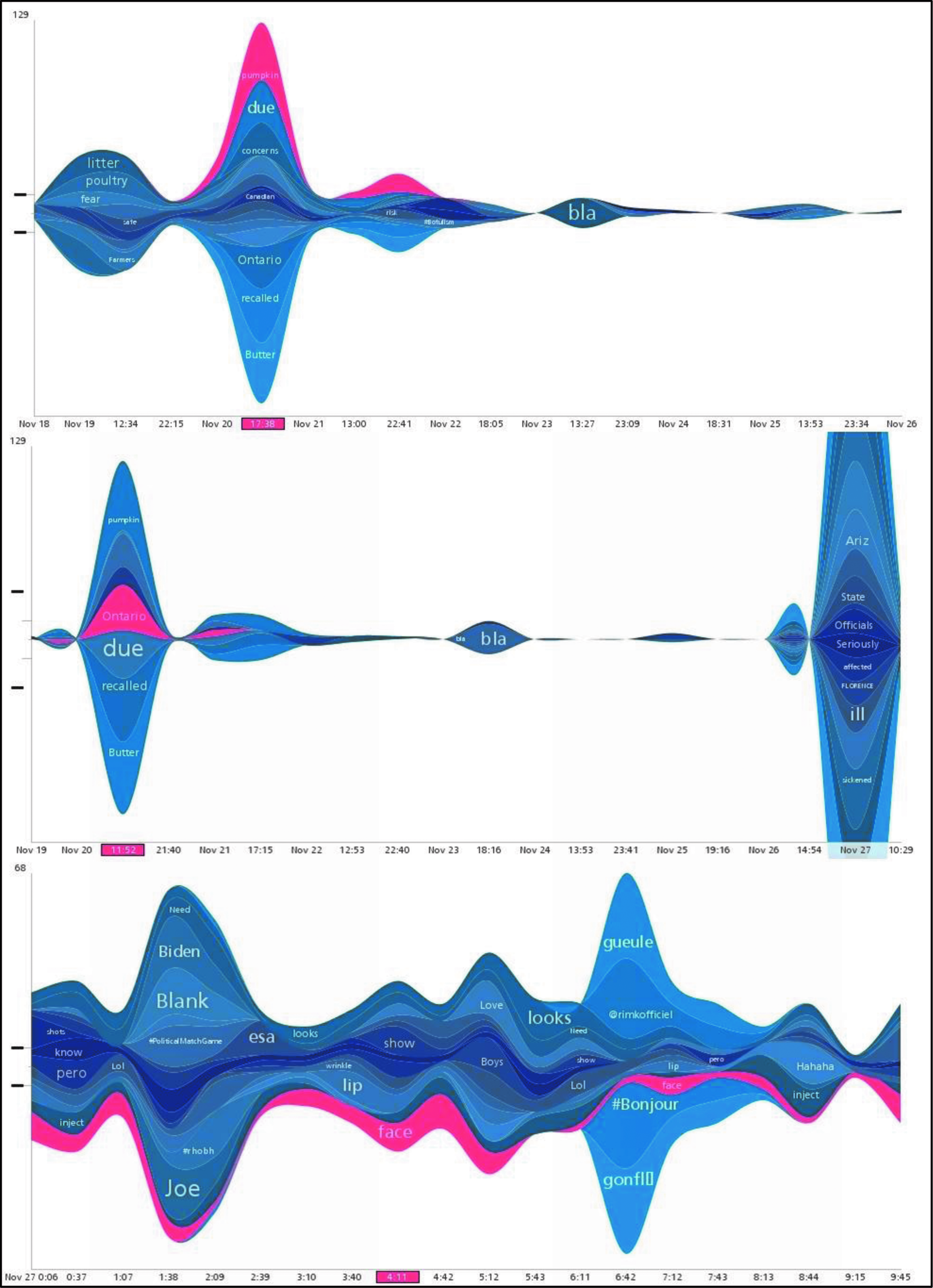
Stream graphs that display time series for the number of Twitter messages. The first 2 series correspond to messages that include the keyword “botulism,” and the third series corresponds with Twitter messages that include the word “botox” (created with Neoformix Twitter StreamGraphs).
Analysis and visualization of information that is additional to message content, or metadata, can help to understand the collective properties of a “crowd” or the spreading process for particular messages. Clearly times and locations associated with message transmission contribute to a spatiotemporal picture of events, but information concerning the sender and relationships with the recipients provide a strong context for the message content. Connectivity, in terms of lists of followers or friends, and rapid response, in terms of replying or resending, are essential elements of social media; connections are visualized most easily as a network.
In early September 2011, French and European Union food safety authorities released statements about an outbreak of botulism, associated with tapenade, in France. Very quickly this event caused a burst of news information and messages in the social media. A network illustrating the complex connectivity of Twitter messages concerning this event is shown in Figure 2 (the networks in Figures 2 and 3 are constructed using NodeXL, an add-in application for Microsoft Excel, http://nodexl.codeplex.com). 29
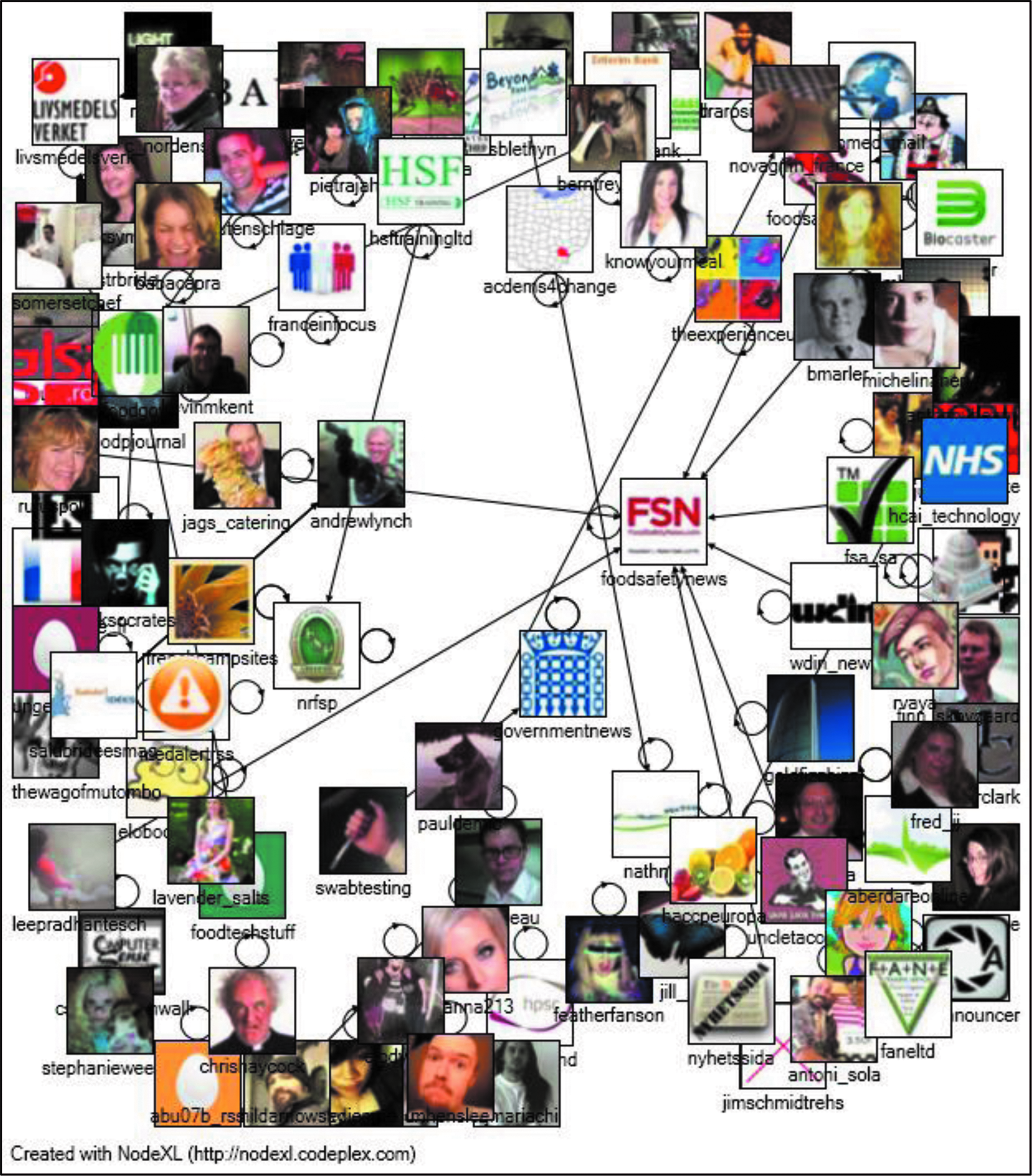
A network representing Twitter messaging following an outbreak of foodborne botulism
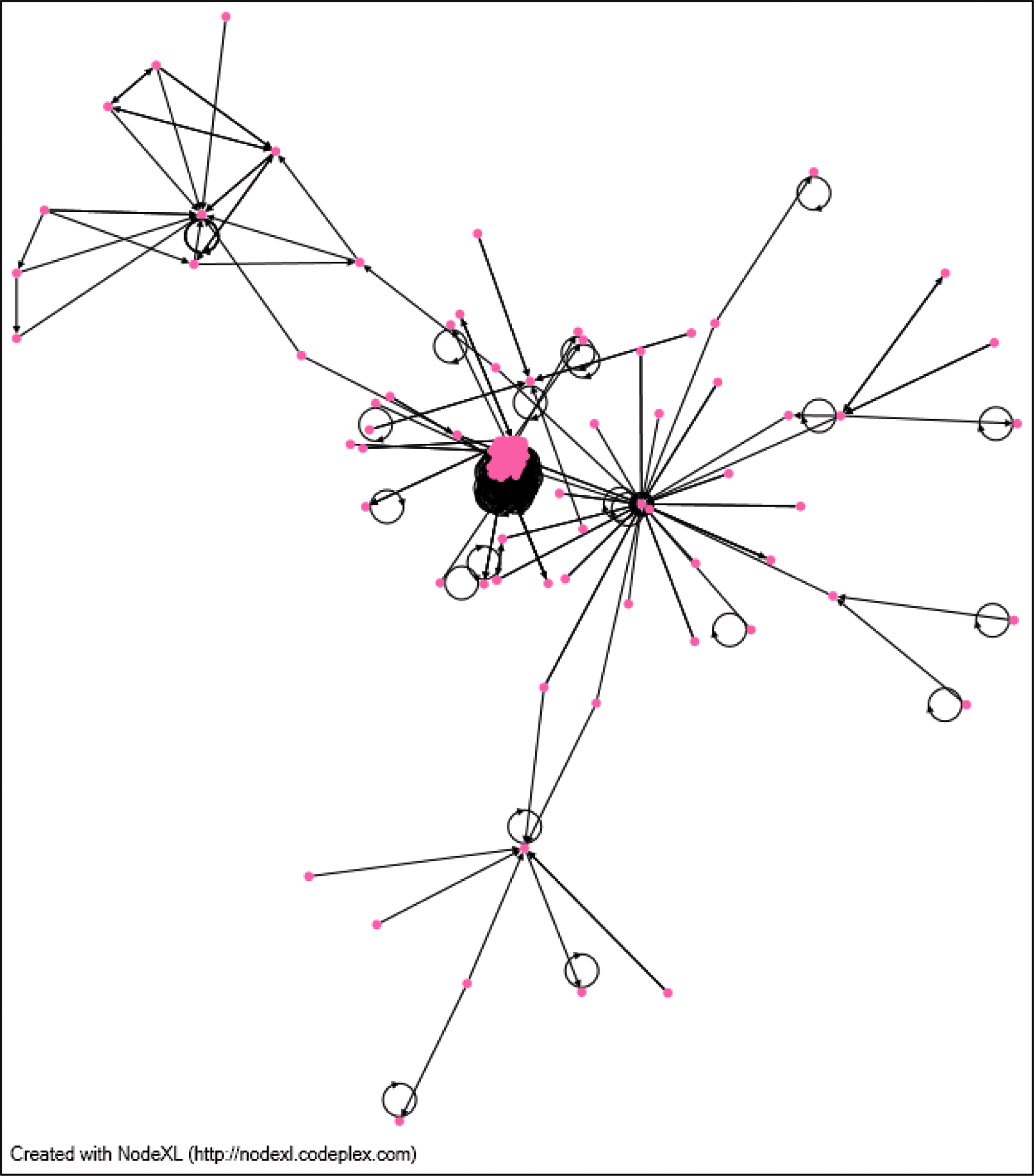
A network representing Twitter messaging following an outbreak of foodborne botulism showing clusters of users
Each message source is represented by a network node and shown as an avatar. Messages that passed between 2 Twitter accounts (evaluated by a “following” or “mention” relationship within the metadata stored by Twitter) are represented by network links. The messages correspond to a short period following the initial announcement, and it is clear that several European national agencies, such as the UK Food Standards Agency, several specialist food industry communicators, such as FoodSafetyNews, and many individuals were connected by shared information. Further analysis shows that there were distinct phases of Twitter activity concerning this event; communication was initially dominated by responses from official sources but, later, involved many groups of (apparently) nonexperts. A network of Twitter messages concerning the tapenade botulism outbreak and corresponding to a period after the initial information burst is shown in Figure 3. The network representation has been changed to emphasize connectivity features, but nodes and links have the same meaning as those in Figure 2 (details of NodeXL network structures and visualizations). 29 In this network structure, there are 2 small but clearly visible clusters of nodes. In the bottom center of Figure 2, a cluster of 8 or 9 nodes is dominated by a single strongly connected node; the other nodes in this cluster are not connected to each other, but there are 2 important nodes that connect this cluster to the rest of the network (strong “betweenness centrality”). In contrast, in the top left of Figure 2, there is a cluster of approximately 10 nodes that are all very well connected to others in the cluster.
Although it is not possible to generalize from this picture, it is clear that network communications, using social media, may have many different forms, and identification of network structures may add to an interpretation of events (the central node of the cluster at the bottom of Figure 2 corresponds with the author of a book about health issues, whereas the mass of nodes at the center of the figure corresponds with Tweets about botulism and tapenade that were not shared with anyone). Clustering, particularly an unsupervised learning approach, is a major tool in the analysis of unstructured communication networks.
Social Media in Nonsocial Organizations
Social media have in the past few years become increasingly important for the public to share experiences, provide advice, and seek help during an ongoing emergency or crisis. 30 In contrast, government authorities have just recently made a distinct and rapid shift in attitude toward making use of social media. This shift is driven by the unprecedented use of social media by citizens and the relative ease of use and accessibility driven by the adoption of smartphone use. Today, a significant and growing number of Swedish government authorities have a presence in social media such as Facebook, Twitter, and YouTube. Such presence has resulted in new possibilities for authorities to reach out to the public with important information during emergencies, infrastructure breakdowns, and crises. Swedish authorities are now taking explicit steps to use social media also for communicating in times of emergencies and crisis. Figure 4 outlines this step-wise approach.
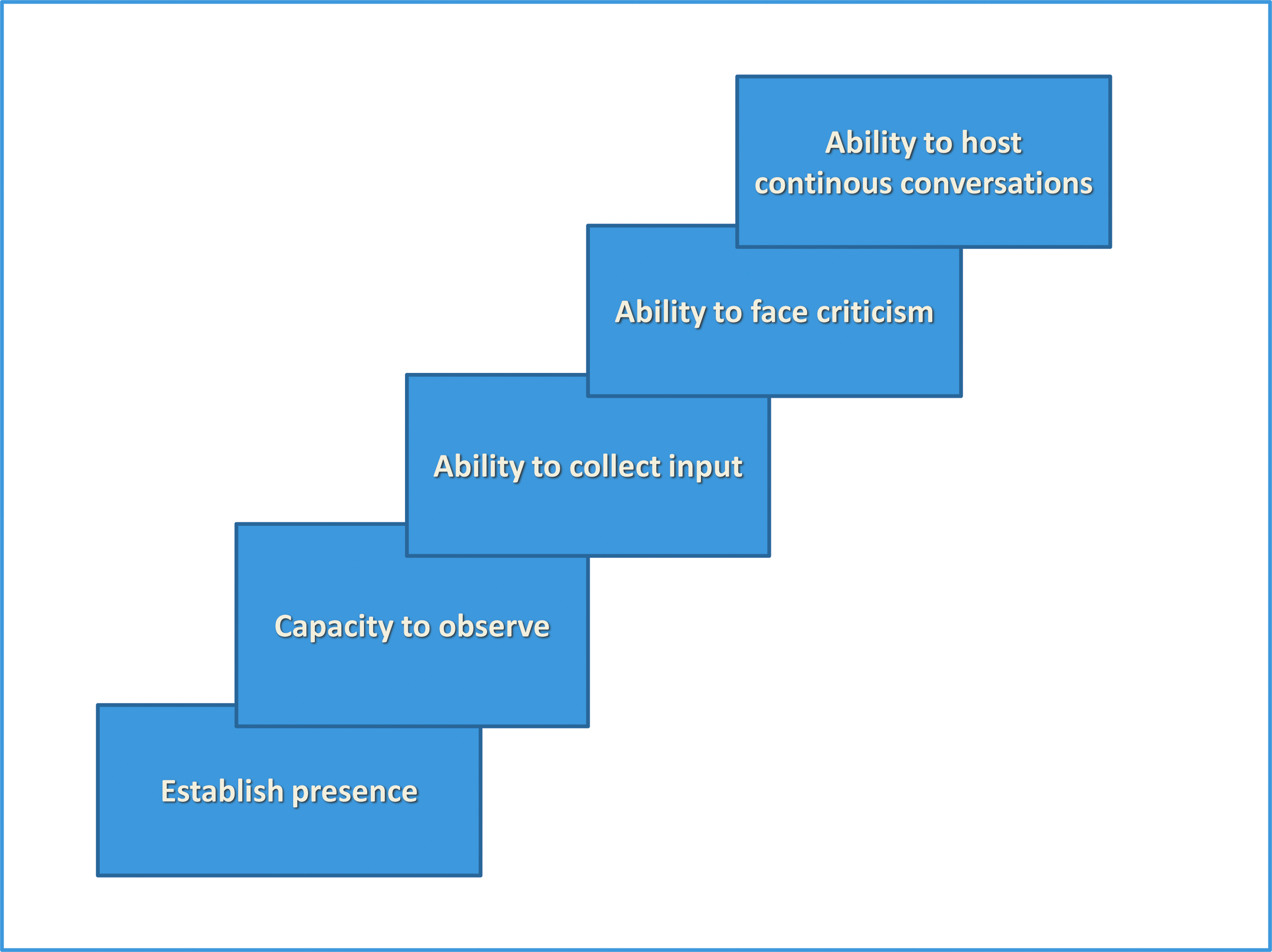
Authority steps in social media use
The first step is to establish a presence and provide one-way information developing trust; the second is focused on learning how to make observations by actively using social media for improved awareness; and the third step focuses on how an authority needs to ensure that they have capabilities to connect and get input from a large number of individuals. The fourth step is about the organization's capabilities to handle severe criticism received publicly over social media. The fifth step focuses on the capacity to ensure continuous dialogue and engagement with the public. The model indicates the different categories of use and purposes of social media range: being there in a dialogue with the public, taking active part, and becoming a trustworthy actor.
However, moving into the social media space for a government authority is not without problems. As shown from the humanitarian response domain, formal organizations are faced with distinct barriers for efficient adoption and use of social media. 31 Bureaucratic organizations face several challenges when trying to make use of social media in balance with the public's expectations. These challenges are not dramatic, but they do indicate that it will take some time before government authorities have a solid presence in the social media landscape.
One of these challenges concerns presence and availability. Most government authorities work from 9 to 5 during work days. Few authorities, except the police, fire, and rescue and paramedics, have any significant work capacity during evenings, nights, weekends, and during vacation periods. This means that interactions between authorities and the public to a large extent must occur during office hours. Interactions by the public during non–office hours result in a situation with a significant delay, when the public must wait until the next 9-5 workday to have any formal response to their comments and inquiries. In order to handle this challenge, authorities in Sweden have explicitly described in their profile information that their social media presence is open only during specific time periods. Some authorities are managing this challenge by explicitly posting updates saying “good morning” and “goodbye, see you tomorrow” to mimic the verbal communication patterns of traditional office work and thereby signal when people can expect to have a response or not. Here we can see a conflict between the temporal rhythms of bureaucratic organizations and the 24-hour real-time flow of the outside world.
Another challenge concerns how government authorities are allowed to respond and give service to inquiries received via social media. Government authorities are mandated to ensure a high level of administrative rigor on all inquiries, even if these inquiries are delivered as a comment on the organization's Facebook wall. This means that inquiries must be processed according to policies and practices developed before the emergence of social media. Balancing administrative rigor against topical relevance (which is the key focus in social media) is not an easy task. The public expects fast interactions in order to receive quick responses to their questions or comments. From an authority's perspective, it is the systematic management of these questions and comments that is more important than the time factor. In addition, it is also sometimes difficult to assess when a comment on, for example, Facebook should be considered to be an inquiry and when a comment is just a comment that does not require any administrative action.
A third challenge concerns the underlying reason for government authorities to establish a presence in social media. A common argument among Swedish authorities is that authorities should have a presence where people are and spend their time, in order to inform and interact with them. If people are on Facebook and Twitter, the authorities should also be there. This is also true during an emergency or crisis in which the everyday interaction over social media is switched to focus on informing and providing advice to the public concerning the evolving situation. When the authorities, in times of emergencies and crisis, use social media as an information channel, the need for information is not reduced—just the opposite. Examples from Sweden show how a massive communication need is triggered by the authority's use of social media as an information channel. The authority's communication activities trigger intense communication activities by the public. This behavior is focused not only on specific follow-up inquiries in a question-and-answer pattern, but also where comments, opinions, and strong feelings are expressed concerning the incident or emergency. It is common that polarized debates emerge on an authority's Facebook pages, where groups of the public debate their conflicts of interest.
Despite these challenges, government authorities are more and more active on social media in order to ensure an extended communication capability with the public. Experiences from authorities in Sweden have shown that social media is not only an important channel for crisis communication, but also to ensure good situational awareness. Based on the information that the public generates and shares on social media, new insights could be assessed based on the digital footprints in social media. 32
When people comment, “like,” re-Tweet, and share information in social media, important digital footprints are generated that could provide meaning to an authority involved in emergency and crisis response. Social media allows authorities to collect questions, comments, and emotional digital manifestations and turn them into insights useful for the next steps in the response work or communication activities.
Monitoring Social Media During Crises
An American study performed by the American Red Cross 33 (http://www.lansstyrelsen.se/orebro/Sv/nyheter/2012/Pages/material-fran-smkris.aspx?keyword=smkris) shows an increasing number of Americans relying on social media for emergency information. However, only a few organizations have systems in place for monitoring, filtering, and responding to “crisis data.” Emergency organizations have to adapt to a new reality in which smartphones and mobile applications are becoming mainstream. The number of smartphones is estimated to grow from 698 million in 2011 to 2 billion in 2016. More than half (51%) of Swedes (18+) have a smartphone, and 65% use it daily to connect on social networks. Furthermore, the study showed that mobile apps and social media are the fourth most popular source for emergency information during a disaster. 33 A quarter of Americans will download an emergency app, and 1 in 5 has already used an app for emergency information. Facebook has almost 1 billion users worldwide; 70% are between 15 and 29 years old. Sweden, with a population of 9 million, has 4.8 million Facebook users. In the Arab world, users have increased by 30% in the first quarter of 2011. Facebook is now developing an “I'm Safe” feature to activate during sudden-onset emergencies. Emergency social users perform rescue actions based on information in social media.
In general, social media strategists recommend that authorities and organizations in crisis management produce a clear strategy and a convertible handbook with best practices for social media use. 12 They also stress the importance of training communication staff, hosting workshops, and developing skills and “buy-in” throughout the organization. To monitor and follow social media, listen to what is going on and be aware of how your authority is mentioned; it is important to be personal and keep focus in your communication. Authorities should be transparent, adequate, accurate, direct, and clear with short, condensed updates, which are expected by the public. In a crisis it is important to stay in the same media to keep up the dialogue with the public. Respond to questions, be honest, apologize for mistakes, and think twice before using images, which increasingly include information that can be sensitive (eg, the exact time and location of where the image was recorded).
Results from the Workshop Scenario
The scenario on a virtual disease outbreak in social media was discussed in the various groups. 23 Was it a natural contamination, sabotage, or a deliberate release of microorganisms? Several emergency management organizations were involved from the beginning. Authorities at local, regional, and national levels and in law enforcement and public and animal health were represented. However, in this case no information was given by professional experts, since all information was given by the public.
Mistrust was observed concerning the information in social media, and verification of information was outlined. Most groups continued their discussions using existing procedures for a natural outbreak, focusing on the need to find out whether the information was true or not. Collection of data to confirm how many people were ill from the verified data launched information in parallel action.
Feedback from the groups made it clear that more knowledge and awareness on social media use is necessary. The scenario demonstrated vulnerabilities in capability to respond to a social media attack, and awareness of the dual-use dilemma for emergency management organizations must be considered. Feedback on the need to practice and use social media in future exercises in training was also given. Research on how agencies should be organized concerning social media is also needed.
Evaluation of the Workshop
During this workshop, it was concluded that panic easily can be created on the blogosphere. There is also a risk that communicators and decision makers feed the panic. Authorities are challenged to give timely responses, be transparent, and answer all questions but are not organized in doing so. An analysis of social media interactions on Facebook, Twitter, and YouTube can be powerful supplemental tools in crisis communication, surveillance monitoring, decision making, and crisis management during an animal bioterrorism incident. There is a need for authorities and organizations to practice and use social media in future exercises and research.
The focus of the workshop was to present aspects of how social media can be used and function in crisis management during biological threats or events. Information received through social media influences crisis management and situational awareness. Social media has become an important complement in media surveillance for decision makers and for communication of a common picture to the public. But there is a need for a common understanding of this whole process.
Discussion
The internet has changed the way people communicate and consume media. Many organizations in crisis management have knowledge of the possibilities and potential benefits of the internet and social media, but few organizations know how to get started. There seem to be quite a few challenges in bringing social media into practice in nonsocial government agencies. Social media are not really accepted as reliable sources among decision makers. Handling undesired comments, obvious errors, deliberate disinformation, cyber attacks, or electronic threats can be a problem in social media since they are widespread and visible for everyone. Earlier unwished comments, obvious mistakes or errors, deliberate disinformation, attacks, or threats can be handled in an organization and not in public. Attacks and threats could be handled by being reported to the police, but in social media these matters are handled differently.
Social media can be used by authorities for communication, to create a dialogue and develop trust. But many agencies are formed like “boxes,” with the idea and attitude of superiority regarding information, decision-making power, and the mandate to act. The outside world goes on 24/7, whereas government offices work a 9-5 schedule. Authorities do not always understand the need for a constant flow of information and dialogue. Active accounts should be established. By monitoring social media, emergency organizations can achieve a complete picture of situational awareness in a crisis. Social media can provide a variety of benefits to support the public and make the right decisions during a crisis like a biological outbreak. They can also be an important tool in communicating directly with the public, which gives credibility to authorities and thus instills the public's confidence.
Twitter was the fastest updated media during the shooting at Utøya, Norway, on July 22, 2011. In Japan during the earthquake on March 11, 2011, the phone system broke down since Tokyo Tweets topped at 1,200 per minute. The earthquake was followed in real time in social media and supported people with information during the first days after the earthquake. More than 9,000 videos were tagged with “earthquake” and 7,000 with “tsunami” on YouTube during the first 24 hours after the event.
Before a Crisis
Put in place a system for regularly monitoring social conversation relevant to your organization. Build active communities where volunteers, supporters, and others are encouraged to participate. Ensure that social media is well integrated into all your official communication channels. Make sure sufficient resources are in place for communicating regularly, during times of crisis and calm.
During a Crisis
If a critical mass of users is identifying similar concerns, acknowledge that you are aware and are looking into it. Monitor mentions of your organization, and use this insight to shape your communication. Develop key messages (or reactive lines) that can be used to address common questions and concerns. Invite your professional network to resonate your message across their social media channels. Use multimedia to provide visual insight into how your organization is responding to the crisis. Provide regular follow-up, assuring online communities that you are taking the crisis seriously. Increased transparency can help to build trust, dispel rumors, and reinforce accountability.
After a Crisis
Thank your communities by highlighting the ways in which they are providing support. Share internally a summary of how you handled the crisis, what worked, and what was difficult.
The focus of the workshop was to present various aspects of how social media can be used and function in crisis management during biological threats or events, and to convey that information received through social media influences crisis management and situational awareness. Different examples of how social media have been used were given by the lecturers during the workshop. For example, during the earthquake in Japan, a website was created for people to search for relatives using their national personal identification numbers. During the Arab Spring in 2011, changes in governments were attributed to actions in social media. The workshop in social media did not have the aim to suggest that this is a solution to current communication and crisis management challenges, but rather that it is a powerful supplement to current and future crisis communication and crisis management. Authorities should establish a presence, a capacity to observe, an ability to collect input, an ability to face criticism, and an ability to host conversations. There are no shortcuts, such as robot-tools; there has to be a real person behind it.
Increasing use of social media as a dominant platform for communication is part of an overall shift to a user-centric world that appears irreversible. In this case it is natural that tools for analysis and visualization will continue to be developed and will be used to inform and learn about collective beliefs. Improved appreciation of collective information concerning public health, and the detection of collective awareness of biological hazards and threats, will be an important part of this trend. 34 It is clear that applications like Google Flu Trends already offer opportunities for early detection of population-based events, but the development also indicates that there may be other chances for discovery. Rather than the find patterns based on prior queries, there is, with large data volume, the potential to discover queries based on observed patterns and hence consider causation. Google Correlate (http://www.google.com/trends/correlate) aims to provide this functionality. 35 Similarly, the measurement of spatiotemporal activity in communication networks indicates distinct patterns of connectivity that contribute to a collective response, but, crucially, they indicate the possibility for built-in response or resilience that is necessary in the face of unpredictable events. The understanding of the dynamics and impact of social media communications is immature and developing rapidly, and not all indicators are positive. In some cases, network-based communications appear to get out of control with the potential to obscure the truth or to initiate panic. 36 However, even a limited knowledge of social media, network sources, and user-user interactions is enough to appreciate that top-down management structures for distributed phenomena, like public health, are changing, and developments can be assisted by a deeper understanding of collective behavior.
A key starting point is to create a structure in which information could be categorized into facts, questions, comments, and emotions. Based on these categories, the authority could monitor the public's reactions and responses 37 and map textual responses from the authority's Facebook wall or Twitterfeed into a matrix. When the authority repeatedly over time monitors, collects, and maps such information, a rich structure will emerge showing how the authority could actively gain feedback from the public in order to further strengthen the communication capabilities. Based on this approach, authorities will not only be able to adjust their communication messages but also become better in adapting the message to have feedback from the public that could be anticipated.
Authorities are now slowly building up this type and similar analytical capabilities. Still, there is a distinct lack of support tools and organizational routines. This is, however, likely to change, and in the next few years government authorities will continue to explore the challenges while at the same time balancing potential legal and ethical aspects that could be associated with such technologies and use.
Conclusions
We conclude that there is a need to improve the awareness of social media technologies as “dual-use” technologies concerning preparedness against bioterrorism and agroterrorism. There is a need to develop a multidisciplinary approach among law enforcement and public and animal health organizations on how to handle social media roles and responsibilities. Therefore, improved interactivity between public and animal health and law enforcement concerning social media implementation is needed in case there is a nonnatural disease outbreak. Organizations can collect valuable information and monitor social media before, during, and after an outbreak. But this requires organizational adaptability to use the interactive social media technology to make use of collective intelligence obtained from the public. Verification of information is always an issue, but based on metadata the collective properties of Twitter messaging can be visualized in stream graphs and networks showing clusters of Twitter users. Visualization of activities on social media is an important future preparedness tool in the response to bioterrorism and agroterrorism.
Footnotes
Acknowledgments
Writing of this article has been supported by the framework of the EU project AniBioThreat (Grant Agreement: Home/2009/ISEC/AG/191) with financial support from the Prevention of and Fight against Crime Programme of the European Union, European Commission—Directorate General Home Affairs. This publication reflects the views only of the authors, and the European Commission cannot be held responsible for any use that may be made of the information contained therein.