






Abstract
Recovering from a biological attack is a complex process requiring the successful resolution of numerous challenges. The Interagency Biological Restoration Demonstration program is one of the first multiagency efforts to develop strategies and tools that could be effective following a wide-area release of B. anthracis spores. Nevertheless, several key policy issues and associated science and technology issues still need to be addressed. For example, more refined risk assessment and management approaches are needed to help evaluate “true” public health risk. Once the risk is understood, that information can be considered along with the types of characterization activities deemed necessary to determine whether the cost and time of decontamination are actually warranted. This commentary offers 5 recommendations associated with decision making regarding decontamination and clearance options that should accompany a comprehensive risk analysis leading to more effective risk management decisions. It summarizes some of the most important technological gaps that still need to be addressed to help decision makers in their objective of reducing health risks to an acceptable level. The risk management approach described should enable decision makers to improve credibility and gain public acceptance, especially when an adequate science and technology base is available to support the required decisions.
It is generally agreed that currently available information is insufficient either to develop a minimum infectious dose or to quantify a “safe” amount of residual B. anthracis spores inside a contaminated facility 5 or throughout a contaminated outdoor environment, either before or after remediation. Under the present national policy framework and associated guidelines, acceptable residual contamination levels would be determined in a site-by-site manner by Unified Command personnel working closely with informed decision makers from relevant local, state, and federal agencies in accordance with the National Response Framework 6 and the National Incident Management System. 7
The Decision Makers' Dilemma
Historical information does not readily lend itself to solving the problem of recovery following a wide-area biological release over an urban area because there are essentially no precedents to widespread and persistent B. anthracis spore contamination in highly populated areas. Adverse public health and economic impacts in such a scenario have the potential to be catastrophic.
Risk assessment and management tools can and should be applied to help evaluate and implement public health, medical, and other options leading to a choice of remediation strategies and a final determination of whether consensus cleanup goals are achieved. However, an important issue that should be raised during such an evaluation is whether an estimated risk is actually great enough to warrant the cost and time of decontamination.
Is Cleanup Necessary?
In the case of health risks arising from a wide-area release of aerosolized B. anthracis spores, if cleanup is judged to be necessary, many unknowns, technological gaps, and resource limitations still impede the ability to reduce risks promptly and ensure a timely return to normal daily life. 8
Without question, the response and recovery effort must be multidimensional, including the rapid determination of initial distributions and levels of contaminant, the potential for spore re-aerosolization and migration over time, the timelines and socioeconomic impacts associated with any remediation approaches, and the potential for adverse health effects from any residual contamination that might remain following cleanup.
Clearance Goals: How Clean Is Safe?
During the 2001 U.S. anthrax cleanups, successful decontamination of the interiors of affected facilities was defined as “no growth of B. anthracis spores on all clearance environmental samples.” 9 In 2003, a National Academy of Sciences committee found that there was no scientific basis for establishing a level of residual B. anthracis contamination that could be safely left behind for indoor locations. 5 In a separate review of approximately 50 research papers published since the late 1990s that focused on indoor cleanup, Lawrence Livermore National Laboratory investigators also found the indoor clearance goal to be rather consistently identified as “no spore growth on all post-remediation environmental samples.” Although this is a stringent standard, there is little evidence at present that supports an alternative and less-stringent option for indoor contamination resulting from the use of significant quantities of weapons-grade B. anthracis spores that have the ability to re-aerosolize.
Despite the stringent historic indoor clearance goals that have been applied for B. anthracis spores, determination of clearance goals following an unprecedented wide-area incident will be site-specific and will undoubtedly entail new risk assessment and risk management considerations to guide decision making. Policymakers will need to understand whether any detected, positive environmental sample results represent an actual health hazard or simply represent a positive analysis for viable spores that may or may not constitute an actual health risk.
How to Approach Outdoor Contamination
Adding to the decision-making dilemma is the fact that current knowledge gaps related to clearance goals are even greater for outdoor than indoor environments. Spore resuspension (re-aerosolization) outdoors is not well understood, and weather conditions and hydrogeology (which can affect adsorption and runoff) will be site-specific, as could be the natural background levels of spores. Strategies to evaluate “real and significant” health impacts need to be factored into remediation recommendations and mitigation options that are considered. We cannot afford to have an urban area unoccupied for tens of years as some have estimated, though such estimates appear to be worst-case predictions based, in part, on our lack of scientific understanding of several key parameters.
It is also important to differentiate between the possible consequences of a release of a highly persistent, spore-forming pathogen compared to the release of a less persistent biological organism. For most bacterial or viral organisms, monitored natural attenuation—that is, allowing time for natural degradation processes to work along with periodic sampling and analysis—in lieu of decontamination will be sufficient, because such organisms are relatively short-lived. However, following a release of highly persistent B. anthracis spores, other factors, such as the risk of inhalation arising from re-aerosolization and the likelihood of human or animal contact, need to be evaluated and different options and strategies for characterization and remediation considered.
What Is the Risk to Public Health?
One possible approach for determining whether remediation is necessary would be to use characterization methods and strategies that better evaluate the actual health risks. Humans or animals can contract anthrax disease not only via exposure through the inhalation route but also through the skin (cutaneous route) or the gastrointestinal (GI) tract, and a risk assessment might well consider each route (Figure 1).
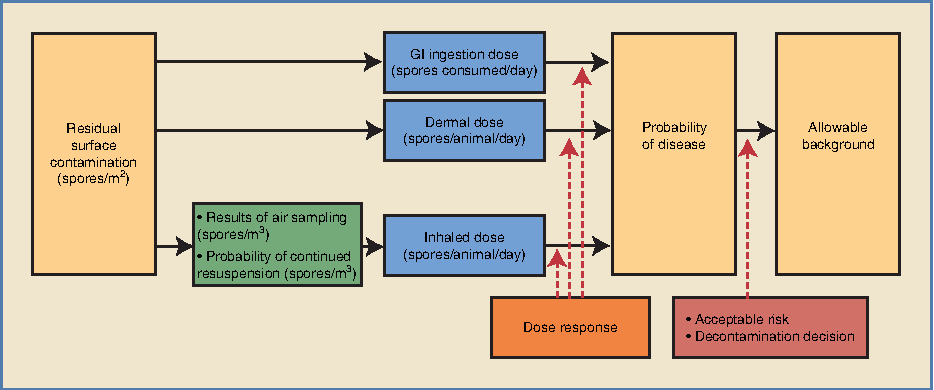
This figure illustrates the importance of evaluating the “true risk” from initial environmental surface sampling and analysis. Actual potential dose and probability of disease will be different for cutaneous, GI ingestion, and inhalation anthrax. Understanding the potential dose as a function of the exposure route is key for determining human health risks and for establishing the allowable residual level of viable spores for clearance purposes. Color images available online at www.liebertonline.com/bsp
While information from surface environmental sampling by itself does not inform us about the potential for resuspension of spores from surfaces and into the air, it would provide some data relevant to assessing potential cutaneous as well as GI 10 risks. The case-fatality rate of cutaneous anthrax is less than 1% with antibiotic treatment. 11 Although the GI form of the disease is relatively rare, sampling for gastrointestinal risks, if deemed appropriate and necessary, might focus on materials likely to be ingested, which could include drinking water and consumable crops.
However, the essential point is that B. anthracis is indigenous to some parts of the country and exists at high levels in some surface environmental samples where there is no reported incidence of anthrax disease. Because the major health risk associated with B. anthracis is that of inhalational anthrax, characterization strategies need to evaluate that specific risk in some improved way.
It is clearly important to minimize risk to the extent feasible and practicable, but a wide-area biological attack might require solutions quite different from those selected for the limited 2001 attacks that occurred through the mail system. Ultimately, it might be necessary to establish a separate clearance goal (or goals) for outdoor areas, coupled with long-term monitoring of the population at risk.
Recommendations for Remediation
If a wide-area B. anthracis attack were to happen tomorrow, focusing on a specific number of spores as the only rationale for determining whether decontamination is necessary, and using the number of spores present to establish clearance goals may not, by itself, be the most appropriate approach. An optimal and comprehensive risk analysis requires that several issues first be evaluated according to the following recommendations.
Recommendation 1
Consider whether decontamination is really necessary. Too often, the default logic or inclination may be to decontaminate solely on the basis of results from surface environmental sampling, but a finding of spores on surfaces alone does not necessitate decontamination. It is essential to understand whether the spores detected from sampling are in fact viable; if they are not, then no health risk exists. Even a finding of viable spores in surface environmental samples does not necessarily imply that a significant health risk exists; such data need to be evaluated in the context of actual exposure routes. Consider as well the effectiveness of a particular decontamination technology being considered, its objective, whether that objective can be met, and the possible drawbacks associated with a given technology. No decontamination technology is entirely without possible adverse effects.
Recommendation 2
Evaluate whether a true inhalation risk exists by assessing the potential for re-aerosolization and whether re-aerosolized spores are in the inhalation size range and are present in the breathing zone. The potential for spore re-aerosolization of weaponized spores, though not well understood and with some contradictory findings reported in the literature,12,13 depends on the details of spore preparation, resulting characteristics of the product, and site-specific environmental characteristics such as hydrogeology, humidity, and temperature. Although some predictive models are likely to be improved with time, in a real incident, onsite sampling and characterization strategies need to address re-aerosolization more effectively.
For example, a determination of no viable spores in the 1- to 4-μm inhalation range from high-volume, continuous air sampling will have a dramatic effect on risk management strategies and clearance decisions because the residual secondary risk of cutaneous anthrax is treatable 99% of the time. 10 Such a finding may eliminate the need for any remediation. Therefore, one clearance goal that could be used is “no viable B. anthracis spores detected from any high-volume (and possibly aggressive) air sampling within the 1- to 4-μm inhalation range.” 14 Thorough and continuous air sampling, representative of changing seasonal variations, is recommended as well as some targeted surface sampling to better understand where to optimize air sampling. This type of approach would be similar to that used for asbestos monitoring and abatement. 15
Recommendation 3
Consider that a decision to eliminate the inhalation threat does not always imply the need for decontamination. Although decontamination is always an option, fixative technologies similar to those used for indoor alpha radiological contamination—such as spraying oil or paint suspensions to bind the material to fixed surfaces—might be an alternative, although such strategies are not yet proven for biological contaminants. As with all mitigation measures, effectiveness should be evaluated to ensure that an approach does not worsen the situation, and an evaluation of incident- and site-specific parameters should be done to determine the better approach.
Recommendation 4
Consider the use of improved antibiotics, vaccines, and other medical interventions, which might allow for the reopening of some contaminated areas if adequate protections for all subpopulations (eg, the immunocompromised) or vulnerable subsets can be ensured. As an alternative, reoccupancy might be recommended only to certain subsets of the population (eg, essential employees), with permission for others phased in over time.
Recommendation 5
Consider assessing the incidence of disease as a criterion either in lieu of or following remediation, rather than focusing exclusively on some number of viable spores or on “no spore growth on all post-remediation environmental samples” as the clearance goal. If no disease is found, additional medical monitoring might be considered a better use of limited resources, and more stringent clearance goals might be relaxed. Clearly, decision makers and stakeholders must carefully weigh the consequences of employing any clearance goal other than some specified level of viable spores.
Gaps to Be Addressed Through Research
Following biological contamination of a large urban area, the best current estimate by subject-matter experts is that reoccupancy would likely not occur in less than 2 years given a worst-case scenario. There is much disagreement on even this rough estimate. Some have suggested that the time could be shortened by improving sampling, analysis, and decontamination resources; however, most suggestions of this sort do little to change the paradigm in a substantial way. In contrast, if science and technology development efforts can address several fundamental gaps to support the above 5 recommendations, then better risk management decisions could be made leading to improved remediation timelines. The following key gaps, if filled, would dramatically improve our ability to respond to a biological incident:
• Develop consensus-derived, scientifically appropriate exposure guidelines to ensure that human health is safeguarded without defaulting to overly conservative actions that would divert limited resources and potentially prolong cleanup efforts without major benefits. This will require additional data on the dose-response relation for inhalational, cutaneous, and gastrointestinal anthrax in humans, requiring a combination of animal testing and predictive computational modeling. • Develop a better understanding of spore resuspension and re-aerosolization in urban environments. Experimental testing needs to be done in controlled environments and with representative spore parameters and the resulting data used to develop improved predictive modeling capabilities. • Improve our understanding of levels of B. anthracis naturally present across the country. Such data would help in developing risk communication strategies and in public acceptance of the facts of extant spore distributions. • Develop effective outdoor remediation technologies to include both decontamination and mitigation (eg, fixative) approaches. Outdoor methods for wide-scale application have undergone very little evaluation, and most decontamination options involve water-based solutions and oxidizers that will be of limited value in high-permeability environments (with permeable materials) where contact time is an issue. In addition, the high loading of organic material outdoors will have a detrimental effect on the effectiveness of oxidizers. • Devise strategies that use high-volume, fractionated air samplers for environmental sampling applications to understand if an inhalation risk actually exists. Because current high-volume air sampling devices usually affect spore viability, a substantial change in approach is needed. • Work to develop enhanced medical countermeasures for the general public, and consider their application in situations deemed appropriate. Provide improved training, materials, and procedures for healthcare workers to facilitate effective medical monitoring options.
Although much has been learned from the indoor B. anthracis contamination incidents since 2001, it is clear that important gaps remain. The challenge of defining acceptable risk16,17 and then achieving a consensus clearance goal within an optimal remediation timeline still exists. Decision makers confronted with wide-area biological contamination should consider the 5 recommendations above when addressing the issue of whether to decontaminate or not and determining an “acceptable” or “tolerable” level of risk to health.