






Abstract
Consequence management following a release of aerosolized Bacillus anthracis spores requires a high level of technical understanding and direction. National policies and regulations address the topics of preparedness goals and organizational structure, but they do not tell responders how to perform remediation. Essential considerations include determining what must be cleaned, evaluating health risks, ascertaining the priority of cleanup, and selecting appropriate decontamination technologies to meet consensus and risk-derived clearance goals. This article highlights key features of a national-level framework that has been developed to guide a risk-based decision process and inform technical personnel of the best practices to follow during each activity leading to the restoration of functions at affected facilities or areas. The framework and associated guidance follows the scheme of 6 phases for response and recovery arrived at through interagency consensus and approval. Each phase is elaborated in a series of detailed decision flowcharts identifying key questions that must be addressed and answered from the time that first indications of a credible biological attack are received to final reoccupancy of affected areas and a return to normal daily functions.
A biological attack is not on the list of disaster scenarios familiar to most members of the public, but the potential casualties that could result, the disruption to lives, and the economic consequences would be causes for serious national concern. Public safety is paramount, and economics will mandate a quick recovery. In recognition of the complex issues that must be addressed, numerous documents have been produced at the national level addressing various topics related to preparedness planning.
The National Preparedness Guidelines 1 state the core preparedness goal for the nation. The National Response Framework (NRF) 2 is a “guide to how the nation conducts all-hazards incident response” when managing domestic incidents. The Comprehensive Preparedness Guide 101, version 2.0, 3 provides Federal Emergency Management Agency (FEMA) guidance on the fundamentals of planning and developing emergency operations plans. It illustrates the relationships among national policies, regulations, standards, and other initiatives at state and local levels that must be coordinated during remediation.
A host of other national-level policies are relevant to consequence management following a biological attack. Important among them are the National Incident Management System, 4 which is not a response plan but includes direction to implement a unified command model, and the Environmental Protection Agency's (EPA's) National Contingency Plan 5 governing “the organizational structure and procedures for preparing for and responding to discharges of oil and releases of hazardous substances, pollutants, and contaminants.” Additional documents and policies at the national level include the Integrated Planning System, 6 Homeland Security Presidential Directive (HSPD) 5, the Robert T. Stafford Disaster Relief and Emergency Assistance Act (Stafford Act), 7 the Clean Air Act, the Clean Water Act, and the Resource Conservation and Recovery Act.
At least some portions of all these documents or acts are relevant to a biological release. However, their high-level content contains little detailed guidance for conducting the numerous activities associated with remediation. In some instances, the sources of information address the issue of who is responsible for particular actions; in others, the focus is more on organizational structure. None of the documents, plans, or acts brings all the required operations together in a policy-level guidance that tells responders exactly how they are to perform remediation and recovery following a biological attack.
To fill the gap, the concept of a national risk management framework for consequence management following a biological attack was born.8–10 Such a decision framework, when fully completed, should explain the specific issues that must be addressed (ie, questions to answer) at the numerous decision points that arise during response and recovery, and then provide technical details on how best to conduct a biological remediation.
The Interagency Biological Restoration Demonstration (IBRD) program—a collaborative effort among the Department of Homeland Security (DHS), the Department of Defense, and numerous other federal, state, and local agencies—was created to improve the nation's ability to respond to and recover from a wide-area biological incident. The DHS and EPA's Draft Planning Guidance for Recovery Following Biological Incidents is the foundational document describing the national risk management framework. 11 This article highlights key features of the expanded framework that was developed to (1) guide a risk-based decision process, and (2) inform technical personnel of the best practices to follow during each activity leading to a restoration of normal functions and reoccupancy of facilities or areas that have been contaminated with a biological agent.
Phases of Response and Recovery
The overarching structure summarizing actions to be taken following a bioterrorism incident can be represented by a few principal phases. Figure 1 is a consensus scheme of the 6 phases of activity—together with the main issues or operational decisions made during each one—developed after extensive multiagency review and approval. 11
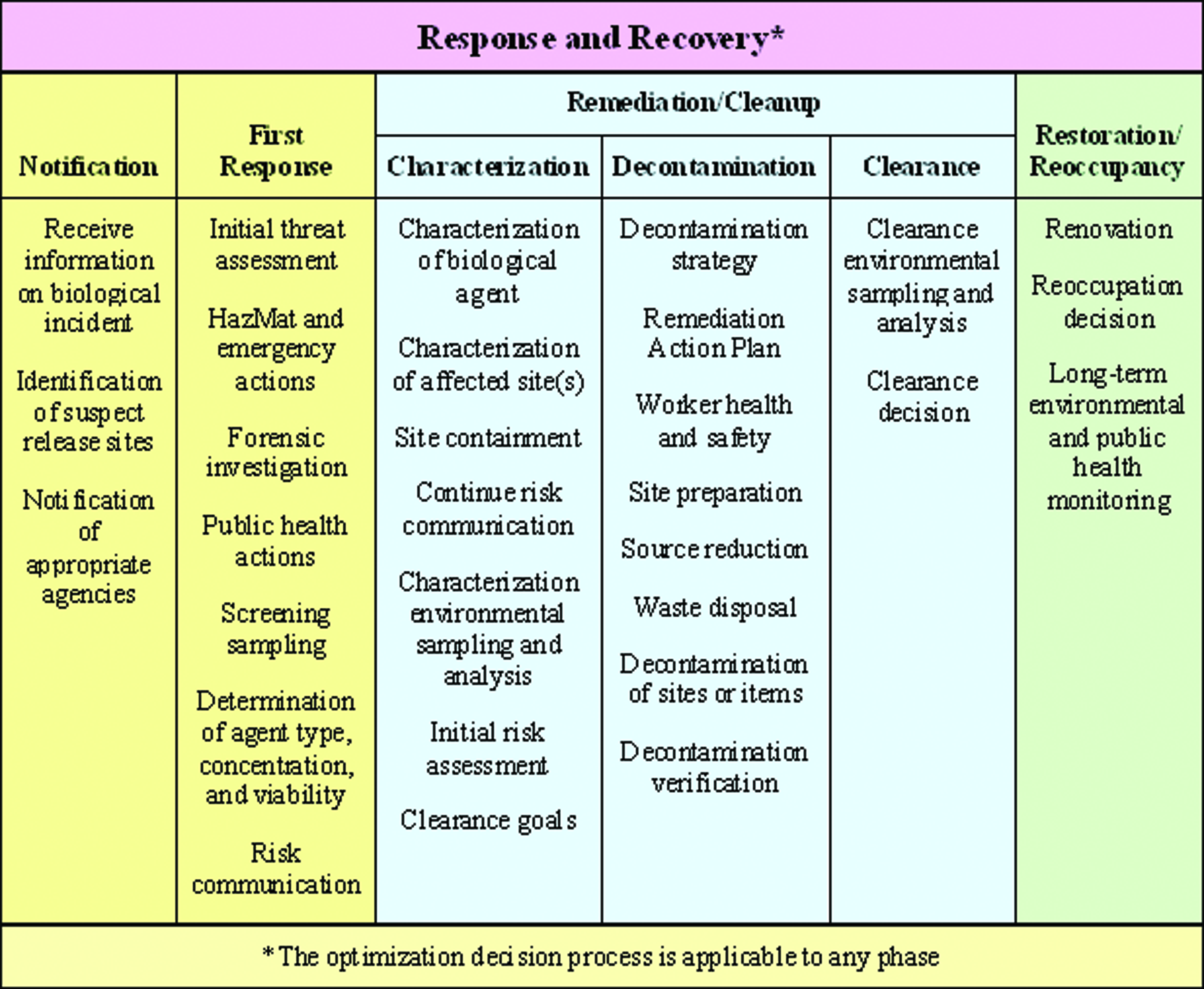
Summary of response and recovery phases to a wide-area biological contamination incident, developed with interagency cooperation. 11 Color images available online at www.liebertonline.com/bsp
As a central component of the Interim Consequence Management Guidance for a Wide-Area Biological Attack, recently developed at the direction of the Homeland Security Council within the IBRD program by a collaboration with interagency participants, the 6 phases are addressed in individual chapters and then expanded into a 20-page operational flowchart that is included in an appendix. 12 Summary pages of the flowchart, which now comprise the national framework, are a featured component of the Draft Planning Guidance for Recovery Following Biological Incidents produced by the Biological Decontamination Standards Working Group, Office of Science and Technology Policy, Committee on Homeland and National Security, Subcommittee on Decontamination Standards and Technology. 11 To further apply framework concepts to a specific jurisdiction as part of the IBRD program, the Seattle Urban Area Consequence Management Guidance for a Wide-Area Biological Attack expands on the framework to provide operational details on response and recovery actions as well as supporting resources for a specific urban area—in this case, the Seattle region. 13 In addition, both the Interim Guidance and Seattle-specific documents provide estimates for duration of the principal operational phases of response and recovery—hours to days for notification, days to weeks for first response, months for characterization, months to years for clearance, and jurisdiction-dependent timeframes for restoration/reoccupancy—with some steps likely proceeding in parallel and in iterative fashion. Unique environmental, economic, and cultural considerations must always be considered during any site- and incident-specific biological remediation effort, and several characteristics unique to the Seattle urban area, for example, differentiate it from other urban environments. Nevertheless, the recently developed guidance documents can be used as templates for other geographical regions interested in formulating their own consequence management guidance for an incident involving a persistent biological agent.
The Framework
The national risk-management framework for decision makers emphasizes remediation activities (characterization, decontamination, and clearance) to a somewhat greater extent than the initial phases of response (notification and initial response). Nevertheless, because early decisions can affect subsequent ones, and because the transition from response to remediation/cleanup is a key component of effective recovery, response issues are addressed in that context. The primary audience for the framework 11 as elaborated in the Interim Guidance document 12 and Seattle-specific guidance 13 is members of the technical community who would be involved in biological response and remediation, including local, regional, state, and federal players. The framework and associated guidance is intended to synchronize and coordinate planning among emergency operation centers and planning cells. The framework and guidance documents will also be of value to emergency managers and decision makers—both civilian and military—by providing background information and rationale for a variety of necessary decisions. For example, checklists of activities for preplanning response and recovery to a B. anthracis incident are included in the guidance.
Before turning to the specifics of the framework and guidance material, 4 overarching concepts are important. First, as illustrated by Hurricane Katrina in Louisiana and the 2011 earthquake in Japan, a major consideration during any disaster is to build and maintain public confidence in government decisions and direction. Communication to the public must be accurate, timely, and frequent, and the coordination of local, regional, state, and federal public information is critical. Thus, risk communication is emphasized throughout the phases of response and recovery addressed in the framework.
Second, although the series of decision flowcharts comprising the framework at first glance seems to treat the 6 phases and steps within them as sequential, many activities will overlap or take place concurrently, and some will be recurrent. Environmental sampling, for example, would likely take place not only early during response but also during characterization sampling, clearance, and possibly following reoccupancy. The same is true for other activities such as risk assessments and prioritization of essential functions and facilities as new information and sampling results are evaluated.
Third, because the goal is to balance achievable and practical results, an optimization approach is emphasized at each stage of remediation. Optimization is a flexible, multi-attribute decision process that seeks to balance many factors with the ultimate goals of transparency, inclusiveness, effectiveness, and shared accountability. Optimization is recommended not only to identify successful cleanup options but also to guide the choice of targets during remediation and restoration, thus providing opportunities for decision makers to gain public confidence through the involvement of stakeholders.
Fourth, our understanding of many technical details important in recovering from a wide-area biological agent attack is currently limited. The guidance addresses such gaps in knowledge, capabilities, and resources in the context of specific activities. Best recommended practices are explained in the context of identified gaps.
The initial phase of response and recovery is notification, a process that can facilitate a timely and effective transition from response to recovery. 11 Initial notification of a potential biological incident could come from a detection system, such as BioWatch, discovery of an overt release such as a white powder, or the occurrence of symptoms or disease (syndromic discovery). Depending on incident specifics, notification could occur 1 or more days after a release. State and local agencies involved in the receipt and assessment of information include state and county departments of health, local medical facilities, and emergency responders (fire and law enforcement), among others. If the presence of a viable biological agent were confirmed, then the responsible public health agencies would begin appropriate actions, such as treatment and decontamination of potentially contaminated individuals, distribution of prophylaxis, vaccination, and medical examinations.
Following a wide-area release, the state governor would likely request federal assistance under the Stafford Act, with FEMA responsible for coordinating support from all federal agencies and nongovernment organizations. Emergency Support Functions (ESFs) group the functions most frequently used and provide the structure for coordinating interagency federal support to states under either declared disasters or non–Stafford Act incidents. The source of funding that would be used to clean up facilities is unclear before the occurrence of an actual incident. Federal funding usually supports meeting government operations and public safety responsibilities and does not cover private property, with the exception of private nonprofit organizations that provide critical services, such as water, power, or medical services. Terrorism insurance is available to businesses under the TRIA program, but not all businesses carry it. Small businesses could obtain loans from the Small Business Administration. However, it appears that if an attack were considered to be an Incident of National Significance as defined in the NRF, then the federal government would provide the necessary coordination and funding, as has been done for this level of incident in the past.
In accordance with the NRF and NIMS, an Incident Command System (ICS) in each command center would coordinate field operations. 4 Under NIMS, command centers might be established at multiple incident command posts, at 1 or more area commands, at several emergency operations centers, and at a joint field office. A key concept is that of incident command evolving into a unified command, which would be formed to direct cleanup jointly and take responsibility for cleanup decisions. One or more Joint Information Centers would be established locally, regionally, or nationally to coordinate and disseminate accurate information to the public and media through the Joint Information System.
Because recovery from a wide-area anthrax incident has never been attempted, many challenges will be identified for which solutions have not been developed. During several indoor cleanups following the anthrax attacks of 2001, a Technical Working Group was convened to provide multiagency, multidisciplinary expert advice for planning and implementing the cleanup effort. An environmental clearance committee (ECC) is not mandated within the context of the traditional ICS for responding to a biological incident; however, establishing an ECC is recommended as an effective way to make sound clearance decisions and add credibility to determinations regarding reoccupation. An ECC functions as an independent body, reviewing all remediation data and then making recommendations on whether decontaminated facilities are ready for reuse. Clearing a facility to allow reoccupancy is a public health issue and is the responsibility of the unified command with guidance from public health officials, other federal and state agencies, and the ECC if one is established. However, the ultimate decision regarding whether an area is cleared for the public rests with local public health officials.
First response activities begin with initial protective actions by local police and fire department personnel at or near the scene, if the release location is known. Other emergency operations personnel (eg, emergency managers, hazmat teams, public health officials, the EPA, and the FBI) would be quickly called in. In addition to initial search and rescue, scene control, and law enforcement activities, initial responses include containing the area(s) of contamination to the extent possible; protecting the crime scene(s); carrying out public health actions, such as treating potentially exposed people; decontaminating people; and performing environmental sampling and analysis. FBI staff would collect environmental samples to produce evidence for attribution and eventual prosecution, and other sampling would be done to commence identification of contaminated areas. First response actions initiated by syndromic discovery are coordinated through public health authorities. For overt incidents, responders would address immediate threats to life or property, establish control, and then manage the incident scene using exclusion, contamination-reduction, and support zones.
The transition from response to remediation entails understanding the remaining health risks and then addressing those risks by prioritizing assets and functions. Hundreds or even thousands of buildings could be contaminated after a B. anthracis attack, many with high economic or social value, so before wide-area cleanup can begin in earnest, it is necessary to identify and prioritize essential areas and facilities. Prioritizing physical assets (such as interstate highways and fire stations) and functions (such as emergency and medical services) serves 4 objectives: 14 (1) minimizing adverse health effects, (2) minimizing socioeconomic disruption, (3) minimizing costs, and (4) maximizing public satisfaction. The recommended prioritization strategy stresses the role of community leaders in working with stakeholders and expert analysts to chart a strategy aimed at minimizing long-term disruption to the area. Framework recommendations include cleaning outdoor areas before indoor facilities—in particular, those areas surrounding priority assets slated for decontamination—and the use of optimization tools to assist with prioritization, resource planning, and resource allocation. Members of a regional task force and local political leaders would work with interagency representatives to decide how best to use available remediation assets.
Central to the transition to remediation are the topics of human health risk and clearance goals, because they are critical to understanding whether remediation is actually necessary and how to implement the many remediation options. The purpose of risk assessment is to characterize potential adverse health effects that could arise from varying levels of exposure to B. anthracis spores. Therefore, characterization approaches need to focus on evaluating actual health risks, and not just the presence or absence of viable spores, before formulating any decontamination strategies. Risk management involves selecting actions from among the alternatives to address specified risks. The challenge then centers on setting “acceptable cleanup levels,” called clearance goals.10,15,16 Following a wide-area attack, a policy of “no growth of B. anthracis spores on all clearance environmental samples” 17 might not be feasible for all contaminated indoor or outdoor areas; however, no current evidence supports a less stringent alternative to this option. A possible outdoor clearance goal is “no viable anthrax spores detected above background levels from any high-volume (and possibly aggressive) air sampling.” 18 In the absence of consensus water guidelines, starting points for water clearance goals are suggested in the guidance documents.
Characterization provides estimates of how widespread the contamination is by assessing outdoor surface contamination, outdoor air contamination from resuspension of spores, and indoor contamination of facilities. Because of the pivotal role of characterization in terms of overarching policy issues that decision makers must address, part of the expanded decision framework for that phase is shown in Figure 2. Diamond boxes show key decisions, and rectangular boxes explain actions or issues where the numbers link one flowchart with another. The same type of detailed expansion was developed during the IBRD program for each of the other phases.
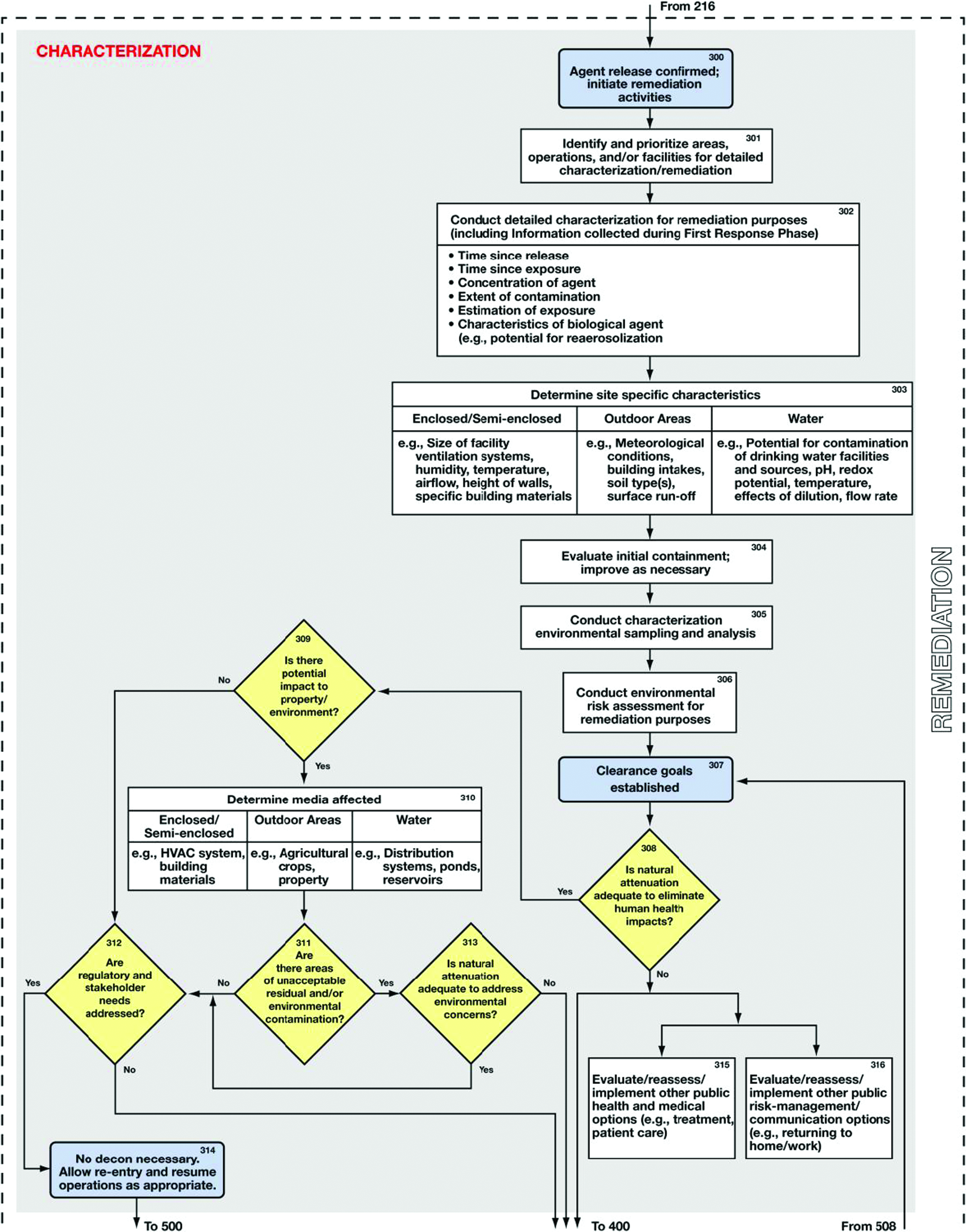
Characterization flowchart from the national framework for response to and recovery from a wide-area biological contamination incident. 12 Color images available online at www.liebertonline.com/bsp
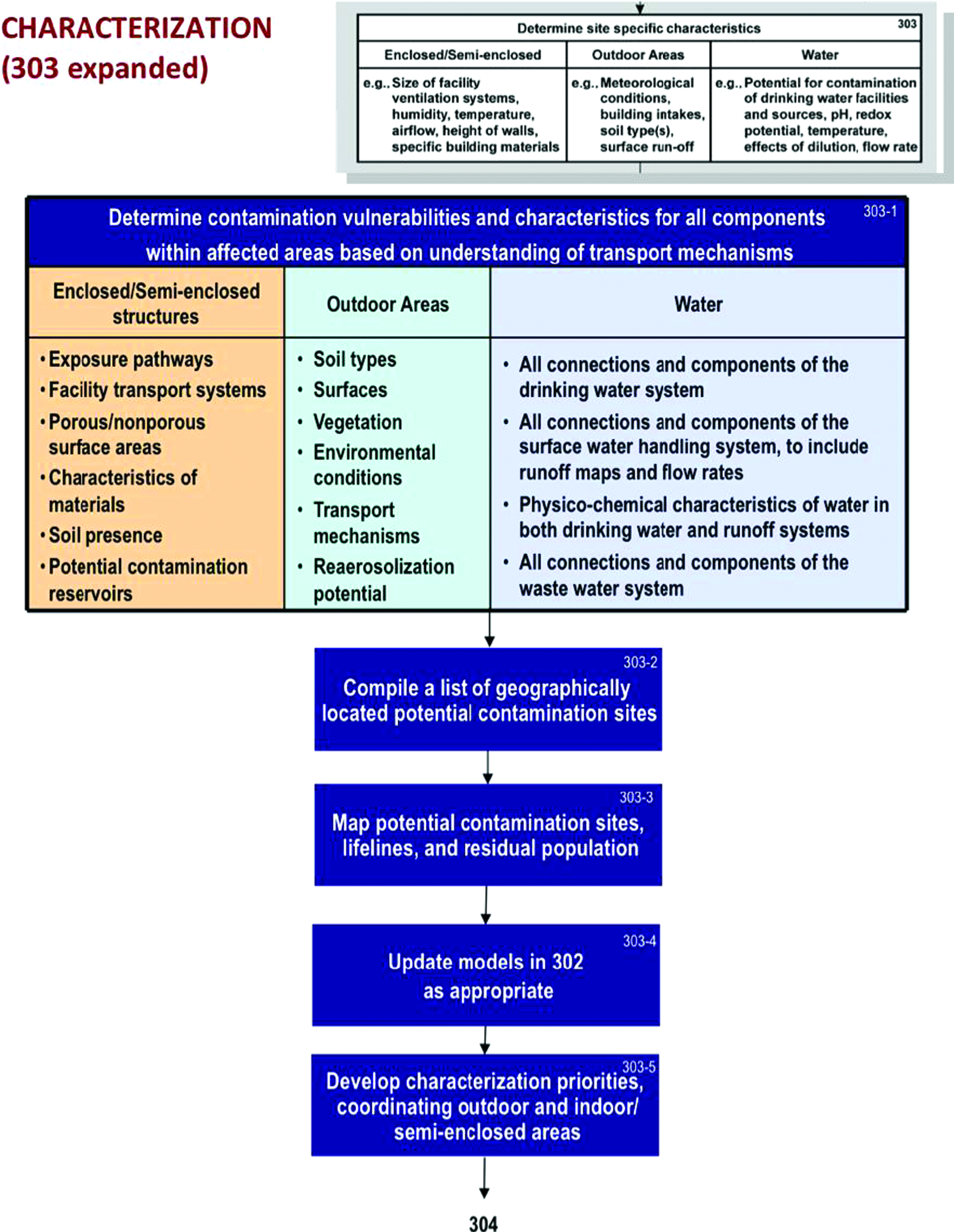
Part of the expanded characterization flowchart—continued.
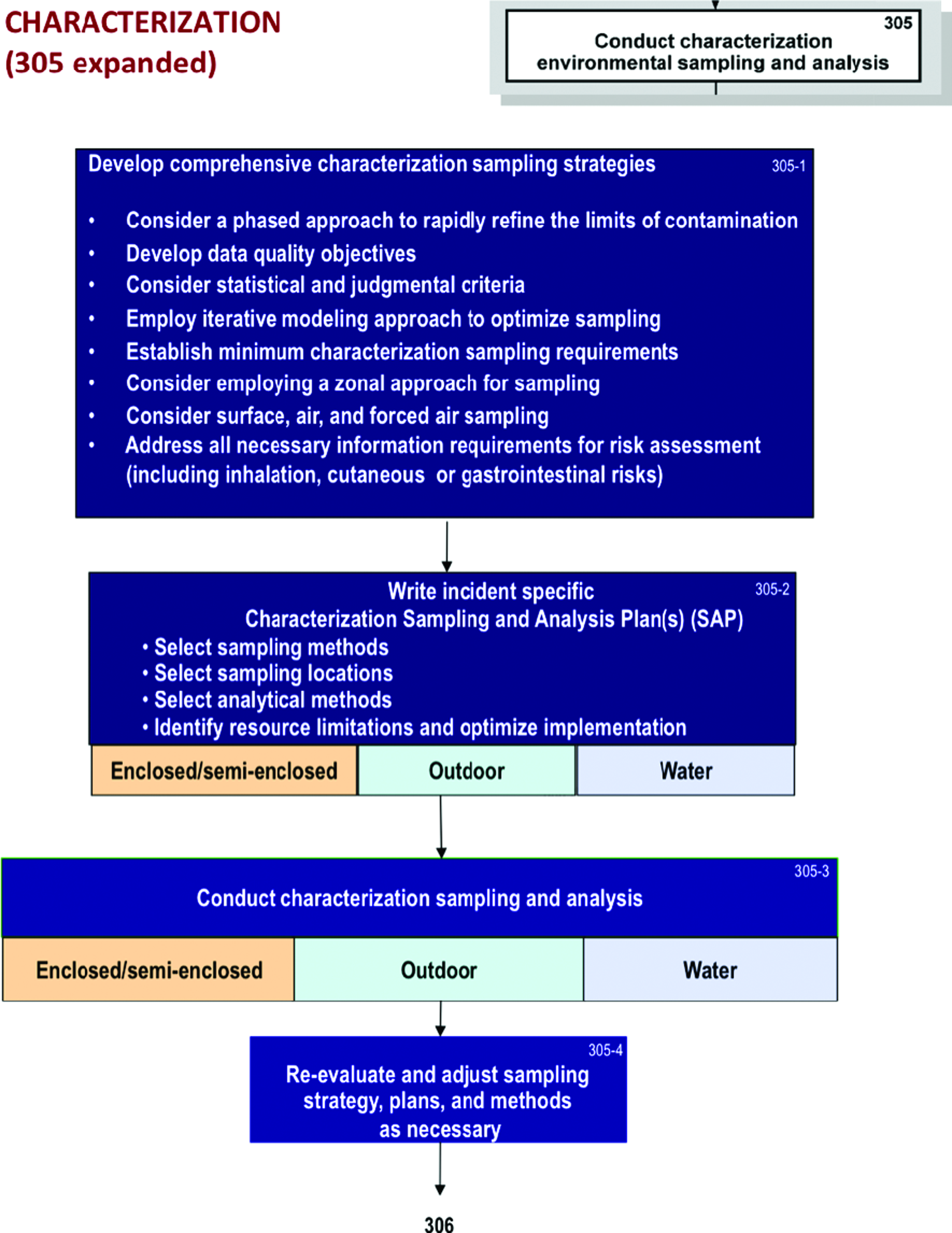
Part of the expanded characterization flowchart—continued.
Three cases are addressed by the framework guidance: those in which little (syndromic discovery), some (BioWatch detection), or good (a witnessed release) information is available about the release location of B. anthracis spores. Information from first responders, including any sampling and early containment measures taken, together with meteorological assessments and site-specific characteristics (such as land cover types, building and population density), as well as data on case distribution, are used to develop initial fate and transport models. Characterization sampling strategies are then developed to make the best use of regional and national resources, including sampling support and analytical laboratories. A key question in the framework is whether monitored natural attenuation is adequate to eliminate human health impacts in any areas of contamination. Characterization zones are developed and refined over time to reflect the information that is currently available. It is not necessary to complete the prioritization, risk assessment, and characterization tasks throughout an entire affected area before beginning to perform decontamination, if indeed decontamination is determined to be necessary.
The purpose of decontamination is to clean up areas affected by a biological release that remain a risk to human health, as determined from the characterization phase, with the highest priority placed on restoring critical infrastructure first to minimize economic and social impacts. Choices regarding decontamination technologies focus on identified best practices while taking into account cost-benefit and risk-benefit considerations together with site-specific environmental parameters. 19 The prioritization of decontamination activities, required tools and techniques, pet and wildlife issues, indoor versus outdoor decontamination, preparation of a Remediation Action Plan, decontamination implementation, verification of decontamination processes, and waste management and disposal issues are all addressed in the guidance documents. The guidance stresses the concept that decisions as to which decontamination method to apply must be incident- and site-specific, including the possible use of monitored natural attenuation in areas deemed less critical than others. For each potential decontamination reagent that is currently available, details are included in the guidance about efficacy, practicality, safety, impacts on schedule, cost, and waste considerations, to the extent such data are available.
Clearance is the process of determining whether a specified clearance goal—developed from the risk assessment and management processes described above—has been met for a particular contaminant in or on a specific area, site, or item. Wide-area clearance is likely to be performed in phases, with some parts of an urban area undergoing clearance before others according to prioritization. A clearance sampling strategy is developed and delineated in a Clearance Environmental Sampling and Analysis Plan. After clearance environmental sampling has been conducted (including aggressive air sampling in outdoor areas), an ECC might be formed to evaluate all relevant information, with possible input from the Technical Working Group. Conclusions about the efficacy of decontamination activities and recommendations about whether to release a specified location for restoration/reoccupancy are forwarded to the unified command for review and action. The unified command submits its recommendations for clearing a site to the local public health official or other appropriate entity for final decisions.
Reoccupancy and a return to normal functioning in affected areas is the ultimate goal of remediation. Although it is the final step of recovery from a biological incident, planning for restoration/reoccupancy begins during prioritization and continues while all other work associated with remediation is in progress. A broad stakeholder group representing civic, community, and business interests is expected to participate, along with scientific and technical personnel from state and federal agencies, in developing strategies for reoccupancy. The recommended methodology for determining the readiness to repopulate an area or subarea follows the same steps, with slight modification, as those applied for prioritization. Post-clearance air monitoring for B. anthracis can be used to assess the continued presence of spores in the breathing zone in areas accessible to the public. The absence of viable spores would provide a measure of assurance to the public even though it is only one measure of potential health risk. Sampling could continue until results from representative conditions are repeatedly negative or remain within accepted levels. Mechanisms such as economic incentives might be applied to stimulate reoccupancy. To help resolve any ongoing concerns, it is essential that area stakeholders continue to be engaged in all aspects of the reoccupancy process.
Conclusions
Response and recovery following a release of B. anthracis spores in a domestic civilian facility or large urban area is a complex undertaking that poses daunting challenges because of current gaps in sufficiency (lack of resources) and proficiency (lack of technologies). To address the challenges, the national risk management framework and associated guidance documents discussed here are designed to help decision makers make the most effective choices possible during remediation while minimizing costs, speeding recovery, and protecting health. At its core, the expanded framework for decision making consists of a risk management process, the clear delineation of roles and responsibilities during 6 phases of response and recovery, and a decision tree that defines key decision points and the actions to take at each point. The framework and associated guidance will continue to evolve according to our best scientific understanding of biological agents, remediation tools and technologies, and other assets that can be brought to bear in managing a response to a biological incident.