






Abstract
A biological attack would present an unprecedented challenge for local, state, and federal agencies, the military, the private sector, and individuals on many fronts, ranging from vaccination and treatment to prioritization of cleanup actions to waste disposal. To prepare for recovery from this type of incident, the Seattle Urban Area Security Initiative (UASI) partners collaborated with military and federal agencies to develop a regional recovery framework. The goal was to identify key information that will assist policymakers and emergency managers in shortening the timeline for recovery and minimizing the economic and public health impacts of a catastrophic anthrax attack. Based on discussions in workshops, tabletop exercises, and interviews with local, state, federal, military, and private sector entities responsible for recovery, the authors identified goals, assumptions, and concepts of operation for various areas to address critical issues the region will face as recovery progresses. Although the framework is specific to a catastrophic, wide-area biological attack using anthrax, it was designed to be flexible and scalable so it could also serve as the recovery framework for an all-hazards approach in other regions and jurisdictions. Benefits from this process include enhanced coordination and collaboration across agencies, a more thorough understanding of the anthrax threat, an opportunity to proactively consider long-term recovery, and a better understanding of the specific policy questions requiring resolution.
In 2007, the Interagency Biological Restoration Demonstration program (IBRD) partnered with the Seattle Urban Area Security Initiative (UASI) * and Joint Base Lewis-McChord (JBLM) to explore issues concerning wide-area recovery from an anthrax attack. The goal was to take a collaborative approach to develop and deliver solutions that were both tailored to the needs of the Pacific Northwest Region and extensible to other regions. To frame the discussion, the program tailored a scenario to the Seattle urban area based on National Planning Scenario 2. The scenario involved simultaneous covert releases of Bacillus anthracis in the Seattle downtown area and near Joint Base Lewis-McChord (approximately 10 square miles each). Tens of thousands of people might be exposed, and thousands would be expected to die. Critical infrastructure such as the Seattle-Tacoma International Airport, the ports of Tacoma and Seattle, and commercial, military, and private property (more than 500 buildings) would be contaminated.
In its final year, IBRD, the Seattle UASI, and Joint Base Lewis-McChord collaborated with regional businesses to develop the Regional Recovery Framework for a Biological Attack in the Seattle Urban Area (referred to in this article as “the framework”) to identify key information that will assist policymakers and emergency managers in shortening the timeline for recovery and minimizing the economic and public health impacts of a catastrophic anthrax attack. It covers planning assumptions, roles and responsibilities, expectations, key decisions, and coordination mechanisms for recovery. (For the purposes of this article, recovery is defined as the ability to maintain and ensure the health and safety of the general public while expediting the remediation, restart, and recruitment of businesses into the affected area.) It does not include response activities such as coordinating evacuation, distributing prophylaxis, and securing contaminated zones. Rather, it focuses on the activities and considerations in long-term recovery that may last months or years after the initial attack.
The document was developed to be extensible to other regions and jurisdictions as the basis for local recovery plans. While the programmatic focus was anthrax recovery, the recovery planning was viewed locally as an all-hazards activity. This article identifies the methodology employed to develop the framework, highlights key stakeholders, identifies key policy issues, and discusses its value to the region.
Methods
The methodology employed for compiling information and collaboratively writing the framework required extensive meetings and workshops with subject matter experts from all levels of government and industry. Information gathering took place through topical workshops, group meetings, and interviews; specific subject matter experts were engaged for the drafting and review of the sections. The IBRD program and local emergency managers who frequently engage with subject matter experts identified participants based on their roles and jurisdictions. The objective was to have a diverse set of perspectives. This section discusses the framework compilation and information-gathering activities.
Framework Compilation
Framework compilation was composed of 3 major activities, based on an outline adapted for recovery from the Federal Emergency Management Agency's (FEMA) Comprehensive Planning Guidance (CPG) 101. 3 The framework goals were initially established by a core team of local emergency managers, called the Regional Framework Team. The team included representatives from the King County Office of Emergency Management, the City of Seattle Office of Emergency Management, the Pierce County Department of Emergency Management, the City of Bellevue's Emergency Preparedness Division, and Joint Base Lewis-McChord.
A set of assumptions was determined, vetted, and finalized with public and private stakeholders, and, finally, regional concepts of operation (con-ops) were drafted. As each section was developed, stakeholders and subject matter experts reviewed new content for agreement with the existing state of knowledge, policies, and organizational requirements.
Information Gathering
To develop the goals, assumptions, and con-ops for the framework, we consulted with stakeholders and subject matter experts to understand organizational needs, responsibilities, and expectations. Initial drafts of framework components were developed using data from case studies of the 2001 anthrax attacks, earlier IBRD workshops, and previously conducted IBRD research. These drafts were then presented for vetting at tabletop exercises, group meetings, and individual interviews. Throughout the drafting of the document, assumptions were continuously revisited and challenged to ensure that they applied to the scenario and the framework.
IBRD held 7 workshops focused on different recovery topics. Table 1 includes a description of the IBRD workshops and the purpose of each and a summary of participants.
IBRD Workshops and Participants
The Regional Framework Team held meetings with local fire departments, law enforcement agencies, hazardous material teams, and other response agencies to frame policies to guide conduct and methods in the affected area.
In July 2010 the team held a final workshop to validate the key elements of the framework and solicit thoughts and input from the community of experts that had been engaged throughout the information-gathering process. The subject matter experts involved in information gathering and the 2 tabletop exercises specific to framework development included representatives from federal, state, and local governments, the military, and the private sector, with expertise that included agriculture, business, ecology and the environment, emergency management, fire and rescue, critical infrastructure operations, law enforcement, public health, health care, public schools, waste management, and subject matter expertise in CBRNE and infectious disease.
In conjunction with the workshops, group and individual interviews were held with involved jurisdictions and subject matter experts for additional clarification and identification of key recovery priorities and objectives. The methodology for each of these meetings differed depending on the subject matter.
Results of Information Gathering
The Regional Framework Team finalized and issued the framework in September 2010. It serves as the basis for developing standard operating procedures that draw from technical guidance and other jurisdictional plans. The findings regarding assumptions, con-ops, and policy questions also provide a starting point for additional research and development to improve readiness for recovery. This section describes the results of the development process, including the temporal organization of the recovery effort, the framework goals, final planning assumptions, and con-ops.
Phases of Recovery
The Regional Framework Team determined that a phased timeline was necessary to break recovery into a series of common activities. The timeline (Figure 1) has 4 phases, each with a number of steps.
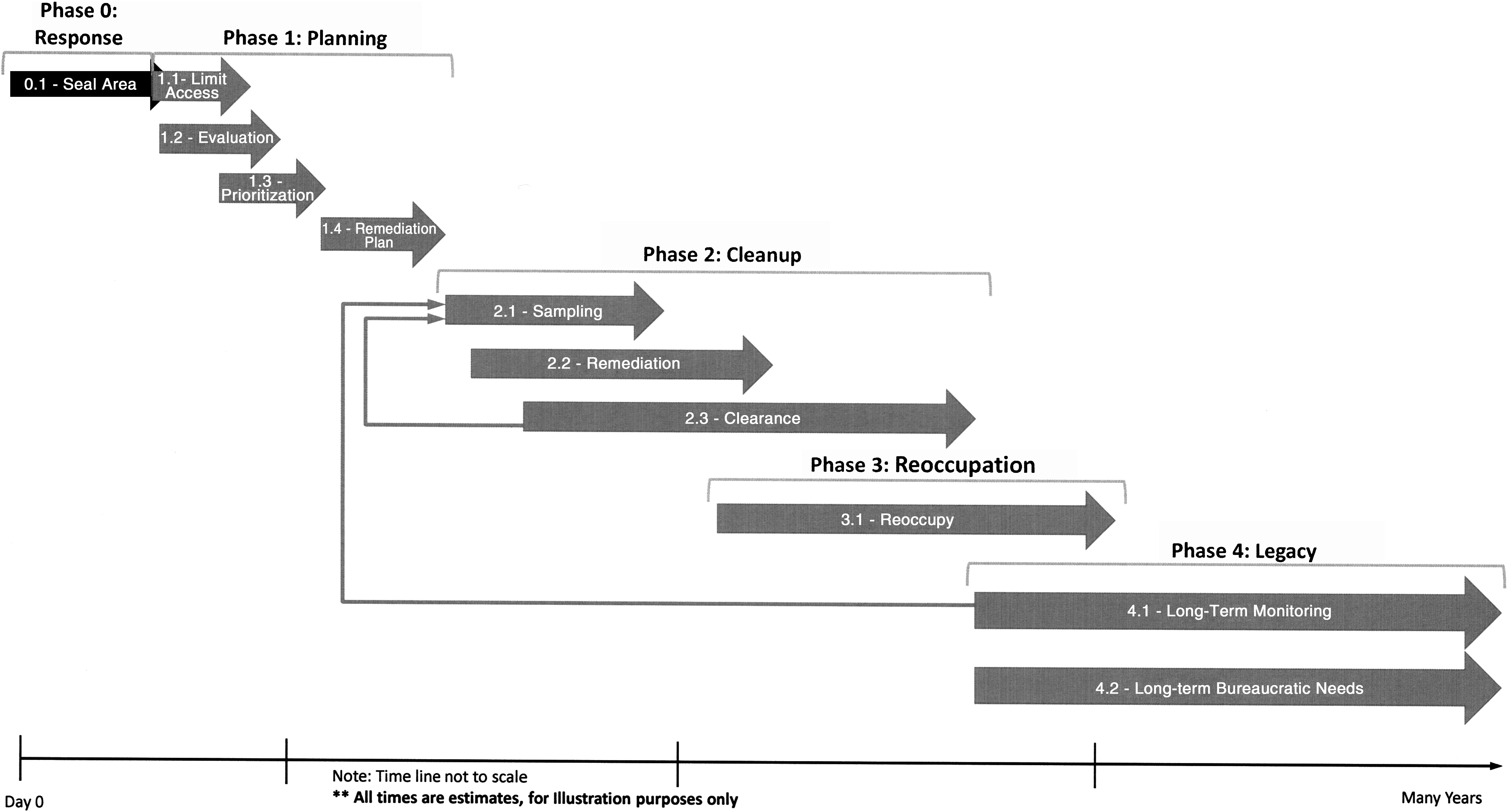
Phased Timeline for Recovery
The phases of recovery were then applied to the 10 topical con-ops identified during workshops and interviews. Each topical con-op includes a separate definition of scope, responsible entity, operational considerations, and policy considerations for each phase.
Framework Goals
One of the first key agreements by the Seattle UASI stakeholders was identification and definition of the framework's strategic goals. These goals were based on emergency management agencies' concepts of operation, the national security priorities associated with a terrorist attack, and findings from earlier IBRD research. The goals are:
• to protect life, property, and the environment to the greatest extent possible; • to prevent opposition forces from destroying the region; • to shorten the timeframe associated with economic recovery to a period of less than 5 years; and • to recover the area to a new definition of normalcy.
Earlier IBRD findings suggest that a period of less than 5 years would be feasible for recovery if sufficient resources, especially laboratory capacity, were made available. However, IBRD findings also suggest that a return to what was previously considered “normal” is unlikely because of the persistence of anthrax in the environment, the impacts on life and property from the incident, and the widespread social disruptions expected as individuals and society adapt to a new environment.
Framework Assumptions
The framework team was forced to make a number of planning assumptions about roles, responsibilities, and policies during recovery, because an attack of this scale has never occurred on American soil. If an assumption should not hold true, the relevance of content in the framework may change. Furthermore, each of these assumptions should be regularly challenged and discussed during jurisdictional planning processes. The full list of assumptions is provided in the framework and is summarized below.
Assumptions about the Federal Government
Some of the most critical planning assumptions identified during the process dealt with the role of the federal government. The key operating assumption is that the federal government would not consider the loss of a major U.S. city an acceptable outcome and will provide extensive resources in both response and recovery phases. Experts and the authors agreed that the federal government would be unwilling to concede such a striking loss to a terrorist organization, as it could be detrimental to government legitimacy. Accordingly, it is assumed that the President would declare a disaster in the region and enact the Stafford Act, triggering FEMA's establishment of a Joint Field Office.
Federal support could speed the recovery by developing a surge capacity for the region, providing funding to incentivize recovery, and forming national programs and guidelines for public health and safety. The surge would include the design and construction of equipment for remediation, an increase in analytical laboratory capacity, and the training of additional remediation professionals. A majority of the subject matter experts believed that the federal government could provide national health and epidemiologic monitoring and guidance for cleanup standards.
Specifically, the framework calls on the Environmental Protection Agency (EPA) to work with local public health agencies to establish a standard for clearance. This standard would be applied nationally and regionally to indicate the safety level of an area. This topic was the source of extensive IBRD research and could be the key element of successful recovery, as conflicting guidance could undermine public confidence locally, nationally, and internationally. The subject matter experts felt that the federal government was uniquely positioned to provide technical and operational support on these issues because of its large resource base and broad jurisdictional reach.
Assumptions about Impacts
Framework planning assumptions also address impacts of the attack, including impacts to continuity of government, critical infrastructure operability, the economy, and public health and safety. In an incident of this nature, the subject matter experts believe that continuity of government will be affected in several ways: government officials may not survive or be able to perform their duties; significant population redistribution could occur; and buildings could be inaccessible, requiring major government reorganization. Additionally, subject matter experts from the military indicated that limited operations would continue at the affected base, although the specific mission could be relocated to allow for effective national defense.
Subject matter experts agreed that critical infrastructure would most likely be contaminated but undamaged and sufficient for recovery. They also agreed that, due to its importance, individuals in appropriate protective gear and with medical countermeasures could operate critical infrastructure. 4 The local and regional economy would be affected by population changes, access to infrastructure, and decreased consumer confidence in regional products. The public health and safety impacts of this attack would be widespread and include mortality, creation of long-term health monitoring systems, inspection programs for regional goods destined for national and international markets, and evacuation of the affected area.
The subject matter experts disagreed about the need for an evacuation in response to an incident of this nature. Some public health professionals felt that an evacuation would not be necessary because of the availability of medical countermeasures, like antibiotics, and personal protective equipment. Emergency managers and law enforcement generally agreed that an evacuation would be requested for operational reasons rather than public health reasons. In their view, remediation operations would be largely impossible with even a small population living in the contaminated area because of logistical and security challenges.
Concepts of Operation
Concepts of operation (con-ops) were drafted with the input of relevant subject matter experts and cover a range of considerations that should be addressed in recovery planning, including key decisions, actions, and policies that must be resolved to meet the framework goals. The Regional Framework Team identified the topics from a list of high-priority challenges identified during the information-gathering process. The 10 topical con-ops are defined and discussed below. Each con-op is defined narrowly for the purpose of the framework.
Access control is the restriction of the ingress of individuals and their property to contaminated zones and individual structures to specifically credentialed people, as well as requiring egress from the contaminated zone through decontamination points. Without access limitations to the affected area, individuals could freely enter and leave the contaminated zones and present a security threat or a transmission vector for the pathogen and could potentially compromise property. Additionally, provision of medical care, food, water, and government services inside the affected area will be very difficult.
Economic development is the con-op for planning and actions to recover and ultimately improve the economic vitality of the region after the incident. Subject matter experts and authors considered economic development to be the most important component of recovery. Impacts of the attack are likely to disrupt commerce both regionally and nationally, and the creation of jobs, economic growth, and opportunity will be necessary to attract individuals and businesses back to the region.
Fatality management is the set of activities associated with investigation of the incident and identification, transport and storage, notification, and processing/disposition (burial and cremation) of the bodies, with appropriate communication occurring throughout the process to address issues such as public health, mental health, family assistance, and palliative care. Because of the catastrophic nature of this attack, the number of fatalities would be very high and could overwhelm the existing fatality management system. Fatality management is one of the key dependencies of recovery because it presents a range of logistical, mental health, public health, and policy challenges.
Postdisaster housing is the housing of displaced people, remediation workers, and volunteers after a catastrophic incident. The subject matter experts agreed that housing in the region would be insufficient. Population dislocation and the uninhabitable nature of the affected area could drive demand for housing well beyond the existing supply. Moreover, the experts agreed that residents who were relocated outside of the region were unlikely to return. Without a postdisaster housing solution, it is likely that a large number of residents could become homeless, quality of life in surrounding areas would be affected, and recovery could be slowed.
Prioritization for cleanup is the con-op that discusses the decisions and actions associated with identifying the key priorities for remediation of the affected area. One of the discoveries of previously conducted IBRD research is that prioritization of cleanup for facilities and infrastructure critical to economic viability may be necessary because of limited resources. This section discusses considerations for making decisions about how to proceed with remediation while focusing on achieving framework goals.
Public health and medical services is the con-op that discusses the activities associated with life-saving, safety, and health related to the incident. This topic is included because it is interlinked with the incident and includes discussion of topics like long-term care, impacts on the healthcare system, the potential approaches to handling long-term monitoring, and the need for constant regional monitoring of the contamination zones. It also discusses public health messaging concerns associated with the incident, including how to live with anthrax, where to find more information, discussion of mental health concerns, and the importance of determining a clearance standard. This section contains most of the framework's discussion of mental health issues associated with the attack, including those affecting emergency response personnel.
Public communication concerns the official communication with the public and coordination of interagency messages to the public. This section was selected because of the vital importance of properly informing the public of the risks posed by anthrax, especially during the reoccupation phase of the incident. The subject matter experts indicated that media coverage of the incident would generally highlight the significant challenges facing the recovery and that social media could have both a positive and a negative impact on public perception about the incident. 5 As a result, it focuses extensively on the need for government transparency and openness during recovery.
The infrastructure and property con-op covers the actions taken to preserve critical infrastructure and property and to mitigate secondary impacts as a result of the initial incident. This section was deemed necessary because of the long-term nature of the recovery and the assumption that evacuation, deaths, and migration will occur because of the attack. With a large number of buildings sitting unoccupied for a long time, it may become necessary for emergency managers to manage the stabilization of properties to ensure public safety or to support the goals of recovery.
The volunteer and donations con-op applies to the effort to efficiently and safely direct volunteer resources to areas where they can be most effective and the effort to effectively and efficiently coordinate and distribute donated goods and money to those in need. The Regional Framework Team selected this topic for inclusion because of the unprecedented nature of the attack scenario. Questions were regularly posed by workshop participants about how to handle volunteers and donations in this context. While very few believed that volunteers would be available—or allowed—to work in the contaminated area, the massive dislocation of people and the secondary impacts of the attack would bring in volunteers to provide services to those in need outside of the directly affected area. Those volunteers could present a logistical challenge since they would need food, medical care, housing, and other necessities. This section discusses legal requirements about using volunteers and directing donations, but it primarily serves to identify key policy questions that need to be answered by state or federal officials regarding the law at the time of the incident.
Waste disposal is the clearing of debris and waste contaminated by the biological agent, including handling, treatment, and transportation. Beyond the decontamination agent wastes produced by remediation, there will be large volumes of debris as the interiors of buildings are stripped to meet public health and safety standards. As a result, a majority of building interiors will require disposal. 6 Because anthrax can be reaerosolized, transportation, handling, and disposal of this type of waste presents a regulatory, logistical, and public health challenge.
Discussion of Results
Undertaking this challenging regional activity provided several benefits to the Seattle UASI in all-hazards recovery planning. The process also highlighted some areas where additional information is needed.
At the end of this process, Seattle UASI stakeholders indicated that both the framework and its development process benefited the involved jurisdictions and speculated that it would have a positive impact on national catastrophic disaster recovery planning. The key benefits included enhanced coordination and collaboration across agencies, a more thorough understanding of the anthrax threat, an opportunity to proactively consider long-term recovery, and a better understanding of the specific policy questions requiring resolution.
The framework served to coalesce policy questions that must be addressed for long-term recovery. These questions span all 4 phases of recovery and cover such areas as safety and health, security, financial management, waste management, legal issues, and economic development. Table 2 shows the outstanding policy questions. For context, we will discuss the outstanding safety and health policy questions for each phase. A complete list of questions is available in the framework. 7
Distribution of Outstanding Policy Questions by Phase and Topical Area
A number of questions are posed in each phase regarding safety and health. During the planning phase, outstanding policy issues revolve around questions about standards of care, inspection requirements for site acceptance, solvency of the healthcare system, cleanup levels, availability of anthrax treatment, and worker safety and health concerns. Remediation phase questions focus on authorities and standards for inspecting, remediating, and clearing buildings. Subject matter experts felt that policy decisions in the reoccupation phase were needed regarding the acceptable risk levels for occupancy of facilities and the level of preventive care required for visitors. Finally, during the legacy phase, policy decisions will be needed regarding the modalities of long-term monitoring, national anthrax vaccination, and command and control for the recovery.
Resolving these questions was deemed a high priority for the success of recovery operations and should be the focus of near-term, pre-incident research activities. One possible approach is a series of policy seminars where policymakers could meet and discuss the merits of different solutions. The belief among regional experts is that answering these questions before the incident will make recovery smoother.
Since publication, the framework has also served a variety of other purposes. It has informed the development of regional exercises, influenced the regional catastrophic planning activities under way by the Puget Sound Regional Catastrophic Preparedness Grant Program, and been used to enhance the Seattle UASI's waste management plan. The framework has been shared with other UASI regions throughout the United States and has received positive feedback on its usefulness. It serves as the basis for the Denver UASI under the Wide Area Recovery and Resilience Program (WARRP). †
In conclusion, the framework is intended as a starting point for jurisdictions to develop detailed operational plans for regional recovery from a catastrophic biological incident, as well as to supplement all-hazards recovery planning. It was designed to be flexible and scalable so that jurisdictions and regions outside of the Seattle urban area could use it for their plans and to increase the nation's resilience to catastrophic incidents of this nature. Additionally, the framework should help frame a policy discussion about recovery from catastrophic incidents. Many of the unanswered policy questions apply to hazards beyond biological attacks, and policy discussions could be prioritized to cover the broadest spectrum of hazards, thus maximizing the impact of policy decisions on all-hazards catastrophic recovery. Furthermore, these policy questions provide an opportunity to improve the information available to policymakers and to improve timelines for recovery.
Footnotes
Acknowledgments
The authors thank their home organizations for supporting their time to collaborate on and develop the framework. They also thank Lance Brooks, U.S. Department of Homeland Security, Science and Technology Directorate, and Ryan Madden, U.S. Department of Defense, Defense Threat Reduction Agency, through the IBRD Project for their support throughout this project.
*
The Seattle Urban Area Security Initiative (UASI) is a federal designation for the city and county entities involved in emergency response in King, Pierce, and Snohomish counties in Washington State.
†
The Wide Area Recovery and Resiliency Program is a follow-on activity to IBRD in the Denver Urban Area. It expands the scope of the activity to include CBRNE hazards and started in early 2011.