






Abstract
Decontamination and recovery of a facility or outdoor area after a wide-area biological incident involving a highly persistent agent (eg, Bacillus anthracis spores) is a complex process that requires extensive information and significant resources, which are likely to be limited, particularly if multiple facilities or areas are affected. This article proposes a systematic methodology for evaluating information to select the decontamination or alternative treatments that optimize use of resources if decontamination is required for the facility or area. The methodology covers a wide range of approaches, including volumetric and surface decontamination, monitored natural attenuation, and seal and abandon strategies. A proposed trade-off analysis can help decision makers understand the relative appropriateness, efficacy, and labor, skill, and cost requirements of the various decontamination methods for the particular facility or area needing treatment—whether alone or as part of a larger decontamination effort. Because the state of decontamination knowledge and technology continues to evolve rapidly, the methodology presented here is designed to accommodate new strategies and materials and changing information.
Recent advances in restoration technologies have proven extremely valuable, but the nation still lacks a systematic methodology for selecting strategies and decontamination technologies based on analysis of the situational information available. Ideally, such a capability would help decision makers sort a multitude of complex pieces of information into a set of applicable decontamination strategies that can both optimize limited resources and reduce the time needed to make the facilities or areas safe and functional.
To fill this gap, this article proposes a methodology for systematic decision making to support large-scale decontamination. Although decontamination efforts for buildings have been done many times, these efforts were conducted by relying on the experience and knowledge of a small number of highly trained B. anthracis experts. In a wide-area event, decontamination would likely be conducted by a larger, less experienced group. The methodology described here captures the collective knowledge and experience of previous decontamination efforts and, combined with new developments in decontamination science, policy, technology, and materials, presents a systematic step-by-step process that experts and nonexperts could follow.
The methodology begins with the assumptions that (1) decontamination will be necessary after an attack with B. anthracis spores, and (2) rapid and thorough recovery of the area is the goal, with public health and safety being the primary concern. The methodology offers an analysis process to evaluate multiple factors in a methodical way and is intended to help decision makers to consider all available options and to narrow down the choices, using situation- and facility-based technical considerations. Further, it provides a trade-off analysis that aids in optimal allocation of scarce decontamination resources among the entire suite of contaminated facilities and areas.
The potentially large number of facilities and probable scarcity of resources dictate that decision makers should consider all possible strategies and technologies. Therefore, the methodology includes a broad array of strategies and decontamination materials, including some atypical strategies and some decontamination materials not used during the 2001 anthrax letters incident that have proven useful in other applications, such as in clinical settings.
Scope of the Methodology
The methodology presented here focuses only on decontamination of facility structures or outdoor areas and does not address such topics as sensitive item, content, and waste decontamination. Future work is needed to incorporate such variable and scenario-specific information and to combine this methodology with existing decision support tools, such as the Environmental Protection Agency (EPA) decision support tool for disposal of residual materials resulting from national emergencies.1–4 Additionally, this methodology considers only chemical and physical decontamination approaches; radiation processes are not included (other than solar, natural attenuation).
The decision support methodology is designed using existing strategies and materials, but because the state of decontamination knowledge and technology continues to evolve rapidly, the methodology is designed to accommodate changing information; specifically, new knowledge and technologies can be included in the process as additional decision criteria and options.
Overview of the Methodology
The methodology in this article focuses on the selection of decon strategies and materials, but prior to this activity, the Unified Command (UC) will have made several important decisions.5–10 The UC will have declared a facility contaminated with a microbiological agent based on identification of the microorganism and facility contamination characterization. If the event is a wide-area contamination, the facility may be placed on a priority list for decontamination.5,6 There may be social and political implications that the UC will need to address in addition to the technical considerations for selecting decontamination strategies; these social and political issues may override the technical assessment that this methodology provides. The Draft Planning Guidance for Recovery Following Biological Incidents, issued by the White House Office of Science and Technology Policy (OSTP), the Department of Homeland Security (DHS), and the Environmental Protection Agency (EPA) in May 2009, provides information for planning the response and responding to an incident.7–9 After the UC has made the decision that a particular facility, area, or set of facilities and areas requires decontamination, the ensuing decisions about how to decontaminate that facility or area are addressed by the decontamination trade-off analysis methodology described here.
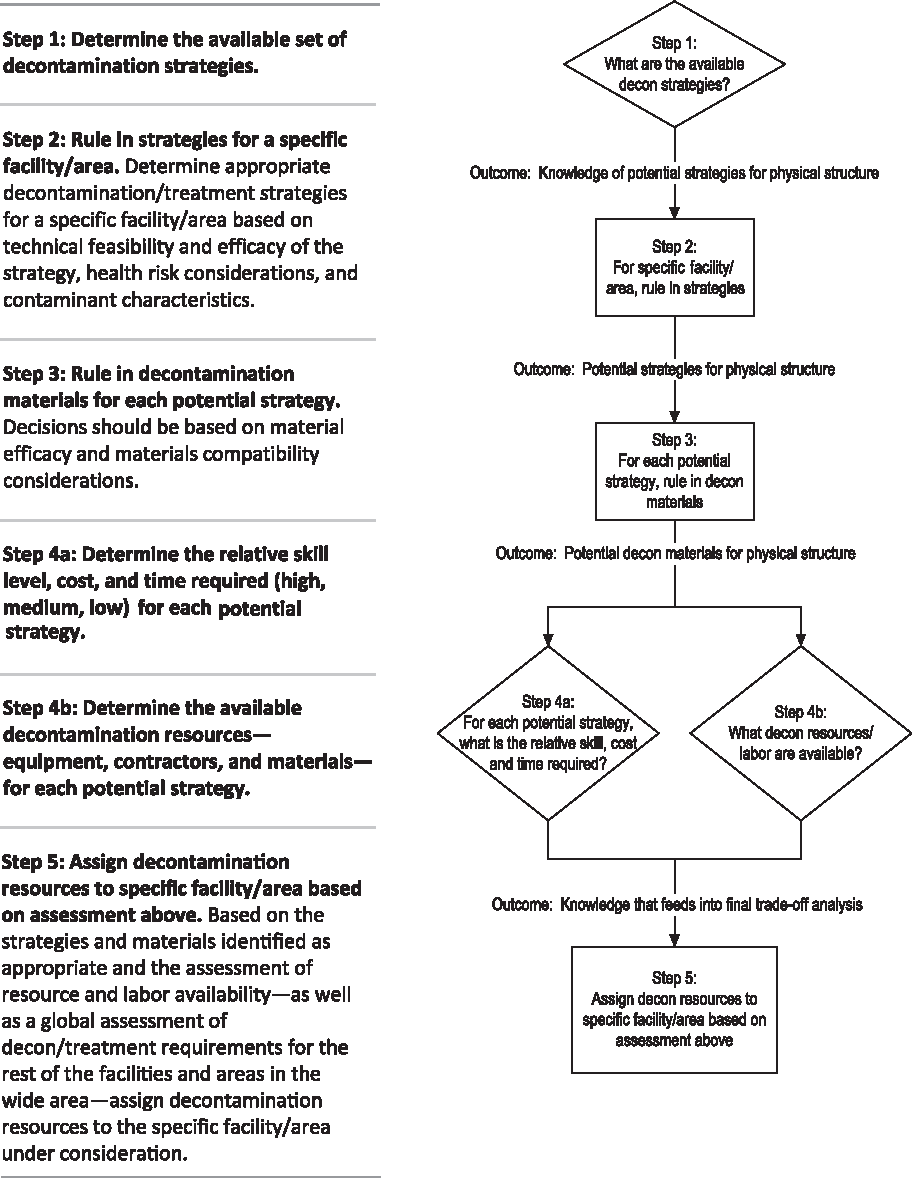
The high-level decision methodology for decontamination strategy, representing a systems approach, is shown in Figure 1. A systems approach is conducive to wide-area biorestoration for several reasons: the large scope of the problem, which encompasses multiple facilities and areas, as well as multiple types of facilities and areas; the large number of potential decontamination strategies and materials that could potentially solve the problem; and the wide range of considerations that factor into strategy and material selection. A systems-level methodology helps decision makers digest a large amount of disparate information and apply the information to guide operational decisions. An important component in choosing decontamination strategies and materials is the amount of residual material and waste to be disposed of; however, as this element has already been rigorously addressed by EPA scientists and their decision support tool for disposal of residual materials resulting from national emergencies, 1 that effort is not duplicated in this methodology.
Overview of Decontamination/Treatment Trade-off Analysis
The overarching approach proposed consists of these steps:
1. Assess the availability of decontamination strategies and identify strategies that are approved for use (eg, the technology is registered for use or given an exemption for B. anthracis spores by the EPA; note that, depending on the incident and location, this may not be required) and can actually be executed by contractors or others. 2. For each facility/area, in priority order (as determined by the decision makers), rule in strategies that are viable for a particular area or facility based on considerations related to factors such as technical feasibility, efficacy, and health risk. 3. For each decontamination strategy ruled in above, rule in decontamination materials that are viable for a particular facility or area based on such considerations as material compatibility and efficacy. 4. Determine the labor, cost, and time required for each decontamination strategy, as well as the decontamination resources and labor that are available for each strategy. 5. Assign resources based on the above assessment. Scarce resources can be applied to the higher priority facilities and to the areas with more limited decontamination options.
The following sections describe the high-level methodology steps. For a rigorous description of implementing this methodology, refer to Handbook for Analyzing Decontamination Technology Tradeoffs: A process for selecting decontamination or treatment strategies and materials for facilities and outdoor areas after a wide-area biological incident. 11
Decontamination Strategies
DHS, EPA, and the Department of Defense (DoD) have relied on fumigation and liquid decontamination during past anthrax incidents. However, an array of methods used by industry or other agencies may be applicable as decontamination strategies and technologies. For example, the sterilization techniques used in pharmaceutical and food processing, veterinary clinics, hospitals, and many other industries and businesses may be suitable for facility decontamination under some conditions. The methodology presented here includes these approaches as standard operating procedures (SOPs) that are modified by replacing disinfectants with sporicides. The methodology also includes owner/occupant or self-decontamination, as well as a number of no-treatment options, as these alternatives may be relevant in certain circumstances, such as a wide-area contamination scenario.
Accounting for this broader array of options, Table 1 describes 11 potential decontamination strategies, grouped into the categories of volumetric decontamination, surface decontamination, hybrid decontamination, and no treatment. As new strategies emerge, they can be added to the table and the methodology, providing decision makers with maximum flexibility and options.
Decontamination Strategies and Descriptions
Decontamination Strategy Selection
The process for ruling in decontamination strategies for a particular scenario in a particular facility or area requires determining the appropriateness of various decontamination treatments and strategies by examining such factors as health risk, facility status, and physical characteristics of the facility or area (Table 2). The methodology weighs considerations in each of these categories to rule out the treatments and strategies that are inconsistent with those considerations.
Factors for Decontamination Strategy Selection
In the category of health risk, the considerations are the concentration level of contaminant, the density of the population, the health profile of the occupants, and the characteristics of the spores. In some instances, these concerns can rule out the strategies of self-decontamination, sporicides used in conjunction with an existing SOP for disinfection, monitored natural attenuation, and seal and treat later. For example, self-decontamination, sporicides used in conjunction with an existing SOP, and monitored natural attenuation would be eliminated in the case of high contamination because of the risk to human health.
The facility status category incorporates knowledge about facility use into the analysis. First, if the facility already has an SOP for disinfection, as is the case in a hospital or laboratory, the methodology will recommend consideration of that SOP with a sporicide in place of the standard disinfectant. Conversely, if the facility is not of the type that would have an existing SOP for disinfection, then the methodology eliminates the option of using an existing procedure. Second, the methodology recommends ruling out no treatment options (eg, monitored natural attenuation, seal and treat later, seal and abandon, and raze and treat waste) for facilities that provide a unique critical function and for those with significant public image or political considerations, such as a national monument or landmark.
In the category of physical characteristics, the considerations are the level of enclosure, as well as the facility size and location. In some circumstances, these considerations rule out, for feasibility or efficacy concerns, the strategies of self-decontamination, sporicides used in conjunction with an existing SOP for disinfection, and monitored natural attenuation. For high-rise facilities, feasibility concerns eliminate the exterior decontamination and no treatment options. Location considerations can eliminate a number of strategies because of their impact on neighboring communities.
Finally, for completeness, the methodology includes consideration of facilities or areas that are clean but have the potential to become contaminated through tracking or reaerosolization. Only the seal and treat later option is allowed for these facilities or areas.
Through consideration of these various factors, the methodology eliminates decontamination treatments and strategies that are incompatible with the contaminated facility or area under consideration. It should be noted that the process does not rank viable treatments or strategies against one other, but only removes those that are not feasible. The remaining treatments and strategies are viable candidates.
Decontamination Materials Selection
For each viable decontamination treatment or strategy, a number of possible decontamination or treatment materials can be considered. Table 3 lists potential decontamination materials, grouped by type. It contains a broad spectrum of decontamination and disinfection materials, including materials developed or used by the military, the pharmaceutical industry, healthcare organizations, and food processors, as well as materials used in homes.12–30 An example of a material from other uses that may be applicable to facilities decontamination is that used in healthcare facility decontamination for Clostridium difficile, a disease causing spore-forming bacterium. Substantial research for controlling this specific microorganism may be applicable for bioterrorism incidents.15,16,19,27–29,31–39
Potential Decontamination and Treatment Materials (partial list, materials may not have been evaluated for B. anthracis efficacy) a
Research, development, and performance evaluation of decontamination materials is ongoing and materials listed may not be fully characterized.
The materials are potential options for owner/ocoupant or self-decontamination.
The gases listed in Table 3 are potential material choices for volumetric decontamination. The liquids listed are potential material choices for surface decontamination, but only a subset is appropriate for use by people other than licensed contractors. Technologies that might be suitable for owner/occupant or self-performed decontamination include HEPA vacuuming and liquid decontamination technologies. Two decon materials, pH-amended bleach and activated peroxides, are useful because they are efficacious against spores and because the public is generally familiar with bleach and peroxide. As new decontamination materials emerge, they can be added to the table and the methodology to provide additional options.
To narrow the choice of appropriate decontamination materials for a particular scenario in a particular facility or area, compatibility and efficacy of the decontamination materials with the existing structural materials of the facility or area should be considered. Such data are available from a number of sources. For example, the EPA's National Homeland Security Research Center has conducted decontamination research that includes rigorous testing of decontamination technologies against a wide range of performance characteristic, and the DoD has produced manuals, reports, and papers on decontamination for the warfighter. These reports, along with research from other agencies, can provide information on decontamination material efficacy on common building materials.40–46 The methodology draws on this information to enable selection of the decontamination materials that are most compatible with the facility or area structural materials.
Combining the compatibility results with the previous step, the methodology produces a list of the treatments and strategies, together with appropriate decontamination materials, that are most compatible with the health risk, facility status, and physical characteristics of the facility or area. Further, these options are rank ordered in terms of their efficacy and compatibility with the structural materials of the facility or area.
Decon Labor, Cost, Time, and Resources
This step in the process gathers information on the relative skill level required of the labor force, as well as the cost and time required, for each of the potential treatments and strategies. It also collects information on what decontamination resources are available in the community, state, and nation. With this information, the methodology compiles a comprehensive set of decontamination treatment and strategy options for a facility or area. The availability, appropriateness, and cost of each will depend on the particular facility, area, and contamination scenario under consideration at that particular time, and scenario-specific information will need to be incorporated. The cost of the actual remediation operation may not be a particularly relevant consideration, because for many facilities that cost will be a small fraction of the revenue lost by the facility in downtime; thus, the total time required for remediation may be the most important cost consideration. Other remediation decision-support tools such as Analysis for Wide-Area Restoration Effectiveness (AWARE) can aid planners in estimating the time and resources required. 47
Decontamination Resource Allocation
The methodology then assists with allocation of resources by considering the facility or area in the broader context of the entire restoration problem and accounting for both the competing priorities of other facilities or areas that need decontamination and the limited availability of resources and labor. The inclusion of a comprehensive set of appropriate decontamination treatment and strategy options for each facility enables an optimized allocation of the decontamination resources across the wide-area problem.
Conclusions
The methodology described here fills a current gap in managing biological decontamination by providing decision makers with a systematic methodology for selecting appropriate decontamination or alternative treatment strategies for facilities or areas. Because it comprises a broad array of strategies and decontamination materials and allows for inclusion of new advances, this methodology can remain valuable and current over time if revisions occur on a regular basis.
The methodology provides the further benefit of providing a record of how the decontamination strategies and materials were selected for specific facilities or areas based on human health considerations, community strategic concerns, and physical characteristics, as well how each facility or area decision factored into the complicated problem of wide-area biorestoration. It can thus offer lessons learned that could further decrease the time and resources needed should future incidents occur.
Footnotes
Acknowledgments
We extend our gratitude to Dr. Worth Calfee, Dr. Shawn Ryan, and Joe Wood of the Environmental Protection Agency, National Homeland Security Research Center; Thane Everett, CIV of JRAD; Bruce Hinds of the Defense Threat Reduction Agency; Jeff Kempter of the Environmental Protection Agency, Office of Pesticide Programs; Rose Krauter of Columbia University; Dr. Ann Lesperance and Kathleen Judd of Pacific Northwest National Laboratory; Capt. Laura Moody of the United States Air Force; Dr. Brooke Pearson of Cubic Applications, Inc.; and John Steiner of Battelle for their expert advice. This work was funded by Ryan Madden of the Department of Defense, Defense Threat Reduction Agency, and Chris Russell of the Department of Homeland Security through the Interagency Biological Restoration Demonstration Program. This work was performed under the auspices of Sandia National Laboratories, a multiprogram laboratory operated by Sandia Corporation, a Lockheed Martin company, for the U.S. Department of Energy's National Nuclear Security Administration under contract DE-AC04-AL85000.