






Abstract
Delivery inside the cells is essential for practical application of antisense technologies. The hybrid locked nucleic acid (LNA)/DNA
Introduction
Antisense-related technologies consist of the utilization of oligonucleotides to interfere with gene expression. Although one drug, fomivirsen, has been approved by the U.S. Food and Drug Administration 1 and a number of antisense drugs targeting a variety of diseases are presently in clinical trials,2–4 several challenges, such as toxicity, nonspecific effects, or inability to penetrate the target, continue to slow progress. In particular, for applications against gram-negative bacteria, uptake by the target cell has been a problem because, although a few cases have been reported,5,6 naked antisense compounds do not diffuse well inside most cells.2,7 Numerous strategies have been developed to solve this limitation. The most successful of them being the conjugation of neutral oligonucleotide analogs to cell penetrating peptides8,9 and the addition of cationic groups like N-(6-guanidinohexanoyl)piperazine to the phosphorodiamidate linker. 10 Cell penetrating peptide–phosphorodiamidate morpholino oligomers were shown to penetrate bacterial cells and inhibit gene expression by blocking ribosomal function 11 or acting as external guide sequences, which are short oligomers that induce RNase P-mediated cleavage of a target RNA by forming a precursor tRNA-like complex.12,13
Hybrid oligomers composed of locked nucleic acids and deoxyribonucleotides (LNA/DNA) are a new generation of chemically modified oligonucleotides that exhibit high-affinity binding to complementary DNA or RNA, 14 are highly resistant to nuclease digestion,15,16 and show low toxicity.17,18 These compounds are being tested for treatment of numerous diseases and several clinical trials are under way.18,19 Although utilization of LNA/DNA as antisense antibacterials has been very limited, one such compound was recently shown to be an efficient external guide sequence eliciting RNase P-mediated degradation of aac(6′)-Ib mRNA and concomitantly inducing a significant reduction in the levels of resistance to amikacin in a hyperpermeable Escherichia coli host. 15 As in most applications of antisense technologies to bacterial systems, uptake of LNA/DNA by the target cells is one of the major challenges. Attempts to conjugate LNA/DNA to cell-penetrating peptides have been largely unsuccessful, most probably due to their negatively charged nature. In our attempts to find a strategy to induce internalization of LNA/DNA co-oligomers, we found that these compounds can penetrate E. coli more efficiently than isosequential oligodeoxynucleotides.
Materials and Methods
Bacterial strains oligomers
E. coli TOP10 F− mcrA Δ(mrr-hsdRMS-mcrBC) ϕ80lacZΔM15 ΔlacX74nupG recA1araD139 Δ(ara-leu)7697 galE15 galK16 rpsL(StrR) endA1 λ− was used as host to test internalization of oligomers. Alexa Fluor 488-conjugated
Quantification and visualization of internalized oligomers
Uptake of fLNA/DNA and fODN was quantified by flow cytometry using cells in a stationary phase that have been incubated in Lennox Luria (L) broth 20 for 18 h at 37°C. Cells were washed with phosphate-buffered saline solution and incubated 15–30 min with phosphate-buffered saline and fLNA/DNA or fODN. After washing the cells, the membrane-specific stain, FM5-95, was added to a final concentration of 5 μg/mL and the samples were analyzed by flow cytometry and laser screening confocal microscopy (LSCM). Viability of cells was assessed by treating the cells as described above, but omitting the FM5-95 treatment and exposing the cells to propidium iodide. Flow cytometry data were analyzed using the CellQuest software. Visualization of incorporation of fLNA/DNA by LSCM was done in a Zeiss Pascal or Zeiss Meta confocal microscope (Zeiss) as described before. 15 Statistical analysis was carried out performing an unpaired two-tailed t-test with Welch´s correction. p<0.05 was considered statistically significant.
Results and Discussion
Internalization of nuclease resistant oligonucleotide analogs into bacterial cells is one of the stumbling blocks in the application of antisense technologies to prokaryotic systems. Although significant progress has been made on internalization of peptide nucleic acids and phosphorodiamidate morpholino oligomers by conjugating them to cell penetrating peptides,9,21–25 strategies to induce cell penetration by negatively charged analogs remain elusive. Since LNA/DNA oligonucleotide analogs have been recently shown to be active as external guide sequences, 15 they are promising compounds to be used as antibacterials. However, before they are seriously considered as candidates for development of new antimicrobials, a strategy for delivery inside the cells must be found. Interestingly, LNA containing oligonucleotides have been recently shown to be delivered into diverse eukaryotic cells without using transfection agents, in a process called gymnosis.26,27 We tested if an LNA/DNA co-oligomer could be internalized by E. coli cells using two complementary experimental techniques, flow cytometry and LSCM. An LNA/DNA co-oligomer was labeled with the fLNA/DNA and mixed with E. coli cells in the stationary phase. The percentage of cells that took up fLNA/DNA was determined by flow cytometry. Figure 1 shows the dot plot and histogram of a typical experiment, of which seven repeats were carried out. As control, six assays were performed exposing the E. coli cells to fODN. Figure 2 shows that while it is clear that the fODN did not associate with cells, 13.96%±5.12% of them were associated with fLNA/DNA. Although these results show a significant difference of behavior of both oligomers when they get in contact with untreated E. coli cells, they do not provide enough information to know the location of the fLNA/DNA with respect to the cell. To determine if the fLNA/DNA molecules penetrated the cell wall and reach the cytosol or simply remained associated to membranes or stayed within the periplasmic space, E. coli cells were examined by microscopy after being exposed to the labeled compound. Figure 3 shows that the fLNA/DNA localizes within the cytoplasmic compartment in numerous cells. To discard the possibility that those cells that show internalization of fLNA/DNA are dead, and therefore more permeable to the entry of the oligomer, a control experiment was carried out exposing the cells to propidium iodide, a membrane impermeant dye that is excluded from viable cells, but reaches and intercalates into the DNA if cells are dead. The results showed that no more than 2% of the cells were dead in each culture.
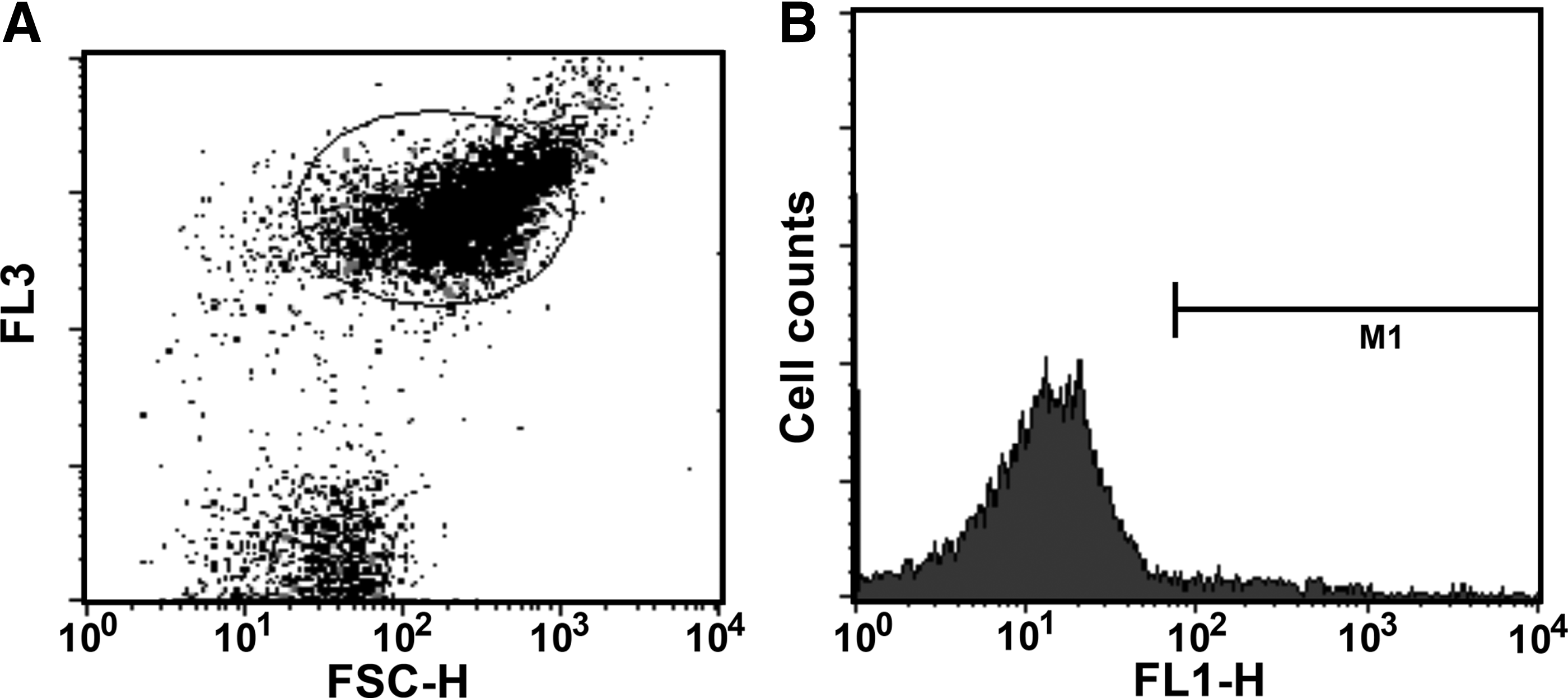
Flow cytometry of fLNA/DNA cellular uptake.

Association of Escherichia coli cells with fLNA/DNA or fODN. The percentage of cells associated with fluorescence is compared for the fLNA/DNA (▪) and fODN (▴). The averages, shown by horizontal lines were fLNA/DNA, 13.96±5.12, fODN, 0.05±0.01. The p value is 0.0349, p<0.05 is considered significant.

Internalization of fLNA/DNA.
The results shown here indicate that hybrid LNA/DNA compounds are good candidates as antisense antimicrobials. However, strategies to increase the efficiency of delivery inside the cells must be developed. Furthermore, future research must address questions like the role played by the length and configuration of the LNA/DNAs in efficiency of internalization as well as the physiologic state of the recipient cells.
Footnotes
Acknowledgments
Financial support for this work was provided by Public Health Service grant 2R15AI047115 from the National Institutes of Health (to M.E.T.), PIP grant 11420100100152 from CONICET (to M.S.R.), and UBACyT grants X-240 and X-997 from the University of Buenos Aires. G.M.T. and C.D.S. were supported by CONICET. A.J.S.B. was supported by fellowships from the American Society for Microbiology (International Fellowship for Latin America) and CONICET. M.S.R. and A.Z. are career investigators of CONICET.
Author Disclosure Statement
No competing financial interests exist.