






Abstract
Objective:
To determine if cumulative measures of pumping behaviors over the first 5 days postpartum predicted lactation outcomes by postpartum days 7 (achievement of secretory activation [SA] and pumped milk volume) and 14 (achievement of coming to volume [CTV ≥500 mL of pumped milk]) in breast pump-dependent mothers.
Methods:
This observational study had usable data for 29 mothers. Predictor and outcome variables were measured via Smart Pump technology (Medela, AG). Pumping behaviors were measured electronically. SA was measured using mothers’ own milk (MOM) sodium (Na ≤16 Mmol). Pumped MOM volume was measured to the nearest 0.1 g. Cumulative pumping behaviors were calculated from birth to postpartum day 5. Breast pump use was standardized during two pumping sessions.
Results:
In this diverse sample (48% Black, 34% Hispanic, 18% other), each additional 1-hour spent pumping between postpartum days 1–5 increased odds of achieving SA by day 7 by 2.8 (p = 0.01) and translated into an additional 1,278 mL of pumped MOM volume. Each additional inter-pump interval >5 hours between birth and postpartum day 5 was associated with a decrease of 242 mL of pumped MOM volume by postpartum day 7 (p = NS). Achievement of CTV by day 14 was not significantly related to pumping behaviors during the first 5 days postpartum.
Conclusions:
The first 5 days postpartum are a critical window when breast pump use significantly affects achievement of SA and pumped MOM volume. The lack of effect on later CTV achievement suggests that effective breast pump use is essential to transition to the autocrine/paracrine control of lactation.
Receipt of mothers’ own milk (MOM; excludes donor human milk) through to discharge from the neonatal intensive care unit (NICU) reduces the risk of potentially preventable complications of prematurity and their associated costs in a dose-dependent manner. 1 Neither high-dose donor human milk nor commercial formula offers this same risk reduction, so strategies that optimize MOM provision are a priority in NICU care. 2 Mothers of preterm infants initiate lactation at high rates with little or no racial/economic disparity and have a goal of continuing MOM provision through to NICU discharge and beyond.3,4 However, these high rates are not sustained through to NICU discharge and are characterized by a Black/non-Black disparity.5–7 Among the most common reasons for early cessation of MOM provision in mothers of preterm infants is “insufficient amounts” or “running out” of MOM.8,9
Mothers of preterm infants in the NICU are breast pump-dependent, meaning that the pump rather than the infant stimulates MOM synthesis, controls MOM removal, and directs the continued regulation of lactation.10,11 Although breast pump-dependency itself is not modifiable in this population, the type of breast pump and the way it is used can be leveraged for optimizing MOM provision. 12 In particular, the early postpartum period, including the lactation phases of secretory activation (SA) and achievement of coming to volume (CTV; ≥500 mL pumped MOM per day by postpartum day 14), appears to be a critical window during which the type of pump and pumping behaviors hold potential to impact long-term MOM volume. 12 Within this short time frame, the first 5 postpartum days, which include the achievement of SA and the transition from endocrine to autocrine/paracrine control of lactation, may be the most important.4,12–14 The most accurate measures of SA in MOM are sodium (Na) concentration and sodium-to-potassium ratio (Na:K). These biomarkers are a consequence of upregulation of transcellular pathways and the closure of the paracellular pathway in the mammary gland. The first days postpartum, lactose, citrate, and potassium (K) increase, whereas total protein and Na decrease, reflecting changes in these pathways. Our research 13 and others 9 have shown that Na <16 Mmol alone indicated that the closure of the paracellular pathway in the mammary gland and predicted the subsequent achievement of CTV. If supported, these data would inform NICU and maternity best practices with respect to prioritizing resources that optimize pumping behaviors during this short, critical interval.
The purpose of this study was to determine if cumulative measures of pumping behaviors (frequency, total minutes, longest interval between pumping) over the first 5 postpartum days predicted lactation outcomes by postpartum days 7 (achievement of SA and pumped milk volume) and 14 (achievement of CTV). This study was a part of a larger project that incorporated objective and accurate measures for all variables including pumping behaviors, pumped MOM volume, and achievement of SA and CTV. 12 Furthermore, breast pump type and evidence-based pumping strategies were standardized for all participants.
Methods
The detailed methodology for this study has been described previously and is summarized briefly here. 12 This nonrandomized 14-day observational study collected daily measures of pumping behaviors, MOM biomarkers of SA, and pumped MOM volume as well as other variables that are not reported in this article (maternal descriptions of breast changes, breast photos, etc.) for mothers of singleton preterm infants (<34 weeks’ gestation) beginning on the day of birth (postpartum day 1) and ending on postpartum day 14. English or Spanish-speaking mothers who planned to provide MOM were approached antenatally or postpartum if the infant’s NICU hospitalization was expected to last ≥14 days. Excluded were mothers who used hormonal contraception and/or galactagogues, were too sick to approach ethically, or whose infants had severe medical conditions or congenital anomalies. Enrollment took place between October 2019 and October 2020 and was paused for 6 months midway due to COVID-19 restrictions. All mothers signed informed consent for themselves and their infant and the project was approved by the institutional review board.
Setting
This study was conducted in an urban, 72-bed NICU that prioritizes MOM feedings via evidence-based messaging for families, the use of breastfeeding peer counselors who are parents of former Rush NICU preterm infants, and one-on-one counseling to optimize breast pumping behaviors. Initial breast pump use in the delivery room is standard of care for mothers of infants admitted to the NICU. 15 For this study, mothers were contacted daily by the study team in order to collect data, and NICU personnel were available to address lactation questions and concerns at any time of day.
Measures
The measures for this study were divided into predictor and outcome variables. Predictor variables included sample characteristics and pumping behaviors that occurred during the first 5 postpartum days. Outcome variables consisted of pumped MOM volume, achievement of SA by postpartum day 7 and achievement of CTV by postpartum day 14.
Day 5 predictor variables
Sample characteristics
Maternal-infant descriptors were collected by accessing the electronic medical record (EMR) and by questionnaires used by our team in previous lactation studies with breast pump-dependent women.4,10,13,16 A specific lactation risk assessment was conducted during the maternity hospitalization using an instrument described in our previously published research.4,10,13,16 Detailed information on maternal co-morbidities was obtained from the EMR and the lactation risk assessment questionnaire.
Pumping behaviors
This study leveraged state-of-the-art technology (Smart Pump, Medela AG, Switzerland) to electronically measure, record, and store data on breast pump use. 12 Specifically, the Smart Pump data logger captured and recorded each daily pump session, minutes pumped per session, as well as which breast pump suction pattern (BPSP; initiation versus maintenance) the mother used for each pumping. These data were stored on customized password-protected data loggers until the study’s end for each mother, at which time they were downloaded into a customized computer software program compatible with Microsoft Excel. Each mother had a total of three Smart Pumps assigned and programmed with her study ID for the 14-day study period: one each for the postpartum maternity unit, the NICU, and in-home use. The Smart Pump is depicted in Figure 1.
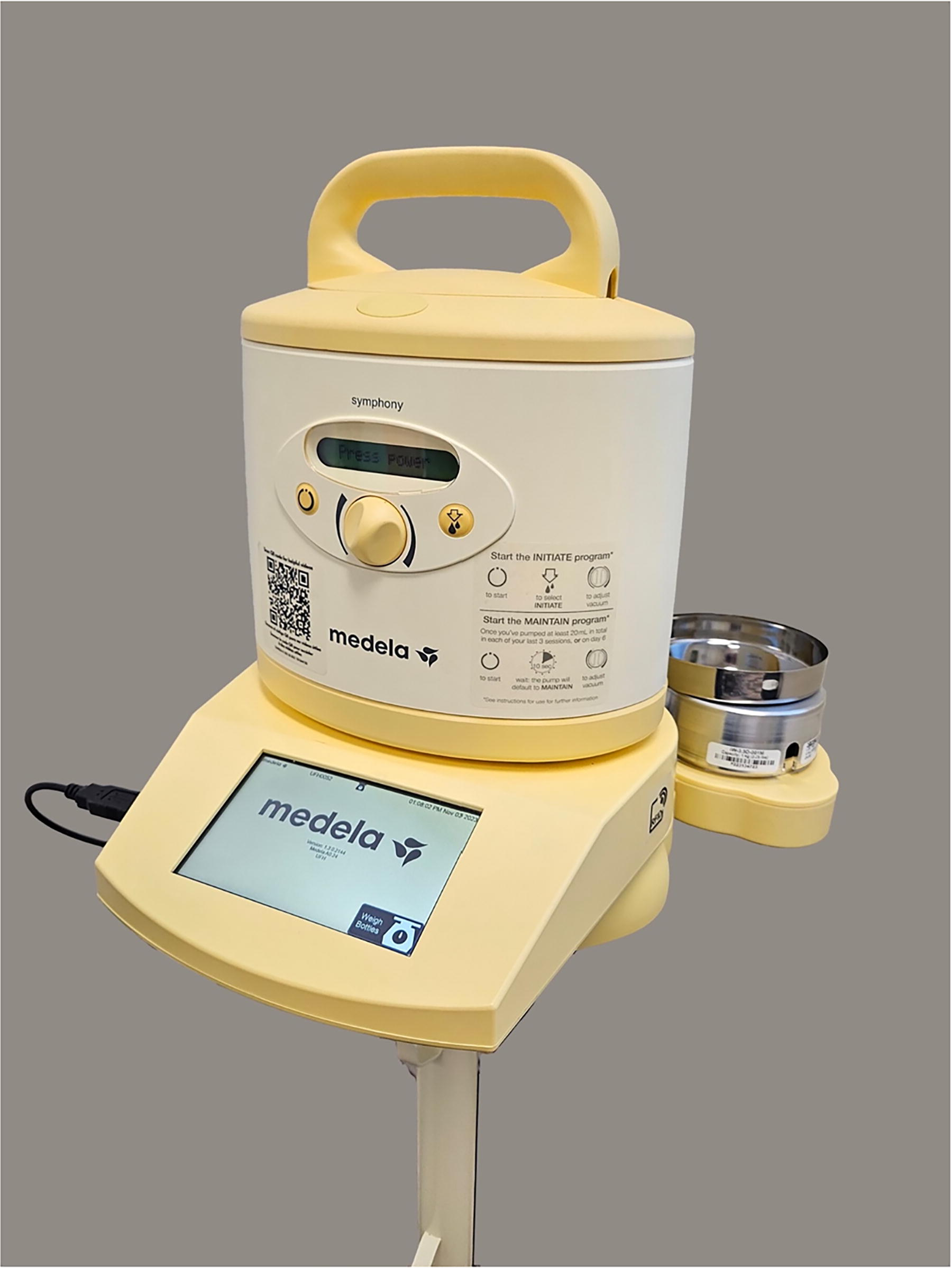
Medela Smart Pump captured pumping behaviors via the integrated data logger; participants weighed pumped milk on the scale to right of pump; the interactive touchscreen was used by participants to enter subject ID, start the pump, stop the pump, and end pump session. Participants weighed pumped milk for right or left breast as prompted by the pump.
Postpartum day 5 cumulative pumping behaviors were calculated for each mother as follows. The Smart Pump recorded minutes spent pumping per session, beginning at 00:00 AM and ending at 11:59 PM. The daily number of minutes spent pumping was calculated for each mother and summed over postpartum days 1–5 to create the variable, cumulative minutes pumped, which was subsequently converted to cumulative hours pumped for ease of interpretation. Daily pumping frequency was calculated based on the number of pump sessions, which were summed for postpartum days 1–5 to create the variable cumulative pumping frequency. Inter-pump intervals were defined as the time between the end of one pumping session and the end of the next pumping session. Inter-pump intervals >5 hours have been negatively associated with short-term MOM synthesis in mothers of preterm infants during established lactation, but not during the first postpartum week. 17 Each interval >5 hours was counted and summed for postpartum days 1–5 to create the variable cumulative number of inter-pump intervals >5 hours.
Days 7 and 14 outcome variables
Postpartum day 7 pumped MOM volume
Pumped MOM volume was measured (nearest 0.1 g) by mothers for each pump session, separately for the right and left breasts, with a digital scale (Tanita scale; model 1479S, Tokyo, Japan) used in our previously published studies and integrated into the Smart Pump.16,18,19 The specific gravity of human milk, 1.031 g/mL, is minimally different than water, allowing a default to 1.0 g/mL for volumetric conversion.16,18,19 The integration of this scale into the Smart Pump facilitated storage of downloadable pumped MOM volume data. Mothers were taught how to operate the user-friendly touchscreen interface display, which prompted them to enter which breast and which of the four sizes of possible MOM storage containers was being weighed. An algorithm in the Smart Pump subtracted the container weight from the pumped MOM volume. The cumulative pumped MOM volume was calculated by summing the total daily pumped MOM volume (right and left breast combined) between postpartum days 1 and 7.
Postpartum day 7 achievement of SA
Achievement of SA was measured by MOM biomarkers, specifically Na concentration. 19 Achievement of SA was calculated as a dichotomous yes–no variable based on Na ≤16 Mmol.9,19 MOM samples (1.0 mL) were collected daily and stored at −20° C until Na concentration was measured in duplicate, using ion selective sensor technology (Horiba, Japan) under the supervision of the PI, who was trained at the University of Western Australia.20,21 The daily concentrations for Na were measured in parts per million (ppm), then subsequently divided by the molecular weight for Na (22.9 g/mol) and expressed in millimoles (Mmol). For this analysis, postpartum day 7 Na concentration was the only MOM biomarker used as an outcome variable. However, previously published research from this study reported time to achievement of SA and impermanence of SA. 12
Postpartum day 14 achievement of CTV
Achievement of CTV was calculated based on pumped MOM volume measured in grams and stored and retrieved from the Smart Pump. CTV was dichotomized as a yes–no variable based on the achievement of pumped MOM volume ≥500 mL (weight ≥500 g) in at least one 24-hour period (between 00:00 AM and 11:59 PM) during the first 14 postpartum days.
Procedures
Standardization of breast pump use
This study standardized breast pump type, BPSP and personalized breast pump use to the individual mother in order to control for the multitude of confounding variables that are independently associated with pumped MOM volume in lactation research.10,11,22 Two separate one-on-one, in-person education sessions were conducted by the research team using evidence-based criteria (summarized in Box 1). The focus of the two sessions was to optimize and personalize breast pump use to mimic the suckling behavior of a healthy breastfeeding infant during the distinct lactation phases of hormonal regulation (session one, prior to achievement of SA) and the transition to autocrine/paracrine regulation of lactation (session two, following achievement of SA). 11 The first optimization session was conducted during the maternity hospitalization (≤3 days postpartum), and the second optimization occurred on or about postpartum day 5, based on the mother’s achievement of SA. Both pumping optimizations consisted of observing and assisting mothers during the entire pump session and documenting personalized recommendations. On both occasions, a follow-up observation of the mother’s breast pump use was conducted to assure understanding and compliance.
Standardization of Breast Pump Use
Data analysis
Descriptive statistics included frequencies, percentages, and mean ± standard deviation. A bivariate Pearson’s correlation was initially performed to examine simple associations between predictor and outcome variables, which also included the covariates of maternal parity and gestational age, known in the literature to impact lactation outcomes. 12 We conducted logistic and linear regressions for categorical and continuous outcome variables, respectively, to generate odds ratio and test relationships between postpartum day 5 pumping behaviors and postpartum day 7 lactation outcomes.
Results
Sample characteristics: A total of 51 mothers were approached, 35 were enrolled, and 29 mothers had usable data (enrollment table previously published, included here as Supplementary Fig. S1). 12 Characteristics of the sample (n = 29) are summarized in Table 1. Most participants were Black and either overweight or obese, with nearly half qualifying for WIC (Special Supplemental Nutrition Program for Women Infants and Children) as a proxy for low-income status. The mean number of co-morbidities per mother was 3 ± 1. The majority (59%) of infants were born via cesarean section (c-section) with a mean birth weight of 1470 grams.
Maternal and Infant Characteristics (N = 29)
BMI, body mass index; MOM, mother’s own milk; SD, standard deviation; WIC, special supplemental nutrition program for women, infants, and children.
Relationships between pumping behaviors and lactation outcomes
During days 1–6 postpartum, the initiation versus the maintenance BPSP was used by all participants. Although some mothers used the initiation BPSP throughout the first 6 days postpartum, its use was concentrated in postpartum days 2, 3, and 4, with mean daily usage time of 32, 57, and 43 minutes, respectively. Lactation characteristics and outcomes are displayed in Table 2, showing that mothers had a mean of one daily inter-pump interval >5 hours in the first 5 postpartum days. Although 69% of mothers achieved SA by postpartum day 7, only 45% achieved CTV by postpartum day 14. Pearson correlations between postpartum day 5 pumping behaviors and lactation outcomes at postpartum days 7 and 14 were calculated. Cumulative pumping frequency was highly correlated with cumulative hours pumped between birth and postpartum day 5 (r = 0.90), so cumulative pumping frequency was excluded from further analyses.
Lactation Characteristics and Outcomes
CTV, coming to volume; PP, postpartum; SD, standard deviation.
Postpartum day 5 cumulative hours pumped and cumulative pumped MOM volume by postpartum day 7
Postpartum day 5 cumulative hours pumped and postpartum day 7 cumulative pumped MOM volume were positively related (r = 0.38). Linear regression revealed that for every additional hour pumped between birth and postpartum day 5, cumulative pumped MOM volume increased by 1,278 mL at postpartum day 7 (Table 3).
Linear Regression Models for Pumped Milk Volume by Day 7 Postpartum
Model R = 0.38, F(1, 27) = 4.7.
Model R = −0.12, F(1, 27) = 0.37.
CI, confidence interval; OR, odds ratio.
Postpartum day 5 cumulative inter-pump interval >5 hours and cumulative pumped MOM volume by postpartum day 7
Postpartum day 5 cumulative inter-pump interval was negatively related (r = −0.12) to postpartum day 7 cumulative pumped MOM volume, with each additional inter-pump interval >5 hours associated with a reduction of 242 mL of cumulative pumped MOM volume by postpartum day 7. However, this relationship was not statistically significant (Table 3).
Postpartum day 5 cumulative hours pumped and MOM Na ≤16 Mmol by postpartum day 7
Postpartum day 5 cumulative hours pumped was significantly and positively related (r = 0.56) to MOM Na ≤16 Mmol by postpartum day 7. Logistic regression revealed that for each additional hour pumped in the first 5 postpartum days, the odds of achieving MOM Na ≤16 Mmol by postpartum day 7 increased by 2.8 (p = 0.014) (Table 4).
Logistic Regression for MOM Na Concentration ≤16 Mmol by Day 7 Postpartum
CI, confidence interval; MOM, mother’s own milk; Na, sodium; OR, odds ratio.
Postpartum day 5 inter-pump intervals >5 hours and MOM Na concentration ≤16 Mmol by postpartum day 7
Postpartum day 5 cumulative inter-pump intervals >5 hours had a nonsignificant negative (r = −0.10) relationship with postpartum day 7 MOM Na concentration (Table 4).
Postpartum day 5 cumulative hours pumped, inter-pump interval >5 hours and achievement of CTV by postpartum day 14
Achievement of CTV by postpartum day 14 was not significantly related to postpartum day 5 cumulative hours pumped (r = −0.05) nor to postpartum day 5 inter-pump intervals >5 hours (r = 0.16) (Table 5).
Logistic Regression Models for Achievement of CTV by Day 14 Postpartum
CI, confidence interval; CTV, coming to volume; OR, odds ratio.
Discussion
To our knowledge, this study and its companion publication 12 are the first to measure early pumping behaviors and lactation outcomes in breast pump-dependent mothers of preterm infants using innovative, objective, and accurate measures for all variables. Our evidence-based standardization and personalization of breast pump use at two critical postpartum time points controlled for extraneous variables that impact the effectiveness, efficiency, and comfort of MOM removal, adding rigor to our findings. We found that each additional hour spent pumping during the first 5 postpartum days yielded an additional 1,278 mL of pumped MOM volume by postpartum day 7, a statistically and clinically significant finding. Similarly, we found that each additional hour spent pumping during the first 5 postpartum days increased the odds of achieving SA by 2.8 by postpartum day 7. No significant relationship was found between cumulative hours of pumping by postpartum day 5 and achievement of CTV by postpartum day 14. Although we found that cumulative inter-pump intervals >5 hours on postpartum day 5 were negatively correlated with all three lactation outcomes, this relationship did not reach statistical significance.
Pumping behaviors and lactation outcomes
Our innovative Smart Pump captured precise data to accurately determine when a mother was or was not pumping, enabling the calculation of all three pumping behaviors thought to affect pumped MOM volume during the early postpartum period. These data are important because there is currently no consensus regarding which pumping behavior(s) should be used to evaluate lactation outcomes or to guide clinical practice. Researchers have studied the achievement of SA using daily pumping frequency (number of pumping sessions) and number of minutes/hours spent pumping.4,13,19,23,24 One study focused on the impact of inter-pump intervals and pumped MOM volume, but this study was conducted during more established lactation, starting on day 10. 17 To our knowledge, our study is the first to include these three pumping behaviors in the same study, although preliminary analysis showed that pumping frequency was highly correlated with number of hours pumped. Thus, we chose to solely retain cumulative hours pumped as it was a more granular source of data. We selected postpartum day 5 cumulative pumping behaviors as predictor variables because recent research has suggested that this short interval may be the most critical within the first 14 postpartum days, especially with respect to lactation outcomes on postpartum days 7 and 14, 9 which in turn predict receipt of MOM at NICU discharge in very low birthweight (<1,500 g) infants.4,24–27
Several recent studies reveal that early pumping behaviors may catalyze closure of the paracellular pathway, a critical component of SA that is measured by MOM Na concentrations.13,23,28 From a biological perspective, the unique sucking rate and rhythm used by the human infant during the very early postpartum period is thought to provide mammary gland programming that impacts both immediate and subsequent MOM volumes.13,23,28 The initiation BPSP used by all mothers in our study mimicked this sucking stimulation, which was shown in a previous randomized trial to significantly increase cumulative pumped MOM volume by postpartum day 14. 22 Although our small sample did not permit separate examination of the impact of initiation BPSP use on lactation outcomes, its potential contribution to our findings must be considered.
Whereas our study is the first to include both objective and accurate measures of predictor and outcome variables, prior research in breast pump-dependent mothers of preterm infants has also shown that early pumping frequency is associated with MOM volume in both the early postpartum period and for several weeks thereafter.3,22–25 Although our data reveal strong associations between pumping behaviors and lactation outcomes by postpartum day 7, we did not find an association between pumping behaviors and the achievement of CTV by postpartum day 14. This lack of effect may be partially explainable by data from the companion article to this study, in which a cluster analysis placed the 29 mothers into a high-intensity pumping group (HIPG; N = 17) and a low-intensity pumping group (LIPG; N = 12). 12 The HIPG mothers pumped a mean of 5 ± 2 times/day and were significantly more likely to achieve CTV than the LIPG, who pumped a mean of 2 ± 2 times/daily. However, the parent study analyzed pumping behaviors through the entire first 14 postpartum days, not cumulative pumping behaviors for the first 5 postpartum days. 12 Also relevant are data from a pilot study of 16 breast pump-dependent mothers of preterm infants, 4 in which mothers who achieved CTV versus those who did not self-reported twice as many cumulative pump sessions between birth and postpartum day 5 (26.3 versus 13.8, p = 0.03) as well as a higher median number of daily pumping sessions over the first 14 days (6.5 versus 4, p < 0.001). 3 In combination, these data suggest that not only are the first postpartum days critical for SA achievement but continued frequent, effective breast pump use is also necessary to catalyze the transition from endocrine to autocrine/paracrine control of lactation that leads to CTV achievement.
Inter-pump interval was included as a pumping behavior due to the paucity of data between this pragmatic measure and lactation outcomes in this population. Inter-pump interval is important because mothers are often advised to interrupt sleep in order to pump every 2–3 hours, often without regard for the potential negative impact of exhaustion and anxiety on pumped MOM volume. 29 We found a negative correlation between number of inter-pump intervals >5 hours and lactation outcomes, although this relationship was not statistically significant. Lai et al. 17 revealed a strong association between inter-pump interval and short-term milk synthesis and MOM volume, suggesting a need to limit inter-pump intervals to <5 hours. However, this important study was conducted during established lactation and did not include the first 5 postpartum days. During established lactation, the impact of long inter-pump intervals is MOM stasis and downregulation of MOM volume via autocrine and paracrine mechanisms, 19 which are not fully established until SA achievement. 29 Thus, the question as to whether inter-pump intervals affect achievement of SA and CTV in mothers of pump-dependent preterm infants requires further study. A research priority is to delineate evidence-based recommendations about sleep interruption versus waking to pump in these vulnerable mothers who are often sick with medical co-morbidities associated with preterm delivery. Specifically, it is important to know if longer sleep intervals can be mitigated by increasing the total pumping time during the daytime hours.
Rigor in studies of breast pump-dependent mothers of preterm infants
The use of objective and accurate measures of pumping behaviors, pumped MOM volume, and achievement of SA and CTV add an element of rigor absent from previous studies that relied upon mothers keeping pumping logs and diaries. Although the missing and erroneous data in maternal pumping records have been noted,17,18 the first 14 postpartum days are intensely stressful for mothers of preterm infants, and likely represent a disproportionate amount of this error in record keeping. Our approach of assigning Smart Pumps to mothers in the maternity and NICU settings as well as in the home allowed the collection and storage of pumping behaviors and pumped MOM volume with minimal error or missing data.
In addition, the standardization of breast pump use at two critical postpartum time points controlled for the independent effects of multiple extraneous variables highly associated with pumped MOM volume in previous studies.3,10,22,30–32 Lactation processes are regulated by different mechanisms between birth and SA achievement and between SA achievement and CTV, hence the importance of assuring that breast pump use properly matches the lactation phase. Between birth and SA achievement, the regulation of lactation and thus MOM volume is controlled hormonally and catalyzed by infant-specific mammary gland stimulation.10,22 Between SA achievement and CTV, autocrine/paracrine control of lactation begins and is controlled via frequent, effective, and efficient MOM removal. 11 These two mechanisms involve different infant sucking patterns, which should be replicated to the extent possible in breast pump-dependent mothers of preterm infants. 10 In particular, the use of the initiation BPSP was shown in a randomized trial to increase daily and cumulative pumped MOM volume in this population and was standardized in this study. 22 Breast shield sizing, breast pump suction pressures, and changes in the duration of pumping sessions were customized during both pumping standardizations. Thus, our incorporation of Smart Pump technology alongside evidence-based protocols for breast pump use reduced significant within and between-mother error.
Strengths and limitations
This study has numerous strengths including the predominantly Black and/or low-income sample that is unusual for lactation studies. The serial data collection protocol, standardization of breast pump use, and simultaneous objective measurement of three pumping behaviors and three lactation outcomes in this population strengthen our findings and conclusions. Our study is limited by a small sample and observational design, but this limitation is somewhat offset by the intense, serial measurement of multiple outcome variables. Similarly, the majority of mothers in our sample were overweight or obese, and most infants were born via c-section. Although a 59% c-section rate is high for infants <34 weeks, it is important to note that 49% of the mothers gave birth to a very-low-birth-weight infant (<1,500 g). These infants had a mean gestational age of 30.5; thus, a 59% c-section rate is expected for this gestational age. 33 While these data are important for informing lactation practices in this population, we acknowledge that our data may not be entirely generalizable to all breast pump-dependent women. Finally, while our personalized standardization of breast pump use was a strength of our study, it may also limit generalizability to institutions where breast pump usage is not optimized to fit the specific lactation phase and/or evidence-based lactation care is not as rigorous.
Conclusion
Cumulative hours pumped over the first 5 postpartum days were highly predictive of both cumulative pumped MOM volume and achievement of SA by postpartum day 7. Every additional hour pumped between birth and postpartum day 5 predicted an additional cumulative MOM volume of 1,278 mL and increased the odds of achieving SA by 2.8 by postpartum day 7. These striking findings are clinically actionable and can be shared with pump-dependent mothers in scripted messaging. We found that cumulative hours pumped over the first 5 postpartum days did not significantly affect achievement of CTV on postpartum day 14, suggesting that continued frequent, effective, and efficient breast pump use between postpartum days 5 and 14 is necessary to catalyze the transition to autocrine/paracrine control of lactation. The methodologies used in this study can be leveraged in future research to optimize MOM volume in this breast pump-dependent population.
Footnotes
Authors’ Contributions
All collaborators listed as coauthors made substantial contributions and consented to this publication.
Disclosure Statement
Potential conflicts of interest: P.P.M. serves as a consultant to Medela for educational activities. R.H. holds a position on Medela America’s scientific advisory board at the time of publication, but did not during the study.
Funding Information
This study was partially funded by Medela (AG), Switzerland.

References
Supplementary Material
Please find the following supplemental material available below.
For Open Access articles published under a Creative Commons License, all supplemental material carries the same license as the article it is associated with.
For non-Open Access articles published, all supplemental material carries a non-exclusive license, and permission requests for re-use of supplemental material or any part of supplemental material shall be sent directly to the copyright owner as specified in the copyright notice associated with the article.
