






Abstract
About 10 years ago, I left clinical practice as a primary care physician to focus on maternal and reproductive health research. Last year, I gave birth to a baby boy who has changed my life in multiple ways; one of them being helping me become a more compassionate and empathetic researcher and better understand the complexities involved in reproductive care throughout the lifecycle.
One of the most fulfilling aspects of my parenting journey has been breastfeeding my baby, although it has not been without its challenges. When my little one was 4 months old, it was time for me to return to work. And although I work from home, I determined that expressing would be the best path moving forward. But alas! Baby boy was not on board with this plan. No matter how many different bottles and nipples we tried, he refused to take expressed milk from a bottle. This means that periodically throughout the day, I feed him at the breast. This has made him my constant work sidekick—joining me on workshops, conferences, and trainings across the country.
Recently, we found ourselves at a training being conducted in a co-working space. When it was time for me to feed my son, I chose to go to the designated “mother’s room.” When I stepped into the room, I was shocked—being in my little bubble of privilege working from home had made me forget what breastfeeding parents need to overcome to be able to continue expressing and breastfeeding after they return to work.
I won’t drone on about the details of this particular room, except to note that it was clearly a prior utility closet, with unfinished floors covered hastily with a dirty old carpet, a chair with little back support that was designed to be a pretty accent piece instead of for actual sitting, no windows, and no ventilation. By the time we got out of there, we were drenched in sweat from the lack of air flow.
Which brings me to why I am writing this piece. The recent U.S. Pregnant Worker’s Fairness Act requires reasonable accommodations be provided in the workplace for anything pregnancy-related, which includes lactation. 1 However, there is little specificity on what these reasonable accommodations are. Some U.S. states have specific laws to support breastfeeding workers, but they often focus on outlining the bare minimum requirements instead of what an ideal space should look like. 2
Today, I would like to make a call to employers to think about breastfeeding in the workplace as more than a box to check. A well-equipped lactation room in the workplace for breastfeeding parents can increase gender equity in the workplace, worker satisfaction and retention, employee well-being, and even have the potential of reducing the need for caregiver leave among parents if children have more resilient immune systems as a result of extended breastfeeding.3–6
As I contemplated what a well-equipped lactation room could look like, I drew from my time providing lactation counseling as a primary care doctor, interviews I’ve conducted with parents for breastfeeding-related studies, best practices noted in the academic literature, UNICEF guidelines, my personal experience as a breastfeeding mom, and a little additional input from friends who have recently breastfed or expressed in the workplace across Latin America, North America, and Europe.3,7–10 I aggregated all of these and created the illustration below Figure 1.
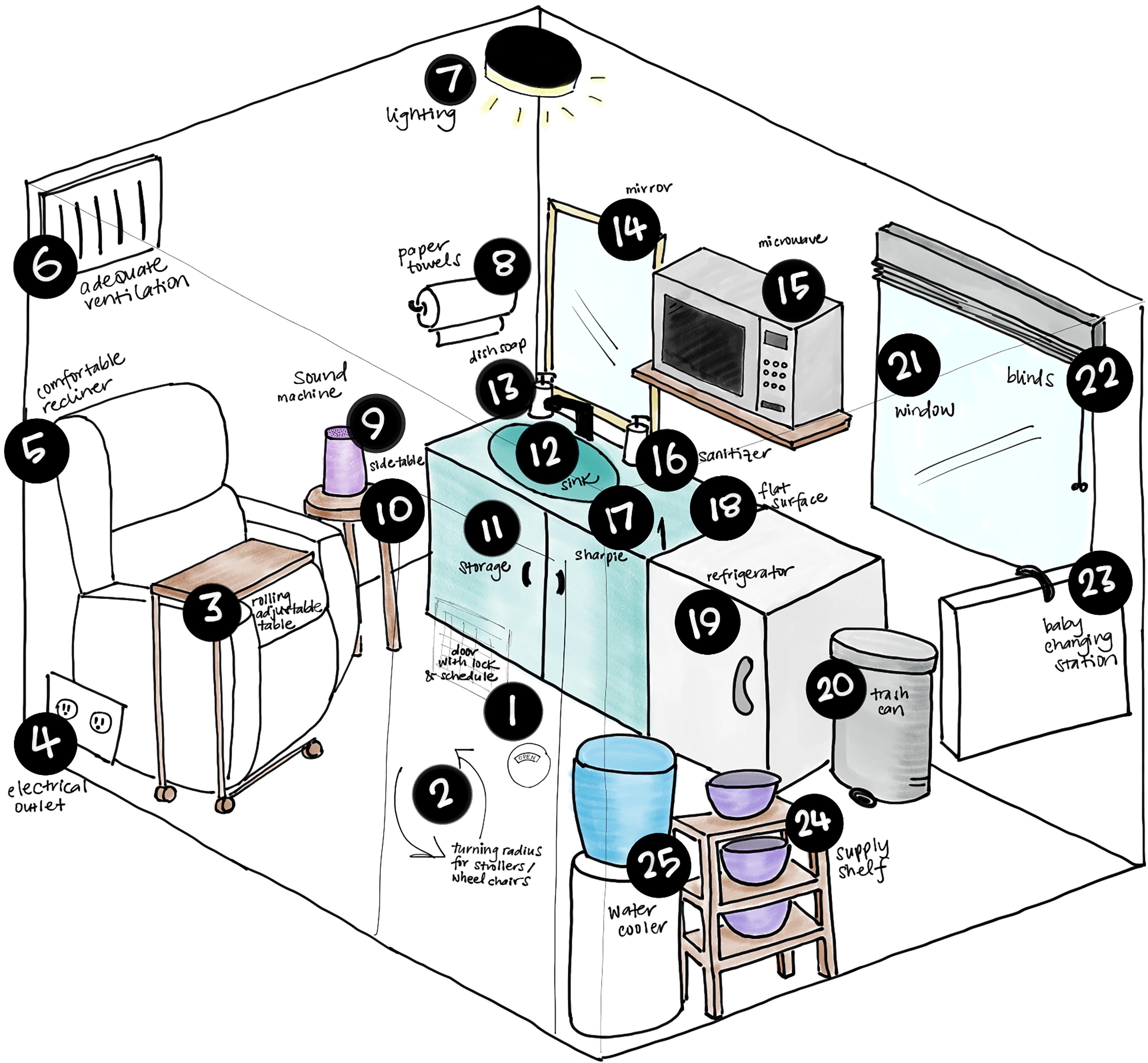
The lactation room wishlist: 25 key features every lactation room should have.
Following the illustration in a clockwise order, starting at the door, here are the key aspects that make this room a nursing parent’s dream. (1) Locking door with an occupied indicator and a sign-up schedule on the front door so parents can plan their days accordingly.1 (2) Enough turning radius inside the room for a wheelchair or a stroller. (3) Rolling adjustable table for pump, laptop, or writing. (4) Easily accessible electrical outlet to plug in a pump or other electronic devices. (5) Comfortable glider, rocker, or armchair with adequate back support and made from a material that is easy to wipe down and clean. (6) Adequate heating, ventilation, and air conditioning (HVAC) service. (7) Dimmable lighting to adjust for personal preferences. (8) Paper towels to dry pump parts and hands after washing. (9) Sound machine to help block the outside noise (because no one wants to hear Stan from accounting talking about their fishing trip while we pump). (10) Side table for water bottle or other personal items. (11) Storage with extra paper towels, dish soap, and multi-surface cleaner. (12) Sink with kitchen style faucet (sink should be exclusively for the pump to avoid contamination). (13) Baby-friendly dish soap to clean pump parts. (14) Mirror to readjust clothing after expressing. (15) Microwave to sterilize pump parts. (16) Hand sanitizer to clean hands. (17) Permanent marker to label storage bags in fridge. (18) Flat surface for preparation. (19) Fridge for milk storage that is not placed directly on the floor (on a small platform). (20) Pedal-operated or other hands-free trash can. (21) Window for natural light. (22) Blinds for privacy as needed. (23) Baby changing station. (24) A supply shelf with supplies such as breastmilk storage bags, permanent markers for labeling, disposable nursing pads, breastfeeding gel pads, baby wipes, and granola bars or snacks (gotta get those extra calories in!). (25) Water cooler to refill reusable water bottles.
My hope is that this illustration depicting the ideal lactation room will inspire more employers to create beautiful and functional spaces for their breastfeeding workers instead of just complying with bare minimum standards and thus providing environments that are conducive for parents to meet their personal breastfeeding goals, whatever they may be.
Footnotes
Disclosure Statement
The author has no conflicts of interest.
Funding Information
This work was not externally funded; time allocated to writing piece was covered through RAND’s internal Independent Research Program.
1
Note that the National Institutes of Health recommends at least 6 lactation rooms in organizations with 1000 female employees, 2 lactation rooms for 250 female employees, and 1 lactation room in settings with less than 100 female employees.