






Abstract
Background:
Some breastfeeding mothers try to increase their milk supply through pharmaceutical, dietary, and behavioral strategies that vary in effectiveness. Information seeking behaviors may influence which strategies mothers use.
Objective:
To describe where mothers obtain information about increasing milk supply, describe the perceived influence of each information source on decision-making about strategies for increasing milk supply, and explore associations between information sources and mothers’ use of galactagogues (i.e., pharmaceutical and dietary strategies) and behavioral strategies.
Methods:
Women who were currently breastfeeding and living in the United States were recruited through Facebook advertisements to complete an online survey between December 2020 and February 2021. Descriptive statistics were calculated, and chi-square tests compared participants’ use of galactagogues and behavioral strategies by information sources.
Results:
Participants were 1,351 breastfeeding mothers (81% non-Hispanic white; 47% first-time breastfeeding; 21% Special Supplemental Nutrition Program for Women, Infants, and Children participants). Nearly all participants (97%) obtained information about increasing milk supply from at least one source, most commonly lactation consultants (68%), Facebook (61%), search engines (50%), websites (47%), and nurses (41%). There was high variability in the perceived influence of each source on decision-making. Galactagogue use was higher among participants who obtained information from the internet (Yes: 68% vs. No: 43%, p < 0.000), social media (Yes: 65% vs. No: 40%, p < 0.000), family and friends (Yes: 65% vs. No: 53%, p < 0.000), and lactation consultants (Yes: 63% vs. No: 54%, p < 0.002). Behavioral strategies were more commonly reported among participants who accessed these same sources, maternal health care professionals (Yes: 98% vs. No: 91%, p < 0.000), and pediatricians (Yes: 98% vs. No: 94%, p = 0.001).
Conclusion:
Breastfeeding mothers commonly obtained information about increasing milk supply from a variety of sources. Information sources accessed were associated with mothers’ use of galactagogues and behavioral strategies for increasing milk supply.
Introduction
Breastfeeding provides optimal nutrition for infants during the first 6 months of life and has been linked to health benefits for both mothers 1 and infants. 2 However, only 25% of infants in the United States are exclusively breastfed through 6 months, and only 36% are partially breastfed at least 1 year or longer, 3 as recommended by the American Academy of Pediatrics. 4 Furthermore, mothers have reported stopping breastfeeding prior to meeting their breastfeeding intentions or desires.5,6 A common reason for early breastfeeding cessation is perceived insufficient milk, which is when a breastfeeding parent believes that they are not producing enough milk to nourish or satisfy their infant. 7
Some breastfeeding parents use foods, beverages, herbal supplements, or pharmaceuticals that have purported effects on lactation (i.e., galactagogues) to try to increase their milk supply and meet their breastfeeding goals.8–11 A survey of breastfeeding mothers in the United States (n = 1,294), conducted in 2020–2021, found that over half reported ever using galactagogues to increase milk supply. 12 However, human lactation is largely driven by frequent and effective milk removal, and the Academy of Breastfeeding Medicine does not endorse the use of any specific galactagogue because of the lack of evidence regarding their safety and efficacy. 13 Further, individual foods or nutrients are not specified in the Dietary Guidelines for Americans 2020–2025 as necessary for promoting lactation. 14 The Academy of Breastfeeding Medicine recommends the use of behavioral strategies to promote lactation, such as increasing the frequency and effectiveness of milk removal from the breast through infant suckling, hand expression, or a breast pump. 13
Despite limited empirical evidence to support the use of galactagogues, breastfeeding parents have reported obtaining information about milk supply and galactagogues from various sources. A cross-sectional study of breastfeeding mothers in the United States (n = 188), conducted in 2015, found that internet sources and social media were the most common source of information on pharmaceutical and herbal galactagogues. 9 Participants also reported that they obtained information or support about how to increase milk supply from lactation consultants, pediatricians, family, friends, and in-person support groups. 9 Similarly, in a large study of current and former breastfeeding women in Australia (n = 2,055), conducted in 2019, participants reported internet sources (52%), lactation support providers (46%), midwives (42%), general practitioners (39%), and social media (35%) as sources of information about galactagogues. 15 Given rapid changes in consumer information preferences, particularly the use of specific social media platforms, 16 additional research is needed to provide updated statistics on breastfeeding parents’ information seeking behaviors for strategies to increase milk supply.
The sources of information that breastfeeding parents access may influence their infant feeding decisions 17 and the strategies that they use to try to increase their milk supply, as described in prior qualitative studies on factors that motivate galactagogue use.18–20 Research that includes more specific and comprehensive assessments of information seeking behaviors for increasing milk supply may reveal opportunities to promote evidence-based strategies for increasing milk production through commonly accessed sources. The current study aimed to describe where breastfeeding mothers in the United States obtained information about how to increase breast milk supply, describe mothers’ perceived influence of each source on their decision-making about strategies to increase their milk supply, and explore associations between information sources and mothers’ use of galactagogues and behavioral strategies to increase their milk supply.
Methods
Data were collected using a cross-sectional online survey administered via Qualtrics (Provo, UT) between December 2020 and February 2021. All research procedures were reviewed and approved by the Institutional Review Board at New York University (IRB-FY2020-4371; IRB-FY2021-4859). The survey instrument was developed by the study team that has expertise in lactation, information seeking behavior, and survey research methodologies. The complete survey instrument was pilot tested with 10 members of the target population to establish face validity and the feasibility of survey administration. Additional details on survey development are described in an earlier publication. 12
Participant recruitment
A convenience sample was drawn from adult women ≥18 years of age who were currently breastfeeding and living in the United States and were recruited through paid Facebook advertisements. Facebook advertisements were targeted to display to individuals who met the following Facebook criteria: self-identified female gender, 18–45 years of age, located in the United States, English speaking, and parent of a child ages 0–2 years. Midway through the recruitment, the display criteria were modified to specifically include Asian, Native American, Hispanic/Latino, and African American interest categories as classified by Facebook algorithms to increase racial and ethnic diversity within the sample. Additional details on participant recruitment are described in an earlier publication. 12
Individuals who clicked on the Facebook advertisements were directed to Qualtrics to answer three screening questions to determine study eligibility (18 years or older, currently breastfeeding, and living in the United States). Eligible individuals were then prompted to complete the electronic informed consent and reCAPTCHA Turing test. 21 All participants who completed the survey were invited to enter a $50 gift card raffle. One winner per every 100 participants was randomly selected. To assess participant validity, 22 the first and last author screened all free-text survey responses for coherence. All responses were deemed valid.
Measures
Participant characteristics
Participants reported maternal age, infant age, race, ethnicity, marital status, employment status, education, state of residence, participation in the Special Supplemental Nutrition Assistance Program for Women, Infants, and Children (WIC), gestational age at birth, delivery mode, first-time breastfeeding, perceived adequate milk, 23 and any infant formula supplementation.
Sources of information
Participants reported whether they had ever gotten information about ways to increase breast milk supply from 21 possible information sources. The response options were “Yes,” “No,” or “Don’t remember.” In the analyses, the responses “No” and “Don’t remember” were combined. To prevent order-effects bias, the source ordering was randomized in the survey. Source options were generated from previous research on sources of information about galactagogues and milk supply 9 and from pilot test participants. In the statistical analyses comparing participants’ use of information sources to the strategies that they used to increase their milk supply, some information sources were combined based on conceptual similarity and informed by previous categorizations of sources of breastfeeding support, 24 as shown in italics. The assessed information sources included co-parent, family, and friends (family and friends); gynecologist or obstetrician-gynecologist, midwife, doula, nurses, and hospital class or pamphlet (maternal health care professionals); Facebook, Instagram, Pinterest, Twitter, and online forums (social media); search engines, websites, blogs, and mobile applications (internet sources); lactation consultants; pediatricians; WIC; and books. In addition, participants had the option to write in “other” information source(s), results of which are not included because they were endorsed by fewer than 3% of participants.
Perceived influence of information sources
Participants responded to the question, “How influential were each of the following sources when making decisions about ways to increase your milk supply?” Only those information sources that participants had previously endorsed were displayed. Response options included “Not at all influential,” “Somewhat influential,” and “Very influential.” Pilot testing indicated that the target population clearly understood the question stem and response options.
Use of galactagogues
Participants reported their current or previous use of any foods or beverages (yes or no), herbal supplements (yes or no), and pharmaceuticals (yes or no) that are purported to increase milk supply. Pilot testing confirmed that the terminology used to describe and assess galactagogue use was widely understood by the target population. In the analyses, participants who endorsed currently or previously using any galactagogues were combined and compared with participants who did not endorse currently or previously using any galactagogues.
Use of behavioral strategies
Participants reported their current or previous use of the following behavioral strategies to increase milk supply: skin-to-skin time with baby, massaging breasts while pumping, increasing frequency of breastfeeding, pumping both breasts simultaneously, pumping after breastfeeding, increasing frequency of milk expression, minimizing stress or using relaxation techniques, pumping while breastfeeding, changing breast shield size, and warming breasts before and during pumping. The options for behavioral strategies were generated from parent-focused educational resources on strategies for increasing milk supply25,26 and from pilot participants. In the analyses, participants who endorsed currently or previously using any of the behavioral strategies were combined and compared with participants who did not endorse currently or previously using any of the behavioral strategies.
Statistical analysis
All statistical analyses were conducted in STATA (release 16, StataCorp, College Station, TX, 2019). Of the 1,420 participants who completed the survey, 1,351 (95.1%) had complete data on the information seeking behavior, galactagogue use, and use of behavioral strategies variables and were included in the study for complete case analysis. 27 The response “prefer not to answer” and all missing responses were treated as missing data. Participants included in the sample did not statistically differ from those excluded on race/ethnicity, marital status, maternal age, infant age, birth and breastfeeding characteristics, galactagogue use, or use of behavioral strategies. However, included participants were less likely to be college graduates, employed, or current WIC participants and were less likely to have received information from WIC (p < 0.05) compared with excluded participants. Information sources did not otherwise vary between included and excluded participants.
Descriptive statistics were calculated to describe participants’ use of each source to obtain information about ways to increase breast milk supply and the total number of unique sources. Frequencies and valid percentages were calculated to describe the perceived influence of each information source on decision-making about strategies to increase milk supply. Chi-square tests of independence were conducted to compare participants’ use of galactagogues and behavioral strategies by information source. To account for the number of comparisons (n = 16 tests), results were considered statistically significant at the Bonferroni-adjusted alpha level of p < 0.003. Cramer’s V was calculated to measure effect size (0.0–1.0), with higher values indicating larger effects. 28 A Mann–Whitney U test was conducted to compare participants’ use of galactagogues and behavioral strategies by the total number of information sources accessed. Results were considered statistically significant at p < 0.05.
Results
Participant characteristics
Participant characteristics (n = 1,351) are presented in Table 1. The mean maternal age was 31.4 years (standard deviation = 4.4). The majority of participants identified as non-Hispanic white (81%) and married (93%). Nearly half were breastfeeding for the first time (47%), and approximately one in five were current WIC participants (21%). Most participants perceived their current milk supply as adequate (84%).
Participant Characteristics of a Sample of Breastfeeding Mothers in the United States (n = 1,351)
SD = standard deviation.
Not married = never married, widowed, divorced, or separated.
Employed = full-time, part-time, self-employed, or maternity leave.
WIC = Special Supplemental Nutrition Assistance Program for Women, Infants, and Children.
Defined as <37 weeks gestation.
Planned, unplanned, or emergency cesarean-section.
GED, General Educational Development; HS, high school.
Sources of information and perceived influence
The majority of participants (97%) obtained information about ways to increase breast milk supply from at least one source (median = 6 sources; interquartile range [IQR] = 4–8; range = 0–17). The percentages of participants who obtained information from each source are presented in Figure 1. The most commonly reported sources were lactation consultants (68%), Facebook (61%), and search engines (50%).
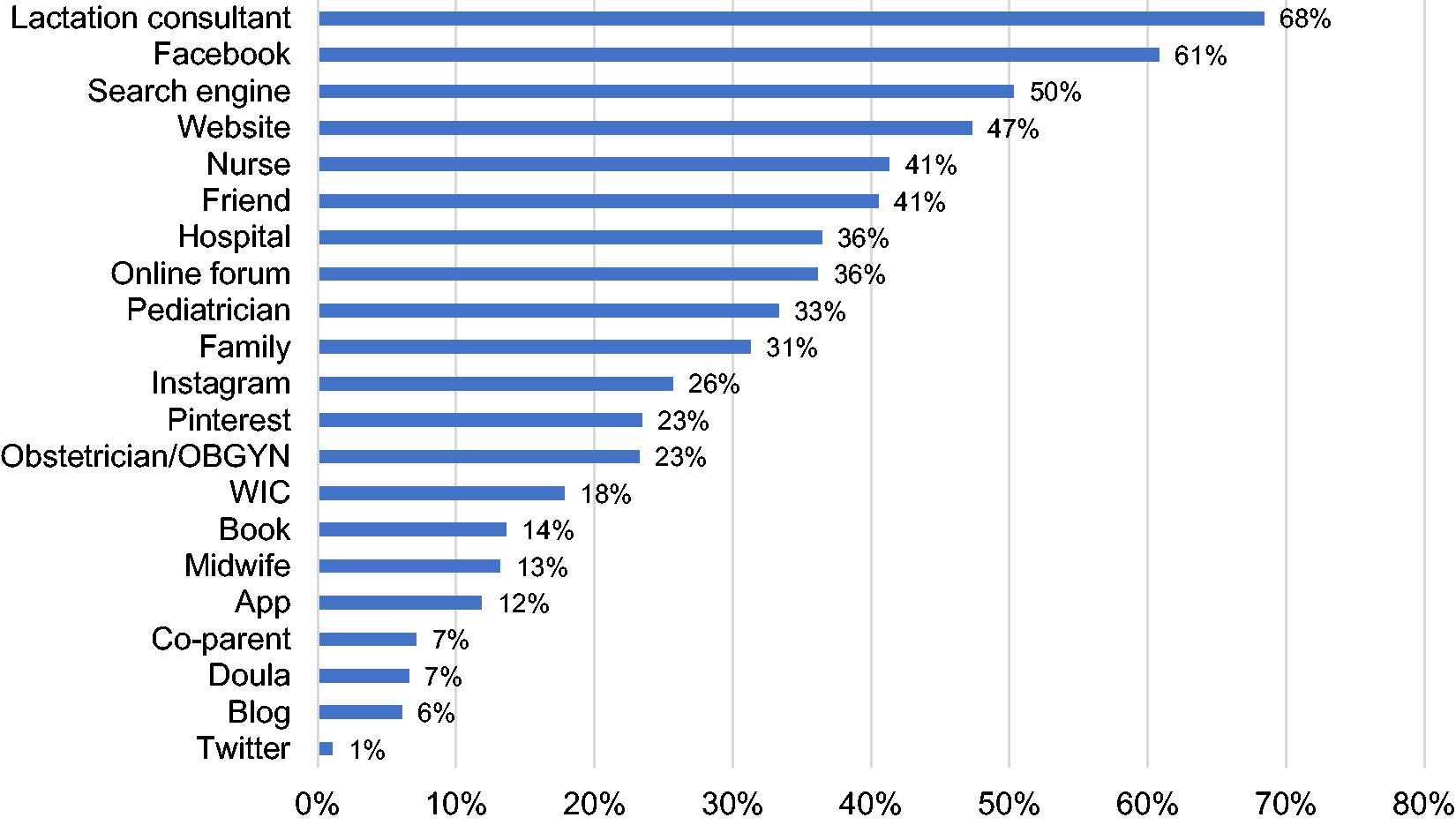
Reported sources of information about ways to increase breast milk supply among breastfeeding mothers in the United States (n = 1,351). OBGYN, obstetrician-gynecologist; WIC, Special Supplemental Nutrition Program for Women, Infants, and Children.
Participants’ perceived influence of each source on decision-making about their use of strategies to increase milk supply is presented in Figure 2. Lactation consultants were perceived as the most influential source (very influential: 77%), followed by midwives, WIC, doulas, and nurses (very influential: ≥50% of participants).
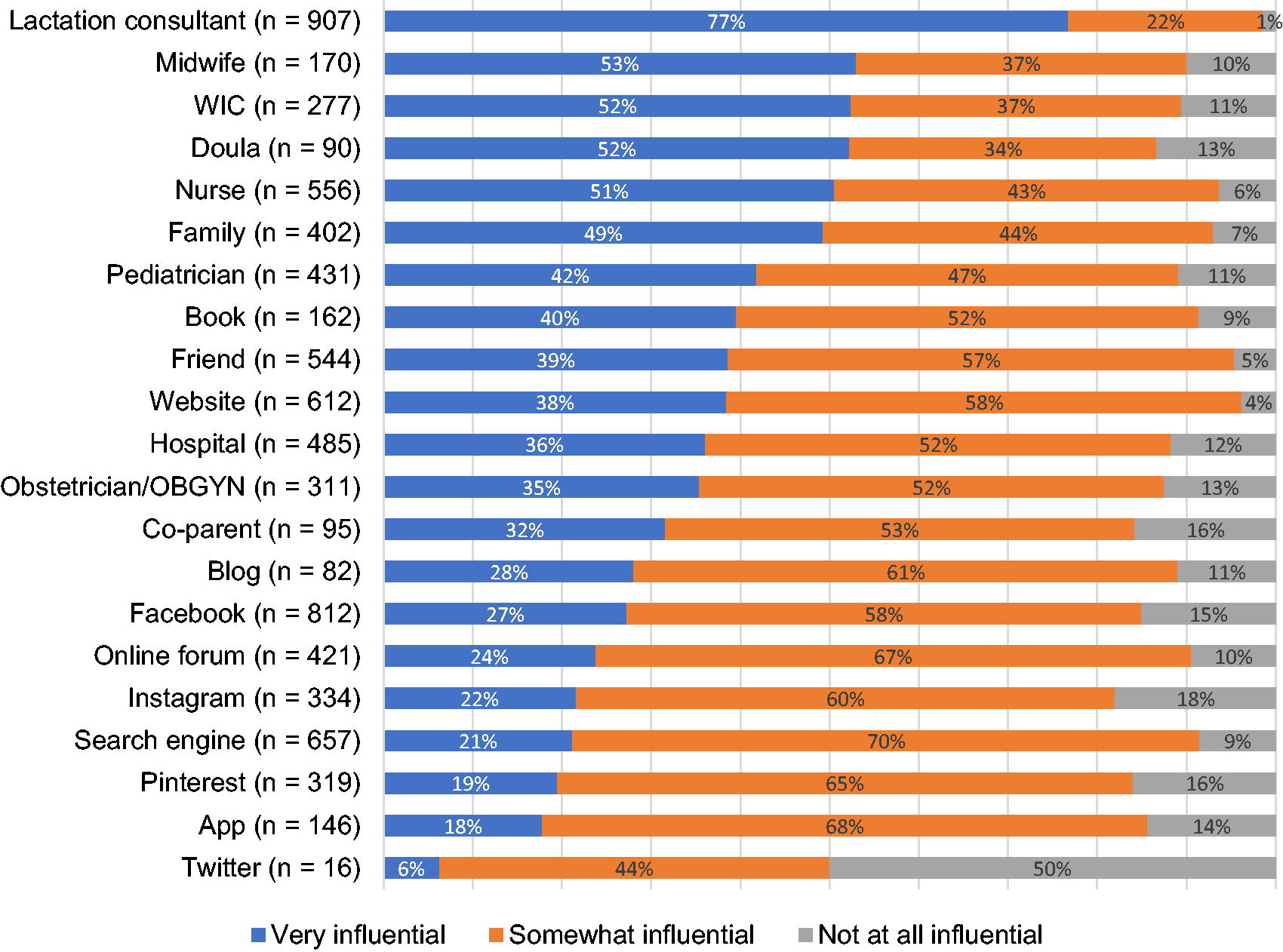
Perceived influence of information sources on decision-making about strategies to increase breast milk supply. OBGYN, obstetrician-gynecologist; WIC, Special Supplemental Nutrition Program for Women, Infants, and Children.
Associations between information sources and strategies for increasing milk supply
Bivariate analysis results comparing participants’ use of galactagogues and behavioral strategies for increasing their milk supply by information source use are presented in Table 2. Over half (60%) of all participants reported using galactagogues to increase their milk supply. Galactagogue use was more commonly reported among mothers who obtained information about ways to increase breast milk supply from internet sources (68% used galactagogues) compared with those who did not obtain information from internet sources (43% used galactagogues; p < 0.000; Cramer’s V = 0.23). Galactagogue use was also higher among mothers who obtained information from social media (Yes: 65% vs. No: 40%; p < 0.000; Cramer’s V = 0.21), family and friends (Yes: 65% vs. No: 53%; p < 0.000; Cramer’s V = 0.13), and lactation consultants (Yes: 63% vs. No: 54%; p < 0.002; Cramer’s V = 0.08) compared with mothers who did not obtain information from those sources. No associations were observed between galactagogue use and obtaining information from pediatricians, maternal health care professionals, WIC, or books (p > 0.003).
Comparison of Mothers’ Use of Galactagogues and Behavioral Strategies for Increasing Milk Supply by Information Sources Among a Sample of Breastfeeding Mothers in the United States (n = 1,351)
Family and friends = co-parent, family, friend.
Maternal health care professional = gynecologist/OBGYN, midwife, doula, nurses, hospital class, or pamphlet.
WIC = Special Supplemental Nutrition Assistance Program for Women, Infants, and Children.
Social media = Facebook, Instagram, Pinterest, Twitter, online forums.
Internet sources = search engine, website, blog, mobile application.
Cramer’s V.
Chi-square test of independence.
Bonferroni-adjusted value = 0.003.
Yes = Participants endorsed ever obtaining information about ways to increase breast milk supply from this source.
No = Participants endorsed that they did not remember ever obtaining information about ways to increase breast milk supply from this source.
Bold font = statistically significant at the Bonferroni-adjusted alpha level of p < 0.003.
The vast majority (95%) of all participants reported using behavioral strategies to increase milk supply. Behavioral strategies were more commonly reported among mothers who obtained information about ways to increase breast milk supply from internet sources (98% used behavioral strategies) compared with those who did not obtain information from internet sources (89% used behavioral strategies; p < 0.000; Cramer’s V = 0.19). Behavioral strategies were also higher among mothers who obtained information from social media (Yes: 95% vs. No: 88%; p < 0.000; Cramer’s V = 0.18), lactation consultants (Yes: 98% vs. No: 90%; p < 0.000; Cramer’s V = 0.18), maternal health care professionals (Yes: 98% vs. No: 91%; p < 0.000; Cramer’s V = 0.16), family and friends (Yes: 98% vs. No: 92%; p < 0.000; Cramer’s V = 0.14), and pediatricians (Yes: 98% vs. No: 94%; p = 0.001; Cramer’s V = 0.09) compared with mothers who did not obtain information from those sources.
Participants who used galactagogues obtained information about ways to increase breast milk supply from more total unique sources (median = 6 sources; IQR = 4–9) compared with non-galactagogue users (median = 5 sources; IQR = 3–7, M; Z = −7.91, p < 0.000). Similarly, participants who used behavioral strategies also obtained information from more total unique sources (median = 6 sources, IQR = 4–8) compared with participants who did not use behavioral strategies (median = 2 sources, IQR = 0–4, M; Z = −8.47, p < 0.000).
Discussion
This study contributes novel findings on information seeking behavior and the use of strategies for increasing milk supply in a large sample of actively breastfeeding women in the United States. Nearly all participants obtained information about ways to increase milk supply from at least one source. Lactation consultants were the most commonly reported source of information and were perceived as the most influential source on mothers’ decision-making about what strategies to use to increase their milk supply. Galactagogue use was higher among mothers who reported obtaining information about ways to increase milk supply from family and friends, lactation consultants, internet sources, and social media compared with mothers who did not use these sources. The use of behavioral strategies was higher among mothers who obtained information from these same sources along with maternal health care professionals and pediatricians.
Our findings that lactation consultants were a commonly accessed and influential information source are consistent with prior studies from the United States9,29 and Australia. 15 Breastfeeding mothers in other studies have described lactation consultants as helpful, 15 supportive, and informed. 29 Results from our qualitative study conducted among a subsample of the current study participants indicated that lactation consultants often had more frequent and enduring contact with mothers beyond the postpartum hospital stay and commonly provided help with breastfeeding problems, such as infant latch. 18 These results affirm the essential role of professional lactation consultants in providing ongoing breastfeeding support, including during the early postpartum period as breastfeeding is established and during later transition periods as breastfeeding challenges evolve with infant development and as parents face additional barriers to breastfeeding (e.g., returning to work). 30 Further research is needed to explore lactation consultant access, use, and influence among more diverse and understudied US populations, including single mothers, parents with marginalized racial and ethnic identities, 28 and parents who are gender diverse. 31
Although participants commonly obtained information from a variety of internet sources and social media, these sources were generally perceived as less influential in decision-making than family, friends, and health care and lactation professionals. A qualitative exploration of Australian women’s decision to use substances (e.g., herbal supplements) to increase milk supply found that participants took the information that they obtained from a variety of sources into consideration, including blogs and social media, during the decision-making process. 20 In the current study, most internet and social media sources were reported as being “somewhat influential.” It may be that breastfeeding parents discuss strategies for increasing milk supply that they learn about online with sources with whom they have a more personal connection as part of a “health information triangulation” process. 32 A separate factor that may have influenced participants’ information seeking behaviors in the current study is the COVID-19 pandemic, as the data were collected between January and April 2021.
Although nearly all participants reported trying behavioral strategies to increase their milk supply, galactagogue use was also reported by over half of the participants. Results from our prior analysis of this sample showed that the most commonly used galactagogues were oats, lactation cookies, sports drinks, combination herbal supplements, and lactation tea. 12 Experimental research on the effects of consuming specific foods or beverages on the volume of breast milk produced has been limited33,34 and has mostly focused on dietary supplement capsules, teas, and powders that contain potential galactagogue ingredients (e.g., fennel 35 and fenugreek 36 ), which have limited regulatory oversight by the U.S. Food and Drug Administration in the consumer marketplace. Notably, results of a recent randomized controlled trial found that lactation cookies were not effective at increasing objectively measured human milk production rate in a sample of breastfeeding parents (n = 176) who generally perceived their milk supply as adequate at baseline. 11 Results from the current study revealed that mothers were more likely to report using galactagogues when they obtained information about increasing milk supply from their family and friends, lactation consultants, social media, and internet sources. One possible explanation for these findings is that information about foods and herbal galactagogues are often promoted by family and friends18,20 or advertised online18,20 and may not be readily shared by health care professionals. 9
Notably, the same information sources that were associated with higher rates of galactagogue use were also associated with a higher likelihood of trying behavioral strategies to promote lactation—with the addition of maternal health care professionals and pediatricians. These results may indicate that mothers are more likely to obtain and use information on behavioral strategies from health care professionals. A minority of participants in our qualitative study reported that they received information about galactagogues from lactation consultants or WIC, but galactagogues were rarely discussed with other health care professionals. 18 Results from a separate study indicated that a substantial portion of U.S. health care providers promote the use of galactagogues. 37 However, opinions vary, and some health care providers have expressed concerns over the lack of evidence to support the use of galactagogues and, therefore, do not recommend them to their patients. 37 In addition to studies that test the safety and efficacy of galactagogues, translational research is needed that could support the dissemination and implementation of evidence-based breastfeeding support across health care providers and lactation consultants.
This study had several strengths and limitations that should be considered when interpreting the results. Our study was strengthened by pilot testing the survey with 10 members of the target population before it was administered to assess the face validity of all survey components and to support an inclusive and representative list of milk supply information sources. Although we were successful in recruiting a large sample of actively breastfeeding mothers in the United States, our convenience sampling approach yielded a sample with limited racial and ethnic diversity. Regarding the information sources, we did not distinguish between how information was obtained (i.e., the information channel) and the underlying source of information, nor did we clarify the exact information about increasing milk supply that mothers obtained. The cross-sectional study design limits conclusions about the relative timing of information seeking from specific sources and mothers’ use of specific strategies. It may be that mothers sought information from different sources after trying strategies that they found to be ineffective for increasing their milk supply. Future studies should clarify temporal aspects of mothers’ information seeking behaviors and their use of specific strategies for increasing milk supply.
Our findings also highlight the need for additional research on the content and recommendations provided by various information sources about how to increase milk supply. Such research is particularly important because information about galactagogues in the absence of breastfeeding support on behavioral strategies to increase the frequency and effectiveness of milk removal may lead to continued perceived insufficient milk and early breastfeeding cessation. 13 Greater awareness of what information is commonly shared about how to increase milk supply and through what channel could inform how clinicians discuss milk supply concerns with breastfeeding individuals. For example, clinicians could use the results of such research to promote credible information sources, acknowledge and correct for common types of misinformation, and be aware of gaps in information regarding milk production. Finally, our findings that internet sources and social media were widely used information sources and positively associated with the use of galactagogues highlight the need for additional research to explore products and recipes that are promoted online for increasing milk supply.
Conclusion
Breastfeeding mothers in the United States obtained information about increasing their breast milk supply from numerous and varied sources. Sources with whom mothers most likely have a close personal connection were rated as the most influential in their decision-making about how to increase milk supply, but social media and other internet sources were among the most commonly accessed sources. These results identify potential channels through which informational campaigns about effective strategies to maintain and increase breast milk production may be delivered. More than half of participants reported using galactagogues to try to increase their milk supply. Lack of empirical evidence and formal guidance to support galactagogue use, in particular, may leave breastfeeding parents navigating decision-making in the midst of breastfeeding challenges, postpartum hormonal changes, and sleep deprivation.18,20 Therefore, it may be advantageous to provide credible, evidence-based information about milk supply and galactagogue use prenatally. 19 Such recommendations highlight the need for additional research on the safety and efficacy of galactagogues and behavioral strategies and accompanying evidence-based recommendations for increasing milk supply.
Footnotes
Authors’ Contributions
R.R.: conceptualization (lead); data curation (lead); formal analysis (lead); writing—original draft (lead). J.D.B.: conceptualization (supporting); writing—reviewing and editing (supporting). A.L.: conceptualization (supporting); writing—reviewing and editing (supporting). A.D.H.: conceptualization (supporting); data curation (supporting); formal analysis (supporting); writing—reviewing and editing (lead).
Author Disclosure Statement
No competing financial interests exist.
Funding Information
Internal support from the Department of Nutrition and Food Studies at NYU Steinhardt and internal support from the Department of Nutritional Sciences and College of Education and Human Sciences at Oklahoma State University.