






Abstract

T
The popularity of feeding by wet nurses began to decline in the 19th century as shock and concern about depravity among wet nurses reached an all-time high and alternative milk sources (e.g., animals) were used. Studies conducted by Theodor Escherich, Chair of Pediatrics at the University of Vienna from 1902 to 1911, demonstrated that the intestinal bacteria of breastfed neonates were significantly different than that of infants fed by other means. His efforts resulted in eventual construction of the Imperial Institute for Maternal and Infant Care and in the opening of the first human milk bank in Vienna in 1909 (Table 1). The second human milk bank opened in Boston in the following year, and more continued to open throughout the United States and Europe during the 20th century.
AAP, American Academy of Pediatrics; EMBA, European Milk Bank Association; HMBANA, Human Milk Banking Association of North America; WHO, World Health Organization; UNICEF, United Nations Children's Fund.
In 1980, the World Health Organization (WHO) and the United Nations Children's Fund (UNICEF) released a joint statement supporting the use of human donor milk as the first alternative if the biological mother was unable to breastfeed. Other organizations released similar recommendations for the use of human donor milk and established regulations for human milk banks. Human milk banks provide the service of selecting, collecting, screening, storing, and distributing donated human milk to meet the specific needs of individuals for whom human milk is prescribed by healthcare providers. In 2010, the European Milk Bank Association (EMBA) was established to promote breastfeeding and milk banking and to encourage international cooperation between human milk banks throughout Europe. The EMBA has working groups to develop European guidelines for donor milk banks, as well as to assess best practices for the processing and fortification of human milk. Currently, Holder pasteurization and standard fortification (i.e., addition of a fixed, recommended amount of multicomponent human milk fortifier to a certain volume of human milk) are the most widely used methods; however, these methods may not provide optimal nutrition, particularly in preterm infants.1,2
Today, there are ∼500 human milk banks operating in more than 37 countries worldwide. In Europe, there are 210 active human milk banks, with France, Italy, and Sweden having the largest number of banks (Fig. 1); the number of human milk banks is continuously increasing. At the end of 2017, 36 human milk banks were operating in Italy, and their activity is coordinated by the Italian Association of Human Milk Banks (AIBLUD). In 2010, AIBLUD published guidelines on the establishment and operation of human milk banks. 3 AIBLUD recently collaborated with the Italian Ministry of Health to develop the “Italian National Recommendations for the Organization and Management of Human Milk Banks as a Tool for the Protection, Promotion and Support of Breastfeeding.” The recommendations aim to define uniform criteria for the establishment of human milk banks, define essential requirements for service and quality standards, and set control criteria for the monitoring of milk bank activities.
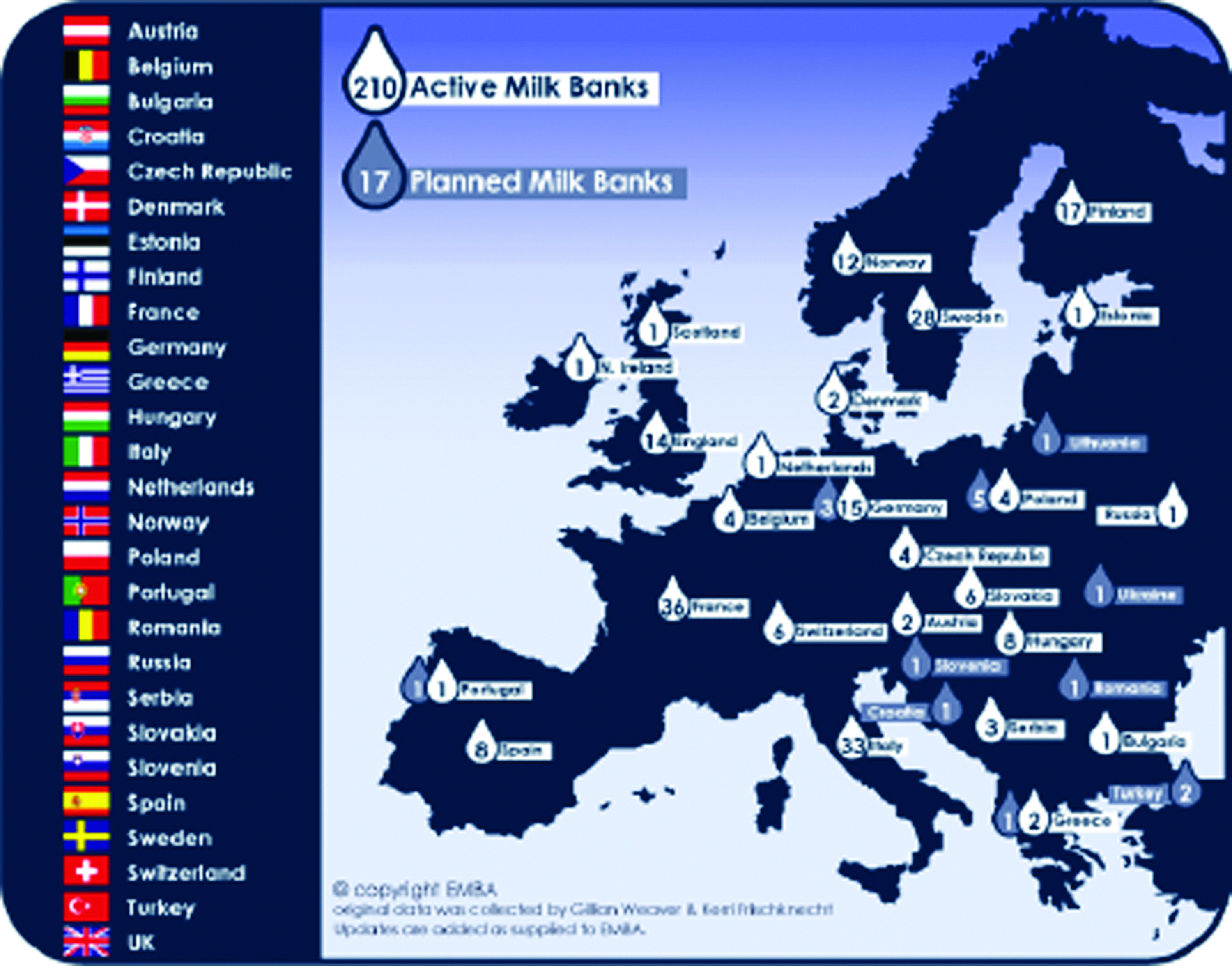
Human milk banks in Europe: 2017.