






Abstract
T
Reduced costs and advances in sequencing technology and applications have allowed researchers to map the microbiome like never before. For example, Quantitative Insights Into Microbial Ecology, or QIIME, is a an open source software package for comparison and analysis of microbial communities. 3 QIIME can be used to process high-throughput sequencing data into a microbiome map in which all the complexity in a microbial community is distilled down into a single point (Fig. 1). Points closer together are more similar, whereas points further apart are more dissimilar. Different parts of the body have completely distinct microbiomes, and these microbiomes can vary based on lifestyle, diet, and environmental factors.
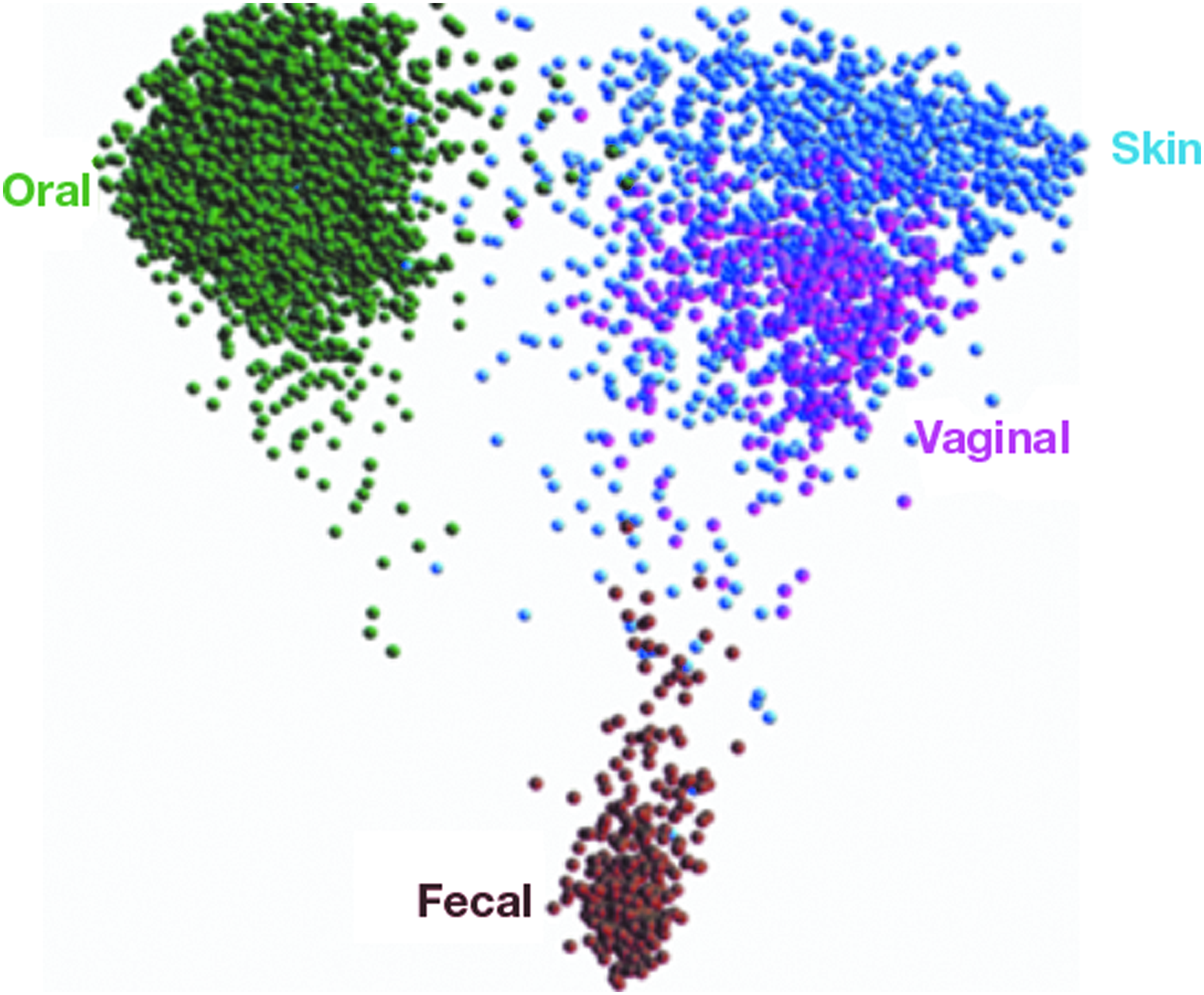
Map of the human microbiome.
Establishment of the initial microbiome in neonates can vary based on delivery method, with vaginally delivered infants acquiring bacterial communities resembling their mother's vaginal microbiota and infants born by cesarean delivery acquiring bacterial communities similar to those found on their mother's skin (Fig. 2). 4 Cesarean delivery has been associated with increased risk of immune and metabolic disorders, suggesting initial differences in the microbiome may have important consequences later in life. A small pilot study demonstrated that infants delivered by cesarean section who were exposed to maternal vaginal fluids at birth had microbiota more similar to those of vaginally delivered infants. 5 Breast milk could also potentially be used to reverse some of the effects of delivery mode, as well as antibiotic use, in infants delivered by cesarean section. 6 The microbiome continues to evolve during the first few years after birth, reaching an adult-like state by around 3 years of age (Fig. 3). 7
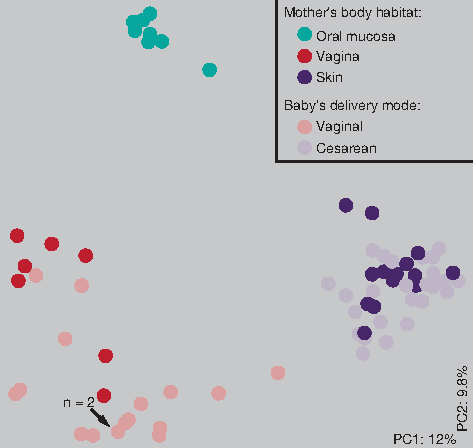
Delivery mode affects establishment of the initial microbiota in newborns. 4
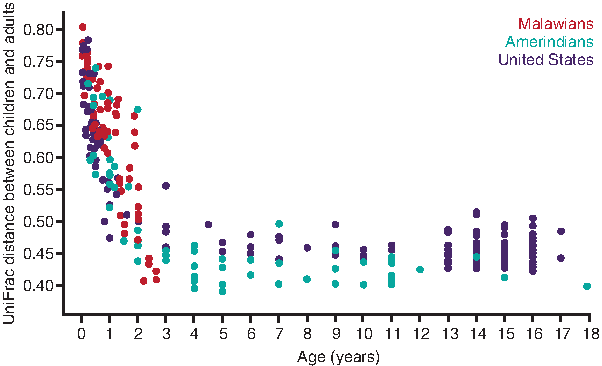
Differences in fecal microbial communities by age. 7
The American Gut Project is a crowdfunded study designed to compare the microbial diversity of the human gut around the world. Preliminary findings from the study have identified many unanticipated factors that affect the microbiome, such as age, sleep, and the variety of plants consumed. Similar analyses are also being performed in infant populations. Data from the study may also be used to understand the relationship between human diseases and gastrointestinal microbiota. Mapping the microbiome could help determine what interventions (e.g., diet changes and fecal transplants) may help restore a healthy microbiome. This could be an interesting application to help treat necrotizing enterocolitis in preterm infants; changes in the infant microbiome could be tracked through treatment and recovery. Microbial “growth curves” could be developed for other diverse infant populations to measure the impacts of breastfeeding, antibiotic treatment, and delivery mode on the microbiome.
Cystic fibrosis (CF) is an example of a disease in which the microbiome can alter pathogenesis and patient outcomes. Chronic lung infections are a serious and potentially fatal complication of CF. 8 Studies are underway to generate a three-dimensional map of the microbial chemistry associated with CF in lungs obtained from end-stage CF patients requiring lung transplants. 9 Characterizing the changes in the lung microbiome may help develop more effective and personalized treatments for CF patients. Many of the techniques developed to study the microbiome in CF and other diseases in adults can also be applied to infant and child populations.