






Abstract
A central goal of The Academy of Breastfeeding Medicine is the development of clinical protocols for managing common medical problems that may impact breastfeeding success. These protocols serve only as guidelines for the care of breastfeeding mothers and infants and do not delineate an exclusive course of treatment or serve as standards of medical care. Variations in treatment may be appropriate according to the needs of an individual patient.
Definitions
Breastfeeding-Friendly physician's office
Breastmilk substitutes
Infant formula, glucose water, or other liquids given in place of human milk.
Background
A mother's prenatal intention to breastfeed is influenced to a great extent by the opinion and support of the healthcare providers she encounters.1–5 Ongoing parental support through in-person visits and phone contacts with healthcare providers usually results in increased breastfeeding duration.6–12 Healthcare providers who interact with mothers and babies are in a unique position to contribute to the initial and ongoing support of the breastfeeding dyad.3–5,11–15 Practices that employ a healthcare professional trained in lactation have significantly higher breastfeeding initiation and maintenance rates, with mothers experiencing fewer problems related to breastfeeding.16–20 The World Health Organization's Baby-Friendly Hospital Initiative describes Ten Steps for Successful Breastfeeding.21,22 These Ten Steps are based on scientific evidence and the experience of respected authorities. The scientific basis of many of these recommendations can also be extended to outpatient practices caring for infants and young children.14,16,17 Even initiating incremental changes to improving breastfeeding support is of value because there is a “dose–response” relationship between the number of steps achieved and breastfeeding outcomes. 23
Recommendations
Quality of evidence (levels of evidence I, II-1, II-2, II-3, and III) for each recommendation, as defined in the U.S. Preventive Services Task Force guideline for “Quality of Evidence,” 24 is noted in parentheses.
1. Establish a written breastfeeding-friendly office policy.16,17,21 Collaborate with colleagues and office staff during development. Inform all new staff about the policy. Provide copies of your practice's policy to hospitals, physicians, and all healthcare professionals covering your practice for you. (III)
2. Offer culturally and ethnically competent care. 25 Understand that families may follow cultural practices regarding discarding of colostrum, maternal diet during lactation, and early introduction of solid foods. Provide access to a multilingual staff, medical interpreters, and ethnically diverse educational material as needed within your practice. (III)
3. If providing antenatal care for the mother, introduce the subject of infant feeding in the first trimester and continue to express your support of breastfeeding throughout the course of the pregnancy. If you are a physician providing postnatal care for the infant, you can offer a prenatal visit to become acquainted with the family during which your commitment to breastfeeding can be shown.2,7,8 Use open-ended questions, such as “What have you heard about breastfeeding?,” to inquire about a feeding plan for this child. Provide educational material that highlights the many ways in which breastfeeding is superior to formula feeding. Encourage attendance of both parents at prenatal breastfeeding classes. Direct education and educational material to all family members involved in childcare (father, grandparents, etc.).1,13,26 The father of the infant is particularly important in support of the mother. 26 Identify patients with lactation risk factors (such as flat or inverted nipples, history of breast surgery, no increase in breast size during pregnancy, previous unsuccessful breastfeeding experience) to enable individual breastfeeding care for her particular situation. (I, II-1, II-2, II-3, III)
4. Physician interaction with the breastfeeding dyad in the immediate postpartum period depends on the system of healthcare and insurance systems in his or her country. For example, if you are in a system in which you can see the infants while in-hospital, you can collaborate with local hospitals and maternity care professionals in your community,16,23,25 providing your office policies on breastfeeding initiation within the first hour after birth to delivery rooms and newborn units. Leave orders in the hospital or birthing facility not to give formula/sterile water/glucose water to a breastfeeding infant without specific medical orders and not to dispense commercial discharge bags containing infant formula, formula coupons, and/or feeding bottles to mothers.27,28 Show support for breastfeeding during hospital rounds. Help mothers initiate and continue breastfeeding. Counsel mothers to follow their infant's states of alertness as they relate to hunger and satiety cues and ensure that the infant breastfeeds eight to 12 times in 24 hours. 29 Encourage rooming-in and breastfeeding on demand. (I, II-2, III) If you are in a system in which hospital staff members are responsible for the care of the newborns in the hospital and outside physicians do not give orders to hospital staff, you will not be able to see babies and offer support to the mothers until after discharge (see point 6 below). However, in many countries hospitals will have received Baby-Friendly Hospital training where mothers should receive good support while inpatients.
5. Encourage breastfeeding mothers to feed newborns only human milk and to avoid offering supplemental formula, glucose water, or other liquids unless medically indicated.25,30 Advise the mother not to offer a bottle or a pacifier/dummy until breastfeeding is well established.31,32 (I, III)
6. In many areas of the world, the first follow-up visit will be done by non–physician healthcare workers. 33 In most European countries midwives care for the mother and infant in the days and weeks after discharge from the hospital. In Germany, for example, every mother and infant has the right to a midwife (often up to 8 weeks of daily visits) covered by insurance. Mothers contact their pediatrician within the first 3 weeks of delivery for the infant's first check-up, which is covered by insurance. In this system, this is the first opportunity the pediatrician has to support breastfeeding. In other countries, such as Australia and New Zealand, routine medical care of infants is undertaken by general practitioners (family physicians), and infants may never visit a pediatrician. In countries such as the United States, where the postpartum care of the mother and infant is done by physicians or physician extenders (for example, physician assistants, nurse practitioners), schedule a first infant follow-up visit 48–72 hours after hospital discharge or earlier if breastfeeding-related problems, such as excessive weight loss (>7%) or jaundice, are present at the time of hospital discharge.25,30,34 (In cultures or medical situations in which the dyad has remained hospitalized for long enough that weight gain and parental confidence are established prior to hospital discharge, follow-up may be deferred until 1–2 weeks of age if otherwise appropriate. For example, in Japan the dyad usually stays in hospital for 5–6 days after childbirth. The Japanese Pediatric Society recommends the first visit to the pediatrician 1 week after discharge, when the infant is about 2 weeks old.) Ensure there is access to a lactation consultant/educator or other healthcare professional trained to address breastfeeding questions or concerns during this visit. Advise the mother that feeding will be observed during the visit so that she can let staff know if the infant is ready to breastfeed while she is waiting. Provide comfortable seating, privacy, and a nursing pillow as needed for the breastfeeding dyad to facilitate an adequate evaluation.
Begin by asking parents open-ended questions, such as “How is breastfeeding going?,” and then focus on their concerns. Take the time to address the many questions that a mother may have. Assess latch and successful and adequate milk transfer at the early follow-up visit. Identify lactation risk factors and assess the infant's weight, hydration, jaundice, feeding activity, and output. Provide medical help for women with sore nipples or other maternal health problems that may impact breastfeeding. Provide close follow-up until the parents feel confident and the infant is doing well with adequate weight gain by the World Health Organization Child Growth Standards. 35 (III)
7. Ensure availability of appropriate educational resources for parents. In accordance with the World Health Organization International Code of Marketing of Breast-milk Substitutes, 36 educational material should be noncommercial and should not advertise human milk substitutes, bottles, or nipples/teats. 28 Educational resources may be in the form of handouts, pictures, books, and DVDs. Recommended topics for educational material can include growth patterns, feeding and sleep patterns of breastfed babies, management of growth spurts, recognition of hunger and satiety cues, positioning and attachment, management of sore nipples, mastitis, low supply, blocked ducts, engorgement, reflux, normal stool and voiding patterns, maintaining lactation when separated from the infant (for example, during illness, prematurity, or return to work), breastfeeding in public, postpartum depression, maternal medication use, and maternal illness during breastfeeding). (I)
8. Allow and encourage breastfeeding in the waiting room. Display signs in the waiting area encouraging mothers to breastfeed (Figs. 1 and 2). Provide a comfortable private area to breastfeed for those mothers who prefer privacy.2,10,14,17 Do not interrupt or discourage breastfeeding in the office. (II-2, II-3)
Breastfeeding-friendly graphic in a family physician's office in the United States. Printed with permission of Tim Tobolic, MD, FABM. Breastfeeding-friendly graphic in a family physician's office in the United States. Printed with permission of Tim Tobolic, MD, FABM.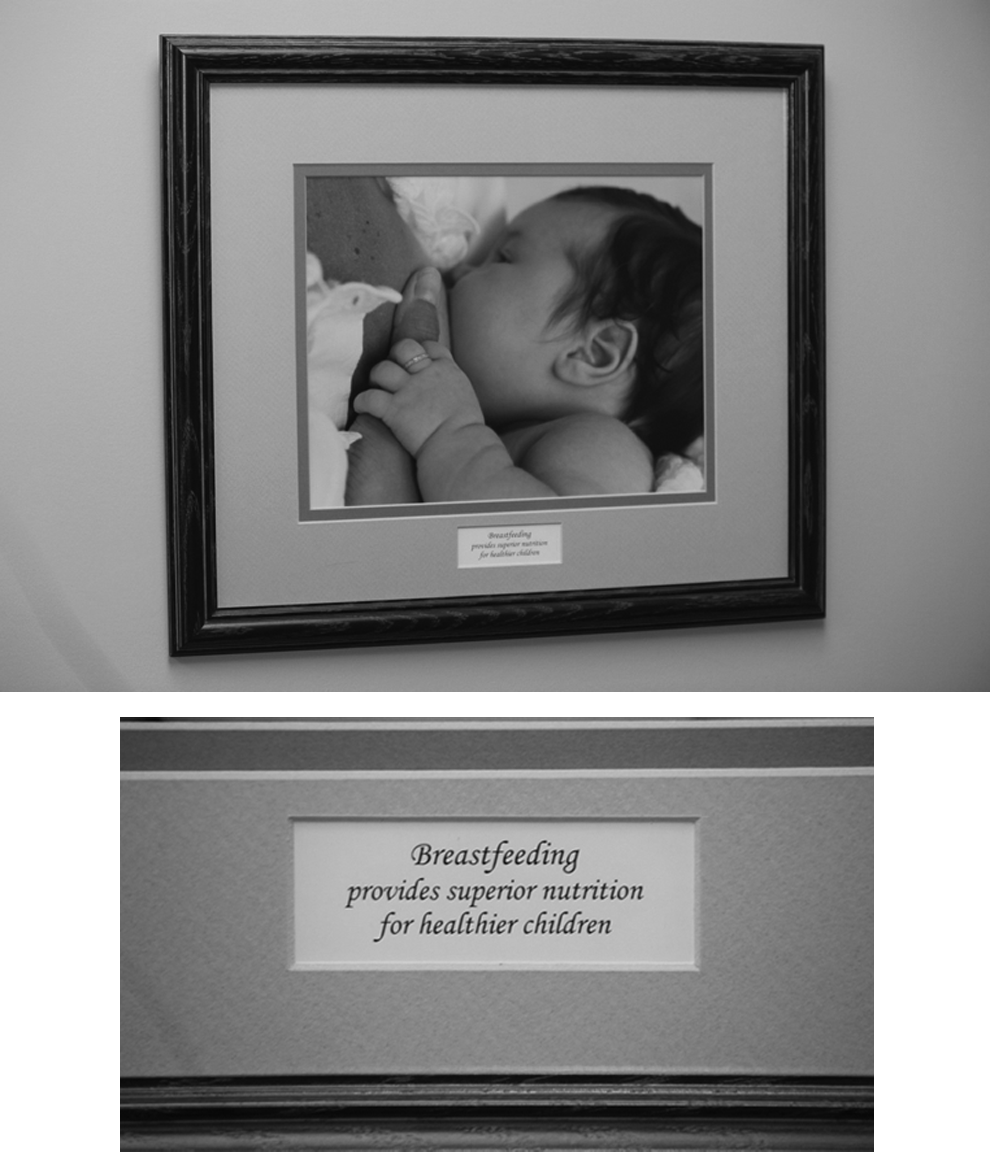

9. Ensure an office environment that demonstrates breastfeeding promotion and support. Eliminate the practice of distribution of free formula and baby items from formula companies to parents.27,28 In accordance with the World Health Organization Code, 36 store formula supplies out of view of parents. Display noncommercial posters, pamphlets, pictures, and photographs of breastfeeding mothers in your office.1,14,17 Do not display images of infants bottle-feeding. Do not accept gifts (including writing pads, pens, or calendars) or personal samples from companies manufacturing infant formula, feeding bottles, or pacifiers/dummies. 36 Specifically target educational material to populations with low breastfeeding rates in your practice. (II-2, II-3)
11. Commend breastfeeding mothers during each visit for choosing and continuing breastfeeding. Provide breastfeeding anticipatory guidance, give educational handouts, and discuss breastfeeding goals at routine periodic health maintenance visits. Encourage fathers of infants and other infant caregivers to accompany the mother and infant to office visits.3–5,11,26 (I, II-1, II-2, II-3)
12. Encourage mothers to exclusively breastfeed for 6 months and to continue breastfeeding with complementary foods until at least 24 months and thereafter as long as mutually desired. Discuss the introduction of solid food at 6 months of age, emphasizing the need for high-iron solids and recommend supplementing vitamins (for example, vitamin D, K, or A) in accordance with published standards, 25 which vary depending on recommendations of the medical society of the country of practice. (III)
13. Set an example for your patients and community. Have a written breastfeeding employee policy and provide a lactation room with supplies for your employees who breastfeed or express milk at work.16,38,39 (II-2, III) For countries with long paid maternity leaves (for example, 12 months in Germany), this may not be as relevant as for countries with no or short paid maternity leaves.
14. Acquire or maintain a list of community resources (for example, breast pump rental locations) and be knowledgeable about referral procedures. Refer expectant and new parents to peer, community support, and resource groups. Identify local breastfeeding specialists, know their background and training, and develop working relationships for additional assistance. Support local breastfeeding support groups.6,19,33,40,41 (I, II-3, III)
15. Support and advocate for health policy that incorporates the costs of breastfeeding care into routine health services in those countries in which it is not. These costs also include consultation and equipment that may be needed for particular clinical situations.
16. Where laws exist, enforce workplace laws that support breastfeeding. Where laws do not exist, encourage employers and daycare providers to support breastfeeding.38.39 Web sites are available to provide material to help motivate and guide employers in providing lactation support in the workplace. 38 (II-2, III)
17. All clinical physicians should receive education regarding breastfeeding, beginning in the preclinical years.13,42–46 Areas of suggested education include the risks of artificial feeding, the physiology of lactation, management of common breastfeeding problems, and medical contraindications to breastfeeding. Make available educational resources for quick reference by healthcare professionals in your practice (books, protocols, Web links, etc. [Table 1]). Staff education and training should be provided to all, including front office staff, nurses, and medical assistants. Identify one or more breastfeeding resource personnel on staff. In countries where the practice model makes it possible, consider employing a lactation consultant or a nurse trained in lactation. If this is not possible, network with other professionals and participate in local perinatal networks as available and appropriate to your location.6,19,33 (I, II-2, II-3)
18. Volunteer to let medical students and residents rotate in your practice. Participate in medical student and resident physician education. Encourage establishment of formal training programs in lactation for current and future healthcare providers.42–46 (II-2, II-3)
19. Track breastfeeding initiation and duration rates in your practice and learn about breastfeeding rates in your community.
Obstacles to Providing Breastfeeding Care
Establishing a Breastfeeding-Friendly office will present some challenges. In the United States and some other nations, primary care services have traditionally received reimbursement based primarily on numbers of patients seen rather than the quality of care delivered. 47
Breastfeeding management and counseling are often labor-intensive. In systems in which the finances of the office are dependent on numbers of patients seen, without reassurance that the practice will be reimbursed for time invested in caring for the breastfeeding dyad, the provider will be under considerable pressure to forego or abbreviate such care. Even if reimbursement is not an issue, the time constraints of scheduling as many patients as possible during the day tend to preclude labor-intensive interventions. Complicated breastfeeding problems will often require immediate attention and may result in disruption of efficient patient flow; patients with previously scheduled appointments will be kept waiting too long.
Although the physician may have a staff member to assist dyads experiencing breastfeeding difficulties, the time spent by a nonprovider lactation specialist in the United States is usually poorly reimbursed, if reimbursed at all. Referral to other breastfeeding support services will likely be an extra expense requiring payment by the family.
These obstacles, while daunting, are not insurmountable. For example, advocacy in the United States has led to strong public health recommendations and recent legislation requiring insurance coverage of breastfeeding services; implementation is in the early phases.46,47 Insurance coverage for lactation consultant services would greatly enhance breastfeeding care at many levels. Because of the uniqueness and complexity of the U.S. healthcare system, some suggestions specific to current U.S. financial and care policy are listed in the Appendix.
Recommendations for Future Research
1. A large, multicenter, prospective, randomized study should evaluate the routine use of an International Board Certified Lactation Consultant (IBCLC) versus nonuse in the outpatient setting. The control group will have “usual breastfeeding support.” Outcomes assessed should include the duration of exclusive breastfeeding and duration of non–formula feeding after the introduction of complementary foods, ideally following breastfeeding rates until at least 1 year of age. A retrospective study of this intervention at a single site showed an improvement in non–formula feeding, 6 but a multicenter trial will evaluate effectiveness in other settings. As many physicians themselves outside the United States also have the IBCLC designation, this may not be a helpful study in these settings.
2. A large multicenter trial should evaluate the effectiveness of having mothers set breastfeeding goals. A very small pilot study showed that an intervention that included educational handouts and mothers setting breastfeeding goals increased breastfeeding duration and exclusivity. 15 A larger study could use the intervention at each prenatal and well-infant visit up to 1 year, even if prenatal care and well-infant care are delivered at separate sites (i.e., an obstetrics office and a pediatric office). The intervention could be evaluated in different populations, with greater ethnic and socioeconomic diversity and specifically including high-risk populations. Should this intervention prove effective across varied populations, the surveys and handouts could be used to develop a standard tool that could be easily reproduced and distributed, analogous to those used to assess developmental milestones.
3. A large pre- and post-intervention trial could evaluate the impact of continuing medical education concerning breastfeeding for practicing physicians. Outcomes assessed should include rates of breastfeeding initiation and exclusivity and non-formula feeding after the introduction of complementary foods.
4. More studies regarding the cost-effectiveness of steps related to making an outpatient practice breastfeeding-friendly are needed.
Footnotes
Acknowledgments
This work was supported in part by a grant from the Maternal and Child Health Bureau, U.S. Department of Health and Human Services.