




Abstract
Background:
The objective of this review was to explore autistic experiences of parenthood, as described by autistic people, from conception to relationships with adult children. In addition, we sought to identify whether particular aspects of parenting and/or particular groups of parents are underrepresented in the already sparse literature on autistic parenting.
Methods:
We searched 10 key databases for articles that reported data on the perspectives and/or experiences of autistic people (formally diagnosed or self-identifying) at any stage of the parenting journey. Following the initial search, we undertook an iterative process of forward and backward searching until no additional relevant articles were identified.
Results:
We identified a total of 167 articles and included 44 articles in the review following title and abstract review and full-text review. This consisted of four review articles, 12 articles that reported on quantitative studies, and 28 that reported on qualitative studies, with 28 of the 44 included articles published in the past 3 years. Communication challenges were highlighted across the majority of the studies, particularly in relation to communication with health care and other services in relation to participants’ children. Sensory issues associated with pregnancy, childbirth, and parenting were also common themes. However, studies also identified strengths of autistic parents including empathy with their child(ren), and a high degree of focus and commitment to child and family well-being. The majority of study participants were mothers, White, and parenting babies or young children.
Conclusions:
A consistent theme across the studies was the external nature of many of the challenges of autistic parenting and the internal nature of many of the strengths. It is perhaps not being an autistic parent that is in itself challenging, but rather the way that autistic parents are (mis)understood and (un)supported by systems designed for neurotypical parents.
Community Brief
Why is this an important issue?
Research into “autism” and “parenting” largely focuses on the experiences of non-autistic parents of autistic children. There is far less research on the experiences of autistic parents. It is likely that autistic people have different parenting experiences than non-autistic people. Previous literature reviews have focused mainly on pregnancy, childbirth, and infant feeding. That does not tell us what happens to autistic parents when their children get older.
What was the purpose of this study?
We wanted to understand what has been published in the literature about experiences of parenthood, as described by autistic people. We wanted to know what questions were being asked in the research, who was asking them, and who they were asking. We also wanted to know whether the research was looking at the strengths of autistic parents, and not just their challenges.
What did the researchers do?
The autistic-led research team searched academic databases for articles that reported autistic people’s parenting experiences. We only included articles that had autistic parents’ voices, not other people talking about them. When we had found the relevant articles from the databases, we checked their reference lists for earlier articles. We also checked other databases to see whether more recent articles had been written that mentioned the ones we had found.
What were the results of the study?
We found 167 articles. We excluded 113 after reading the titles and abstracts and another 26 after we read the full articles. We included a total of 44 articles in the review. There has been a considerable increase in research into autistic parenting in recent years, with 28 of the 44 articles published in the past 3 years. Much of the research focuses on pregnancy, childbirth, infant feeding, and raising young children. There is less research on parenting older children or adults. The research identifies common challenges for autistic parents, including sensory issues and communication barriers. Autistic parents have difficulty communicating with health professionals and experience stigma and misunderstanding. There is less research into the strengths of autistic parents. The research that does exist consistently reports evidence of high levels of empathy, commitment to their children’s well-being, and positive parent–child relationships.
What do these findings add to what was already known?
These findings bring together the limited research on the experiences, and particularly the strengths, of autistic parents. They also demonstrate the significant gaps in the current research, including the experiences of autistic fathers, parents who do not identify as mothers/women or fathers/men, non-White autistic parents, parents of older children, and studies specifically focusing on parenting strengths.
What are potential weaknesses in the study?
The small number of studies limited our ability to draw conclusions about some things. Our interpretations of the research findings are influenced by our own perceptions and lived experiences.
How will these findings help autistic adults now or in the future?
This review creates a starting point for increasing our understanding of autistic parents’ experiences. Importantly, it demonstrates that autistic parents are different from, not “less than” or “worse than,” non-autistic parents.
Introduction
Autism is a lifelong condition. However, research into the autistic experience has traditionally focused on the early years of life. There is a large body of literature on the experiences of autistic infants and children, although reported from the perspective of caregivers, educators, and health professionals. Historically, there has been far less research on the experiences of autistic adults, although this is changing—with this journal a key contributor.
One important life transition that is particularly neglected in the literature is the experience of parenthood. There is an abundance of literature on the experiences of (predominantly) non-autistic people a parenting autistic children, much of it focused on the “challenges” of doing so. Topics addressed in depth in the literature include parents’ responses to their child’s diagnosis,1,2 parental stress and/or mental health,3–8 parents’ quality of life,4,9,10 experiences of affiliate stigma, 11 and the economic burden of raising an autistic child. 12
Conversely, a 2011 review of the literature specifically on autistic people’s experiences of parenting, broadly defined, identified only 13 published articles, 13 2 of which did not contain data directly from or attributable to autistic parents. Significantly, the majority of articles identified by the review focused on the experiences of pregnancy, childbirth, and/or parenting an infant. However, parenting—similar to autism—is a lifelong condition. Thus, understanding the autistic experience of parenting, and how it is similar to and differs from, the non-autistic experience, requires thorough study of the lived experience of autistic parents, including fathers, at all stages of the parenting journey.
A specific aspect of the autistic experience that underpins much of the (very limited) research into autistic parenting undertaken to date is the sensory challenges that are often associated with autism14–16 and the sensory demands that are associated with pregnancy, childbirth, and early parenting. Similarly, given that these early stages of parenting require ongoing interaction with the health care system, and that there is considerable evidence that autistic people’s communication challenges are exacerbated in health care environments,17,18 these aspects are beginning to be the focus of research.
As researchers embarking on a series of studies into the experiences of autistic parents, we undertook a scan of the literature and identified that there had been a recent surge in research in this area. A preliminary search of PROSPERO, MEDLINE, the Cochrane Database of Systematic Reviews, and JBI Evidence Synthesis was conducted to identify any previous, current, or underway systematic reviews or scoping reviews on the topic. Four published review articles were identified. Three of these explored a specific aspect of autistic parenting, either experiences of pregnancy and childbirth,19,20 or experiences of infant feeding. 21 Only one, published 3 years ago, explored autistic parenting beyond the infant stage. 13 Only one review was located that was underway, and this focused specifically on aspects of the perinatal period. As our initial scan had identified more than a dozen articles published subsequent to these reviews, we felt that an updated and comprehensive review of the extant literature would be a significant contribution to researchers and practitioners seeking to understand what is known about the experiences of autistic parents and to identify the current gaps in the research base.
The objective of this review was to explore autistic experiences of parenthood, as described by autistic people, from conception to relationships with adult children. In addition, it sought to identify whether particular aspects of parenting and/or particular groups of parents are underrepresented in the already sparse literature on autistic parenting. The review was registered with PROSPERO on January 29, 2024 [CRD42024501055].
Review question
An individual’s parenting experience is influenced by a range of factors beyond their neurotype. Thus, the review did not seek to define or describe “autistic parenting” but rather to answer the question: What does the literature tell us about the experiences of autistic people as parents?
Methods
Inclusion criteria
Articles were included where they reported data on the perspectives and/or experiences of autistic people (formally diagnosed or self-identifying) at any stage of the parenting journey, from conception to parenting adult children. Exclusion criteria included studies of nonhuman subjects, non-autistic parents of autistic children, or parents with “autistic traits” who were neither diagnosed nor self-identified as autistic. Studies that solely reported data from medical records or perspectives of other people (such as health professionals) on the experiences of autistic parents were also excluded.
For the purpose of this review, parenting was defined as bringing up a child in the role of a parent. This includes biological parents, step-parents, adoptive and foster parents, or others acting in the role of primary caregivers who have sole or shared responsibility for the care of a child of any age. The review was not limited to a specific geographic location or setting. The concept and context of parenting were not defined or limited by gender identity or traditional family structures.
Given the paucity of research in this area, the review was not limited to articles that were solely focused on parenting, but also included articles that reported data on autistic parenting as a primary, secondary, or partial focus. All study designs were considered eligible for inclusion in the review, as long as they contained data collected directly from autistic parents. The review included quantitative and qualitative studies, as well as systematic reviews, text, and opinion articles that met the inclusion criteria.
Search strategy
The search strategy aimed at locating a broad range of published studies. An initial, limited search of MEDLINE (PubMed), Scopus, and CINAHL (EBSCO) was undertaken to identify articles on the topic. Words contained in the titles and abstracts of relevant articles and index terms used to describe the articles were used to develop a full search strategy.
The search string used (adapted for each database as appropriate) was as follows: “autistic mother*” OR “autistic parent*” OR “autistic father*” OR “autistic caregiver” OR “autistic carer.” We did not include person-first search terms (e.g., “parent* with autism”) due to the extremely high number of irrelevant articles located using this term in the initial search.
The databases searched were Scopus, PubMed, Academic Search Ultimate, E-Journals, Humanities Source Ultimate, APA PsycARTICLES, Psychology and Behavioral Sciences Collection, APA PsycINFO, Sociology Source Ultimate, and CINAHL Ultimate. The searches were conducted in January 2024. An example of the search is provided for replicability purposes. b The search of Scopus was conducted on January 10, 2024, using the search string “autistic mother*” OR “autistic parent*” OR “autistic father*” OR “autistic caregiver” OR “autistic carer” [all fields, limited to publications in English] returned 118 hits: 97 journal articles, 21 reviews, 6 books, 4 book chapters, 3 notes, 2 editorials, 1 short survey, and 1 letter.
Given the anticipated limited number of studies (based on the results of previous reviews), the original intent was for all publication types to be included. However, this was later limited to peer-reviewed studies. The two primary reasons for this change were the number of book chapters identified that could not be accessed through the library databases, and the large number of nonreviewed articles (such as online articles) for which the identity of the author could not be verified. No limits were set on date range, but only studies published in English were included. Following the database search, the reference list of all sources that met the inclusion criteria was screened for additional studies (backward search) and a citation search was conducted for all included studies (forward search). This was an iterative process, repeated for each new inclusion until no additional sources were identified. This process was completed in February 2024.
Study/source of evidence selection
Following the search, all identified citations were collated and uploaded into Endnote v21 and duplicates removed. Citation details were imported into the JBI System for the Unified Management Assessment and Review of Information (JBI SUMARI) (JBI, Adelaide, Australia). Titles and abstracts were screened by two independent reviewers for assessment against the inclusion criteria for the review; S.T.J. reviewed all articles and C.B. and S.A. each reviewed 50%. Discrepancies were resolved in discussion with all three reviewers. Potentially relevant sources were retrieved in full, and their full text assessed in detail against the inclusion criteria by two reviewers, with discrepancies resolved in discussion with all three reviewers. This process was repeated following each iteration of the backward and forward search.
Quality was assessed using the JBI-SUMARI tools for critical appraisal for systematic reviews, 22 analytical cross-sectional studies, 23 qualitative research, 24 and narrative textual evidence. 25 S.T.J. assessed all included articles and C.B. and S.A. each assessed 50%. Discrepancies were resolved in discussion with all three researchers. Due to the paucity of studies, and the aim of the review to explore what areas and participant groups have been included in research to date, studies were not excluded from the review based on quality scores.
Data extraction
A data extraction tool was developed using the standardized Joanna Briggs Institute data extraction tool in JBI, adding several autism-specific items (Supplementary Data S1).
Data extracted for all study types included year of publication, year of data collection (if available), parenting stage, parent type (mothers, fathers, both and/or other), number of (autistic) participants, and key findings. Data extracted for original research articles also included the country of residence of participants, ethnicity of participants, mean age of participants, extent of autistic parenting focus (sole/primary focus of study, one of main foci, minor aspect of study); and for quantitative studies, survey instruments used. Data extracted for review articles also included databases searched, search terms used, and number of studies included.
Autism-specific items extracted for all study types included researcher positionality (research team includes an autistic researcher or not stated) and community involvement (autistic people involved in all aspects of study development, autistic people involved in some aspects, or not stated); and for original research articles included diagnostic positioning (formal diagnosis required or self-diagnosis included) and terminology used in article title (person-first or identity-first).
A pretest of the extraction tool was undertaken, in which two authors extracted data from five articles, with discrepancies discussed by the research team and appropriate additions and clarifications made to the data extraction tool. Following this, data extraction was undertaken by S.T.J., with a random 10% of articles independently extracted by C.B.
Researcher positionality
The first author is an autistic autism researcher and the mother of two adult autistic sons. While she was not aware that she was autistic until her children were in their teens, she was very aware that her experiences of parenthood differed from those described in the parenting books she read. She now works as a consultant and advocate supporting autistic adults and their families. The second author is a non-autistic autism researcher who primarily researches with autistic adults. The third author is a non-autistic researcher who also collaborates with autistic researchers.
Community involvement
This research originated from the first authors’ interactions with other autistic parents, both in person and in online forums. A common topic of concern was the lack of understanding of, and support for, the autistic parents’ experiences of parenting, and the impact this has on autistic parents and their families. The review itself did not involve community members but was undertaken by the autistic-led research team. The draft article was reviewed by three autistic parents for appropriate language and content and to ensure that the conclusions and recommendations were consistent with autistic experiences of parenting.
Results
A total of 167 articles were identified through the database, forward, and backward searching. Ninety-seven were excluded at title and abstract screening, and 26 were excluded at full-text review. There were 15 discrepancies between coders at title and abstract screening (8.9%); following discussion, 13 of these were moved forward to full-text review, reflecting the conservative nature of the screening process. There were five discrepancies at full-text review (7.2%), and four of these were included in the literature review. A total of 44 articles were included in the review (see Fig. 1). Four were review articles, 12 reported on quantitative studies and 28 reported on qualitative studies.
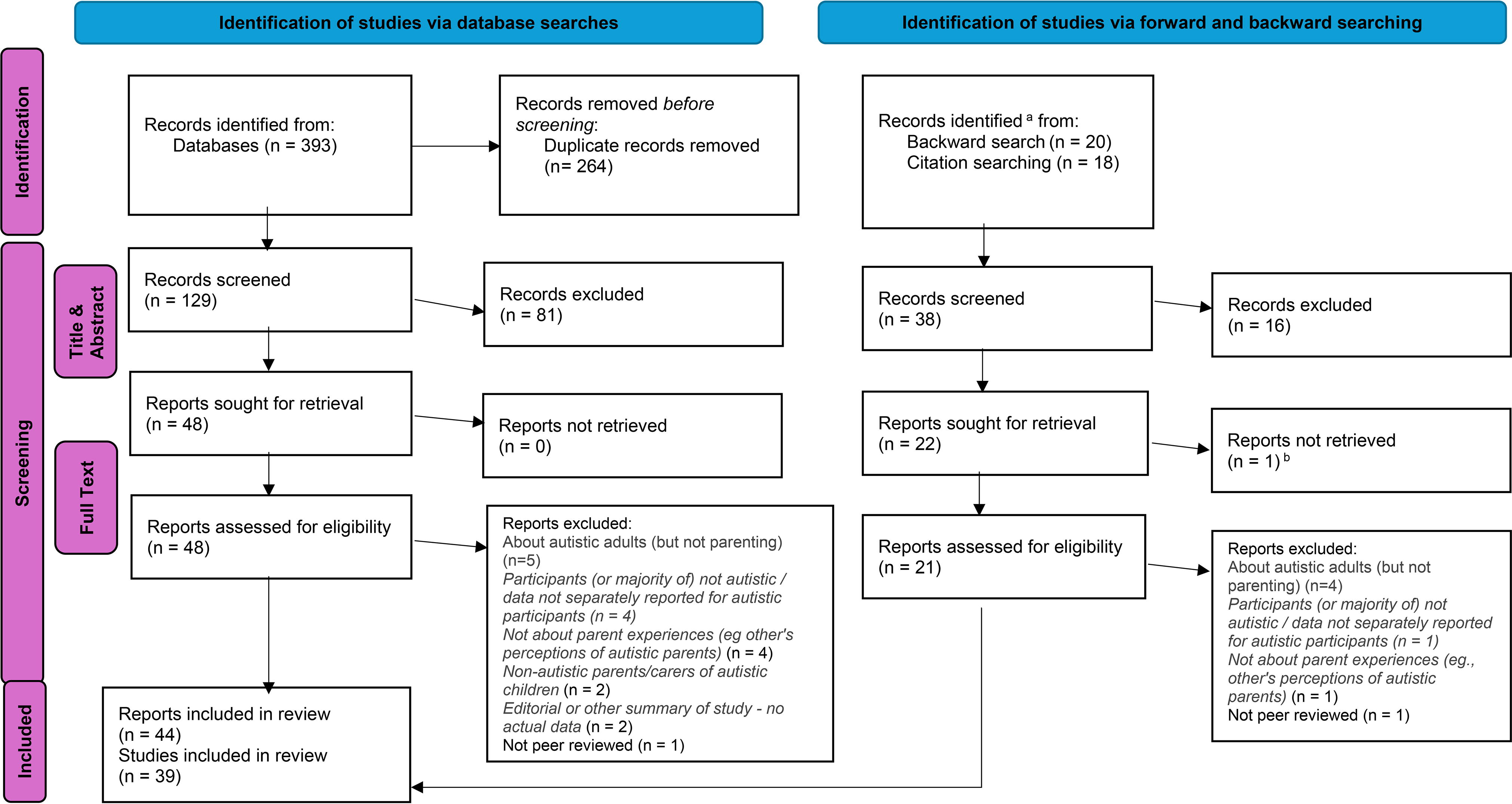
PRISMA flowchart.
Review articles
We identified four review articles, all published between 2021 and 2023. Two of the reviews focused on autistic people’s experiences of pregnancy and childbirth,19,20 and one on autistic people’s experiences of infant feeding. 21 Only one review article explored parenting beyond the infant stage. 13 Based on the JBI criteria, the reviews were assessed as ranging widely in quality, from a low of 3 to a high of 10 out of a possible 11, with the infant feeding review 21 receiving the highest score. The criteria most commonly assessed as “not met” or “unclear” were assessing the likelihood of publication bias (all four reviews), reporting methods to minimize errors in data extraction (three articles), and critical appraisal conducted by two reviewers (two articles).
These reviews included between 6 and 13 studies each, with a total of 20 articles included across the four reviews (Table 1). Of the 24 individual articles included in the current review that were not included in any of the previous reviews, 15 were published in 2023 or 2024, that is, subsequent to the completion of those reviews, 4 were published in 2022, thus likely after data collection was completed for the reviews; 1 was represented in the reviews by another publication using the same data set 39 ; and 1 had only a minor aspect of the study reflecting on parenting so may not have met the inclusion criteria of previous reviews. 40
Articles Included in Previous Reviews
Did not report data directly attributable to autistic parents but rather data attributed to those who chose not to become parents.
Utilized medical records rather than parent reports, an exclusion criterion for the current review.
About autistic young people and their parents, including thoughts about becoming a parent in the future, but did not report data on autistic parents.
Unpublished document obtained by the review authors.
About people with “autistic traits” rather than people diagnosed or identifying as autistic.
One reported using the Critical Appraisal Skills Programme as an appraisal tool, 21 one reported using the Appraisal Tool for Cross-Sectional Studies, 20 and the others did not refer to study appraisal. As with the current review, due to the paucity of research in this area, all the identified articles were included in each review. Only one review 21 reported the involvement of autistic researchers and/or engagement with the autistic community in conducting the study.
The two reviews of autistic experiences of pregnancy represented the voices of 427 20 and 437 19 individuals, respectively, noting that the overlap between the two reviews in included studies means that many of these will be the same individuals. The review of infant feeding experiences 21 represented the voices of 323 autistic mothers, with participants from many of those studies also represented in the other reviews. The review of autistic experiences of pregnancy and parenting 13 included 13 studies representing 425 autistic pregnancy experiences and 949 parenting experiences, with overlap in participant numbers both within the review (i.e., as it included studies with data collection at multiple time points) and with studies included in the other reviews.
Quantitative articles
A total of 12 articles were identified reporting on 11 quantitative studies (see Table 2), 6 of which had been included in previous reviews. Ten of these were solely or primarily focused on aspects of autistic parenting, whereas in 2 articles,27,32 parenting was a minor aspect within a broader focus.
Quantitative Articles
States “diagnosis or suspected diagnosis,” but unclear whether this refers to self-diagnosis.
These two articles report on the same data set.
Quality scores for the 11 analytical cross-sectional studies ranged from four to six, out of a possible maximum of eight. None of the 11 articles provided evidence that the researchers had identified, and controlled for, confounding factors. The other criteria most commonly assessed as not met or not evident were valid and reliable measures of exposure (five articles), objective and standard criteria used for measurement (two articles), and valid and reliable measures of outcomes (two articles).
The number of study participants ranged from 22 to 417. The majority of participants in these studies were from the United Kingdom (776), the United States (247), and Australia (218). Six of the 12 articles reported data on participant ethnicity, typically grouping participants as White or non-White (with variations in the breakdown of ethnicities beyond that). There was a predominance of participants classified as White, with a range of 92% to 95%, with the exception of one article published in 2016, 30 which reported that 82.5% of participants were described as Caucasian and 17.5% were described as “non-Caucasian.” In total, the 12 articles provided data on 680 participants who identified as White, 52 who identified as non-White, and 606 whose ethnicity was not stated.
Eight of the articles focused solely on the experiences of mothers,27,35,41,43–47 and four included both mothers and fathers.26,30,32,42 In sum, they represented the experiences of 1,151 autistic people identified as female and/or as mothers, 38 identified as male and/or as fathers, and 149 identified as parents with no gender indication. c
In two articles, parenting was a minor focus of the study, with a small number of questions related to aspects of parenting included in a larger survey. One was a study of issues related to vulnerability, mental health, and life satisfaction, 32 and the other a study of health care communication. 27 Parenting was a partial focus in a third study, in which satisfaction with parenthood was explored alongside adult attachment style and marital satisfaction. 26
Pregnancy, childbirth, and parenting infants
Six of the 12 articles reported on the experiences of autistic people during pregnancy, childbirth, and/or the early months of parenting,27,43–46 or related issues such as infant feeding. 47 These studies found that autistic women experienced challenges in communicating with health professionals during the prenatal, perinatal, and postnatal periods, including both expressive communication difficulties such as communicating their needs and their pain27,45 and receptive communication difficulties such as receiving adequate and appropriate information.27,45,46 They were also more likely to experience anxiety and depression during and following pregnancy,43,46 and to have significant challenges due to sensory (hyper) sensitivity and overwhelm.44,46 However, one small-scale study also reported no differences between autistic and non-autistic mothers in satisfaction with life, self-perception of parenting anxiety, involvement, nurturance, or routine. 43 In addition, the infant feeding study reported a much higher rate of breastfeeding among the autistic mothers in the study than in the underlying population, accompanied by a strong motivation to breastfeed for the well-being of their infant, and the capacity to identify their own strategies to reduce dysregulation when breastfeeding in the absence of effective infant feeding support. 47
Parenting minor children
Four studies, with a total of 185 participants, explored autistic people’s experiences of parenting minor children (i.e., those older than infants but younger than 18 years) of different ages, looking at areas such as parenting efficacy, 30 satisfaction with parenting, 26 parenting stress and family outcomes, 41 and talking with their autistic children about their shared diagnoses. 42 The three studies that included both mothers and fathers reported that autistic fathers had lower parenting efficacy scores than non-autistic fathers, with no differences in scores between autistic and non-autistic mothers 30 ; that autistic parents did not derive any less pleasure or satisfaction from parenting than did non-autistic parents 26 ; and that the majority of autistic parents had discussed their diagnosis with their autistic child and reported positive family interactions associated with their shared diagnoses. 42 The study with autistic mothers found no significant differences between autistic and non-autistic mothers in family outcomes (such as understanding child’s strengths, abilities, and needs or helping child learn and develop), or in parenting stress scores. 41
Parenting minor and adult children
Only two studies included autistic parents of adult children. One was an article that focused on vulnerability in autistic adults, 32 with only a brief reference to parenting—noting that autistic parents were significantly more likely to report that a professional had questioned their ability to care for their child. The other explored a range of topics, including differences in parenting styles, communicating with professionals, and personal experiences of parenting, but—with the exception of a section on pregnancy and breastfeeding—it did not report data separately by child age group/life stage. 35 The results of this study were consistent with those on pregnancy and early parenting, finding higher rates of anxiety and depression, and difficulties communicating with health professionals about their own needs and those of their children.
Who is doing the research?
An analysis of the disciplinary background of the research teams, based on the location of the lead researchers and (where reported) their doctoral degree, showed that the majority of the quantitative studies emerged from psychiatry (six) or psychology (five). One was led by researchers in public health. 47 Five of the studies included previously validated parenting measures, and in all cases these were measures designed by and for non-autistic people.
Only one article reported that the research team included an autistic researcher. 47 Two reported involving autistic people in all aspects of the study development35,47; and five reported involving autistic people in some aspects of the research.27,32,42,45,46 The use of identity-first language in article titles increased over time, with three of the five articles published before 2020 using person-first terminology, but only one of seven published from 2021 onward doing so. 44 Five of the studies limited participant inclusion to those with a formal autism diagnosis, including three of the five published before 2020; six included self-identified autistic adults, and one was unclear.
Qualitative articles
A total of 28 articles were identified, reporting on 23 qualitative studies (see Table 3), 9 of which had been included in previous reviews. Twenty-four of these were solely or primarily focused on aspects of autistic parenting, whereas in four articles,40,51,54,57 parenting was a minor aspect within a broader focus.
Qualitative Articles
Note that although the title of article refers to “parents with significant autistic traits,” the participants were in fact parents who identified as autistic.
These two articles report on the same data set.
These three articles report on the same data set.
These two articles report on the same data set.
Overall, the 28 qualitative articles were assessed as being of high quality, with 24 scoring seven or above, including 12 being assessed at the maximum score. The criteria most commonly assessed as not met or not evident in the qualitative articles were “providing a statement locating the researcher culturally or theoretically” (9 articles) and “addressing the influence of the researcher on the research and vice versa” (10 articles).
The predominant method of data collection in these studies was interviews, reported in 22 of the 28 articles, which represents 17 of the 23 studies. These included face-to-face interviews, telephone interviews, and online interviews, with many studies using a combination of modalities. One study utilized written reflections, 29 one an online focus group, 58 and two reported on secondary analyses of blog posts.33,50 The remaining two studies each had a single participant; one utilized a combination of data collection methods 31 and the other was an autoethnographic reflection. 48
The number of study participants ranged from 1 to 35. The majority of the 247 participants in these studies were from the United Kingdom (112), Australia (70), and the United States (53). Nineteen of the articles focused solely on the experiences of mothers, and nine included both mothers and fathers. In sum, they represented the experiences of 232 autistic people identified as female and/or as mothers, 13 identified as male and/or as fathers, and 2 identified as “parents.”
Pregnancy, childbirth, and parenting infants
Nine of the 28 articles reported on the experiences of autistic people during pregnancy, childbirth, and/or the early months of parenting,29,31,33,34,37,39,59–61 and one on infant feeding. 38 All of these focused exclusively on mothers. The findings were consistent with, and expanded on, those from the quantitative studies. Autistic mothers reported considerable challenges associated with sensory sensitivity and overload, stress and anxiety, and receptive and expressive communication. The synergistic and spiraling impact of these factors was evident in these qualitative studies,29,31,34,37,39,59,61 resulting in the escalation of pain, reduction of ability to cope with pregnancy and labor, and depletion of capacity to advocate for their needs. Another common finding was lack of understanding of autism among health professionals,34,59 as well as feelings of being judged, negatively perceived, or discriminated against due to their autism,31,37 resulting in some autistic mothers choosing not to disclose their diagnosis despite their need for specific supports. 61 Again consistent with the quantitative literature, these studies also found that autistic mothers aspire to be good parents and undertake considerable research into what is best for their child, 29 report specific parenting strengths such as persistence and empathizing with their baby’s sensory needs, 59 and persevere with breastfeeding despite heightened sensory challenges.38,60
Parenting minor children
Six articles, with a total of 75 participants, explored autistic people’s experiences of parenting minor children of different ages. Three explored specific aspects, such as learning from home during the COVID-19 pandemic, 40 experiences interacting with statutory services regarding their autistic child, 55 and factors that impact autistic parents’ mental health and well-being. 62 Three explored the experiences of being an autistic parent more broadly,28,36,63 and all of these described using an interpretative phenomenological analysis (IPA) approach to explore lived experiences. In total, they represented 72 mothers and 3 fathers of children aged between 2 and 18 years. An additional three articles49,51,64 did not report data on the ages of the autistic parents’ children, although it appears from a close reading of the included quotes that they were referring predominantly, if not exclusively, to nonadult children.
These studies identified some challenges in the parent–child relationship, such as the requirement to suppress their own needs to meet those of their child(ren), particularly in the context of conflicting routines and sensory needs.28,51,63 However, they identified many positive aspects of being an autistic parent, for both the parent and the child. For the child these included a parenting style embedded in empathy,49,62 a deep understanding of their child’s interests and needs,40,49 and, particularly for those parenting an autistic child, a shared understanding.28,36,63 For the parent, this included the joy of a deep connection with another human being,51,55 as well as the impetus and opportunity to develop new skills. 63 The most significant challenges of parenting for many autistic parents may come from outside the parent–child relationship itself, with many of these studies reporting that autistic parents experience difficulty in social interactions with other parents, 49 and feel unsupported, judged, and stigmatized as autistic adults when interacting with services for their child.28,36,49,55,62,64
Parenting minor and adult children
Nine articles, including the autoethnographic article, 48 and the analysis of autistic parenting discourse in online media 50 clearly stated that they included autistic parents of adult children. Two articles reported on studies that were not specifically focused on parenting but included data on autistic parents’ experiences. Both were undertaken in Australia, and both included mothers and fathers. One explored the effects of COVID-19 on mental health and feelings of social isolation among autistic people and their families, 57 and the other examined autistic identity in the family and community among late-diagnosed autistic adults. 54
Three of the research study articles that focused specifically on parenting explored the experiences of autistic mothers. One explored the sensory experiences of autistic mothers, and two of the seven participants had a child aged more than 18 years. 56 The second explored autistic mothers’ experiences of raising a non-autistic adolescent daughter, again two of the seven participants had a child aged more than 18 years. 53 The third explored female perspectives of parenting and reported that the four parents had “children aged between 8 and 40 years (mean = 23; SD = 8.9).” 65 The autoethnographic article reflected on the experiences of an autistic mother, starting with her own childhood and throughout the journey of parenting her son. 48
Of the two parenting-focused articles that included both mothers and fathers, one explored the experiences of parenting and support 58 and the other parenting during the COVID-19 pandemic. 52 In the former, two of the seven participants had a child aged more than 18 years, and in the latter the participants’ children ranged in age from 4 to 25, with a mean age of 10 years.
Consistent with the studies of parenting minor children only (and noting the small number of parents with adult children in these samples), autistic mothers reported sensory challenges associated with parenting,52,56,65 feelings of anxiety and overwhelm,52,57 and difficulties in understanding social dynamics and interacting with other parents.53,65 Difficulties in communicating with health, education, and other professionals continued,58,65 alongside concerns about being misunderstood and stigmatized. 58 Commonly identified strengths, among the few studies that explored this aspect of autistic parenting, included adherence to structure and routine, 65 proactivity in providing opportunities for positive social interactions for their child, 53 and an intense focus on ensuring their family’s mental health and well-being. 52 In addition, parents of autistic children reported positive aspects of the shared neurotype and the insight and understanding it brought to their parenting.48,54,65
Who is doing the research?
An analysis of the disciplinary background of the research teams, based on the location of the lead researchers and (where reported) their doctoral degree, showed that the majority of the qualitative studies emerged from nursing (eight), although these were predominantly focused on pregnancy, childbirth, and/or infant feeding. The other dominant disciplines were psychology (six) and education (five), with the latter often conducted with coresearchers in psychology. There were also two articles from psychiatry, one each from public health, social work, social sciences, and occupational therapy, and two from independent researchers.
Twelve of the 27 data-driven articles reported that the research team included one or more autistic researchers, representing none of the 6 articles published before 2021, but 71% of those published after 2020. Of the 15 articles that did not report including autistic researchers, none reported that autistic people were involved in all aspects of the study design, 4 reported that autistic people were involved in some aspects, such as providing input on data collection tools, and 11 did not make any reference to the involvement of autistic people other than as study participants.
The use of identity-first language in article titles increased over time, with 5 of the 6 articles published between 2011 and 2020 using person-first terminology, 3 of the 10 published in 2021 and 2022, and none of the 11 published in 2023 doing so. However, a similar pattern was not observed in terms of participant inclusion criteria, with 2 of the 6 articles published between 2011 and 2020 limiting participation to those with a formal autism diagnosis, 1 of the 10 published in 2021 and 2022 (and one unclear), but 4 of the 10 published in 2023 having this restriction.
Discussion
The topic of autistic experiences of parenting, long absent from the academic literature, is of increasing interest to researchers. In addition to the 4 review articles, we identified 1 article published up to and including 2010, 2 published between 2011 and 2015, 9 between 2016 and 2020, and 28 in the past 3 years.
Whose voices are being heard?
While research into the lives of autistic children and adults predominantly reports on the experiences of males,66,67 research into the experiences of autistic parents is very heavily skewed toward mothers. Across the 44 articles included in this review, we were able to locate the voices of approximately 50 fathers and 1,400 mothers. As with other aspects of autism research,68,69 and health research more generally, 70 the majority of experiences investigated are those of White American, British, or Australian women, while the voices of ethnic minorities, or other genders are rarely heard.
This review sought to explore the experiences of autistic parents across the parenting journey, from conception to parenting adult children. It is perhaps not surprising that three of the four previously published reviews have focused on the experiences of pregnancy, childbirth, and/or parenting infants given the focus of the underlying research corpus. Six of the 12 quantitative articles and 9 of the 28 qualitative articles focused on these aspects, and a further 4 and 6, respectively, focused on parenting young children (often including aspects of the former). While nine of the qualitative studies included all parenting stages, we were able to identify fewer than 10 respondents who were parents of adult children.
Who is telling the story?
Research into the lived experiences of autistic parents is predominantly being undertaken by researchers from the disciplines of psychology and psychiatry. This may, in part, explain the predominant framing of autism as a set of deficits in research questions deemed worthy of investigation. There is more diversity of disciplinary approach among qualitative researchers, with pregnancy, childbirth, and/or infant feeding research often undertaken by nursing researchers and research into parenting of young children involving those from education and social sciences.
There is a notable absence of autistic inclusion in the research, particularly the quantitative research. Twenty of the 48 studies did not make any reference to an autistic team member and/or any engagement with autistic people in the development and implementation of research designs, and some studies explicitly articulated a decision not to seek autistic expertise. We are conscious that the absence of reference to inclusion of autistic researchers did not necessarily mean there was no autistic researcher in the team. Disclosure still carries risks of discrimination for autistic academics and it is likely that some choose not to disclose. Therefore, the rate of autistic inclusion in research into the experience of autistic parents may be greater than indicated by our count.
What are they telling us?
Autistic mothers consistently report significant challenges associated with sensory aspects of pregnancy and childbirth, both internal aspects of what is happening within their bodies and external aspects of the health care environment. The small amount of research that investigates autistic parents’ experiences beyond pregnancy and childbirth suggests that the sensory challenges associated with parenting, including the sensory demands of caring for a child and the conflicting sensory needs of child and parent, continue well beyond this early well-researched stage.52,56,65
Communication challenges were highlighted in almost all of the studies of autistic pregnancy and birthing experiences, and again these persisted as autistic parents continued on the parenting journey. Many autistic parents reported struggling to access the information they needed, in a format that was appropriate, leading to anxiety and distress. They also struggled to communicate their needs to health professionals and others in positions of power in relation to both them and their children. In pregnancy and childbirth, this often resulted in unnecessary distress, pain, and ongoing physical and mental health issues. As the parenting journey continued, this inability to understand and be understood—described by Milton as the double-empathy problem 71 —often resulted in compounding anxiety, distress, overload,52,57 and even avoidable intervention by social services.
Other aspects found to be challenging for autistic parents included social interactions with other parents,53,65 the physical and emotional demands of managing a family, and limits to executive function capacity. Higher rates of stress, anxiety, and depression than the non-autistic parent population were commonly reported,43,46 along with feelings of exhaustion, overwhelm, and burnout.44,46,52,57 It is important to note that all of these factors function in combination; for example, sensory sensitivity is likely to be increased during periods of anxiety, 16 executive function may decline when communication is unclear, 72 and the compounding effects may lead to overwhelm and burnout.44,46,52,57
Contrary to many of the stereotypes of autistic people,58,73,74 the small amount of research that has been undertaken on autistic parenting experiences without taking a deficit lens suggests that there are strengths associated with autistic people’s parenting. While these studies are preliminary, their findings include that autistic mothers do not have lower parenting efficacy than non-autistic mothers, 30 do not differ in family outcomes (such as understanding child’s strengths, abilities, and needs or helping child learn and develop) or in parenting stress scores, 41 and autistic parents do not derive less pleasure or satisfaction from parenting. 26
The literature included in this review also found many positive aspects of autistic parenting, both for the parents and for their children. It is noteworthy that, particularly in the quantitative studies, such findings are often reported as unexpected. This reflects a bias in the underlying assumptions about autistic people and therefore in the focus of research into their parenting experiences. For example, in reporting findings on satisfaction with parenting: “Equally surprisingly, for parenthood satisfaction, results showed that parental AS diagnosis (either in the self or the spouse) did not significantly diminish the satisfactions and pleasures that respondents derived from their parenting roles.” 26
The qualitative literature, in particular, shows that well-established autistic strengths such as focus, commitment to detail, and desire to learn are brought to the parenting experience.29,52 This is perhaps most evident in the consistent finding that, despite experiencing significantly greater challenges, autistic mothers are more likely to breastfeed than their non-autistic peers due to their knowledge of its benefits and their commitment to the well-being of their infant.38,47,60
Autistic parents report high levels of empathy with their children, both autistic and non-autistic,49,59,62 and a deep understanding of their child’s interests and needs.28,36,40,49,63 Their awareness of their own limitations and challenges, combined with the commitment to the well-being of their child, often results in them planning and implementing ways to accommodate these, such as proactively providing opportunities for positive social interactions for their child, 53 or developing strategies to manage the sensory challenges of breastfeeding.38,60 They also report experiencing great joy, connection, and personal development from the parenting experience.51,55,63
Limitations
The review was limited to studies published in English, and it is likely that articles published in other languages would provide information on parents from a broader range of ethnicities. It is also likely that there are studies that meet the criteria that were not located despite our extensive and iterative search process. For example, one of our anonymous reviewers identified a relevant doctoral thesis in which 12 autistic mothers reflected on their experiences via asynchronous virtual interviews. These mothers reported parenting competence and positive relationships with their children, but negative experiences and stereotypes from others in relation to their parenting. 75
In a number of instances, specific data (such as ages of participants’ children) were not reported in articles included in the review; we did write to corresponding authors to request this information but did not always receive it. Related to this, the quality scores reported often reflect that specific criteria were not reported in the articles. However, this may be due to word length limitations rather than that those criteria not being met (i.e., scores of “unsure” rather than “no”). The decision to limit the review to peer-reviewed studies also carries the risk of publication bias impacting our findings, given that this prioritizes certain voices. For example, we note above the predominance of specific disciplines and, particularly in some areas, the limited inclusion of autistic voices in the conduct of research.
A necessary limitation of the review was that it could only include articles published at the time the searches were conducted. Given the growing research interest in this area, new studies continue to be published. Even in the short time since our article was submitted, several articles that have been published would have met our inclusion criteria. One of these was the review identified as in progress in the PROSPERO search, focusing specifically on the prenatal to postnatal period, 76 and another reported on data included in our review in the form of thesis publication. 77 Others were new areas of exploration. Findings from a qualitative study with nine Spanish autistic mothers included that mothers’ autism diagnoses follow the diagnoses of their child(ren), and that sensory sensitivities and anxiety have significant impacts on their parenting experiences. 78 An analysis of reflections on motherhood from a Reddit community for autistic parents identified that autistic mothers perceive their parenting to be different to that of non-autistic parents, seek and receive support from other autistic parents, and experience stigma in their interactions in the community. 79 An Australian study with 10 autistic working mothers identified both similarities with the experiences of non-autistic working mothers, such as the stress of juggling work and caring responsibilities, and additional challenges specific to autistic working mothers such as lack of understanding in the workplace of the female presentation of autism. 80 We hope that this much-needed rise in research into the experiences of autistic parents continues, and we are optimistic that an updated systematic review will be needed before the 10th anniversary of this journal, and that it will identify many more articles with a more diverse participant sample.
Recommendations for future research
There is a paucity of research into all aspects of autistic people’s experiences of parenting, and we do not wish to discourage researchers from pursuing any topics in this field. However, this review identified a particular need for targeted research:
on underrepresented groups of autistic parents, including fathers, those from diverse cultures, and parents of older children; from the perspectives of, and including researchers from, diverse disciplines; that includes meaningful autistic representation and consultation from study inception to dissemination; that focuses on the strengths of autistic parents; and that develops and utilizes more appropriate autistic-affirming measures of parenting experiences.
Conclusion
A consistent theme across the studies was the external nature of many of the challenges of autistic parenting and the internal nature of many of the strengths. It is important to acknowledge that there are some challenges associated with parenting that are exacerbated by challenges associated with being autistic, such as the sensory demands of children and the often-heightened sensory sensitivities of autistic people. However, some of the internal challenges for autistic parents identified in the review, such as sensory, communication, and executive functioning issues, are exacerbated by systemic barriers. It is equally important to acknowledge that there are strengths that autistic people bring to parenting, which are currently underexplored in the literature, including high levels of empathy with their children and intense commitment to their children’s well-being. It is therefore perhaps not primarily being an autistic parent that is in itself challenging, but rather the way that autistic parents are (mis)understood and (un)supported by systems that assume neurotypicality and are therefore designed for neurotypical parents.
Footnotes
Acknowledgments
The authors thank Jeff Segal, Jane Hancock, and Dr Nina Chad for insightful comments on the draft version of this article.
Authorship Confirmation Statement
S.T.-J.: Conceptualization, methodology, validation, writing—original draft, and writing—review and editing. C.B.: Methodology, validation, writing—review and editing, and supervision. S.A.: Methodology, validation, writing—review and editing, and supervision. The article has been submitted solely to Autism in Adulthood.
Author Disclosure Statement
No conflicts of interest to declare.
Funding Information
Research by the primary author is supported by an Australian Government Research Training Program (RTP) Scholarship toward the degree Doctor of Philosophy at the University of Southern Queensland.