




Abstract
Background:
Recently, the discussion surrounding autism-related language has gained prominence within Western autism communities, but studies about how people perceive Chinese autism-related language are notably scarce.
Methods
: We conducted an online survey between June 23 and July 29, 2023, targeting Chinese language users (mostly from the Chinese mainland) using convenience sampling. Utilizing 7-point scales, our study aimed to assess preferences, perceptions of offensiveness, and familiarity with 13 autism-related terms categorized into formal terminologies, functioning labels, and community terms. A diverse sample of 1,016 individuals, aged 14.75 to 72.49 years, participated. We employed analysis of variance models to analyze distinctions and similarities across identity groups, including autism stakeholders and the general public. To further explore the underlying attitudes, we employed cluster analysis to group individuals based on their endorsements of the terms.
Results
: Among the respondents, the Chinese translations of Neurodiversity (神经多样性), Spectrum (谱系), and Autism1 spectrum disorder (孤独症谱系障碍) emerged as highly favored and low offensive terms, particularly among autistic individuals and parents of autistic children. In contrast, the respondents generally considered Closed-off kid (闭娃), High/low function (高/低功能), Autism2 (自闭症), and Autism2 spectrum disorder (自闭症谱系障碍) less favored and more offensive. Cluster analysis identified variable attitude clusters, revealing no uniform perception across and within different identity groups.
Conclusions
: While different identity groups demonstrated some similarities in their perception of autism-related terms, our findings highlight the lack of a universally accepted approach to discussing Chinese autism-related terms. This research extends the discourse on autism-related terminology beyond Western contexts and highlights the social identity and cultural aspects in the translation and construction of autism-related terminologies.
Community Brief
Why is this an important issue?
Using the right words about autism is crucial for combating stigmas, stereotypes, and biases. Knowing preferred terms helps ensure respectful and positive discussions about autism. In Chinese, there are two words for autism. One is “孤独症” [Autism1 (GDZ), Gūdúzhèng, “GuDu” means isolation/loneliness, and “Zheng” means disease/symptoms]. The other is “自闭症” [Autism2 (ZBZ), Zìbìzhèng, “ZiBi” means self-closing]. Additionally, there are terms unique to the Chinese culture, such as Closed-off kid (闭娃, Biwa) and Alien kid (星儿, Xing’er). The introduction and translation of autism terms into Chinese show cultural adaptation and how meanings are shaped. Therefore, understanding the preferences of Chinese people, especially autistic people, for autism-related terms is important. This knowledge helps advance the neurodiversity movement in China.
What was the purpose of this study?
To explore how Chinese people with different backgrounds talk about autism. Our goal was to learn which words they liked and disliked, and how much they knew about these words.
What did the researchers do?
We did an online survey from June 23 to July 29, 2023. We asked over 1,000 Chinese-speaking people. They included autistic people, parents of autistic children, autism professionals, and the general public. We asked them how they felt about different autism-related words on a scale from 1 to 7. They used the scale to tell us what they liked, disliked and knew well.
What were the results of the study?
Chinese people liked the words Neurodiversity (神经多样性) and Spectrum (谱系) a lot. This preference was the most obvious in autistic people and parents of autistic children. In contrast, people disliked certain words. These words included Closed-off kid, High/low function, Autism2 (ZBZ), and Autism2 (ZBZ) spectrum disorder. Even though people generally prefer certain words, differences still exist within groups based on age, gender, and cultural attitudes.
What do these findings add to what was already known?
This study from China joins the worldwide talk about autism language. It tells us that people may have different opinions about how to talk about autism. It reminds us that there is no single way to talk about autism that works for everyone.
What are potential weaknesses in the study?
We noticed three weaknesses in this study. First, we did not randomly select the participants. We also overlooked autistic people with limited cognitive abilities. Next, we only focused on specific term preferences. We are not clear why people liked or disliked certain words.
How will these findings help autistic adults now or in the future?
These findings can help people understand that using polite and friendly words when talking about autism is important. They can help service providers, schools, and support groups choose words that are liked and not hurtful. By using words that autistic people prefer, we can make the world a kinder and more supportive place for them, both in China and around the world.
Introduction
Social constructivism asserts that language emerges from social practices and interactions and plays important roles in shaping social identity.1–3 Autism, initially framed as medical terminology, encompasses various characteristics in social communication as well as circumscribed and repetitive behaviors, activities, and passionate interests. 4 Over time, the understanding of and the discourse surrounding autism have emerged as more than just a matter of medical perspective. It has transformed into a dynamic and interactive process, fostering a deeper appreciation and inclusive approach to autism. More importantly, in the past few decades, autistic people have become increasingly determined to shape broader public discourses about autism from many aspects. 5 Of these aspects, the most prominent one is engaging in a debate about how to use autism-related terms morally and ethically.6–8
At the heart of this debate is the way in which the autistic community * seeks to define itself and to respond to the terms in which others refer to it, with the neurodiversity paradigm playing a central role. The neurodiversity paradigm asserts that the idea that there exists one normal or healthy type of brain or mind or a definitive right style of neurocognitive functioning is a culturally constructed fiction. 9 Neurodiversity is a form of human diversity and a potential source of creativity.9,10 All people, regardless of how much they deviate from neurodevelopment norms, should be respected and treated with dignity. 11
The neurodiversity paradigm has challenged the legitimacy of the use of some terms in communication, for example, by proposing the use of diversity-focused language (e.g., neurodivergent) as opposed to ableist-focused language (e.g., individuals suffering with autism).6,12 Terms and social distinctions, once widely accepted and taken for granted in the academic and public areas, are now at the center of contention embedded within various cultural contexts, reflecting deeper differences in the social identities, clashes, and transformation of values and ideologies, and critique of hegemonic structures.13–15
In this context, we strive to make sense of the profoundly dynamic debate surrounding autism-related terminology in the Chinese language contexts. The Chinese language refers to the languages that are written and spoken in China and other Chinese communities, particularly Simplified Chinese and Mandarin. We do so by highlighting the differences in the perceptions of different social identity groups for autism-related terms, and by attempting to compare the understandings and construction of these terms by Chinese in their communicative contexts.
The term autism was originally developed and used by medical doctors to conceptualize a specific health condition. Swiss psychiatrist Eugen Bleuler coined the English term autism in the early 20th century, derived from the Greek word autos, which means self, and described the egocentricity associated with schizophrenia. 16 Leo Kanner defined autism in 1943 as a condition affecting children who exhibit social and communication difficulties and repetitive stereotyped behaviors. 17 He called it “early infantile autism” and the third edition of the Diagnostic and Statistical Manual of Mental Disorders (DSM) included it in the 1980s. 18 Since then, the medical community has used autism as a diagnostic label for people who meet its criteria.
From its historical origins to the contemporary debates on language, the concept of autism has undergone a significant transformation, with one of the most prevalent discourses centering around the choice between person-first language (PFL) and identity-first language (IFL). To avoid stigmatization and discrimination, the American Psychological Association (APA) advocates PFL in research, such as a person with autism, indicating that autism is only a component of an individual’s unique strengths, needs, and experiences. 19 However, some autistic people reject PFL and endorse IFL, such as an autistic person, to embrace autism as an integral part of their identity.6,20–27 This preference varies across individuals and contexts, for example, some professionals still prefer PFL to maintain formality.23–25,28
Apart from the PFL versus IFL discussion, the debates on languages related to autism have expanded over time to encompass broader issues, including the formal terminologies used in the government or academic publications (e.g., autism spectrum disorder[s]/condition[s]), the functioning labels describing abilities used to classify autistic people (e.g., Asperger, high/low functioning, profound), the community terms used by autistic people or their families (e.g., Aspie, neurodiverse), and the references to people who are not autistic (e.g., neurotypical, control, non-autistic, typically developing).23,29–31 The discourses have also addressed the avoidance of ableist language,21,32 the discussions related to risk and red flags,33,34 and the patronizing and dehumanizing terminologies. 35 More importantly, these discussions have extended beyond English-speaking societies such as Australia, 36 the United Kingdom, 24 and the United States, 28 to include a more diverse linguistic and cultural landscape with contributions from French-speaking 23 and Dutch-speaking22,37,38 autistic adults. Originally initiated by autistic advocates, these conversations have grown to include a variety of perspectives, from family members and friends of autistic individuals to professionals working with autism, internet users, and the general public.24,25,39
The results of these studies advocate that the use of languages more preferred by the autistic community is supported by academic journals. Nowadays, several major academic journals have required authors to consider whether they have used appropriate and nonstigmatizing language and terms when describing autistic individuals.40–42 The anti-ableism movement within and outside the autistic community in the West has eventually led to a more inclusive and respectful environment for autistic individuals. For example, the emphasis on using IFL over PFL reflects a dominant shift in the autistic community, the academia and the general public to regard autism as a core part of autistic individuals’ identities rather than a defect that ought to be dispelled. In summary, this ever-growing dialogue has significantly reshaped how we discuss and conceptualize autism in Western societies.
Sociocultural and language contexts play a pivotal role in shaping how people understand, discuss, and accept autism.3,29,43 However, the Chinese, a significant linguistic and multiple ethnicity entity, has received relatively less attention in this global transformation. When it comes to the context of Chinese, it is particularly important to understand how the unique linguistic landscape of Chinese would complicate discussions of autism-related language.
In the realm of autism terminology within the Chinese language, two distinct renditions have evolved. The initial rendition of autism in the Chinese language was articulated as “Gūdúzhèng (孤独症=Autism1, GDZ in acronym).” Autism1 (GDZ) made its debut in the Simplified Chinese translation of Clinical Psychiatry by Mayor-Gross and colleagues (1963), as translated by Ming Ji and associates. 44 It was then adopted in subsequent scholarly articles 45 and was notably included in the first clinical report of autism in China. 46 The second Chinese translation for autism is articulated as “Zìbìzhèng (自闭症=Autism2, ZBZ in acronym).” Autism2 (ZBZ) comes from Japanese and was first formally seen in a case of early infantile autism reported by Sumi in 1952. 47 The introduction of Autism2 (ZBZ) into the Chinese academic discourse occurred in 1966. 48 Subsequently, it was incorporated into scholarly articles by researchers across different regions who utilize both Simplified and Traditional Chinese, including the Chinese mainland,49,50 Hong Kong Special Administrative Region (SAR), 51 and Taiwan region.52,53 Despite their different origins, these two terms have been used interchangeably in Chinese literature without a consensus for several decades.54,55 To achieve consistency at the official level, the China Disabled Persons’ Federation issued a notice in 2022 recommending using Autism1 (GDZ) over Autism2 (ZBZ). 56
Autism1 (GDZ) and Autism2 (ZBZ) diverge not only in their etymological roots but also in their connotations within the Chinese cultural context. Literally, Autism2 (ZBZ) is more approached to the original concept of autism coined by Leo Kanner, as “Zìbì (自闭)” means self [intentionally] closing-off, while “Gūdú (孤独)” in the term Autism1 (GDZ) means loneliness/isolation.
More importantly, the impact of the bi-translation of one terminology extends beyond linguistic nuance, influencing public perceptions and attitudes toward certain mental health conditions. For instance, there are two Chinese translations of schizophrenia. Researchers in Hong Kong SAR, China, found that by adapting a novel and neutral label (思觉失调, dysregulation of thoughts and perception), replacing the original more negative and familiar (精神分裂症, mental split-mind disorder) although more aligned with the original English term label, could attenuate the stereotypical images of schizophrenia. 57 To date, inquiry into the impact of bi-translation of autism on societal perceptions of the Chinese language remains markedly insufficient. 32
Apart from the bi-translation phenomenon of autism, the use of English acronyms without any translation, termed zero translation, is also common in the Chinese autism-related language, for instance, ASD (short form of autism spectrum disorder) and AS (short form of Asperger syndrome), reflecting a bilingual context within the Chinese autism community. In addition, other terms have been introduced from English, such as Asperger syndrome = 阿斯伯格综合征, † spectrum disorder = 谱系障碍, ‡ high/low function = 高/低功能, neurodiversity = 神经多样性. Finally, Chinese user societies, including China, Singapore, and Chinese in North America, have given rise to their unique community terms for describing autistic individuals, such as “Alien kid (星星的孩子/星儿/星星的人, Xingxingdehaizi/Xing’er/Xingxingderen).” In the Chinese mainland, Closed-off kid (闭娃, Biwa) is also commonly used among the autism community. These distinctive expressions reflect how the autism communities in Chinese societies are constructing their identities related to autism.
If we expand our focus beyond the word level, the Chinese language further complicates the distinction between IFL and PFL at the phrase level. Unlike Indo-European languages, Chinese frequently employs zero-derivation nominalization, § ,58,59 and a specific adjective form for autism is lacking. Unlike phrases, nouns serve as the foundational building blocks of meaning in Chinese, and variations in their use directly reflect differences in cultural, social, and ideological frameworks. Therefore, studying noun terminology in the Chinese context is more crucial than studying phrases.
In summary, these distinctive localization processes of autism-related terms give rise to a unique and multifaceted phenomenon within the Chinese language context. It is very necessary to investigate how the autism community perceives these autism-related terms, along with their similarities and differences compared with the public’s perception.
In terms of perceptions, previous research has largely examined preferences, offensiveness, and rankings of specific autism-related language terms. An important aspect often overlooked is the potential link between familiarity with these terms and individual perceptions. On one hand, it is well-established that increased knowledge about mental or psychiatric conditions can mitigate public stigma and reduce social distancing from those with such conditions.60–62 On the other hand, in some cases, greater familiarity with certain terms can paradoxically lead to increased stereotypes and stigma. 61
Take autism-related terms as an example. Tang and Bie analyzed the articles published in five leading newspapers in China portraying autism between 2003 and 2012. 63 On one hand, their findings verified that public awareness of autism had a substantial increase over time. On the other hand, they discovered that the positive approach in the coverage of autism decreased, while the use of stigma cues increased over time. Only 9.7% of the analyzed articles contained hope cues, while about 15% of the analyzed articles explicitly discussed autistic people related to dangers, problems, sufferings, or burdens, representing the media portraying a sense of powerlessness and contributing to the social stereotype of “autism as a problem”(p. 450). 63
Therefore, higher familiarity with autism-related terminology can, paradoxically, yield negative effects, shaping how these terms are perceived by both autistic individuals and the general public. More specifically, if the media coverage is plagued with biased portrayals without diversity and limited focus on first-person accounts of autistic individuals, this will eventually perpetuate a significant negative impact on public awareness of autism, including misconceptualizing, stigmatizing, and stereotyping of autistic people. 64 As the dynamics of autism-related language evolve, there is a lack of direct evidence on how familiar people are with established (e.g., formal terminology) and emerging (e.g., neurodiversity) terms. The relationship between familiarity, preferences, and offensiveness thus remains to be revealed.
The introduction, translation, and localization of autism-related language, together with the societal context, constitute a distinctive framework that shapes the establishment of awareness and identity for both autistic individuals and the broader public. In the Chinese mainland, apart from a few hospitals, the majority still adhere to the Tenth Revision of the International Classification of Diseases and Related Health Problems (ICD-10) in their health information management systems, in which infantile autism and Asperger syndrome are two formal diagnostic labels.65,66 However, within the last decade, expert consensus on autism services has favored the DSM-5 and ICD-11 diagnostic criteria, which use Autism1 (GDZ) spectrum disorder and ASD as the formal terminologies.67,68 Therefore, the mismatch between the health information system and the operating diagnostic guidelines may cause confusion about the concept of autism among the autism community and the general public.
The prevalence of autism is similar in China and in the West. 69 However, public awareness and perceptions of autism differ significantly between China and the West. 70 For example, one previous study found that only 57%−65% of China’s residents had sufficient knowledge about autism, whereas 86%−91% of U.S. residents did. 71 Furthermore, China’s residents exhibited higher levels of stigma associated with autism (38% vs. 14% in the United States). Stigma has negative consequences for parents of autistic children in China, affecting their well-being.72,73 Moreover, Chinese autistic individuals and parents of autistic children often conceal the diagnosis from the public instead of embracing it as a source of pride.54,74 Studies on the perception of autism-related terminology can thus provide powerful insights into the differences in understanding of autism between China and the West.
Therefore, in response to the global dynamics of autism discourse, a central focus of this study is to identify how Chinese users, particularly those using Simplified Chinese, use autism-related terms in their communication and analyze differences in perceptions and preferences across various social identity groups, including the autism community and the general public. Building on previous studies, we investigated preference and offensiveness toward autism terms and analyzed responses to open-ended questions about alternative names. 36 We also added a familiarity dimension and examined its correlation with preference and offensiveness. The study focused on intergroup and intragroup variations in term perceptions among the autistic community and other groups, such as parents, professionals, and non-autistic individuals. We also used cluster analysis to identify common preferences and to analyze underlying intragroup and intergroup variability and coherence.
Methods
Recruitment and survey data collection
We collected the sample of this online survey study from June 23 to July 29, 2023, using convenience sampling. To recruit a diverse group of participants, including autism stakeholders and the general public, we utilized various methods such as social media posts, SMS messages, and referrals from advocacy organizations. Participation required being at least 14 years old, demonstrating adequate Chinese reading ability, and possessing an intelligence quotient (IQ) score of 50 or above. Parental or guardian awareness was encouraged for participants younger than 18 years (passive parental consent). We presented the survey using Simplified Chinese. Participants would report their demographics (including birth-assigned sex, social gender, day of birth, current residency, current occupation, education attainment), number of known autistic people, formal autism diagnosis history, and whether they are parents of autistic children. If participants reported that they were autistic or parents of autistic children, they would further choose the IQ range that best describes their IQ or their autistic children’s. To facilitate further comparison between studies, we used an abridged Autism Spectrum Quotient (AQ28) to measure participants’ autistic traits.75,76 Then, the participants would rate their preferences, offensiveness, and familiarity with autism-related terminology. 36 For details of the survey structure, refer to Supplementary Data S1.54,77 We report the findings of terminology ratings in the present article. We obtained ethical approval from the Medical Ethics Committee of the Third Affiliated Hospital of Sun Yat-Sen University (II2023-125–01) and preregistered the study on the Open Science Framework. 54
Terminology classification
We generated the autism-related term list by cooperating with various autism stakeholders (autistic individuals, specialists, operators of an autism organization, and parents of autistic children). First, we made a preliminary autism-related term list after hosting two rounds of internal meetings within our authors’ group. We then asked various autism stakeholders for their opinions regarding the term list, which resulted in adding the terms Asi, Closed-off kid, and Spectrum to the final list. We categorized the terminologies into three groups: Formal Terminologies, Functioning Labels, and Community terms.
Formal terminologies
Autism1 (Guduzheng, 孤独症, GDZ), Autism1 spectrum disorder (孤独症谱系障碍), Autism2 (Zibizheng, 自闭症, ZBZ), and Autism2 spectrum disorder (自闭症谱系障碍).
Functioning labels
High/low function (高/低功能) and Asperger syndrome (阿斯伯格综合征).
Community terms
Asi (abbreviation for Asperger syndrome in Chinese using the first two Chinese characters, 阿斯), AS (acronym for Asperger syndrome in English), ASD (acronym for autism spectrum disorder in English), Spectrum (谱系), Neurodiversity (神经多样性), Alien kid (Xing’er, 星儿), ** and Closed-off kid (Biwa, 闭娃).
Preferences, offensiveness, and familiarity
We followed Bury et al.’s study 36 to measure preferences, offensiveness, and familiarity for 13 terms using a 7-point Likert scale (1 = strongly disliked/not at all offensive/unheard of, 4 = neutral, 7 = strongly like/strongly offensive/strongly familiar). Familiarity was defined as the acquaintance with the terms. The following instruction was used in our survey, “Please indicate your preference/offensiveness/familiarity level for each of the following terms used to describe autism.” Higher scores meant more overt preferences, offensiveness, or familiarity. Participants could also suggest and rate unlisted terms at the end of the scales.
Data analysis
Quantitative data
First, we used the sktest package in STATA17.0 to assess variable normality. We employed 10,000 bootstrap samples with bias-corrected and accelerated 95% confidence intervals (BCa 95% CI) to address the marked skewness in preference, offensiveness, and familiarity ratings. 78
Next, we conducted bivariate correlations between the AQ28 total scores and terminology ratings. For descriptions of correlations between AQ scores and terminology ratings, see Supplementary Table S1 and Supplementary Data S1.
We analyzed the association between the diagnosis disclosure and the choices of terms. We calculated the frequency of term selection based on the current disclosure situation: the child knew the diagnosis, the child did not know but the parent would tell, and the child did not know and the parent would not tell.
We compared the group differences (group identities: autistic person, autistic parents, parents, specialists, etc.; social genders, geographic regions, IQ, and disclosure of autism diagnosis to children) in terms of ratings by conducting one-way analyses of variance (ANOVAs). Specifically, we set the rating scores (preferences, offensiveness, and familiarity) as dependent variables and subgroups as independent variables. Using the Bonferroni method, we corrected for multiple comparisons (279 ANOVA models, †† Bonferroni corrected p = 0.05/279 = 1.79e−4).
To understand how autistic individuals and parents (as key stakeholders) perceived different terms (dependent variables) in terms of preferences, offensiveness, and familiarity (independent variables), we conducted separate repeated-measures ANOVAs for each perception for these two identity subgroups. We used Tukey pairwise comparisons (p = 0.05) to test differences in terminology ratings if the repeated-measure ANOVA models were significant after the Bonferroni correction (padjusted = 1.79e−4).
Finally, we explored potential attitude subtypes of people when rating the terms to understand the attitudes that underlie consistent or inconsistent assessments by different populations. We used Ward’s method to perform hierarchical cluster analysis. This data-driven approach revealed patterns within responses and provided insights into preference attitudes. The dendrogram showed the hierarchy of clusters, with each participant initially as a single cluster. Clusters merged until all participants were grouped. We manually selected the final hierarchical level for the most distinct explanation. We used one-way ANOVAs to investigate cluster differences in preferences, offensiveness, and familiarity, with post hoc analyses using the Bonferroni method (padjusted = 1.79e−4) for significant ANOVA models. We used STATA17.0 for all analyses.
Qualitative data
We grouped alternative names suggested by participants into different categories according to the literal properties of these names: offensive and insulting words, medicalized words, nomenclature, neurodivergent variant words, ambiguous words related to autism/asperger, and names with poetic images or associations.
Results
Participant characteristics
We excluded 73 participants, leaving 1,016 participants, for the final analyses (refer to Supplementary Data S2). The age range of the participants varied from 14.75 to 72.49 years, with an average age of 34.41 (standard deviation = 9.08). Of the participants, 10.4% identified themselves as autistic (n = 106), 30.6% were parents of autistic individuals (n = 311), 43.4% were non-autistic individuals (n = 441), and 13.9% were specialists (n = 141). Out of the participants with autistic children, 14 were also autistic themselves. Notably, six participants with autistic children chose not to share their autism diagnosis status, and one autistic participant did not disclose whether they had an autistic child. We therefore grouped these individuals, along with others who preferred not to share their identity, under the category of Undefined Identity (n = 38, 3.8%). From the parents’ reports, the age range of their autistic children ranged from 1 to 25 years (Mage = 8.30, SD = 4.68). For an overview of participants’ characteristics, refer to Table 1.
Participant Demographics by Identities
AQ28, Autism Spectrum Quotient-28; IQ, intelligent quotient; IQR, interquartile range.
Disclosure of diagnosis and choice of terms
Only one-fifth of the parents (n = 61) disclosed the autism diagnosis to their children. In contrast, over one-third of the parents (n = 127) intended to keep the diagnosis undisclosed. The most common terms among the parents who communicated the diagnosis were Asperger syndrome (41%), Autism2 (ZBZ) (28%), and Asi (25%). No other term had a frequency of 15% or more (Supplementary Fig. S1). The parents who did not plan to discuss the diagnosis now mainly chose Neurodiversity (34%), Autism1 spectrum disorder (32%), Asperger (25%), Spectrum (23%), and Alien Child (20%) as future terms. Neurodiversity (30%) was also the most favorable term for those who did not intend to disclose the diagnosis.
Differences in preference, offensiveness, and familiarity of different terms across identities
Preferences
Autistic individuals expressed a significantly stronger preference for terms such as Autism1 spectrum disorder and ASD compared with autistic parents, parents, and non-autistic individuals. Moreover, they expressed higher preferences for Spectrum and Neurodiversity than parents, non-autistic people, and autism specialists. Autistic parents did not show significantly more or less preference than other groups except for Autism1 spectrum disorder and ASD. Parents ascribed significantly higher preference scores to Neurodiversity than non-autistic individuals. Specialists exhibited a stronger preference for Autism2 (ZBZ) compared with autistic people and parents. They also registered higher average preference ratings for Autism1 spectrum disorder than parents and for ASD than non-autistic people. Non-autistic individuals favored Autism2 (ZBZ) more compared with parents.
Offensiveness
Autistic people reported the lowest perceived offensiveness ratings across the terminologies ASD, Spectrum, and Neurodiversity when compared with parents, non-autistic people, and specialists. Autistic people also rated lower offensiveness scores on Autism1 spectrum disorder than non-autistic people. Moreover, autistic people considered Autism1 (GDZ) and Autism1 spectrum disorder as less offensive than parents and undefined identities, and they rated lower offensiveness scores on Spectrum than autistic parents. Meanwhile, autistic parents ascribed lower offensiveness scores on Autism1 (GDZ) than undefined identities, and autism specialists also considered it less offensive than parents. No other post hoc tests met the Bonferroni correction threshold.
Familiarity
Autistic people, parents, specialists, and undefined people demonstrated significantly higher familiarity than the non-autistic group with all the listed terminologies. Autistic people showed higher familiarity with Neurodiversity than other groups. Meanwhile, parents were more familiar with Closed-off kid and Alien kid than other groups. Autistic parents were significantly more familiar with Autism2 spectrum disorder, functioning labels, and community terms, including Spectrum, Neurodiversity, Closed-off kid, and Alien kid, than non-autistic people. Overall, non-autistic people had among the lowest familiarity levels toward the listed terms across identities, even though not all pairwise comparisons were statistically significant after multiple comparison corrections.
Figure 1, Supplementary Table S2, and Supplementary Table S3 show the results and detailed data.
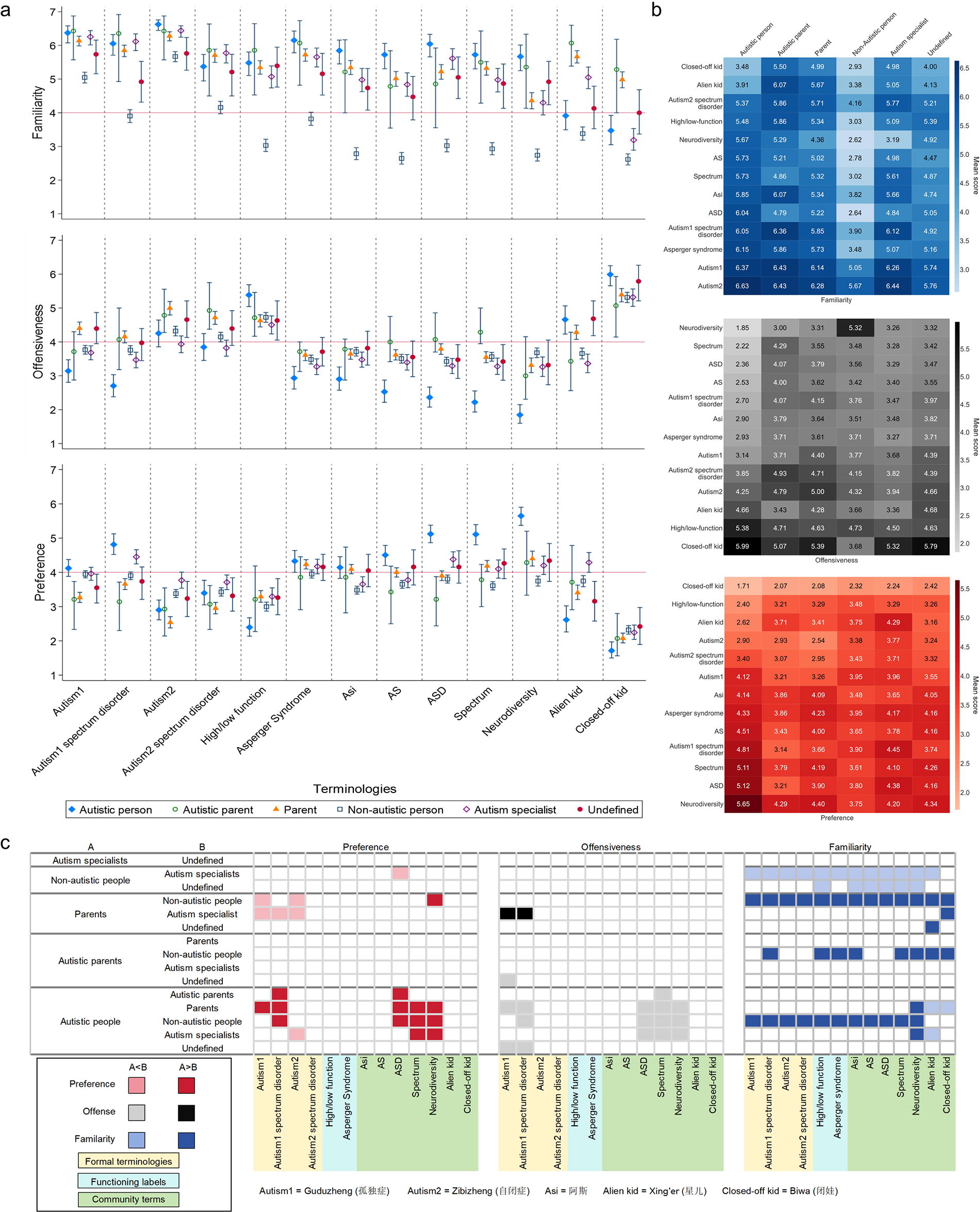
Preference, offensiveness, and familiarity ratings by identities.
Gender and regional differences
No one-way ANOVA model examining preference or offensiveness across different genders or regions passed the Bonferroni correction threshold (see Supplementary Tables S4, S5, and S6). However, when considering the familiarity of terminologies, gender differences were observed for Asi, AS, Spectrum, and Neurodiversity. For Asi, AS, and Neurodiversity, non-binary/undisclosed gender individuals displayed significantly the highest familiarity with these terminologies, followed by females, while males exhibited the lowest levels of familiarity. For Spectrum, non-binary/undisclosed individuals reported significantly higher familiarity than males and no significant difference compared with females. Regarding the regions, the difference in familiarity with Asperger syndrome reached statistical significance, and post hoc analyses revealed that participants from the Northwest China region reported the lowest familiarity scores with Asperger syndrome. No other grouping differences indicate significant differences (Supplementary Tables S4, S5, S6, S7, S8, S9, and S10). For detailed descriptions of the post hoc analyses, refer to Supplementary Data S3.
Autistic individuals and parents’ ratings for different terms
We used repeated-measures ANOVAs to compare preferences, offensiveness, and familiarity ratings for different terminologies among autistic individuals and parents. We report the results for each group separately. Due to the rich findings, our report focuses on the most preferred, offensive, and familiar terms and groups the pairwise comparisons inside the formal terminology, functioning labels, and community terms. We present more detailed results in the supplementary tables.
Autistic individuals (see Fig. 2, Supplementary Table S11, Supplementary Table S12, Supplementary Table S13):
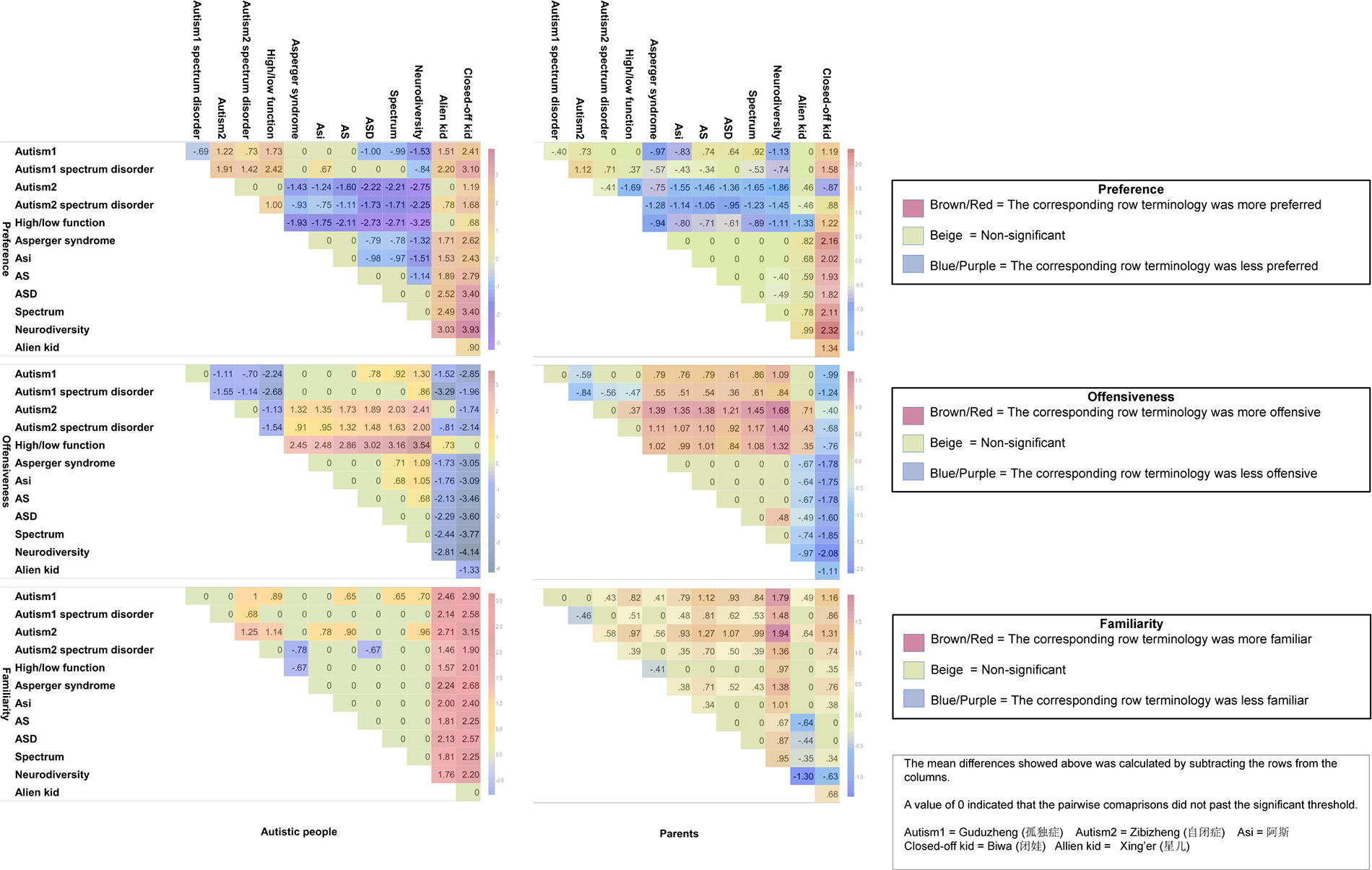
Pairwise comparison of different terminologies on preference, offensiveness, and familiarity in autistic people and parents.
Neurodiversity, ASD, and Spectrum were the most preferred and least offensive terms.
Closed-off kid was the least preferred and most offensive term. It had a similar level of familiarity with Alien kid, and was also the least familiar term. High/low function and Alien kid were also less preferred and equally as offensive as Closed-off kid.
Among the four formal terms, autistic individuals reported the highest preference for Autism1 spectrum disorder, followed by Autism1 (GDZ). Meanwhile, autistic individuals felt that Autism1 and Autism1 spectrum disorder were less offensive than Autism2 (ZBZ) and Autism2 spectrum disorder. In addition, autistic individuals reported that they were less familiar with Autism2 spectrum disorder than the other three formal terms.
Among the remaining functioning labels and community terms not mentioned above, AS, Asperger syndrome and Asi had similar preferences and offensiveness ratings.
Parents (see Fig. 2, Supplementary Table S14, Supplementary Table S15, and Supplementary Table S16):
Asperger syndrome (functioning label), Neurodiversity, Asi, Spectrum, ASD, and AS (community terms) were the most preferred and least offensive terms. Intriguingly, Neurodiversity was the least familiar term for parents. Closed-off kid was the least preferred and most offensive term. Meanwhile, it was the second least familiar term. Among the four formal terms, parents reported the highest preference for Autism1 spectrum disorder and the highest aversion to Autism2 (ZBZ) and Autism2 spectrum disorder. Among the remaining functioning labels, High/low function and community term Alien Kid not mentioned above, although relatively familiar, were less preferred and more offensive for parents.
The attitude cluster analyses
The cluster analysis using preference ratings unveiled six distinct attitude patterns (see Supplementary Fig. S2 for the cluster dendrogram; Fig. 3 and Supplementary Table S17 for descriptive statistics). We defined each cluster by Chinese idioms according to each pattern (details of the definition in Supplementary Data S4). As depicted in Figure 3, 42% of autistic people aligned with “Divergentism”, 30% with “Inclusionism”, and 15% with “Moderatism”, while 13% belonged to other clusters. In contrast, parents exhibited more balanced proportions for “Divergentism”, “Inclusionism” and “Moderatism” (22%–23%), and 14% aligned with “Hermeticism”. Among non-autistic individuals, “Moderatism” and “Adiaphorism” comprised the most substantial shares (29% and 25%, respectively), followed by “Conformism” (21%). Intriguingly, only 8% of the non-autistic sample was classified as “Divergentism”. Regarding autism specialists, they were primarily in “Moderatism” and “Inclusionism”, representing over 3/5 of this group, while “Conformism” and “Adiaphorism” each accounted for slightly over 10%. For detailed definitions and ANOVAs of the attitude clusters, refer to Supplementary Tables S17–S18, Supplementary Figures S2–S3, and Supplementary Data S4.
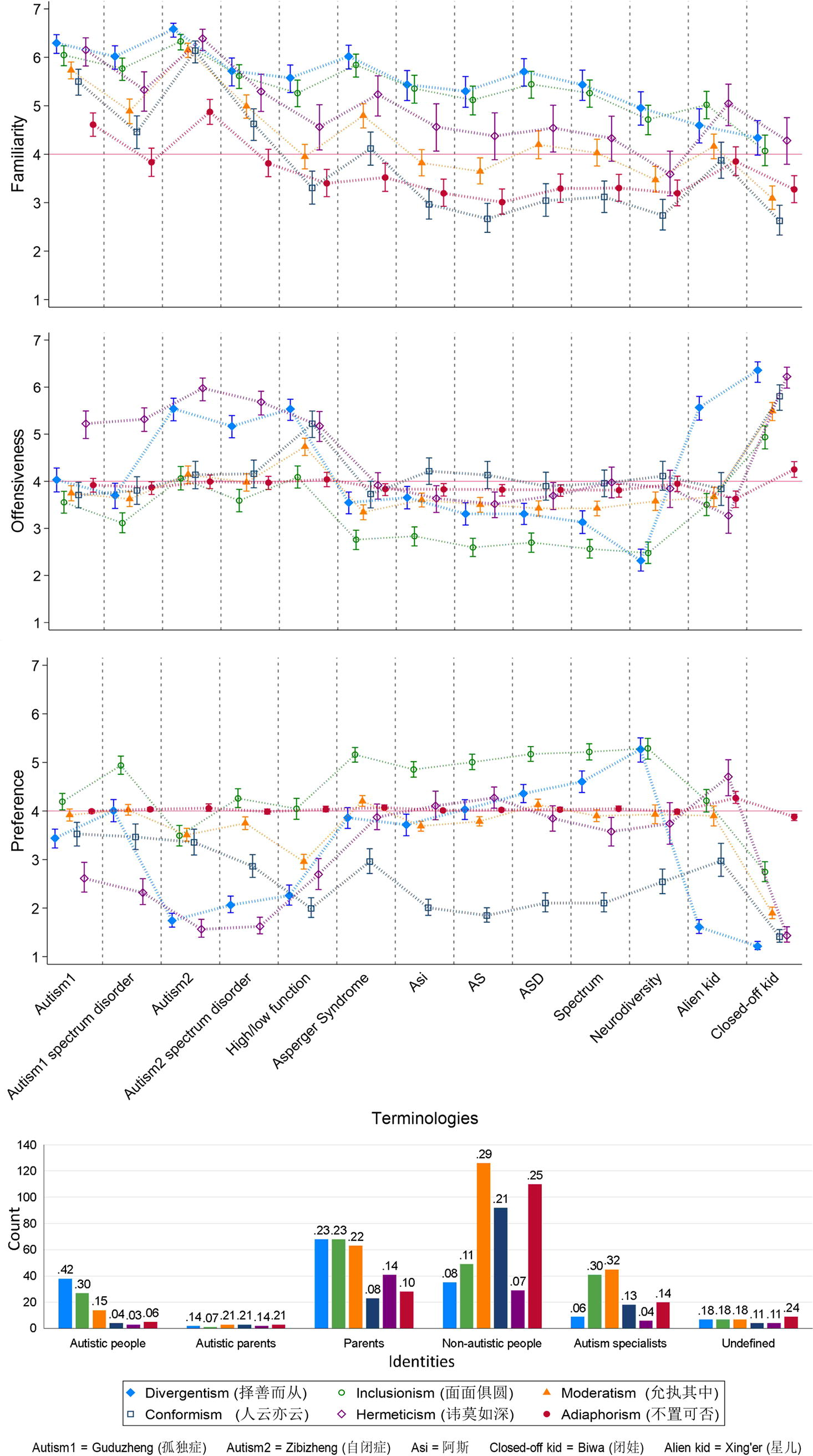
Attitudes toward various terminologies describing autism. The bar graphs below were the number of counts of each identity belonging to different clusters.
Recommendations for alternative names
Participants in the survey offered a wide range of alternative names and phrases to describe autistic individuals, although the frequencies were low. We categorize these terms into six main groups as follows:
Offensive and Insulting Words: Including terms such as Idiot/fool, Neurotic, and Weird/bizarre, which participants considered offensive. Medicalized Words: Such as Patients, Mental disorder/disability/disease, and Psychosis, which are related to medicalizing and stigmatizing the condition. Nomenclature Words: Terms such as Developmental delay, Social developmental disorder, Jargon disorder, Selective mutism, Language developmental disorder, Social intercourse disorder syndrome, and Autism spectrum (condition), which are more clinical and descriptive. Neurodivergent Variant Words: Such as Neurominority and Atypical neurodevelopment/Neuroatypical, focusing on neurodiversity. Ambiguous Words Related to Autism/Asperger: Incorporating terms derived from autism or Asperger, such as A kid (A娃), Aspie, Typi-closed (典闭), and Asi-er (阿斯儿), which may have ambiguous meanings. Names with Poetic Images or Associations: Including words such as Angel, Baroque pearls, Rain man, Blue-sky/Flash thinking syndrome, You from the stars, and Joyful child, which convey a positive or celebratory perspective.
For details of these alternative terms, refer to Supplementary Table S19.
Discussion
In recent years, the discussion surrounding autism-related language preferences and usages has gained significant attention in Western countries and regions.21,23,24,28,29,36,79 However, this crucial discourse needs to be unveiled in Chinese. In the current study, we explored the uncharted terrain by examining the preferences, perceived offensiveness, and familiarity associated with a wide range of terms used to describe autism within the Chinese language.
Our investigation encompassed input from autistic individuals, parents, specialists, and the non-autistic general public across Chinese populations. These populations primarily reside in the Chinese mainland but also include individuals from Taiwan region, Hong Kong SAR, Macao SAR, and other international contexts. Our study offers the initial evidence regarding the perception of autism-related terminology in Chinese, revealing both shared and divergent perceptions among these groups. There is no unified approach to discussing autism in Chinese, and we propose acknowledging and honoring the choices made by autistic individuals. Furthermore, we urge increased awareness of neurodiversity and greater recognition of autistic individuals and their first-person narratives. We believe these actions can foster a more profound comprehension of the sociocultural intricacies in autism research. 43
Notable terminology perception variations between autistic people and other identities
Our study finds that different identity groups show variability and diversity in terms of word preferences, aversion, and familiarity. The following discussion focuses on autistic individuals’ preferences and compares both similarities and dissimilarities between autistic individuals and other identities, reflecting variations in the understanding of the concepts and values embedded in autism-related terms.
Autistic individuals exhibit stronger preferences for Neurodiversity, Spectrum, ASD, and Autism1 spectrum disorder while showing aversion to Closed-off kid, Alien kid, High/low function, and Autism2 (ZBZ). They also perceive higher familiarity with Neurodiversity than other groups. Meanwhile, parents demonstrate higher preferences for Neurodiversity, Spectrum, Asperger, Asi, and AS. Parents’ familiarity with Alien kid and Closed-off kid is significantly higher than that of other groups. In comparison, specialists express more preference for Autism2 (ZBZ) than parents and autistic people. Non-autistic people do not show a clear preference or aversion but are relatively more familiar with the formal terminologies, especially Autism2 (ZBZ), than other categories. Autistic parents, a very distinct identity group in our study, have preferences close to parents and show significantly less preference for Autism1 spectrum disorder and ASD and more familiarity with Spectrum than the autistic people. However, caution is warranted in interpreting these findings due to the group’s smaller size and greater individual variation.
Our findings highlight a paradox. Terms that resonate with parents, professionals, and the general public—those that are preferred, familiar, and nonoffensive—may inadvertently offend autistic individuals, such as Autism2 (ZBZ) or Alien kid. Conversely, some terms that resonate with autistic individuals, such as Neurodiversity, remain unfamiliar to others. As our community perspective contributor, Xia shared their feelings about the term Alien Kid:
The term “Alien Kid” is very romantic, so it is easily accepted by parents, but it kind of excludes our qualifications to live on the Earth. It seems to be saying that we are not earthlings, we are aliens who were sent to destroy the Earth. (Xia, 2024)
The divergent perceptions of terminology across various groups may stem from disparities in their conceptualizations and understandings of autism. For instance, autistic people prefer terms signifying diversity and spectrum, including Autism1 spectrum disorder, ASD, Spectrum, and Neurodiversity. These terms may reflect the identity of their diversity, differences, and nonpathological characteristics.23,35,36 In contrast, they reject unfavorable stereotyping terms that are imposed on them by others, such as Alien kid and Closed-off kid. 80 Parents preferred Asperger, and its abbreviations may be related to the ICD-10 classification system and Aspie supremacy, which we will discuss later. In addition, Alien kid and Close-off kid are more familiar among parents than other groups, likely because these two terminologies are more in line with parents’ conceptualization of autism and more likely to be accepted in parent-oriented communication. Meanwhile, specialists show stronger preferences on formal terms, especially Autism2 (ZBZ), than autistic people and parents. Similarly, previous studies found that in the United Kingdom, the United States, and French-speaking regions, autistic adults and their circles preferred IFL but found PFL offensive, while professionals favored PFL for formality.23–25,28
Another noteworthy finding from our study pertains to the contrasting familiarity levels of parents and autistic individuals with the term Neurodiversity despite their shared high favorability toward it. Generally, autistic individuals are moderately familiar with the term, whereas parents are less acquainted with it. This lack of awareness among parents is further evidenced by the relatively low percentage (13%) of parents who reported using this terminology to discuss the diagnosis with their autistic children. In essence, this finding may suggest that autistic individuals are more familiar with and recognize the concept of neurodiversity, while parents are just beginning to be aware of it.
Regarding other group differences, it is worth noting that our study does not find any difference in autism-related language preferences among autistic individuals with varying IQ scores or social genders similar to previous studies on PFL and IFL.22,36 Our preset stringent significance threshold may lead to this discrepancy, which could reduce the sensitivity in detecting such differences. Nevertheless, the small effect sizes of the ANOVA models suggest that any overall differences are likely negligible.
Words and meanings shape perception of Chinese autism-related terms
Our research revealed variations in the perception of terms across different groups. However, we also identified shared perceptual patterns that we attribute to the semantic nuances inherent in the Chinese language. Certain terminologies, namely Closed-off kid, Autism2 (ZBZ), Autism2 spectrum disorder, and High/low function, consistently receive lower preference scores across different identity groups, even though those words receive equally high familiarity as other terms in almost all groups except in non-autistic groups.
Of these words, Autism2 (ZBZ) and Autism2 spectrum disorder are formal terms that are widely applied in official and Chinese social media and academic journals, 54 while the Close-off kid is derived from the community terms of the parent group, dropping the word autos (self, 自) and retaining the word closed (闭), and adding a word kid (娃). Regarding the phonetic pattern and meaning of the words, these three words share an underlying common meaning: (voluntarily/self [intentionally]) closing-off. Based on our previous findings from thematic analysis of the reasons for aversion to Autism2 (ZBZ) and Autism2 spectrum disorder, we found that participants generally perceived the denotation and association of the word as the main reason influencing their evaluations and that close-off entails negative meanings: associations of higher levels of severity, more stereotypical associations, and a false or biased understanding of the ontogeny of autism. 54 They also signified that the term self closing-off has been abused as a self-mockery on the Chinese internet platforms.
Regarding High/low function, in line with a previous study, English-speaking autistic adults showed a low percentage of endorsement for this type of functioning label.23,29 The reason for this may be related to the inability of functioning labels to recognize that a person’s function varies across domains, changes over time, and fluctuates with situations.7,29,81,82
Furthermore, our study reveals that Chinese users’ perception of Asperger-related terms is significantly different from English users. Chinese people, including both the autism community and the general public, contend a relatively neutral to positive attitude toward the word Asperger. This phenomenon stands in contrast to the lower endorsement of this functioning label among English-speaking autistic adults worldwide. 29 One possible explanation is that Chinese people are less familiar with the history of Hans Asperger as an eugenicist psychiatrist. 83 Moreover, the transliteration of Asperger into Chinese is phonetic, creating an increased ambiguity of the link between the signified (meaning) and the signifier (word and phonetic). 84 This means people outside the autism community will find it difficult to infer that the word Asperger refers to autism from the phonetic or denotation. This rule also applies to Asi, AS, and ASD. This translation itself creates an invisible boundary in communication, making it difficult for those outside the autism community to identify the characteristics of those inside, but allowing members inside the community to communicate smoothly and distinguish between insiders and outsiders, just as how the name of the community came into being. Nevertheless, the popularity of these terms, which lack obvious meaning, reflects the fact that in the Chinese language environment, a clear identity, authority, and ideology related to autism have not yet emerged. 85
Another potential explanation could be related to Aspie supremacy to distinguish individuals with Asperger syndrome from other autistic people. 86 Aspie supremacy contends that individuals with Asperger syndrome make efforts to distance themselves from autism, claiming that they are evolutionary superior to neurotypicals and individuals with other types of autism because they have distinctive abilities, are verbally fluent, and intellectually unimpaired. In China, autistic self-advocates and parents form groups using names related to Asperger’s. People with Aspie supremacy wrote articles trying to distinguish individuals with Asperger syndrome from autism. 87 Some clinicians also published popular science focusing on the distinction between Asperger syndrome and autism.88,89 Moreover, the current medical record system in the Chinese mainland applies the ICD-10, which classifies Asperger syndrome as a separate diagnosis. 66 This distinction in diagnosis contributes to the perception of Asperger syndrome being different from autism. In the current study, our data indicate that over 40% of parents who disclosed the diagnosis to their autistic children have used Asperger syndrome, making it the most commonly used label in our sample. By endorsing this terminology, parents may seek to differentiate their autistic children from the broader autism spectrum, potentially perceiving a sense of superiority.29,86
As Chinese philosopher Zhuangzi said: “Things are so because they are called so.” 90 We believe that the core driver of preference for autism-related terms in the Chinese context is the word and meaning of the word. 84 On the word level, words unfamiliar to the general public, words that do not contain 闭(closed), and words that are phonetically transliterated are more likely to gain high preferences and low aversion. On the meaning level, the preference for terms involving pathological and stigmatizing associations is lower than those with unclear or nonpathological meanings, 54 free-text responses for alternative terms also support this phenomenon (Supplementary Table S19). The preference may reflect how the autism community and public perceive the terms associated with autism. However, using informal, vague terms, or functioning labels could have several negative consequences: reduced access to services, division within the autism community, hindered positive autistic identity formation, and increased public stigma.21,23
Linguistic and cultural perspectives on autism-related terms
In the current study, we identify both similarities and differences in how autism-related terms are perceived between Western and Chinese languages. We will discuss these findings from two perspectives: linguistic and translation, and cultural.
At the linguistic and translation level, there is a unique dual localization of autism-related terms in the Chinese language, which has led to debates that differ from those in the West. In English, the spelling and the phonetics of autism remain consistent. The central debate revolves around what autism signifies: whether it means a kind of ability or an identity but not the linguistic form, for example, a word or a phonetic. 84 In contrast, Chinese translation and naming of autism-related words exhibit different patterns, including literal translations of the English terms, zero translations, utilization of English abbreviation, and creation of community terms. This ongoing process of acculturation and construction is further supported by the present study’s findings of alternative terms provided by participants, ranging from those closely related to English to distinctly Chinese expressions.
On one hand, the translation of terms such as Autism1 (GDZ) and Autism2 (ZBZ) utilize the compound-word nature of Chinese, emphasizing semantic clarity and cultural authenticity, a stance supported by numerous Chinese scholars and authorities as an expression of cultural originality.55,91–93 On the other hand, terms such as Asi, AS, ASD, and other phonetic transliterations directly borrowed from English are preferred in academic and autism community discourse. This dual approach exemplifies the complex cultural negotiation inherent in the localization of terminology: one aspect strives to establish cultural subjectivity through precise translation, while the other aspect reflects an acknowledgment and assimilation of concepts and values from foreign cultures. The coexistence of the dual process is not inherently contradictory or conflicting, as traditional Chinese culture embodies a philosophy of thought and practice that extensively integrates and harmonizes differences, an argument we explore further in the subsequent cultural dimension.
Chinese traditional culture, such as Confucianism, affects Chinese people’s perception and attitude toward terminology. Cluster analysis reveals intriguing insights into preferred attitudes and the underlying consistency therein. Within the groups of autistic individuals and parents, about half of the participants have neutral attitudes, falling into either the “Inclusionism” cluster (30% for autistic individuals and 23% for parents) or the “Moderatism” cluster (15% for autistic individuals and 22% for parents). Additionally, 14% of parents exhibit “Hermeticism,” preferring abbreviations and obscure terms. Professionals lean toward “Inclusionism” (30%) and “Moderatism” (32%). Non-autistic individuals have lower familiarity, with 20% being “Conformism” and the rest showing neutrality (“Inclusionism” [11%] and “Moderatism” [29%]) or indifference (“Adiaphorism” [25%]) toward terminology. Across the various identity groups, substantial portions of people exhibit attitudes aligned with “Inclusionism” and “Moderatism.” We view these two attitudes as reflecting the positive aspects or proper use of Zhōngyōng (中庸, the Doctrine of the Mean). On the contrary, we consider “Hermeticism,” “Adiaphorism,” and “Conformism” as representing the negative aspects or extreme use of Zhōngyōng. 94
Zhōngyōng emphasizes a moderate, constant attitude, avoiding extremes and bias. 95 Its positive aspects include thoughtful decision-making, cherishing peace and harmony, and impartiality. However, excessive Zhōngyōng can lead to indecisiveness, compromising one’s principles, and suppressing dissent even when necessary (bottle it up). Recent research supports an “inverse U-shaped relationship,” suggesting that a moderate degree of Zhōngyōng enhances creativity and flexibility, while both deficient and excess levels inhibit creativity.96,97
As Grant et al. stated, “Readers of different ideologies in the same culture will read and understand the same text differently, not to mention those from distinct cultures” (p.4). 98 Consequently, the sociocultural perspective offers an alternative framework for understanding how Chinese users translate, interpret, and employ autism-related terms while also accounting for individual and group variations.
The influences of sociodemographics on autism-related terms
The cultural perspective described above helps us understand the consistency of attitudes across identities. Moreover, the variability that exists within the same identity group may also be related to sociodemographic factors, such as gender and age. When examining how age influences people’s attitudes toward various terminologies, our results indicate that the “Divergentism” cluster includes participants with the youngest mean age (see Supplementary Data S4). This cluster also includes the highest portion of non-binary/gender-undisclosed individuals, with 46% of the non-binary/undisclosed participants being categorized under it (see Supplementary Table S20). Taking the autistic group as our specific example, the cluster analysis reveals that nearly half of autistic people fall into the “Divergentism” category. Notably, among the 37 autistic non-binary/gender-undisclosed participants, 20 fall into the “Divergentism” category (54%). This finding aligns with that of Bury et al., which found that non-binary autistic individuals in Australia expressed more divergent and specific preferences for IFL and aversions toward PFL. 36 Additionally, further examination of the demographics of the three major clusters in the autistic population—“Divergentism,” “Inclusionism,” and “Moderatism”—reveals that individuals in the “Divergentism” cluster are among the youngest (with mean ages of 24.35, 25.12, and 29.43, respectively). This correlation might be explained by the tendency of young people to be more receptive to new or unconventional ideas, such as neurodiversity. The “Divergentism” cluster represents a group that favors novel terms emphasizing diversity, demedicalization, and the concept of autism as an identity. Past studies on Dutch and Australian populations also demonstrated that younger autistic people tended to favor IFL terms, which represented their acceptance of their autistic identity.22,36,38
Suggestions for actions
Based on our research, we recommend the following actions:
Advocating Neurodiversity: The Chinese non-autistic public and parents of autistic people have insufficient knowledge of autism and neurodiversity. There is a need for more science popularization and advocacy in these areas. Autistic people and professionals should collaborate actively by providing explanations and education on various diversity-focused terms, such as Neurodiversity and Spectrum, to the autism community and the broader public. Eventually, we can contribute to fostering a more positive perception of the autistic community among the broader population.60,61,99,100 More specifically, we encourage neurodivergent people in Chinese societies to self-advocate more actively. We argue that Chinese autistic people should take a more representative role in all stages of research. Autistic and other neurodivergent communities should have the greatest power to define and construct the concept of neurodiversity.
101
Standardized use of formal terminology in publications: At present, there is still a lack of standardization of the formal terms used in Simplified Chinese clinical guidelines or popular science publications. We call for the application of Autism1 (GDZ) or Autism1 spectrum disorder in future clinical guidelines and popular science publications. In particular, we suggest that publications should explicitly use the word Autism1 (GDZ) or Autism1 spectrum disorder in the title and body, and only note “also known as Autism2 (ZBZ)” in the first mention so that we can make a gentle substitution and enable Chinese-using communities to get used to this standard. Avoid using terms that autistic people generally dislike: Parents, specialists, mass media, and the general public should avoid using terms, including Closed-off kid, Alien kid, High/low function, Autism2 (ZBZ), and Autism2 spectrum disorder. More constructive conversations between communities: We appreciate the importance of language as a tool for building a more inclusive and accepting society. Therefore, when using autism-related terms, it is important to understand how autistic people interpret these terms and respect autistic people’s preferences. We especially encourage specialists and parents of autistic children to listen to and respect autistic people’s opinions. Different groups, including both autistic and non-autistic, should strengthen equal dialogues and exchanges.21,24,81 More qualitative and mixed-methods investigation on autism-related language and Autistic identity: As research on terminology preferences and self-identification is sparse in Chinese contexts, we suggest that more research should focus on the needs of autistic people in China. In the discussion of term preference, researchers should further investigate why some terms are prone to misunderstandings and biases, and how these terms affect people’s perceptions.
Limitations and future directions
Our study encountered limitations inherent to its design and execution. First, convenience sampling will inherently introduce selection bias. Also, while most respondents were from China, our survey did not adequately capture the views of Chinese users elsewhere, such as those in Singapore. Furthermore, our survey mainly covered those using Simplified Chinese as a written language, while some Chinese societies, such as Taiwan region, Hong Kong SAR, and Macao SAR, mainly use Traditional Chinese. Therefore, the attitudes and preferences we uncover might not fully represent the broader Chinese population. This limitation underscores the need for caution when generalizing our findings to more extensive and diverse populations.
Additionally, the requirement of at least a 50 IQ score, while essential for comprehension, excludes individuals with more significant cognitive challenges. Future research could address these limitations by employing diverse recruitment strategies, including face-to-face interviews and augmentative communication methods.
Another issue in our study is that we only collected IQ information from autistic people. Our initial aim was to compare our findings with previous studies regarding the effect of IQ. This may cause potential misunderstandings related to ableism. Nevertheless, autistic people had the option to withhold their IQ information.
Despite limitations, our findings provide valuable insights and set the stage for future research. Analyzing unlisted terminologies suggested by participants could uncover emerging trends and preferences. Qualitative studies can explore the complexities of participants’ attitudes toward terminology beyond the data-driven clusters. Understanding the underlying motivations requires delving into the lived experiences and nuanced perspectives of the autism communities. Finally, investigating the link between language choices and mental health outcomes within the autistic community is essential. 101
Conclusion
Our study pioneers an academic exploration of a diverse Chinese-using community, illuminating a previously unexplored topic. It emphasizes the importance of avoiding unfavorable terms and adopting inclusive languages. Our findings suggest the need for further qualitative research on language preferences and their impact on mental health. This work contributes to creating a more understanding, respectful, and supportive environment for Chinese autistic individuals, underscoring the powerful role of language in bridging gaps and fostering connections in autism awareness and advocacy.
Footnotes
Acknowledgments
We sincerely thank all the survey participants and their efforts in sharing the survey. Special thanks to the autism communities, including Qingshan Aspie (青衫Aspie), Asidi (阿斯弟), Asperger Mutual Aid Home (阿斯伯格互助家园), self-advocates Qing Xia and Mengfei You, the parent advocate, and New York State Developmental Disabilities Planning Council member Bing Feng, the Douban Group-From Asperger to the Autism Spectrum (从阿斯伯格到孤独症谱系), Guangzhou Huadu District Hand-in-Hand Special Children Volunteer Service Team (广州花都区手牵手特殊孩子志愿服务队), Guangzhou Liwan District Xing-Yao Autistic Adolescents Social Service Center (广州市荔湾区星耀自闭症青少年社会服务中心), and Macau Autism Association (澳门自闭症协会), for their active participation, dissemination within their communities, and providing valuable feedback for the study results. Special acknowledgment to the We Media Teams, including Jing Yi-Mo (静易墨) and PAI Patrick (PAI派崔克), for promoting the survey. We pay special acknowledgment to Qingshan, the founder and organizer of Qingshan Aspie, for her valuable and detailed feedback on our article. We specially provided our appreciation for Guardians of Alien Kid (星儿守望者). They provided valuable suggestions on the Chinese terminologies used to describe autism. In addition, we appreciate the valuable suggestions from Wuxia Bai and Kitchun Lao about the English translations of the Chinese autism-related community terms. We also acknowledged Yongmei Yu for actively disseminating the survey to the people of Xinjiang Autonomous Region, PRC China. We also thank Chi Tian, the cofounder of Choochooz Youth Innovation (处处志), for promoting the survey to non-autistic adolescents in China, devoting himself to overcoming the communication barrier between autistic and non-autistic adolescents.
Authorship Confirmation Statement
U.L.: Conceptualization (equal), methodology (lead), investigation (equal), data curation (supporting), formal analysis (lead), visualization (lead), writing—original draft, review, and editing (equal). J.D.: Methodology (equal), investigation (supporting), formal analysis (supporting), visualization (supporting), and writing—review and editing (equal). F.L.: Methodology (equal), conceptualization (supporting), formal analysis (supporting), investigation (supporting), and writing—review and editing (equal). Q.C.: Data curation (lead), visualization (supporting), formal analysis (supporting), and writing—review and editing (supporting). W.C.: Investigation (supporting), methodology (supporting), and writing—review and editing (equal). Y.P.: Methodology (supporting), visualization (supporting), and writing—review and editing (supporting). X.Z.: Investigation (equal), resources (lead), conceptualization (lead), project administration (lead), supervision (lead), and writing—review and editing (equal). H.Z.: Conceptualization (lead), supervision (equal), investigation (supporting), methodology (lead), data curation (supporting), formal analysis (equal), visualization (supporting), and writing—original draft and review and editing (equal). All authors reviewed the results and approved the final version of the article. This article has been submitted solely to this journal and is not published, in press, or submitted elsewhere.
Data Availability
The datasets and analysis materials for this study can be accessed on the Open Science Framework (Lao, Liang, Zhu, et al. 77 ). These resources will be periodically updated to reflect any significant increases in survey data.
Author Disclosure Statement
X.Z. received funding from the Guangdong Science and Technology Department, and H.Z. received funding from the Guangzhou Municipal Science and Technology Bureau. The funding organizations do not influence the current study’s design, data collection/analysis/interpretaion, manuscript review/approval, or publication decision. No competing financial interests exist for the remaining authors.
Funding Information
This research was supported by the Science and Technology Program of Guangzhou, China,

References
Supplementary Material
Please find the following supplemental material available below.
For Open Access articles published under a Creative Commons License, all supplemental material carries the same license as the article it is associated with.
For non-Open Access articles published, all supplemental material carries a non-exclusive license, and permission requests for re-use of supplemental material or any part of supplemental material shall be sent directly to the copyright owner as specified in the copyright notice associated with the article.
