






Abstract
As autistic people get older, they may suffer increasingly with poor health and as a result may transition to residential care. Very little is known about the support needs of older autistic adults in general, or their specific needs within residential care services. As such, it is impossible to determine whether existing residential services are meeting the needs of older autistic adults. A first step to resolving this issue is to determine what are the priority topics for research and practice in this area. A multidisciplinary expert group was formed, and three meetings were held in 2018. Group members included older autistic adults, the immediate family members of older autistic adults (siblings and children), service providers, clinicians, and researchers based in the United Kingdom. Their aim was to progress the research and practice agenda in residential care for older autistic adults by identifying priority topics for research and recommendations for practice and policy. Ten key topics were identified, including supporting transitions to residential care, training for staff, and supporting physical health. This article summarizes the discussions around these topics and highlights areas for future research and practice development.
Lay Summary
Why is this topic important?
We know very little about the support needs of older autistic adults, or their specific needs if they have to enter residential care. We do not know whether existing residential services are providing autism-appropriate support.
What is the purpose of this article?
To identify priority topics for future research and practice development relating to older autistic adults in residential care.
What did the researchers do?
We formed an expert group, including older autistic people, family members, service providers, clinicians, and researchers, to discuss how residential care is run now and what research and recommendations are needed to adjust residential care to meet autistic needs.
What did the expert group recommend?
We identified 10 topics, where important adjustments for the needs of autistic older people may need to be made in existing residential care. These are as follows: managing transitions into residential care; autism training for residential care staff; recognizing and respecting autistic differences and understanding autistic well-being; supporting physical health; the sensory environment and sensory processing; design principles; creating community and belonging; autonomy and choice; advocacy; and evaluating care quality. We hope that identifying these 10 priority topics will act as a starting point for researchers to pursue these important questions.
What are potential weaknesses in these recommendations?
Although we included representatives from many areas of the autism community, we were not able to directly include any autistic people currently living in residential care, although we hope that through this work their experiences will be centered in future research. In addition, we did not include the direct perspectives of autistic adults with high support needs (e.g., intellectual disability and communication difficulties) although these perspectives were conveyed by proxy representatives such as siblings and specialist service providers.
How will these recommendations help autistic adults now or in the future?
We believe these insights can guide further research with residential care service providers, determining how to provide for the increasing number of older autistic people living in residential care homes. The well-being of these residents must be equivalent to the standard for their nonautistic peer group.
Introduction
Autism is a lifelong condition,1–3 and so over 70% of all autistic people will be adults. Yet, later life outcomes and trajectories for older autistic adults have not yet been addressed effectively in autism research.4–6 However, over recent years, there has been a movement to identify priority topics for research in autism and aging and understand the experiences and support needs of older autistic adults.3,7–9 The first cohort of people diagnosed as autistic are reaching later adulthood, and as they age there is an increasing need to examine the individual support needs of this group. 10
Multiple serious medical conditions are more common in autistic adults compared with the nonautistic population, including immune conditions, seizure, diabetes, gastrointestinal conditions, sleep disorders, stroke, and Parkinson's disease. 11 Autistic adults are five times more likely than nonautistic people to have poor health, and this is especially so for older people. 12 High prevalence of physical and mental health conditions affects autistic adults in old age, in both the presence and absence of an intellectual disability. 13 Prevalence of mental illness is also significantly higher in the autistic population, and such long-term mental health conditions are generally associated with cognitive difficulties in later life.14–17 These conditions may lead to poorer well-being and impact on a person's ability to live independently.18,19 Similarly, autistic people experience high levels of loneliness and isolation, which are associated with poorer cognitive function in older adults in the general population.20–22 These factors independently or in conjunction may lead to an increased need for autistic people to transition to residential care in later life. While care and support at home should be provided, where possible, residential care may be necessary for some older autistic adults. A recent workshop to set priorities for research into autism, physical health, and aging highlighted the need for investigation of autistic people's use and experiences of residential care homes. 23
Various features of autism such as sensory sensitivities, 1 different communication and social interaction profiles,1,24 and challenges managing transitions 25 could all make traditional residential care challenging, or even hostile, for older autistic adults. While little is known about the determinants of good provision, or the nature of current best practice in care for older autistic adults, we can predict from research into other mainstream service providers that autistic adults could reasonably expect a lack of knowledge, training, and understanding in these services.26,27
With a vision of identifying the major topics of the autism community in terms of residential care for older autistic adults and driving forward research and the development of best practice principles for residential care for autistic older people, we held a series of multiexpert meetings. This article provides an overview of the discussions and outcomes from each workshop to encourage future research and practice development around the suitability of residential care homes for older autistic adults.
Methods
Aims
This project worked with key stakeholders in the autism community, including autistic adults, their family members, service providers, researchers, and clinicians to refine research questions relating to the current use of residential care by older autistic adults. Each of the meetings focused on a specific topic: (1) evidence and experience-based accounts of the needs of older autistic adults and their allies; (2) charting current best practice and key questions in residential care for older adults in general; and (3) merging best practice in elder care with autistic requirements. These meetings were designed to establish future research concepts, potential markers of good practice, and to create a community of practice for future development of the field.
Participatory research paradigm
The involvement of autistic people, their allies, and other members of the autism community in research is becoming increasingly recognized as best practice in the field and exemplified by equal partnerships between academic and community representatives.28,29 The research team comprised two psychologists and two autistic research consultants, all with an interest in the needs of older autistic adults. Together, we hosted a multiexpert group of 14 individuals, bringing together older autistic adults, siblings and children of older autistic adults, researchers and clinicians specializing in autism and in old age, autism service providers, and older age residential care service providers to create a diverse group with different expertise and experiences. Experts were nominated or self-nominated through our research and practice networks, with opportunities to participate shared on a project website and through social media.
Meeting design and outcomes
The multiexpert group attended the three half-day summits at six-weekly intervals. The summits were held at a venue appropriate for autistic people: a quiet space with natural light, breakout rooms, and options to communicate in speech, writing, or sketching, and with agendas discussed in advance with autistic participants. Brief presentations framed specific challenges in understanding the needs of older autistic adults in residential care, and breakout sessions then addressed components of these challenges. Each meeting ended with a feedback session and roundtable discussion on key outcomes of the breakout discussions.
At Meeting 1, we discussed the needs of older autistic adults and their allies, hearing individual presentations on personal experiences and then dividing into two breakout groups. These groups generated identifiable needs on post-it notes (e.g., natural light in indoor spaces; making choices; access to preferred hobbies), and then organized these into categories (e.g., sensory accommodations; autonomy). After the meeting, the first author consolidated the content produced by each small group into one set of categories of needs, by identifying overlapping and duplicate categories and exemplars.
At Meeting 2, we reviewed best practice and key questions in residential care for older adults in general. Again, we started with presentations, this time from practitioners in old age psychiatry and care home service providers. The breakout groups then each evaluated existing, mainstream models of best practice (the Care Inspectorate framework for inspection of health and social care services and tools to aid transition and communication (Alzheimer Scotland's Getting to Know Me, and the Alzheimer's Society's This is Me) identifying the following: (1) content that was relevant to autistic people; (2) content that should be adapted for autistic people; (3) content that was missing, and required to cater to autistic people.
Before Meeting 3, the outcomes from discussions at the first two meetings were merged to provide an account of best practice in elder care with autistic requirements. The first author presented this at the start of Meeting 3, followed by a plenary discussion aiming to identify required innovations in research and practice. The breakout group discussions at this meeting focused on development of a new measure, the Autistic Satisfaction with Care Holistic Interview (ASCHI), reported elsewhere. 30 The outcomes reported below derive from that final workshop presentation, refined by the plenary feedback (Fig. 1).
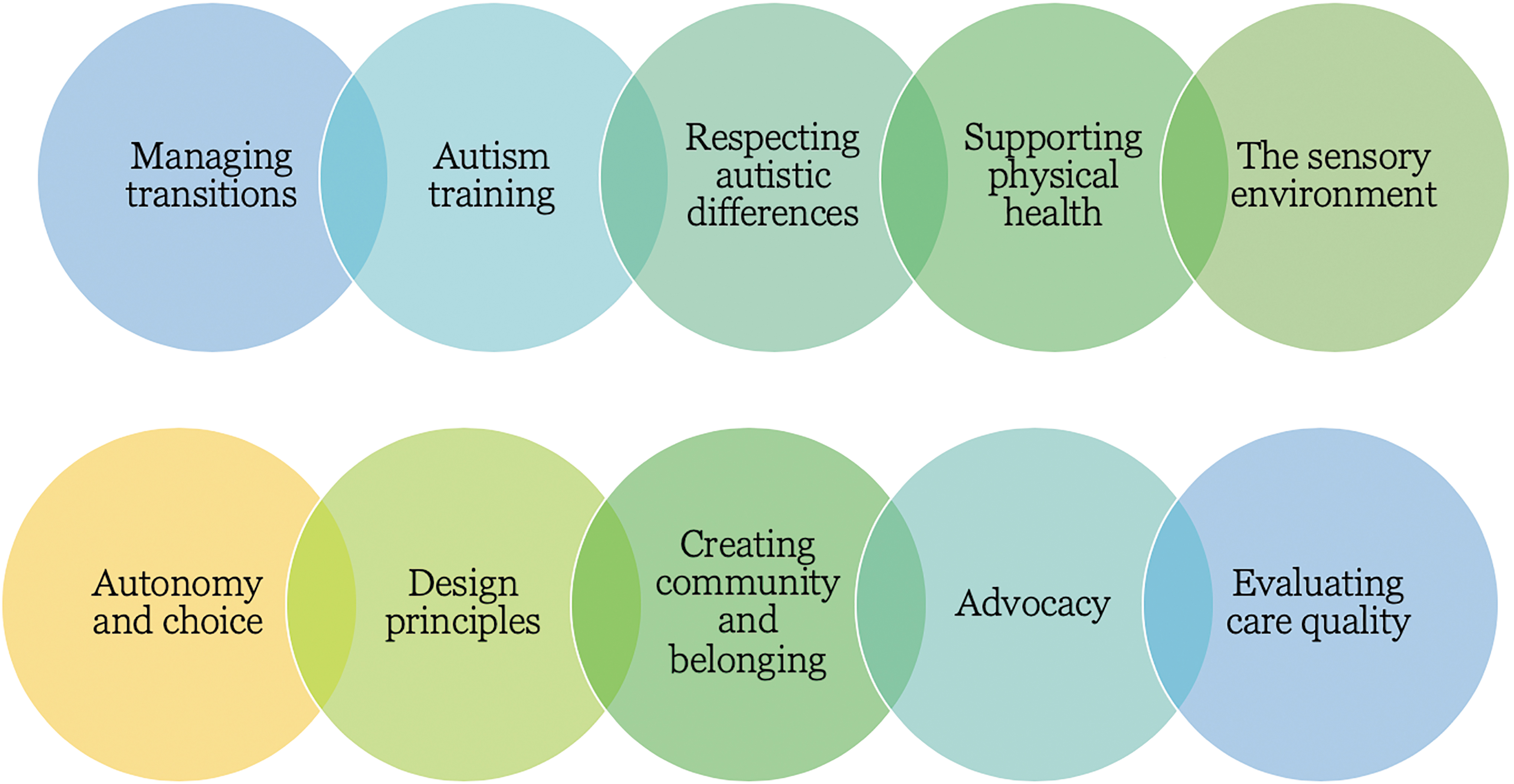
The 10 topics identified during the workshops as important for residential care for older autistic adults.
1. Managing transitions into residential care
For autistic adults who have lived independently, transition to residential care is likely to be a very daunting prospect. The required adjustments to lifestyle and environment may be particularly difficult because all transitions are hard, because the prospect of a care home lifestyle is unappealing, or both. The issues will be exacerbated when transition occurs as a result of acute health crisis, and/or in the absence of family support.
A good transition for autistic people could involve familiarization with the residential care before moving in, including photographs, short visits, and opportunities to meet staff and other residents. While good practice guides to support transitions exist (e.g., Age Cymru 31 ), several topics that are important for good care for autistic people are not included in these tools, and they may use inaccessible abstract and open-ended language.32,33 Given that currently existing transition tools32,33 were evaluated by the summit group as not meeting the needs of older autistic people, new and bespoke transitional tools for autistic people should be developed. The creation of a new transitional tool for autistic older adults should invite the sharing of information about communication styles and strategies, how pain and stress are experienced and communicated, strategies to manage anxiety and upset, sensory processing information, and communication around personal care preferences. In addition, transition tools should ensure that autistic people have a clear understanding of who will have access to their personal information. The development of a transition tool is a key topic for future research and practice and will allow for a person-centered approach to transition to consider the needs, preferences, views, and values of the autistic person moving into residential care.
2. Autism training for residential care staff
While most staff working in residential care will have received training on age-related conditions such as dementia, few are likely to have received autism training. Some training and good practice guides exist for older adults with intellectual disability in residential care (e.g., through the Palliative Care for People with Learning Disabilities Network) and for supporting autistic adults more generally (e.g., through the Autistic Self Advocacy Network); no good practice guide currently exists for older autistic adults in residential care. Autism-specific training is essential to ensure that staff are able to recognize and support the needs of older autistic adults, for example, having the ability to differentiate between dementia and autistic stress responses. This training should be developed and delivered in collaboration with autistic people: it should go beyond basic facts about autism and include information about how to support the well-being of autistic people within the context of living in a residential service with other people. It should include information on relational aspects of interaction and communication, the importance of hobbies and interests to well-being, autistic experiences of pain and anxiety and how these are communicated, how to support transitions, and information about sensory processing differences. In addition, training should acknowledge that a number of older autistic adults will not have received a diagnosis of autism due to historic changes in diagnostic criteria, and in public and medical awareness of autism. Training should take account the often high turnover of staff within the care sector, and be able to be delivered in a timely and accessible way. Ensuring staff receive autism training is essential for good quality care for autistic older adults. Researchers should work with autistic older adults and families to develop this training and evaluate its impact.
3. Recognizing and respecting autistic differences, and understanding autistic well-being
Building on aforementioned training, recognizing, and supporting autistic differences and how they contribute to autistic well-being are an essential component of good residential care. For example, while residential care homes may encourage residents to engage in activities with others, it is important to recognize that this may not be accessible or desirable for autistic people. Similarly, communal spaces, including dining rooms, within residential care may not be a comfortable space for autistic people. Services should ensure that autistic people have the option and support to engage in activities and socializing when they want to, rather than assuming that social time is always beneficial. Moreover, recognizing what constitutes a good social interaction for an autistic person is imperative, as this may not align with neurotypical norms. It is essential for person-centered residential care to recognize individual socializing preferences and markers of well-being (e.g., stimming) to ensure a high quality of care for autistic older adults. Finally, for autistic people, engaging in interests and hobbies plays an important role in well-being, and it is important to ensure that they have the space, time, materials, and support to pursue their interests.
4. Supporting physical health
Autistic people experience systemic barriers to healthcare throughout their life, including low levels of autism knowledge in primary and specialist care. A healthy diet and exercise are key components of maintaining a healthy lifestyle. Residential services should ensure that autistic people have access to suitable wellness activities that align with their current level of physical ability, and nutritious food that does not provide sensory discomfort. At the same time, as old age is often a time of declining physical health, ensuring autistic older adults can access health services, including routine screening, is an essential part of residential care. Four topics of support were identified as particularly important.
First, due to differences in sensory processing and interoception, autistic people may experience physical symptoms in a nontypical way and may need support in recognizing and explaining their symptoms. Second, diagnostic overshadowing may mean that clinicians overlook mental and physical health problems in autistic people, attributing symptoms to the autistic experience: advocacy may be needed to ensure their experiences and concerns are taken seriously. Third, autistic people may find communication with clinicians generally difficult: it may be challenging to articulate their symptoms and to process or remember information received during an appointment. Fourth, the sensory environment within a hospital or clinic may be distressing for autistic people. Residential care staff can ensure support is in place to reduce these barriers to health care. Researchers should work on developing and evaluating tools that allow autistic people to monitor and communicate their symptoms to clinicians, facilitating swift and accurate diagnosis.
5. The sensory environment and sensory processing
Autistic people experience hyper- or hyposensitivity to sensory stimuli. We do not know how the aging process, such as age-related changes in vision and hearing, or postmenopausal changes, may affect autistic sensory processing. It is imperative that future research explores these potential changes in autistic sensory processes throughout the life span to understand how to best support autistic older adults.
In the absence of specific information regarding the sensory profiles of older autistic adults, recommendations for practice can still be made based on current knowledge about autistic sensory processing. The residential care environment should be personalized and adaptable to each individual, with a particular focus on reducing strong smells from communal spaces or kitchens, bright lights or other visual stimuli, noise from other residents, staff, activities, or equipment, and furniture that exacerbates proprioceptive difficulties. Autistic people may also benefit from sensory inputs, such as weighted blankets, soothing lights, or deep pressure. Services should be aware of the importance of the sensory environment for autistic people and take measures to accommodate these needs.
6. Design principles
Guidelines for residential care for older adults acknowledge how important the residential environment is for enhancing both the functional capabilities of residents and in sustaining their well-being. 34 Environmental intervention through careful design of residential care can reduce disabling aspects of the physical environment, and can have a powerful impact on personal functioning and well-being. 35 In residential care for people with dementia, adhering to dementia design principles can support daily activities such as dressing and eating, improve sleep, and reduce falls, wandering, and getting lost. In autism practice, this may include having individual thermostats to control temperature, having access to sensory stimulating activities, having access to pets or support animals, and having Internet access. Future research should investigate which specific aspects of the residential care environment may be particularly disabling to autistic adults, as well as exploring what design lessons can be adapted from dementia care best practice.
7. Creating community and belonging
Some autistic people need specific support in engaging with others and finding their place within the community. Moving into residential care can result in a loss of the community that autistic adults have built, and it may be particularly difficult for older autistic adults to develop a feeling of belonging within the new residential care setting and with the wider community that is not adapted to them. It is important for residential care services to be creative in community building both within and beyond the residential care service and consider the specific needs that autistic people may have in relation to this. While autistic people may need support to engage with others, for integration into a community to be meaningful, it is crucial to also offer support to residents and staff to interact with the autistic person.
8. Autonomy and choice
The ability to make choices and have those choices respected is a critical part of living in residential care, and particularly in relation to health care, day-to-day activities, and food and drink. Autistic people may find making decisions or communicating those choices difficult, but this should never be used to allow a loss of autonomy. In particular, autistic people in residential care may need to plan and communicate their wishes regarding end-of-life care and arrangements after they die. Some autistic people may struggle to conceptualize what death means, which may make this situation more complex. Future research should investigate the usability of decision-making and communication aids with older autistic adults, and explore the possibilities for adapting existing systems to be more usable for this group. Researchers and practitioners should work together to develop the supports that can allow autistic people to make informed decisions and communicate their wishes regarding palliative care and funeral plans.
9. Advocacy
Transition to residential care may coincide with other important life decisions, such as making a will, and older autistic adults may benefit from an advocate who is knowledgeable about autism to help communicate their wishes. The duty of an advocate is to represent the views of the autistic person and facilitate communication. If lack of mental capacity is established under the Mental Capacity Act, welfare deputies can be appointed, whose purpose is to represent the best interest of the autistic person. Researchers and practitioners should collaborate to develop a best practice model of advocacy for older autistic people, involving a multidisciplinary, multiperspective team, including family members, legal experts, officially appointed advocates, professional staff working in residential care, and autistic people. This best practice framework should also clearly delineate the roles and responsibilities of an advocate, and facilitate autistic people to make an informed choice of who is involved in supporting their decision-making.
10. Evaluating care quality
In the United Kingdom, the quality of residential care homes is assessed by the Care Inspectorate, Care Quality Commission, and Regulation Quality Improvement Authority using quality indicator frameworks. These include scrutiny of leadership, staff teams, physical environment, care and support, and supporting well-being. Several key indicators of equitable care for autistic older people are not addressed by these frameworks. These include practical considerations such as the personalization of space and accounting for sensory differences, as well as systemic considerations, including staff autism training, autistic appropriate individualized and tailored care, and working in partnerships with health care services, advocates, and proxies to ensure that the welfare needs of the autistic adult are met.
Policymakers are responsible for ensuring that quality of services can be benchmarked against meaningful criteria, pertinent to the lives of autistic people, ensuring equality of service with nonautistic people. Policymakers should work in partnership with autistic advocates and researchers to investigate what the current experiences are of autistic people in residential care, and to calibrate criteria to ensure support is meeting the needs of those in residential care.
Discussion
As autistic people get older, they may transition to residential care. Within the context of an aging population combined with increased diagnosis of autism, ensuring residential care services meet the needs of older autistic people is an increasingly important issue. Currently, there is very little research into old age in autism in general,4,36 and none relating to older autistic adults in residential care. In the absence of an evidence base, evidence-based best practice, as required in the United Kingdom by the Care Quality Commission, the Care Inspectorate, and the Autism Act 2009, cannot exist. Thus, the standard and suitability of existing care, particularly for older adults, have not yet been explored.
In this article, we summarize key topics for development in research, practice, and policy in relation to residential care for autistic older adults, based on three multiexpert meetings. In bringing together autism expertise with aging expertise, merging research, practitioner, and lived experience, we derived new insights to catalyze future research and practice development. Relevant approaches could include a survey of, and interviews with, older autistic people and their carers to chart experiences of old age in more detail; systematic ethnographic evaluations of existing specialist services such as Specialområde Autisme's Seniors House and Scottish Autism's Founders House; and evaluation and adaptation of our recommendations by expert groups in other countries. This work would benefit from the close involvement of autistic people, their family members (especially siblings or children, who may be responsible for elements of care in older age), and also relevant practitioner and policy groups. As well as research examining the 10 topics described in this article, a longitudinal study of autistic old age and of transition into residential care is needed to provide key information about current practise and to identify points in time and place where the lives of older autistic people would benefit from appropriate adaptations. With increased awareness of the need for research into autism and older age, researchers and funders should recognize the importance and timeliness for allocating resources to this area. 36
Footnotes
Acknowledgments
The authors thank the range members of the multiexpert group for their input to this process.
Authorship Confirmation
C.J.C. led on writing the article, with contributions from C.M., M.D., and S.F.-W. All coauthors reviewed and approved the article before submission.
Author Disclosure Statement
No competing financial interests exist.
Funding Information
This work was supported by a Collaborative Research Grant (grant reference 7259) from Autistica to C.J.C., C.M., and S.F.-W.