






Abstract
Big impacts on the early Earth would have created highly reducing atmospheres that generated molecules needed for the origin of life, such as nitriles. However, such impactors could have been followed by collisions that were sufficiently big to vaporize the ocean and destroy any pre-existing life. Thus, a post-impact-reducing atmosphere that gives rise to life needs to be followed by a lack of subsequent sterilizing impacts for life to persist. We assume that prebiotic chemistry required a post-impact-reducing atmosphere. Then, using statistics for the impact history on Earth and the minimum impact mass needed to generate post-impact highly reducing atmospheres, we show that the median timing of impact-driven biopoiesis is favored early in the Hadean, ∼4.35 Ga. However, uncertainties are large because impact bombardment is stochastic, and so biopoiesis could have occurred between 4.45 and 3.9 Ga within 95% uncertainty. In an optimistic scenario for biopoiesis from post-impact-reducing atmospheres, we find that the origin of life is favorable in ∼90% of stochastic impact realizations. In our most pessimistic case, biopoiesis is still fairly likely (∼20% chance). This potentially bodes well for life on rocky exoplanets that have experienced an early episode of impact bombardment given how planets form.
Introduction
Benner et al. (2020) argued that the most likely time for the origin of life (OoL) would have been 4.36 ± 0.1 Ga in the wake of a hypothesized
A single Moneta impact is one hypothesis for the relative excess of highly siderophile elements (i.e., iron-loving, abbreviated HSEs) in the Moon’s and Earth’s mantles. During the Moon-forming impact, HSEs should have been sequestered in each planetary core, so over-abundant HSEs in today’s mantles are commonly interpreted as evidence for late-accretion impactors. Earth’s mantle has substantially more HSEs than the Moon by an amount that cannot be accounted for by Earth’s greater gravitational cross section (Day and Walker, 2015). A single massive Moneta impact could explain the Earth-Moon HSE discrepancy because, by the statistics of small numbers, Moneta could have missed the Moon and hit the Earth (Sleep et al., 1989; Bottke et al., 2010).
However, the lunar HSE depletion can be explained without a Moneta impact. Lunar HSEs could have been lost to space during impact delivery because of the Moon’s small gravity (Kraus et al., 2015). Alternatively, HSEs delivered to the Moon during its ∼150 million-year magma ocean could have been sequestered in the core due to iron sulfide exsolution (Morbidelli et al., 2018; Rubie et al., 2016). Finally, there is some chance that Earth’s HSEs do not record late impacts because the Moon-forming impact-delivered HSEs (Sleep, 2016). Another explanation for Earth’s HSEs that do not require impacts is that HSEs are gradual core contributions over time from mantle plumes (Halliday and Canup, 2023; Mundl-Petermeier et al., 2020). If indeed Earth’s HSEs reflect asteroid bombardment after the Moon formed, then the HSEs can be explained by multiple ∼500–2000 km impacts rather than a single big (∼2100 km) collision.
Recently, Wogan et al. (2023) and Zahnle et al. (2020) used photochemical models of post-impact atmospheres to show that impacts significantly smaller than Moneta can efficiently produce molecules critical for prebiotic synthesis. In their simulations, impactor iron equilibrates with vaporized ocean water to generate atmospheric H2, CH4, and NH3 that form thermochemically as the reducing steam atmosphere cools. Once steam condenses to an ocean, subsequent photochemistry of a Titan-like, hazy atmosphere produces prebiotic nitriles.
Zahnle et al. (2020) contributed a preliminary study that used simple atmospheric models and assumed all impact-delivered iron was available to reduce the atmosphere, and later Wogan et al. (2023) improved upon their calculations with more sophisticated and accurate simulations. Photochemical modeling in Wogan et al. (2023) showed that the production of both HCN and HCCCN only occurs when
Here, we employ the results of Wogan et al. (2023) along with Monte-Carlo simulations of Earth’s impact history to estimate when life most likely emerged, assuming the OoL required abundant prebiotic nitriles (e.g., HCN). Our calculations account for the possibility of planet sterilization by impacts that would have vaporized the ocean (Sleep et al., 1989; Maher and Stevenson, 1988). We assume that an OoL-favorable impact is one that produces significant prebiotic nitriles and is not subsequently followed by an ocean-vaporizing impact that destroys any biosphere that has emerged. By considering the fraction of stochastic impact realizations that do not have an OoL-favorable impact, we also estimate the probability of life beginning if Earth’s history was rerun.
Methods
The rate impacts that hit Earth bigger than mass m (in kg) at age t (in Gyr) can be written as follows:
Here,
We assume that the majority of the size-frequency distribution of impactors is identical to that of the main-belt asteroids (Extended Data Figure 1 in Marchi et al., 2014). Data for the frequency of main-belt asteroids only extends down to about 1 km diameter (
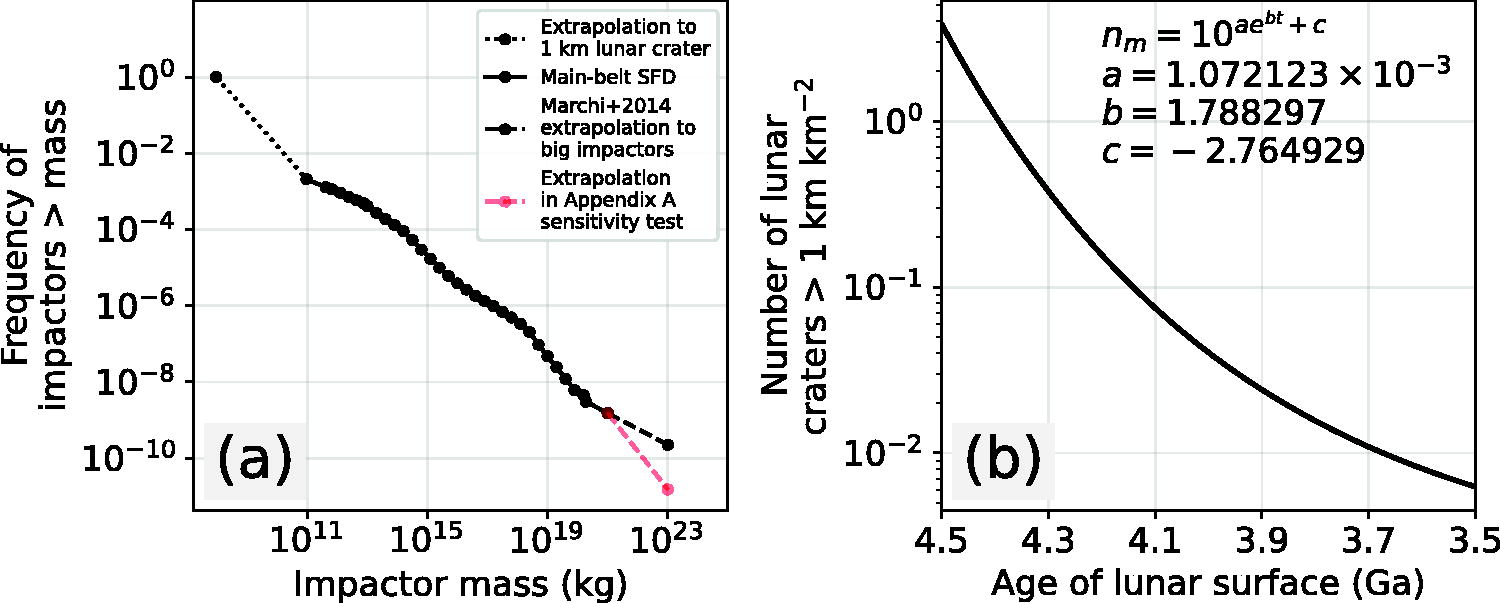
Our assumed
The flux of impactors,
Extrapolating the lunar impact history to Earth requires a correction for Earth’s greater gravitational attraction. Assuming that the approach velocity of impactors far from Earth and the Moon was on average ∼13 km/s (Marchi et al., 2018) and using Equation (7)–(14) from the work of Zahnle and Sleep (2006), we compute that Earth should have received
Equation (2) also accounts for Earth’s surface area (
The time derivative of N
0 gives the flux, F
0:
The average number of impacts on Earth between time t
1 and t
2 with mass greater than m is then
To simulate impact histories, we consider a grid of ∼200 impactor masses between 1012 and 1023 kg, and a grid of ∼60 times between 4.5 and 3.5 Ga. Indexes j and i indicate the mass and time grid cells, respectively, while, for example,
Next, we sample a Poisson distribution for each
Our final step is to assign impact velocities to each collision in the many sampled impact histories. Appendix Figure A1 shows Earth’s impact velocity distribution. We created this distribution by using the JPL database of close approaches to Earth by small bodies (Park and Chamberlin, 2023), considering all close-approach asteroids within 0.05 AU to Earth. The database gives the approach velocity of each asteroid far from Earth, so we compute the impact velocity by accounting for Earth’s gravitational potential energy. Here, we are assuming that the impact velocity distribution for small bodies (e.g., < 10 km) is identical to the velocity distribution for bigger asteroids (e.g., > 10 km). This may not be the case because small bodies are more strongly influenced by processes like the Yarkovsky effect (Bottke et al., 2006), where an asteroid’s orbit is altered by anisotropic thermal emission.
The final collection of sampled impact histories can then be used to compute impact statistics that are relevant to the timing and likelihood of the OoL.
Figure 2 illustrates three of 5000 impact histories computed with our Monte-Carlo approach (Section 2). In Figure 2a, a Moneta-sized impact, which we define as an impact between
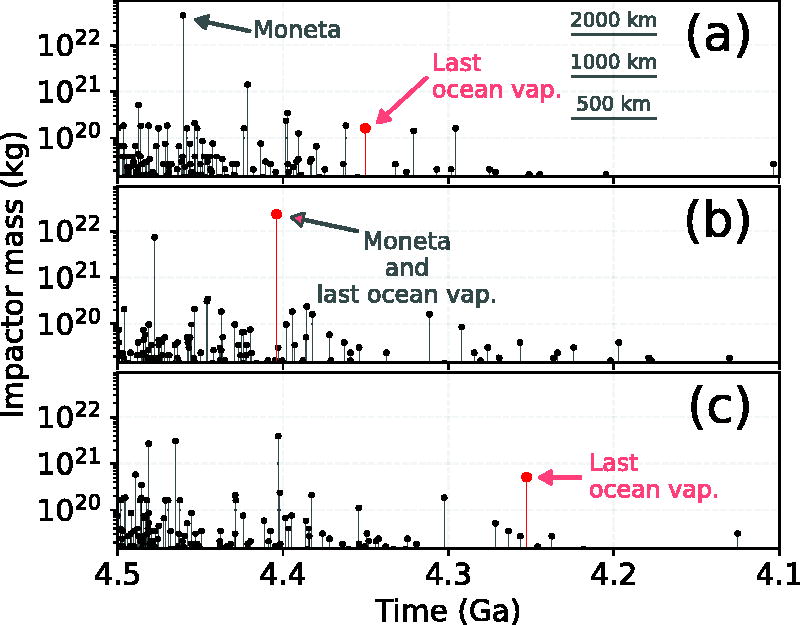
Three simulated impact histories of the 5000 derived from our Monte-Carlo approach (Section 2). Each vertical line indicates an impact of a mass shown by the y-axis. The red lines indicate the last impact to vaporize the ocean assuming 10% of an impactor’s kinetic energy heats the ocean. The legend in
Moneta also occurs in the Figure 2b impact realization. In this scenario, any life created in the wake of Moneta will not be subsequently impact-exterminated because Moneta is the last impact to vaporize the ocean.
Figure 2c shows an impact history where Moneta does not occur. Instead, Earth’s mantle HSEs are delivered by multiple 1021 to
As illustrated in Figure 2, an OoL-favorable impact does not occur in every simulated impact history. In our impact-driven model for the OoL, biopoiesis requires (1) an impact of sufficient mass to make prebiotic nitriles and (2) the lack of a later ocean-vaporizing collision that destroys the biosphere without rekindling it. Figure 3 shows the probability of both conditions occurring as a function of the minimum impact mass that produces prebiotic molecules.
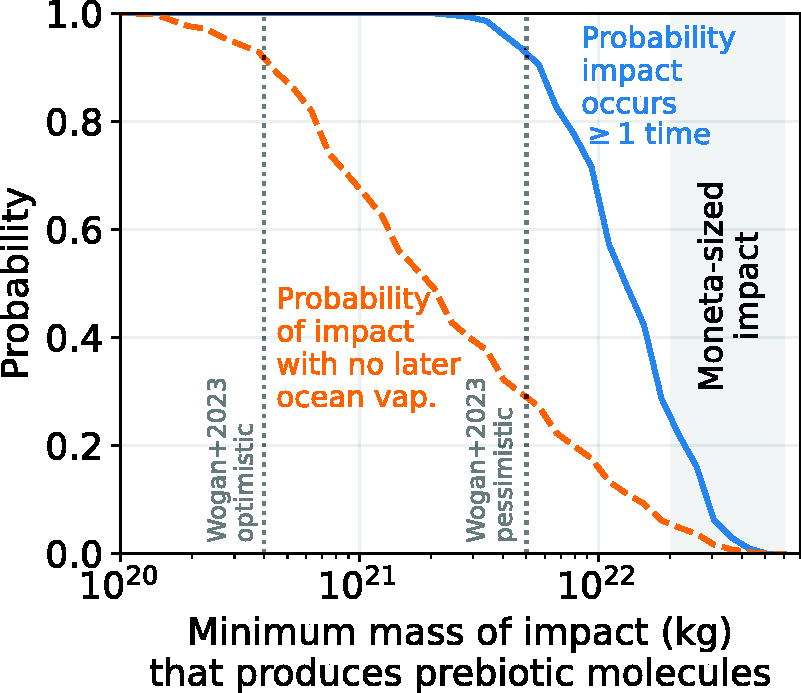
The probability of an impact that causes favorable conditions for an origin of life on Earth. The blue solid line is the probability of an impact occurring at least once. The orange dashed line is the probability of an impact without a subsequent ocean-vaporizing collision. Probabilities are shown as a function of the minimum impact mass to produce significant prebiotic molecules (e.g., HCN). Two plausible minimum masses are the Wogan et al. [2023] optimistic and pessimistic scenarios indicated with vertical dotted lines. The shaded region between
For example, consider the Wogan et al. (2023) optimistic minimum mass of
To estimate the most likely timing for the OoL, we consider both the optimistic and pessimistic criteria of Wogan et al. (2023). Figure 4a is the optimistic case, showing the timing (Fig. 4a (i)) and mass (Fig. 4a (ii)) of the last
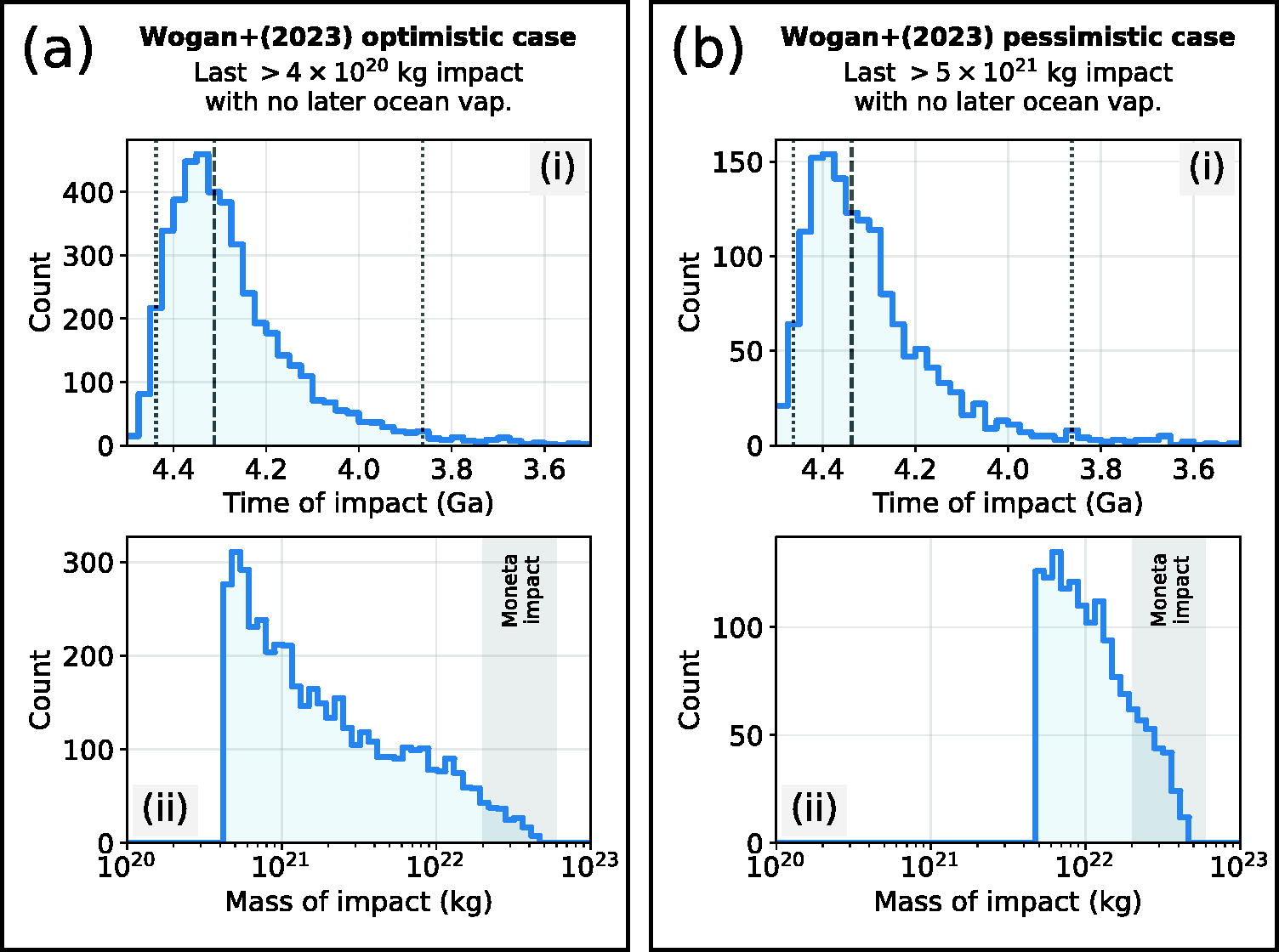
The timing and mass of an OoL-favorable impact on the early Earth.
The timing of an OoL impact is qualitatively unchanged when instead adopting the Wogan et al. (2023) pessimistic case, which requires a
In this model for biopoiesis, we suggest that life could have started within ∼10 s of millions of years after an OoL-favorable impact because this is the maximum duration of the H2- and CH4-rich atmosphere that makes nitriles like HCN (Wogan et al., 2023). We ignore the <10 s million-year span between an impact and life’s origin because it is small compared to our ∼500 million-year uncertainty for the timing of an OoL-favorable impact.
Our estimated timing for biopoiesis is compatible with the earliest well-accepted geologic evidence of life in the form of stromatolites in the 3.5 Ga Pilbara block of western Australia (Walter et al., 1980; Buick et al., 1981; Van Kranendonk et al., 2018). Older geologic evidence of life exists, such as a >3.7 Ga black shale metamorphosed to graphite with negative
Hadean zircons provide some constraint on Earth’s impact history, which we do not explicitly account for in our calculations. The oldest zircons are from Jack Hills, Australia, with U-Pb dates as old as ∼4.38 Ga (Valley et al., 2014). Benner et al. (2020) argued that a Moneta-scale impact (
Even if an impact failed to reset a zircon chronometer, the shock wave produced by an asteroid collision may create micro- to nanostructural features in zircons that could be preserved over billions of years (Reimink et al., 2023). Therefore, the presence or absence of shocked Hadean zircons in the geologic record may provide some constraint on Earth’s impact history. For example, Reimink et al. (2023) estimated the probability of preserved zircons with shock features assuming Earth experienced a “late-heavy bombardment” at 3.9 Ga. In this scenario, they found that shocked zircons were likely preserved, yet they found none in a collection of 4.02 Ga zircons from the Acasta Gneiss Complex. Overall, the absence of preserved shocked zircons suggests that a “late-heavy bombardment” did not occur at 3.9 Ga. Our Monte-Carlo models of Earth’s impact history do not use zircon shock features as a constraint. A better model would incorporate this information, noting that resolving the issue of preservational bias of zircons is beyond the focus and scope of this paper.
It is tempting to extrapolate our results beyond the early Earth to exoplanets, but we must do so with caution because planets orbiting different stars likely have bombardment histories, unlike the Hadean. Planets in the habitable zone of a late M-type star during the stellar main-sequence phase were interior to the habitable zone for several hundred million years during the superluminous pre-main-sequence phase (Luger and Barnes, 2015). Lichtenberg and Clement (2022) used N-body simulations to show that, for planets hosted by late M-dwarfs, large asteroid impacts are not useful for prebiotic chemistry because big impacts most likely occur within 100 million years of planet formation during the stellar pre-main-sequence when the planet is outside of the habitable zone. The pre-main-sequence phase is not an issue for an impact-induced OoL on planets that orbit sun-like stars because the phase only lasts ∼3 Myrs, while large asteroid impacts occur for 108 years (Lichtenberg and Clement, 2022). Therefore, our result that an OoL-favorable impact was likely on early Earth (93% chance in an optimistic case) might be best extrapolated to habitable zone exoplanets orbiting sun-like stars.
A caveat to our results is that ocean vaporization by an impact is likely a complicated function of impact mass, velocity, and incident angle, which we do not fully account for (Appendix B). Throughout Section 3, we have assumed that 10% of an impactor’s kinetic energy heats the planetary surface (
To determine the sensitivity of our results to
An additional related caveat is that our calculations assume that an impact that vaporizes the ocean also sterilizes the planet, but this may not be the case if thermophilic microbes survived in the deep (>1 km) subsurface (Sleep and Zahnle, 1998; Zahnle and Sleep, 2006). If ocean vaporization did not destroy the biosphere, then our results would prefer an OoL earlier than we predict in Figure 4, and an OoL-favorable impact would also be more probable than we have estimated (Fig. 3).
Conclusions
We used Monte-Carlo simulations of Earth’s impact history to determine the most likely timing for the OoL, assuming it required abundant prebiotic nitriles. We used the results of Wogan et al. (2023), who found that significant OoL precursor molecules, such as HCN, were produced in the Hadean atmosphere after a
For either the optimistic or pessimistic cases, we found that the most likely timing for an OoL impactor is ∼4.35 Ga with a 95% uncertainty spanning the entire Hadean eon (approximately 4.45 to 3.9 Ga). The large uncertainty is caused by the intrinsic stochastic nature of impacts. These results suggest that Benner et al. (2020) proposed timing of the OoL, at 4.36 ± 0.1 Ga, is too narrow. Furthermore, the mass of the OoL-favorable impactor is most likely (80% to 96% probability) smaller than the Moneta impactor (Fig. 4) proposed by Benner et al. (2020), because the size-frequency distribution of asteroids favors more frequent smaller impactors.
Our simulations of Earth’s impact history do not always result in a bombardment favorable for an OoL. There are some impact histories where a collision of sufficient mass to produce prebiotic molecules does not occur or, alternatively, does occur but primitive life is subsequently destroyed by an ocean-vaporizing impact that does not rekindle the biosphere. With our nominal assumptions, an OoL-favorable impact occurs 93% or 30% of the time when we assume a
If life began after an impact that generated a reducing atmosphere, then this work suggests that OoL on Earth was fairly likely (at least a ∼16% chance) and indeed strongly favored (93% chance) under optimistic assumptions. Given that rocky planets form from accretionary impacts, our work supports an optimistic outlook for life on exoplanets that orbit sun-like stars and future searches for biosignatures.
Software
The source code needed to install the necessary software and reproduce all main text calculations (i.e., Figs. 2–4) is archived on Zenodo: https://doi.org/10.5281/zenodo.11051955 (Wogan, 2024).
A size-frequency distribution sensitivity test
We assume that the size-frequency distribution of objects that struck the early Earth is similar to the main-belt asteroids. A problem with this approach is that the main-belt asteroids only contain objects up to ∼1000 km diameter, yet the early Earth is expected to have experienced impacts larger than this (Marchi et al., 2014). Therefore, we must extrapolate the size-frequency distribution above ∼1000 km to larger objects. Throughout the main text, we use the same extrapolation as Marchi et al. (2014) (the black dashed line in Fig. 1), who extend the size-frequency distribution with a log-log slope of
To test the sensitivity of our results to this chosen extrapolation, we re-did our Monte-Carlo analysis using a log-log slope of
B impact energy required for ocean vaporization
Recently, Citron and Stewart (2022) performed smoothed-particle hydrodynamics impact simulations over a range of impact angles, masses, and velocities to estimate the impact properties that can vaporize an ocean. Figure A4a shows their simulation results for the change in the atmosphere’s and ocean’s internal energy (
Energy delivery to the atmosphere/ocean appears to depend on impact angle, mass, and velocity (Fig. A4). In addition, all the Citron and Stewart (2022) simulations are far more massive than the minimum threshold for ocean vaporization, so we must rely on extrapolations. Therefore, our assumption of a constant
We evaluate the sensitivity of our results to an assumed constant
Figure A6 shows the timing of the last impact to make conditions favorable for biopoiesis that does not experience subsequent ocean vaporization for
Overall, uncertainty in the impact properties required to vaporize the ocean has a small effect on our qualitative conclusions. Regardless of
Footnotes
Acknowledgments
We thank our two reviewers for providing thoughtful comments that improved this article. In addition, we thank Roger Buick for reading an early draft of this article and giving useful feedback. We also thank Steve Warren for reading an early draft and correcting several grammatical errors.
Author Disclosure Statement
No competing financial interests exist.
Funding Information
N.F.W. and D.C.C. were supported by Simon’s Collaboration on Origin of Life Grant
Abbreviations Used
Associate Editor: Sherry L. L. Cady