






Abstract
As focus for exploration of Mars transitions from current robotic explorers to development of crewed missions, it remains important to protect the integrity of scientific investigations at Mars, as well as protect the Earth's biosphere from any potential harmful effects from returned martian material. This is the discipline of planetary protection, and the Committee on Space Research (COSPAR) maintains the consensus international policy and guidelines on how this is implemented. Based on National Aeronautics and Space Administration (NASA) and European Space Agency (ESA) studies that began in 2001, COSPAR adopted principles and guidelines for human missions to Mars in 2008. At that point, it was clear that to move from those qualitative provisions, a great deal of work and interaction with spacecraft designers would be necessary to generate meaningful quantitative recommendations that could embody the intent of the Outer Space Treaty (Article IX) in the design of such missions. Beginning in 2016, COSPAR then sponsored a multiyear interdisciplinary meeting series to address planetary protection “knowledge gaps” (KGs) with the intent of adapting and extending the current robotic mission-focused Planetary Protection Policy to support the design and implementation of crewed and hybrid exploration missions. This article describes the outcome of the interdisciplinary COSPAR meeting series, to describe and address these KGs, as well as identify potential paths to gap closure. It includes the background scientific basis for each topic area and knowledge updates since the meeting series ended. In particular, credible solutions for KG closure are described for the three topic areas of (1) microbial monitoring of spacecraft and crew health; (2) natural transport (and survival) of terrestrial microbial contamination at Mars, and (3) the technology and operation of spacecraft systems for contamination control. The article includes a KG data table on these topic areas, which is intended to be a point of departure for making future progress in developing an end-to-end planetary protection requirements implementation solution for a crewed mission to Mars. Overall, the workshop series has provided evidence of the feasibility of planetary protection implementation for a crewed Mars mission, given (1) the establishment of needed zoning, emission, transport, and survival parameters for terrestrial biological contamination and (2) the creation of an accepted risk-based compliance approach for adoption by spacefaring actors including national space agencies and commercial/nongovernment organizations.
Introduction to the Crewed Exploration of Mars and Planetary Protection Knowledge Gaps
As we prepare for the first mission to Mars with a human crew, we have a continuing obligation to protect against harmful contamination at the red planet. In particular, it is unlikely that the search for life on Mars will be completed by the time the first crew systems arrive at the martian surface. Indeed, some consider the presence of astronauts to be an essential augmentation to the robotic search for evidence of life. In addition, the environment of Earth needs to be protected from any potential hazards posed by the uncontrolled release of a putative martian life form into the terrestrial biosphere.
Prevention of possibly harmful cross-contamination between Mars and Earth is the practice of planetary protection. At present, the knowledge of how to achieve these two goals (prevention of forward contamination from Earth and backward contamination from Mars) is well described for robotic systems. In contrast, for human missions there are principles and guidelines (COSPAR, 2021; Fisk et al., 2021), * but these are insufficient to guide engineering design and mission operations—in part, because our knowledge of Mars (and of how contamination from future crewed systems will interact with Mars) is likewise incomplete. These gaps in our knowledge (Olsson-Francis et al., 2023), as also described in National Aeronautics and Space Administration (NASA)'s interim directive NID 8715.129 (2020), need to be addressed by acquiring new data during the next decade, if planetary protection measures are to be implemented successfully for human missions.
The Outer Space Treaty (OST) (United Nations, 1967) is the internationally recognized legal basis for the adoption of planetary protection policies and their implementation. Under Article IX, the OST requires that “States Parties to the Treaty shall pursue studies of outer space, including the Moon and other celestial bodies, and conduct exploration of them so as to avoid their harmful contamination and also adverse changes in the environment of the Earth resulting from the introduction of extra-terrestrial matter and, where necessary, shall adopt appropriate measures for this purpose.”
It is, therefore, an obligation of signatory States to ensure national mechanisms are in place to ensure compliance with this provision, with application to both governmental agencies and nongovernmental entities. Although not legally binding under international law, the Committee on Space Research (COSPAR) Planetary Protection Policy (together with its implementation guidelines and associated requirements) provides an internationally endorsed reference in support of States' compliance with Article IX of the OST, as recognized by the UN Committee on the Peaceful Use of Outer Space (COPUOS) (United Nations, 2017). The means by which this compliance is achieved is reserved to the judgment of the States authority responsible for each planetary mission (Coustenis et al., 2023), although it is commonly the case that cooperating States authorities will agree to follow COSPAR policy as the basis for their joint compliance.
Developing mission architectures and mission profiles for eventual human missions to Mars continues to be part of the NASA charter and a major activity within the agency. Similarly, the European Space Agency (ESA), as outlined in Agenda 2025 and the Terra Novae 2030+ strategy roadmap, plans to develop key building blocks by 2035 for the horizon goal of a human mission to Mars by the 2040s, and with member states recognizing human space exploration as an “inspirator.”
The Japanese Aerospace Exploration Agency (JAXA) has a joint research agreement to work on a crewed pressurized lunar rover with potential feed-forward to Mars. Also, China is developing the capability to perform crewed Mars missions in the 2030s, and commercial space companies have also expressed the desire to send crewed missions to Mars in the 2030s.
The current objective for the first NASA Mars mission concept is to land humans on the surface of Mars and return them, and their returning cargo, safely to Earth. The landing site for such a mission will be driven by crew safety, available capabilities, knowledge of the Mars environment, planetary protection concerns, and science priorities. The top priority for the crew—once they land and validate habitation/exploration/ascent capabilities—will be to perform high-value utilization tasks, the details of which are expected to be established by NASA and partnering agencies.
The process for selecting and prioritizing these utilization tasks has yet to be defined. Key decisions, such as whether subsequent crews will return to the first landing site or explore new landing sites in other regions, also remain undecided. The engineering requirements (including those for planetary protection) for such a mission would be developed under an eventual “Human Mars Exploration Program,” with leadership and membership that is, again, yet to be established. In lieu of such requirements, guidance has been provided by NASA leadership to support the development of human Mars mission architecture concepts (NASA, 2015), and it is these concepts that have been used in this COSPAR meeting series as the point of departure from which to evaluate the planetary protection knowledge gaps (KGs) from a future mission point of view.
The most recent analysis assumptions have been used to establish the “minimum” human Mars exploration concept within NASA's Moon to Mars campaign architecture development space, which includes the following: A light initial exploration footprint, sending four crew members to Mars orbit, with two of those crew members descending and living on the surface for a 30-sol surface stay Multiple Mars landers, with the first lander(s) pre-deploying cargo to prepare for a later crew landing Modest initial surface infrastructure: a ∼10 kWe (minimum) fission surface power system and communications infrastructure, but no fixed surface habitat, and no requirement for return mission-critical in situ resource utilization (ISRU) propellant production An “all-up mission” approach, with crew departing Earth with all the transit propellant they need for the round-trip journey, a consequence if there is no ISRU propellant for the first mission.
A description of this 30-sol Mars surface mission is documented in NASA document HEOMD-415, “Mars Surface Activities for Crewed Mission Systems and Utilization Reference Mission” (Hoffman, 2022), anchoring the shorter end of possible surface stay durations. This document also includes an Appendix that outlines a notional surface exploration cadence for longer surface stay missions. Of course, other mission concepts are being considered, but most of the KGs discussed in the series (all except two: see Table 3) are applicable across all mission architectures.
The COSPAR Meeting Series Approach to Addressing Planetary Protection KGs for the Crewed Exploration of Mars
The current COSPAR planetary protection policy content on “Principles and Guidelines for Human Missions to Mars” (COSPAR, 2021) was adopted in Montréal in 2008 and is focused on qualitative guidelines for such missions. The follow-on activities reported in this article and planned for the future are intended to support further quantitative engineering design for a crewed mission to Mars that can both protect Mars from Earth microorganisms and protect Earth from the return of possible martian microorganisms. The process that has been followed to develop requirements for planetary protection for a crewed mission to Mars has been to hold a series of meetings with an international group of multidisciplinary scientists and engineers to address planetary protection for human missions to Mars. These meetings started with a NASA-only meeting in 2015 (Johnson et al., 2016), which leaned on earlier considerations of the topic (Criswell et al., 2005) to identify KGs that would need to be addressed to develop engineering requirements for planetary protection for crewed missions to Mars.
Since 2015, and based on a proposal made during the 2014 COSPAR General Assembly, the topic of planetary protection KGs for human missions has been systematically addressed during the COSPAR meeting series (Kminek et al., 2016; Race et al., 2019, 2020) (Spry et al., submitted) cosponsored by COSPAR, NASA, and ESA. These were open meetings typically comprising 50–60 in-person attendees (later virtual meetings were larger at 80–100), and at various times the meeting attendees included spacecraft engineers, scientific discipline specialists, astronauts, legal professionals, crew flight surgeons, program and project managers, and representatives of commercial spaceflight organizations.
The KGs that were generated were grouped into three study areas: (1) Microbial and human health monitoring, (2) technology and operations for contamination control (also called “spacecraft systems”), and (3) natural transport of contamination on Mars. Closure of these KGs would lead to an end-to-end knowledge-based solution for countries and organizations seeking to comply with the OST to set planetary protection requirements and develop implementation procedures for human missions. The groups at each meeting performed assessments of the measurements and data needed to close each of the KGs, together with an identification of locations/destinations and instruments needed for making those measurements. Figure 1 illustrates the series of meetings, starting with the NASA workshop in 2015 until the latest COSPAR virtual meeting in June of 2022, and identifies the goal of each meeting as a path to identifying a venue and way to close each KG.
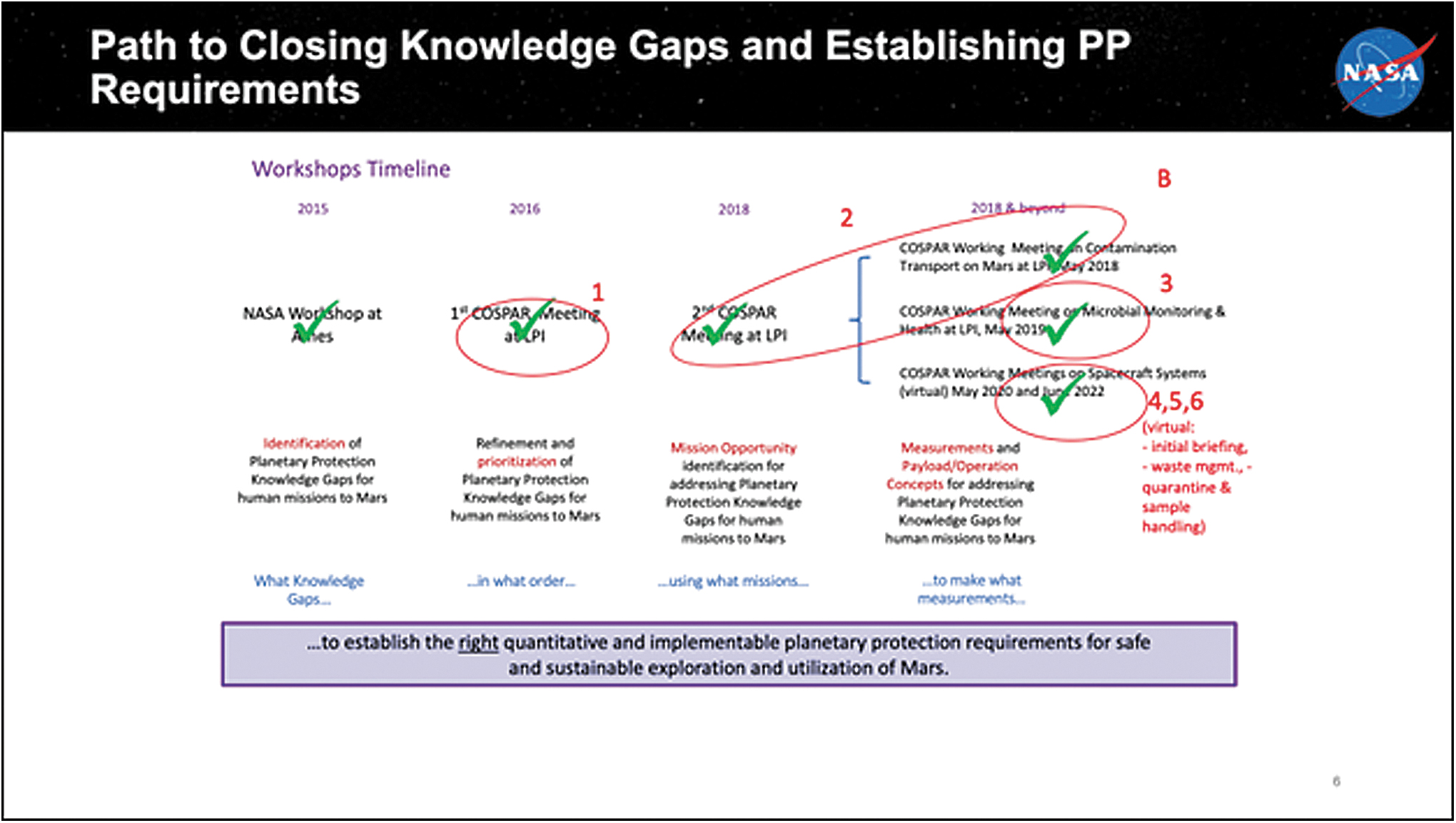
Meeting series and purpose overview for the COSPAR Planetary Protection Knowledge Gaps for Human Missions to Mars. COSPAR = Committee on Space Research.
The first (2016) COSPAR meeting started with the KGs that were generated at the 2015 NASA meeting, and these were refined and prioritized. From this point forward in the meeting series, the wording of the KG set was not reconsidered, and none of the subsequent meetings identified any “new” topic, giving confidence that the KGs robustly reflect the activities needed to reach an end-to-end implementation solution. The second COSPAR meeting was actually two meetings across 3 days. In the first day and a half, a broad group considered mission opportunities and destinations (venues) where measurements could be made to provide data needed to address the KGs across the full spectrum of the three study areas. In some cases, measurements to close KGs could be taken at multiple venues. It is reasonable to assume that agencies will prefer to close gaps at the lowest-cost venue, which may be, for example, at Earth analogs rather than through (more expensive) in-space missions. However, some KGs can only be closed through new data obtained at Mars. The second part of the meeting on days 2 and 3 focused on the “Natural transport of contamination on Mars” with a smaller group identifying a suite of measurements that are needed to allow the generation of a high-fidelity model for contaminant transport at Mars. The third (2019) COSPAR meeting focused on “Microbial and human health monitoring.” The meeting determined that there is a path to in situ monitoring of both environmental and crew microbiology and made some key recommendations concerning available technology and adaptations needed to address planetary protection goals.
The following fourth, fifth, and sixth COSPAR meetings were virtual and in the course of the three meetings considered the “Technology and operations for contamination control” in spacecraft systems, including topics such as waste management and quarantine approaches. The discussions occurred under a set of working assumptions that evolved and were captured in text as the series progressed. These were intended to support discussions that would lead to a knowledge-based transition from current robotic planetary protection approaches to an end-to-end solution for planetary protection implementation for the first crewed Mars mission. The assumptions were as follows:
Human spaceflight hardware leaks (in nominal and off-nominal operation), so the old robotic paradigm of managing a fixed initial bioload is inappropriate (NRC, 2002).
The introduction of a maintained temperate terrestrial environment at the martian surface affords the opportunity for many more organisms (in type and quantity) to escape into the martian environment.
This exploration is taking place in a post-Mars Sample Return (MSR) context where martian life was NOT (yet?) discovered at the martian surface/shallow subsurface in returned Mars material, but we know a lot more about Mars from those samples.
KGs need to be understood and preferably closed before launch to protect the integrity of scientific return and the Earth.
Presented in this article is a summary of the discussions and findings at each meeting, supported by the current state of the art at the time of writing. For detailed discussions on each topic, the reader is referred to the original meeting reports in each case (Kminek et al., 2016; Race et al., 2019, 2020) (Spry et al., submitted). The KGs, grouped into the three study area categories mentioned earlier, are listed by summary description in Table 1.
Summary Descriptions of the Knowledge Gap Topic Areas, Based on the 2016 (First) COSPAR Planetary Protection Knowledge Gaps for Human Missions to Mars Meeting Outcome
COSPAR = Committee on Space Research; ISRU = in situ resource utilization.
In this article, Section 3 below discusses the state of the art and KGs in the area of Microbial and Human Health Monitoring. This is followed by Section 4 on KGs for Technology and Operations for Contamination Control, which considers the performance of the various spacecraft systems with regard to forward and backward biological contamination control. Section 5 considers our up-to-date understanding of Natural Transport of Contamination on Mars, on the fate of terrestrial biological materials released into the martian environment. The venues and approaches available for closing KGs are discussed in Section 6, with Sections 7 and 8 containing the Discussion and Conclusions of the study, respectively.
Microbial monitoring is considered essential for understanding and mitigating the threat of forward contamination from a crewed mission, as well as the best approach for monitoring against exposure to a putative martian microorganism. The ideal microbial monitoring technology for crewed spacecraft exploration would feature straightforward sampling, sample processing, sample analysis, and data interpretation. Also, being usable in the resource-constrained environment of a space mission, without ground support, is essential, and avoidance of classical culturing methods (that further increase microbial biomass and, thus, contamination risk) is extremely desirable.
In the course of the meeting series, molecular biology technologies and the MinION metagenomic DNA sequencing technology, in particular, were repeatedly assessed to be the best available technology to meet this need. This approach would result in a DNA-based survey of the microorganisms present and their functional capabilities, but with protocols, data interpretation, and decision-making processes for a Mars mission yet to be determined, based on findings from anticipated future ground, International Space Station (ISS), and cislunar data sets.
In the past two decades, molecular biology technologies in genomics and DNA sequencing have advanced extremely rapidly, deepening our understanding of microbial populations and their characteristics and interactions (Karouia et al., 2017). The participants at the meetings held an expectation that this trend would continue ahead of the first crewed Mars mission, but discussions were grounded in analytical capabilities currently available.
ISS microbial monitoring for human health
In-flight microbial diagnostic monitoring requirements for crew health and environmental management are described in the ISS Medical Operations Requirements Document (NASA, 2003). Historically, these have been cultivation based and have required return of samples to the ground for analysis, which would not be possible on a crewed Mars mission. However, Nanopore sequencing is now in routine use onboard the ISS, with experimental operation having occurred since 2016. Such in situ analysis was made possible by the emergence of portable molecular biology tools, such as miniPCR bio's “miniPCR” and Oxford Nanopore Technologies' “MinION” instruments. Both platforms were tested onboard the ISS in 2016, marking the first polymerase chain reaction (PCR) and DNA sequencing to take place beyond the Earth (Boguraev et al., 2017; Castro-Wallace et al., 2017).
After these initial demonstrations, a methodology was built around these technologies to perform routine microbial identifications aboard the ISS. A culture-independent swab-to-sequencer process based on these technologies was developed and tested for the first-time aboard the ISS in 2018. During this testing, two crewmembers performed four independent swab-to-sequencer experiments. The data revealed a high similarity with the human microbiome studies on Earth as well as previous culture-based ISS data (Stahl-Rommel et al., 2021). Not surprisingly, much higher diversity was noted with the swab-to-sequencer method in comparison with the historical culture-based data, as a significant number of difficult-to-culture microorganisms were able to be detected. Continued onboard validation of this swab-to-sequencer method for surface analysis is ongoing as a part of the ISS Crew Health Care Systems (CHeCS) standard medical operations testing with the goal of moving beyond culture-based analysis for exploration.
Most recently, the success of this approach in confirming the ability to meet crew health identification requirements and the benefits accompanying a culture-independent method has led to the establishment of the BioMole Facility by the CHeCS team. BioMole is the set of hardware, consumables, and procedures required to support sample preparation and nanopore sequencing onboard the ISS. BioMole goals include expanding sample sources, comparing data with previous methods, demonstrating onboard data analytics, and validating new hardware. To date, comparative surface analysis, molecular- and culture-based, has been completed. In addition, the demonstration of a sample-to-answer process was achieved when BioMole data were processed onboard ISS using the IBM Open Data and AI Edge software platform installed on the Spaceborne Computer-2. The taxonomic profiles generated from the Edge analysis were consistent with profiles generated from the downlinked processed data. Potential future BioMole efforts will involve microbial profiling of the ISS water system, ISS validation of the MinION Mk1C, and an expansion to use as a research facility available to investigators. Even with all these advances, the current BioMole facility requires a significant amount of crew time to perform the end-to-end analysis. A high-throughput methodology with more limited crew interaction to operate would be desirable for future crewed Mars missions (Karouia et al., 2017).
Microbiome monitoring and human health
To date, there is a very limited understanding of how space travel conditions may affect human microbial biology or even pathogenicity. For example, if exchange between the human microbiome and the diversity on Earth is restricted or cut off completely, what effect does this have on the fine balance of microbial influx, equilibrium, and efflux and consequently to human (astronaut) health (Bijlani et al., 2021b)? Indeed, the definition of a healthy human microbiome is still subject to debate, and the random set of microorganisms each infant ingests over time is hypothesized to become an important part of each individual's core set of tolerated commensals (LaPelusa et al., 2021). Each individuals' microbiome normally possesses sufficient resilience to maintain its steady state against perturbations, and dysbiosis has been associated with multiple disease conditions. Microbiome composition and fluctuations are, therefore, considered to be highly individual.
However, knowledge about the healthy and diverse microbiome baseline and its taxonomic/functional fingerprint is an important reference for a Mars mission with regard to detection of unusual perturbations (Kuehnast et al., 2022). With the astronaut's microbiome perpetually monitored, a system should be established to translate sequence data into medical guidance and an early warning system. Perturbations could then potentially be prevented by prophylactic strategies such as cleaning, antibiotic application, stress reduction, food design, sterilization, reconstitution, or probiotics. From a generic human health point of view, it is likely that advances in medical research will provide the tools to enable such a strategy (within the time frame ahead of a crewed Mars mission). However, from a planetary protection perspective, we need to establish the type, depth and frequency of microbiome monitoring, the methodology, data analysis, and models, so that a procedure can be established to translate sequence data into an early warning and decision-making system for backward contamination purposes (protecting the crew and, subsequently, Earth).
One consideration for such a system is the needed depth of the required sequencing-based analysis. The amplicon-based taxonomic analysis described in Section 3.1. has demonstrated efficacy as a decision tool for replacing a culture-based method for known human pathogens. However, in the case of monitoring a healthy crew microbiome and/or detecting perturbations resulting from exposure to martian material, functional genomic analysis using “shotgun” whole genome sequencing (WGS) may be required (Fig. 2).
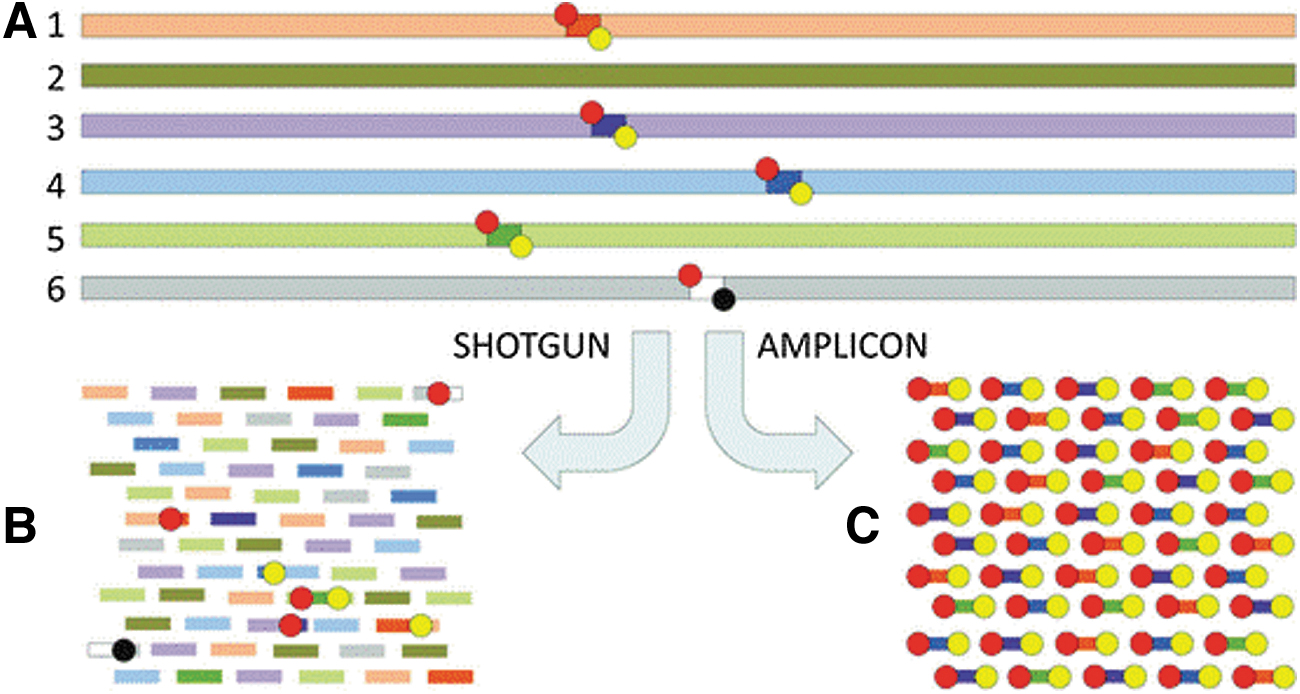
Comparison of “Shotgun” WGS and amplicon-based sequencing. In Shotgun WGS, the whole genome of all target DNAs
Sustaining humans in space environments requires the ability to monitor and react to the accumulation of harmful pathogens, including, for example, antibiotic-resistant bacteria. Sustaining humans in space environments also requires determining how microorganisms with beneficial effects that may be necessary for long-term human health can be maintained. Similarly, characterizing the microbiome of the built environment of the ISS and relating it to studies of “healthiness” in terrestrial built environments will lead to an understanding of the necessary sampling frequency needed to monitor the microbiome of future crew vehicles for both forward and backward contamination management.
Shotgun metagenome methodologies for WGS that enable the recovery of near complete genomes of unculturable microorganisms have already been used in multiple studies on samples from spacecraft-associated environments. Singh et al. (2019) recovered sequences from microorganisms such as Deinococcus, Kineococcus, Hymenobacter, and Blastobacter, among others in metagenomic data from the ISS.
In that case, the metagenomic data from such samples were used to facilitate the optimization of isolation and cultivation conditions required for organisms that would be considered “resistant” from a forward planetary protection perspective (non-spore formers that display radiation and desiccation tolerances), organisms whose growth is confirmatory of the detection in the metagenomic assay. This approach of metagenome-to-cultivation phenotype was recently used to isolate a novel bacterial genus from the ISS (Singh et al., 2019; Bijlani et al., 2021a). In principle, such a “metagenome to phenome” investigative approach can also be used for the detection of low abundance or novel pathogen, and “problematic microorganisms” for planetary protection. The approach could potentially aid in predicting, for example, microbial tolerance against spacecraft cleaning reagents and the environmental conditions at the planetary target (e.g., regolith on Mars).
Another recent study on the ISS in which an environmental metagenome data set was used to reveal the presence of 115 microbial genera and 318 species dominated by Rhodotorula (35%) and Pantoea (10%) that were interpreted as a viable and thriving community (Singh et al., 2018). An important feature of this study was that signal from dead cell DNA was removed from the sample before analyzing DNA from just the intact cells (Vaishampayan et al., 2013). This means that dead cells that have no capacity to replicate and cause forward/backward contamination do not obscure the signal from viable organisms. In this study, propidium monoazide was used as a viability marker to selectively permit amplification only of DNA from intact microorganisms before downstream molecular analyses (Vesper et al., 2008; Weinmaier et al., 2015; Bonetta et al., 2017; Kibbee and Örmeci, 2017).
ISS metagenomics sequence analyses have also provided near-complete draft assemblages of seven genomes. Subsequently, based on the average nucleotide identity (<95%) and digital DNA–DNA hybridization (<70%) characterizations (Goris et al., 2007), four of these seven genomes were phylogenetically affiliated to a novel genus (Kalamiella). Furthermore, seven strains belonging to this novel genus were retrieved from the ISS culture collection, which was initially isolated from various locations of the ISS and archived (Venkateswaran et al., 2017). However, 16S rRNA gene sequence analyses could not resolve the taxonomies of these 7 ISS strains because they exhibited high DNA sequence similarities with 25 already described Pantoea species (>97.5%). The comparative WGS analyses demonstrated that these ISS strains were not phylogenetically affiliated with any already described genus belonging to the family Erwiniaceae. These were eventually described as Kalamiella piersonii, a novel genus/species combination (Singh et al., 2019).
After this initial K. piersonii isolation from the ISS, multiple reports have documented its incidence in clinical cases across various countries, resulting in the US Center for Disease Control classifying it as an emerging pathogen (source:
Most recently, a comprehensive study was conducted involving the collection of thousands of swab samples (in duplicates) from various surfaces on the ISS (Venkateswaran et al., in preparation). These samples were analyzed by using shotgun metagenomics as well as performing a metabolomic analysis. By combining metagenomic and metabolomic data (both genetic and metabolic profiles of the community), the researchers were able to gain further insight into the microbial biomass present on the ISS and understand the functional capabilities of these microorganisms. The data obtained from this study will be used to develop a three-dimensional locational map of microbial communities on the ISS. In the future, this approach could allow assessment of the functional capabilities of microbial communities. Moreover, the information gathered from this non-DNA-based research could be utilized to develop “biosensor” instruments that can detect and monitor the presence of specific microbial species or capabilities, based on the production of particular metabolites, which can support decision-making in management and mitigation of microbial exposure for Mars, the crew, and Earth.
Validating these techniques by using state-of-the-art methods on the ground will allow us to develop modified methods and procedures for use in flight. Using metagenomic sequencing for microbial monitoring of the spaceflight environment during long-duration missions will require protocols that simplify or automate sample processing, run on flight compatible hardware (e.g., MinION sequencer), meet mass requirements, use reagents with shelf lives adequate for the mission, and reduce or eliminate the use of toxic reagents (Stahl-Rommel et al., 2021). Data processing will also need to be largely automated since it will not be practical to transmit large metagenomic data sets back to Earth for analysis. Onboard databases of common spacecraft organisms will be crucial for this effort. The Sample to Sequencer protocol developed by NASA targets bacteria with 16S rRNA gene-based amplicon microbiome analysis. However, a protocol is needed that will generate shotgun metagenome libraries in space and under microgravity to understand not only microbial speciation but also the functional properties of the microbial community.
Sampling and sample processing considerations
Microbial sampling from low-biomass environments (e.g., spacecraft surfaces on Earth) is extensively documented, despite cotton swabs only recovering as little as 1% of the biomass present on a surface (Bargoma et al., 2013). In scenarios where sample collection is performed outside of a spacecraft (e.g., ISS external surfaces), additional challenges arise. First, the swab must be specifically designed for use with large bulky extravehicular activity (EVA) gloves or capable of interfacing with robotic manipulators. In microgravity environments, the swab must be tethered to prevent accidental loss of the swab materials. The construction of the swab needs to be compatible with spacecraft cabin flammability and toxicity requirements, as well as the extreme temperatures and vacuum conditions experienced during EVAs. In addition, both the swab and container must maintain sterility during the transition from the spacecraft's pressurized cabin to the vacuum of space and vice versa.
Currently, NASA has approved EVA swabs for use outside of a spacecraft, enabling the collection of up to eight samples within a given EVA (Rucker et al., 2018). Ground tests were conducted using these flight-approved EVA swabs to collect samples from spacesuits, and the microbial communities samples were successfully analyzed using metagenomic sequencing techniques (Danko et al., 2021); however, they are yet to be deployed to the ISS. In addition to NASA's efforts, Russia's Central Engineering Scientific Research Institute (TSNIIMASH) and the Institute of Biomedical Problems have developed the “Test” swab kit for evaluating exterior surfaces on Russian elements of the ISS. These kits were used on at least seven EVAs to collect samples for ground-based analysis. Viable bacteria and fungi were cultured from these samples (Deshevaya et al., 2020). To minimize the need for culture-based analysis, samples collected by NASA will be analyzed with amplicon-sequencing or “shotgun” metagenomics depending on the concentration and quality of DNA recovered.
Bioinformatic considerations
Decision-making using amplicon-sequencing or “shotgun” metagenomics-based analyses will be dependent on the availability of robust bioinformatic tools. Work is needed to generate a database of metagenomes from built environments on the ISS and on Earth, and to use that data from environments on Earth to define nominal healthy microbiomes for the spacecraft environment. In addition, these approaches should also be capable of detecting and quantifying persistent and problematic microorganisms in each environment, so that perturbations resulting from Mars exposure can be detected and mitigated.
The microbiome of the built environment has received considerable attention, especially due to the Sloan Foundation “Microbiology of the Built Environment” (MoBE) program, which has funded much of the research to date in this field and for which a data analysis center exists, running on the Qiita platform (Gonzalez et al., 2018). One important feature of ongoing MoBE research is that the Sloan Foundation does not currently support biomedical or disease-related research in its portfolio.
Therefore, although tens of thousands of samples have been collected from built environments, including hospitals, offices, homes, and the ISS, work to characterize built environments as healthy or unhealthy is still in its infancy. Health-relevant information that is being collected by other US government agencies † as well as NASA will first be of considerable value in understanding what makes a healthy versus unhealthy human environment. Second, these data will allow space agencies to determine what is necessary in terms of controlling harmful microorganisms and promoting beneficial microorganisms so that spacecraft can support long-term space flight in environments that are completely isolated from Earth's microbial inputs. In doing so, we will learn how to discriminate the effects of space travel from the effects of exposure to martian material.
At present, there is no single repository that captures all sequencing data. In part this is because of the data volumes involved and because of the difficulty of depositing data and curated metadata to most repositories. In addition, many studies have either only collected 16S rRNA amplicon data, which cannot be used to, for example, probe antibiotic resistance loci or pathogenicity islands in the genome and, therefore, it can give only limited information. It is also well known that different methodologies used for DNA extraction, library construction, and bioinformatics processing can give variable results, as was benchmarked in the Microbiome Quality Control project (Sinha et al., 2017) and standardized in the Earth Microbiome Project (EMP) (Thompson et al., 2017). The Sloan MoBE community and the EMP community have now largely standardized on a set of methodologies, greatly increasing the potential utility of the data, both for planetary protection and other applications.
Sequence analysis can also be complemented with information about known phenotypes to allow, for example, “healthy microbiome” versus “problematic microbiome” status to be established. Several resources now connect microbial genomes to structured machine-readable information about phenotype, including PATRIC (Gillespie et al., 2011), DOE's kBASE (Arkin et al., 2018) that incorporates GOLD, the Genomes Online Database (Kyrpides, 1999; Mukherjee et al., 2019), BugBase (
Traits such as virulence, antimicrobial resistance (preferring experimentally measured Antimicrobial Resistance (AMR) profiles over presence of putative AMR genes), biofilm formation capability, tolerance to environmental stressors, ability to invade epithelial cells, and performance in in vitro models of pathogenicity can be evaluated to compile a pathogenicity score. This can then be used to train a random forests classifier on clinically validated pathogenic and nonpathogenic strains. The results of this classifier would be usable to augment existing databases of pathogens and non-pathogens, especially with new genomes reconstructed from metagenomics data that are not in the database of reference strains. A similar approach could be developed for planetary protection-related parameters, which can then be used to train a random forests classifier on planetary protection validated strains. A plausible approach that has worked in other systems can be tried using phylogenetic distance metrics, specifically, UniFrac (Lozupone, 2005) to differentiate “nominal” from “perturbed” microbiomes. UniFrac calculates pairwise distances between environments based on their unique versus shared coverage of a phylogenetic tree, and can be applied to trees constructed from complete genomes and/or to trees of individual gene families, as well as its more typical application to 16S rRNA trees. The hypothesis is that “nominal” microbiome environments will separate from “perturbed” based on principal coordinates reduction of UniFrac distances computed from the genomes of the organisms in each sample, or of a reduced subset of genes that are known to be involved in processes that are beneficial or harmful to mammalian hosts. This could be an extension of “genomic UniFrac” (Lozupone et al., 2008), which was designed to track the evolution of beneficial carbohydrate-active enzymes in the mammalian gut microbiome.
At the very least, functional properties can be assigned to filtered metagenomic sequences from test environments to identify “problematic” microorganisms, as has previously been performed (Singh et al., 2018). In this case, metagenomic sequences were filtered by comparison with a subset of the NCBI RefSeq database of organisms on the risk group database maintained by the American Biological Safety Association (
Relationship to microbial and human health monitoring KGs
How do we systematically provide for microbial monitoring of the environment (KG 1A)?
Environmental microbial monitoring for the purpose of planetary protection, in transit to Mars and both inside and outside the crewed surface habitat, is necessary to evaluate how microbial populations change over time and to understand the microbial load (in type and quantity) that is present at any particular location, addressing planetary protection concerns around both “forward” (from Earth to Mars) and “backward” (from Mars to Earth, or, to the astronauts) contamination. For spacecraft environments, the overall objective is to understand how microbial populations behave over time, with the goal of distinguishing adaptations to spaceflight and isolated closed human support environments, versus perturbations resulting from potential effects of the introduction of planetary materials (e.g., lunar or Mars dust) into the habitats and human support systems. Collecting these data sets, starting with current Low Earth Orbit (LEO) and planned lunar spaceflight systems, is a high near-term priority required to provide baseline data on environments and enable changes to be monitored as future Mars systems are being developed.
Although the MinION metagenomic DNA sequencing technology currently being developed for crew health monitoring (see Section 3.1) was repeatedly assessed to be the best available technology to meet this need, enhancement is needed to establish generation of WGS data sets to allow increased depth of understanding of the microbiomes present in these environments. Other improved technologies may be available for flight by the time of the first crewed mission launch to Mars, but it cannot be presumed so. Independent of the technology used, the metagenomics approach results in a DNA-based survey of the microorganisms present, with proof of concept already demonstrated under the ISSMO study (Checinska Sielaff et al., 2019; Urbaniak et al., 2022). Finalized protocols, data interpretation, and decision-making processes for a crewed Mars mission are still to be determined based on findings from anticipated future ground, ISS, and cislunar data sets.
How do we systematically do microbial monitoring of humans (KG 1B)?
Monitoring selected microorganisms using classical (cultivation-based) microbiological assays to assess potential risks to astronaut health has a long history as standard medical practice during human space exploration. These are mass, volume, and labor-intensive assays. For ISS and other LEO missions, where the samples are returned to the ground for analysis, this is less important. However, for in situ microbial analyses, as would be required on a crewed Mars mission, an alternative is sought. Ongoing microbiome initiatives using the MinION platform are greatly expanding the depth of the analysis, beyond assessing a few marker organisms of crew health and disease, to facilitate efforts to identify a broader range of potential human health indicators and infection markers that would establish baseline crew microbiome profiles and might better inform crew health status.
The primary objective for systematic monitoring of human-associated microorganisms is to distinguish potential causes of disease by providing a baseline to identify changes that would inform decisions on treatment. A substantial body of work already exists, from the ISS and other spaceflight experiments, describing changes in selected microorganisms and small multicellular organisms that suggest there are changes to host–pathogen interactions due to spaceflight, although those changes are not observed to be large (Blaustein et al., 2019). As this research continues, it is a high near-term and ongoing priority to ensure that the potential to address questions relevant to backward planetary protection is retained as standard protocols and capabilities for assessing astronaut health are developed: parameters such as sampling frequency and depth of analysis may be different for understanding the implications of changes observed after exposure to planetary environments, compared with regular health assessments. Again, finalized protocols, data interpretation, and decision-making processes for a Mars mission are still to be determined, based on findings from anticipated future ground analog, ISS, and cislunar data sets.
How do we design spaceflight systems to mitigate microbial growth (KG 1C)?
This question is intended to address all aspects of spaceflight hardware, including the pressurized rover/habitats, unpressurized vehicles, space suits, and other support systems, as described in the HEOMD-415 concept. Materials selection is a critical aspect of reducing microbial growth and considering how materials degrade over time from both chemical and structural standpoints. Smooth surfaces without pits and crannies are easier to clean, since potential microhabitats where microorganisms can adhere and accumulate or form biofilms are eliminated. Some microorganisms can derive nutrients or energy from reactive materials, releasing volatiles or breaking down over time, so careful materials selection, in combination with effective cleaning practices, should reduce, for example, microorganism-associated corrosion and biofouling. For components or locations where significant microbial accumulation is expected, repeated sterilization or sanitization is a common method to control contamination, but this has to be balanced with toxicity or damage from the sterilization/sanitization process.
With the advent of additive manufacturing and in situ manufacturing capabilities, innovative solutions could be explored, such as regular re-manufacture and replacement of contaminated parts, where the remanufacturing process itself will “resterilize” the microbial contaminants present in the stock material. Microbial monitoring can be used for microorganisms classified as “problematic,” ones that persist or recur through time at sensitive locations. Metagenome samples collected over a period of time from the same sampling location can be examined for the presence of such problematic microorganisms. Using filtered metagenome reads, “problematic” microorganisms that persist over multiple sampling periods from a single location can be identifiable (as has already been done for organisms detected on three consecutive flights on the ISS). Tools such as SourceTracker (Brown et al., 2019) can be used to determine potential sources of contamination and to track successional changes at a location before implementing appropriate mitigations. Each of these solutions needs to be adopted as appropriate by the engineering teams responsible for hardware development, re-evaluating preferred or standard go-to heritage material choices in the context of controlling or reducing microbial burden. This will be a topic for case-by-case implementation early in the design stages of relevant spacecraft hardware.
What operational guidelines are needed to address planetary protection concerns and crew health (KG 1D)?
Standardized safe operating procedures that are implemented correctly by astronauts during both nominal and off-nominal scenarios are essential for effective planetary protection implementation. However, detailed operational procedures can only be developed in the context of specific hardware systems and operational concepts. Although HEOMD-415 is the concept under which this study was developed, this KG 1D will be addressable at a later time, for example, through Earth analog studies. Early (lunar surface/Gateway) exploration target missions can be used to establish necessary draft guidelines. These will include the development of operations and hardware usage that enable clean and efficient activities, while minimizing exposure to potentially harmful planetary materials. In the near term, this KG should be addressed by training and knowledge capture from previous robotic missions, the Apollo experience, and terrestrial analog activities such as submarine, Antarctic, and Arctic exploration, so that the experience accumulated over decades to date is retained and supplemented as approaches for clean operations are established. Subsequently, final operational guidelines applicable to the mission design and final hardware performance would be established based on these earlier analog and data capture activities.
State of the Art in Spacecraft Systems and Contamination Control
A representative human Mars mission architecture concept
As previously stated, the KG considerations in this report are based on a mission architecture concept whose most recent iteration is described in HEOMD-415 (Hoffman, 2022). This document details operational timelines for crewed exploration at Mars to meet high-level NASA objectives. The primary purpose is to describe the basis of estimate for how much time might be available during each martian sol for exploration activities, after accounting for crew and equipment care overheads. The results are one set of factors that will be considered as specific goals and objectives are eventually assembled into a mission plan.
For the purposes of the planetary protection KG discussion, the next several subsections describe key content of HEOMD-415 to aid in the subsequent discussion of some specific planetary protection issues related to human missions. The full HEOMD-415 document can be reviewed to obtain a more complete understanding of this human Mars mission scenario concept. The scenario concept used for this particular analysis presumed crew and cargo (including much of the necessary surface infrastructure) would be delivered on separate vehicles, with cargo pre-deployed to Mars one or more trajectory opportunities before crew arrival. A fission surface power system, a crew-capable unpressurized rover, and the vehicle used to return the crew to orbit (the Mars Ascent Vehicle) are delivered to the designated landing site; the Pressurized Rover—used as the pressurized crew compartment during landing and as habitation during the surface stay—and other cargo used to explore the surface are delivered to Mars on a separate lander, loitering in orbit until the arrival of the crew.
For this particular architecture and mission scenario concept, a Mars Deep Space Transport would be used to transport the crew between Earth and Mars, entering a 5-sol Mars orbit (5-sol referring to the period of this elliptical orbit) for a 50-Earth day loiter at the planet. (Note: interplanetary trajectories are typically based on a terrestrial clock, using Earth days. But crew surface operations will use a martian clock, hence the use of sols in this discussion.) This would allow a 30-Earth day stay in Mars orbit (during which the surface mission will be carried out) with up to 10 Earth days before and 10 days after to account for vehicle staging and phasing. After rendezvous with their pre-positioned Mars Descent System (i.e., a lander), carrying the Pressurized Rover (derived from lunar experience) as part of its payload, two of the four crew members would transfer to the Pressurized Rover through a pressurized mating adapter for descent to the martian surface. Before initiation of the surface mission, the crew will have verified that the surface power infrastructure is functioning and their Mars Ascent Vehicle, plus other pre-deployed surface infrastructure, are ready for use. The two crew members remaining on-orbit would tend the Deep Space Transport, which serves as a communications relay back to Earth during the surface mission. The orbiting crew can aid the surface crew by handling remote tasks, such as telerobotic operation, monitoring of surface assets, or data analysis to support next-day planning and coordination with subject matter experts on Earth. The orbiting crew will also use their orbital vantage point for a variety of observations and experiments particularly suited to this location, such as remote observation of a significant portion of the Mars surface or of Phobos/Deimos.
As currently described, this Mars surface mission is divided into six major phases, depicted in Fig. 3. The timeline details begin with two crew members arriving at their landing site and concludes when the crew leaves the surface in their Mars Ascent Vehicle. Day-by-day details of crew activities during each of these phases are described in detail in HEOMD-415. Planetary protection considerations may impact the surface mission timeline. At the present time, planetary protection requirements for crewed missions to Mars are in an early stage of definition. However, based on historic precedent and the premise of this meeting series, it is expected that some level of constraint on forward and backward contamination will need to be applied, beginning with the predeployment of surface mission cargo and extending after the crew departs the surface, especially in the areas of pristine sample acquisition, containment and disposal of waste materials/contaminants, and restricting the amount/type of uncontained Mars material returned to Earth. This may imply extra steps/duration in preparatory work (involving direct interaction with the martian environment) and maintenance activities. The following sections describe some of the specific activities and systems associated with planetary protection issues or concerns as they are currently understood.
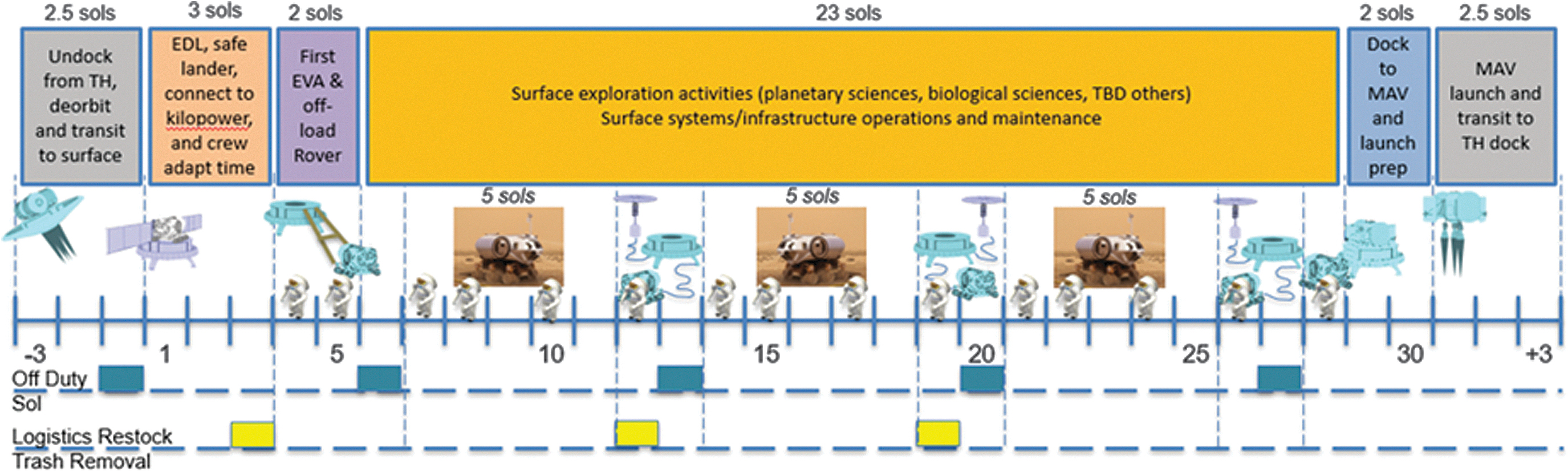
Thirty-sol timeline for the notional human Mars surface mission described in HEOMD-415 (Hoffman, 2022). Used with permission.
Even during this first human Mars surface mission, there is a presumed significant reliance on EVAs to accomplish both exploration activities (e.g., scientific experiment deployment and selective sample collection) as well as mission support-related activities (e.g., maintenance/repair and logistics replenishment). Although details for Mars EVA equipment are still conceptual, experience with past and current EVA systems indicates that there will be leakage at joints and seals in the pressure garment and from the portable life-support system (LSS). Filtration technologies (e.g., HEPA filtration) have been proposed to mitigate this forward contamination source. More analysis is needed to refine what planetary protection requirements will be needed compared with the currently existing guidelines for human missions. The analysis will determine both the acceptability of the approach and the required level of filtration.
HEOMD-415 analysis assumes use of a rapid cabin ingress/egress mechanism such as a suitport, which would require suitport-compatible EVA suits. A suitport is a concept technology that may accomplish the “surface mating and pressurized transfer of crew/cargo” capability for the interface between a Mars surface exploration suit and the pressurized cabin of the Pressurized Rover. This interface concept allows the majority of suit hardware to remain outside the cabin, with the crew entering and exiting the suit through a hatch built into the back of it that can be mated to an interfacing hatch in the Pressurized Rover hull. Use of suitports could reduce dust migration into habitable crew cabins and/or improve the safety of rapid and frequent EVA excursions. It remains forward work to develop technologies, concepts, and operations for both the Mars surface exploration suit hardware and the surface mating and pressurized transfer of crew/cargo capability to address compatibility with the chemically reactive soil, as well as forward (planetary protection) and backward (crew health) contamination during crew ingress/egress operations.
Although the suitport concept interface allows Mars exploration suit hardware to remain outside the Pressurized Rover cabin, suit components known to wear out with repeated use may need maintenance or replacement during a mission of even this short 30-sol duration. Examples include gloves and boots. There are also items, such as joints, rotating bearings, and seals that are likely to wear out under Mars surface conditions, but the replacement frequency is unknown (and may be unknowable until testing experience is obtained). This implies that, until enough observational data are available from which a prediction for deterioration or failure of these items can be made, a program of periodic inspection and repair will need to be incorporated into surface mission timelines. Currently, an assumption of no more than 24 cumulative EVA hours will pass before replacement of gloves is needed, and possibly boots, filters, and batteries as well. Other wear-susceptible items will be inspected and then repaired or replaced if necessary. For short duration surface missions, where only a pressurized rover is available to the crew, this type of maintenance may need to be carried out inside the rover cabin.
In the current concept, the cabin would be depressurized to allow the crew to enter through a hatch (not the suitport), and EVA equipment doffed in the repressurized cabin while maintenance tasks are accomplished. When maintenance is complete, the crew don their suits before a second depressurization of the cabin is made to allow the crew to exit through the hatch and dock their suits to the suitports. An entire sol is anticipated to accomplish all these activities. Dust mitigation and planetary protection will be concerns when suits are brought inside for maintenance and will need to be factored into an integrated mitigation protocol between all martian surface assets. This means, as the Pressurized Rover design matures, a functional capability must be incorporated that mitigates the intrusion of dust and martian regolith into the cabin and prevents cabin contaminant material from being transported to the external environment when the hatch is used for EVA ingress or egress. This functional capability will be vital for crew health and/or planetary protection reasons and is an area of forward work. It should also be noted that, although the HEOMD-415 analysis assumed suitports, functional equivalents and alternative approaches that would mitigate dust intrusion into the cabin and minimize forward contamination from the cabin may also be considered.
As one important principle in breaking the chain ‡ of contact for backward planetary protection, current operational concepts assume the Mars surface exploration suits are left behind on Mars, and crew return to Mars orbit in separate intravehicular activity (IVA) suits. The Mars IVA Suit System concept of operation is expected to be substantially similar to crew Earth launch/landing, lunar transit, and Gateway operations. IVA Suit Systems for Mars descent and ascent operations are expected to be similar enough to crew Earth launch/landing that a common IVA suit can be used for both. Because the IVA suits are stowed after arrival and remain unused until the time of departure, they can be considered relatively clean from a planetary protection perspective; certainly cleaner than the Mars surface exploration suits. A minimum-functionality Pressurized Tunnel is a hypothetical “one job, one time” device that permits IVA crew transfer between the Pressurized Rover and the Mars Ascent Vehicle. Such a device would facilitate planetary protection compliance by allowing crew to access the Mars Ascent Vehicle without going outside; this also minimizes Mars Ascent Vehicle cabin volume by eliminating the need for Mars surface exploration suit don/doff and stowage.
In addition to these EVA-associated activities and their planetary protection implications, the Pressurized Rover is also directly involved in another activity with planetary protection concerns, that is, trash/waste disposal. One possible concept for trash/waste management on the martian surface is described in HEOMD-415. In this concept, the Pressurized Rover has a limit for onboard logistics and trash. Although this limit can be changed as the Pressurized Rover design matures and as choices are made regarding its operation, a limit of 14 sols is assumed in this example.
Part of the payload delivered with the crew and their Pressurized Rover are a number of small logistics containers that are used to replenish consumable items on the Pressurized Rover during the surface mission. These small logistics containers are also assumed to be used for long-term trash disposal (Section 4.4). For example, on Sol 12 of the mission described in HEOMD-415, crew conduct their first logistics restocking and trash removal operation. During a 3-h EVA the morning of Sol 12, crew offload a logistics container from the lander deck for repositioning onto a Pressurized Rover suitport. Fresh logistics will be transferred from the small logistics container into the Pressurized Rover, then the empty logistics container will be filled with trash. The now trash filled logistics container will be placed at a location on the surface next to the lander as its permanent disposal location. (Note: this disposal location reflects the current best guidance available, including forward planetary protection considerations from the COSPAR meeting series. The approach to disposal will be revisited as new guidance becomes available.)
With these two assigned capabilities—delivery of crew consumables to the martian surface and long-term storage of trash/waste on the surface—the small logistics containers (or their functional equivalents) will incorporate planetary protection concerns into their design. Specifically, concerns related to mitigating forward contamination that could originate from certain delivered crew consumables (e.g., food) as well as concerns related to trash/waste containment suggest that evolving protocols could require viability for decades of Earth years (a specific period of containment has yet to be determined and will require additional analyses and consideration of the risks involved). The surface power system and rovers will likely be fully functional at the time of crew departure, with significant remaining service life anticipated. Science and other utilization (including technology demonstrations) plans will be in place to take advantage of this capability without crew being present. Consequently, the Pressurized Rover closeout activities will focus on gathering material that will be returned to the Deep Space Transport (such as transferring returned samples and logistics) and configuring this vehicle for uncrewed operations.
Because no decision has been made at this time regarding subsequent crews returning to any particular Mars landing site, uncrewed operations could mean permanently decommissioning those subsystems needed for crew support and configuring these subsystems for long-term containment of biological material, consistent with planetary protection guidelines. If crew reuse of these elements is anticipated during a subsequent mission, then uncrewed operations mean placing crew support subsystems and other infrastructure in a dormant state, but in a manner that also provides for biological containment during this inactive period.
Acceptability of microbiological and organic release from humans and their support systems
Critical to the success of planetary protection implementation for human missions is the integration of the transport and survival characteristics of terrestrial microorganisms at Mars, as well as the capability to monitor the nominal (and detect non-nominal) microbiome profile of the crew and human systems, into hardware technology and operations. Such integration needs to happen in parallel with development of mission architecture and design concepts to be incorporated into later engineering designs and spacecraft hardware. Discussions in the fifth meeting concerning KG 2B on permitted microbial/organic releases did not identify an acceptable threshold or degree of filtration/sterilization processing needed. Only that uncontrolled exchange did not seem to be the correct answer, but that a “to be determined” (TBD) performance value should be based on threat of organisms released (number and type) and their expected transport behavior.
The meeting attendees recommended that a “use case” needs to be developed, so that needed requirements can be identified and addressed, with one of the splinter groups highlighting that recovered gas (collected during EVA depressurization) should be HEPA filtered to address both forward and backward planetary protection concerns. Similarly, tools and instruments, and so on, may need to be sterilized before both egress and ingress from an EVA.
Decontamination, verification, and monitoring protocols
Space agencies have mitigated biological contamination of spacecraft destined for certain Solar System targets from the 1960s to the present day. These include the most recent planned and launched Solar System missions such as Europa Clipper, Mars 2020, and ExoMars. For such robotic spacecraft, the key tenets for preventing harmful contamination at the target involve microbial growth mitigation strategies that consist of appropriate design, microbial reduction, cleanliness verification loops, and recontamination prevention, implemented throughout the hardware life cycle (Benardini et al., 2014).
In contrast, and in keeping with the assumptions described in Section 2, human spacecraft systems are not designed to be “sterilizable,” nor should they be, since the presence of the crew means that the substantial microbial community (microbiome) that is traveling with the humans in the spacecraft would immediately begin to recontaminate any sterilized environment. Wherever humans have unmitigated direct contact with an environment, their microorganisms are transferred (see also Section 6.1), so mitigations and monitoring will be required if microbial release into the martian environment is to be controlled (KG 2C). Although there have been mission-enabling technology advancements for understanding both cleanroom microbial contamination and microbial reduction parameters (e.g., heat and vapor hydrogen peroxide [H2O2]) (Chung et al., 2008; Schubert and Beaudet, 2011), microbial mitigations for crewed missions have an increased level of complexity.
Microbial surveillance and tracking studies on the ISS have demonstrated that the microbiology of its built environment changes to include the microorganisms of each successive crew who lives on the ISS (Voorhies et al., 2019; Avila-Herrera et al., 2020). Cleaning and sterilization methods will only temporarily reduce the microbial load on a surface, which becomes repopulated with (different) microorganisms over time. This necessitates a tolerance of recleaning approaches. Spacecraft microbial reduction protocols can be leveraged from earlier NASA robotic missions, separately or in combination, with additional operational cleaning strategies such as antimicrobial wipes, vaporized sterilizing agents, and germicidal lighting. Autoclave or other gaseous methods may be considered for small tools and equipment. In addition, surfaces impregnated with antimicrobial agents or naturally antimicrobial materials could be used (Sobisch et al., 2019). However, some elements of a habitat or capsule may be incompatible with antimicrobial surface treatments, antimicrobial material choices, or aggressive cleaning processes, so end-to-end strategies need to be developed.
Microbial mitigations also need to be built into operational concepts. For all crewed missions, mass and volume are at a premium, so mitigations that are low mass/volume would be preferred such as using reusable surface wipes with in situ generated disinfectant rather than prepacked wetted single use wipes. Also, exploration concepts that feature an airlock facility, which could house the pressurized suits and equipment for martian surface exploration, may facilitate needed microbial control.
The airlock environment could be isolated and separately sterilized before astronaut exit to the martian surface, including exterior surface sterilization of the pressurized suits after the crew has suited up. Approaches would also be necessary for research tools and instruments, robotic support equipment, and returned samples. However, it would be important to continue microbial monitoring protocols to verify cleaning effectiveness and antimicrobial material effectiveness and predict cleaning timelines and microbial adaptation or resistance (Checinska Sielaff et al., 2019). These microbial monitoring protocols would also help catalogue the type of microbial contamination that the martian environment may be exposed to, which is similar to that of the characterization being conducted on the MSR Campaign (Farley and Williford, 2017).
Testing of hardware and protocols would need to be conducted by using analog facilities (Section 6.1) to determine the most efficient (and sufficient) habitat/operations mitigation approaches, together with protocols to allow effective crewed exploration on the martian surface, all while mitigating both forward and backward contamination risk.
Waste management issues
For the question of whether trash and waste should be buried, in general, the breakout groups indicated that burying risked undetected leakage over time, particularly when the regolith at Mars may have oxidative properties. Also, burying requires work, which (unless done robotically) would deplete one of the key most valuable mission resources (crew time) in essentially a nonproductive task. For the first mission at least, surface storage was preferred. This could be at grade, in a depression (to further reduce exposure to wind), or even raised on a platform (which would allow access for a future mission, with more capability to process and recycle the waste). The discussion concurred that some degree of microbial tracking is required, in the sense of understanding the initial bioload so that the risk can be assessed. There was not a consensus that monitoring the bioload over time was necessary: Some considered that the ambient temperature would be too cold for further replication, whereas others maintained that direct evidence is still justified by the risk.
For location(s) of the trash site, it was recommended that a single site adjacent to the landing site be used for waste disposal. The rationale was pragmatic in the sense that, for the short duration mission planned, there is no need to dispose of waste material en route, and returning the waste to the landing site location makes it easier for tracking, allows for potential resource recovery by processing at the landing site by later missions, and potentially allows for sterilization at the landing site, for example, by exposure to irradiation from the “Kilopower” surface power elements that may be present. The consensus was that waste containment should be designed to be effective for 50+ years. This assessment was reached based on a number of factors, which included a subjective assessment of what might be possible for a containment system in a mass-limited environment, some notion of the cadence of crewed exploration, consideration of estimates of decay of the biological threat, and anticipation about the trajectory of our knowledge about the Mars environment and the need for planetary protection constraints to protect future science.
As to whether waste should (always) be sterilized before containment, there was no clear single answer. Although an active sterilization process is an effective approach to achieving planetary protection goals, this is potentially a mass and power overhead (for the sterilization device) for the mission. In addition, the mission would have to be able to accommodate a failure of the sterilization process due to, for example, equipment malfunction. Effective containment of unsterilized waste, potentially taking into account passive sterilization processes at Mars, may be sufficient. An engineering trade study is needed to evaluate this issue in more detail.
To determine the performance criteria for the containment, there was broad agreement that multiple layers of containment (at least two, potentially three) should be used, with the outer layer being a larger container that was resistant to the Mars environment. In some groups, sealing was preferred. In others, closure but with venting through a HEPA filter (and potentially also a molecular scrubber) was the preferred solution. In particular, the issue was identified that a sealed vessel will leak eventually. Given the absence of a clear answer, an engineering trade study is needed to address this issue.
Quarantine issues
Addressing the end-to-end quarantine issues (KG 2D), the sixth meeting first considered what happens if one crew member becomes sick during the surface mission? It may be difficult to determine what is “sick” and what is causing the sickness, that is, is it a martian microorganism or an Earth microorganism or an infection-independent disease, which causes symptoms such as fever. There will not be a full-service diagnostic laboratory facility available to make a definitive determination. Over the more than 20-year life of the ISS there have been very few food poisonings, multiple urinary tract infections (which could merely be a hydration issue), lots of skin issues (could be hygiene, lack of showers), but less in the way of communicable disease issues. A determination will have to be made on the minimal tools and equipment necessary to make the needed determination (the medical kit available for the surface mission is still TBD).
For all three groups, it was assumed that, if one crew member gets sick, everyone in the same spacecraft is exposed. Current COSPAR policy guidelines for crewed missions (developed under a different exploration approach from the current HEOMD-415 concept) (Race et al., 2008) include a direction focused on backward contamination, stating “quarantine capability for both the entire crew and for individual crewmembers shall be provided during and after the mission.” With the currently envisaged surface spacecraft architecture, it is difficult to imagine how an infected crew member could be reliably isolated. Engineers in the groups expressed that duplicate Environmental Control and Life Support Systems would be too massive and complex for missions using current technology. To fully partition the spacecraft into two separate zones would be very difficult. Implied in this is the need for informed consent from the crew. The astronauts are in a closed system together and have a shared risk of health issues, together with all other mission risks.
The discussions were supportive of instruments that could be used to discriminate between Earth microorganisms and Mars microorganisms, one of which could be the MinION as described in meeting 3 (Race et al., 2020) of this COSPAR series and in Section 3.1. This is based on the assumption (which may not be true) that Earth and putative Mars organisms are similar enough that nanopore sequencing can be applied and that the comparison of the results from life forms from Earth and Mars give meaningful results, but not all participants shared this view. The quarantine issues amplify the concern that we need to know what is a healthy microbiome for the crew, ahead of deployment to the surface, to monitor for anomalies. However, not all terrestrial microorganisms have been characterized, so discrimination will be challenging without establishing a baseline. Mitigation approaches may also need to be developed. It was noted that, to form a firm concept, it is necessary to determine what would be the minimal medical equipment, [diagnostic] tools, and medications to support these missions, and this has not yet been determined. The shelf-life of drugs and bio-/chemical compounds for diagnostics also need to be part of this calculus.
For the crew in the Mars transfer vehicle on the return-to-Earth leg of the mission, as with the surface crew illness scenario, isolation will be very difficult in this setting, and the pragmatic approach is to assume all are exposed. However, in contrast to the surface mission, best-effort isolation approaches may be possible to reduce the disease load that the uninfected crew are exposed to, since the associated PPE mass might be tolerable for the larger orbiter vehicle, in contrast to the surface rover. All discussions confirmed the need to isolate the crew from samples on the return journey. One of the splinter groups commented on the need for urgent critical care availability on landing, prioritizing crew safety ahead of sample safety. Also considered was the need for a glovebox for use during the return phase of the mission. This is not described in the HEOMD-415 (surface operations) concept, but is being talked about in the NASA community. Although the glovebox would be a useful science tool, there were discussions over whether this is a planetary protection requirement and whether it should be identified as such. Although it is certainly a desirable science addition, there are multiple ways to handle samples not necessarily using a glove box (using a robotic arm, etc.). In the final analysis the splinter group felt the need to put Mars samples into containment equipment that transfers them safely into locations for the crew to access, with the caveat that the crew habitat is never exposed, so YES crew should be isolated from samples. However, it was suggested that the subset of Mars samples with greater potential to have extant life (from “pristine locations”) should not be opened in the Earth-return transit. In addition, a waiting (quarantine) period before opening any Mars samples for analysis during the return journey from Mars was also suggested.
In another approach, some participants felt that Mars sample science should be deferred until samples are back in the Earth–Moon system for the first mission, keeping the samples sealed for the science community on Earth to analyze with the scope and breadth of terrestrial analysis capabilities rather than the mass- and volume-limited analytical instruments could be flown on a Mars transit vehicle. Their perspective is to simply collect and seal samples to avoid contamination. Opening them in the transit vehicle, for example, would affect the samples (humidity, pO2, etc.). The group considered that most sample science conducted on Mars would be in situ/handheld measurements needed to select/prioritize samples. After samples are sealed/contained, measurements should be limited to monitoring their environmental history (temperature, pressure, seal validation, etc.). The group stated that the value and return on investment comes with the use of Earth-based laboratory capabilities to do the scientific analysis, which is much better than any mass-/volume-/power-constrained payload that we can put on the spacecraft. The group suggested to potentially put the samples “in the trunk,” a compartment that is completely segregated from the crew compartment. However, these are science-based rather than planetary protection decisions, as long as the isolation between the crew and Mars samples is maintained.
On return to Earth, all agreed that quarantine was necessary, with knowledgeable participants noting that 21 days is the standard approach and recommending that the clock starts on landing. However, it was again noted that the crew may need medical intervention and/or have an illness that is difficult to diagnose on landing, and this needs to be built into whatever approach is developed. Some suggested that some time on the return trip could be considered as quarantine time, with shorter period of time to be sequestered when they return to Earth. One splinter group highlighted the continued need to accomplish the end-to-end process of quarantine, considering other impacts to the rest of the Earth's biome/ecosystem from exposure to Mars material, not just the impact to humans. The acceptable risk in astronauts returning to Earth if they are (or have been) sick with an unknown illness was raised, although without conclusion. There is a need for future discussions at an international level to resolve this topic, although the legal and political dimensions of this discussion is beyond the scope of this report.
In summary, in addition to the need to quarantine astronauts on their return, there were three specific recommendations from the sixth meeting:
The crew should be considered as a unit, meaning if one individual gets sick it will be impractical for them to be isolated from the other crew member(s) (this differs from the current COSPAR Planetary Protection Policy language).
Pristine life detection/subsurface samples should be kept separated from the crew during the return trip, both to keep them pristine and to protect the crew. (If there are time-sensitive measurements that need to be made during the return trip [e.g., mineral hydration analysis and radioisotope decay] they could be made on a dedicated non-pristine set of samples)
An approach to breaking the chain of contact between Mars and the Earth is still needed to protect the broader biosphere, even if the crew exposed on Mars appears unharmed.
State of the Art in Contamination Transport and Microbial Survival
The most recent COSPAR Panel on Planetary Protection (PPP) review of current scientific knowledge concerning forward contamination by robotic missions (Coustenis et al., 2023; Olsson-Francis et al., 2023) focused on three key areas: (1) Biocidal effects of the martian environment, (2) stability of liquid water, and (3) transport of spacecraft bioburden. These areas were discussed in the context of survival of dormant and actively growing cells (Rummel et al., 2014). Although harmful contamination can only occur after proliferation, dormant cells are also important as they can be transported through the atmosphere to a potentially habitable environment, for example, Special Regions (Rummel et al., 2014; Rettberg et al., 2016). The conclusion of the 2023 review is that to update the policy for robotic exploration there are several KGs associated with the atmosphere of Mars that require new targeted research, including the following:
Understanding the biocidal effects of Mars surface conditions (ultraviolet [UV] radiation, oxidants, etc.).
Measuring the effect of the atmosphere and dust storms on the kinetics of microbial survival.
Measuring the rate of dust accumulation and the impact this has on microbial survival kinetics.
Meteorological investigations to develop, test, and validate contamination transport models.
High temporal resolution, high fidelity, long duration in situ measurements of the absolute water vapor content, temperature, and wind speed near the surface.
Although written to address robotic missions, all of these topics apply equally to a crewed exploration mission, with 1 and 3 being addressed in Section 5.1 and the remainder in Sections 5.2–5.4.
Microbial survival on Mars
Control and prevention of terrestrial contamination can be implemented at the source (reduced bioburden of spacecraft), en route (lethal conditions of space environment), at arrival (lethal conditions at the surface), or by combinations thereof. Of highest concern are terrestrial contaminants that could grow on Mars, thus planetary protection focuses on limits of growth and propagation, which are mainly influenced by temperature and water availability (Rummel et al., 2014).
Microorganisms that contaminate Mars and do not propagate are unlikely to interfere with life detection studies (although their organic components may hamper detection of past life). In addition to temperature and water activity limitations on growth, terrestrial contaminants must also survive (through resistance or through protective mechanisms such as shielding) a number of lethal factors on the martian surface. Recent articles on the habitability of the martian surface have identified ∼20 biocidal or inhibitory factors that Earth microbiota must overcome to survive, metabolize, grow, and evolve on Mars (see reviews by Beaty et al., 2006; Stoker et al., 2010; Schuerger et al., 2013; Rummel et al., 2014; Cockell et al., 2016). Of these, solar UV irradiation is the most biocidal factor encountered at the surface followed by desiccation, low-pressure, volatile oxidants, and high salts or acids in the regolith.
Characterizing how terrestrial microbiota on, or within, spacecraft can survive under the range of biocidal conditions at the surface poses a significant challenge to predicting the potential forward contamination of a local landing site or a more expansive Special Region on Mars. In this study we summarize temperature and water activity limits on growth of terrestrial organisms, discuss relevant lethal factors and their impact on terrestrial organisms, summarize new studies on microbial growth under Mars-relevant conditions, and finally summarize gaps in knowledge identified across the COSPAR meeting series.
Temperature limits on growth
Efforts to assess the extremes of life on Earth have been made to guide decisions on planetary protection on Mars and are integral to the establishment of Special Regions on Mars (Beaty et al., 2006; Rummel et al., 2014). Based on these reviews, the lower temperature limit for replication likely lies around −15°C to −18°C. Mykytczuk et al. (2013) showed growth of the permafrost isolate Planococcus halocryophilus (aerobic gram-positive bacterium) in brine at −15°C with a doubling time of 50 days. Collins and Buick (1989) reported replication at −18°C in Rhodotorula glutinis (yeast) with a doubling time of 34 days. Based on these studies, COSPAR's planetary protection policy has adopted a lower temperature threshold for replication of −25°C, which provides sufficient safety for new discoveries (COSPAR, 2021).
Extreme desiccation (i.e., low aw) limits on growth
The atmospheric environment on Mars is deemed highly desiccating (Banfield et al., 2020). On Earth, it has been shown that as soil loses water during desiccation overall respiration decreases (Liu et al., 2022); for example, Moyano et al. (2012) showed that carbon dioxide production in bulk soil ceased at a water activity (aw, a measure of the amount of unbound biologically available water) value of 0.89. To date, the water limit for microbial activity is 0.585 (24°C and pH 6.1) (Stevenson et al., 2017). However, although not actively growing, certain microorganisms, for example, strains of Deinococcus radiodurans, have been shown to be resistant to desiccation (Saffary et al., 2002). Under highly desiccating conditions, certain microorganisms can enter a dormant state, forming spores, which are low in water content, high in dipicolinic acid and divalent metals, and protect against desiccation effects, as well as dry and moist heat exposure (see Nicholson and Schuerger, 2005, for details). On Earth, spores have been shown to remain viable for extended periods of time (Leishman et al., 2010; Wood et al., 2015). In space, spores survived for 6 years, if shielded against solar UV radiation (Horneck et al., 1994).
Lethality of solar UVC and UVB radiation
Solar UV irradiation on Mars is attenuated below 190 nm by the column abundance of CO2 in the atmosphere (Kuhn and Atreya, 1979). Of the UV bands that strike the surface, UVC (200–280 nm) contributes ∼98% to the biocidal effect compared with ∼2% by UVB (280–320 nm) and <0.1% by UVA (320–400 nm) (Keller and Horneck, 1992; Setlow, 2001; Santos et al., 2013). Rapid inactivation of common spacecraft microorganisms can occur when cells or spores are exposed as monolayers to UVC irradiation similar to the surface of Mars (Nicholson and Galeano, 2003; Schuerger et al., 2003, 2006, 2019; Link et al., 2004; Moeller et al., 2007; Moeller et al., 2009; Beblo et al., 2011; Taylor et al., 2020). The inactivation is fast enough that fully exposed horizontal spacecraft surfaces will likely experience greater than six orders of magnitude bioburden reduction in under one sol under clear sky conditions (Schuerger et al., 2006).
Based on UV flux models derived from the Rover Environmental Monitoring Station (REMS) instrument on the Mars Science Laboratory (MSL) rover (Vicente-Retortillo et al., 2015; Moores et al., 2017), if the UVC flux at the surface were 3 W/s ( = 10.8 kJ/m2/h), a 6-log reduction for the UV-resistant bacterium Bacillus pumilus SAFR-032 (derived from Schuerger et al., 2006) would be achieved in ∼360 min. Six hours is significantly less than 1 sol on equatorial Mars at Ls = 180 (autumnal equinox) and tau = 0.5 (clear sky). As direct UVC exposure is attenuated by shadowing, sun orientation, dust accumulation on spacecraft, dispersal into the local terrain, or cell pigments, the time to achieve this degree of bioburden reduction will increase, perhaps significantly (Mancinelli and Klovstad, 2000; Horneck et al., 2012).
Lethality of solar particle events and galactic cosmic radiation
Solar particle events (SPEs) are composed of outflowing protons—and to a lesser extent helium atoms and high atomic number and energy (HZE) particles—from the Sun's surface that are accelerated to high energies by its atmosphere or corona. The flux at 1 AU on the Moon is adequate to deliver up to 3 Gy/year on average (Kim et al., 2009). At Mars (∼1.52 AU) this will be reduced by a factor of 3.3-fold due to the volumetric dilution effects of the greater distance, as well as being further attenuated by the (although tenuous) martian atmosphere. However, this low flux suggests that ∼5 × 10³ years might be required at 1 Gy/year to accumulate a bioburden reduction of −10 logs assuming 0.5 kGy/log reduction (Schuerger et al., 2019). Because SPE fluence rates are relatively low—and the SPE occurrences intermittent—the microbial reduction effect on Mars spacecraft during a mission is expected to be very low.
By contrast, galactic cosmic radiation (GCR) is effective at a constant background level. Over time, for both organisms and other biomolecules, radiation-based degradation can occur, particularly from the HZE component of the exposure. The GCR absorbed radiation dose on the surface of Mars as measured by the Radiation Assessment Detector (RAD) instrument is 0.21 mGy/day, translating to ∼0.08 Gy/year (Hassler et al., 2014). This means to accumulate a bioburden reduction of −10 logs assuming 0.5 kGy/log reduction (per Schuerger et al., 2019) would take ∼6.25 × 10⁴ years, again resulting in insignificant microbial reduction effect on a crewed Mars spacecraft in the time frame of a mission.
However, the effect of GCRs on biomolecules, down to significant depth, over time, is a key element of the justification (extensively reviewed, and accepted by the COSPAR PPP) by the MMX project for unrestricted Earth return from Phobos (NAS-ESF, 2019). Here, the basis that any martian material (that could have originally had viable organisms) that is present in samples from Phobos would have been sterilized due to GCR exposure. Similarly, for old terrain on Mars not exposed to hydration events, the martian surface and shallow subsurface down to a depth of 0.7–2.5 m is predicted to to be sterile, absent some martian biological process we are not aware of (Pavlov et al., 2002; Cheptsov et al., 2021)
Lethality of oxidants
Oxidants remain one of the major unconstrained factors for microbial lethality on Mars. Oxidants may be produced through solar UV interactions with the atmosphere (e.g., H2O2) or regolith (e.g., perchlorates), present in the regolith (e.g., Fe-bearing minerals), produced through water–mineral interactions (e.g., reactive oxygen species), or a combination of these processes (Lasne et al., 2016). Oxidation of biomolecules renders them nonfunctional; and the extent of oxidation will determine whether cells are inhibited or killed. To date, H2O2 has been detected in the martian atmosphere, has seasonal variability, an average atmospheric concentration of about 30 ppb (Clancy et al., 2004; Encrenaz et al., 2008), and is postulated to be present in the regolith. Perchlorates (ClO4 −) have been detected at several locations on the martian surface (e.g., 0.4–0.6 wt % at the Phoenix landing site) and are postulated to be globally distributed at concentrations of 0.5–1 wt % (Hecht et al., 2009; Kounaves et al., 2014).
Despite an abundance (10–20 wt %) of iron-bearing species in martian regolith, only hematite (Fe2O3) and goethite have been conclusively identified (Christensen et al., 2000, 2004). Clays may also be important catalysts of oxidizing reactions on Mars given their likely global distribution at concentrations of 4–5 wt % (Carter et al., 2010). The presence of oxidants has been proposed as an explanation for the low level of detectable organics in martian soils despite the likely habitability of early Mars (Benner et al., 2000). Although more recently, the SAM experiment on NASA's Curiosity rover has demonstrated that complex organics are present in the martian regolith (Eigenbrode et al., 2018), much remains unknown concerning the distribution, heterogeneity, and effect of oxidants in the martian environment with regard to habitability and as a planetary protection concern (Kminek et al., 2017; Spry et al., 2021; Olsson-Francis et al., 2023).
Critical parameters for models of contamination control that account for the effect of oxidants remain undefined and include oxidant species identity, distributions (area and depth), concentrations, lifetimes, rates of production, water availability, synergy between oxidants, and, perhaps most importantly, rate of organic degradation by oxidants under martian conditions (atmosphere, radiation, temperature, etc.). These parameters have only been examined in a few limited studies to date (McDonald et al., 1998; Shkrob et al., 2010; Wadsworth and Cockell, 2017).
High salt concentrations in some regolith (e.g., MgCl2, NaCl, FeSO4, and MgSO4)
Evaporite deposits, for example, chlorides, sulfates, and (per)chlorates on the surface of Mars, have been interpreted as evidence of a water-rich evaporitic past where putative life may have existed (Wänke et al., 2001; Hecht et al., 2009). Extensive studies have suggested that some of these salts are highly hygroscopic, absorbing moisture from the atmosphere through deliquescence and hydration for short periods of time (dependent on the location, season, and atmospheric conditions) (Davila et al., 2010; Gough et al., 2011; Fischer et al., 2016; Rivera-Valentín et al., 2020).
On Earth, salts are known to impact microbial growth due to low water activity, high ionic strength, and in some cases extreme chaotropicity (Crisler et al., 2012; Schneegurt, 2012; Hallsworth, 2021). Although this may hinder growth, no evidence exists that highly saline conditions on Mars would kill or eradicate microbial life.
A recent study has demonstrated that microorganisms can survive periods of desiccation and deliquesce in a Mars-simulated brine (Cesur et al., 2022). During the drying process, microorganisms can be trapped within fluid inclusions allowing them to survive for long periods of time (Rothschild et al., 1994; Grant et al., 1998). When dissolved, some of these salts may also be highly acidic (e.g., ferric sulfate). At low pH biological molecules will be protonated, negatively impacting their function. Although inhibitory, low pH may not be immediately lethal. Furthermore, current martian conditions are not conducive to the formation of acidic solutions from these minerals. Notably, high salts in Mars analogs had a direct biocidal effect on Bacillus subtilis spores under both dehydrated and hydrated conditions, whereas acidic Mars analog soils were biocidal only under hydrated conditions (Schuerger et al., 2012, 2017). Furthermore, it has been shown that the acidophilic iron–sulfur bacterium Acidithiobacillus ferrooxidans is able to survive in a desiccated state for several days at Mars surface conditions and to grow solely on the nutrients provided by minerals in (analog) Mars regolith under aerobic and anaerobic acidic conditions, participating in the redox cycling of iron (Bauermeister et al., 2014).
Lethality of low (Mars ambient) pressure (7–12 mbar) and space vacuum
There are few published reports that describe direct testing of microbial survival at low pressures similar to the martian surface. Much of what is known must be extracted from experiments on Mars surface simulations in which nontreatment laboratory controls exist. For example, when comparing low-pressure versus laboratory controls in a series of Mars simulations, Schuerger et al. (2003) reported that low pressure appeared to induce ∼20% reduction in spore survival of the bacterium B. subtilis HA 101 over short-term exposures of tens-of-minutes to a few hours. Other literature also supports this conclusion. For example, Schuerger et al. (2019) (Fig. 1) identified that low-pressure experiments with B. subtilis demonstrated spore survival losses of ∼50% over the course of 200 days in vacuum, with losses of approximately ‒2 logs observed over the course of nearly 6 years in LEO during experiments by Horneck et al. (1994) in the Long Duration Exposure Facility.
A series of experiments were performed on free-flying satellites in Earth orbit (in the Biopan facility on Foton missions with a duration of ∼2 weeks), and on the ISS in the Expose missions where several different microorganisms were exposed to space vacuum for 1.5–2 years. It was demonstrated that most of them could survive exposure to vacuum, if shielded against solar UV radiation (Horneck et al., 2001; Cottin and Rettberg, 2019).
Microbial growth under Mars-relevant conditions
Significant literature presents empirical evidence that extremophiles and mesophiles on Earth can metabolize organics, grow, and potentially evolve under a diversity of conditions relevant to the surface or shallow subsurface of Mars. It is beyond the scope here to review this full body of literature; however, a few broad conclusions can be drawn.
First, at least 30 bacteria—but no archaea or fungi—have been identified that are capable of metabolism and growth under simulated Mars surface conditions of low pressure (7 hPa), low temperature (0°C), and CO2-enriched anoxic atmospheres (called low-pressure temperature atmosphere [PTA] conditions) (Nicholson et al., 2013; Schuerger et al., 2013; Schuerger and Nicholson, 2016; Schwendner et al., 2020). Other studies have characterized microbial activity under low-pressure environments that are much higher than the surface pressure on Mars but significantly lower than Earth's sea-level pressure of 1013 hPa (Kanervo et al., 2005; Pokorny et al., 2005; Schirmack et al., 2014; Waters et al., 2014; Mickol and Kral, 2018). These later studies suggest that many subsurface niches on Mars with pressure down to 50 hPa may support a wide diversity of terrestrial microbiota.
Second, numerous studies have demonstrated that terrestrial algal, bacterial, and archaeal species are capable of growth in diverse Mars analog soils doped with organics (Nicholson et al., 2012; Bauermeister et al., 2014; Al Soudi et al., 2017; Kölbl et al., 2017; Schuerger et al., 2020) and carbonaceous chondritic materials (Mautner, 2002a, 2002b). However, most of these studies failed to evaluate growth under simulated martian low-PTA conditions. One notable exception was the study by Schuerger et al. (2020) in which the hypopiezotolerant (defined as being capable of growth at 7–10 hPa) Serratia liquefaciens was capable of growth in diverse Mars analog soils under laboratory conditions of 1013 hPa, 30°C, and Earth-normal gas composition of pH2/pO2 (78%/21%) but failed to grow under low-PTA conditions. The added geochemical and physical stressors in the analogs appeared to be enough to inhibit growth under low-PTA conditions, even when a known hypopiezotolerant bacterium was used. This last study calls attention to the need to conduct a wider diversity of biological growth experiments under regolith geochemical and low-PTA conditions similar to the surface or shallow subsurface of Mars. As numbers of stressors are added to metabolic and growth assays that approach actual conditions on Mars, we may discover that few, if any, terrestrial microbiota are capable of growth under conditions found at the surface or shallow subsurface of current-day Mars.
Synergism among biocidal factors on Mars
Approximately 20 biocidal or inhibitory factors are likely to be present in martian surface or subsurface environments (Beaty et al., 2006; Schuerger et al., 2013; Rummel et al., 2014). Most studies into microbial survival, metabolism, growth, and evolution under Mars-relevant conditions explore single parameters. However, synergistic interactions among the 20 biocidal factors are likely to significantly increase the lethality of the martian environment. Numerous articles have described synergistic biocidal effects between vacuum (VAC) and high temperatures (Dose and Klein, 1996; Schubert and Beaudet, 2011), VAC and low temperatures (Ashwood-Smith and Horne, 1972), VAC and UV irradiation (Keller and Horneck, 1992; Horneck, 1993; Saffary et al., 2002), and VAC and ionizing radiation (Silverman et al., 1967). The overarching results of these—and other studies on synergism in the space environment—suggest that synergistic interactions can often add 1–3 logs of additional biocidal effects for a given time-step between a few hours to a few days.
In contrast, few studies have examined multifactorial combinations of the biocidal factors listed for the surface or subsurface of Mars. The difficulties in doing so are twofold. First, complex Mars simulation chambers (Schuerger et al., 2008; Martin and Cockell, 2015; dos Santos et al., 2016; Rabbow et al., 2016) are difficult to build and maintain. Second, multifactorial experiments increase exponentially in complexity as the numbers of factors being tested jump from three (3! = 6 combinations) to four (4! = 24 combinations) biocidal factors. However, it is imperative that such multifactorial experiments be developed to probe the actual suite of biocidal or inhibitory conditions likely to be encountered on the martian surface. It is plausible, perhaps even very likely, that synergistic interactions among the ∼20 biocidal factors on Mars will make metabolism and growth of Earth microbiota untenable for the martian surface.
KG closure
In this study, we summarize the parameters to be addressed to close the KG 3C in microbial survival and KG 3E on protective mechanisms for microorganisms at Mars, identified across the COSPAR meeting series and companion white paper (Spry et al., 2021), and identify immediate research needs.
Synergistic effects
How do interactions of biocidal factors affect microbial survival, growth, and adaptation in Mars-like environments? To date, many studies have assessed the impact of individual Mars conditions on the survival, metabolism, and growth of a variety of terrestrial organisms, but very few studies have examined combinatorial effects. Immediate research needs include the following:
Development of experiments that take into consideration multifactorial combinations of biocidal or inhibitory factors under conditions relevant to Mars. In part, studies have been limited due to technical challenges and costs associated with building and maintaining Mars simulation chambers.
Detailed information on Mars environmental parameters from a surface mission. Current orbiters and rovers do not address all parameters (UV, desiccation, volatile oxidants, high salt in soil, acidity, solar energetic particle events, low air pressure, etc.).
Oxidative effects
A vital component required for closure of the aforementioned KG is to understand oxidant effects in the surface and shallow subsurface on Mars and their effects on terrestrial microbiota on spacecraft. Oxidative processes in the surface and shallow subsurface are predicted to have significant biocidal effects, which have not been well defined. Current missions have a limited ability to measure oxidants, and no foreseeable robotic lander is likely to identify all of the oxidants present in martian regolith. Measurements, experiments, and models are needed to:
Constrain and understand the oxidant nature of the martian surface and shallow subsurface (species, distributions, production rates, etc.).
Determine the lethality of these oxidants on terrestrial contamination. In situ experiments may be necessary to measure (and subsequently model) the rate of oxidation of organic material on the martian surface.
Protective mechanisms
Just as knowledge about biocidal factors is critical, any mechanism that could protect cells from the lethal effects on the surface of Mars must be understood, quantified, and modeled. A few studies have considered possible mechanisms of protection such as (1) dust loading on spacecraft surfaces (Schuerger et al., 2012); (2) terrain and/or spacecraft shadowing that decreases UV irradiation and wind dispersal of microorganisms from spacecraft surfaces (Moores et al., 2007); (3) the formation, transport, and shielding efficiency of particulates released from habitats; (4) structural architectures or site terrains adjacent to landed elements (e.g., increased humidity under large structures); and (5) the presence of biofilms and other cell debris around attached terrestrial organisms (Billi et al., 2019).
As little as 0.5 mm of martian fines can attenuate the biocidal effects of UV irradiation by a factor of 1 × 10⁵ (Mancinelli and Klovstad, 2000; Schuerger et al., 2003). Additional survivability experiments are needed to quantify the impact of protective mechanisms against the inhibitory effects of biocidal factors found at the martian surface. Establishing these parameters will require controlled ground-based and LEO experiments with known microbial contaminants from cleanroom environments.
Environmental conditions
It has been shown that liquid water is stable on Mars in the form of brines (Martin-Torres et al., 2015). Two other environmental conditions constraining the habitability of the near surface of Mars are the thermal range and the UV radiation dose (Rummel et al., 2014). To better constrain the parameters for potential for growth and survival of terrestrial contaminants on Mars, it is essential to identify and quantify the distribution of environmental conditions on the surface and near subsurface of Mars at the human (meso)scale and at scale relevant to microorganisms. More complete knowledge of environmental conditions will direct the types of contamination controls that will need to be implemented and will facilitate the delineation of Special Regions on Mars. Immediate research needs include the following:
Mapping and modeling to assess presence of habitable conditions (e.g., temperature, water availability, and soil composition) and biocidal conditions (e.g., radiation environment and oxidants)
Experiments to further assess the role of salts as a water sink and source on microbial survival, growth, and adaptation under Mars-relevant conditions (Rivera-Valentín et al., 2021).
Quantitative models
For risk assessment and mitigation, it is critical to develop and test accurate models of survival, growth, and adaptation of terrestrial contaminants under martian conditions. Models for microbial survival are continually under development and refinement for applications in fields such as food science and include first-order kinetics (log-linear) models, as well as fully probabilistic (stochastic) models (Peleg, 2023). Unfortunately, in part due to the KGs mentioned earlier, a suitable model of contaminant survival under Mars conditions has yet to be developed (Meyer et al., 2019).
Recent models for microbial survival in other planetary bodies and systems can provide guidance (Schuerger et al., 2019; McCoy et al., 2021). The information that will be gathered to close the aforementioned KGs will feed into and facilitate the development of models. Additional research needs for modeling include studies that focus on the following:
Fundamental understanding of mechanisms of lethality.
The effects of biocidal factors on the survival and growth of non-cultivable bacteria, archaea, fungi, and other eukarya present on humans and spacecraft.
Ground-truthing of models during future missions.
Dust and aeolian transport at Mars
Martian dust transport
In parallel with the microbial survival characteristics of Mars, consideration also needs to be given to the potential mobility of microorganisms through aeolian transport. Olsson-Francis et al. (2023) state that “Of particular concern is airborne transport since the Martian atmosphere is not sufficiently dense to attenuate the UV radiation and protect suspended microbial cells. Though, cells could be transported through the air shielded from UVC radiation by local dust and/or by the total column of dust in the atmosphere (especially during dust storms, which are known to absorb UV efficiently).” The basis of this is that, on Earth, microbial cells associated with dust are known to travel for thousands of kilometers (Mayol et al., 2014; Li et al., 2016), and aerial distribution of microorganisms has been demonstrated to occur at Mars analog sites, for example, the Atacama (Azua-Bustos et al., 2019).
The typical airborne dust aerosol size of Mars is on the order of 1–2 μm, with the notable exception of global dust storms, when suspended particle sizes have been observed to reach maximal sizes of 8 μm (Lemmon et al., 2019). This is much larger than the typical size of Bacillus spores (the mean values for B. subtilis, e.g., are 1.07 ± 0.09 μm [length] and 0.48 ± 0.03 μm [diameter]) (Carrera et al., 2007). Conceivably, a ∼1 μm diameter spore encapsulated within a suspended 8 μm diameter particle could have a 3.5 μm layer of biomaterial protecting it from UVC exposure.
Atmospheric attenuation of solar irradiation
In addition, the atmosphere itself could attenuate the UVC, with Olsson-Francis et al. (2023) again observing: “For example, during the last global dust storm monitored by REMS, the daily maximum UV radiation decreased by more than 95% when the opacity reached 8.5 (Viúdez-Moreiras et al., 2019) … generally, the transmittance of the atmosphere is expected to decrease with exp(-tau), with tau being the opacity.” Although dust lifting events predominantly occur during the martian day, any particle suspended during dark hours during a dust storm will not be exposed to solar UVC. Hence, atmospheric processes may allow viable terrestrial contamination to be transported from a spacecraft to a distant Mars location (potentially a Special Region) and be protected by a layer of a few grains of protective dust or by the total column of dust, over time. Mars Exploration Rover (MER)-era measurements have estimated that airborne dust deposits at a rate of 0.004 ± 0.001 per unit of surface optical depth deposited per martian sol. This would mean that, for that location, after 30 sols, there is a layer on top of every flat, exposed surface that absorbs 12% of the incident UV radiation (Kinch et al., 2015). Of course, at the microscopic level, under some particles, this could potentially result in close to 100% UV obscuration. The dust deposition rate was also studied at the Mars Pathfinder landing site, which estimated dust fall rates of about 20–45 μm per Earth year at that location, consistent with previous studies of dust deposition on Mars (Johnson et al., 2003).
The global dust storm phenomenon
Olsson-Francis et al. (2023) summarized that, during the course of a dust storm, orbital and in situ observations show the following:
There is a rapid vertical transport of dust to high altitudes (up to 90 km) in the mid-to-high latitudes within just a few sols (Heavens et al., 2018; Vandaele et al., 2019).
Dust fronts slosh back and forth in a wide latitudinal range of up to 40◦ within 1 sol during major dust storms (Wu et al., 2020), which allows for a rapid interchange of materials (dust and water) between the polar region and the middle latitudes.
During one dust storm, the atmospheric haze blocking sunlight increased within 10 sols from an opacity of ∼1 to an opacity of ∼8.5 at Gale Crater, and the daily maximum UV radiation decreased in that short period by >90% (Viúdez-Moreiras et al., 2019).
Based on the analysis so far, adopting a conservative planetary protection stance, data support that dust circulation can be assumed to cover the entire planet from the surface to 80 km altitude and from one hemisphere to the other, including the polar caps (Heavens et al., 2018; Vandaele et al., 2019; Wu et al., 2020; Broquet et al., 2021). This would allow for transport of terrestrial contaminants between all areas of Mars, including ice deposits and recently discovered equatorial regions that contain 40% weight of water in the upper meter of the regolith, which could be associated with the presence of either water ice, permafrost, or large quantities of highly hydrated minerals (Mitrofanov et al., 2022). Although not instantaneous, and so exposing the transported contaminants to solar UVC, this process is occurring during a period of solar UV obscuration.
Surface–atmosphere processes that move sand and raise dust
The mechanisms by which sand is moved and dust is lifted on Mars are not well quantified. Observations provided by the Mars Environmental Dynamics Analyzer onboard Perseverance at Jezero Crater have shown that, during the first 216 sols, four convective vortices raised dust locally. At the same time, on average, four passed the rover daily, >25% of which were significantly dusty (“dust devils”) (Newman et al., 2022). As for gusts, all imaged dust lifting events occurred during strong convective activity from ∼10:30 to 16:00 Local True Solar Time, which manifests as large temporal variability in wind speed. However, dust lifting by wind gusts appears relatively rare inside the Jezero crater, whereas dust lifting by convective vortices is very common. Dustier vortices typically have larger pressure drops and maximum wind speeds, which are expected to be correlated. No local dust lifting by vortices was found for tangential wind speeds below 15 m/s, or central pressure drops below 2.6 Pa. This was also the minimum wind speed reported at which surface darkening (inferred to be dust lifting by a passing vortex) was observed at InSight (Baker et al., 2021).
Dust in the atmosphere of Mars: “Clear” sky and localized, regional, and global dust storms
The omnipresent dust haze, a regular feature of the Mars atmosphere even for “clear sky” or dust storm free conditions, is responsible for the permanent reddish color of the Mars sky. Over its 14-year history, from 2004 to 2017 of measurements of the atmospheric column dust opacity or “tau,” the MER Opportunity found that the opacity varied from tau = 0.5 for “clear sky” conditions to tau >2.0 for dust storm conditions (Zurek et al., 2018). Surface dust enters the atmosphere by the lofting action of surface winds. When these winds are strong enough, surface dust is actively lofted into the atmosphere generating a dust storm. Depending on the strength and duration of the surface winds, dust storms on Mars may be local, regional, or global in scale. Global dust storms can cover the entire planet. Regional dust storms (covering ∼106 km2) and planet-encircling global dust storms occur in the southern hemisphere during spring and summer. Local dust storms can occur in any season and can impact almost any geographical region on the planet, but there are preferred storm tracks (Zurek et al., 2018). The exact mechanism for local dust storms evolving into regional and planetary-encircling dust storms is not known but may be related to the vertical height of the localized dust storm. There is a pattern during the southern spring and summer seasons, when Mars is near perihelion and solar heating is greatest that regional dust storms are generated (Zurek et al., 2018). Some regional dust storms will evolve into planet-encircling hemispheric or even global dust storms (Zurek et al., 2018). Historically, the planetary-scale dust events appeared to occur every 3–4 years (Zurek et al., 2018). The clearing of the atmosphere after a global dust storm can take several months, whereas regional and local dust storms may last a few weeks or from one to a few days.
Estimates of the mass of dust suspended in the atmosphere of Mars have been derived from the Viking Infrared Thermal Mapper by Martin (1995), who found that during the peak of the 1977b regional dust storm, a total dust mass of ∼430 million metric tons (4.3 × 10¹⁴ g) was suspended in the atmosphere, equivalent to a global layer 1.4 μm thick. During a local dust storm near Solis Planum, ∼13 million metric tons (1.3 × 10¹³ g) of dust were lofted, equal to about a 6-μm layer of dust in that vicinity (Martin, 1995).
Geographical distribution of incident solar radiation at the surface of Mars for different atmospheric dust conditions
The distribution of incoming solar radiation at the surface of Mars varies for different atmospheric dust opacities and has been calculated (Levine et al., 1977). Figure 4 (left side) shows the distribution of solar radiation at the surface of Mars for “clear” sky conditions, corresponding to an atmospheric opacity of tau = 0.10. In general, this distribution follows the distribution at the top of the atmosphere, except for magnitude, which is decreased somewhat because of clear sky absorption and scattering. A significant hemispheric asymmetry exists in that there is considerably more insolation over the southern polar regions than the northern polar regions during the local summer solstice. Since the southern winter season occurs at aphelion, it is colder and of longer duration than the northern winter season. This results in a more extensive southern polar cap. The rapid near-complete melting of the southern polar cap results from the hotter southern hemisphere. The northern polar cap remnant is a permanent surface feature that results from the cooler summer in the northern hemisphere.
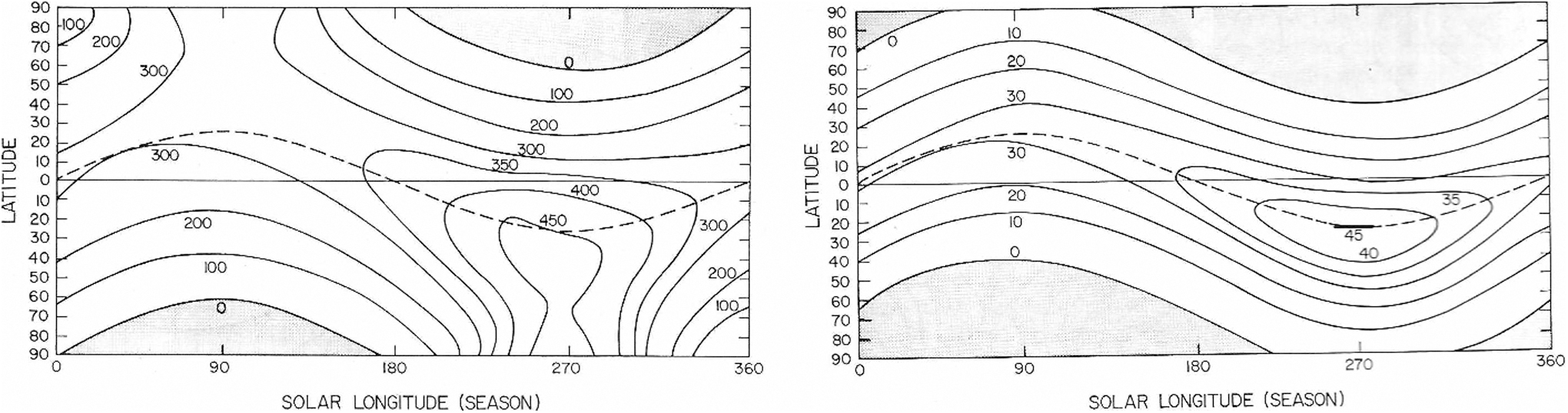
Solar radiation incident on the surface of Mars. Left: for “clear” atmospheric conditions (atmospheric opacity, tau = 0.10) [in calories cm-2/(planetary day)]. Right: for dust storm conditions (atmospheric opacity, tau = 2.0) [in calories cm−2/(planetary day)] (from Levine et al., 1977). Used with permission.
In contrast, Fig. 4b (right side) shows the distribution of solar radiation at the surface of Mars during the 1971 global dust storm observed by Mariner 9, with an atmospheric opacity, tau = 2.0 (Masursky et al., 1972). The insolation distribution closely parallels the seasonal march of the Sun, with maximum insolation in the tropics and only small amounts of solar radiation reaching the polar regions. For example, in the polar latitudes during the southern hemisphere summer, the insolation is only about 5% of the clear sky values.
With the increasing focus on a crewed mission concept for Mars in the 2039 time frame, many Mars-specific environmental factors are now being considered by NASA and other engineering teams. Learning from NASA's Apollo Missions to the Moon, where lunar dust turned out to be a significant challenge to both crew safety and mission success, attention is now turning to the dust in Mars' atmosphere and regolith.
To start the process of identifying possible dust-caused challenges to human presence on Mars, and thus aid early engineering and mission design efforts, the NASA Engineering and Safety Center organized and conducted a workshop entitled “Dust in the Atmosphere of Mars and Its Impact on Human Exploration” that was held in Houston, TX, during June 2017. This workshop was held independently of the planetary protection meeting series being discussed in this article, but addressed topics of common interest. The workshop addressed the topics of knowledge of Mars dust physical and chemical properties and abundance, composition, and impact on human health, as well as its impact on surface mechanical systems such as spacesuits, habitats, and mobility systems. Approximately 70 participants from NASA centers, universities, and industry participated, resulting in a report by Winterhalter et al. (2018). In summary, the assembled experts concluded that dust in the atmosphere of Mars is an issue to be addressed well before spacecraft are built to carry humans to the red planet.
In particular, measurements and experiments need to be taken and conducted on the surface of Mars by precursor landers to ascertain dust characteristics that will influence hardware design as well as provide toxicology data to safeguard crew health. In addition, it was considered that dust samples need to be collected and examined for possible extant life, perhaps through an MSR mission, with contemporary findings by the Curiosity rover team regarding the presence of complex organics and seasonal methane being considered important steps in that direction.
Measuring and modeling atmospheric transport on Mars
A key KG identified in the 2018 COSPAR Refining Planetary Protection Requirements for Human Missions was KG 3A, described as “Measurements/models for Mars atmospheric transport of contaminants.” The highest priority in understanding the natural transport of contaminants on Mars is to understand how they are dispersed by the wind, as this drives the requirements for equipment design and operations in the field. The first step in addressing KG 3A is to develop and apply atmospheric dispersion models to one or more high-priority candidate sites for a future human exploration zone. These preliminary dispersion models can be used to conduct sensitivity analyses with a variety of input conditions to determine both the degree and transport range of contamination. The modeling results will inform preliminary recommendations for reducing the risk of forward contamination during robotic and human operations within an exploration zone. Ultimately, the nature of boundary layer physics requires empirical measurement of the boundary layer.
In particular, measurements of the atmospheric state (e.g., pressure, temperature, and humidity) and direct measurement of atmospheric forcing (e.g., turbulent fluxes) are needed to adequately characterize the lower atmosphere (MEPAG, 2015). Moreover, the properties of the planetary boundary layer are season-, daily-, and location-specific. In situ measurements are critical to accurately describing the natural transport of contaminants. Long-term high-frequency meteorological measurements are needed at multiple fixed concurrent locations within the specific exploration zone to enable assimilation into atmospheric dispersion models. The minimum number of concurrent locations will be dictated by the size and topographical variations of the areas within an exploration where humans would have their base and be exploring with rovers. Ideally, all future surface assets (irrespective of their primary purpose) should incorporate the capability to make high-fidelity meteorological measurements to begin building this data set.
Refinement of the preliminary aeolian dispersion models will require in situ measurements at multiple key sites within an exploration zone of the processes that control the local climate near the surface, particularly those relating to the entrainment, transport, and deposition of airborne particulates and saltating grains. Although details of requirements will require further study, especially after selection of an exploration zone, it is anticipated that, at a minimum, they will include measurement of the turbulent fluxes of heat and momentum; high precision measurements of air temperature, pressure, humidity, and 3D wind velocity; the concentration and atmospheric column abundance, deposition, and erosion rates; and finally the physical and chemical properties of mobilized grains. The latter measurements can be used to establish the biocidal properties of the dust, sand, and regolith, which will feed into KG 3C to help determine microbial survival rates. In addition to making these measurements by one or more precursor missions, it will be critical that the weather stations are long-lived or replaced/reactivated once humans arrive and begin to operate within the exploration zone. Because martian weather patterns are not strictly repetitious year-to-year, these measurements must be made over one or more annual cycles, preferably during both intense dust storms and relatively dust-free quiet conditions (i.e., over a broad range of Ls ).
Some of the in situ measurements listed earlier have not been made to date by any landed spacecraft on Mars (e.g., turbulent fluxes or 3D wind velocity), but because they have been listed as high-priority investigations by MEPAG (Mischna et al., 2009; Rafkin et al., 2009; MEPAG, 2015), Goal II, Objective A.1, Investigations 1, 2, and 3 (GII: A1.1–3); Goal II, Objective A.4, Investigation 1 (GII: A4.1), they are of significant interest to the scientific community and would undoubtedly result in benefits beyond those required for the development of a planetary protection implementation solution.
Drilling and ground transport
Implicit in the “Special Regions” concept is that habitable environments could occur on Mars and, therefore, martian life in such environments cannot yet be ruled out. Life detection investigations of sites that may host Mars life would be an important planning and operational input for future human missions (Stoker et al., 2021). If unaddressed, our gaps in knowledge in subsurface sampling will mask the future potential for both biological forward contamination of the subsurface (by Earth microorganisms) and backward contamination (of the spacecraft by drilled materials) during subsurface sampling and drilling.
Study the potential for particle-bounce forward contamination (into a special region)
Subsurface transport can be considered on multiple scales from shallow (0–2.5 m) to km depths, and transport of contaminants is different for each. Shallow drilling, such as the proposed Icebreaker mission (McKay et al., 2013), could collect ice-saturated samples at 0–1 m depth (Glass et al., 2014) and assess their habitability and assay for martian life biosignatures protected from surface chemistries. This near surface environment is also at the greatest risk from forward contamination as a result of human activities but is of the most interest in the near term for reasons of accessibility and potential use as a resource (Sanders et al., 2015; Kleinhenz et al., 2018). The ice table beneath tens of centimeters of soil could host perchlorate brines but may not be habitable at modeled temperatures (Rivera-Valentín et al., 2020).
Lander or rover missions that are specifically investigating potential martian life will be COSPAR Category IVb missions. As was done for the Robotic Arm assembly on Mars Phoenix (Arvidson et al., 2009), planetary protection guidance requires that elements of a life detection mission contacting the sample (e.g., part of a drill extending below the surface) be appropriately sterilized (NASA STD 8719.27). One acceptable approach is to heat-sterilize the components that will either be placed below the ground or in contact with the components that will penetrate below the ground and place these inside a biobarrier that is removed after a Mars landing (an example is shown in Fig. 5). To prevent terrestrial contaminant organisms from traveling onto the drill auger/bit through sample transfer, there must be an air gap between the sterilized drill and a sample delivery subsystem that contacts “dirty” instruments (which cannot be sterilized by heat or other methods).
Icebreaker drill concept:
Other forward contamination vectors include the venting of materials by the spacecraft or instruments (which can be managed with knowledge of emissions and wind direction) and “particle-bounce” of transported material. Both windblown and mechanically transported material may fall into contact at times with spacecraft or instrument components that are not appropriately clean. Contaminants acquired through contact may then be carried along in this surface dust, which can be blown or fall onto the drill (or directly into the open borehole) and, therefore, reach the shallow subsurface. At moderate depths (up to 100s meters), subsurface temperatures should block penetration of fluid-borne physical/chemical/biological contaminants by freezing. As long as these contaminants are not themselves generating heat, then the underlying potential martian aquifer where fluid transport could transmit contamination on a regional scale will not be accessed.
As seen in the flows of contaminants in terrestrial sites, it is not unreasonable to consider the transport of contaminating terrestrial organisms from surface operations into a deep subsurface aquifer, which perhaps could result in alteration or destruction of a hypothetical deep subsurface martian ecosystem. However, there is currently no identified mechanism on Mars for direct contaminant transport to these deep environments, or any indication of extant ecosystems at depth. The current lack of evidence for these, and the difficulty of accessing 100 m–km depths on Mars, will relegate these deeper-subsurface gap investigations to be a lower priority for inputs for the initial crewed human missions (Heldmann et al., 2022). A possible gap is our lack of knowledge regarding the extent of particle-bounce contamination between a drill and robotic sample transfer devices during drilling and sampling operations.
One school of thought regarding the discovery of biosignatures or fossil or extant subsurface life on Mars is that it would be such a profound discovery that understanding its local provenance or stratifigrafic position might be deemed less important. However, verification of those results and learning more about the subsurface environments that preserved them requires some control and knowledge of the back-contamination spread of Mars subsurface materials brought up and scattered across the spacecraft and the mission site.
Uncontrolled mixing of sample materials would destroy some potentially valuable data. Characterizing the external contamination of Mars-drilled sample return tubes or the site exposure of human crew members (Bussey and Hoffman, 2016; Hoffman, 2022) is a strong motivation to study the provenance of locally scattered subsurface materials in Mars-like laboratory and field conditions. Similarly, might scattered subsurface sample find its way into warmed environments on spacecraft or other facilities that could be habitable to any extant local organisms brought up?
The entire sample acquisition chain (drills and scoops, robotic transfer mechanisms, and instrument ports) is a potential vector for subsurface materials, scattered by wind and/or spillage (Davé et al., 2013). Another sampling gap or uncertainty regard the extent of sample-scatter during full-scale drilling, sample acquisition, and handling.
Technologies for remediation/alleviation of subsurface forward contamination
Since the Viking missions of the 1970s, the technology has existed for heat, and later chemical, microbial reduction on spacecraft systems before launch. Biobarriers, as demonstrated on Phoenix (Arvidson et al., 2009), are a means of preserving that cleaned state until Mars arrival (see also Fig. 5). To prevent spores from traveling onto the drill auger/bit through mechanical sample transfer, there must be a gap maintained between a sterilized drill and the sample delivery subsystem that itself touches the “dirty” instruments (which cannot be heat sterilized to Viking standards). At the same time, clumping and sticking experiences with samples within the Phoenix scoop mean that future Mars sampling missions must have positive actuation, not relying solely on gravity. This complicates the gap issue, effectively requiring samples to be actively propelled by some means (such as mechanical or pneumatic contact) across the gap.
However, we currently have no means to reclean or recover from inadvertent contamination, once the biobarriers are discarded after arrival. If particle-bounce or operational errors (unplanned contacts) cause a drill to become contaminated, NASA could be faced with a choice of an end-of-mission versus violating international agreements regarding Special Regions. Furthermore, if material is blown from a (less cleaned) lander or rover deck down into an adjacent open borehole, a Special Region could be violated. These issues are already a serious scientific (and political) obstacle to drilling on Mars and/or exploring the subsurface locales where Special Regions and, hence, biosignatures or life might exist.
We lack a demonstrated technology (using heat, UV, and chemicals) that will enable re-sterilizing (in the sense of heat microbial reduction to Viking levels) a contaminated drill string. In situ inadvertent “contamination accidents” may require a local drill cauterization device to mitigate potential borehole contamination.
We lack sufficient knowledge of contamination mitigation performance in relevant field analog Mars-like environments
Field testing in Mars-relevant environments, together with Mars environmental chamber testing, is necessary to create enough confidence in technologies and results to propose them for flight application. Laboratory testing alone is not sufficiently rigorous, as a priori knowledge and control of test materials and environments allow their anticipation (whereas nature is unpredictable and unforgiving). Selected field test sites should strive to apply the highest-fidelity terrestrial analogs for drilling in the martian icy regions, including ice-cemented soils, massive ice, and other soils with periglacial characteristics. Past NASA-developed planetary drill prototypes have been tested at Arctic (Glass et al., 2008) and Antarctic (Zacny et al., 2013) analog sites, establishing performance and operational baselines.
Caves and other martian environmental niches
One important feature of Mars as we know it today is its geological variability. Tanaka et al. (2014) described 44 discrete geological units based on remote sensing data, with more added since. Each of these units are geomorphologically distinct at the “landscape” scale, with even more variability at the scale of potential microbial habitats, below the resolution range of remote sensing instruments. This is illustrated from the “ground truth” observations in the “blueberries” at Opportunity's Eagle Crater landing site and the phosphate deposits exposed by Spirit's “wheel drag.” Rummel et al. (2014) discussed how microorganisms could potentially sequester water from their microenvironment and wait until temperature conditions rise until metabolic activity is possible, potentially as a result of diurnal or seasonal cycling. Some of these environments (Fig. 6), especially below the shallow subsurface and protected from GCR effects described in Section 5.1, could be habitable for a contaminant terrestrial organism that reaches them. None of them are well characterized, either in abundance or distribution, or with regard to accessibility by a contaminant particle. Caves are highlighted here, in particular, because they became the driving case in the NASEM (2021) report evaluating the bioburden constraints for robotic Mars rovers. In brief, the report found that, at the present time, there is insufficient knowledge of the occurrence and distribution of caves on Mars to guarantee a 600 km “buffer” between a cave opening and a “contaminating” rover location to protect against aeolian transfer of viable organisms, based on the phenomena described in Sections 5.1 and 5.2.
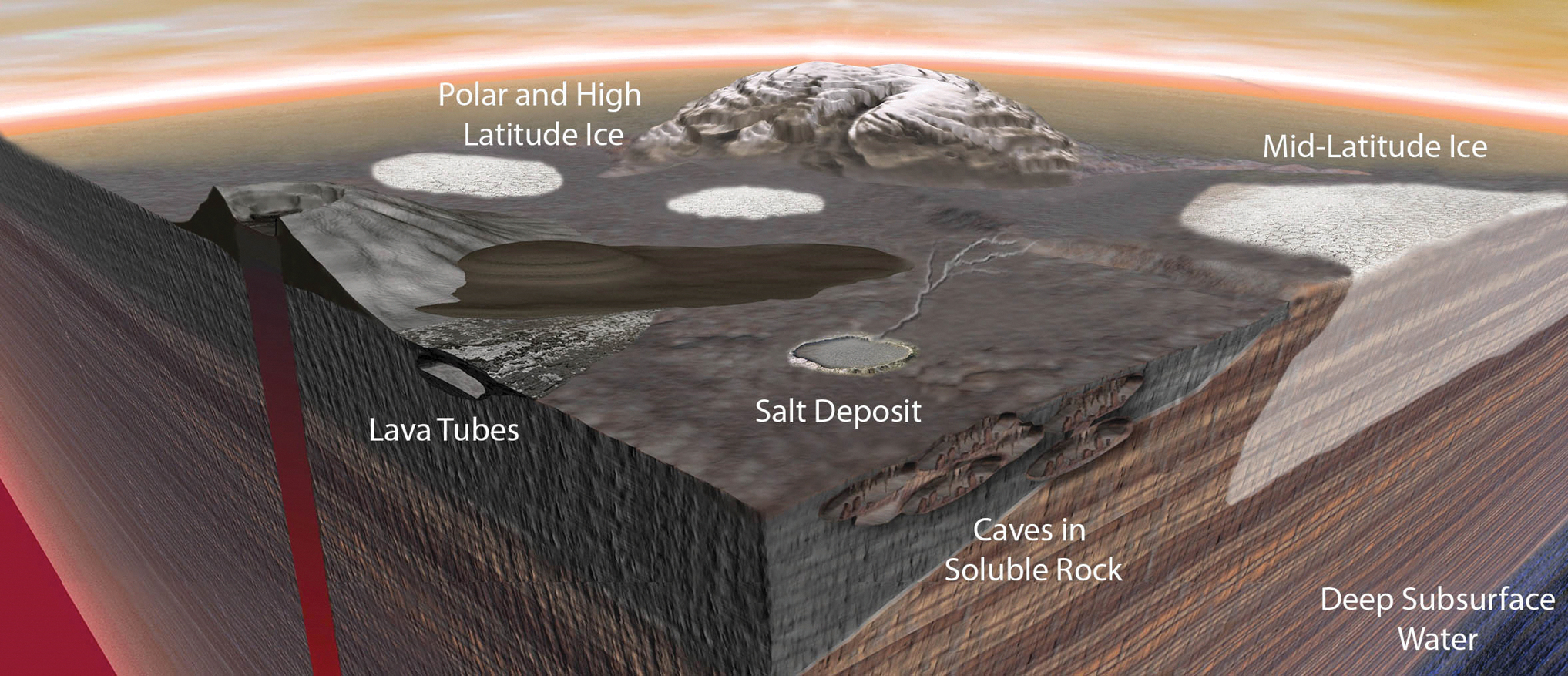
Artist's depiction of many of the potential “Special Regions” in or near which proliferation of terrestrial microorganisms is a possibility. NASA, National Aeronautics and Space Administration. Artist Credit: Julie Fletcher. Source: Stoker et al. (2021), white paper submitted to the Planetary Science and Astrobiology Decadal Survey, reproduced with the permission of Carol Stoker, NASA.
Authors of NASEM (2021) found that, although it is unknown whether terrestrial microbial life could proliferate in martian caves, it has been determined that ice in terrestrial caves can contain metabolically active bacteria (Carrier et al., 2020), and so there is a risk that it could. The buffer distance estimate was obtained by using a 15-h time period (an extended sol daylight period) as the duration constraint under which terrestrial biota could survive UV exposure under martian conditions (which per Section 5.1 may or may not be conservative, depending on the configuration of the biological contamination). Drawing from observations of average wind speeds measured by Viking Lander 2 (∼10 m/s was the upper range for the daily mean) (Martínez et al., 2017), Phoenix (∼6–10 m/s) (Holstein-Rathlou et al., 2010), and MSL (approximately <10 m/s during the Bagnold Dune wind characterization campaign) (Martínez et al., 2017; Newman et al., 2017), this estimate was obtained using a wind speed of 10 m/s. On this basis a suspended particle could travel ∼540 km in 15 h. Adding margin, the committee adopted a buffer radius of 600 km. They considered this a conservative value because it assumes unidirectional transport and does not include dust settling time, commenting that, because caves represent radiation-shielded environments where terrestrial biota could potentially proliferate, a conservative buffer distance is appropriate. The committee further noted the limitations in our knowledge of regions to be protected, such as subsurface access points.
Only ∼5.0% of the martian surface has been mapped at <1 m/pixel, and although nearly 100% of the surface has been mapped at ∼6 m/pixel by the MRO Context Camera, this means that for the majority of the martian surface, most features (such as subsurface access features) of a scale <6 m have likely not so far been detected.
Having adopted many of the findings of the COSPAR meeting series into an Interim Directive (NID8715.129; NASA, 2020), NASA is beginning the process of incorporating these KGs into hardware design roadmaps, so that design and performance decisions for contamination control can be matured in parallel with engineering designs. Triggered by Terrae Novae vision and goals, ESA is also starting to monitor ongoing and future LEO, Moon and Mars project activities, with the aim to coordinate the effort of closing the current KGs for landing humans at Mars.
Field technology trials with humans involved at different capacities (Cockell et al., 2019), in terrestrial, lunar, or microgravity settings offer venues for planetary protection risk reduction involving astronauts training for Mars exploration and can specifically address the KGs of how crewed systems and the Mars system will interact. In addition, new knowledge from robotic exploration of Mars (specifically sample return), as well as other flight and technology opportunities are necessary to support closure of open planetary protection KGs. The COSPAR meeting series first considered venues for KG closure in 2018 (Race et al., 2019). This section provides an update to those discussions.
Terrestrial analogs for the human exploration of the Moon and Mars
The anticipated human exploration of Mars, as described in the HEOMD-415 concept, will likely involve personnel-tended or robotic drilling of surface and near-surface materials for geological characterization, the ground truth of orbital and surface rover data, and sampling for detection of putative martian life. Space agencies (NASA, ESA, JAXA, and CSA) and nongovernmental organizations test robotic and future human exploration missions-supporting technology in planetary geology and astrobiology analog settings. These trials can be days- to weeks-long within a typical 3-year project or multiyear “Habitat Demonstration” campaigns (Hi-Seas, D-RATS, etc.). Although most astrobiology and technology campaigns (e.g., NASA's Planetary Science and Technology from Analog Research and Astrobiology Science and Technology for Exploring Planets Programs) focus on robotic missions, their execution involves human teams and planetary protection-related practices relatable to human exploration missions to the Moon, Mars, and beyond.
Technology studies in analog environments
The Desert Research and Technology Studies (DRATS) is a multiyear annual NASA campaign conducted in the high desert area of northern Arizona at Black Point Lava Flow near Flagstaff since 1997. DRATS objectives include testing RV-like pressurized rovers for human crews in desert (analog) terrains, while testing science instruments, communication systems, and operational planning for human and robotic surface exploration (Eppler and Bleacher, 2013). For instance, 2010 DRATS integrated a purpose designed geological laboratory (GeoLab) that consisted of a pressurized glovebox for astromaterials handling and geological characterization analysis into NASA's Habitat Demonstration study (Evans et al., 2013). A 2022 reboot of the DRAT program involved moonwalking-roving-operations and geology traverses for upcoming Artemis missions (Artemis 3 and beyond). There remains potential for incorporation of planetary protection KG studies in future DRATS campaigns.
Astrobiology-focused technology studies
As described in Section 4, without appropriate mitigation, human crewed systems would release their microbiome into the martian environment. Furthermore, because mission operations timelines are constrained, bioburden decontamination tasks must be time-effective. Thus, an essential requirement for human astronauts is the development and use of nonaggressive (safe), simple, quick, and effective cleaning and microbial reduction protocols (procedures here referred to as “decontamination”), and rapid bioburden monitoring of viable terrestrial bulk microbiota and wherever necessary. Crews can test efficacy of decontamination approaches inside habitats and pressurized rovers, as well as for cleaning suits inside airlocks outside the habitat before EVAs in the martian environment. In addition, biological recontamination mishaps could occur immediately after EVA primary decontamination protocols for rapid decontamination cycles of hardware tools in the field are specifically needed.
Contamination prevention procedures applied to laboratories and cleanrooms are not transferable to terrestrial fields or spacecraft environments. Life detection technology experiments in Analog Environments test concepts and pivotal aspects of planetary protection implementation for human exploration missions. These campaigns involve a combination of high-fidelity science, exploration technology, and mission operations and can address KGs, including (1) mission's operations-integrated “decontamination and verification of space hardware,” (2) contamination prevention/mitigation by refinement of engineering design of spacecraft hardware, (3) understanding of the fate of source to sink microbial contaminants, including “transport and survival of viable terrestrial microorganisms/bioburden in Mars-like soil and habitable settings. Examples of Astrobiology Technology campaigns follow.
The Arctic Mars Analog Svalbard Expedition
Arctic Mars Analog Svalbard Expedition (AMASE) tested technology for collecting, handling, and analyzing organic biomarkers in icy materials in the Svalbard islands (Norway). The 2005–2006 campaigns involved a two-step cleaning (5% sodium hypochlorite and distilled-water saturated wipes) and lipopolysaccharide-free, polyester swabs of post-cleaned mission hardware, a manual drill, and the Jet Propulsion Laboratory (JPL) Cliffbot rover's arm-mounted sampling scoop, subjected to liquid extraction and co-analysis with the immunoassay-based Limulus Amebocyte Lysate (LAL) and gas chromatography–mass spectrometry for a broader characterization of molecular organic surface background (Steele et al., 2008). The two-step protocol yielded unsatisfactory results, that is, higher post-cleaning concentrations of lipo-polysaccharide (LPS) (two to three orders) than the (LAL) detection limits of <0.002 endotoxin units/cm2, suggesting relevant contamination of the space hardware. Therefore, during the 2007 campaign, Eigenbrode et al. (2009) tested a seven-step new multi-reagent cleaning protocol as follows: (1) distilled water, (2) high-level disinfectant (glutaraldehyde, o-phenylphenol, and tertiary amyl phenol), (3) 70% isopropyl alcohol, (4) distilled water, (5) 5% sodium hypochlorite, (6) 30% H202, and (7) 70% isopropyl alcohol). The enhancing protocol enabled effective bioburden removal of ice sampling tools and aseptic samples, giving confidence that similar protocols could apply to future astrobiology life detection missions to cold/icy planetary environments.
The Mars Analog Research and Technology Experiment
In Peña de Hierro near the Río Tinto (southern Spain), Mars Analog Research and Technology Experiment (MARTE) drilled into an oxidized massive Iberian Pyrite Belt deposit to search for a novel deep subsurface chemoautotrophy-biosphere based on acidic iron and sulfur metabolism (McKinley, 1995; Fernández-Remolar et al., 2004; Stoker et al., 2008). The Río Tinto near surface is a terrestrial geological analog of the MER Sinus Meridiani site, with sulfates and iron oxyhydroxides (Christensen et al., 2004; Klingelhöfer et al., 2004). The MARTE drilling platform deployed in the third year (September 3–30, 2005) was one of the most sophisticated systems assembled for automated near-surface planetary drilling, core sample handling, and analysis within the remote science mission simulation (Stoker et al., 2008). The end-to-end drilling cycle involved multispectral imaging and rapid adenosine triphosphate (ATP) assay of an extrusion core's surface before and after facing. The remote team analysis of whole core data directed the robotic acquisition of science subsamples that were automatically and manually powdered for research with the Signs of Life Detector (SOLID2). SOLID is an automated lab-on-a-chip flight instrument prototype using sandwich microarray immunoassay and 450 antibodies against amino acids, organic macro polymers (nucleic acids, proteins, and polysaccharides) at 1–2 ppb (ng/mL) and whole cells (104–105 cells/mL) (Rivas et al., 2011) in powdered or liquid materials (Parro et al., 2008; Fernández-Martínez et al., 2019; Sánchez-García et al., 2020) for environmental monitoring, including the anthropogenic biome.
The MARTE equipment was automated, but human tending to address fault conditions, cleaning and sterilization between operations, and real-time life detection (ATP) assay was necessary. The Miller et al. (2008) field protocol enabled a four-order magnitude drop of environmental and anthropogenic ATP contaminants in a high biomass-dominated background environment. All sample handling hardware along the path to life detection were cleaned (to remove high levels of airborne delivery of biological particles) with recleaning every half hour using a multistep protocol (Milli-Q water, 10% Lysol, 70% ethanol, and flame sterilization of metallic surfaces) to mitigate the entrainment of wind-delivered exogenous biomass into the aseptic drilling and sample immunoassay analysis.
The Atacama Rover Astrobiology Drilling Studies
The 2019 Atacama Rover Astrobiology Drilling Studies (ARADS) campaigns in the hyper-arid Atacama Desert (Chile) field-tested an autonomous rover-mounted robotic drill prototype for a 6-Sol life detection mission to Mars (Moreno-Paz et al., 2019; Glass et al., 2023; Stoker, 2023). The ARADS Contamination Control Strategy and Implementation was applied to the TRIDENT and Icebreaker drills and Sample Handling and Transfer System, including an arm-mounted scoop analog to the Phoenix Icy Soil Acquisition Device (Bonitz et al., 2008) and metal funnels.
The Contamination Control involved a five-step protocol and post-cleaning validation of drills and sample transfer systems using, for the first time, co-analysis of bioburden, that is, whole cells, extracellular polymers, and proteins, by the SOLID immunoassay and in situ real-time ATP swab Luminometry assay. This fluorescence immunoassay is a promising tool with which to acquire contamination knowledge of hardy microorganisms that survive chemical treatment in clean rooms (Horneck et al., 2012; Moissl-Eichinger et al., 2015) and address anthropogenic forward-contaminants on Mars.
The ARADS protocol used distilled water, acetone, IPA, and 3% H2O2—activated 5% sodium hypochlorite, enabling a 4-log bioburden reduction to <0.1 fmoles (funnels and drill) and 0.2–0.7 fmoles (scoop) of total ATP. The surface ATP residue (clean reference background) was 1–2 attomoles (amoles) or 10−18 mol/cm2. Under time-critical mission simulation constraints (20–40 min), 60% to 100% of the (post-cleaning) hardware background values remained below 3–4 bacterial cells cm−2 (equivalent to NSA estimated of 300–400 CFU/m2), the threshold limit for class <7 aseptic operations. Effective decontamination and validation protocols can include simple cleaning agents and steriants instead of more hazardous chemicals, for example, 30% H2O2 (Bonaccorsi et al., 2023), and human crews could use them safely and efficiently in a martian field setting.
MINe Analog Research
MINe Analog Research (MINAR) 5, the fifth campaign of the program, conducted in October 2017, offered an opportunity to conduct human-operated geochemical and life detection in a low biomass environment, into chlorides, sulfates, and their complex mixtures with clay minerals, for example, Halite (NaCl), sylvite (KCl), and polyhalite, K2Ca2Mg(SO4)4·2H2O (Cockell et al., 2013, 2019).
It was demonstrated that chemical decontamination methods (in place of flame/heat sterilization, which is prohibited under the stringent Boulby mine safety plan) enable and optimize human-operated aseptic drilling into ancient ultralow biomass evaporites without anthropogenic contamination detectable by ATP/LAL assays and allow optimized anthropogenic contamination monitoring in low- and high-use areas of a deep cave planetary analog. The campaign involved ESA astronaut training on planetary protection, exploration tools, and techniques or sample acquisition (NASA drills, Small Planetary Impulse Tool robotic hammer, and universal sampling bags), analysis (Raman spectroscopy, Close-Up Imager, MinION DNA sequencing technology, methane stable isotope analysis, and metabolic and biomarker-based life detection instruments) and environmental monitoring (Rutgers Electrostatic Passive Sampler assayed by JPL).
Polar analog environments
Analog mission trials in terrestrial polar environments have broad testing goals. Examples involve (1) human crewed science traverses and human factor performance evaluations; (2) science and operations for aseptic sampling of ice-cemented ground, ice cores, and subsurface water sampling; and (3) long-term ecology and contamination studies. Similar studies are relevant to closing planetary protection KGs for crewed Mars missions.
Human crewed science traverses
Hoffman and Voels (2012) reviewed 50+ years of High Arctic and Antarctic Science Traverses Analog Missions by the Canadian Space Agency's Analog Research Network and NASA scientific traverses in planning for human exploration of Mars and the Moon (e.g., South Pole-Aitken). The traverses offer opportunities for camp planning, testing science operations, logistics, and training equipment and crew capabilities transferable to long-duration space missions. The polar wilderness traverse enables higher TRL technology and higher fidelity analog test beds, integrating system-level interactions into crew physical and mental health (isolation, fatigue, waning interest, anxiety, and leadership) under relevant mission constraints.
Aseptic acquisition of icy materials
Aseptic drilling of icy materials (Christner et al., 2005) is required while developing and testing underwater exploration and borehole technologies enabling forward contamination mitigation of planetary subsurface icy environments. Coelho et al. (2022) summarized contamination control techniques developed for the past 24 years for borehole ice sampling. Aseptic drilling protocols apply microbially reduced and sterilized sampling materials (drills) through chemical disinfection (i.e., 5% sodium hypochlorite, ethanol 75–95%, and sterile water), physical ablation of external ice layers of drilled ice and glacial material to obtain pristine science samples, and preparation of sterile ice cores (blanks) as negative controls. Aseptic drilling is required to access the permanently frozen Lake Vida ice Core (Kuhn et al., 2014), the 3500 m-deep Lake Vostok 300 km from Antarctica's South Pole, the largest East Antarctic Ice Sheet subglacial lakes (Abyzov et al., 2001), or a permafrost ice wedge in the Canadian High Arctic (Goordial et al., 2017) and Alaska (Kayani et al., 2018). Analogous approaches will be required for deep drilling at Mars.
Anthropogenic contamination studies
Most of the Antarctic environment is considered pristine, uniquely so for terrestrial environments. The Antarctic Treaty (US Department of State, 2002) requires the complete removal of human sewage wastes from field encampments, but their discharge from permanent installations such as the McMurdo Station into the McMurdo Sound is permitted. The US Antarctic Program has been monitoring the human impact (physical, chemical, and biological) on the marine and terrestrial environments adjacent to McMurdo Station for many years (Kennicutt et al., 1995, 2010). Microbial anthropogenic contamination is well documented for the McMurdo Station and elsewhere in Antarctica (see review by Cowan et al., 2011), that is, fecal coliforms, Escherichia coli, enterococci, coliphage, Clostridium perfringens, and enteroviruses (Lisle et al., 2004). Contamination impacts 1 km along the McMurdo Station shoreline and 300 m seaward, with total coliforms 1.28 × 10⁶ CFU 100 mL−1 versus ≤3 CFU 100 mL−1 (or not detected) in nonimpacted water column samples have been described (Lisle et al., 2004 and references therein). Low water temperature (∼1.8°C) can enhance, rather than inhibit, the survival of human microbiome bacteria (Halton and Nehlsen, 1968), while reducing anthropogenic organics degradation (Howington et al., 1994).
The McMurdo Dry Valleys are the best-known Earth analog to the Phoenix Mission landing site in the martian high-northern plains (Tamppari et al., 2012) with hyperarid condition and sublimation-dominated dry permafrost (Heldmann et al., 2013). Anthropogenic contamination studies in the Antarctic Dry Valleys can address planetary protection KGs about the forward contamination risk posed by human crews releasing human microbiota from the surface into the near-surface environments on Mars. In particular, an area of 480 km2, comprising parts of both Barwick Valley and the adjacent Balham Valley, is protected under the Antarctic Treaty System as Antarctic Specially Protected Area Number 123 because it is one of the least disturbed or contaminated of the McMurdo Dry Valleys. It is consequently important as a reference base for measuring changes in the similar polar desert ecosystems of the other Dry Valleys where scientific investigations (and potentially KG closure activities) are conducted (Antarctic Treaty Secretariat, 2008).
Mars sample return
Mars has long been a captivating target for future human exploration, and much has been learned from remote sensing and robotic exploration, but there remain many unknowns related to potential hazards posed by the martian environment. To inform human planetary protection policy development, new data with a high degree of confidence will be required, and the most plausible means of collecting data with sufficient breadth, and the required degree of definitiveness, is by means of the return of martian samples to Earth.
In planning human missions, there are three principal classes of hazards related to dust or granular materials (summarized in Beaty et al., 2019) as follows: (1) those that could cause harm (biological or chemical) to human explorers visiting (or living on) the martian surface, (2) hazards to the engineered systems (especially mechanical or electrical) that human explorers would rely on to survive on Mars, and (3) potential martian biological hazards that could be transported back to Earth. All three concerns are included in the current COSPAR Policy for Human Missions to Mars, which provides general principles and implementation guidelines but not quantitative requirements for future human missions (COSPAR, 2021). A robotic MSR mission would present an ideal opportunity to improve our understanding of these hazards (Bass et al., 2012) and address key KGs of importance to planetary protection concerns (Spry et al., 2018).
As summarized in Section 5.2.2 and illustrated in Fig. 7, dust steadily falls out of the martian atmosphere (although in certain locations it is also known to be periodically re-entrained and removed by dust devils and in other areas, dunes are shown to be mobile). We know that the background deposition rate varies significantly from place to place, but we do not know of any place where the redistribution rate is zero. Dust deposition recently caused the demise of the InSight lander by accumulating on its solar panels, which prevented it from recharging its batteries. It is essentially impossible that crews at the martian surface would be able to avoid being exposed to this kind of uncontained martian material. This further implies that the action of returning astronauts to Earth at the end of the mission could introduce martian material to the terrestrial biosphere, since we do not know how to fully “break the chain of contact” with a human mission. Although the current general scientific consensus is that this would pose a low, but as-yet undefined, risk to both human health and the terrestrial biosphere (NRC, 2002), it is essential to understand all possible outcomes to the fullest possible extent.
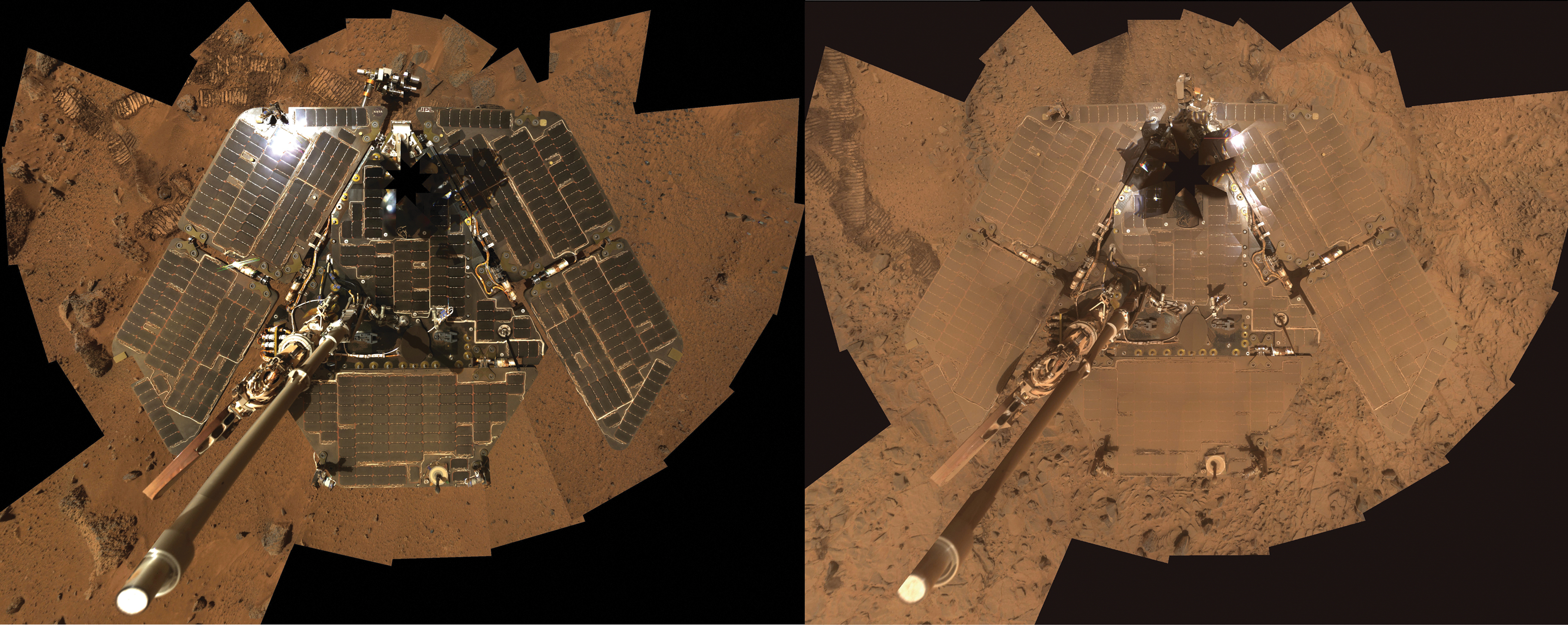
Panoramic camera mosaic views of dust coverage on the rover Spirit's solar panels illustrating changes over time (mission Sol 586 [left] vs. Sol 1355 [right]—Images courtesy of NASA/JPL-Caltech). The images exemplify the pervasiveness of martian dust, and the resulting exposure risks for astronauts on the surface and for the potential back-contamination of Earth. JPL, Jet Propulsion Laboratory.
The rover Perseverance has been exploring Mars since its landing on February 18, 2021. This rover has the capability to collect samples, which may be returned to Earth by a future mission for high-precision high-accuracy analysis in terrestrial laboratories. As of this writing, Perseverance has collected two regolith samples. One of these samples was placed in a sample depot at a location on the martian surface called Three Forks, and the other (at least so far) has been retained on the rover. Either of these could be a target for sample return in the future. The samples themselves are from an aeolian bedform on the martian surface, and if they make it to Earth, they should give outstanding insight into airfall sedimentation, subsequent wind-related redistribution, and crucially the geochemistry (including any organic or biological component) of this environment.
As part of its broader planning for MSR, iMOST Team (Beaty et al., 2019) defined as one of its seven objectives, Objective 6: Understand and quantify the potential martian environmental hazards to future human exploration and the terrestrial biosphere. This objective statement was further decomposed into three investigation strategies (6A, 6B, and 6C), shown in Table 2.
Investigation Strategies to Understand and Quantify the Potential Martian Environmental Hazards to Future Human Exploration and the Terrestrial Biosphere (from Beaty et al., 2019)
Attention must be paid to the methodology and statistics of assessing the biohazard risk of a returned sample set that might have material from multiple environments (NRC, 2009), particularly in light of our improved knowledge of Mars. Such updated approaches need to be integrated with preliminary scientific examination, as they are complementary and intrinsically related (Haltigin and Smith, 2014; Kminek et al., 2014). In addition, the revisions should take into consideration terrestrial technological advances in the intervening period, particularly in the context of robotic handling (e.g., surgical equipment and microelectronics industries) and updated life detection instrumentation and technologies (e.g., -omics type approaches) (Dauphin et al., 2009; Reuter et al., 2015; Johnson et al., 2017).
It is likely that, if objectively reliable sterilization processes were applied to them before release, subsamples of returned samples could be safely released from containment, to enable more timely scientific inquiry into their geological or other properties not directly associated with whether they harbor replicative and potential biohazardous material. For instance, treatments with gamma irradiation, dry heat, or a similarly penetrating sterilization process could be appropriately validated. Similar methodologies have been developed for the safe release from containment of the most hazardous terrestrial microorganisms (US Centers for Disease Control and Prevention, 2018).
Identification of opportunities that currently exist within agencies to close planetary protection KGs are important to enable a compliant implementation solution moving forward. These opportunities encompass a wide range of agency opportunities, from fundamental research and technology development calls to more integrated solutions, such as instruments being readied for flight to specific opportunities for flight missions. Given the current lack of dedicated planetary protection funding sources to close crewed KGs, the philosophy would be to integrate gap closure activities throughout the established funding mechanisms within projects and programs. In addition, given the myriad of interface points between engineering, science, crew health, and planetary protection identification of research and technology development and preliminary design activities where planetary protection can be addressed can be synergistic not only to have compliant systems and manage the process, but also can be integrated as a cost savings to minimize the technology infusion overhead or where existing areas may have common objectives (e.g., microbial monitoring or mars environmental assessments).
Some of the actively worked areas in technology development include understanding Mars biocidal effects and the development of sequence-based microbial monitoring. Both NASA and ESA are currently working to expand the use of DNA-based biological cleanliness assessments for spacecraft with dedicated workshops to identify potential pathways forward (Green et al., 2023), investments in competed research announcements such as the NASA Research Opportunities in Space Earth Sciences Planetary Protection Research Program (ROSES PPR), NASA Established Program to Stimulate Competitive Research Program (EPSCoR) and the Small Business Innovation Research Program, ESA's collaborative development with BioMerieux for automated water, air, and surface sampling and monitoring Microbial Detection in Air System for Space (MiDASS), ESA's continued development of the Detection of Microbial Macromolecules and Protein Contaminants on Surfaces (DEMPCOS) Project, directed funding from NASA and ESA Offices of Planetary Protection, enabling policy to leverage biodiversity and genomic-based approaches (NASA-STD-8719.27 and ECSS Q-ST-70-55C), and the use of ISS as a testbed for environmental and crew health sequencing (Stahl-Rommel et al., 2021).
Continued technology development and mission planning also remain important in closing the KGs for crewed missions. Some examples of upcoming mission opportunities and potential missions under study with technology feed-forward to Mars include the following:
First mArs High-resolution Regional Environmental monitoring Network for Human Exploration-related climate Investigations and dust Transport (FAHRENHEIT) mission study being conducted by ESA would provide critical data to close a gap in model validation of the Mars transport environment.
ESA's Argonauts Lunar Logistics Lander mission as an opportunity to be leveraged for lunar surface scientific investigations.
Mars Ice Access (conceptual design)—led by ESA—is anticipated to characterize the martian subsurface. The in situ investigation of water-rich layers will provide data critical to future human Mars exploration. The mission has potential for opportunistic payloads, which are still being selected, to provide environmental data to close planetary protection KGs. As an example, the mission could be used to conduct Mars dust characterization and modeling investigations, including particle size distribution and composition analysis. This information will develop needed understanding of natural transport mechanisms and rates for dust on Mars and provide a baseline for risk assessment of aerial transportation of terrestrial organisms in the martian atmosphere.
ESA's ExoMars mission, scheduled for launch in 2028, can also be used as an opportunity for testing culture-independent biological (metagenomic) samples taken during ground operations to help close KGs related to microbial monitoring.
Small satellites and nanosatellites can also provide a means for understanding microorganism survival to the deep space environment, such as was launched with BioSentinel (Padgen et al., 2023), or potentially even to the martian surface.
Existing engineering efforts in waste management have leveraged high heat processes and have integrated microbial reduction inputs for planetary protection into the engineering design.
ESA is also considering upgrading the MELiSSA (Micro-Ecological Life Support System Alternative) Pilot Plant (MPP, Barcelona, Spain) into a human-rated facility. The MPP supports the development of technology for a future regenerative LSS for long-duration human space exploration missions. Evolution of the MPP into a human-rated facility will not only enable the demonstration of regenerative LSS with humans in the loop, but it will also provide a unique testbed for isolation campaigns simulating the conditions of human space missions and monitoring human physiology and health, including those needed to develop and validate planetary protection approaches.
Alongside the agency programs, it is also of value for the planetary protection community to continue to participate in Mars working groups such as Mars Exploration and Planning Working Group (MEPAG), International Mars Exploration Working Group (IMEWG), and low-cost Mars planning groups to identify and leverage flight opportunities and synergistic science objectives to close planetary protection KGs.
Crewed missions
Unique opportunities to use cislunar space, including the lunar surface and Gateway in orbit at the Moon, can be leveraged to learn more about how to address planetary protection challenges associated with human missions to Mars. Although it is important to understand and plan for the significant differences between the lunar and martian environments, it is also important to leverage potential similarities regarding KGs and potential mitigation approaches we can take with human missions to the Moon and the intended longer-term sustained presence in deep space, on the lunar surface at a Moon base, and potentially in areas beyond a lunar base.
Artemis
The Human Landing System (HLS) Program is developing demonstration landing missions and sustaining lunar landing systems, largely by, but not limited to, leveraging commercial systems development and services. In addition to requirements and approaches captured in the HLS Planetary Protection Plan (HLS-PLAN-013), there are additional potential opportunities to address planetary protection KGs. One of the most relevant activities in which HLS can engage to help close planetary protection KGs is with the highly dynamic landing of relatively large crewed vehicles.
The landing dynamics will cause complex plume surface interactions that can give rise to (1) contaminants adhering to the outside of the lander (e.g., potentially by electrostatic dust adhesion) and (2) that can cause the distribution of contaminants well beyond the lander. Plume surface interactions and transport dynamics on Mars are anticipated to be different from those on the Moon; however, monitoring, and potentially testing mitigation strategies, can still be conducted during these landed missions to help inform how to address potential contamination challenges from human Mars landings. Examples of KGs that can be informed from human lunar landings include 1A, 2A, 2B, and 2C.
As occurred with Apollo, even early HLS landing missions will presumably leave waste behind, including vented materials. Such waste materials could be monitored, and potential mitigation and containment strategies can be tested, to help inform how to handle waste products during human Mars missions. This can help address KGs 2B (microbial/organic releases from humans and support systems) and 2G (acceptable contamination level from wastes left behind).
Unpressurized and pressurized lunar rovers are presently being pursued under the EVA and Human Mobility Program. Similar to how we can address KGs from crewed lunar landings, we can also learn from unpressurized and pressurized surface vehicles. All the KGs noted earlier also apply to using lunar rovers to help inform similar Mars vehicles, including the venting from spacesuits during unpressurized roving, and perhaps more importantly, what presumably could be a very different quantity and quality of venting from pressurized vehicles. The operation of such vehicles should be able to help specifically address how contaminants are vented and spread as a result of surface mobility. In addition, the design of such surface mobility assets could conceivably include potential contamination mitigation approaches that could be tested on the moon to inform their potential utility at Mars.
Lunar base camp planning and design efforts are underway and present numerous opportunities to help address KGs. In addition to the KGs noted earlier, base camp design can also help address KGs 1D (Operational guidelines), 2F (ISRU compatibility), and 2I (Approaches to “Break the chain”). For example, the location of ISRU assets could be important for addressing and mitigating contamination impacts on human assets such as habitats and mobility vehicles, although this is more particularly useful for subsequent missions beyond that described in HEOMD-415.
Conducting teleoperations on the Moon, particularly low-latency teleoperations (LLT), either from lunar orbit from the Gateway or completely on the lunar surface, has the potential to inform how LLT could be used at Mars for planetary protection-related reasons. KGs 1D, 2C, 2D, 2G, and 2I could potentially be informed by the use of LLT. LLT can be used to develop and test operational guidelines and protocols that could decrease crew health and safety risk, and help execute decontamination protocols and verifications methods, depending on the availability of suitable robotic assets. LLT could also be used as a potential strategy to help “break the chain,” by allowing orbiting or surface crew to manipulate samples without having direct contact with them. More generally, LLT will likely be a planetary protection risk management strategy suitable for use at Mars, including possibly from Mars orbit before crew landings (Lupisella and Race, 2018). The Moon offers a good opportunity to test these kinds of LLT methods in advance of using them at Mars (Bobskill et al., 2015). It is even possible (even though it is not currently planned) that LLT from the Gateway (or possibly the lunar surface base) could be used to examine contamination at the Apollo sites without having to introduce additional contamination so that we can baseline the contamination implications relative to the original Apollo missions for which we have a reasonable inventory of contamination sources (Glavin et al., 2004, 2010; Lupisella et al., 2018). LLT operations of this kind can also help address KG 3F by conducting detailed assessments of the degradation of materials at the Apollo sites.
Gateway
Given one of the present operations concepts that the crew landing vehicle (presently being developed under HLS noted earlier) will mate with the Gateway to transfer crew to the human lander before landing on the Moon, there is an opportunity to monitor and precisely measure the transfer of potential contaminants from the Gateway to the HLS vehicle and vice versa, both internally and even externally, as well as performing baseline monitoring of crew and systems. This kind of contaminant transfer could be important for potential martian architectures that may include crew transfers in Mars orbit. This monitoring and measuring, as well as testing of potential mitigation strategies, are particularly important for KGs 1A and 1B, but could also help address KGs 1D, 2A, 2B, 2C, 2D, and 2G.
Discussion
Post-COSPAR meeting KG status
As stated at the front of this report, the original intention of the meeting series was to identify KGs whose closure would allow development of engineering requirements in support of planetary protection implementation for a human Mars mission. However, the subsequent discussions have shown that, for many of the agreed KGs, multiple parameters need to be addressed to demonstrate closure of the KGs. Sometimes, for any given parameter, multiple figures of merit need to be established, meaning quantitative descriptions of required performance for each KG (e.g., the filtration performance and design lifetime for containment for a vented waste container) that would eventually become engineering requirements. These figures of merit are needed for both policy compliance demonstration and hardware performance purposes. The status of the KGs captured from the first (2016) COSPAR meeting is updated in Table 3.
Planetary Protection Knowledge Gaps Status at the End of the COSPAR Meeting Series
Planetary Protection Knowledge Gaps Status at the End of the COSPAR Meeting Series
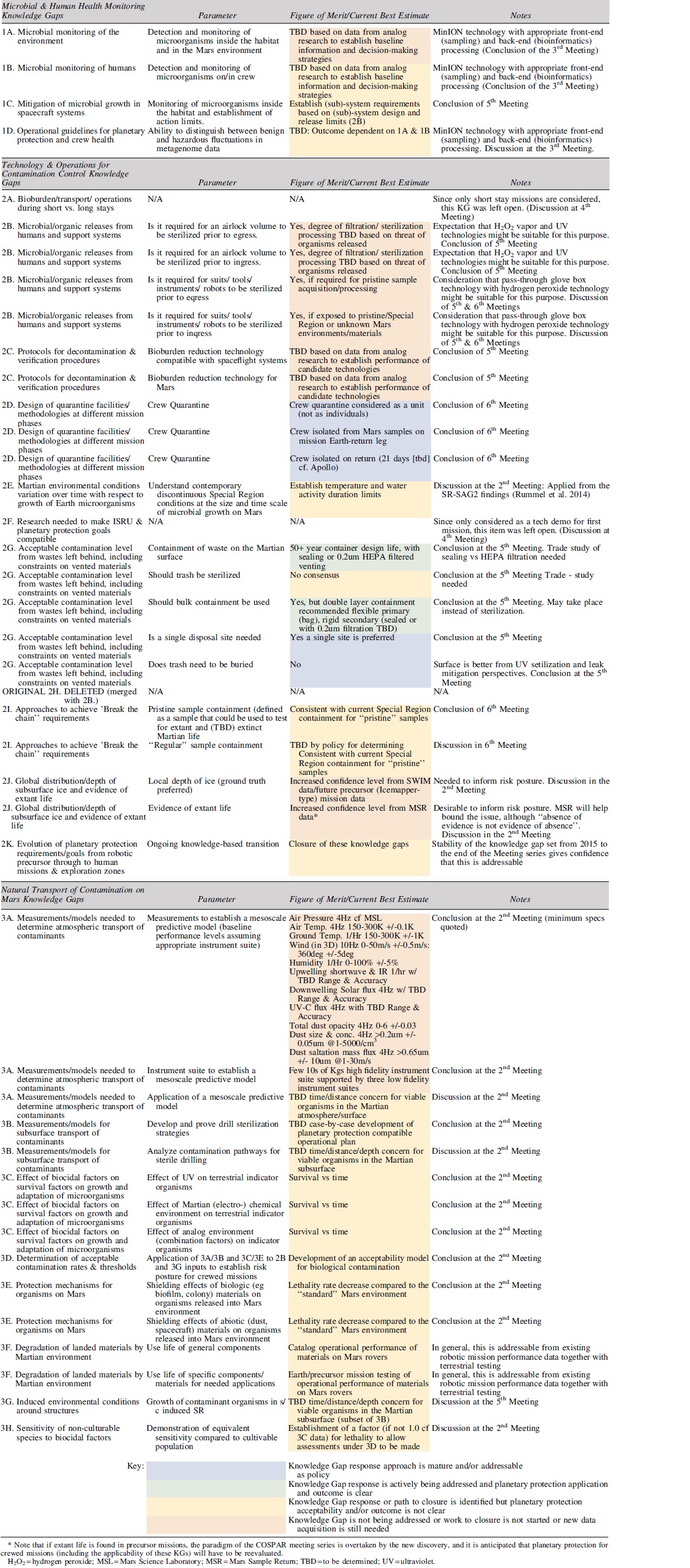
For two KGs (KG 2D, design of quarantine facilities/methodologies at different mission phases, and KG 2G, acceptable contamination level from wastes left behind, including constraints on vented materials), the meetings themselves provided solutions that, if adopted into policy and implemented, would allow engineering design requirements for elements of the design to be compliant with planetary protection policy, shown in blue in Table 3. For other elements of KG 2G, key parameters are being actively addressed, and the planetary protection application and outcome is clear (given acceptance into policy in due time), shown in green in Table 3.
For the majority of the KGs, either the response or path to closure is identified, but planetary protection acceptability/outcome is not clear (shown in yellow in Table 3), or the KG is not being addressed at the present time (work to closure is not started or new data acquisition is still needed—shown in pink in Table 3). It is worth noting that, although planetary protection KGs may be robust to changes in mission architecture, the relevant parameters and figures of merit to close those KGs will be specific to a given architecture. Although the present data are responsive to the HEOMD-415 document and other current Mars architecture concepts, as architectural concepts evolve, the parameters and figures of merit would need to be updated too, to maintain an end-to-end planetary protection concept that is in compliance with the intent of the COSPAR planetary protection policy. In addition, leaving gaps unaddressed means that risk remains for the mission and either a credible planetary protection implementation may not be possible (from the point of view of internal or external stakeholders), or an engineering implementation risk remains that may have undesirable outcomes or consequences during the mission.
Space agencies and other stakeholders involved in the creation of Mars exploration hardware need to integrate planetary protection planning into their engineering activities to ensure timely closure of KGs for their crewed Mars mission architectures (Siegel et al., 2023), recognizing that iterations may be required as mission goals, architectures, hardware, and operational concepts evolve. With the expectation that no single agency or organization will do all this work alone, hardware manufacture, modeling, testing, and operational concept development are all anticipated to be shared efforts. It is expected that planetary protection implementation will be shared too, with shared outcomes in terms of planetary protection implementation risk. In this scenario, determining technical approaches that achieve the end goal of planetary protection compliance will likely become an interagency activity, for crewed Mars exploration missions.
COSPAR, in particular the PPP in its role as provider of the international standard for planetary protection as well as a forum for international consultation (Coustenis et al., 2023), has a key part to play in facilitating continued alignment between the COSPAR Planetary Protection Policy; the goals of planetary protection in complying with international consensus approaches to avoidance of harmful contamination of Mars and protection of the Earth from harmful effects of exposure to martian material; and the evolving implementation strategies of the nations developing crewed Mars exploration hardware. Part of the activity of the PPP is to “provide an international forum for the exchange of information on the best practices for adhering to the [planetary protection] requirements” (Coustenis et al., 2023). This is a particularly valuable aspect of the Panel's role in providing guidance and facilitating discussions to obtain scientific consensus on the acceptability of specific planetary protection implementation steps and strategies emerging from KG closure activities, as they relate to the policy and guidelines. In coordinating policy revision with updates and progress in spacefaring nations' plans for crewed exploration of Mars, a common risk posture and shared best practice can be achieved across the international spacefaring community.
Conclusions
This article summarizes and updates the work to identify planetary protection KGs that was done by COSPAR and space agency partners, with broad input from academia, industry, and other stakeholders. The broad stakeholder community engagement made for a robust set of KGs that withstood the 7-year timeline of the meeting series. The analyses done, under the assumptions and constraints developed by the conveners and participants, demonstrated that the complex problem of planetary protection implementation is tractable for a future crewed Mars mission. That is, the KGs identified, together with approaches to close those KGs, make an end-to-end planetary protection implementation solution into a plausible low-risk proposition for crewed Mars missions.
The next step is for the space agencies and partners to plan and execute activities to address closing the KGs, using the outcomes from the different meetings as appropriate. The Table 3 Planetary Protection Knowledge Gaps Status at the End of the COSPAR Meeting Series is an excellent place to start. Agency objectives for KG research targets, and implementation strategies to obtain figures of merit for parameters identified will put us on the path to reducing planetary protection implementation risk for the first crewed Mars mission. Coordinating with the different stakeholders and partners can identify which parameters need to be studied next, and by whom, to close which KGs, on what timeline, with optimal use of resources. Options exist for coordination between space agencies, through COSPAR, other international coordination groups such as the International Space Life Sciences Working Group (ISLSWG), the International Mars Exploration Working Group (IMEWG), the International Space Exploration Coordination Group (ISECG), and potentially others, to facilitate this study. A high-value activity would be a follow-on symposium to generate a framework under which this work could proceed most efficiently, particularly given the short timelines for KG closure, decisions on ISS utilization, and lunar hardware architecture and utilization.
This meeting series was a crucial step toward developing the requirements for Planetary Protection for crewed missions to Mars, and now we need to find ways to begin closing the KGs. With assumptions made, KGs and potential solutions developed, a path forward is provided to develop requirements for planetary protection for crewed missions to Mars. These requirements will ultimately reduce the risk of harmful contamination of extant martian life (should there be any), and adverse effects on Earth's biosphere from a returning crewed mission. With this article, we hope the work that was done will gain wide stakeholder support for this approach to the first crewed Mars exploration mission.
Footnotes
Acknowledgments
The authors would like to recognize and thank all the participants and contributors to the COSPAR meeting series for their creativity, expertise, and generosity in time, addressing the challenges of planetary protection for a crewed mission to Mars. In particular, previous space agency Planetary Protection Officers Cassie Conley and Lisa Pratt (NASA), and Gerhard Kminek (ESA), are recognized for their advocacy in supporting this workshop series.
Authors' Contributions
J.A.S., B.S. J.N.B., and A.C. provided project administration and supervision for this article.
J.A.S., B.S., C.B., D.W.B., J.N.B., R.B., S.L.C.W., A.C., P.T.D., L.F., B.G., S.J.H., J.S.L., M.L.L., J.M.T., K.O.F., M.P., D.A.P., J.D.R., M.S.R., A.C.S., E.S.N., N.K.S., S.S., C.R.S, S.O.U., K.J.V., and M.P.Z.M. provided original draft text.
All authors, including the text providers and M.S.B., D.A.C., D.P.F., M.F., F.K., R.M., A.B.R., P.R., R.R.Z., K.Y.S., M.S., and P.S., provided substantive technical review and editing.
Author Disclosure Statement
No competing financial interests exist.
Funding Information
James A. Spry is supported through the SETI Institute by NASA contract 80HQTR20F0153 for support of all phases of current and future planetary protection missions to ensure compliance with planetary protection standards.
Part of the study (the David W. Beaty/Nitin K. Singh/Kasthuri J. Venkateswaran contribution) described in this publication was carried out at the Jet Propulsion Laboratory, California Institute of Technology, under a contract with NASA.
Associate Editor: Sherry L. Cady