






Abstract
The concept of a biosignature is widely used in astrobiology to suggest a link between some observation and a biological cause, given some context. The term itself has been defined and used in several ways in different parts of the scientific community involved in the search for past or present life on Earth and beyond. With the ongoing acceleration in the search for life in distant time and/or deep space, there is a need for clarity and accuracy in the formulation and reporting of claims. Here, we critically review the biosignature concept(s) and the associated nomenclature in light of several problems and ambiguities emphasized by recent works. One worry is that these terms and concepts may imply greater certainty than is usually justified by a rational interpretation of the data. A related worry is that terms such as “biosignature” may be inherently misleading, for example, because the divide between life and non-life—and their observable effects—is fuzzy. Another worry is that different parts of the multidisciplinary community may use non-equivalent or conflicting definitions and conceptions, leading to avoidable confusion. This review leads us to identify a number of pitfalls and to suggest how they can be circumvented. In general, we conclude that astrobiologists should exercise particular caution in deciding whether and how to use the concept of biosignature when thinking and communicating about habitability or life. Concepts and terms should be selected carefully and defined explicitly where appropriate. This would improve clarity and accuracy in the formulation of claims and subsequent technical and public communication about some of the most profound and important questions in science and society. With this objective in mind, we provide a checklist of questions that scientists and other interested parties should ask when assessing any reported detection of a “biosignature” to better understand exactly what is being claimed.
Introduction
The search for extraterrestrial life is one of the greatest and most exciting scientific challenges of this century. It is now beyond doubt that large numbers of potentially habitable environments are present throughout our galaxy. Almost daily, new planets are detected orbiting stars other than the Sun. Estimates of the occurrence of rocky exoplanets located in the habitable zone range between 1% and 20% per stellar system (Seager, 2018).
Within our own Solar System, various potentially habitable environments have been identified that might have locally supported the origin and evolution of life in the past, and may still host life today; for example, the oceans of icy moons (Sephton et al., 2018), the subsurface of Mars (Tarnas et al., 2021), or even the clouds of Venus (Limaye et al., 2021), as well as environments such as the surface of early Mars that might once have hosted life before becoming uninhabitable (Sauterey et al., 2022).
At the same time, extreme environments previously thought to be uninhabitable on Earth, in both the past and present, are now known to be capable of sustaining various ecological niches, expanding by the same token the range of possible extraterrestrial habitats for life (Carré et al., 2022).
The endeavor of finding life beyond Earth encompasses many different scientific areas, such as biology, chemistry, geology, physics, and astronomy, each with a multitude of different subdisciplines using their own specific terminology. Hence, there has been a proliferation of terms indicating signatures of life, such as “biomarkers,” “bioindices,” “biotracers,” and most predominantly, “biosignatures,” whose usage in astrobiology has surged in recent decades (Fig. 1).
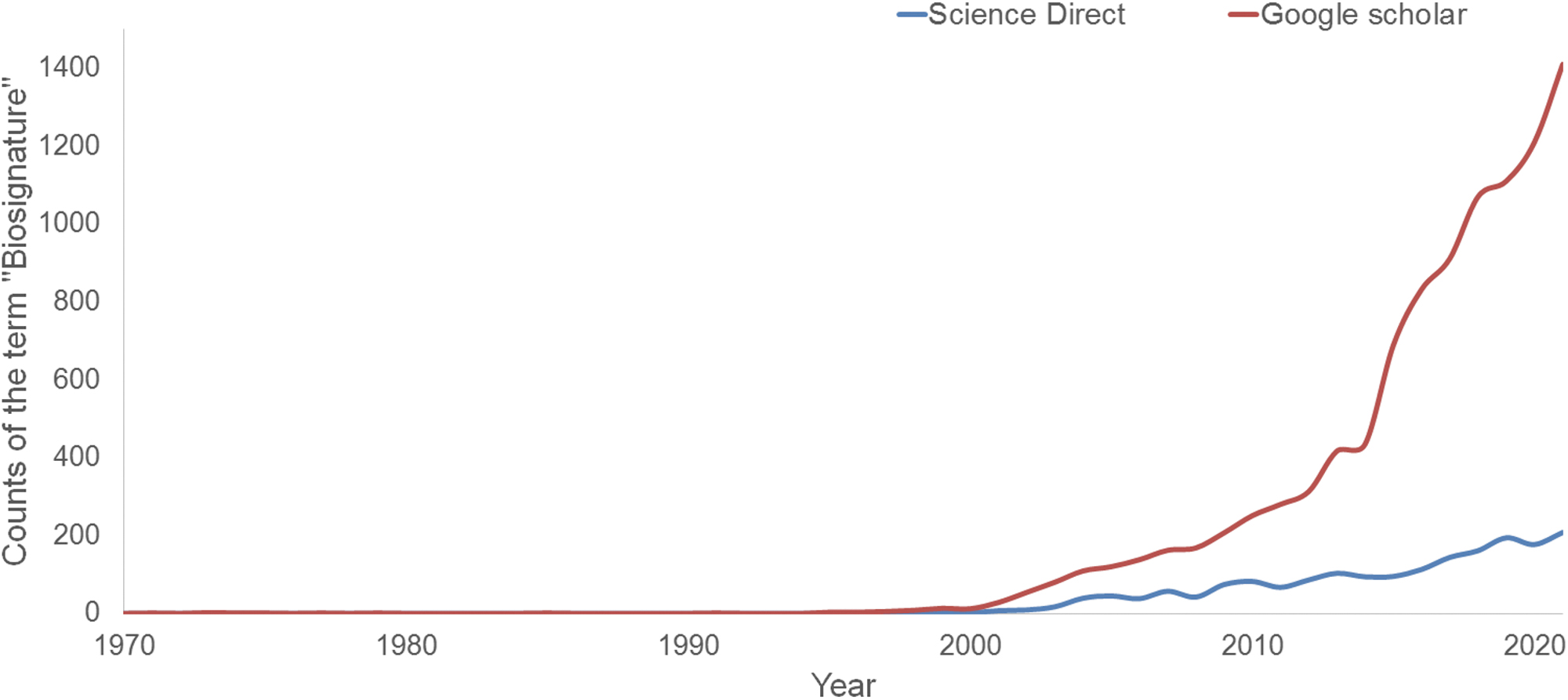
The usage of the term “biosignature” in the literature from 1970 to 2021. Number of occurrences based on Science Direct (blue) and Google scholar (red).
These terms, however, are generally poorly or equivocally defined. Even within subdisciplines, several definitions coexist with different implicit understandings, and are often used loosely and interchangeably, not to mention usage of these terms and others in disciplines outside of astrobiology such as in medicine (Baurley et al., 2018) or environmental research (Jirova et al., 2016). Although efforts have been made to propose more formal definitions in some fields (Des Marais et al., 2008), practices continue to vary across the community. As a result, nuances are often not understood outside of disciplinary specialties, leading to misunderstandings and sterile disputes.
The concepts of biosignature and associated terms shape ideas and provide frameworks to postulate hypotheses and interpret data. They also provide tools for science communication, not only between peers but also with the general public. Yet at the same time, the identification and detection of signs of life, or “biosignatures” in general, are prone to numerous sources of uncertainty; some arise due to instruments and methods of detection pushed to their limits, whereas others can be ascribed to models based on delicate assumptions and hard-to-estimate parameters, along with a multitude of ways of construing the concept of biosignature in practice. As a result, signatures of life may not be recognized as such, leading to false negatives. Conversely, false positives are also possible, notably when the concept of biosignature is too permissively interpreted, with detrimental effects on researchers' reputations in the eyes of the public and the rest of the scientific community.
In addition, the concept of biosignature and its definitions play an important structuring role in certain research programs. Ongoing development in European, Chinese, and U.S. space missions and instrumentation requires an improved strategy on the detection of life or biosignatures. Various active missions and numerous planned or proposed programs may encounter and detect possible traces of life. These include missions focused beyond our Solar System, primarily space-borne and ground-based telescopes that can target exoplanet atmospheres such as the James Webb Space Telescope (JWST), the upcoming Extremely Large Telescope (ELT), or the Chinese space telescope Xuntian (Pan et al., 2021; Gibney, 2022). In addition, various Solar System missions may also detect life, including missions to the icy moons such as ESA's Jupiter Icy Moons Explorer (JUICE) (Grasset et al., 2013) and NASA's Europa Clipper (Howell and Pappalardo, 2020), as well as missions to Mars such as the Mars 2020 program (Mustard et al., 2013), ExoMars (Vago et al., 2015), Mars Sample Return by both NASA/ESA (Kminek et al., 2022), Tianwen-2 and 3 by China (Xu et al., 2022), and related sample curation planning (Beaty et al., 2019; Meyer et al., 2022), or to Titan with the Dragonfly program (Barnes et al., 2021).
Although life detection may not be the main objective of many Solar System missions, almost all current missions include the topics of life detection or of understanding our origins in their mission strategy (National Academies of Sciences, Engineering, and Medicine, 2022). Further, recent developments, notably in biology, planetology, and instrumentation, have led to a renewed interest in life-detection endeavors. Hence, the clarification of biosignatures as a concept is both timely and necessary.
Recently, several works have focused on how to improve biosignature detection and interpretation, leading to different propositions in terms of frameworks or sets of criteria to support an actual claim of life (Meadows et al., 2022). These include studies on a Ladder of Life Detection (Neveu et al., 2018), a confidence of life detection scale (Green et al., 2021), and various frameworks to evaluate biosignatures (Marshall et al., 2017; Pohorille and Sokolowska, 2020). These efforts have all focused on actual detections, on measured data, or, minimally, on potentially measurable data.
In the present paper, we do not focus on any particular type of data but on the very concept of biosignature, its associated terminological multiplicity, and the plurality of definitions it has acquired. We aim at making explicit the different elements that can influence what one considers biosignatures to be and to imply. In particular, we examine what the term “biosignature” actually refers to in the literature.
We make explicit the abductive chain of reasoning from observations all the way back to the interference of the presence of living entities. We show where differences and uncertainties arise throughout this chain of reasoning. We establish an overall checklist of questions to ask oneself when facing biosignature claims so as to try and avoid their numerous pitfalls. This is done with the intent of improving clarity, accuracy, and multidisciplinary discussions when communicating about some of the most profound and important questions in science and society: that of the origin and distribution of life in the Universe.
When searching for life, we are faced with indirect evidence and a multitude of proxies. It is useful to have a way to claim that something—perhaps a substance or a signal (see Section 4)—is a sign of biological activity, even if it is a by-product of life and not life itself. The field of life detection is an amalgamation of many different disciplines with their own proxies and standards of reporting that may be unknown to, or have entirely different meanings for, other disciplines.
To be able to make a commonly understood and accepted claim about the presence of life, well-defined proxies and standards of reporting are required. But does this justify the need for the concept of biosignature? Currently, the concept of biosignature is not clearly and unequivocally defined throughout the disciplines focusing on life detection, and as will be shown in Section 3, a plethora of terms are used to describe an indication, a suggestion, corroborating evidence, or a proof of life. Some strong versions of the concept (and, more particularly, strong definitions of the term, “biosignature”) have been proposed according to which a biosignature is to be understood as a definite proof of life (Des Marais et al., 2008; Gargaud et al., 2009).
However, definitive proofs of life seem difficult to obtain, especially when examining evidence from the deep past or distant space. Further, some potential biosignatures need detailed information about the environment to discount false positives—for example, the case of molecular oxygen in the atmosphere (Meadows et al., 2018). As a result, current research and discussions primarily focus on ambiguous biosignatures (see also Sections 5 and 6). Such vagueness and plurality of interpretations can be damaging, as they create misunderstandings between scientists from different disciplinary backgrounds; they are also confusing to the general public and may lead to overinterpretations and false hopes. As a result, it may be argued that the concept of biosignature is doing more harm than good, and should not be used. Hence an “eliminativist” view that the concept should be banned in science.
One cannot help but notice, however, that the term “biosignature” has been frequently used in the scientific literature for decades (Fig. 1) and, despite the drawbacks mentioned earlier, has become a mainstream go-to term when reporting observations related to the possible presence of life. This is the case for possible life in extreme or inaccessible environments (Varnali and Edwards, 2013; Vítek and Wierzchos, 2020), including not only the deep past several billion years ago (Campbell et al., 2015), but also and most significantly in space (Schwieterman et al., 2018). In addition, the term plays a major role in shaping future research. Biosignatures are incorporated in roadmaps, such as the AstRoMap European Astrobiology Roadmap (Horneck et al., 2016), the Decadal Strategy of the National Academies of Sciences, Engineering, and Medicine on Planetary Science and Astrobiology 2023–2032 (2022), NASA Roadmap to Ocean Worlds (Hendrix et al., 2018), the US Pathways to Discovery in Astronomy and Astrophysics for the 2020s (National Academies of Sciences, Engineering, and Medicine, 2021), or ESA's Voyage 2050 report (Tacconi et al., 2021).
There is hope that a proper set of biosignatures will be devised to function as a convenient toolbox for life detection when there is sufficient evidence to report that life is present, or has a high probability of being present, in different planetary environments and places. This goes hand in hand with investigations that push the boundaries of current observations: in such contexts, the concept of biosignature can have a useful heuristic role by specifying novel targets for future observations. It is not surprising, therefore, that the concept should also be widely deployed in the design of space missions with life-detection objectives (Abrahamsson and Kanik, 2022; Baqué et al., 2022) and instruments (MacKenzie et al., 2021; Seaton et al., 2021; Quanz et al., 2022; Dannenmann et al., 2023).
An eliminativist view on the concept is, therefore, not pragmatically tenable. Quite the contrary, the concept of biosignature appears to play a significant role in the practice of science, not to mention its attention-grasping appeal outside of science. All of this justifies the need for the concept and warrants further refinements so as to make the concept work across multiple disciplines and avoid confusion through the multiplicity of related terms.
The Ubiquity of Life-Detection Terms in Science
A search of archived online material suggests that the terms “biomarker” and “biosignature” began to gain currency in the exobiology/astrobiology community in the late 1990s (Fig. 1), largely through initiatives associated with NASA. For example, the terms are found in Meyer et al.'s (1995) NASA report, “An Exobiological Strategy for Mars,”, and appears in a May 1998 edition of Universe, the newsletter of the Jet Propulsion Laboratory, in connection with the launch of the NASA Astrobiology Institute (Jet Propulsion Laboratory, 1998). Though “biomarker” may be found earlier, for instance in the context of rock sample analysis (Rho et al., 1973), it is interesting to note that historic papers about possible evidence of life on Mars from the pre-Viking era (Sinton, 1957, 1959; Sagan and Lederberg, 1976) did not use any generic term equivalent to biosignature, referring either simply to “evidence” or to specific pieces of evidence such as spectra and fossils.
The Viking Biology Instrument team used similar expressions, for example, “evidence of living microorganisms” (Brown et al., 1978). Likewise, the study by Sagan et al. (1993) of spectra of the Earth obtained by the Galileo spacecraft refers to “evidence of life,” “signs of life” and even to the possible “signature of a light-harvesting pigment” but not to biosignatures (or equivalent). However, the paper by McKay et al. (1996), which began the controversy about possible evidence of martian life in meteorite ALH84001, used the term “biomarker” (not “biosignature”) as did the NASA Astrobiology Roadmap of 1998 (Morrison et al., 1998). The term “biosignature” proliferated in the course of this controversy (Thomas-Keprta et al., 2002) and was formally defined in the NASA Astrobiology Roadmap of 2003 (Des Marais et al., 2003).
Today, “biomarker” is still sometimes used as a synonym for “biosignature,” but as a general term for evidence of life, the latter term is dominant in the astrobiology community (Fig. 2). The term “biomarker,” however, remains standard for organic molecules recovered from sediments and their diagenetically altered products in ancient sedimentary rocks (Summons et al., 2022); in this restricted sense, it is widely used by geologists and paleontologists without necessarily intending any astrobiological connotation. In other fields, including molecular biology, medicine, and soil science, “biomarkers” are biological markers of a particular state, for example, a given medical or environmental condition, rather than markers of biology itself.
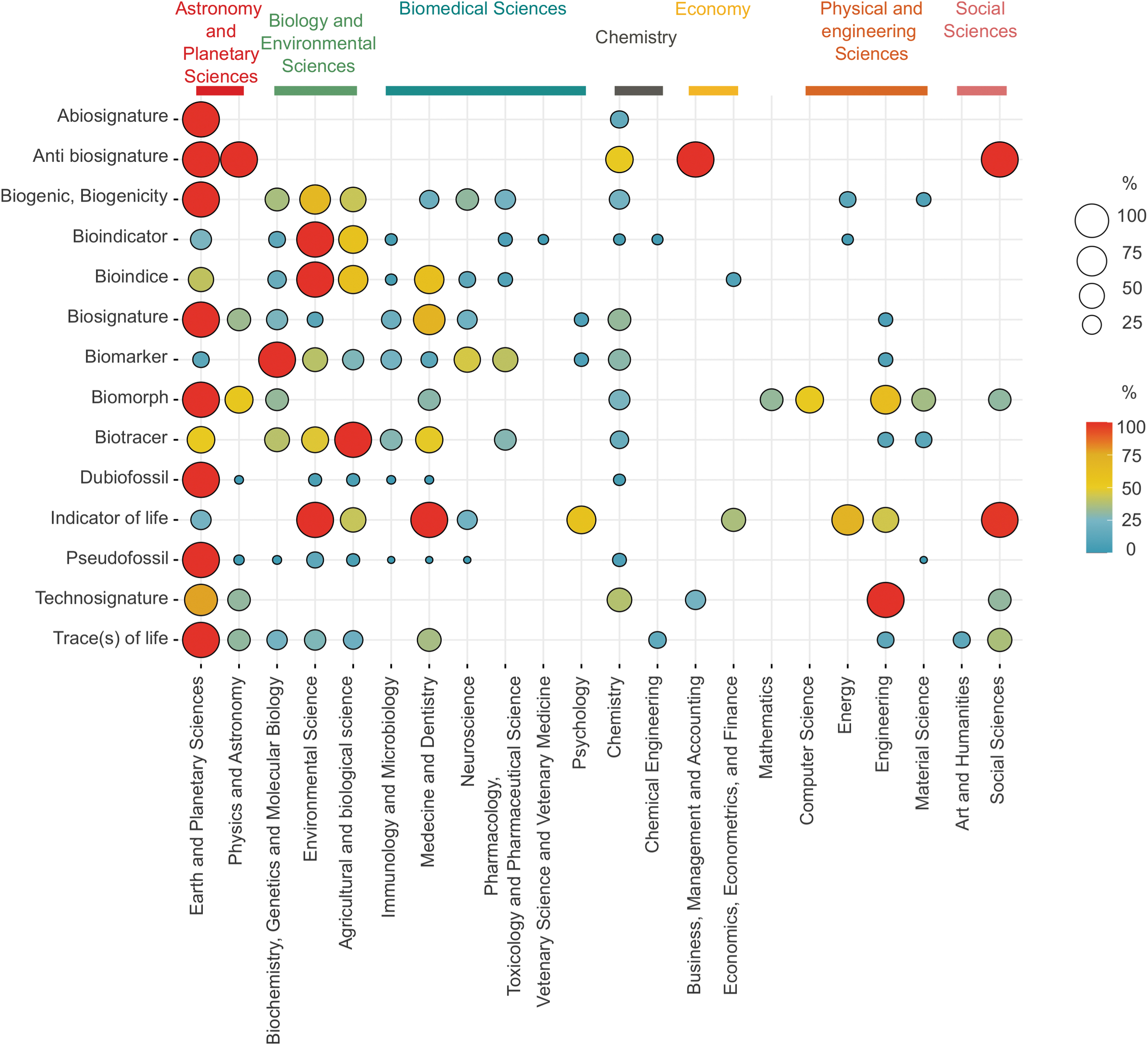
Usage of “biosignature” and related terms depending on disciplinary context. Standardized number x of articles in each discipline as recorded by Science Direct, where x = number of articles for the keyword per discipline/maximum number of articles for the keyword across all disciplines.
The term “biosignature” has been variously defined and redefined. For Thomas-Keprta et al. (2002), it is “a physical and/or chemical marker of life that does not occur through random, stochastic interactions or through directed human intervention.” The 2003 and 2008 NASA Astrobiology Roadmaps (Des Marais et al., 2003, 2008) define a biosignature as “an object, substance, and/or pattern whose origin specifically requires a biological agent.” Intentionally diluting this for application to exoplanet spectroscopy, Catling et al. (2018) define it as “any substance, group of substances, or phenomenon that provides evidence of life.” Pohorille and Sokolowska (2020) define biosignatures as “chemical species, features or processes that provide evidence for the presence of life” and then discuss a combined signal detection, Bayesian, and utility theory approach. Some researchers have rejected the term “biosignature explicitly” (e.g., Gargaud et al., 2009, who prefer “indices”). Nevertheless, it continues to be widely used (see Table 1 below).
Examples of Biosignatures from a Variety of Contexts
Biosignatures are listed, alongside their type and disciplinary context.
The term “biosignature” is often qualified; there is discussion of possible, probable, putative, potential, tentative, ambiguous, poor, and candidate biosignatures (Schwieterman et al., 2015; French and Blake, 2016; Costello et al., 2021; Zhan et al., 2022). It has been made more specific to various contexts by the appendage of words such as cryptic, atmospheric, surface, gas, mineralogical, morphological, molecular, chemical, geological, agnostic, spectroscopic, direct, indirect, and temporal, and by the prefix techno-. It has also been reworked to yield “false biosignatures” and “pseudobiosignatures” (McMahon and Cosmidis, 2021), and even “abiosignatures” and “antibiosignatures” that are intended to indicate the absence of life (Chan et al., 2019; National Academies of Sciences, Engineering, and Medicine, 2019; Schwieterman et al., 2019).
While some prefer to use the phrase “life signatures” (Enya et al., 2022), a plethora of other terms exist for describing evidence of life with more or less specificity: “trace,” “tracer,” “fossil,” “bioindicator,” “biomarker,” “proxy,” and simply “evidence.” As with the term “biosignature,” some of these words have also been modified in ways that suggest the complexity of grappling with evidence of life in the context of inadequate or misleading data, yielding, for example, “pseudofossils,” or “dubiofossils” (Rule and Pratt, 2019).
Also note that usage of these terms is by no means restricted to the search for life as intended in astrobiology, even broadly construed (Fig. 2). Not only has the science of life detection produced a rich and subtle lexicon, but also numerous terms such as “bioindicator,” “bioindice,” “biomarker,” or “biotracer” are commonly used in other scientific disciplines, notably in the biological and environmental sciences, as well as in the biomedical sciences. Some of these terms and others such as “anti-biosignature,” “indicator of life,” or “technosignature” are also found in chemistry, business and economy, physics and engineering, or even the social sciences. This multiplicity of disciplinary contexts points to a plurality of ways of understanding biosignature-related terms, all conducive of possible misunderstandings.
Regardless of this terminological diversity, the concept of a biosignature remains at the forefront of modern astrobiology. It just needs to be articulated with caution, notably by examining the implicit conceptual framework that seems to underpin it.
If one starts from the definition according to which a biosignature is an “object, substance, and/or pattern whose origin specifically requires a biological agent” (Des Marais et al., 2008, p 729), biosignatures seem to be of at least two types. Some are material things such as objects and substances that are observed: one can think about a microfossil and a specific gas being biosignatures. Others are patterns, which are properties of objects and substances, namely repeated spatial or temporal variations. The varying nature of biosignatures is also revealed in biosignature taxonomies. For instance, it has been proposed to sort exoplanet biosignatures into three main categories (Meadows, 2008): atmospheric biosignatures (that concern the presence of specific gases such as oxygen, ozone, and others); surface biosignatures (typically defined as patterns resulting from the interaction of light with life on the surface of a planet, such as the photosynthesis “red edge” due to sudden change of plant reflectance near the infrared part of the electromagnetic spectrum); and temporal signatures (which are time-variation patterns in, e.g., atmospheric and surface variables).
Biosignatures can also be construed as specific combinations of objects, substances, or patterns, for instance, combinations of gases (Thompson et al., 2022). Note that biosignatures may refer as well to specific quantified amounts related to the inferred objects, substances, or patterns, for instance, specific abundances of given gases that may denote fluxes and thermodynamic disequilibria (Kleidon, 2010; Krissansen-Totton et al., 2016). Depending on context, biosignatures can thereby be quite different types of things, which adds to the ambiguity of the concept. This varying nature of biosignatures can be traced to the complex causal chains spanning from putative biological entities (light years away or billions of years old) to present-day observations and their interpretation.
Take the example of oxygen produced by living organisms on a planet orbiting its star, and possibly also by abiotic processes (“original causes” in Fig. 3): this oxygen may accumulate in the atmosphere where it is transformed into ozone due to the radiation emitted by the star. Depending on context, specific properties of ozone and oxygen will be chosen as targets for observation, such as their light absorption features (“observable features” in Fig. 3). Yet, oxygen only has weak spectral features in the visible part of the electromagnetic spectrum, whereas ozone strongly absorbs in the infrared, making it a better target (hence the distinction made for illustrative purposes in Fig. 3 between oxygen that is categorized as an “intermediary” and ozone that is selected as an “observable” entity).
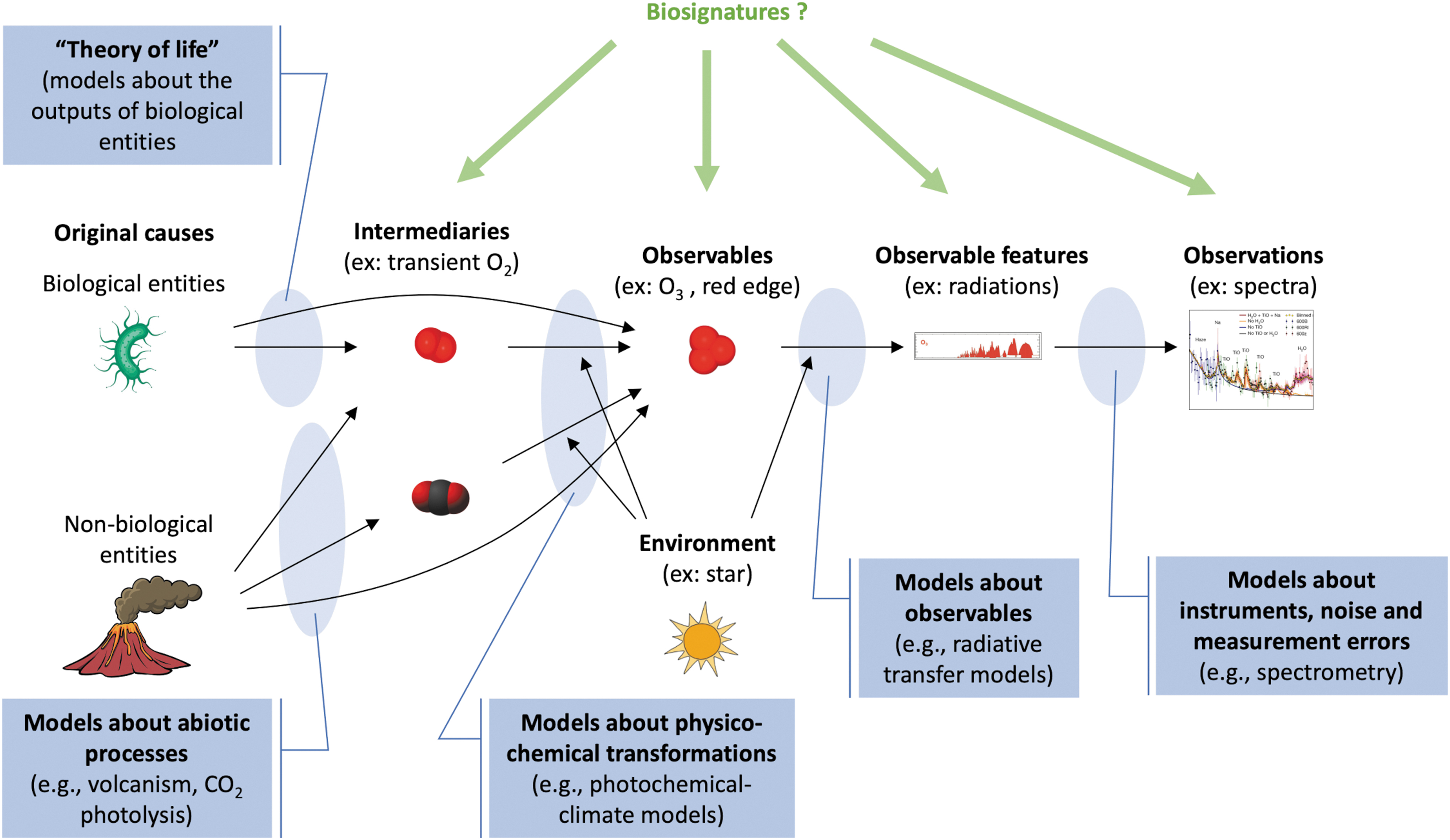
Possible biosignatures and theories/models mobilized along the way. Original causes, which can be biological or non-biological entities, produce different outputs (some of which cannot be directly or easily observed) that may get transformed by the environment, leading to observables, which, in turn, can be characterized by means of specific observable features, the latter being, in turn, measured by specific instruments and procedures and resulting in observations. Depending on context, biosignatures can be defined in reference to any of these elements. Abductive backward inferences from observations to original causes (and their biological nature) are mediated using several stages of theories and models (in blue). Illustrated in the case of astronomical observations of exoplanets, but meant to apply broadly to any sort of biosignature. For instance, in geobiology, isotopic analyses of rock samples involve models about instruments (such as mass spectrometers), noise and measurement errors; models about how isotopes behave in such experimental settings; models about how isotope patterns may have been affected by different transformation processes, including the passing of time, but also extraction, transportation, manipulation, and various other contamination sources; as well as models about biotic and abiotic processes that may account for the presence of these patterns in the first place.
In the end, spectroscopic observations will be made (“observations” in Fig. 3), parts of which will be interpreted as revealing (or not) the presence of ozone and oxygen. Here, the concept of biosignature may refer to the gaseous substance (oxygen) directly produced by biological entities (“original causes” in Fig. 3); to the gaseous substance (ozone, considered as an “observable”) resulting from the transformation of primary products (“intermediaries”); to specific properties of either substances, such as their specific absorption spectra or their abundance (“observable features”); or to the end-observations that are made, for instance, the full spectrum resulting from a measurement procedure (“observations”). As noted by Schwieterman et al. (2018), one may ask whether a biosignature is the measured spectral signal or the inferred presence of the gas based on that signal, or even the inferred presence of biological entities at the origin of that gas.
Indeed, the notion of biosignature is conditioned on the reliability of intricate inferences from a measured signal all the way back to the presence of biological entities. All of these abductive inferences, also called “inferences to the best explanation” (Harman, 1965; Lipton, 1991), are mediated by specific models and theories, as well as a number of particular conditions that depend on the specific case. Considering again the simplified example of oxygen-producing biological entities (Fig. 3), the claim that oxygen is a biosignature presupposes that we have a “theory of life” or models about the outputs of biological entities, according to which oxygen is indeed produced by biological entities. It also presupposes that we have models about all relevant abiotic processes in the given environment of that exoplanet that would rule out any significant abiotic synthesis of that oxygen, something not obvious in itself though abiotic levels of oxygen should be minor on an Earth-like planet (Meadows et al., 2018).
Similarly, claiming that ozone is a biosignature consists of making the abductive backward claim that the presence of ozone is due to the transformation of biogenic oxygen. This requires, in addition to a theory of life and models of abiotic processes, the use of models about the physicochemical transformations that are likely to occur given the environmental context in which ozone is embedded. These models include, for instance, photochemical-climate models that are constrained by data about the planet and its star, and the presumed chemical composition of the planetary atmosphere under study, and which can be used to calculate theoretical spectra for comparison with observations. In turn, claiming that a specific property of ozone, such as its light absorption features, is a biosignature further requires specific models about the observable properties of ozone, such as radiative transfer models, given specific conditions.
As for claiming that a measured signal or an observation reveals the presence of a property of an object or a substance that may ultimately be traced back to a biological entity, this also requires the use of models that account for the observation procedure, for instance, taking into account signal strength (a function of viewing strategy, instrument sensitivity, etc.) as well as various noise sources (which can be broadly split into instrumental and non-instrumental). Considerations such as these apply to a wide variety of biosignatures, as listed in Table 1.
There are two lessons that can be drawn: The inference from observations of a certain signal all the way back to the assertion of the presence of biological entities somewhere at the origin of that signal is a chain of interwoven abductive backward inferences mediated by several layers of theories, models, and particular conditions. Further, since each of these theories, models, and particular conditions only receive a certain degree of confirmation, the overarching inference of the presence of biological entities can only be confirmed up to the compounded degrees of confirmation of all the ingredients used in the chain of backward inferences. In practice, this confirmation ought to be even lower than that since alternative, less favorable models cannot be ruled out for sure, which is a general issue for any abductive reasoning. Depending on context, the concept of biosignature may apply to different types of elements intervening along the way in the causal chain. Yet, depending on the position of these elements in the chain of backward inferences, corresponding biosignatures will be subject to varying degrees of confirmation.
Though biosignatures aim at signaling the definite presence of life, they are often found in practice to be inconclusive (Pohorille and Sokolowska, 2020). The model of backward inferences we outlined earlier highlights three major inferential steps where justificatory uncertainties may emerge, possibly weakening the resulting biosignature claims and their interpretation.
There is, first, the question whether the observations that are made are truly indicative of the inferred observable features or not (last inference on the right-hand side of Fig. 3). In other words: Is the signal real? Indeed, the validity of a signal can be hampered in multiple ways, notably as a result of: (a) an insufficient signal-to-noise ratio, which is to say that the desired signal is not strong enough relative to background noise; (b) a lack of reproducibility, the signal having been only detected once; (c) a lack of statistics, in the sense that the signal might have been measured a few times but not enough to be statistically meaningful; (d) calibration errors, leading to instruments and methods not functioning appropriately; or (e) analytical errors applied through pre- or post-processing algorithms used for data handling.
To mitigate these sources of uncertainties, different strategies can be implemented, notably attempting data reproduction by other scientific teams, using different instruments or methods if possible. This strategy can be done not only on the very same object, but also on different samples collected in other locations, following the conventional scientific method (as underlined in Green et al., 2021), and as is, for example, custom for exoplanet detections (Mantovan et al., 2022). One can also implement advanced statistical methods, for instance, approaches capable of discriminating specific parameter distributions between populations of biotic and abiotic observations (as proposed, for instance, in Rouillard et al., 2021).
Second, there is the question whether the observable features, which are extracted from the raw observations, are actually indicative of the inferred observables or not (middle-right hand side of Fig. 3). In short: Does the signal correspond to what we think it corresponds to? Lack of signal resolution, contamination, and lack of signal specificity (i.e., same signal for different sources) could all lead to wrongly interpreted signals. The speculated detection of martian methane, for instance, exemplifies lack of signal resolution and specificity as well as signal contamination, as the strongest detected methane lines overlap with gases in the Earth's atmosphere and no methane could be observed above noise levels at the specific methane lines (Knutsen et al., 2021). The disputed detection of phosphine in the Venusian atmosphere is another example of contamination (the perceived phosphine signal is very close to the sulfur dioxide signal) and of lack of signal resolution (the observed signals are too broad for the specific interpretations that were based on them) (Greaves et al., 2021a, 2021b; Villanueva et al., 2021). In such cases and others, the observational features of interest may actually be produced by a mixture of undescribed and unknown phenomena. As a result, these observational features may not actually correspond to the expected observables. Solutions to decrease uncertainties in this inferential step include obtaining more analogue data, for example, laboratory and simulated spectra of possible exoplanet atmospheres. More generally, there is a need to explore potential confounders for any set of observable features of interest, to devise means to neutralize their effects in terms of observable features, and to make sure these confounders are, indeed, addressed whenever the presence of a given observable is inferred from a set of observable features.
Third, there is the question whether the inferred observables are indicative of the presence of living entities or simply by-products of abiotic processes (left-hand side of Fig. 3). In other words: Is the thing you think the signal corresponds to actually indicative of life? Well-known examples of such question-raising inferences include: the Viking Labeled Release Experiment results (Levin and Straat, 2016), with a still ongoing discussion about whether the measurements are indicative of life or not; the analyses of the ALH84001 martian meteorite (Davila et al., 2008), which contains organic compounds and inclusions that could be suggestive of life but can be formed abiotically; and interpretations of geological features as indicative of the oldest known forms of life on Earth (Brasier et al., 2002), whereas such features can also be formed abiotically.
To increase confidence, one can use a suite of observables (Gargaud et al., 2009; Javaux, 2019), as with the proposed Exomars biosignature score (Vago et al., 2017) instead of single observables. Indeed, a joint set of observables (e.g., isotopic or organic compositions or morphologies) may converge to a more robust interpretation of the presence of biological entities in a particular context (geological, astronomical, physico-chemical) when this set of observables as a whole cannot be explained abiotically even though an individual observable may seem abiotic. However, even sets of observables may not be unambiguous. In the exoplanetary context, for instance, combinations of gases that would normally be attributed to life (e.g., simultaneous detection of high levels of an oxidized and a reduced gas) may still be the result of a companion body with a different atmosphere orbiting the observed planet (Rein et al., 2014). Additional observables could still be added, such as temporal variations, to reduce uncertainties, but erroneous interpretations are still possible, as with any case of general underdetermination of theories by observations (Duhem, 1906; Quine, 1951; Laudan, 1990).
Another strategy is to decrease the plausibility of abiotic alternatives that might account for the observables in the context of interest and try falsifying the null hypothesis that the signal is abiotic (Brasier et al., 2002). This can be done by testing known and new abiotic processes in nature or in the laboratory (McMahon and Cosmidis, 2021). However, the challenge is compounded by the presence of “unknown unknowns”: contexts and processes are infinite and difficult to test, or even to imagine as there is always the possibility of unconceived alternatives (Stanford, 2001). Such unknown unknowns can still lead to false positives. The well-known phrase “the absence of evidence is not evidence of absence” (often attributed to William Wright, 1837–1899) may still apply, and observables that are sought after for their biogenicity might still have abiotic causes.
On the other hand, unknown unknowns may also lead to false negatives, as we might miss indices of life because we are not looking for them or because we cannot recognize them, or because the diversity and complexity of some contexts (e.g., exoplanets) are difficult to envision and comprehend with present-day knowledge and technology. “If we only consider life that is the most unambiguous and, therefore, the least gray, we may fail to recognize life that is very different or life that is very new. Not only would this result in missing a significant discovery, it also raises issues of planetary protection” (Smith et al., 2021a, p 13).
Are Biosignatures Inherently Probabilistic? The Confidence Level of Biosignatures
The term “biosignature” conveys the idea that the observation has a definite biological origin, and that it is conclusive in this respect. This idea comes from our common sense understanding of what a “signature” is: according to the Oxford Dictionary of English, a signature is nothing other than “a distinctive pattern, product, or characteristic by which someone or something can be identified, and more specifically a person's name written in a distinctive way as a form of identification in authorizing a cheque or document or concluding a letter.” Following such definition, therefore, strictly speaking, a biosignature should be understood as a distinctive attribute of life: it “would be a clear-cut proof or mark of the presence of organisms, as living beings or as fossils” (Gargaud et al., 2009). This is the type of “strong” definition that is implied in works such as proposed by Des Marais et al. (2008) as discussed earlier. In practice however, we have learned that candidate biosignatures are rarely distinctive in this sense.
As a consequence, “biosignature” is often qualified by an adjective such as putative, tentative, possible, potential, candidate, probable, and so forth (see Section 2). Such qualifiers thereby indicate varying degrees of confidence, though not certainty, and lead to what can be called “weak” definitions of biosignature that specifically acknowledge the uncertainty in biosignature detection. Along these lines, Schwieterman et al. (2018, p 667) question the degree of certainty required to describe an object or measurement as a biosignature: “Can something be considered a biosignature if there is a nonzero probability that it is not produced by life?”
This certainly is the case in practice. For instance, a spectral feature may be used as a biosignature even though it may be explained by abiotic sources or by measurement error. In the case of the search for life on exoplanets, biosignatures will remain inherently uncertain and probabilistic, unless technological evidence of life is discovered, since biogenicity may never be verified in situ (though one may secretly hope for the contrary). Moreover, our knowledge of the diversity of exoplanetary atmospheres is still poor and remains to be constrained (with the help of the JWST, the ELT, and other future telescopes) before we can hope to detect an anomaly that might possibly be of biological origin.
Given these circumstances, instead of claiming that exoplanet biosignatures do not exist (as a strong definition would imply), one can relax the constraints on defining biosignature and use instead a weak version according to which a biosignature would be an observation—related to an object, substance, pattern—whose origin likely (according to current knowledge) requires a biological entity. Schwieterman et al. (2018, p 666) recognize that “a prospective exoplanet biosignature will always be a potential biosignature with other possible explanations (unless technological), [especially since] the full range of abiotic chemistries that may produce false positives is unknown.” This is also the case in analyses of the putative earliest traces of life on Earth, and possibly on Mars, where the limit between non-life and life is blurry or when life attributes are not preserved to remove ambiguity (McMahon and Jordan, 2022).
As described by Catling et al. (2018, p 709), “the extraordinary claim of life should be the hypothesis of last resort only after all conceivable abiotic alternatives are exhausted,” a view that has also been expressed by several early Earth micropaleontologists (Brasier et al., 2002; Brasier and Wacey, 2012; Javaux, 2019). Because of the inevitable uncertainty of life detection on an exoplanet, these researchers propose to use a range of probability, in the form of five confidence levels, ranging from “very likely” (90–100%) to “very unlikely” (<10%) inhabited. “A biosignature is any substance, group of substances, or phenomenon that provides evidence of life,” bearing in mind that specific “information and general procedures [are] required to quantify and increase the confidence that a suspected biosignature detected on an exoplanet is truly a detection of life” (Catling et al., 2018, pp 709–710).
This results in a Bayesian approach aiming at assessing the conditional probability that the hypothesis of life existing on an exoplanet is true given observational data and context exhibiting a range of possible biosignatures. However, interpreting these confidence levels could remain extremely controversial, especially due to current poor knowledge of the exo-atmospheres “zoo.” For instance, not all planetary scientists would endorse the view that an O2-rich atmosphere with other biosignature gases, including CH4 and N2O, and a liquid ocean identified on an Earth-size exoplanet in the habitable zone of its host star would be considered “very likely inhabited at 90–100%” as suggested (Catling et al., 2018, p 729).
In any case, since both strong and weak definitions of “biosignature” are used in the literature, it is important to make explicit which one is used (in a given piece of research) and assess the uncertainties at stake (Gillen et al., 2023). For clarity however, whether biosignatures refer to in situ or remote detection, it might be preferable and less misleading to use a strong definition together with a qualifier or confidence level specifically addressing the uncertainty, as discussed earlier. Of course, debates will inevitably occur about the level of uncertainty that is highlighted. Yet, the addition of a specific uncertainty-encapsulating qualifier to the term “biosignature” has the advantage of making explicit that science treads here on uncertain grounds, and there is nothing wrong with this.
What Is the “Bio” That Biosignatures Refer to?
Biosignatures aim at identifying the presence of particular types of entities: living entities. By construction, therefore, any concept of biosignature relies on an implicit assumption about what life is: a definition of life, or at least the identification of key properties of life that should make unambiguous the presence of living entities. Different definitions and usages of “biosignature” may also rely on similar or different versions of life definitions, which may (or may not), in turn, correspond to the same types of life. Although a plethora of definitions has been proposed, this conceptual task remains elusive (Tirard et al., 2010).
In practice, biosignatures rely on key characteristics inferred from typical Terrestrial life as we know it, that is to say carbon-based life that uses liquid water as a solvent (Westall and Brack, 2018). In metabolism-driven views, detection focuses on analyses of metabolic products such as minerals (e.g., framboid pyrite produced by sulfur-reducing bacteria), complex molecules such as pigments, peptides, or lipids, and isotopic fractionation of elements used in biosynthetic pathways such as C, N, S, and metals such as Fe, Cu, or Zn (Javaux, 2019). A thermodynamic approach will attempt to measure, for instance, a disequilibrium between gas species in a planetary atmosphere (Tanaka and Hirata, 2018).
Biologists would very much like to detect direct evidence of reproduction as indirect evidence of Darwinian evolution (transmission of information with variation linked to evolution), such as the detection of dividing fossil cells or spores, cysts involved in dissemination, or indicating vegetative and dormant life stages, and their evolution through time in a fossil record (Javaux, 2019). Detection of technology capable life (i.e., technologically intelligent life, not just intelligent life) includes the identification of communication messages or spaceships (Sheikh, 2020), though even those are subject to debate (e.g., the recent crossing of our Solar System by ‘Oumuamua, interpreted by most as a rocky object (Meech et al., 2017) but by some as an alien spaceship (Loeb, 2022)).
Each of these characteristics, when considered in isolation (and not in combination with all others), is not enough to guarantee life. As is well known, flames grow and consume matter; crystals are organized; viruses contain genetic information and reproduce; robots can repair themselves, etc. In all these cases, some properties of life are exhibited, but not enough for the systems to be considered typically living. However, where exactly to draw the line is not easy, since we spontaneously consider sterile organisms, for instance, to be alive even though they miss some key properties that we usually associate with life, namely reproduction and the capability to evolve by Darwinian selection. In any case, when searching for traces of life in the deep past or in distant space, considering as a joint set the different characteristics inferred from typically alive terrestrial entities, such as compartmentalization, metabolism, reproduction, evolution by natural selection, would strengthen the confidence level of life detection.
At the same time, there is a need to recognize that distinguishing living from non-living systems is far from obvious. As shown in microbiology, numerous entities have been discovered whose classification as alive or not is not straightforward (e.g., giant viruses, endosymbiotic bacteria, etc.) (La Scola et al., 2003; Nakabachi et al., 2006). Further, the origin of life probably occurred along a continuum of multiple abiotic reactions and thresholds (Jeancolas et al., 2020). Thus, there is a gray border between life and non-life that excludes a dichotomous categorization of life but should be accounted for by a “degrees of life” view or a notion of “lifeness” (Bruylants et al., 2010; Sutherland, 2017; Malaterre and Chartier, 2021).
This has consequences for the concept of biosignature and its operationalization. Indeed, if life comes in degrees, then the “bio” of biosignature needs to be specified as a particular degree of lifeness. Further, the existence of more-or-less alive entities will also likely blur the signal one may get, making it even more difficult to assess the presence of truly living entities (Smith et al., 2021a). There are, of course, unambiguous traces that could be called “biosignatures,” such as complex molecules (e.g., long strands of DNA, carotenoids) or complex morphologies (e.g., a dinosaur skeleton) known only in biology. Even if such traces are highly idiosyncratic and specific to terrestrial life, analog ones linked to biological information, compartmentalization, or metabolism might serve as universal biosignatures (Smith et al., 2021a). Conversely, at the other end of the spectrum, there are unambiguously abiotic objects such as minerals, rocks, gases, liquids, etc.
It is, of course, within the fuzzy area between these extreme examples, from chemistry to life (with terrestrial or extraterrestrial biochemistries and morphologies) where signals exist that are the hardest to decipher in terms of biosignatures. This is, for instance, the case in micropaleontology, where biosignatures may actually refer to possibly prebiotic organic traces (McMahon and Jordan, 2022). Further, in an extraterrestrial context, it is more difficult to set a threshold between biochemistry and abiotic chemistry as the latter might not be outcompeted by biology as it is on Earth and could possibly synthesize very complex organic compounds analogous to biomolecules (Barge et al., 2022).
Overall, this shows that the “bio” that is embedded in the concept of biosignature is something worth reflecting upon. Not only does it come with its own set of implicit assumptions as to what we consider life to be, but it also presupposes a clear-cut delineation between the biotic and the abiotic worlds that is far from obvious, and that is likely to blur even more the conclusions one may wish to draw from biosignatures.
Conclusion
The concept of biosignature is intrinsically fraught with ambiguities. In this respect, it is far from unique; many scientific concepts are vague but nevertheless useful (e.g., information, gene, evolution, probability) and perhaps in some ways they are useful because they are vague: flexible or “fuzzy” definitions may guard against inflexible thinking and promote interdisciplinarity (Löwy, 1992). No doubt there is much more to say about vagueness and fuzzy concepts (Kenney and Smith, 1996). Nevertheless, given that claims and debates about life detection are complex and invite considerable public and media scrutiny, it has been suggested that the associated language and concepts—and even the peer review process—may need to be restructured for the benefit of clear communication and public understanding.
We avoid such sweeping conclusions here. Nor do we offer a new definition of “biosignature” that might circumvent all ambiguities. Rather, we acknowledge that the concept is presently used in different ways in different contexts. This being so, we suggest that astrobiologists should exercise particular caution in thinking and communicating about biosignatures. We have two recommendations.
First, those deploying biosignature concepts in their own work should select their terms carefully and define them explicitly where appropriate, paying attention to the distinctions we have made in this paper (e.g., between observations and observables). Such an approach may help to avoid unnecessary and unproductive semantic arguments, and to facilitate understanding across teams and disciplines. It should also extend to press releases and other public communications to avoid misleading journalists, to keep away from raising false hopes (and following distrust), and in general to improve public communication about some of the most profound and important questions in science and society.
Second, those interpreting biosignature concepts and terms in the work of others should ask themselves well-targeted questions, particularly whether the work is from a discipline outside the core expertise of the interpreter. Pertinent questions include:
If several similar concepts are used in a publication, are they used as synonyms or with specific differences?
Are terms such as “biomarker” being used in a subdiscipline-specific way?
What does the word “biosignature” (or similar) refer to? Is it being used to refer to an observation (e.g., signal from a spectrograph), an observable feature (a transmission spectrum), an observable object or substance (ozone), or an intermediary object or substance (oxygen that is transformed into ozone), or a plurality of any of these?
Upon which models and assumptions do the backward abductive inferences from observations to the presence of life rely?
Is the context of the signature well-described and is this context fully considered in the assessment of biogenicity?
If the detection is presented with error bars/caveats/less than total confidence, is this because of uncertainty about the association of the phenomenon with life, the identification of the phenomenon in the data, or the quality of the data themselves? Is an abiotic hypothesis tested? Has enough science been done to explore the possibility of abiotic “mimics” in the relevant environment?
Does the concept of biosignature that is used correspond to a stronger (binary) or weaker (probabilistic) inference to the presence of life?
What implicit conceptualization of life do the authors have in mind?
Going through this list of questions when writing articles or preparing communications should help authors remove ambiguities as to what they consider the term “biosignature”—or some of its synonyms—to actually mean. Given the plurality of epistemic contexts where biosignature concepts intervene, we do not propose another scientific method (i.e., what to do to interpret, confirm and/or falsify one's data). Rather, we emphasize the need for clear and unambiguous communication.
Footnotes
Acknowledgments
The authors thank the International Space Science Institute (ISSI) in Bern for supporting the Working Group TRACERS, as well as members of the European Astrobiology Institute project team “Tracing Life and Identifying Habitable Environments.”
Authors' Contributions
Inge Loes ten Kate, Emmanuelle J. Javaux, and Lena Noack led the ISSI proposal that supported this work. Christophe Malaterre coordinated and led the writing of the paper. All other authors contributed significantly to the conceptualization and writing of the paper.
Author Disclosure Statement
No competing financial interests exist.
Funding Information
Christophe Malaterre acknowledges funding from Canada Social Sciences and Humanities Research Council (Grant 430-2018-00899) and Canada Research Chairs (CRC-950-230795).
Inge Loes ten Kate acknowledges funding from NWO Origins Center Startimpuls.
Sean McMahon acknowledges funding and support from the EURiCA project “Exploring Uncertainty and Risk in Contemporary Astrobiology,” funded by a Leverhulme Trust Research Project Grant (RPG-2021-274).
Emmanuelle J. Javaux and Yannick J. Lara acknowledge funding from BELSPO for BRAIN 2.0 PORTAL (B2/212/P1/PORTAL). Emmanuelle J. Javaux and Vinciane Debaille acknowledge funding from the EoS “ET-Home” project (EOS30442502) and FRS-FNRS PDR (PDR35284099) “Life in Archean coastal environments”.
Frank Postberg, Nozair Khawaja, and Fabian Klenner were supported by the European Research Council (ERC) under the European Union's Horizon 2020 research and innovation program (Consolidator Grant 724908-Habitat OASIS).
Lena Noack was supported by the European Union via the European Research Council (ERC, DIVERSE, 101087755) and by the German Research Foundation (DFG) for project NO1324/6-1 funded within the Priority Programme SPP1992 “Exploring the Diversity of Extrasolar Planets”.
Abbreviations Used
Associate Editor: Christopher McKay