






Abstract
The question of the origin of life is a tenacious question that challenges many branches of science but is also extremely multifaceted. While prebiotic chemistry and micropaleontology reformulate the question as that of explaining the appearance of life on Earth in the deep past, systems chemistry and synthetic biology typically understand the question as that of demonstrating the synthesis of novel living matter from nonliving matter independently of historical constraints. The objective of this contribution is to disentangle the different readings of the origin-of-life question found in science. We identify three main dimensions along which the question can be differently constrained depending on context: historical adequacy, natural spontaneity, and similarity to life-as-we-know-it. We argue that the epistemic status of what needs to be explained—the explanandum—varies from approximately true when the origin-of-life question is the most constrained to entirely speculative when the constraints are the most relaxed. This difference in epistemic status triggers a shift in the nature of the origin-of-life question from an explanation-seeking question in the most constrained case to a fact-establishing question in the lesser-constrained ones. We furthermore explore how answers to some interpretations of the origin-of-life questions matter for other interpretations.
1. Introduction
One most puzzling phenomenon that science is after is that of the origin of life (OoL). Although scientific literature often refers to the “question of the origin of life,” this question can be understood in many ways. In some contexts, the question can be rephrased as “Where does life we see on Earth come from?” or “How actually did life appear on Earth?” or still “How is it the case that there presently is life on Earth?” But the question can also be quite differently construed. Some may argue that the proper question that lurks behind the “origin-of-life-question” is not a how-actually question but a how-possibly question such as “How possibly did life appear on Earth?” or “How plausibly did life appear on Earth?” Still for others, the scope of possibility may concern not just Earth and its history but is more general and ahistorical, leading to questions such as “How possibly might life-in-general appear from nonlife anywhere in the Universe?” Still, this can be understood in different ways, notably depending on whether human (or otherwise agential) interventions are permissible or whether the phenomenon to be explained—the explanandum—should be construed as a naturally occurring phenomenon. In the latter case, this can lead to questions such as “How possibly might life in general spontaneously appear from nonlife anywhere in the Universe?” while the former view would lead to questions like “How possibly might life in general be made to appear from nonlife anywhere in the Universe?”
In turn, these different formulations of the OoL question lead to different types of approaches to the question. The diversity of these approaches is apparent in the literature and in the diversity of disciplines that contribute to the question. This is something that has already been described, for instance in Morange (2010), Malaterre (2010a), Mann (2013), and Jeancolas et al. (2020) where different scientific approaches to the question of understanding life and its origin were identified. Also, in Scharf et al. (2015), a three-tiered typology of “approaches to OoL science” has been proposed that include historical, synthetic, and universal approaches, and which can be used to sort the different disciplines or fields that contribute to OoL science (prebiotic chemistry, synthetic biology, artificial life, etc.). To better characterize the different aims that scientists pursue in OoL science, Scharf et al. even proposed to distinguish seven “types of life” considered in OoL studies: terrestrial/actual, extraterrestrial, nonstandard composition, nonstandard structure, plausible, reinvented, in silico/abstract.
These works show that there is an acute need to disentangle the different OoL questions that are addressed in the field. Here we propose to do so by focusing not so much on the different types of approaches to the OoL question (and the scientific disciplines, fields, or research programs behind these approaches) but on the very question itself. As such, our prime objective is not to sort out the types of research being conducted under the OoL umbrella but to examine what motivates this research: the OoL question and the multiple ways in which it can be understood. In other words, we aim to explicate the different types of questions for which answers are sought. By so doing, we will show that the questions take different forms depending on their specific focus: whereas some of the OoL questions are clearly explanation-seeking questions (as in “explaining the origin of life on Earth”), others are actually better understood as fact-establishing questions that investigate possibilities (as in “synthesizing new life in the laboratory”). The reason is that the phenomena which are targeted by different formulations of the OoL question actually turn out to have different epistemic (i.e., knowledge-related) status: whereas some are well established (the OoL on Earth), others are presently still speculative and remain to be established (the possibility of synthesizing life in the laboratory).
To disentangle the different construals of the OoL question, we identify three sets of constraints that are imposed, sometimes explicitly but often implicitly, to the object of inquiry: a constraint of historical adequacy (typically, compatibility with current knowledge about early Earth); a constraint of natural spontaneity (the transition from nonliving matter to living matter should take place via naturally occurring or naturalizable processes); and a constraint of similarity with the only life-form we currently know—that which is present on Earth (in other words, life-as-we-know-it as opposed to life-as-it-could-be). Taken together, these three sets of constraints define a conceptual space within which the different formulations of the OoL question can be positioned, depending on whether constraints are imposed or relaxed. While the different types of questions map onto the diversity of scientific approaches to the OoL question, and onto the different life-type targets one may choose (as pursued by different research teams and programs in a variety of scientific disciplinary fields), they also make salient other issues about the epistemic status of their object of inquiry (i.e., their degree of acceptance as established knowledge or truth within the scientific community), the nature of the question that is being asked, the relationships between different formulations of the OoL question (and possibly their respective answers), or about the possibility of relaxing constraints as a heuristic to tackle more tractable questions.
In what follows, we start by disentangling OoL questions along a historical/ahistorical dimension (Section 2): we examine the extent to which some OoL questions are deeply constrained by historical adequacy (thereby becoming questions of natural history) while other formulations are free from such constraints. We further disentangle OoL questions depending on whether permissible processes for the transition from nonliving matter to living matter must all be naturally occurring processes or whether interventions are permissible (Section 3): while some ways of framing OoL questions allow for the researcher's intervention during the process (or, as a matter of fact, other types of interventions), other ways of addressing the OoL require that all processes be natural (or at least naturalizable) in the sense of spontaneously occurring without any intervention. Finally, we disentangle OoL questions depending on how constrained they are by properties of life-as-we-know-it, as opposed to being free of such constraints (Section 4). This leads us to consider a three-dimensional conceptual space within which the different ways of understanding or formulating the OoL question can be positioned, depending on the extent to which these questions are narrowed down by the three sets of constraints (Section 5). We discuss the extent to which different types of OoL questions relate to explananda with different epistemic status depending on their position in this space. We map this change in epistemic status to a shift from explanation-seeking questions in the most constrained region of the space to fact-establishing questions in lesser constrained regions (Section 6). Finally (Section 7), we examine heuristic strategies that consist in shifting from one type of OoL question to another. In particular, we investigate the extent to which relaxing (or adding) constraints goes hand-in-hand with what appears to be more (or less) tractable questions.
2. Origins-of-Life Questions and the Constraint of Historical Adequacy
A first way to disentangle OoL questions is to assess whether these questions are constrained by an objective of historical adequacy or not. Whereas some formulations of OoL questions are implicitly or explicitly set in a historical context—typically the context of the Earth of the deep past—other formulations voluntarily reject any such historical constraint and position themselves in an ahistorical context. As we will see below, when these historical constraints (among others) are relaxed, the OoL questions at stake bear on explananda that become more general, allow for multiple interpretations, and become increasingly speculative.
Framing the OoL question in a historical context is typically what happens when the explanatory ideal is that of explaining the OoL as it actually unfolded on primitive Earth some 4 billion years ago. In this case, the OoL question is constrained by historical facts, as presently best reconstructed by the historical sciences of the deep past, and in such a way that any putative answer to this question is required to be (at least) consistent with these facts. The historically constrained OoL question can be reformulated for instance as “How actually did life appear on Earth some 4 billion years ago?” More detailed constraints can be added. First, additional temporal or sequential constraints will impose specific timings for given events to take place as well as a sequential ordering of these events. For instance, temporal constraints will include a chronological marker at 3.42 Ga, the earliest time for which undisputed traces of living cells have been found (Javaux, 2019), as well as a marker at 4.56 Ga, the time of the initial accretion of Earth. As a result, any historically constrained OoL is bound to take place between these two markers. Second, constraints that concern specific events or past states of affairs can also be added. These include physicochemical constraints in terms of possible constituents of primordial proto-living systems (e.g., types of prebiotically plausible chemical compounds, purity, concentration, stability) (Kitadai and Maruyama, 2018) as well as environmental constraints accounting for the conditions of early Earth in which these chemical compounds and systems are hypothesized to have formed and evolved (e.g., atmospheric composition, temperature and acidity of the oceans, presence of wet-dry cycles, freeze-thaw cycles, volcanism and hydrothermal vents, high-energy meteoritic shocks, serpentinization and metamorphic reactions) (Kasting, 2005; Benner et al., 2020; Damer and Deamer, 2020). This is most notably the case with research that stresses the importance of conducting experiments in prebiotic analog conditions such as specific hydrothermal springs (Deamer, 2021).
Despite significant uncertainties, these historical constraints can play a regulative ideal (Sutherland, 2017). Traces of the Earth's deep past have indeed been largely erased due to the high metamorphism that prevailed at that time and to the meteoritic Late Heavy Bombardment (LHB) that is assumed to have taken place some 3.8 Ga. As a result, the early history of Earth is clouded in unknowns that concern not just the global environmental conditions of early Earth but also the relevance of these global conditions compared to more varied and localized micro-environments (such as hydrothermal vents or serpentinization networks [Van Kranendonk et al., 2021]), and, as a consequence, the types of prebiotic compounds and systems that were present at the time (Stüeken et al., 2013). Uncertainties also concern the chronological dating and the time frame available for proto-living systems to appear. Some push the possibilities back into the very first moments of Earth when it started to harbor a crust and be habitable due to the presence of liquid water and a temporary reducing atmosphere some 4.3 Ga (Benner et al., 2020). Others see the 3.8 Ga meteoritic LHB as a reset factor (Sutherland, 2016). Depending on whether one considers putative traces of living systems to be present 3.8 Ga ago (Schopf, 2006) or whether one takes a more conservative marker at 3.4 Ga, the window for life's appearance may vary from maybe a few million years to nearly a billion. Finally, much uncertainty remains concerning the actual genealogy of early life-forms. The earliest traces of life analyzed so far do not reveal the chemical composition of these fossilized living entities, hence no possible molecular-based comparison for instance with the Last Universal Common Ancestor (LUCA) that can be inferred from phylogenetic studies (Koonin, 2003; Weiss et al., 2016). This leaves wide open the genealogical path taken by actual life in its very early days. For all we know, it could be the case that these earlier traces are from extinct taxa and not relevant at all to the current three domains of life (Archaea, Bacteria, and Eukarya). In any case, the relative looseness of such historical constraints does not make them irrelevant for sorting the research questions that are being pursued. Indeed, despite all these uncertainties, some formulations of the OoL question clearly assume a context that is characterized by an objective of historical adequacy or at least consistency or plausibility as best as afforded by the current status of science.
On the contrary, other formulations of the OoL question appear unbound by such historical constraints. This is for instance the case when no specific chronological constraints are imposed, allowing the transition from nonliving matter to living matter to take place in any specific time frame—notably in shorter and experimentally accelerated temporal windows, so as to be amenable to experimental practice—or in any specific order. Relaxing historical constraints also means opening up the space of possibilities in terms of chemical compounds that can be mobilized beyond those that are prebiotically plausible. Environmental conditions too no longer need to be constrained by prebiotic plausibility. This leads to reformulating the OoL question for instance as “How might life appear on Earth?” Other similar non-historically constrained OoL questions include “Could any form of life be synthesized?” or “What kind of environment would be favorable to the emergence of life?” As such, relaxing the historical constraints that applied to the appearance of life on Earth in the deep past turns the OoL question into a question that possibly encompasses the appearance of any extraterrestrial form of life as well, including one that would perfectly resemble life-as-we-know-it on Earth though its appearance might have taken a totally different historical path. Understood in such a way, the OoL question takes the form of “How might alien-life appear on planet T?”
Note that relaxing the constraints on the OoL question changes its epistemic nature. Whereas the most constrained version of the question concerns an explanandum—the phenomenon to be explained—that we have good reasons to believe is true, lesser-constrained versions still concern, to date, open possibilities or pure conjectures. Indeed, if the OoL question is asked with a view to explaining the actual origin of the type of life that is presently found on Earth, then the explanandum “there is life on Earth, and such life was already present on early Earth some 4 billion years ago” is likely the closest to the truth one may formulate. Of course, even in this case there still remains some degree of uncertainty as it is possible that such early life be unrelated to current life as mentioned above (e.g., extinct taxa). Yet the phenomenon to be explained is a phenomenon that is considered as an established one. On the other hand, OoL questions without historical constraint open possibilities that are yet to be established: for instance, no one has yet synthesized novel life-forms in the lab from whichever chemical compounds, nor observed any naturally occurring transition from nonliving matter to living matter. As the constraint is relaxed, the question shifts from explaining a known phenomenon (the OoL of primitive Earth) to explaining possible new phenomena and establishing those phenomena (the possibility of bridging the gap between nonliving matter and some form of living matter that is yet to be established).
3. Origins-of-Life Questions and the Constraint of Natural Spontaneity
A second way to disentangle OoL questions is to assess whether they refer to an ideal of explaining the OoL by appealing to naturally occurring processes only. When this explanatory ideal strongly constrains the OoL question, the appearance of life is construed as a phenomenon that should naturally occur by itself, without any intervention (by agential entities such as humans, machines, or even any living being), hence somehow spontaneously. Let us call this constraint the constraint of “natural spontaneity.” Imposing this constraint results in framing the OoL question for instance as “Which natural processes best explain how living matter spontaneously appears from nonliving matter?” In this case, note that the question is totally agnostic with regard to historical constraints. It makes it possible to appeal to any process that is known to naturally occur on Earth, is thought to have occurred on primitive Earth, or is believed to occur anywhere else, notably on other planets of the Solar System or on exoplanets. This can be the case, for instance, with chemical processes spontaneously occurring in hydrothermal vents or springs on Earth or elsewhere (Longo and Damer, 2020) as well as with hypothesized processes of chemical evolution (Calvin, 1956; Bartel and Szostak, 1993). What all these processes have in common is to spontaneously unfold, which is to say that they should take place without any agential intervention. By this we mean that interventions by humans, human-built machines, nonhuman living entities—including extraterrestrial and supernatural entities—are not allowed to play any role in the causal chain from nonlife to life.
Relaxing this constraint of “natural spontaneity” can be done in different ways and at different degrees. At one end of the spectrum, experiments can be set up in the field at prebiotic analog sites (Deamer, 2021). One would also accept the use of artificial experimental setups purposely built to reproduce properties of naturally occurring configurations. Among them, we can cite efforts to model hydrothermal vents in laboratories (Kawamura, 2017) or to make hot spring simulation chambers (Gangidine et al., 2020). When the “natural spontaneity” constraint is relaxed, one may allow for artificial processes that do not actually mimic naturally occurring processes but that appear as reasonably transposable to natural environments. Let us call them “naturalizable processes.” Such processes include among others wet dry-cycles which are transposable to tide pools, as well as solution transfers which are transposable to stream-connected pools (Becker et al., 2018). At the other end of the spectrum, fully relaxing the “natural spontaneity” constraint allows for artificial processes that require highly sophisticated interventions. Among them, we can cite SELEX-based in vitro evolution (Pressman et al., 2019) or multistage microfluidics reactions (Matsumura et al., 2016).
More precisely, one may think of relaxing the “natural spontaneity” constraint in two ways: either by mobilizing lesser “natural” processes or by allowing increased intervention (hence lesser “spontaneity”). Regarding the naturalness of processes, different degrees of relaxation can be achieved. The simple fact that a prebiotic chemist puts the necessary reactants in fine-tuned concentrations, in pure water, and at a favorable temperature represents a way of slightly relaxing the natural spontaneity constraint. This relaxation can be interpreted as a way to accelerate what could otherwise be achieved in nature or to increase its probability: it brings together different compounds in some conditions which could spontaneously occur given a sufficiently long waiting time. Moreover, the fine-tuned stable settings of the laboratory bypass the often-varying environmental conditions in nature. This results in yields that would be considered implausible in nature. Further relaxation may be achieved by artificially parallelizing a large number of reactions in order to increase an outcome probability. Such a high-throughput strategy is feasible via microfluidic droplet technology which enables the study of thousands of reactions at once (Ameta et al., 2021). The constraint can be further relaxed by allowing intricate complex setup conditions while still letting things unfold by themselves. A typical example would be Miller's historical experiment (Miller, 1953): the complex apparatus made with connected vessels and tungsten electrodes is highly artificial even if the purpose is to model naturally occurring events; once set up, however, the physicochemical dynamics spontaneously happen. The complexity of the starting material also affects the natural spontaneity constraint. Indeed, the more complex the starting compounds are, the less likely they are to occur in nature.
Intervening at different stages of the processes is also a way of relaxing the natural spontaneity constraint: this allows for less spontaneous but more controlled processes. This is for instance the case with serial dilution experiments (Vincent et al., 2019) or with multistage droplet microfluidics experiments (Matsumura et al., 2016) for which the involvement of the researcher and of complex pieces of equipment at different moments of the process are needed. Note that this is also implicitly the case when one implements experiments with sophisticated compounds such as oligo-DNAs which rely on machine and human interventions for their synthesis. Another case is exemplified by the merger of a machine-synthesized genome with a genome-free cell (Gibson et al., 2010) which relaxes tremendously the natural spontaneity constraint: not only are numerous interventions required at different stages of the experiment, but input materials are also highly sophisticated up to the point of also mobilizing products from living organisms, notably a cell whose genome is removed. At the extreme, one could allow for the intervention of sexually reproducing organisms to bridge the gap from nonliving entities (gametes, which cannot reproduce alone hence are not living according to some definitions of life such as the NASA one) to living entities (fertilized egg). Even more extreme cases of agential intervention would include nonterrestrial intervention. This has been hypothesized in theories of panspermia (Sadlok, 2020), or even directed panspermia where intelligent beings deliberately spread living entities (Crick, 1982; Sleator and Smith, 2017). Still, some could insist on including supernatural or divine intervention on the spectrum (Pennock, 2003), though this move would be incompatible with methodological naturalism and would shift the OoL question from science to religion, which is outside our scope.
Similarly to what we have seen in the case of the “historical adequacy” constraint, the explananda—the phenomena to be explained—which are the most constrained in terms of “natural spontaneity” are also the most likely to be true. Indeed, the abiotic synthesis of complex organics, their abundance on meteorites, the presence of billion-year-old traces are all good reasons to believe that life did spontaneously appear through the unfolding of natural processes on primitive Earth. In turn, this explanandum makes requests for explanation legitimate. On the other hand, explananda that are lesser constrained in terms of natural spontaneity tend to be more speculative given the present status of scientific knowledge (typically, they are not considered as established facts but as facts to be established). Searching for explanations of these speculative phenomena is of course possible. Yet if ever such explanations are to have any empirical significance, establishing the phenomena becomes a most pressing question. The fact that agential explananda appear less likely to be true may be counter-intuitive. Given the extraordinary chemical complexity of prebiotic Earth, one could think that it would be easier to make life from scratch in simpler and fine-tuned conditions in the laboratory. Yet one may argue that such high complexity, which is perhaps unreachable to human agency, may actually be a necessary condition for the OoL (Islam and Powner, 2017).
4. Origins of Life Questions and the Constraint of Life-As-We-Know-It
The third dimension that we propose for disentangling OoL questions is to assess whether the questions refer to the type of life that we find on Earth. This constraint of “similarity to life-as-we-know-it” plays a role in narrowing down the types of life whose origins are at stake. It characterizes the distance between the living systems whose origins are being investigated and the sorts of living systems we presently observe, independently of the constraints of “historical consistency” and “natural spontaneity.” A typical way to reformulate the OoL question more precisely in this context would be for instance as “Which processes best explain how life-as-we-know-it appears from nonliving matter?” This constraint presupposes that life-as-we-know-it is well characterized in one way or another.
This can be done along four sets of characteristics. First, life-as-we-know-it can be characterized in terms of chemical composition. This chemical composition is well established and is based on organic chemistry, with water as solvent. The main molecular species found in living organisms are well known and, though there are variations, include such compounds as nucleic acids, amino acids, fatty acids, and carbohydrates—some of which only of a specific chirality—which assemble themselves respectively into RNAs, DNAs, proteins, lipids, and polysaccharides. Structurally speaking, these molecules are found within a bilayer lipidic membrane that delimits a cell, generally thought to be the fundamental unit of this life-as-we-know-it. Second, well-characterized biochemical processes usually occur in known life-forms. These include electron transport chains, the citric acid cycle, the Calvin cycle, and many other anabolic and catabolic pathways. Likewise, the processes that concern the transfer and copy of informational content between DNA, RNA, and proteins are well established. At a higher scale, dynamic processes concern ecological networks, and evolutionary patterns common to all known living species have been well investigated, even if a lot still remains to be done (Noble, 2015). Third, life-as-we-know-it can be characterized in terms of the environments where it can thrive. Despite the astonishing diversity of these environments, it is possible to point to common necessary factors that are the presence of electron donors (e.g., water, sulfide, organic matter), electron acceptors (e.g., dioxygen, nitrate, sulfate), sources of carbon (carbon dioxide or organic matter), sources of energy (light energy or chemical potential of some reduced chemical species), and sources of liquid water. The very last point imposes further restrictions on physical parameters of the environment such as temperature and pressure. Finally, life-as-we-know-it is characterized by some form of genealogical continuity (Mariscal and Doolittle, 2018), all extant organisms sharing a common LUCA as inferred by phylogenetic studies (Koonin, 2003; Weiss et al., 2016).
Relaxing the “similarity to life-as-we-know-it” constraint can be done along all four characteristics identified above. For instance, relaxing the constraint in terms of chemical composition turns the OoL question into that of the origin of hypothetic life-forms such as those based on silicon instead of carbon (Bains, 2004). Similarly, one may inquire into the possibility of entities with DNAs and RNAs made from 8 nucleotides rather than 4 (Hoshika et al., 2019). When one relaxes the constraint in terms of metabolism and dynamical processes, then the investigation of the origins of systems governed by other metabolisms for instance, or other evolutionary dynamics, becomes acceptable as the focus of the OoL question. This could include the investigation of self-sustained artificial cells that would be devoid of reproduction capabilities (Beneyton et al., 2018). Relaxing the constraint with respect to environmental characteristics makes it possible to target, among others, life-forms under high pressure (Tobé et al., 2005) or thriving in liquid methane oceans on the surface of Titan (McKay and Smith, 2005). Finally, relaxing the constraint in terms of genealogical continuity opens up questions such as that of the origin of forms of life that would be somehow similar to life-as-we-know-it yet be the result of a different origin with no genealogical relationship to the life-forms that now exist on Earth.
Note that the further one chooses to be from life-as-we-know-it, the further one may end up from something that most will accept as alive. Of course, all OoL questions presuppose some sort of agreement as to what one considers to be “life,” independently of which constraints are added to the question. The “similarity to life-as-we-know-it” constraint just makes this point more pressing since systems that are far from life-as-we-know-it might simply be far from life itself. Some may, for instance, consider stars (Lineweaver, 2006), software (Turney, 2021), or machines (Zykov et al., 2005) as possibly alive and thereby propose to formulate corresponding OoL questions that would not be constrained by similarity to life-as-we-know-it. Others may target the emergence of intermediate life-forms that could have preceded LUCA, like RNA-based protocells (Joyce and Szostak, 2018; Toparlak and Mansy, 2019), or the synthesis of minimal cells whose genome would be extremely different from naturally occurring ones (Pelletier et al., 2021). In these cases as well, the question arises whether the entities whose emergence is at stake should still be considered alive despite being significantly different from life-as-we-know-it. Though our point in this paper is not to discuss definitions of life but simply to disentangle OoL questions as construed in the field, note that definitions of life that are gradual and that rely on exemplars of life-as-we-know-it as a benchmark for truly alive entities could bring a solution to this issue (Bruylants et al., 2010; Malaterre, 2010b; Sutherland, 2017). This is all the more so when methods are proposed to assess the relative distance—or lifeness—of given entities to specific examples of life-as-we-know-it (Malaterre and Chartier, 2019).
In any case, formulating explananda that are constrained by “similarity to life-as-we-know-it,” for instance in terms of genealogical continuity, are more likely to turn out to be empirically established compared to those explananda that are the least constrained simply because existence of life-as-we-know-it is an established fact. Actual life is something we are familiar with, that can be observed and investigated over and over again, even in the absence of a paradigmatic definition. Therefore, explaining the origin of life-as-we-know-it is explaining the origin of a known fact. On the other hand, lesser-constrained explananda are likely to be more speculative. For instance, a silicon-based form of life has been hypothesized (Bains, 2004) but never observed in nature nor in the laboratory. In that case, explaining the origin of silicon-based life will rest on thin ice, at least until the existence of such silicon-based life is established.
5. The Dimensions of Origins-of-Life Questions
The three types of constraints we identified above—historical adequacy, natural spontaneity and similarity with life-as-we-know-it—map different dimensions along which to disentangle the diversity of OoL questions. When taken together, they form a multidimensional conceptual space that makes it possible to dissociate significantly different ways of specifying OoL questions, from a strongly constrained version in one corner to a much lesser constrained version at the other extreme, and a range of options in between. For the sake of simplicity, we will assume that constraints can be either high or low (see Fig. 1). When all three constraints are high (region A1 on Fig. 1), the OoL question then presupposes that the type of life whose origin is being investigated is nothing different from the type of life that planet Earth harbors, that it is the history of this origin that is being sought after as it actually unfolded in the deep past, and that this origin is taken to be the result of naturally occurring spontaneous processes. This OoL question can be made more explicit under the form “How did life-as-we-know-it spontaneously appear from nonliving matter on prebiotic Earth?” Typical research programs that address this version of the OoL question are found in the fields of prebiotic chemistry, micropaleontology, or planetology, to name a few (e.g., Maruyama et al., 2013; Patel et al., 2015; Pearce et al., 2018; Damer and Deamer, 2020). Top-down approaches that investigate the phylogenetic roots of life or search for minimal genomes also contribute to this same question (e.g., Ouzounis et al., 2006; Weiss et al., 2016).
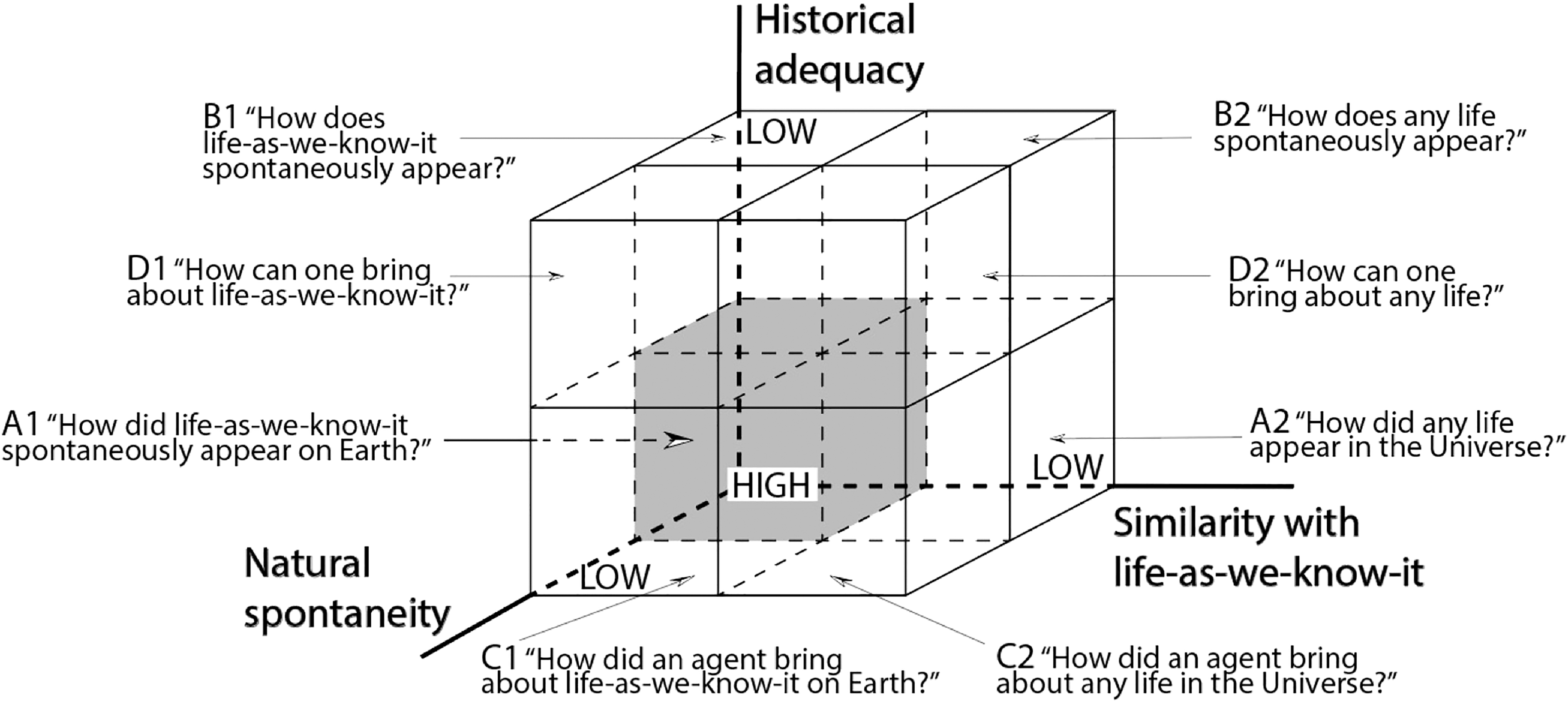
The conceptual space of origin-of-life questions. Each axis corresponds to one of the three constraints identified above: historical adequacy, natural spontaneity, and similarity to life-as-we-know-it. Combinations of low and high values along these axes define eight regions that lead to specific formulations of the OoL question.
On the other hand, constraints can be fully relaxed along all three dimensions (region D2 on Fig. 1). In such a case, the OoL question becomes one of investigating the transition from nonliving matter to living matter independently of any historical prebiotic plausibility nor any compliance with life-as-we-know-it, and without any constraint about naturally occurring processes. The OoL question is then better understood as something like “How can one bring about any life-like entity given no constraints of any kind?” This is the type of question that sets the agenda of research programs in such fields as synthetic biology, systems chemistry, or Alife (e.g., Cronin and Walker, 2016; Glade et al., 2017; Lutz, 2020).
In between these two extremes, any combination of low/high constraints is possible. For instance, one may construe the OoL question with low historical constraints, high natural spontaneity constraints, and low constraints with regard to similarity to life-as-we-know-it (region B2 on Fig. 1). In such a case, the OoL question takes the form of “How can life (in general) spontaneously appear from nonliving matter given no historical/prebiotic constraints?” Along the same lines of inquiry, one finds questions such as “Which chemistries make possible the appearance of life (in general)?” but also existence questions such as “Are there other forms of life (than life-as-we-know-it) that have spontaneously appeared somewhere in the Universe?” or complementary questions such as “What is the probability of life in the Universe?” In all these cases, constraints in terms of historical adequacy and similarity to life-as-we-know-it are low while the constraint of natural spontaneity is high. Research programs that more specifically address this formulation of the OoL question include programs in astrobiology that aim at finding new forms of life outside of Earth, or in universal biology (e.g., Deamer and Damer, 2017; Bartlett and Wong, 2020). A quite different way to construe the OoL question is to have low historical and natural spontaneity constraints while still requiring strong similarity to life-as-we-know-it (region D1 on Fig 1). In that case, the question can be understood along the lines of “How might such-and-such experimental settings (which require much intervention from the researcher) make it possible for life-as-we-know-it to appear given no requirement for prebiotic plausibility?” Research programs that mobilize compounds or systems similar to those of present life-forms to try and synthesize living entities in the laboratory typically address this formulation of the OoL question. They are found in fields such as synthetic biology (e.g., Gibson et al., 2010; Stano, 2018). Different combinations of these constraints also help make sense of conceptual distinctions that have been made between “protocell” (historical adequacy constraint), “minimal cell” (similarity with life-as-we-know-it), and “artificial cell” (no constraints) (Caschera and Noireaux, 2014). As can be seen in Fig. 1, four other combinations of constraints lead to four other types of formulations of the OoL question.
Altogether, the three types of constraints reveal different types of research questions that lie under the broader “OoL question.” These research questions result from specifying different degrees of constraints in terms of historical adequacy, natural spontaneity, and similarity to life-as-we-know-it. The conceptual space within which the different questions can be positioned not only makes room for all the different formulations of the OoL question found in the literature (Scharf et al., 2015) but also helps make sense of the diversity of scientific research programs that target OoL questions. As a result, it provides insights as to why some researchers may claim to address the OoL question while appearing not to do so for others. The OoL question is indeed a contextual question that receives more precise formulations depending on the set of constraints that are included (or accepted) within different research programs.
Some may, for instance, frame the OoL question as mainly explaining the appearance of the first self-replicating ribozyme (RNA-world hypothesis) (e.g., Cheng and Unrau, 2010; Tjhung et al., 2020). In this context, the OoL question becomes “How did the first self-replicating ribozyme appear on primitive Earth?” Such a question is constrained along the dimensions of historical adequacy and natural spontaneity, yet much less constrained along the dimension of similarity to life-as-we-know-it, since it can (quite understandably) be argued that self-replicating ribozymes are still quite a stretch to life-as-we-know-it (though simple ribozymes are quite common within extant organisms). Similarly, others may frame the OoL question as that of explaining the appearance of mutually catalytic networks of small molecules capable of rudimentary reproduction (e.g., Kauffman, 1993; Segré et al., 2001; Hordijk and Steel, 2018). In such cases again, the constraint of natural spontaneity is seen to play a strong role, possibly complemented by the constraint of historical adequacy when chemical prebiotic plausibility is stressed. A very different—and quite extreme—case is that of adding a genome to a genome-deprived cell (Gibson et al., 2010). Considering this experiment as an affirmative answer to the question “Is it possible to synthesize life in the laboratory?” can only be done by strongly constraining the question by life-as-we-know-it (it bears on existing cellular organisms) while totally relaxing the constraints of historical adequacy (no prebiotic plausibility at all) and natural spontaneity (extremely high degree of sophisticated experimental interventions).
Different research programs thereby target quite different interpretations of the OoL question despite all claiming to shed light on that very question. Depending on how one specifies one's research question in terms of the three constraint-dimensions we have highlighted, that question may appear as more or less appropriate for different audiences which, in turn, value each question differently. As a result, it is no surprise that claims about answering the OoL question raise much controversy: these claims are often different claims about answering different questions, often motivated by specific disciplinary anchorages within a broad range of fields all by and large interested in OoL research. The conceptual space of Fig. 1 not only accounts for the diversity of interpretations of the OoL question but also, and maybe more importantly, highlights how these questions relate to one another in a systematic way. The questions are not just different questions on their own: they are variations of one another when specific constraints are imposed or relaxed. In other words, one may shift from one question to another by varying the degree of constraints along one or several dimensions at once.
6. From Explanation-Seeking Questions to Fact-Establishing Questions
Clarifying the different ways in which the OoL question can be interpreted makes explicit the fact that in many cases the phenomena that form the target of the question have not yet been established. A consequence is that, despite all appearances, the OoL question rarely is an explanation-seeking question of the form “Why P?” or “How is it the case that P?” with P a true proposition depicting an actual phenomenon (i.e., a phenomenon that is considered by the scientific community as empirically well established). This is something that we noted above when we discussed each type of constraint and that we can now assess more systematically when considering the three types of constraints together. Indeed, only in the most constrained case is the OoL question a proper explanation-seeking question: when all constraints of historical adequacy, natural spontaneity, and similarity with life-as-we-know-it are applied, the OoL question bears upon explaining the historical origin of life-as-we-know-it on Earth: “How did life-as-we-know-it spontaneously appear from nonliving matter on prebiotic Earth?” This can be reformulated as “Why P?” or “How is it the case that P?” with P the proposition “Life-as-we know-it spontaneously appeared from nonliving matter on prebiotic Earth.” As far as we can tell, and even if the constraints are still loosely defined, P is true. As a result, one can justifiably request an explanation of the phenomenon described by P. Of course, we might err by considering P as true since, for all we know, currently available evidence is still compatible with other hypotheses such as directed panspermia or the emergence of life-as-we-know-it during a later second origin among the remains of a more primordial life different from life-as-we-know-it. Yet, at present, P is largely considered as true within the broader scientific community.
On the other hand, whenever any of the three constraints are relaxed, the question can no longer be of the form “How is it the case that P?” since P has not yet been empirically established (in other words, P is hypothetical). As a consequence, the question becomes something like “How would it be the case that P, if P were true?” (call this a “counterfactual explanation” [Lewis, 1973]). Some will consider explananda in these lesser-constrained regions as constituting valid hypotheses that legitimately deserve explaining despite not having been established. One would then not be looking for an answer to a regular explanation-seeking question of a known phenomenon: one would aim at answering a possible explanation-seeking question of a possible phenomenon. Such questions are notably found in some more theoretically oriented domains of OoL research that investigate conditions for self-organization (Zeravcic et al., 2017; Gartner et al., 2020) or evolution (Nghe et al., 2015; Goldenfeld et al., 2017). In any case, a most pressing question for these explanations to have empirical significance is whether their target phenomena P can be established or not, hence the need of answering a question of the form “Is it the case that P?” Consider, for instance, (B2) “How does life (in general) spontaneously appear from nonliving matter given no historical/prebiotic constraints?” for which only the natural spontaneity constraint is high, while historical adequacy and similarity to life-as-we-know-it constraints are low. For reformulating the question as an explanation-seeking question of the form “Why P?” or “How is it the case that P?” we would need to formulate P as “Life (in general) spontaneously appears from non living matter given no historical/prebiotic constraints.” Yet we would be hard pressed to accept P as true. Indeed, as it currently stands in science, we have no clue whether P is true since this has never been established: no one has ever observed the spontaneous formation of living matter from nonliving matter in the laboratory. P remains a hypothesis or a possibility. Similarly, no one has yet identified a form of extraterrestrial sign of life (extant or past).
Given the current state of science, this situation typically concerns all regions of the multidimensional conceptual space of Fig. 1 except the most constrained one. In these regions, the epistemic status of the explananda remains highly speculative as we speak: science is exploring possibilities. On the other hand, in the most constrained region, the epistemic status of the explanandum is considered as true (or closest to true we can formulate). One significant epistemic task that needs to be accomplished in the lesser-constrained regions is to establish the truth of the explananda by establishing the existence of the phenomena (for instance, establish the existence of [traces of] life on other planets or exoplanets or establish the possibility of creating life in the laboratory). This amounts to establishing new instances of OoL. Of course, one may still look for possible explanations of speculative phenomena, yet the empirical significance of such explanations will remain suspended until their target phenomena are established. One may argue that, in some cases, searching for an explanation of a speculative explanandum could be done at the same time as searching for the existence of that explanandum. This is indeed plausible: for instance, when engineering a synthetic cell, one may assume that one would be able to put forward reasons for explaining the life-like behavior of these synthetic cells. On the other hand, explaining how some forms of life came to be on another planet can only have empirical significance once the existence of life on that planet has been established, which is to say, once the fact-establishing question has been positively answered. One nuance to consider is the relative coarseness of the conceptual space as depicted in Fig. 1, in which constraints are taken to be either high or low. In actual practice, these constraints come in degrees, resulting in turn in degrees of “speculativeness” (or plausibility) of corresponding phenomena.
7. Epistemic Trajectories and Interdependence of Origins-of-Life Questions
Although research in the OoL field generally refers to the question of the origin of life without further specification, actual approaches cover the variety of nuances presented above. Researchers are indeed led to relax constraints for reasons imposed by their usual practice of science (these include methodological, technical, and theoretical considerations, limitations with regard to available or attainable evidence, as well as a broad range of sociological and institutional factors). As we have seen, the relaxation of constraints is associated with addressing more speculative explananda. Establishing or observing such explananda (e.g., forms of life that differ from life-as-we-know-it) then becomes a central part of the question if ever that question is intended to have empirical significance. But are we only facing limitations here? Relaxing constraints has an epistemic cost, yet by the same token it enables technically more tractable approaches that are more likely to yield an explanation. We argue below that, beyond the value that a given community may grant to particular findings, addressing relaxed OoL questions seems almost necessary to construct a path to addressing the most constrained question.
The fact that researchers typically address relaxed versions of the OoL question may be best explained by their practice of science. Indeed, technical tractability imposes experimental or theoretical choices, and research communities seek avenues that are the most productive given these choices. In the extreme case, opportunities to contribute to the OoL question arise from discoveries or technologies with completely different purposes. Examples are numerous: the appearance of computer science led to the field of artificial life (Langton, 1998); every improvement of analytical tools invites a reanalysis of Miller-like experiments (Cleaves et al., 2008; Scherer et al., 2017); synthesis of liposomes for drug delivery brings in possibilities to build protocells (Cheng and Pérez-Mercader, 2019); droplet microfluidics for high-throughput screening enables compartmentalized life-cycles of chemical reaction networks (Matsumura et al., 2016); CRISPR-based gene editing opens the possibility to experimentally investigate minimal genomes (Pelletier et al., 2021); the discovery of functional roles for liquid-liquid phase separations in cells revives coacervate theories (Jia and Fraccia, 2020); and so forth. The framing of the OoL question may also reflect intricate combinations of technical and sociological factors. For instance, producing pure enantiomers is entrenched in the practice of chemistry, primarily for pharmaceutical motivations, but the study of chirality has considerable momentum in prebiotic chemistry (Pavlov and Klabunovskii, 2014). There is indeed strong institutional support, established methodologies, and a well-identified impact in the community for studying chirality in its own right, somehow removing some of the burden imposed by the most constrained OoL question. Another important example is the detection of exoplanets, enabled by a dramatic improvement in observation and analysis capabilities. The discovery of exoplanets has a strong impact in astrophysics independently of the OoL question (Khan et al., 2017). However, the question of life elsewhere (relaxing the historical adequacy constraint) is seen as a central motivation in research programs for exoplanets, leading to focused notions such as “Earth-like planets” and “habitable zones” (Schwieterman et al., 2018).
In any case, epistemic reasons that lead to constraint relaxation also lead to questions that tend to be more amenable to experimental or theoretical investigation. Relaxing the constraint of “historical adequacy” allows one to reach experimentally feasible time frames. The experimental inaccessibility of geological time scales can be overcome by recreating environmental conditions and isolating particular events. Even in the case of temperature variations across day and night, driving an experimental system in an accelerated manner provides access to the outcome of many repeated cycles. Relaxing historical adequacy constraint also allows one to consider a variety of candidate chemistries, a mere necessity given the poor knowledge of prebiotic chemical environments. Overall, the historical timeline is reconstructed only in theory, based on experimental data corroborated with geological records. With respect to the constraint of “similarity to life-as-we-know-it,” one may consider attempts to build protocells in a bottom-up manner. This task reveals to be highly challenging from the physical-chemical viewpoint and has not been achieved yet. At this stage, it seems necessary to use compounds, arrangements, and conditions that do not reflect life-as-we-know-it but would maximize the chances for experimental success (e.g., alternative biopolymers or activated building blocks to achieve template-based replication). Relaxing the “similarity to life-as-we-know-it” constraint is also unavoidable when searching for signs of extraterrestrial life in the Solar System or on exoplanets. On the other hand, relaxing the “natural spontaneity” constraint is constitutive to experimental approaches, where spontaneity can only be allowed within certain limits. Chemistry proceeds from purified compounds, in which case agents intervene beforehand. These compounds, together with clean laboratory procedures, are necessary for the sake of experimental design, analysis, and reproducibility. In directed evolution, the mechanisms of Darwinian evolution are executed through instruments and purified enzymes and building blocks. Such interventions yield molecules with specific properties (e.g., catalytic RNAs known as ribozymes and obtained by SELEX) that are rare thus extremely unlikely to be found by chance. Nevertheless, showing the existence of these molecules is central to our ability to study RNA-world scenarios, among others. Furthermore, computer-based artificial life gets rid of all the constraints mentioned above, but this research still represents a powerful tool to investigate at large the principles governing the OoL.
Though relaxing constraints imposed onto the OoL question leads to research questions with increased tractability, specific works may be seen as narrowing down too much the space of possibilities, or as driving us away from answers to the more constrained questions. For instance, whether computer simulations have any chance to produce any form of life is debated (Chu and Ho, 2006). It is thus crucial to analyze the epistemic interdependence between different readings of the OoL question, notably to investigate how less-constrained questions may shed light or not onto more-constrained ones.
A first virtue of less-constrained questions is that demonstrations of impossibility should apply to more-constrained versions of the question. Showing that certain polymerization processes fail over an extended phase diagram of physical-chemical conditions (temperature, pH, salinity, etc.) discards such processes from any particular scenario. Impossibilities can be demonstrated theoretically, by showing that dynamical regimes are incompatible. For example, due to the error threshold of Eigen, sustained template-based polymerization catalyzed by a replicase is incompatible with the presence of RNAs shorter than the replicase in the absence of compartment-level selection (Szathmáry, 2006). The case of the replicase points to the other side of the problem, which is to demonstrate the feasibility of certain states or regimes. Once theory has defined a threshold (a set of minimally required parameter values) for sustained replication, synthesizing a replicase ribozyme (a catalytic RNA) compatible with the threshold would be a central milestone for RNA-world scenarios. However, replicase ribozymes are not found in extant life, have no historical record, and are unlikely to appear spontaneously. This highlights how studies based on relaxed questions allow one to isolate intermediate steps within a range of possible scenarios, then either reject or provide a proof-of-concept for the existence of certain states of matter (Jeancolas et al., 2020).
A second virtue of relaxed OoL questions is their heuristic value to guide processes of generalization and refinement. Simply put, once a less-constrained question has been answered, one can add constraints back and address a more-constrained question with the insights gained from the lesser-constrained one. This reveals to be particularly useful when dealing with emergent phenomena that result from collective self-organization, where the interactions of many components with many degrees of freedom lead to a combinatorial explosion of possibilities. Sequence-function relationships in peptides or RNAs as well as evolutionary dynamics in chemical reaction networks fall in this category (Kun et al., 2005; Baum, 2018; Pressman et al., 2019; Ameta et al., 2021). The typical approach to studying these systems is to consider that what is true for a certain system must be true for a large category of systems. To exemplify this, knowing how widespread RNAs or oligopeptides of a given catalytic activity are (within the “neutral space”) gives information about the probability of emergence of self-reproduction and the evolvability of molecules. Predicting sequence activity is currently infeasible computationally. In practice, the characterization of the neutral space is achieved by combining computational studies on toy models, measuring statistical distributions in experimental models (e.g., artificial selection of sequences that bind to a particular molecule), and confronting them with theoretical expectations for the shape of these distributions (Boyer et al., 2016; Pressman et al., 2017). The assumption here is that, although the particular measurements and models are irrelevant to the most constrained OoL questions, they nevertheless represent knowledge that can be generalized and applied to the latter. The specific application of the results to OoL scenarios can be seen as a process of naturalization, where sequences are selected based on the three types of constraints: the sequences should be active in physical-chemical conditions corresponding to geological records (constraint of historical adequacy); they should have a higher probability to appear spontaneously, notably by being among the shortest (constraint of natural spontaneity); and they should be connected through a stepwise evolutionary path to molecules observed in extant life (constraint of similarity to life-as-we-know-it).
So, in contrast with the idea that imposing constraints from history or life-as-we-know-it helps select situations which have the most chances to succeed, it appears that relaxed OoL questions can indeed provide strategies to gain information and make progress toward defining plausible OoL scenarios even in their most constrained formulations.
8. Conclusion
The OoL question misleadingly subsumes several research questions depending on how the question is understood. By considering three sets of constraints—“historical adequacy,” “natural spontaneity,” “similarity to life-as-we-know-it”—we have shown that the question can be construed in strikingly different ways depending on its position within the conceptual space that the three sets of constraints define. Most importantly, the nature of the question actually changes depending on how constrained one considers the question to be. While the OoL question is an explanation-seeking question in its most constrained version, it foremost becomes a fact-establishing question as soon as constraints are relaxed. We also argued that the epistemic trajectories of research questions within the conceptual space defined by the three sets of constraints is, most notably, affected by considerations about the tractability of research questions, such tractability most likely increasing while constraints on the question are relaxed. Disentangling the different construals of the OoL question matters since what may be considered by some to be a proper answer to the question may be considered by others not to answer the question at all. The reason is not only that each one may be pursuing a different question but also that the very nature of the question changes depending on how constrained one considers the question to be. However, studies that address less-constrained but more tractable questions constructively contribute to the more constrained questions, whether they establish intermediate steps, provide means of generalization, or indicate paths for naturalizing synthetic processes.
Footnotes
Acknowledgments
Special thanks to Sandeep Krishna, Andrea Loettgers, and Richard Swiderski for very helpful comments on an earlier version of the manuscript. The authors thank the audience of the Molecular Origins of Life, Munich 2021, for stimulating discussions. The manuscript also benefited from the comments of two anonymous reviewers for Astrobiology. CM acknowledges funding from an ESPCI Joliot Chair, Canada Social Sciences and Humanities Research Council [Grant 430-2018-00899] and Canada Research Chairs [CRC-950-230795]. CJ acknowledges financial support by Université de Paris and the École Doctorale FIRE - Programme Bettencourt. PN acknowledges funding from Institut Pierre-Gilles de Gennes (Laboratoire d'excellence, “Investissements d'avenir” program) [Grants ANR-10-IDEX-0001-02 PSL and ANR-10-LABX-31], the European Research Council (ERC) under the European Union's Horizon 2020 research and innovation programme [Grant 101002075], and the Human Frontier Science Program [Grant RGY0077/2019].
Author Contributions
All authors contributed equally to this study.
Declaration of Interest
The authors declare no competing interests.
Abbreviations Used
Associate Editor: Christopher McKay