






Abstract
We measured the N concentrations and isotopic compositions of 44 samples of terrestrial potassic and micro- and meso-porous minerals and a small number of whole-rocks to determine the extent to which N is incorporated and stored during weathering and low-temperature hydrothermal alteration in Mars surface/near-surface environments. The selection of these minerals and other materials was partly guided by the study of altered volcanic glass from Antarctica and Iceland, in which the incorporation of N as NH4 + in phyllosilicates is indicated by correlated concentrations of N and the LILEs (i.e., K, Ba, Rb, Cs), with scatter likely related to the presence of exchanged, occluded/trapped, or encapsulated organic/inorganic N occurring within structural cavities (e.g., in zeolites). The phyllosilicates, zeolites, and sulfates analyzed in this study contain between 0 and 99,120 ppm N and have δ15Nair values of −34‰ to +65‰. Most of these minerals, and the few siliceous hydrothermal deposits that were analyzed, have δ15N consistent with the incorporation of biologically processed N during low-temperature hydrothermal or weathering processes. Secondary ion mass spectrometry on altered hyaloclastites demonstrates the residency of N in smectites and zeolites, and silica. We suggest that geological materials known on Earth to incorporate and store N and known to be abundant at, or near, the surface of Mars should be considered targets for upcoming Mars sample return with the intent to identify any signs of ancient or modern life.
Introduction
Nitrogen is a key element for understanding the evolution of terrestrial planets (see Canfield et al., 2010; articles in Bebout et al., 2013a). The mass fractions and isotope compositions of nitrogen (N) in atmospheric and geologic reservoirs can provide useful information for determining the nature of precursor materials, the long-term evolution of atmospheres (e.g., volatile outgassing), habitable past environmental conditions, and possibly (bio)geochemical cycling processes (Boyd, 2001; Zerkle and Mikhail, 2017).
Reactive fixed N species such as NH3, NH4 +, and NO3 − are particularly important in the origin and maintenance of life on Earth. Since fixed N is required for assimilation into DNA, RNA, and protein precursor biomolecules, such as amino acids, and because microbes play a crucial role in the N2 fixation process, it is a compelling potential tracer for astro- and exobiological processes (see Capone et al., 2006).
Viking lander and Mars Science Laboratory (MSL) measurements reveal that Mars' atmosphere contains a significantly lower concentration of N2 (∼2.7% by volume and ∼0.15–0.2 mbar) compared with that of Earth, and it is isotopically heavier (i.e., δ15N = +572 ± 82‰ with 15N/14N normalized to the present ratio of that in Earth's atmosphere; Mahaffy et al., 2013; Wong et al., 2013). Mars' primordial volatile inventory, however, is estimated to have been rich in N2 corresponding to 3–300 mbar (McKay and Stoker, 1989), in addition to containing CO2, H2O, and other volatiles (see modeling by Kurokawa et al., 2018).
The 15N enrichment of Mars' atmosphere may have resulted from progressive fractionated loss to space through escape processes (Brinkmann, 1971; McElroy, 1972; McElroy et al., 1976; Fox and Dalgarno, 1983), solar wind stripping (Jakosky et al., 1994), or impact erosion. An appreciable quantity of initially atmospheric N could, however, be bound within surface/near surface materials such as regolith-buried nitrates and nitrites, which typically occur in very dry desert soils on Earth (Mancinelli, 1996; Mancinelli and Banin, 2003; Stern et al., 2015) or as structurally stabilized NH4 + in the crystal structures of potassic minerals such as certain phyllosilicates (Mancinelli, 1996; Bishop et al., 2002; Mancinelli and Banin, 2003).
NH4 + has not yet been identified on Mars. However, the recent detections of nitrates in eolian sediments from Gale Crater (Stern et al., 2015, 2018), martian meteorites (e.g., EETA79001, Tissint), and N-bearing organic compounds in minerals of Tissint and ALH 84001 meteorites believed to be indigenous to Mars (Kounaves et al., 2014; Jaramillo et al., 2019; Koike et al., 2020) indicate that atmospheric gases (e.g., H2O, CO2, N2) may be exchanged with, and stored within, martian surface and near-surface materials. The specific minerals and other phases that could house various N-bearing species and potentially preserve biogeochemical records have remained uncertain (see Mancinelli and Banin, 2003).
Orbital spectroscopic, in situ lander and rover exploration, and theoretical mineralogical considerations indicate that most of Mars' upper crust is composed of basaltic volcanic rocks and sediments. The latter contain various authigenic minerals consistent with low temperature hydrothermal weathering and diagenetic processes (Gregg and Williams, 1996; Bandfield et al., 2000; Poulet et al., 2007; Squyres et al., 2007; Ehlmann and Edwards, 2014; Schmidt et al., 2014; Vaniman et al., 2014). Amorphous silicates have also been detected (Michalski et al., 2005; Chevrier et al., 2007; Horgan and Bell, 2012; De Vet et al., 2014; Grotzinger et al., 2014; Vaniman et al., 2014; Bristow et al., 2018), and these appear to represent variable deposits of altered volcanic or impact-derived glasses.
Fe-Mg phyllosilicates (e.g., nontronite-saponite) are typical of basalt weathering and common, but more locally dominant Al-phyllosilicates (e.g., kaolinite, montmorillonite) (Poulet et al., 2005; Bibring et al., 2006; Mustard et al., 2008; Carter et al., 2013; Sun and Milliken, 2015) and various other hydrous minerals are present as well. These include sulfosalts (sulfates) such as kieserite (Arvidson et al., 2005), gypsum and polyhydrated sulfates (Gendrin et al., 2005), jarosite (Squyres et al., 2004a, 2004b; Milliken et al., 2008), and alunite (Swayze et al., 2008).
Also observed is opaline silica, which occurs as rock coatings (Kraft et al., 2003; Michalski et al., 2005) or aqueous and hydrothermal/fumarolic deposits (Arvidson et al., 2008; Squyres et al., 2008; Ruff and Farmer, 2016), carbonates (Ehlmann et al., 2008; Morris et al., 2010; Niles et al., 2013), and zeolites such as analcime related to impact-induced hydrothermal systems (Ehlmann et al., 2009; Carrozzo et al., 2017). Occurrences of the two zeolites chabazite and clinoptilolite have also been suggested (Mousis et al., 2016) based on spectroscopic observations (Ruff, 2004; Michalski et al., 2005).
However, because the chemical signatures of many clays and zeolites can be similar and there are differences between the spatial resolution and detection limits of orbital versus in situ measurements (Sætre et al., 2019), the amount of zeolites on the Mars surface may be underestimated. This could be important because, like phyllosilicates, zeolites typically occur as glass alteration products (Stroncik and Schmincke, 2002; see Nikitczuk et al., 2022a). Moreover, in pyroclastic and impact deposits, they have the potential to be sorbents, UV-shields for organic compounds, or reactive catalysts that could serve as records of martian atmospheric and hydrosphere chemistry (Ming and Gooding, 1988).
Considering these various issues, we undertook an investigation to measure the N concentrations and isotope compositions of various authigenic minerals and phases known on Earth to be alteration products of basalt and that have been identified, or could be present, on the martian surface. Many of the phases chosen for study have also been identified in altered hyaloclastites sampled from Iceland, Oregon, Antarctica, and elsewhere (see discussion by Nikitczuk et al., 2022a). The N concentrations and isotope compositions presented for the various phases studied here were compared with those of terrestrial altered basalts and hyaloclastites and both pristine and altered mid-ocean ridge basalts (MORB) and ocean-island basalts (OIB).
In this framework, this study constitutes an in-depth survey of the N retentivity in various Mars-analog phases and minerals. The results serve to build a data base for understanding the potential of these materials to preserve biogeochemical and environmental processes and records on planets and, here, Mars. Some of these phases, particularly the zeolites, Fe-rich smectite (i.e., nontronite, a typical alteration product of basalt), jarosite (hydrated K sulfates), and apophyllite (in which K+ and NH4 + can reside), were considered for the first time, in the present study, with regard to their N concentrations and isotope compositions.
We analyzed illite (i.e., a K-rich clay mineral), for which many studies have documented elevated N concentrations (see Bobos and Williams, 2017) in a variety of settings (hydrothermal deposits, authigenic phases in clastic rocks at depth in sedimentary basins). Finally, and, in addition, we measured several other materials identified on the martian surface, such as amorphous silica (opal) or cristobalite (quartz polymorph). These are of interest because of their enhanced potential to incorporate N and preserve textural and biogeochemical evidence of putative martian microbial life (see the recent discussions by Ruff and Farmer, 2016; Steller et al., 2019; Ruff et al., 2020).
Materials and Methods
Various Mars surface/near-surface analog materials for nitrogen analyses
The suite of samples comprises individual mineral specimens separately sampled from various formation environments. Most of the phyllosilicates and zeolites analyzed in this study were formed as secondary or late minerals in diagenetic or in low-temperature processes such as in some hydrothermal systems. Basaltic and silicic volcanics and intrusives were the primary source rocks, and the secondary mineral phases occur as either alteration products of primary high-temperature glass or minerals.
Other materials occur as pore-filling cements and in amygdales or vugs. Many other phases have been either identified spectroscopically on the martian surface via satellite observations (see the review by Ehlmann et al., 2011) or detected in different rover missions (e.g., Squyres et al., 2004a, 2004b, 2008; Arvidson et al., 2008; Schmidt et al., 2009; see the discussion in Section 4). Some phyllosilicates formed in glacio- fluvio-lacustrine sediments (CLA005, 84754 Illite), whereas silica deposits include hot spring sinters (ICE003, MAF700) and sulfate deposits include evaporitic lacustrine (SPT-158 thenardite) and acid-mine drainage (32918 jarosite) conditions.
We compared our data with the whole-rock data of Nikitczuk et al. (2022a) for hyaloclastite tuffs and breccias from the Eastern and Western Volcanic rift zones, Iceland, and the Carapace Nunatak, South Victoria Land, Antarctica, respectively. Although the Carapace sandstone, studied by Cannon et al. (2015), is related to the Antarctic hyaloclastites in that it contains altered glassy basaltic-andesitic debris, it is a volcaniclastic sandstone composed of rock fragments, quartz, feldspars, micas, and a mostly zeolite cement.
Analysis of nitrogen concentrations and isotopic compositions
We employed sealed-tube-combustion and carrier-gas methods using a system that couples an all metal, low-blank vacuum extraction and cryo-purification line built at Lehigh University with a Finnigan Gas Bench II carrier gas system (see the description of methods by Bebout et al., 2007). For all measurements, 8–252 mg of crushed material were loaded into 6 mm (o.d.) quartz tubes, along with 1 g of CuxOx reagent.
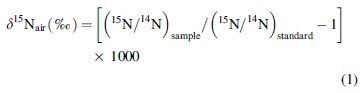
The tubes were then evacuated for 24 h on a glass vacuum line, with intermittent heating to ∼100°C to remove adsorbed atmospheric N. They were then sealed under vacuum and heated to 1050 °C in a programmable muffle furnace. Tubes were cracked onto the high vacuum metal extraction line, and cryogenically purified molecular N (N2) was then transferred into a Finnigan Gas Bench II continuous-flow interface where it was entrained in a He stream and conveyed into a Finnigan MAT 252 isotope ratio mass spectrometer. The N isotope compositions are reported in conventional delta notation (Eq. 1) as per mil (‰) with respect to terrestrial atmospheric N2 (and reported as δ15Nair) where:
Sealed tubes containing only the Cu/CuOx regent (reagent blanks) were regularly analyzed during analytical runs to monitor the contribution of the combustion reagent and the extraction vacuum system to measured N2. To determine N concentrations, measured N peak area was interpolated to an internal silicate standard-calibrated relationship between N peak area and N concentrations. Nitrogen concentrations are reported as ppm (μg/g). The analytical uncertainties for N concentrations are usually <5%. Uncertainties for δ15N values are 0.15‰ (1σ) for samples with >5 μg/g N, and 0.6‰ (1σ) for samples with 1–5 μg/g N.
Mapping of nitrogen and carbon (and major element) concentrations
To demonstrate the residency of N (and C) in many of the phases studied here, mapping of 12C-, 13C-, 12C14N, 12C15N, 28Si- and 35Cl- was conducted on palagonitized volcanic glass via secondary ion mass spectrometry (SIMS) using a Cameca IMS1280-HR at the Pheasant Memorial Laboratory, Institute for Planetary Materials, Japan. Polished 2.5 cm round thin sections were Au-coated (200 nm) with a JEOL JFC-1500 ion sputtering device. A primary Cs+ beam impacted the sample surface at −20 keV. For mapping of 80 × 80 μm areas, the primary beam current was set to 3 pA with a 1 nA 180 s pre-sputtering (100 μm2) and 30 s automatic mass calibration period. A contrast aperture of 400 μm was used, and the energy band pass width was also set to −10 to 40 eV. The entrance and exit slit widths were set to 50 and 150 μm, respectively. The resultant mass resolution (m/Δm) of ∼8000 could separate interferences of 12CH− and 13C14N−. Each run consisted of three to four cycles.
X-ray mapping of the major elements was conducted by an electron probe microanalyzer in wavelength-dispersive mode with a JEOL JXA-8800 and a JEOL JXA-8530F, and both were also housed at the Pheasant Memorial Laboratory, Institute for Planetary Materials, Okayama University, Japan. The mapping was performed at modified conditions using 15 kV accelerating voltage, working distance of 11 mm, 200-nA probe currents, and 10–20 ms dwell time per 1–3-μm pixel, depending on the target dimension. Natural silicates and synthetic oxides on ASTIMEX MINM25–53 were used as standards.
Results
Nitrogen concentrations and isotopic compositions of potassic and micro- and meso-porous minerals
The measured N concentrations and isotopic compositions of the various minerals and phases are presented in Table 1 and Fig. 1. There is a large range in both N concentrations, from 0 to 99,120 ppm, and in δ15N, from −34.0‰ to +65.4‰. The phyllosilicates show the widest range in N concentration from 17 to 99,120 ppm (with all but three samples having <2000) followed by the zeolites with 0.5 to 4827 ppm, sulfates with 59 to 3460 ppm, and lastly silica with 48 to 62 ppm (δ15N = −1.4‰ to +2.1‰). The highest N concentration is from a 2:1 layer clay mineral, whereas the lowest concentrations (<0.1–0 ppm) are from the apophyllite samples and two zeolites, heulandite (8fl2–003), and mesolite (M-1).
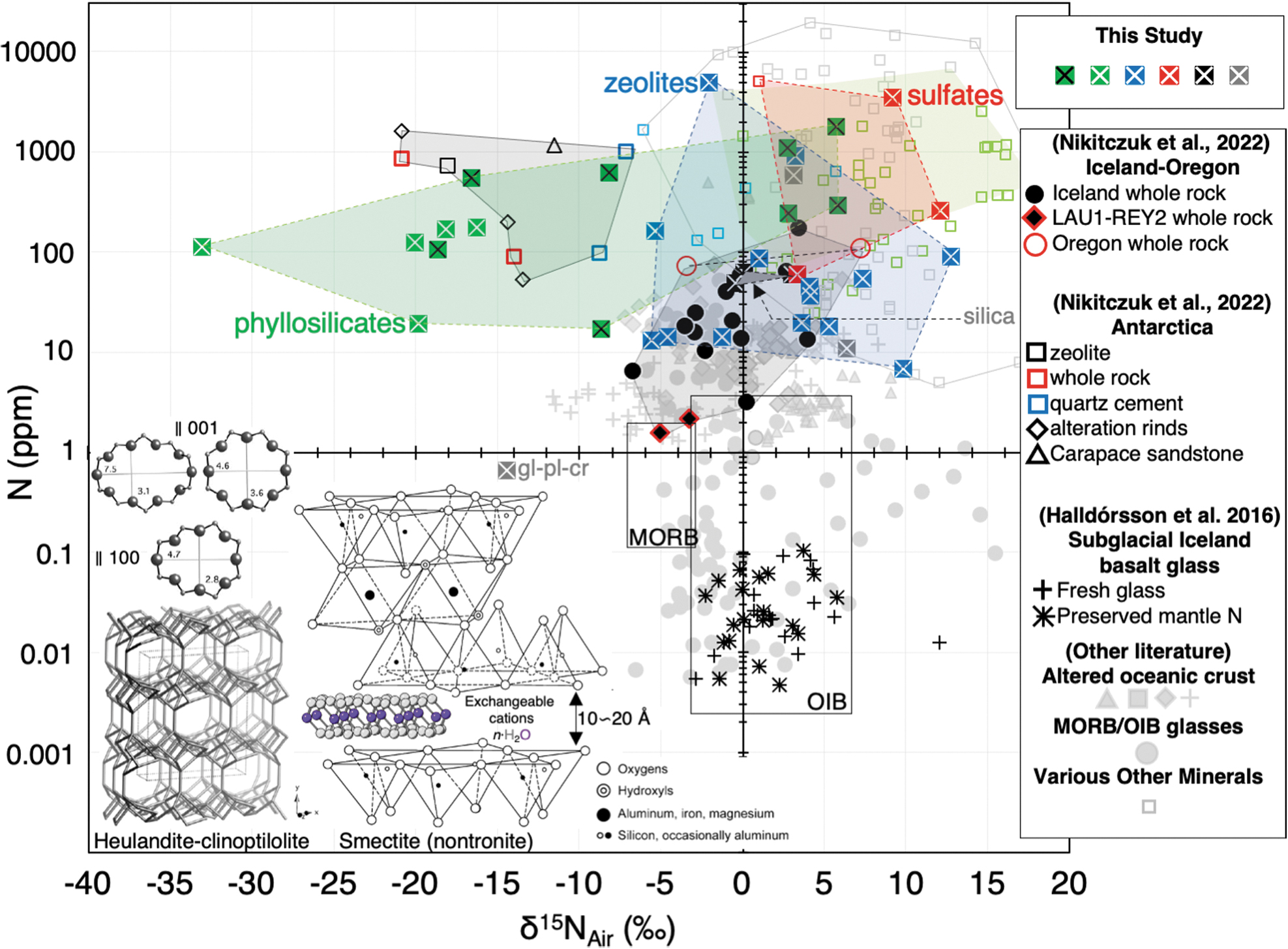
Nitrogen isotope compositions as a function of N concentration in potassic and micro- and mesoporous Mars-analog minerals from globally distributed locations. For reference, also plotted are previously published data for whole rock and physical separates of alteration rinds and cements from Antarctic basaltic andesitic flow foot breccias and Iceland and Oregon basaltic tuffs (presented in Nikitczuk et al., 2022a). See Table 1 for a list of minerals and N data for this study plotted here and Nikitczuk et al. (2022a, 2022b) for hyaloclastite N data. Data point labeled as gl-pl-cr represents a mixture of glass, plagioclase, and cristobalite. Also plotted from the literature and outlined in the gray dashed line are buddingtonite (NH4
+-rich feldspar), alunite (sulfate), muscovite/biotite (phyllosilicate-micas), illite-smectite/chlorite, melanophlogite (silica clathrasil), and beryl/cordierite (cyclosilicates) from modern and fossil hot springs, low temperature to hydrothermal and metamorphic sedimentary environments (Krohn et al., 1993; Boyd, 1997; Papineau et al., 2005; Svensen et al. 2008; Lazzeri, 2012, Lazzeri et al., 2017; Bebout et al., 2016; Bobos and Williams, 2017). The green area outlining the phyllosilicates also includes micas and illite-smectite-chlorite from the literature (no dashed outline), which extends to the right side of the plot, and shows that this mineral group has the widest range in isotope compositions. Phyllosilicate data points from this study with white Xs represent smectites. The red area outlining the sulfates from this study also includes one sample of alunite from the literature (Krohn et al., 1993). The nitrogen concentrations (ppm) of minerals from literature were converted from weight percent (NH4)2O or N, or from parts per million NH4
+. General ranges for MORB and OIB are outlined in boxes at the lower right (Marty and Zimmerman, 1999; Marty and Dauphas, 2003; from Cartigny and Marty, 2013). Other data for basalts are for fresh subglacial Iceland basaltic glasses (from Halldórsson et al., 2016; values converted from μcm3 STP/g to μg/g), with those representing unmodified mantle signatures based on 40Ar/36Ar and 4He/40Ar ratios indicated, and fresh MORB and OIB glasses (Exley et al., 1986/1987; Sakai et al., 1984; Marty and Humbert, 1997; Cartigny et al., 2001), and for altered oceanic crust (Busigny et al., 2005; Li et al., 2007; Bebout et al., 2018). At the bottom left are crystal structural schematic diagrams for the framework zeolite heulandite-clinoptilolite (left; from Database of Zeolite Structures
Nitrogen Concentrations and Isotope Compositions of Potassic and Micro- and Meso-Porous Mars-Analog Minerals (and Siliceous Deposits)
Sample sources: American Museum of Natural History, Canadian Space Agency Planetary Analogue Suite, Lehigh University, Universität Salzburg.
Indicates N concentration and δ15N values that are averages of two separate measurements from samples that required splitting within the extraction line to avoid detector oversaturation.
c = carbonate; f = feldspar; p = phyllosilicate; si = silica; su = sulfate; z = zeolite.
The phyllosilicate, zeolite, and sulfate groups have at least one specimen with N concentrations >1000 ppm. The most negative and the most positive δ15N values are for the smectite clay saponite (sample 111976) and the zeolite scolecite (sample 8f8–22), respectively. Smectite clays (saponite, nontronite, montmorillonite) have 19–172 ppm N and δ15N of −34‰ to −17.2‰. Similarly, two of the halloysites have N concentrations of 106 ppm and 540 ppm and δ15N values of −17.5‰ and −19.6‰. Illite (sample 84754) and fluorapophyllite (sample RC-298) have the most positive δ15N values of the phyllosilicates (+4.9‰ and +47‰, respectively).
Out of the 44 samples measured, six have near atmospheric isotope values (i.e., δ15Nair = 0 ± 2‰). Out of 38 samples with measurable quantities of N, 17 have δ15N values similar to that of organic matter in sediments (Fig. 2; δ15N between 0‰ and 10‰; see Sweeney et al., 1978; Holloway and Dahlgren, 2002), and 26 are within the range of, or are more positive than, typical MORB values (−5 ± 2‰; see Cartigny and Marty, 2013) or OIBs.
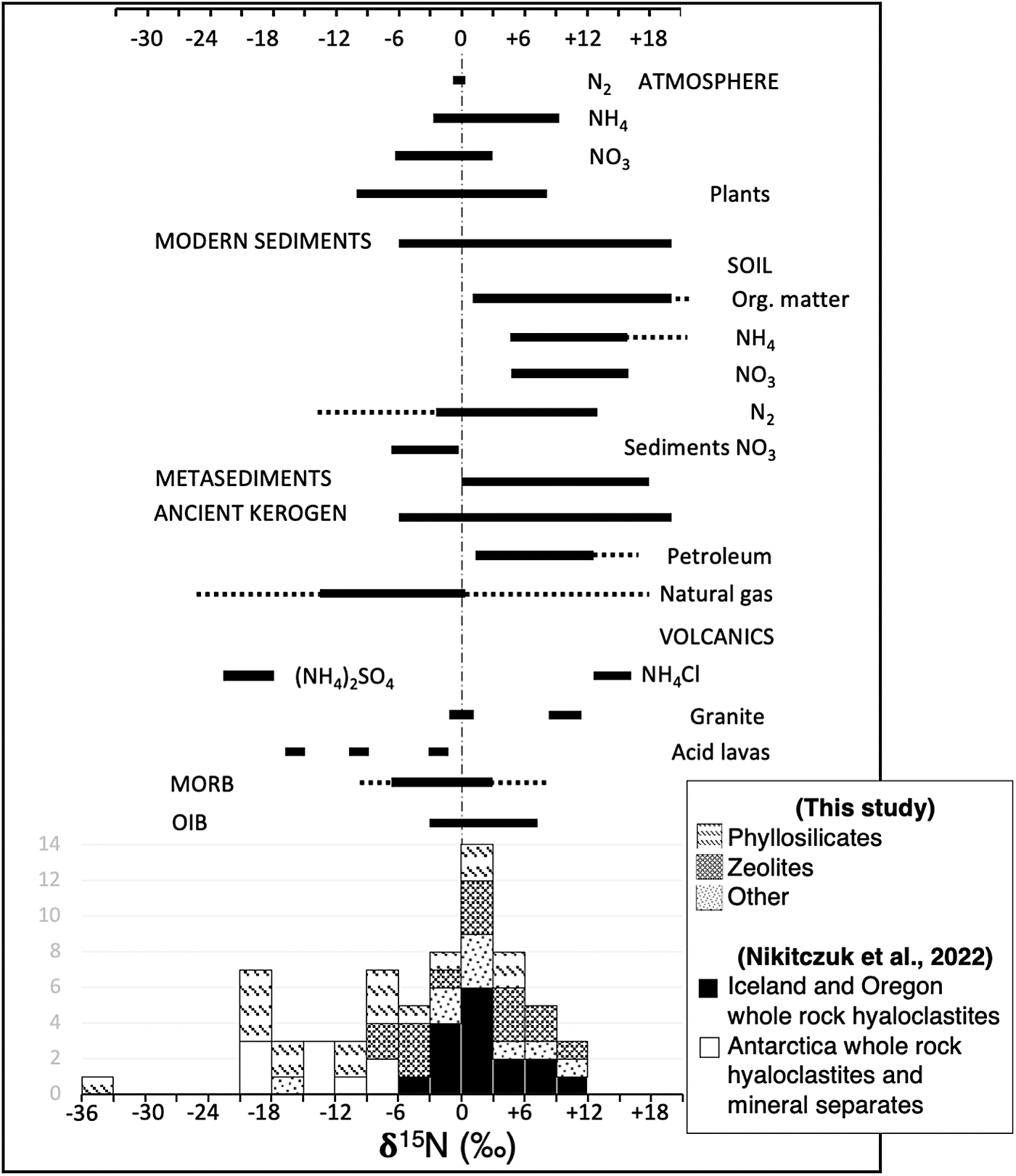
Histogram of δ15N values for Mars-analog minerals (phyllosilicates, zeolites, sulfates, silica, feldspathoid, ash, palagonite) and altered Iceland, Oregon, and Antarctica hyaloclastites (from Nikitczuk et al., 2022a) compared with ranges in natural terrestrial materials. Included with “other” are the sulfates alunite, thenardite, and jarosite, amorphous silica, leucite (feldspathoid), palagonite, and volcanic ash. Note that the bulk of the data overlap with the ranges of sedimentary and soil components. Ranges after (Létolle, 1980) and (Cartigny and Marty, 2013). Data not displayed in this plot include fluorapophyllite (RC-298; +47.0‰) and scolecite (8f8-22; +65.4‰).
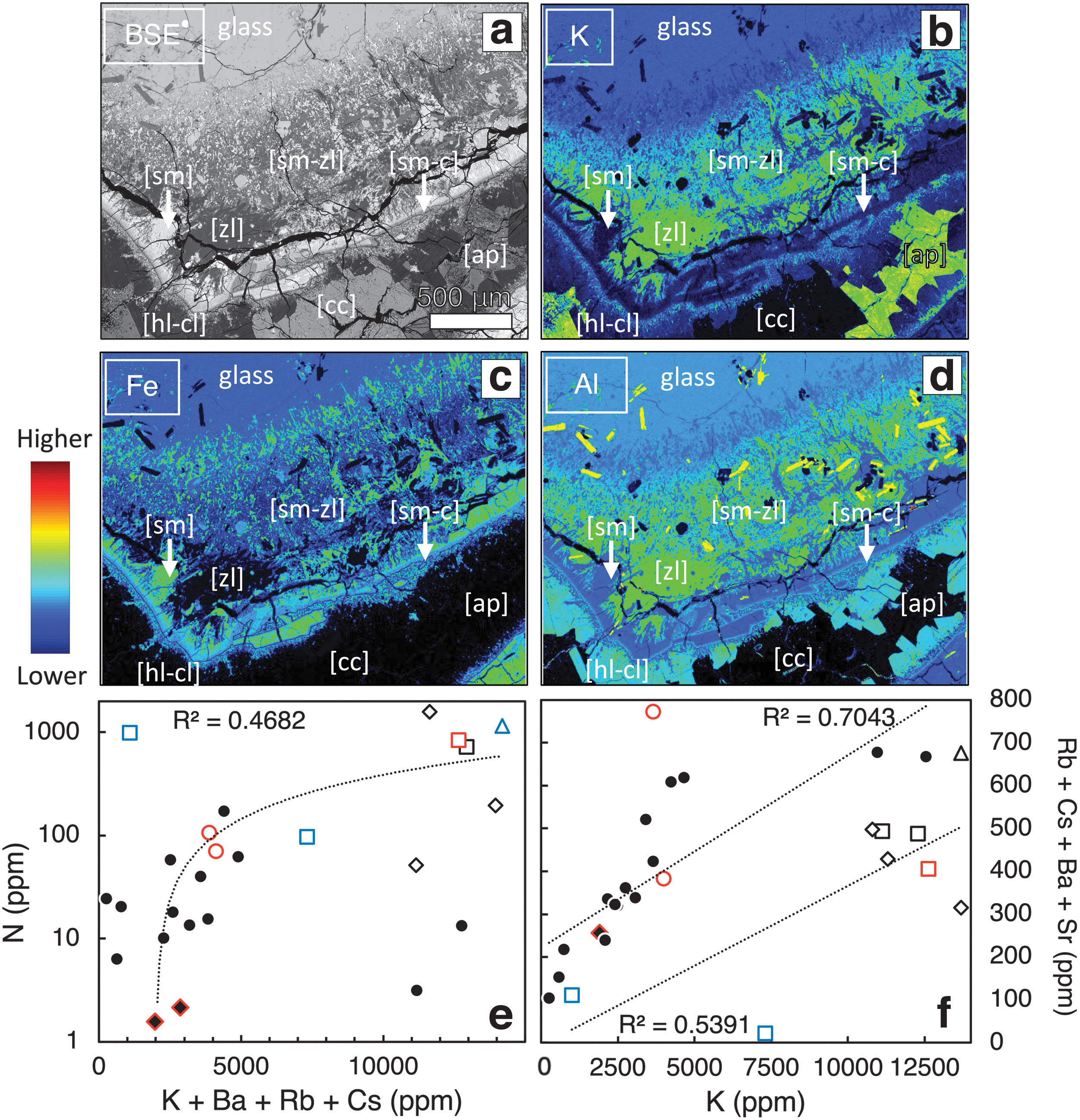
Figures 1 and 2 show plots of N concentrations in ppm versus δ15N and δ15N compared with the ranges of different natural materials, respectively, for the various phyllosilicate, zeolite, sulfate, and amorphous silica-quartz samples obtained in this study and for hyaloclastites from Iceland, Oregon, and Antarctica (data from Nikitczuk et al., 2022a). The major element microprobe data for the hyaloclastites indicate that they contain mixtures of various phyllosilicates that include nontronite-montmorillonite-mica in Antarctic and nontronite-montmorillonite-saponite-beidellite for Iceland samples (Fig. 3; see Nikitczuk et al., 2022a).
Like most of the hyaloclastite samples, all minerals also have higher N concentrations than MORBs or OIBs. The phyllosilicates in this study, especially smectites, have significantly more negative δ15N values than all other materials except the Antarctic breccias, with which they overlap in terms of N concentrations and δ15N. The zeolites, sulfates, palagonite, and silica varieties, however, overlap with the δ15N values of MORBs, OIBs, altered basalts from the literature, and Iceland and Oregon altered basalts (Nikitczuk et al., 2022a), but range to notably more positive values than most of the phyllosilicates analyzed in this study. In addition, many of the phyllosilicates and all zeolites, sulfates, palagonite, and silica-quartz also overlap with the isotope compositions of modern and ancient sediments and soil organic matter (Fig. 2) and are similar to that of the altered basalts, including those from Iceland and Oregon (Nikitczuk et al., 2022a).
Figure 3 shows major element electron microprobe maps of a clast rim and cement in an Antarctic hyaloclastite. One observes a >0.5 mm-wide glass alteration zone and coarse-grained silicate-carbonate cements (see the detailed study by Nikitczuk et al., 2022a). Figure 3 also shows the behavior of N concentration versus the concentrations of different alkali and alkaline-earth elements. It shows co-enrichments of N, and these elements possibly indicating that N occurs largely as NH4 + in LILE-rich phases such as clay minerals and zeolites (see Kolesov and Geiger, 2006; Geiger and Dachs, 2009; Geiger et al., 2010).
Element mapping using SIMS in altered hyaloclastites reveals large variations in the N and C concentrations between different authigenic minerals that occur as cements, glass coatings, and glass alteration. Figure 4 shows SIMS N and C element maps obtained for selected areas that contain major secondary phases in rock thin sections of Antarctic hyaloclastites from the Kirkpatrick Basalt. These locations are representative of areas similar to those depicted in the intergranular cemented lower portion in Fig. 3.
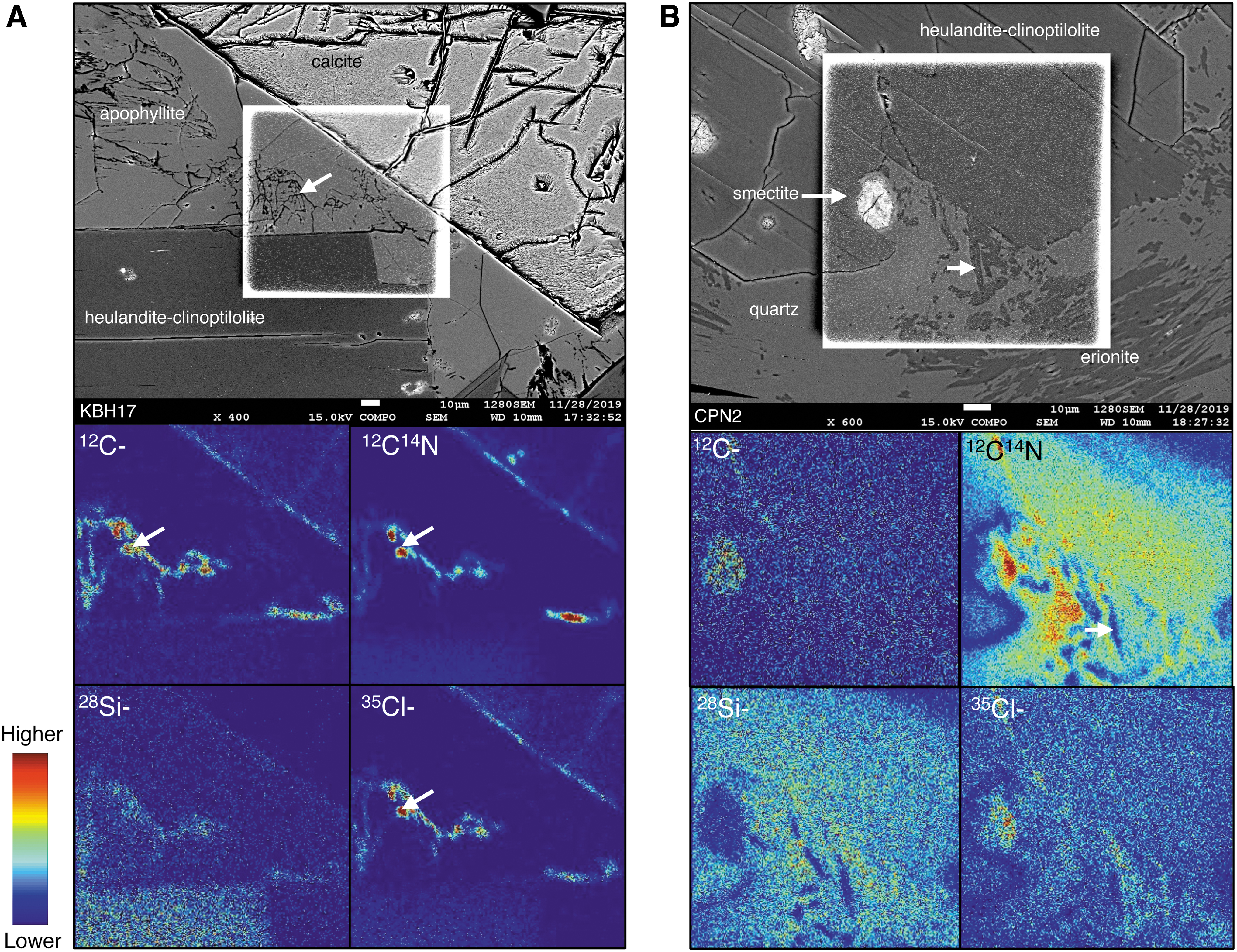
BSE images and 12C-, 12C14N, 28Si-, and 35Cl- isotope maps from round polished 2.5 cm diameter petrographic thin sections of Antarctic hyaloclastites studied in more detail by Nikitczuk et al. (2022a). The BSE images of intergranular cements of Antarctic samples KBH17
The color scales depicted in the SIMS maps represent total ion yield intensity concentrations with warmer and cooler colors plotted using a jet-color scale that corresponds to higher and lower concentrations, respectively. The highest and lowest concentrations in each image are scaled differently, and therefore, the same colors in different maps do not represent the same concentrations of the different elements shown. The K-bearing phases such as heulandite-clinoptilolite, which are expected to contain N as NH4 +, are associated with elevated concentrations of 12C14N (Fig. 4A, B), with some variability in other zeolites and glass replacement phases. Other K-bearing phases such as apophyllite or erionite, for example, have very low 12C14N concentrations (Fig. 4A, B). Generally, the highest 12C14N signals are observed in heulandite-clinoptilolite and clay replacing glass (saponite-nontronite). Zeolites and apophyllite do not contain appreciable 12C- or 13C-, whereas smectite does show elevated concentrations.
Iceland basaltic tuff samples (Supplementary Fig. S1A, B) show variable 12C14N concentrations in some palagonites, infilling clays in dissolution channels, pits, vesicles, and zeolite cements. Where multiple layers of clay coatings/cement are visible, for example in vesicles, a difference in N is observed among these layers (e.g., Supplementary Fig. S1B). In several locations within fresh glass of the Iceland basaltic tuff, high 12C14N signals are detected, but they are accompanied by large variations across different materials in the map area and are coincident with variable 35Cl- signals.
Topographic lows within thin sections, such as those from fractures, grain boundaries (e.g., Fig. 4 and Supplementary Fig. S1A), or glass pits, commonly show co-enrichments in C, N, and Cl. It is likely that these elevated and coincident C, N, and Cl concentrations are indicative of the presence of resin; these elements are components of the epoxy resin used to embed the sample. In all instances of N enrichments, however, including those observed in secondary minerals, whether co-enriched in C and/or Cl or not, N consistently shows the highest concentrations. Smectite coatings on glass surfaces also consistently show N enrichments that are commonly coincident with Cl but not with C.
Three samples of amorphous siliceous materials (samples 81233, ICE003, and MAF700) yielded similar N concentrations and δ15N of 48–62 ppm and −1.4‰ to +2.1‰, respectively (Table 1; Fig. 1). The δ15N values are near Earth atmospheric values (by definition, 0‰), perhaps indicating direct uptake or occlusion (e.g., in fluid inclusions) with only modest amounts of isotopic fractionation. A fourth sample from Mount St. Helens that consists of cristobalite, but also glass and plagioclase, has a far lower N concentration of 0.7 ppm and much lower δ15N of −15.4‰.
Discussion
Most of the K-bearing and micro and meso-porous Mars-surface-analog minerals (Table 1) contain measurable quantities of N, and they show a wide range in both N concentration and δ15N (Fig. 1). The isotopic compositions of the various mineral phases analyzed in this study likely reflect the δ15N of the fluids present at the time of crystallization or formation, with varying degrees of bioprocessing of this N, with superimposed temperature-dependent fluid-mineral fractionation. Isotopic fractionation in such settings would be dictated by both temperature and the speciation of N in the environments in which the solid phases were crystalized (e.g., as NOx, or NH3), and as demonstrated by Busigny and Bebout (2013; in particular, see the fractionations among NH4 +, NH3, and N2), these fractionations can be large at lower temperatures (i.e., below 100°C). The measurements of whole rock altered hyaloclastites by Nikitczuk et al., (2022a) appear to indicate significant secondary N enrichment beyond levels attributable to magmatic/igneous processes.
The N enrichments in minerals studied here, and in the hyaloclastites, at least in part originate from sedimentary/organic-derived components from late low-temperature to hydrothermal or weathering/diagenetic environments. A similar conclusion was reached in a study of altered volcanic glasses of both modern and Mesozoic seafloor (see Bebout et al., 2018) and for altered whole rocks in cored sections of modern seafloor (e.g., Busigny et al., 2005; Li et al., 2007). In aggregate, the minerals analyzed in this study (Table 1) represent the typical products of surface alteration of basalt on Earth, a planet teeming with life. Thus, the results of this study can provide a framework for sampling on the martian surface to maximize the potential of identifying N biosignatures.
Comparison of nitrogen enrichment in Mars-analog minerals with nitrogen residency in altered hyaloclastite whole rocks
Recently, studies focusing on N contents and isotope compositions of silicate rocks have been aimed at understanding mantle and crustal cycling on Earth and possibly other terrestrial planets (see Bebout et al., 2016). They have shown that abiotic and inorganic/organic N can be transferred to secondary phases formed during diagenetic, low-temperature hydrothermal or high pressure-temperature metamorphic fluid-rock interactions that occur during oceanic basalt alteration and subduction processes (Busigny et al., 2005; Li et al., 2007; Halama et al., 2010, 2014; Bebout et al., 2013a, 2013b, 2016, 2018; Busigny and Bebout, 2013; Anderson et al., 2019).
Among the samples investigated in this study, significant differences in the range of N concentrations and isotope compositions were observed and notably among different specimens of the same mineral types (Table 1). These include six specimens of apophyllite (0–1754 ppm, δ15N = +4.8 to +47.0‰), four of which contained no N, three of halloysite (106–239 ppm, δ15N = −19.6‰ to +1.8‰), three kaolinite varieties (17–1086 ppm, δ15N = −9.6‰ to +1.8‰), three chabazites (13–85 ppm, δ15N = −6.6‰ to 0‰), and three heulandites (0–54 ppm, −2.2‰ to +6.4‰).
These observations of minerals largely formed in volcanic source rock environments highlight the importance of the processes by which, and when, N is being conveyed into these minerals. These differences may also be related to the age of the deposits and, in turn, the overall degree of alteration. In modern palagonitized seafloor basalts and variably altered glasses from Mesozoic ophiolites, Bebout et al. (2018), for example, found that altered samples contain higher N concentrations and that the range of concentrations in older samples also extends to higher values (up to 18 ppm N in modern basalts and 53 ppm in Mesozoic ophiolites).
Similarly, Nikitczuk et al. (2022a) showed that the N concentrations of whole rock basalts from Iceland (Pleistocene) and Oregon (Pliocene-Pleistocene), along with Antarctic basaltic andesite whole rock and secondary mineral separates (Jurassic; Fig. 1), generally correlate with maturity of alteration stage or reaction progress, observed as greater degrees of crystallinity (Jakobsson and Moore, 1986; Stroncik and Schmincke, 2001, 2002) and deposit age.
The generally lower concentrations of N in Iceland basalts compared with that of the Antarctic basaltic andesites probably resulted from the lower abundances of authigenic minerals in the former, especially zeolite cements and clays, and the difference in zeolite species present and difference in the source of the N. Given that the Iceland and Antarctic localities are interpreted to have been similarly affected by meteoric-sourced, circum-neutral to alkaline waters in open system conditions but at differing temperatures (Nikitczuk et al., 2022a), alteration timing, deposit age, and temperature may be important factors influencing N concentrations and δ15N values. Such differences in the formation conditions of the minerals analyzed in this study, among other factors such as water/rock ratio, redox states, and gross quantity of N in the systems, may explain the wide range in N concentrations and δ15N values.
Here, it is important to note that, as for the array of minerals from the Earth analyzed in this study, variably altered glasses returned from the martian surface could show a wide range of ages and could similarly have experienced a wide range of environmental conditions during their alteration. What these materials have in common is their derivation largely via alteration of basalt or in other aqueous settings, both known to have been in abundance on the ancient Mars surface. It is likely that the alteration of martian glasses in hydrous conditions would result in a textural and mineralogical progression with age similar to that suggested by Stroncik and Schmincke (2001). Nitrogen uptake and expected residency would be expected to evolve during this progression.
Modes of nitrogen incorporation and storage in various minerals and selected other materials believed to reside on the Mars surface
Major element chemistry of the various phases analyzed in this study has not yet been obtained, and thus the forms of N that are present have not been unequivocally determined. We can, however, use the linkage between the environments in which these phases commonly form (basalt alteration), the whole-rock and in situ data obtained for altered hyaloclastites containing the same phases (Nikitczuk et al., 2022a), and other accounts of silicate N to infer the most probable manners in which N has been incorporated and stored in these phases.
In terrestrial igneous and sedimentary crustal rocks, N is typically fixed within secondary and primary K-bearing minerals as NH4 + (Busigny and Bebout, 2013). Several feldspars (Honma and Itihara, 1981; Krohn et al., 1993; Svensen et al., 2008) and phyllosilicates such as illite-smectite or micas (Williams and Ferrell, 1991; Boyd, 1997; Bobos and Williams, 2017; Jo et al., 2018) from sedimentary environments, for example, have been found to be naturally ammoniated. If N is mainly present as fixed NH4 +, then a good correlation between N and geochemically similar cations such as K+ might be expected (Busigny and Bebout, 2013). The lack of visible plagioclase alteration in Iceland and Antarctic hyaloclastites, or any observable relationship with Na or Ca concentrations, suggests that secondary N species do not replace them in the plagioclase structure. The general relationship observed between N concentrations and those of LILE cations (i.e., K, Rb, Cs, Ba, B and U) supports this conclusion (Nikitczuk et al., 2022a).
Iron and Mg concentrated within smectites (e.g., nontronite, saponite in this study, glass coatings and cements in hyaloclastites; Fig. 3) are not replaced by NH4 +, but smectites are known to house elements that are geochemically similar to K mainly as interlayer cations in addition to potential organic molecules. However, deviations from the LILE-N relationship in hyaloclastites and the significantly wide range in N contents and isotope compositions exhibited by the phases in this study could reflect the residency of N in other forms in mineral structures (e.g., N2 in channels and cages in microporous mineral phases; Nikitczuk et al. 2022a).
Many phases are typically both potassic (Table 1) and/or micro or mesoporous, especially zeolites. Nitrogen can also be supplied as various species (i.e., N2, NH3/NH4 +, NO2, NO3) and be redistributed from different sources under various conditions such as in fluids of alteration processes through degassing of uprising magmas, meteoric-sourced surface waters, or leaching from crustal weathering or sediments. Nitrogen incorporation in addition to fixation in lattices may, thus, occur by occlusion/trapping within structural cavities during formation or by direct adsorption onto charged surfaces or exchange with cations after formation.
Porous zeolite structures and interlamellar smectite clay surfaces have significant ion-exchange/adsorption capacities, whereas zeolites also have molecular sieve properties with cation (e.g., Cs+, NH4 + and Sr2+) selectivity. Also, smectites can swell/expand upon hydration and influence interlayer spacing. Volatile gaseous and solution species (e.g., NH4 +, N2) within the surrounding environments may, therefore, be readily exchanged with sorbed charged species. The adsorption of N2 or exchange of NH4 + and other cations from solution has been well documented in clinoptilolite, for example (Rožić et al., 2000; Liu et al., 2018; Kennedy et al. 2019) and various hydrated clays (e.g., Cornell, 1993; Jurček, 1999; Rožić et al., 2000).
The “confinement effect” of zeolites, that is, the microporous nature of zeolite crystal structures that allows entrapping of molecules within their channels that can subsequently diffuse or participate in physio-adsorption or catalysis (see Derouane, 1987; Derouane et al., 1988; Kolesov and Geiger, 2006; Geiger and Dachs, 2009; Sastre and Corma, 2009) may be important for the incorporation of N during diagenetic processes such as alteration of basalts. Chabazite, for example, is known to occlude several elemental/molecular species in crystal structural voids (e.g., Di Iorio et al., 2020), and N-bearing organic molecules such as small proteins or amino acids may be sequestered (Zimmerman et al., 2004).
The surface area and reactivity of clays also allow for organic compounds within pore fluids (e.g., Kennedy et al., 2002), bacterial cells (Playter et al., 2017), or unsaturated lipids and pigments that are easily oxidized (e.g., Hedges and Keil, 1995) to be preserved through adsorption and encapsulation during deposition. In addition, other microporous minerals, such as melanophlogite (a silica clathrasil) and beryl/cordierite (cyclosilicates), have shown that N2 (and possibly NH4 +) in addition to other guest molecules, such as H2O, CO2, CH4, hydrocarbons, and some organic matter, can be enclathrated or occluded within the structural cavities of their crystal lattices (Bebout et al., 2016; Kortus et al., 2000; Lazzeri et al., 2017; see sketches of zeolite and phyllosilicate atomic structures as insets in Fig. 1) during low-temperature hydrothermal or metamorphic processes.
Nitrogen on early Mars and the potential for atmospheric volatile exchange with martian crustal materials
Various observations of the martian surface suggest that the planet likely had a more substantial atmosphere possibly dominated by CO2-N2-H2O (McKay and Stoker, 1989; Summers and Khare, 2007 and references therein). Noachian pN2 may have played an important role in maintaining elevated temperatures and a more reduced, slightly acidic to alkaline, atmosphere containing H2O, CO, CH4, and NH3/NH4 + (Miller, 2001; Chevrier et al., 2007; Mahaffy et al., 2013; von Paris et al., 2013; Wong et al., 2013; Melwani Daswani et al., 2016; Peretyazhko et al., 2016; Kurokawa et al., 2018; Kajitani et al., 2019; Koike et al., 2020). Although atmospheric NH3 is photolytically converted to N2 by the absorption of UV radiation, organic aerosols produced by CH4 photolysis (Sagan and Chyba, 1997) and other constituents such as H2O or CO that absorb similar wavelength UV rays (Hudson, 1974) could have shielded NH3 and significantly increased atmospheric residence time. In addition, based on Eu anomalies in shergottite pyroxenes, the martian mantle is highly reducing (Wadhwa, 2001); therefore, N in the mantle is likely to be present as NH3 (Libourel et al., 2003).
The global distribution of hydrated mineral deposits on Mars' surface generally consists of two types. Widespread phyllosilicates are mainly observed in ancient Noachian terrains, which indicates their formation very early in Mars' history during the pervasive low-temperature hydrothermal water-igneous rock interaction in alkaline pH subsurface hydrologic systems (Poulet et al., 2005; Bibring et al., 2006; Mustard et al., 2008; Ehlmann et al., 2011; Carter et al., 2013; Sun and Milliken, 2015). A theoretical study by Chevrier et al. (2007) is noteworthy as an attempt to calculate surface alteration mineralogy as a function of varying ancient Mars surface conditions. Those authors were focused on the range of conditions affording stabilization of various phyllosilicates, in particular minerals in the smectite group that are typical products of basalt weathering on Earth and apparently on Mars (nontronite and saponite; see Table 1 for the N data for these phases obtained in our study). These thermodynamic calculations indicate that phyllosilicates such as these likely precipitated at alkaline to weakly acidic pH (values of 4–10) perhaps representative of the Noachian but contrasting with the strongly acidic pH that led to the later formation of the extensive sulfate deposits on the martian surface (e.g., jarosite; see the N concentrations and isotopic compositions for various sulfate phases in Table 1).
The theoretical study of Chevrier et al. (2007) also indicates that dissolved silica activity strongly influences smectite precipitation, particularly at a lower pH to values as low as 3. Conversely, extensive deposits of sulfates both spatially and temporally represent a climatic change that occurred from the wetter alkaline Noachian to drier acidic environments in the Hesperian (Bibring et al., 2006; Rampe et al., 2020). Some observations, however, indicate that potentially habitable wet and alkaline (i.e., clay forming) conditions or hydrothermal circulation may have existed, at least sporadically, later in Mars' history (e.g., Carter et al., 2013; Grotzinger et al., 2014; Vaniman et al., 2014; Sun and Milliken, 2015). Moreover, measurements by the Curiosity rover are consistent with present-day water exchange between the atmosphere and soil salts, which suggests a widespread existence of liquid water brines (Javier Martín-Torres et al., 2015) beyond equatorial regions. Therefore, phyllosilicates (and zeolites) may have been forming for much of Mars' history and potentially contain a trove of planetary chemical information.
If Earth-like biology ever developed on Mars, microbial fixation processes may have occurred. Experiments subjecting extant terrestrial N-fixing microbes to partial pressures ranging from Earth-like to lower than the current pN2 on Mars (0.2 mb) have shown that dinitrogen can be biologically fixed at 5–780 mb. Such pressures could potentially be lower than on primordial Mars (Klingler et al., 1989).
Also, abiotic pathways for N fixation/reduction include impact shock heating, hydrothermal processes, lightning, or cosmic and UV rays. These can dissociate molecular N2 to produce NxOx species that can be reduced (Mancinelli and McKay, 1988; Summers and Khare, 2007) during catalyzation by FeS (Summers et al., 2012) or other native metals to form NH4 +. Chemical weathering products of Mars surface materials may be directly linked to the physical and chemical incorporation of volatiles such as H2O, CO2 (Huguenin, 1976), or N2/NH3/NH4 + into authigenic minerals. The basalt alteration products palagonite, smectites, and zeolites, which are apparently widespread on Mars' surface (Michalski et al., 2005; Chevrier et al., 2007; Horgan and Bell, 2012), have high specific surface areas and adsorptive capacities (Fanale and Cannon, 1971, 1974, 1978; Fanale et al., 1982) that increase with increasing pressures and temperatures (Fanale and Cannon, 1978; Fanale et al., 1982; Zent et al., 1987).
The Mars regolith possibly played an important role as a strongly adsorbing buffer and exchanger for NH3 (Fanale et al., 1982). For example, adsorption and deliquescence (Zent et al., 2010; Harri et al., 2014; Nikolakakos and Whiteway, 2018) and modeling experiments (Mousis et al., 2016) and thermodynamic and powder X-ray diffraction data reveal that, at water vapor pressures and temperatures experienced on the modern Mars' surface, zeolites such as chabazite or clinoptilolite and smectites such as nontronite and montmorillonite can uptake CO2 and H2O and exist in hydrated states. Such minerals could retain volatiles in micropores (Jänchen et al., 2006) and potentially be as important sinks in the martian subsurface (Mousis et al., 2016) as hidden clathrate reservoirs. Under a more substantial atmosphere that would have allowed more prolonged existence of liquid water, such processes in addition to chemical incorporation by mineral fixation may have been occurring.
The potential of nitrogen in alteration phases on the Mars surface to provide a record of modern and ancient (bio)geochemical processing
Loss of isotopically fractionated N over time may be responsible for Mars' low atmospheric N2 concentration and extremely positive δ15N value. Analyzing the δ15N of ancient materials such as smectite clays or zeolites could help validate whether ancient Mars' atmosphere contained more N with a significantly different isotope composition. In shock-melted glass, for example, from the martian shergottite meteorite ALH84001 with a formation age of 3.9–4.56 Ga (Jagoutz et al., 1994; Turner et al., 1997), comparatively light N (δ15N = −30‰ and +4‰) relative to the modern Mars atmosphere has been reported, which supports the N-loss hypothesis.
Consider that the whole N dataset of Mars surface/subsurface-analog minerals (this study) and altered hyaloclastites (Nikitczuk et al., 2022a) are from a terrestrial planet with a well-developed biosphere. However, the isotope compositions straddle Earth's atmosphere (δ15Nair = 0 ± 2‰) with only a few exceptions (Fig. 2). This range is well within the current uncertainty of the Mars atmosphere (±82‰; Wong et al., 2013), and thus analysis of such materials returned from Mars could provide a relatively accurate approximation of the δ15N of the martian atmosphere at the time of their formation. If samples of various ages are obtained, a time series could potentially reveal the timing of the atmospheric loss (shift in δ15N), if it, indeed, occurred.
Ammonium in altered basalts may preserve organic matter isotope values that record biogeochemical processes or abiotic igneous processes. Determining the source of N and understanding the processes involved in producing the isotopic composition included within geological materials on Earth requires comparisons with the range of existing reservoirs (Fig. 2). Like many of the minerals analyzed here, several studies of the modern oceanic crust have revealed significant N enrichments complemented by positive shifts in δ15N with respect to fresh “mantle-like” values.
Nitrogen enrichments in oceanic crust have been attributed to siting as NH4 + in potassic secondary phases. Positive δ15N values on Earth can reflect fractionations up to 10–30‰ in organic-bearing sediments (e.g., Fig. 2) attributed to bacterially mediated nitrification/denitrification processes or anaerobic ammonium oxidation (Fogel, 2010; Lam and Kuypers, 2011). Therefore, positive δ15N shifts and overlapping isotopic compositions of altered rocks and sediments (e.g., Fig. 2) are recognized as resulting from alteration fluids that previously exchanged N with nearby sediments adding sedimentary-organic N to basalts during alteration (Busigny et al., 2005; Li et al., 2007; Bebout et al., 2018). This may be the case for many of the zeolites, phyllosilicates, and other Mars analog materials analyzed here and by Nikitczuk et al. (2022a) with more positive δ15N and N enrichments relative to MORB and OIB and overlapping δ15N values with sediments. Likewise, the altered Late Archaean seafloor (Abitibi greenstone belt) shows similar N incorporation and positive δ15N shifts but preserved on time scales of billions of years (Anderson et al., 2019).
Acquiring preserved atmospheric and/or (bio)organic isotopic information requires selecting ancient targets that are as “fresh” as possible from locations with the highest erosion/exposure rates (youngest exposure ages) and that were shielded from highly ionizing galactic and solar cosmic radiation (see Pavlov et al., 2012; Cannon and Mustard, 2015a, 2015b). This is because (1) ancient complex organic molecules are destroyed by cosmic rays in the subsurface (Pavlov et al., 2012; Hays et al., 2017) and affect preservation, and (2) long-term exposure to cosmic rays could significantly alter 15N/14N or 13C/12C ratios through spallation nuclear reactions effectively changing the δ15N or δ13C values (Pavlov et al., 2014).
It appears, though, that the absolute δ15N or δ13C values are inversely related to the total N or C abundances (Pavlov et al., 2014), and thus if materials with 10s to 1000s of ppm N were obtained, such as the phyllosilicates, zeolites, sulfates, or silica-quartz phases analyzed in this study (Table 1), the isotope shifts would be of notably lower magnitudes than for lower-N materials. It has also been suggested that, on Mars, a geologic rather than an atmospheric N reservoir may be found in ancient N-bearing phyllosilicates that could potentially serve as an abiologic standard against which to identify isotope fractionation patterns (van Zuilen, 2008). On Earth, fractionations are measured as deviations relative to the atmospheric standard (δ15Nair = 0‰ by definition). Therefore, obtaining ancient, cosmic-ray-shielded, recently exposed, N-bearing minerals may provide such a Mars standard. Such data are even more useful when combined with other isotope systems such as C, with the latter also closely linked to terrestrial biogeochemical cycling (see Banerjee et al., 2006).
Conclusions
As planetary exploration and Mars sample-return advance, it is crucial that scientifically rewarding targets are selected that are worthy of the meticulous and expensive efforts such missions employ. By investigating the concentrations and isotope compositions of N, an element of biogeochemical significance, in mainly low-temperature basaltic alteration minerals and other phases that are recognized as existent or potentially present on Mars' surface and comparing them with that of well-characterized altered hyaloclastites, we have established that most of these potassic and/or micro and mesoporous materials are natural receptacles for N once in the atmosphere.
Given that some phases on Mars such as certain phyllosilicates (i.e., nontronite) may have formed deep in Mars' past and, along with other phases, continued to form at various geologic points in time, nitrogenous materials may provide a unique potential in preserving planetary N records that are valuable to sample-return science goals. Variably altered basaltic glasses are enriched in N relative to MORB or OIB but show a wide range of concentrations and isotopic compositions, many of which overlap δ15N values of sedimentary/organic components. This enrichment is indicative of processes beyond magmatic degassing that includes supply during low-temperature to hydrothermal alteration. Silicate N is commonly fixed as NH4 + replacing K+, as indicated by relationships between N and alkali/LILE cations (i.e., K, Rb, Cs, Ba, Fig. 3) in altered Iceland, Oregon, and Antarctic hyaloclastites. However, various minerals and phases in this study that do not typically contain K in their crystal structures still contain N and show differences between different specimens of the same mineral types. This, in combination with the scatter in cation correlations and the range in N concentrations and δ15N, suggests the existence of several potential retention sites and retained N species, such as exchanged or occluded/trapped or encapsulated NH3/NH4 + (including organic molecules), or N2 within structural cavities or interlayer surfaces.
Although only nitrates have been found in Mars' surface materials to date, given that terrestrial basalt alteration phases and other minerals can be significant N repositories and that Noachian Mars may have contained more atmospheric N2, H2O, or possibly NH3, analogous speciation and siting in similar hydrous mineral phases at or below the Mars' surface in forms other than nitrates may have occurred. We propose that evidence of the existence of N-fixing biological processes, if they developed on Mars, or information regarding the abiotic chemical evolutionary past of Mars, could exist as mineralogically preserved organic or fixed N and its stable isotope composition in phyllosilicates, zeolites, siliceous materials, hydrated sulfates, or nitrate-bearing deposits.
Determining the inventory, form, distribution, and storage phases of N is a critical factor for understanding the probability of life originating and evolving on another planetary body such as Mars. Future Mars' surface lander or rover missions should consider N inclusion in phases associated with altered basalts to aid in guiding appropriate sample selection, especially for return to Earth. The N concentrations and isotopic compositions in minerals should, however, be considered in context with other geological features (sedimentary deposits, igneous intrusions/lava flows, relationships to paleo-environments such as lakes).
Future contributions to this work should consider (1) major and trace element compositions of the minerals, (2) analysis of local sedimentary materials and environmental parameters such as water chemistry and temperature contributing to the alteration of specific glasses/basalts, (3) delineating the specific forms of N present including organic molecules, and (4) combining other isotope systems with N to evaluate magmatic and organic source contributions (e.g., 40Ar/36Ar, 4He/40Ar, 13C/12C) or water chemistry and temperature effects (e.g., H/D and O).
Footnotes
Acknowledgments
Mineral specimens are from the collections of CAG of the Universität Salzburg, the American Museum of Natural History, Lehigh University (Department of Earth and Environmental Sciences), and from the Canadian Space Agency (CSA) planetary analogue materials suite (Cloutis et al.,  ). Micro-analytical and geochemical analyses of rock samples (other than those of N) were performed at the Pheasant Memorial Laboratory (PML; Institute for Planetary Materials). The authors thank Bruce Idleman for technical support of the stable isotope geochemistry laboratory at Lehigh University.
Authors' Contributions
All people who meet authorship criteria are listed as authors, and all authors certify that they have participated sufficiently in the work to take public responsibility for the content, including participation in the concept, design, analysis, writing, or revision of the article. Each author certifies that this material or similar material has not been and will not be submitted to or published in any other publication before its appearance in Astrobiology.
Author Disclosure Statement
No competing financial interests exist.
Funding Information
Support of the N isotope analyses was provided by the National Science Foundation (grant EAR-1624092, to G.E.B.). Funding for the work at the PML was from grants from the 21st Century Center of Excellence, Japanese Ministry of Education, Science, Sports, and Culture (to E.N.). Funding for geochemical and mineralogical analyses was also provided by the Lehigh University Department of Earth and Environmental Sciences, Office of International Students and Scholars (OISS), and College of Arts and Sciences (CAS). C.A.G. is supported by the Austrian Science Fund (FWF: P 30977-NBL) and the “Land Salzburg” through the initiative “Wissenschafts- und Innovationsstrategie Salzburg 2025.”
Supplementary Material
Supplementary Figure S1
Abbreviations Used
Associate Editor: Nita Sahai
References
Supplementary Material
Please find the following supplemental material available below.
For Open Access articles published under a Creative Commons License, all supplemental material carries the same license as the article it is associated with.
For non-Open Access articles published, all supplemental material carries a non-exclusive license, and permission requests for re-use of supplemental material or any part of supplemental material shall be sent directly to the copyright owner as specified in the copyright notice associated with the article.
