






Abstract
The Mars Sample Return (MSR) Campaign represents one of the most ambitious scientific endeavors ever undertaken. Analyses of the martian samples would offer unique science benefits that cannot be attained through orbital or landed missions that rely only on remote sensing and in situ measurements, respectively.
As currently designed, the MSR Campaign comprises a number of scientific, technical, and programmatic bodies and relationships, captured in a series of existing and anticipated documents. Ensuring that all required scientific activities are properly designed, managed, and executed would require significant planning and coordination. Because there are multiple scientific elements that would need to be executed to achieve MSR Campaign success, it is critical to ensure that the appropriate management, oversight, planning, and resources are made available to accomplish them. This could be achieved via a formal MSR Science Management Plan (SMP).
A subset of the MSR Science Planning Group 2 (MSPG2)—termed the SMP Focus Group—was tasked to develop inputs for an MSR Campaign SMP. The scope is intended to cover the interface to the Mars 2020 mission, science elements in the MSR flight program, ground-based science infrastructure, MSR science opportunities, and the MSR sample and science data management.
In this report, a comprehensive MSR Science Program is proposed that comprises specific science bodies and/or activities that could be implemented to address the science functionalities throughout the MSR Campaign. The proposed structure was designed by taking into consideration previous management review processes, a set of guiding principles, and key lessons learned from previous robotic exploration and sample return missions.
Executive Summary
The Mars Sample Return (MSR) Campaign represents one of the most ambitious scientific endeavors ever undertaken. Analyses of the martian samples would offer unique science benefits that cannot be attained through orbital or landed missions that rely only on remote sensing and in situ measurements, respectively.
Ensuring that all required scientific activities are properly designed, managed, and executed would require significant planning and coordination. As currently designed, the MSR Campaign comprises a number of scientific, technical, and programmatic bodies and relationships, captured in a series of existing and anticipated documents.
Because there are so many scientific elements that would need to be executed to achieve MSR Campaign success, it is critical to ensure that the appropriate management, oversight, planning, and resources are made available to accomplish them. To date, however, no dedicated budget lines within NASA and ESA have been made available for these purposes, and no formal MSR Science Management Plan (SMP) has yet been established. It is thus evident that:
To aid in planning, the MSR Science Program requires an overarching SMP to fully describe how it could be implemented to meet the MSR scientific objectives and maximize the overall science return.
A subset of the MSR Science Planning Group 2 (MSPG2)—termed the SMP Focus Group—was tasked to develop inputs for the MSR Campaign SMP. The scope covers the interface to the Mars 2020 mission, science elements in the MSR flight program, ground-based science infrastructure, MSR science opportunities, and the MSR sample and science data management. Some of the required bodies and activities already exist; the remainder require definition.
In this report, a comprehensive MSR Science Program is proposed, comprising specific science bodies and/or activities that could be implemented to address the science functionalities throughout the MSR Campaign. The proposed structure was designed by taking into consideration previous management review processes, a set of guiding principles, and key lessons learned from previous robotic exploration and sample return missions.
While we acknowledge that the proposal is non-unique, that is, other implementations could meet the overall needs of the MSR Campaign, we have striven to optimize efficiencies and eliminate unnecessary overlap wherever possible to reduce the potential cost and complexity of the MSR Science Program.
Many elements of the proposed Science Program are interdependent, as the decision to trigger certain bodies or activities depend on reaching key milestones throughout the MSR Campaign. Although the timing of certain elements may be flexible depending on the anticipated date of samples arriving on Earth, it is crucial that others are implemented as soon as is feasible.
As a first step, formalizing the Science Program's management structure as soon as possible would ensure that impending time-sensitive trades are conducted, and the resulting decisions are made with adequate scientific input.
Summary of Findings
Table of Contents
Abstract
Executive Summary
Summary of Findings
Introduction
Context
Scope
Definition of terms
MSR Science Program structure
Document overview
The MSR Campaign
MSR Science benefits
MSR scientific objectives
MSR Campaign overview
MSR sample science investigations: Objective-driven vs. opportunity-driven
Approach to Developing an MSR Science Management Plan
Current MSR management bodies and documentation
MSR Independent Review Board findings
MSR Campaign: Required science functionalities
Functionalities managed outside of the SMP scope
MSR Campaign science management: Guiding principles
Science Program element eligibility
Management and scientific precedents from previous missions
Proposed MSR Science Management Structure and Science Bodies
Overview
Science Program management
Scientific operations and investigations
Participation open to the entire science community
MSR Campaign Science Data
Overview
M2020 science data
M2020 Sample Dossiers
Sample environmental history
Sample initial characterization data
Science data from program elements and objective-driven investigations
Publication rights
MSR Science Program Schedule
Timing of opportunities relative to key decision points and milestones
Integrated timeline
Summary and Conclusions
Summary of Findings
Response to Statement of Task
Response to MSR Independent Review Board recommendations
Adherence to guiding principles
Scientific risk mitigation
The need for an integrated MSR Science Program
Acknowledgments
Disclosure Statement
Funding Information
References
Acronyms Used
Appendix A: Unpublished Reference Documents
Context
I
A number of scientific functionalities must be successfully defined, established, and executed throughout the end-to-end sample return effort. To aid in preparing for the scientific elements of MSR, ESA, and NASA had jointly chartered the MSR Science Planning Group (MSPG) in 2018. This group produced a series of technical reports (MSPG 2019a,b) and a Framework for Returned Sample Science Management (“the Framework”; MSPG 2019c), delivered in late 2019.
To build upon the findings of MSPG, the MSPG2 was jointly chartered by ESA and NASA in 2020. Among other deliverables, the MSPG2 Terms of Reference specifically requested:
“Inputs to the Science Management Plan. The MSPG-2 is expected either to adopt the MSPG recommendations, or to propose suitable alternatives, regarding science management planning issues. The scope of this task could include, but not necessarily be limited to, the following:
Amplify the planning descriptions of the bodies & processes described in the Framework document, Section 4.
Define the interface, organizational relationships, and communication pathways between science, curation, Mars 2020, facilities planners, and planetary protection.”
A subset of MSPG2— the Science Management Plan (SMP) Focus Group (FG)—was assigned to this task, aiming to propose a plan that describes the functionalities and implementation of an MSR Science Program. The present document provides the outputs of the SMP-FG deliberations and could be used by ESA and NASA management as input to the eventual SMP.
Scope
The MSR SMP will describe the MSR Science Program and how it should be implemented to meet the MSR scientific objectives and maximize the overall science return. The scope should cover the interface to the Mars 2020 mission, science elements in the MSR flight program, ground-based science infrastructure, MSR science opportunities, and MSR sample and science data management. Some of the required bodies and activities already exist; the remainder require definition.
Upon direction of the MSPG2 leadership, a number of elements described in the Framework were excluded from consideration. Specifically, the facilities planning groups and long-term sample management beyond the first round of objective-driven science are not part of this report.
There is considerable overlap between the scientific activities undertaken during the MSR Campaign and other aspects of sample handling and management, including umbrella agreements between the MSR partners, MSR Program flight elements, sample curation, sample safety assessment, and sample allocation and management procedures, and public engagement. The relationship between the SMP and companion documents is provided in Section 3.4.
Defining the interface with the M2020 mission is of particular importance. While M2020 is clearly a critical component of MSR, it is not managed jointly between the MOU partners. Rather, M2020 is managed exclusively by NASA's Science Mission Directorate (SMD) and as such has been assigned responsibility for a number of important tasks that will contribute to the MSR effort (see Section 3.4). The proposed science bodies and activities described in this report were designed to ensure that authorities already assigned to M2020 are respected.
Moreover, as the SMP would cover the timespan from 2021 until nominally two years after sample arrival on Earth, future updates are expected. The present document serves as a starting point for developing an overarching MSR Science Program.
Definition of terms
For the reader's clarity, a number of key terms used throughout this report are defined here:
MSR Science Program structure
Ultimately, the SMP will provide a plan as to how the MSR Partners develop and manage the MSR Science Program. In doing so, the SMP-FG has produced its report with an intended structure that represents target groups at various levels (Figure 1):
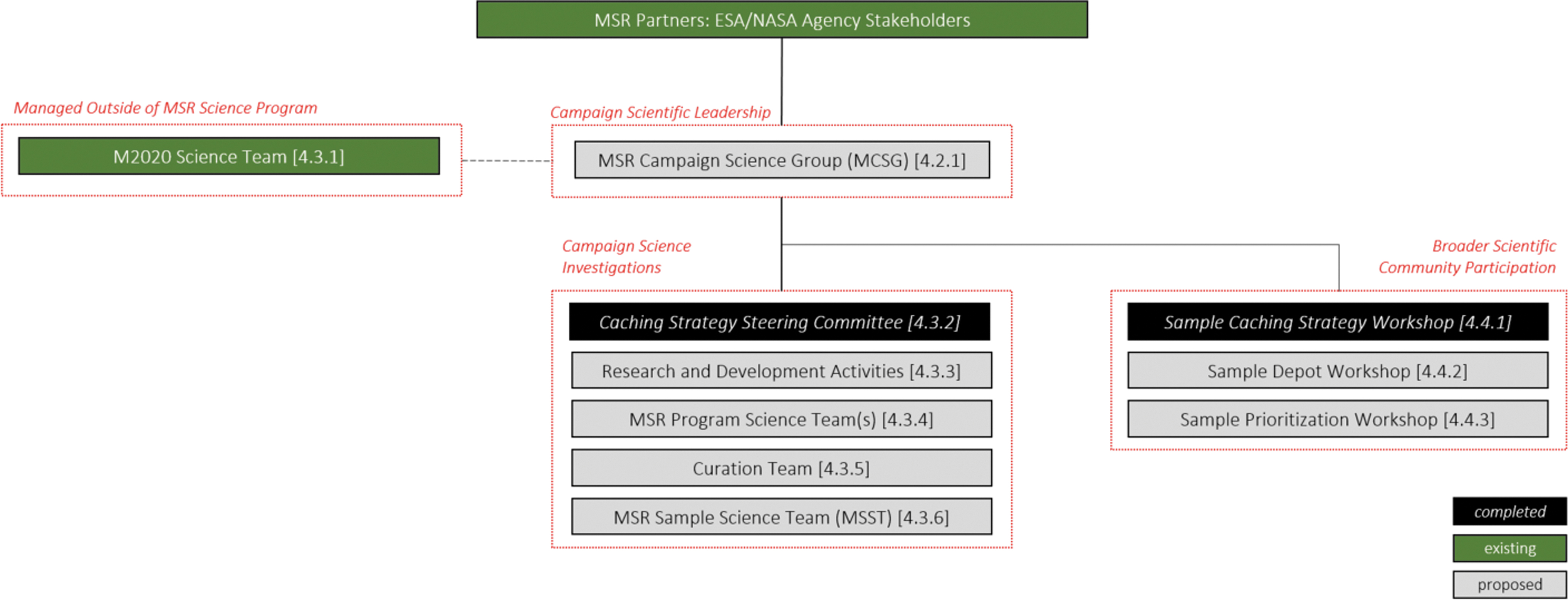
Graphical representation of the proposed MSR Science Program, illustrating relationships among the MSR Partners and other Science Program stakeholders. Numbers in parentheses indicate the report section where the proposed body or activity is described.
The SMP-FG report is structured and reported as follows:
The MSR Campaign
MSR Science Benefits
A successful MSR Campaign would provide scientific value of the highest order in understanding martian geologic processes and other foundational aspects of its evolution and present state, including whether the near surface of Mars hosts, or has ever hosted, life.
The MSR Campaign offers unique science benefits that cannot be attained through orbital or landed missions that rely only on remote sensing and in situ measurements. Like previous sample return missions such as Apollo, Genesis, Stardust, Hayabusa 1and 2, and the current OSIRIS-REx mission, MSR plans to deliver to Earth samples that can be studied in the world's best laboratories for decades to come.
In many cases, the samples can be studied with no time limitation (see Tosca et al., 2021) and can be preserved for future generations of researchers and technologies and held in curation facilities for posterity (see Tait et al., 2021). In contrast to in situ studies on Mars, returned sample studies and instruments have no practical limitations on power, size, weight, data rates, consumables, component life, or the ability to modify sample preparation procedures and analytical methods in response to new discoveries.
Martian samples can be analyzed by using elaborate and delicate preparation techniques to maximize science yield. These studies can characterize the Mars samples down to the micrometer, nanometer, and atomic scale. Studies of Mars samples in Earth-based laboratories offer the ability to design experiments iteratively and in real time as sample characteristics are revealed. With no requirement to prejudge what we could find in the samples, the dilemma of deciding which instruments to fly on a Mars mission is avoided since every possible technique on Earth would be available when the samples arrive.
The MSR Campaign also benefits from the M2020 Perseverance rover's ability to acquire a scientifically selected set of samples with geological diversity and context. A coherent in situ-characterized suite of geologic samples can help realize the full scientific potential of samples returned from Mars. The suite of samples offers one of the main aspects lacking in the world's martian meteorite collection: geologic context. For example, without locality information and geologic context radiometric dating cannot provide a robust martian geologic timescale.
Another valuable aspect of a carefully selected sample suite is the ability to collect a diversity of martian rock types guided by in situ environmental observations and scientific considerations. In particular, Perseverance can collect, and prepare for return, fragile sedimentary rocks that would never survive the impact ejection processes that deliver meteorites from Mars to Earth. Carefully preserving the samples in sealed containers would also minimize the potential effects of terrestrial contamination and alteration commonly affecting meteorites.
Thus, it is likely that the Mars sample return cache would have within it martian rock types distinct from martian meteorites that we have never seen before in Earth-based laboratories. These precious martian sediments, and other constituents contained within them, may even hold clues to answering the age-old question “Was there ever life on Mars?”.
MSR scientific objectives
The overarching research objectives of the MSR campaign have been adopted from the International MSR Objectives and Samples Team's (iMOST) final report (Beaty et al., 2019). The iMOST report offers guidelines for decision making with regard to future investigations and in support of the efforts of the M2020 mission to acquire and select for return the most suitable samples necessary to reach the MSR scientific research objectives.
An educated strategy of acquisition, caching, and selection for return will be essential because M2020's Perseverance rover is able to store more sample tubes than the subsequent MSR Program elements would be able to return. The geological and environmental context of all returned samples, which will include rocks, regolith, dust, and atmosphere, will be defined thoroughly via data and images acquired by the instruments onboard Perseverance and multiple spacecraft investigating Mars. Sample diversity necessary to achieve the following broad range of research goals would be enabled by the comparably large number of sample tubes to be returned, which will include a variety of distinct relevant geological and geochemical features.
The scientific objectives and sub-objectives of MSR are reproduced below as originally presented in Beaty et al., 2019:
Sedimentary system: Characterize the essential stratigraphic, sedimentologic, and facies variations of a sequence of martian sedimentary rocks.
Hydrothermal: Understand an ancient martian hydrothermal system through study of its mineralization products and morphological expression.
Deep subsurface groundwater: Understand the rocks and minerals representative of a deep subsurface groundwater environment.
Subaerial: Understand water/rock/atmosphere interactions at the martian surface and how they have changed with time.
Igneous terrane: Determine the petrogenesis of martian igneous rocks in time and space.
Carbon chemistry: Assess and characterize carbon, including possible organic and pre-biotic chemistry.
Biosignatures—ancient: Assay for the presence of biosignatures of past life at sites that hosted habitable environments and could have preserved any biosignatures.
Biosignatures—modern: Assess the possibility that any life forms detected are still alive or were recently alive.
These generic MSR science objectives were produced prior to Jezero Crater having been selected as the M2020 landing site. Refined objectives will be tailored to match the specifics of the scientific discoveries of the M2020 science team and the sample cache(s) collected by Perseverance.
MSR Campaign overview
The planned MSR Campaign spans multiple flight missions and one ground element (Figure 2), described briefly below. For a detailed summary of activities, please see Meyer et al. (2021) and references therein:
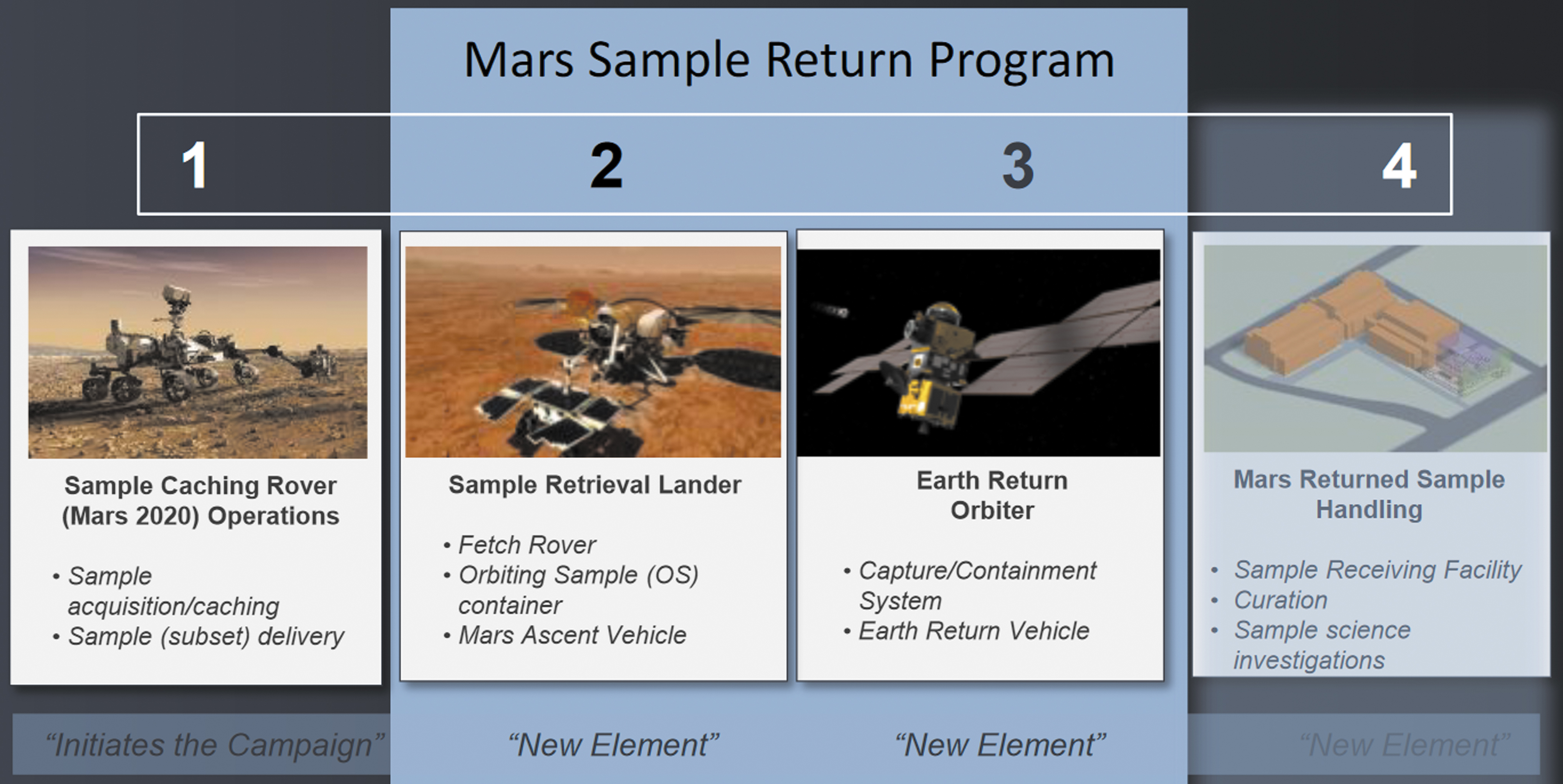
Overview of the planned MSR Campaign showing the current “3 + 1 architecture” outlining the three flight and one ground elements designed to collect samples on Mars and safely return them to Earth. The MSR Program refers to the 2-Sample Retrieval Lander (SRL) and 3-Earth Return Orbiter (ERO) missions. In its entirety, the collection of missions and ground segment (1-4 below) is referred to as the “MSR Campaign” (from Gramling and Braun, 2021).
Under the anticipated schedule at the time of this writing, the NASA-led SRL mission, including an ESA-led SFR, would launch in 2026 and arrive at Mars in late August/early September 2028. Note that the MSR Program will also have a viable backup option to launch the ERO and SRL missions in 2028 with sample return to Earth in late 2033. Descriptions of the essential timing aspects of the MSR Campaign that influence the science management planning are provided as follows.
2021
2021–24
2024–26 (or 2024–28)
2027 (or 2028–29)
2028–29 (or 2030–31)
2029 (or 2031)
2031 (or 2033)
2031–32 (or 2033–34)
2032–TBD (or 2034–TBD)
After delivery of the samples to the SRF, scientific investigations would commence concurrently with the initial characterization of the samples. Teams of investigators competitively selected years in advance will conduct a variety of studies that will address the MSR objectives (“objective-driven investigations”). During this period, there would be considerable overlap with curation activities and sample safety assessment, which will require appropriate coordination to optimize the use of sample material and maximize the scientific return.
Two types of investigations would be conducted within the SRF itself: (i) those that require time-sensitive measurements (i.e., characterizing physical or chemical properties that may change rapidly after sample tube opening) (Tosca et al., 2021) and (ii) those that require measurements that are sensitive to sample sterilization processes and have an element of time-criticality (Velbel et al., 2021). Other studies may be conducted outside the SRF after samples have either been deemed to be safe or rendered so.
As with other sample return missions, it is envisioned that scientific investigations would continue for decades to come after the objective-driven investigations are complete. However, such “opportunity-driven” investigations are not included within the scope of the SMP and are thus not discussed further in this document.
Approach to Developing an MSR Science Management Plan
Current MSR management bodies and documentation
The end-to-end MSR Campaign as currently designed comprises a number of scientific, technical, and programmatic bodies and relationships captured in a series of existing and anticipated documents. The following represents the overall MSR Campaign management structure as it exists at the time of writing:
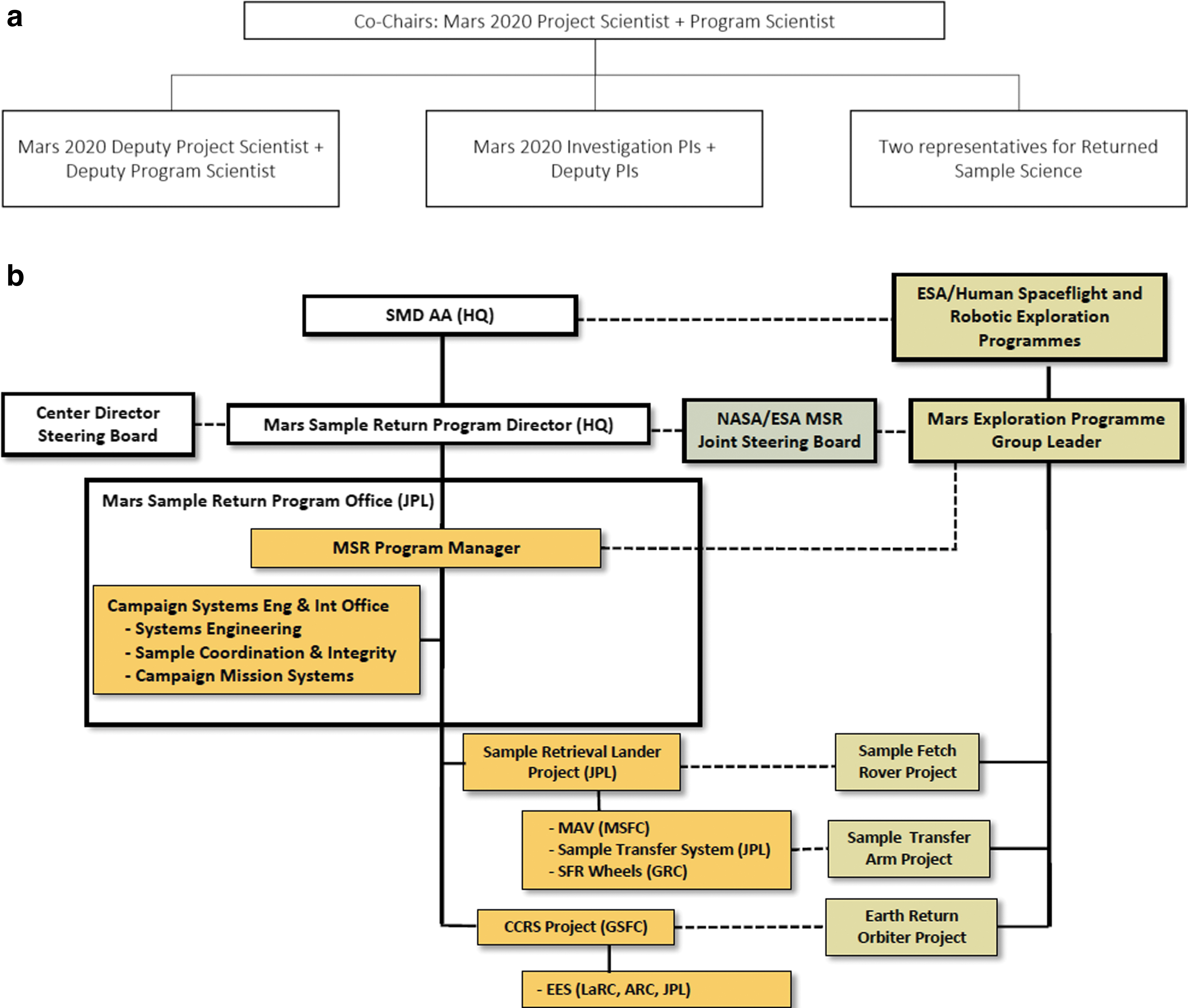
M2020 is currently operating on the martian surface and is managed effectively by NASA's MEP. The MSR Program element is largely engineering-driven, focused solely on the flight missions' requirement to return the samples collected by M2020 back to Earth. However, there is a need to develop sample integrity science requirements and monitor their implementation on the various MSR Program elements.
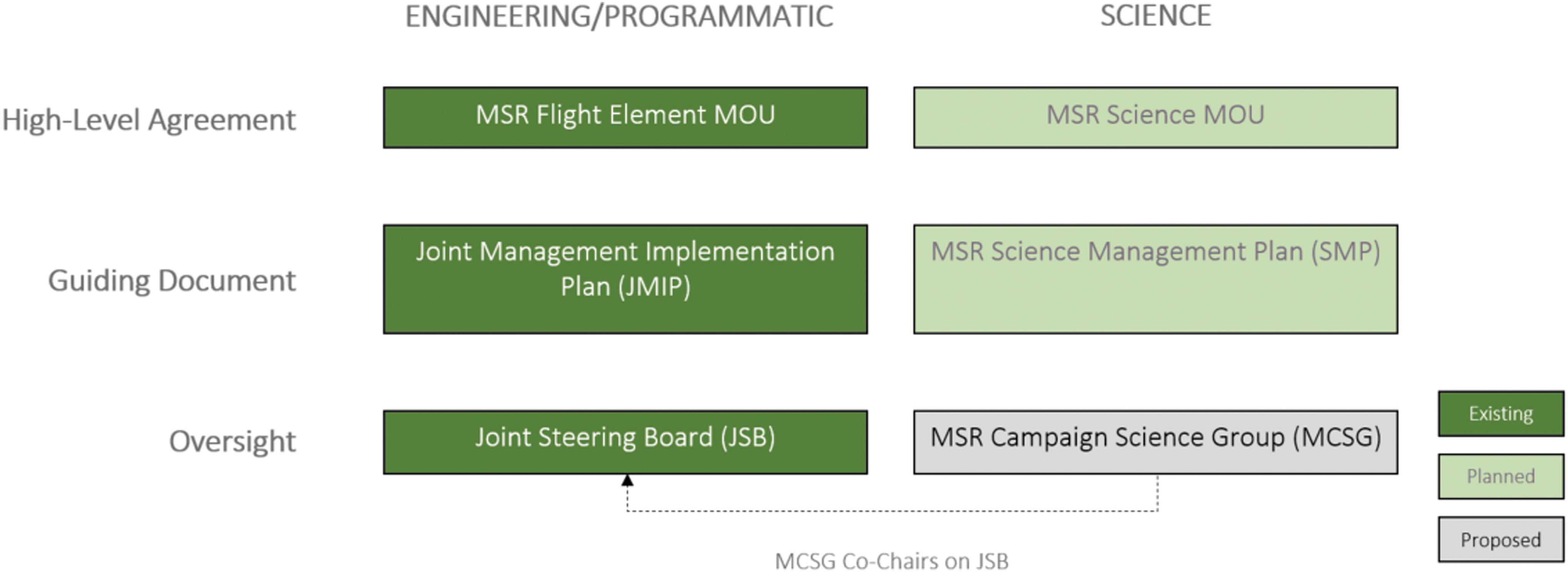
Proposed science management structure and documentation that are designed to mirror the existing structure for engineering elements of the MSR Program. Note that the Engineering/Programmatic column pertains to the MSR Program (i.e., flight elements) only.
Given that the overall MSR science benefits are intended to be shared among the MSR Partners, it will be crucial to develop a joint science management structure that covers scientific aspects of the end-to-end Campaign to ensure that the MSR science objectives can be successfully achieved.
Jointly managing the MSR Science Program will require a series of international agreements. At the time of writing, it is expected that two critical documents will be produced in the coming year:
To provide inputs for the Science MOU and SMP, the MSPG2 SMP-FG has developed a strawman MSR Campaign science management structure, described in detail throughout Section 4. The following sections provide the context with which we developed the proposed structure, incorporating previous management review processes, identifying both the science functionalities that are, and are not, managed within the SMP, outlining the principles by which the structure could be designed and integrating key lessons learned from previous robotic exploration and sample return missions.
In August 2020, NASA chartered an MSR Independent Review Board (IRB) to evaluate the technical progress on its early concepts for contributions to the MSR Program. Noting that MSR is one of the most technically challenging undertakings ever attempted, ultimately the IRB concluded that the Agency is ready to proceed.
The IRB's final report in November 2020 provided 43 recommendations for both programmatic and technical elements of MSR preparations, to which NASA has provided an initial response (NASA SMD, 2021). The IRB stated explicitly the importance of close coordination in all scientific elements of M2020 and MSR, issuing three such recommendations in particular:
Wherever possible, the SMP-FG attempted to develop findings consistent with the above recommendations that NASA and ESA management could incorporate into its planning.
MSR Campaign: Required science functionalities
Under our definition, the MSR Science Program would encompass all scientific activities conducted during the MSR Campaign, noting that the M2020 mission is independently managed. As such, we envision a variety of scientific bodies or entities to be required, categorized broadly under the themes of:
NASA's MEP/MSR MOA (RD-04) provides an initial breakdown of specific science and other tasks required throughout the MSR Campaign, along with relative decision-making authority within NASA. We have also identified a variety of other specific tasks that would benefit from joint definition and oversight.
Table 1 outlines a list of envisaged functionalities that may be carried out under the MSR Campaign, indicating which are already listed explicitly within the MEP/MSR MOA (RD-04). Note that only NASA responsibilities have been indicated in the table. However, the MSR Science Program will be jointly managed with the respective ESA decisional authorities that will be indicated when they are formalized.
Preliminary List of Science Functionalities to be Addressed During the MSR Campaign. Column 1 Provides a Brief Description of the Task. Note That the Respective ESA Decisional Authorities are not Indicated as They have Yet to be Formalized. The Reader can Consider That Items Indicated at the NASA SMD AA Level Would go to the ESA Director of Human and Robotic Exploration. Column 2 Indicates Whether That Task has been Included in the NASA MEP/MSR MOA Document. Column 3 Indicates the Decisional Authority within NASA for the Given Tasks Identified in the MOA. [MEP: Mars Exploration Program; SMD AA: Science Mission Directorate Associate Administrator; MSR: Mars Sample Return Program; PSD: Planetary Science Division]. Black Shaded Cells Represent Tasks That are the Sole Responsibility of the M2020 Science Team
Preliminary List of Science Functionalities to be Addressed During the MSR Campaign. Column 1 Provides a Brief Description of the Task. Note That the Respective ESA Decisional Authorities are not Indicated as They have Yet to be Formalized. The Reader can Consider That Items Indicated at the NASA SMD AA Level Would go to the ESA Director of Human and Robotic Exploration. Column 2 Indicates Whether That Task has been Included in the NASA MEP/MSR MOA Document. Column 3 Indicates the Decisional Authority within NASA for the Given Tasks Identified in the MOA. [MEP: Mars Exploration Program; SMD AA: Science Mission Directorate Associate Administrator; MSR: Mars Sample Return Program; PSD: Planetary Science Division]. Black Shaded Cells Represent Tasks That are the Sole Responsibility of the M2020 Science Team
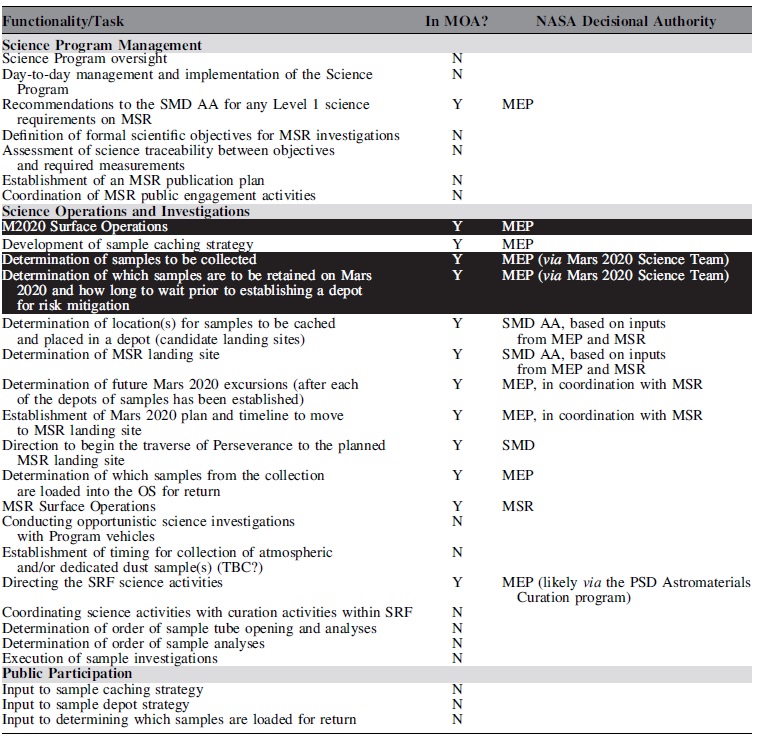
The MEP/MSR MOA also stipulates that MEP is responsible for coordination between NASA and ESA for M2020 surface operations and sample collection. Because there are so many scientific elements required to achieve MSR Campaign success, it is critical to ensure that the appropriate management, oversight, planning, and resources are made available to accomplish them. To date, however, no dedicated budget lines within NASA and ESA have been made available for these purposes, and no formal MSR science program plan has been established.
Given that the MSR Campaign science activities have already commenced with M2020, the MSR Science Program should be initiated and funded as soon as is feasible and should run through the end of the “objective-driven” investigations that directly address the MSR science goals.
The SMP will describe the overall structure of the MSR Science Program and detail how it will be implemented to meet the MSR science objectives and maximize the overall scientific return of the MSR Campaign. Because science is intrinsically linked with other aspects of sample handling and interrogation, clear decisional boundaries are also required for elements of sample handling after return. As such, the SMP will serve as a reference document to (as examples) the following anticipated documents:
Undoubtedly, scientific input will be required to produce each of the above. However, the specific objectives of each of these documents is considered distinct from the SMP and will thus be managed separately.
In addition, the SMP will be required to set boundary conditions for one other critical document:
Though technically outside the scope of the SMP itself, the Science Data Plan would be a subordinate document to the SMP, owned by MSR Campaign Science Program management bodies (see Section 4.2).
MSR Campaign science management: Guiding principles
Five guiding principles have served as the foundation of the SMP-FG deliberations, drawn directly from the SMP Framework document (MSPG 2019c). These principles were formulated upon previous science management recommendations, leveraging experience from other major international science partnerships and sample return missions.
Summarized below, they aim to balance the need of MSR partners to achieve a return on their investment with the need to engage many international scientists to meet the MSR scientific objectives:
Once drafted, the official SMP, the Science MOU, and any future modifications to either document should ensure consistency with these principles.
Science Program element eligibility
The MSR Science Program is an ambitious effort and, as such, will draw immense interest from the international science community. While ensuring alignment to the Guiding Principles outlined above, the SMP-FG has aimed to develop a Science Program to address both community and MSR Partner needs as follows:
Management and scientific precedents from previous missions
In many ways, the MSR Campaign is unprecedented with regard to technical and managerial perspectives. It involves multiple flight missions coordinated by two space agencies leveraging a science mission managed exclusively by only one of those agencies and adds a ground segment that may rival the complexity of a flight effort. As such, attempting to develop an overarching, cohesive Scientific Program may appear daunting.
However, multiple decades of mission experience (e.g., Longobardo 2021 and papers therein) have provided significant lessons directly applicable to MSR, from which NASA and ESA managers can base their planning. Prior sample return missions, including Stardust (Brownlee, 2014), OSIRIS-REx (Lauretta et al., 2017), Hayabusa (Yoshikawa et al., 2015) and Hayabusa2 (Tsuda et al., 2013), Mars exploration missions such as the Mars Science Laboratory (MSL) (Grotzinger et al., 2012), and the ExoMars rover (Vago et al., 2017), and sample analysis efforts such as the Apollo Next Generation Sample Analysis (ANGSA) program (RD-06) have helped shape our rationale in developing recommendations for the MSR Science Program, as reported below.
Long-term planning
Science team selection
3.7.3. Science team composition
Preparatory activities
Involvement of the broader science community
Accessibility of data products
Proposed MSR Science Management Structure and Science Bodies
Overview
We have developed a design reference program comprising specific science bodies and/or activities that could be implemented to address the science functionalities outlined in Section 3.3. While we acknowledge that the proposal is non-unique, that is, other implementations could meet the overall needs of the MSR Campaign, we have striven to optimize efficiencies and eliminate unnecessary overlap wherever possible to reduce the potential cost and complexity of the MSR Science Program.
Each of the proposed bodies or activities is organized and reported around the following headings:
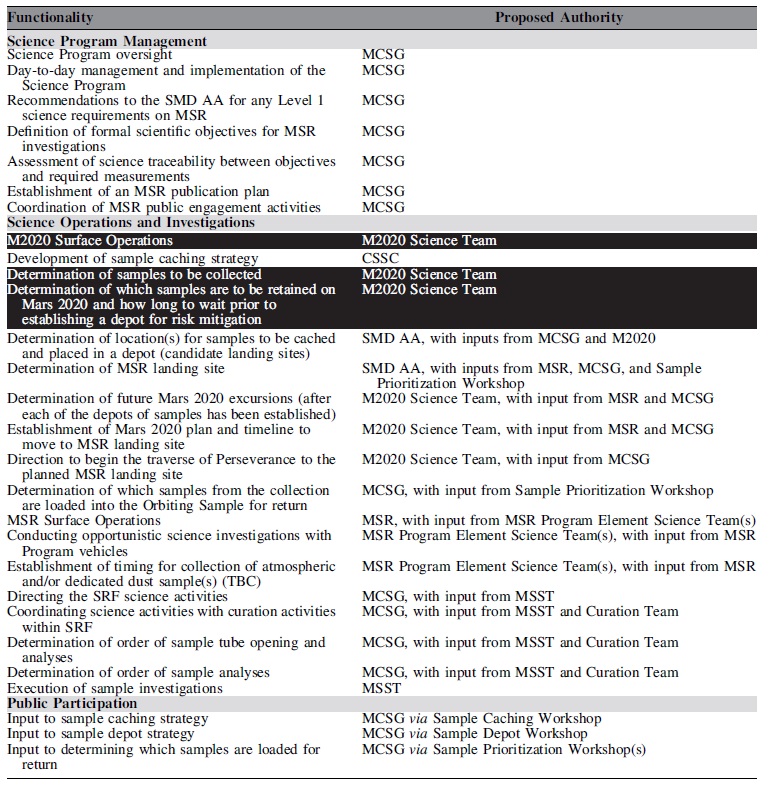
Broadly, the ESA and NASA MSR lead scientists would largely manage the preparation and implementation of the MSR Science Program, including the science input necessary for ground-based infrastructure. As a complement, the following sections represent a cohesive, integrated set of initiatives that respective ESA and NASA managers could put in place to address the scientific needs of the MSR Campaign and, in some cases, respond to the IRB recommendations presented in Section 3.2. A summary of the functionalities and proposed decisional authorities is presented in Table 2.
Scientific Functionalities Required Throughout the MSR Campaign and Proposed Decisional Authorities for Each. Descriptions of Each Authoritative Body are Described in Sections 4.2-4.4. As with Table 1, note That the Respective ESA Decisional Authorities are not Indicated as They have Yet to be Formalized. The Reader can Consider That Items Indicated at the NASA SMD AA Level Would go to the ESA Director of Human and Robotic Exploration. Black Shaded Cells Represent Tasks That are the Sole Responsibility of the M2020 Science Team
Scientific Functionalities Required Throughout the MSR Campaign and Proposed Decisional Authorities for Each. Descriptions of Each Authoritative Body are Described in Sections 4.2-4.4. As with Table 1, note That the Respective ESA Decisional Authorities are not Indicated as They have Yet to be Formalized. The Reader can Consider That Items Indicated at the NASA SMD AA Level Would go to the ESA Director of Human and Robotic Exploration. Black Shaded Cells Represent Tasks That are the Sole Responsibility of the M2020 Science Team
MSR Campaign Science Group (MCSG)
Rationale
Oversight and guidance will be required at the highest level of the MSR Science Program. The proposed MSR Campaign Science Group (MCSG) would assist in the execution of the SMP, operating in two phases:
Development of such a body would result in a similar structure of processes and envisaged documentation for both the engineering and science elements of MSR (see Figure 5).
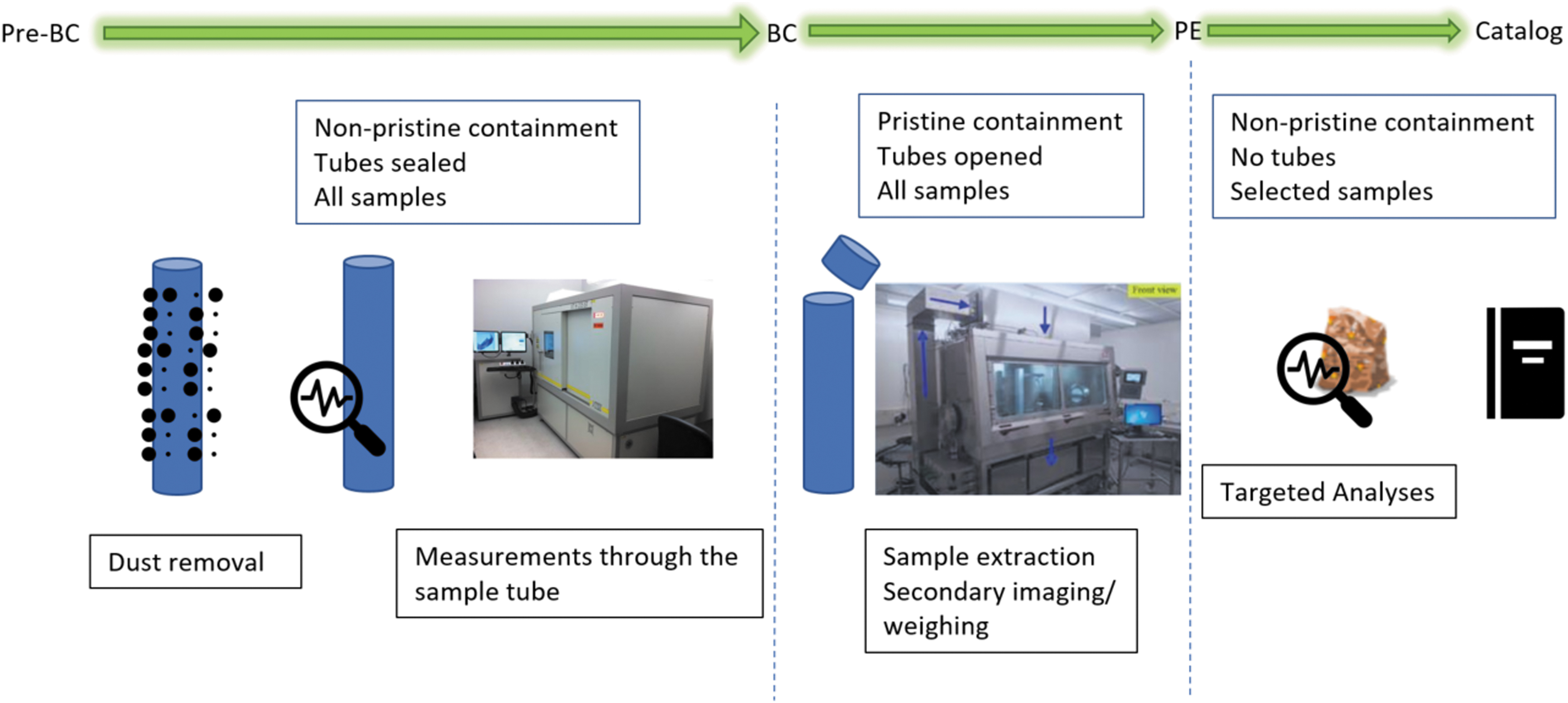
Proposed timeline of activities within the Pre-Basic Characterization, Basic Characterization, and Preliminary Examination (from Tait et al., 2021).
Serving as the interface between the MSR Partners and the science community, the MCSG would represent many of the functions of a traditional PSG for NASA flight missions or Science Working Teams (SWT) for ESA flight missions and provide overall guidance for the long-term strategic science planning and the day-to-day management of the Science Program.
Ultimately, the MCSG members act as the stewards of the Science Program and are focused on the entirety of the MSR Campaign's end-to-end scientific activities. As such, it will represent MSR science to the MSR Partners, international science community, and the public.
Roles and responsibilities
The MCSG would be required for a number of tasks that may vary over time. In the immediate term, it could be responsible for the following:
Support the oversight process from NASA and ESA management in the execution of the Science Program.
Provide a research and development (R&D) roadmap.
Review Level 1 science requirements.
Draft and maintain the SMP and the Data Management Plan.
Approve the Terms of Reference for ad hoc and standing working groups and committees within the frame of the Science Program.
Develop and maintain strategic decision guidelines to inform M2020 Science Team sample caching strategy.
Define engineering data products required to trace sample history.
Manage the scientific side of the interfaces between the MSR Science Program and M2020, Sample Curation, and Planetary Protection.
Provide scientific input into M2020 and MSR Program operational activities.
Establish formal MSR sample science objectives and MSR Campaign success criteria.
Develop and maintain, once M2020 samples have been acquired, a Science Traceability Matrix between sample science objectives and specific measurement requirements to meet them.
Oversee scientific elements and instrumentation for SRF planning.
Participate as needed in the public outreach process, especially in the U.S. and in Europe.
Over the longer term, responsibilities in addition to those listed above could include the following:
Provide day-to-day leadership of the Science Program's technical activities.
Work with the MSR engineering implementation office.
Provide progress reports to advisory bodies.
Ensure that any advance long-lead planning for the receipt of the samples, and their proper analysis, is provided for.
Engage the broader science community through regular workshops, conferences, and community events.
Establish a scientific publication plan.
Facilitate conflict resolution among science team members.
Selection process and composition
The MCSG would be co-chaired by NASA and ESA MSR lead scientists, with the remainder of members selected as follows:
The selection of MCSG members would take into account Equity, Diversity, and Inclusion (EDI) along with diversity in career stage as considerations.
To avoid real or perceived conflict of interest, sitting MCSG-1 members should not be eligible to be PIs or Co-Is of objective-driven investigations at the time of proposal submission; any MCSG-1 member wishing to propose an investigation would step down at that time. After investigations have been selected, additional members could be added (e.g., science theme group leads).
Appointments for the competitively selected (i.e., non-ex officio) members of the MCSG would be made nominally for a duration of 4 years, after which the positions could be open for re-competition to allow for adjustments in expertise to react to new findings.
Dependencies
Formation of the MCSG would represent the de facto initiation of the Science Program. In the immediate term, MCSG Part 1 should be populated as soon as is feasible given that MSR Campaign activities have already commenced. Specific scientific inputs on behalf of the Science Program are required already, including interfacing with M2020 operations, technical planning of the SRF, and formalization of MSR science objectives and traceability. In the longer term, MCSG Part 2 would be tied to the AO(s) for objective-driven sample investigations, nominally up to seven years before samples are returned to Earth (see Section 6.1.4).
Key outputs
The MCSG would serve as the integrating body for scientific elements of the MSR Campaign and would provide critical inputs into MSR Campaign-level reviews and overall Science Program management.
Establishing the MSR Campaign's formal science objectives, Level 1 science requirements, and success criteria are of critical importance to maximize the MSR Campaign's scientific return. These products will be developed and maintained by the MCSG along the following schedule:
Beyond the products described above, the MCSG would also generate the following:
The MSR Data Management Plan.
Strategic decision guidelines to inform the M2020 Science Team sample caching strategy.
Definition of engineering data products required to trace sample environmental history.
Technical reports feeding SRF planning and other elements where scientific input is required.
Inputs for the objective-driven investigation AO(s).
Reports for advisory committees, as needed.
Rules of the Road document governing expected behaviors and interactions of the MSR Sample Science Team (MSST, Section 4.3.6).
Initial draft and maintenance of the Sample Dossiers produced by M2020 (Section 5.3).
Timeline
Engineering developments for the MSR Program and the MSR Campaign are well underway, and scientific input is required immediately to ensure that the MSR Program technical requirements will meet the needs of the Science Program. As such, the MCSG should be put in place at the earliest possible opportunity. Given its importance in overall Science Program leadership, it should remain in place throughout the MSR Campaign and would be closed upon completion of the objective-driven investigations and the declaration of mission success (nominally two years after return).
M2020 Science Team
Rationale
The M2020 mission goal is to develop a scientific understanding of the geology of Jezero Crater, identify ancient habitable environments, locate rocks with a high probability of preserving biosignatures, and use the rover's instruments to look for potential biosignatures within those rocks. M2020 will select and collect the samples intended for Earth return.
Roles and responsibilities
The M2020 Science Team is responsible for the science operations of the Perseverance rover and is structured and managed outside the scope of the SMP. Roles and responsibilities are described in (RD-02). A group of 15 M2020 Returned Sample Science Participating Scientists (RSS-PS) were competitively selected by ESA and NASA to join the Perseverance science team and provide advice on the selection of samples to be cached.
Selection process and composition
The M2020 Science Team was selected through a NASA competitive process outside the scope of the SMP. Investigations were bid to a competitive AO and selected on a combination of science merit and technical feasibility. The team was subsequently supplemented through competitive processes for Returned Sample Science Participating Scientists (RSS-PS) in 2018 and general Participating Scientists in 2020.
Dependencies
The launch of M2020 represents the beginning of the MSR Campaign and (in principle) represents the start of the MSR Science Program activities.
Key outputs
The M2020 Science Team is responsible for collecting and depositing the sample cache at Mars and will begin development of the Sample Dossiers (Section 5.3) that outline the end-to-end environmental history of each sample.
Timeline
M2020 launched on July 30, 2020, landed safely on Mars on February 18, 2021, and is currently active. Its nominal mission lifetime is one Mars year, with the possibility for extension subject to rover health and sufficient budget.
Caching Strategy Steering Committee (CSSC)
Rationale
The retrieval of samples cached by M2020 requires transport by one of two pathways: (1) retrieval of the samples by the SFR and delivery to the SRL or (2) delivery of the samples to the SRL by M2020's Perseverance Rover.
Which strategies are actually implemented will depend on the nature and perceived value of each sample, the diversity of the samples at a depot, landing site accessibility for SRL, the capabilities of Perseverance and SFR, lifetime projections for Perseverance and SFR, and the projected risk of rover survivability and navigability of the terrain encountered.
As there are multiple options to the sample caching strategy, expert input was required to inform operational decisions for M2020 and future MSR systems (e.g., SRL, SFR). Note that the CSSC was established on an ad hoc basis by NASA and ESA; such a role would be taken over in the future by the MCSG.
Roles and responsibilities
The CSSC was responsible for the following:
Reviewing options for decisional guidelines to inform Perseverance's sample caching strategy.
Planning and implementing a virtual workshop to discuss and provide feedback on the options.
Providing a final report based on the workshop findings.
Workshop structure and findings are described in Section 4.4.1.
Selection process and composition
Members of the CSSC were appointed by the MSR Partners. Chaired by NASA and ESA MSR science representatives, CSSC membership comprised representation from key MSR Campaign knowledge domains including:
MSR Partner science leadership
M2020 science and operations
MSR Program management and operations
MSR Campaign science
the academic science community
Logistics were provided by the MSR Program Office at the Jet Propulsion Laboratory (JPL). The team's primary function was specifically to organize and execute the Sample Caching Strategy Workshop (Section 4.4.1) but may be called upon again for specific needs.
Dependencies
The sample caching workshop was required prior to the Perseverance landing to inform future operational decisions for the M2020 science team.
Key outputs
The CSSC delivered its final report in March 2021 (CSSC, 2021), outlining a variety of strategic intents and decision guidelines.
Timeline
The CSSC was chartered in December 2020 and was disbanded in March 2021 following the acceptance of the final report.
Research and Development (R&D) activities
Rationale
With MSR Campaign activities already underway, there remain a number of open engineering and scientific trades that require dedicated R&D activities to address. As highlighted throughout the MSPG2 technical reports (MSPG 2021a, b), near-term effort is needed to advance technical requirements and reduce risk for future MSR Campaign element design and operations.
Roles and responsibilities
The R&D roadmap generated by the MCSG would serve as the guideline defining the critical open trades to which teams from the scientific community would submit proposals. Selected teams would be tasked to conduct the necessary experiments and formulating results so that information can be delivered to the MSR Partners to inform necessary trades.
Selection process and composition
Wherever possible, existing ESA and NASA competitive processes could be leveraged. In the US, for example, the Mars Data Analysis Program (MDAP) and/or Laboratory Analyses of Returned Samples (LARS) programs could have specific research priorities identified and supported in ongoing calls. In instances where existing programs do not or cannot encapsulate the research priority, a dedicated MSR R&D budget line should be considered, as could ad hoc opportunities sponsored by the MSR Partners.
Dependencies
Many of the open trades can have an impact on the design of the SRF or of the flight elements. As such, early high priority projects should aim to be completed before crucial design trades are closed.
Key outputs
It is expected that selected research programs would produce a number of peer-reviewed publications for the literature. In cases where specific answers are required to inform engineering trades, short technical reports may also be required as deliverables to the Partners.
Timeline
Given that SRF and MSR Program element requirements are presently being developed, it is crucial to commence the R&D program as soon as possible. The research community must be given adequate time to conduct their experiments and provide meaningful results that can be incorporated into the facility or hardware design where possible. The MSR R&D program would be required until the initial sample investigations are competed and selected and the MSST (see Section 4.3.6) is formed.
MSR Program element science teams
Rationale
Although the SRL, SFR, and ERO are not planned to be equipped with dedicated scientific payloads, they will be functional vehicles operating on or in the vicinity of Mars. As such, they will provide invaluable opportunities for ancillary science by using existing engineering sensors, even if tasked (e.g., primarily or strictly) sample retrieval functions. This is even more relevant after the samples will have been delivered to the MAV, when the SFR would be free to perform scientific, post-delivery activities. Data from engineering sensors and modeling will be required to document the environmental histories of the returned samples.
Roles and responsibilities
To exploit the scientific, engineering, and public engagement opportunities (e.g., during the MAV launch) of the MSR Program flight elements, a small team or teams of dedicated scientists would be responsible for the following:
Developing opportunistic scientific objectives that can be met on a no-interference basis with engineering tasks.
Participating in operations planning of the vehicle(s).
Collection of relevant data products.
Planning and acquisition of data and development of models to contribute to sample environmental history knowledge.
Planning of atmospheric and/or dust sample(s) acquisition (should engineering constraints permit).
Publishing scientific findings in relevant journals.
Delivering scientific data products to the appropriate archives.
Participating in public engagement activities.
Selection process and composition
Program element (i.e., ERO, SRL, SFR) science teams would be competed internationally. Applicants could be recommended by the MCSG and selected by the Partners, assigned within the following roles:
Dependencies
Population of the element science team(s) would be tied to the respective launch dates. Planning of competitive AOs would thus need to be reactive to any change in the high-level MSR Program schedule. If such teams are formulated, individual element SMPs would likely be required, produced by the MCSG, and be daughter documents to the overarching MSR SMP.
Key outputs
The element Science Team would be responsible for collecting, analyzing, and archiving scientific data using available onboard sensors, and contribute to the Sample Dossiers (Section 5.3) that outline the end-to-end environmental history of each sample.
Timeline
Because no dedicated scientific instruments are onboard, these teams could be composed relatively late in the development process. Competitions could take place after NASA Key Decision Point D (KDP-D) of the respective element (e.g., SRL, ERO) has been completed, at launch, or perhaps even during cruise. The teams would remain in place until a minimum of six months after its last opportunistic science measurement has been collected and the relevant data delivered to the appropriate archive.
Curation team
Rationale
Upon return to Earth, the samples will be transported to the SRF for their initial characterization (MSPG 2021a, b). While the curation function will encompass numerous responsibilities, one of the major aims at this preliminary step is to produce a
Roles and responsibilities
At this stage, the Curation Team will be responsible for all examinations necessary to create a descriptive sample catalog, including (but not limited to):
Sample tube weighing, imaging, and initial observations.
Imaging and measurements conducted through sample tubes.
Headspace gas extraction, seal quality check, and atmospheric composition analysis.
Sample extraction, secondary imaging.
Selected targeted analyses.
The Curation Team would also be required to support the science investigations (see Section 4.3.6) with the following:
Preparation of samples for PI-led, competitively selected research within the SRF, including time-sensitive and sterilization-sensitive measurements.
Preparation of samples allocated to PIs for competitively selected research outside the SRF.
Each of the above will involve a wide range of scientific and/or technical experts whose priority is to maintain the scientific integrity of the samples and work closely with the selected MSR Sample Science Teams (see Section 4.3.5) to maximize the scientific value and utility of the samples.
Selection process and composition
The Curation team would be composed of joint ESA and NASA staff members to satisfy two required sets of expertise: (i) intellectual guidance to plan the measurements that will be conducted and (ii) physical manipulation of equipment and samples to collect the measurements. Some positions may be staffed through competitive opportunities.
Dependencies
Examinations on the samples are tied exclusively to the sample return date. Flexibility in planning for the Curation Team should be made to accommodate the MSR Program flight schedule.
Key outputs
The principal output of the initial sample characterization process will be the MSR sample catalog (MSPG 2021d). The catalog is expected to be a living-document with updates made as new measurements are collected for each sample. In the long-term (and beyond the scope of the SMP) catalog data would also enable future researchers to submit sample access proposals for investigations; design of consortium sample studies; and a sample allocation committee would be established to make informed decisions about the best use of limited, high-value, and irreplaceable sample mass.
Timeline
To provide sufficient time for preparation and training, the team should be selected four years in advance of the samples returning to Earth. It is recommended that the team stays intact until initial characterization has been performed on all eligible samples and the sample catalog has been delivered (nominally two years after sample receipt).
MSR Sample Science Team (MSST)
Rationale
Ultimately, MSR is being conducted to answer fundamental research questions about Mars and the solar system through scientific analyses of the samples. An MSR Sample Science Team (MSST) composed of international scientists would be populated to design and conduct the investigations to address the objectives outlined in Section 2.2. It would serve as an equivalent of a NASA or ESA flight mission science team, whereby individual investigations (including personnel and instruments, whether inside or outside the SRF) are competed and then combined to form a broader team. Overall leadership would be provided by the MCSG Phase 2.
Sample allocations for scientific investigations should be managed and decided jointly by NASA and ESA. A dedicated Sample Handling & Management Plan needs to be developed and maintained under the authority of the MCSG.
Roles and responsibilities
After formation, the MSST would:
Develop Campaign-level thematic groups to establish integrated scientific investigations addressing high-level MSR science objectives.
Provide advice and participate in the design, implementation, and/or calibration of scientific instrumentation to be located within the SRF (Carrier et al., 2021).
Provide scientific input to the exercise prioritizing the order in which the sample tubes will be opened and interrogated.
Provide scientific input to the exercise for prioritizing the order in which the sample analyses will be conducted.
Participate in the planning, rehearsal, and execution of scientific operations, including timing, duration, and selection of measurements to be collected.
Support the Pre-BC, BC, and PE processes (see Tait et al., 2021 for details) in an advisory role or by performing some of the investigations as part of their science plan.
Perform the scientific investigations on the allocated samples, including elements of the sample safety assessment.
Interpret data products to make scientific observations and conclusions.
Publish the results in peer-reviewed journals.
Deliver scientific data products to the appropriate archives.
Participate in public engagement activities.
Individual PIs and/or thematic team leads would represent the MSST in the MCSG Phase 2.
Selection process and composition
Much like MSL or M2020, the MSST would be competitively selected through an open international AO. Proposal teams would self-organize and propose full investigations to address the MSR science objectives, including research questions, team members, and instrumentation. Teams may propose the use of existing instruments, upgrades to existing instruments, new off-the-shelf instruments, or new customized instruments, all of which may be proposed for installation and use inside or outside the SRF. To maximize potential scientific utilization of the samples, bids from consortia would be encouraged.
Proposed investigations should define members in the following roles:
Collectively, selected teams will comprise the MSST. Subsequently, the MSST could be complemented through a separate AO for:
PSs would be granted full MSST status for the duration of their activities, including all publications and delivery of any required data products.
Following guidelines from ANGSA (RD-06), members of the Curation Team would be granted MSST membership and would be subject to its guidelines but would not be eligible to be PIs or Co-Is on the objective-driven investigations.
Dependencies
Understandably, formation of the MSST is tied strictly to the return date of the samples. Building on lessons learned from previous sample return missions, it is recommended to hold the AO up to seven years in advance of sample receipt to allow for instrument development, preparatory research activities, sample measurements protocol development, Biosafety level 4 (BSL-4) training (where appropriate), and operational rehearsals prior to conducting investigations on the Mars samples.
Key outputs
The MSST would be the primary source of science dissemination for the Campaign. The team would produce peer-reviewed publications and conference presentations to add to the literature. Moreover, they would also be required to participate in a variety of public engagement activities, as results stemming from sample science will undoubtedly generate immense public interest.
Timeline
Assuming a competitive AO up to seven years in advance of sample receipt, the team would need to be in place until completion of the objective-driven investigations (nominally two years after receipt). Team extensions could be considered at that time for ongoing investigations. Following from previous mission experience, we recommend holding the PS AO up to two years in advance of sample receipt to allow for proper integration into the broader team and to increase readiness to conduct their proposed investigations.
Participation open to the entire science community
Sample Caching Strategy Workshop
Rationale
As outlined in Section 4.3.2, the CSSC was tasked with organizing and executing the MSR Sample Caching Strategy Workshop to consider the strategy for caching samples on Mars as a key element in planning their return to Earth. It provided a forum for mission planners and the broader science public to help define Scientifically Return Worthy (SRW) caches and determine an optimal caching strategy. An SRW cache is currently defined as (i) distinct sample suites or individual samples selected to represent the diversity of the exploration area and address the MSR Campaign science objectives (Section 2.2), including the history and evolution of Jezero Crater; (ii) available in situ data and other information to understand the geological history of the samples; and (iii) inclusion of one or more witness blanks (CSSC, 2021).
Roles and responsibilities
Workshop participants were encouraged to provide feedback to the CSSC on the various sample caching options available to the M2020 team through real-time comments and email communication.
Selection process and composition
Workshop participation was completely open to the public and was advertised through a variety of channels to maximize participation.
Dependencies
Scheduling of the workshop was required prior to M2020 landing to provide sufficient time to provide input to Perseverance operational planning.
Key outputs
Workshop findings were provided to the CSSC and ultimately delivered to the Partners in the form of a Workshop Report (CSSC, 2021). Key recommendations included (i) creation of an initial depot within Jezero Crater; (ii) collection of a second sample set if Perseverance health permits; and (iii) maintenance of multiple sample delivery pathways to the SRL. These findings are being incorporated into M2020 operations.
Timeline
The workshop was organized in late 2020 and held on January 21, 2021.
Sample Depot Workshop
Rationale
A future Sample Depot Workshop or Workshops would be another forum for community discussions, providing input to depot location(s) and strategy after Perseverance has collected a suite of samples. Members of the science community would be given the opportunity to present rationale for determining whether the sample caches remain onboard Perseverance or are deposited on the ground. If the latter, input would also be sought to select a specific location for the cache.
Roles and responsibilities
Workshop participants would be encouraged to provide feedback to the MCSG on the preferred strategies based upon operational knowledge gathered by the M2020 Science Team over its prime mission and any orbital data collected between now and then.
Selection process and composition
Workshop participation would be completely open to the entire worldwide science community.
Dependencies
Workshop recommendations would be required prior to M2020 reaching its baseline mission timeline of one Mars year.
Key outputs
The primary output of the Sample Depot Workshop would be a recommendation to the MCSG for final consideration, with ultimate decision-making power resting with the MSR Partners.
Timeline
Assuming continuing health of Perseverance, the initial workshop would need to take place in late 2022 or early 2023. A second workshop could be envisaged if a second SRW cache is collected by M2020.
Sample Prioritization Workshop(s)
Rationale
One or several Sample Prioritization Workshops could be held if more samples are collected by Perseverance than can be returned by the MSR Program. This (these) workshop(s) would aim to provide recommendations on which samples should be prioritized by the SFR.
Roles and responsibilities
Community groups would be invited to develop information packages to present at the workshop(s), which would provide recommendations on which samples should be prioritized by the SFR based on engineering constraints and science maximization (i.e., which samples would best meet the objectives).
Selection process and composition
Workshop participation would be completely open to the entire worldwide science community.
Dependencies
Workshop recommendations will influence the SFR landing site, and thus the workshop(s) must take place after the launch of the SFR but must finalize landing site recommendations no less than 9 months prior to SFR arrival.
Key outputs
Discussions during the workshop would be collated and deliberated upon by the MCSG, ultimately submitted for final decision by the Partners.
Timeline
Specific scheduling of the workshop would be relative to the MSR Program schedule.
MSR Campaign Science Data
Overview
In providing accurate, timely, and public access to the MSR Science Program data, the MSR Campaign would (i) improve the quality and quantity of the scientific return of the sample collection; (ii) generate a long-term, documented archive for future analyses of the samples and reinterpretations and comparisons with new observations; and (iii) demonstrate the transparency of the full program.
Such an open policy may also offer an unprecedented opportunity for education and public engagement. Following the example of previous successful missions to Mars, data should be released in user friendly, web-based tools, ideally together with a consistent outreach program that can be used to engage the public's interest in this unique initiative.
Online access to MSR science data should be the primary method for data distribution, using existing archives such as the NASA Planetary Data System (PDS) and the ESA Planetary Science Archive (PSA), ideally with the latest data archive standard PDS-4 or any other dedicated, online archive.
Broadly, MSR science data deliverables can be divided into two elements (Figure 6):
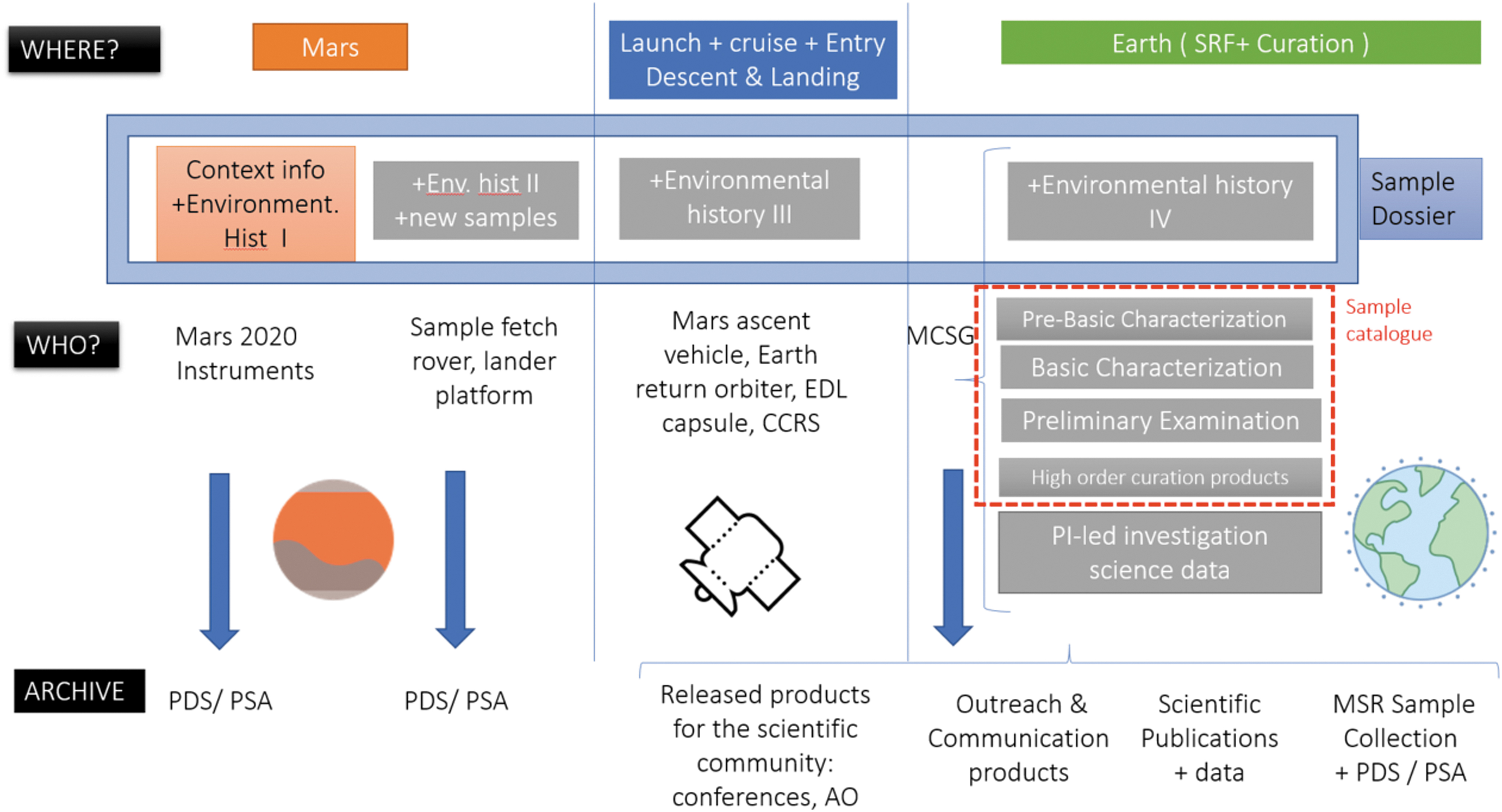
Overview of data deliverables produced during different stages of the MSR Campaign.
While specifics of the overall data management approach will be described in the Data Management Plan, high level considerations may include:
All scientific datasets of the selected objective-driven science investigations are shared with the entire MSST.
Each scientific dataset has a well-defined owner (i.e., a PI).
Within the proprietary period, scientific datasets can only be used by members of the MSST for publication after agreement provided by the owner of the scientific dataset.
After a proprietary period of X years (TBD), all standard scientific datasets become publicly available at the NASA PDS and ESA PSA archives.
Defined engineering datasets of the MSR program flight elements to support the scientific analyses and interpretation of the scientific datasets will be available to the MSR CSG.
All defined engineering datasets of the MSR flight elements will become publicly available within six months of acquisition through the NASA PDS and ESA PSA archives.
The aim should be to coordinate global scientific publications and conference abstracts to (i) help focus effort and attention in key areas and ensure that the entire scientific community has an opportunity to contribute; (ii) minimize duplication of effort or misuse of samples; (iii) ensure that appropriate credit is properly attributed; and (iv) make a long-term plan for the sample release that allows for new techniques to be developed and new resolutions/accuracies of the instrumentation in the future.
This coordination will require specific procedures for the MSST to follow as they develop abstracts and manuscripts that describe scientific data. Instructions for seeking MCSG approval, procedures for communicating with the MSST about the dissemination of science results, and authorship guidelines should be described in the MSST Rules of The Road when it becomes available. In parallel, the appropriate data (as will be described in the Data Management Plan) should be released and archived at the PDS/PSA or equivalent online archive in a timely manner.
Scientific data produced by the M2020 mission are managed outside the scope of the MSR SMP. Details for its handling and dissemination can be found in the M2020 Science Team Guidelines (RD-02).
M2020 Sample Dossiers
The overarching goal for M2020 is to document as much auxiliary information (metadata) as possible about each sample in a readable manner, beginning from well before the sample is collected until the sample is placed in a depot or transferred to the SRL.
For each sample, an initial dossier (or field notebook) will be prepared. As the information contained within will be of interest to the public and will influence future proposals for sample investigations, we recommend that the dossiers are released as soon as possible after sample collection. This initial dossier would be a public release by M2020 project science and could include the science rationale for collecting the sample(s) as follows: limited, though important, engineering data; volume assessment; and initial evaluation of the in situ science that led to sampling.
Subsequently, a full “Pathway to Sampling Package” (PSP) document should be produced, led by one of the M2020 RSS-PS for each sample. This document is designed to start from the notional proposal for collecting a sample long before collection, including rationale for targeting that type of sample, and would trace the entire target selection process from outcrop to selection of the abrasion target to selection of the actual cored sample. This package would also need to include the PDS reference of all the raw data of each instrument used to characterize the setting. The PSP may be updated with later additions, such as orbital observations, or observations from the fetch rover.
Data to be collected include the following:
The field notebook should adhere as much as possible to the standard format recommended for data submissions to the PDS an PSA (NASA 2020).
Sample environmental history
The MSR Campaign will be capable of delivering the samples to Earth, avoiding environmental extremes that would compromise the scientific integrity of the samples and providing knowledge of the environmental conditions that the samples experienced until recovery. It is of great scientific importance to document the environmental histories of the returned samples from collection through storage within the SRF to aid in interpretation of scientific results and provide recommendations for the engineering data and models that should be made available to the MSST prior to scientific investigations of the samples.
It is extremely important to maintain the scientific integrity of the samples to the highest degree. When possible, all sample environmental history data and associated models and relevant results from ground testing of flight elements should be published in the PDA/PSA or in peer-reviewed scientific journals as appropriate.
The data products most critical for interpreting data collected from the returned samples include the following:
These data products will be produced via combination of direct measurement by M2020 science instruments, Program element engineering sensors, data from orbiters, and numerical modeling efforts. The data should be added to the M2020 Sample Dossiers that will consist of all rover engineering data related to sample acquisition and caching, all relevant science data for documentation of the geological context of the sampling sites and collected samples, and all relevant environmental data at the time of sampling including outside temperature, pressure, humidity, and atmospheric opacity.
Sample initial characterization data
The primary output of the initial characterization process is a detailed sample catalog that documents the results of the measurements collected during Pre-BC, BC, and PE (MSPG 2021d). The goal of the catalog will be to provide sufficient information such that researchers can have a detailed enough understanding of material within the collection to base future allocation requests for investigation.
Any given measurement during this process may be needed for several purposes as follows: (i) to contribute to sample catalog production; (ii) to satisfy the SSAP; and/or (iii) be included in a scientific investigation. To ensure proper scientific usage, all PE data products should first be reviewed by the MCSG and MSST to evaluate whether they are considered sensitive to a given investigation. If so, the data would be treated under the proprietary period described in Section 5.7 and utilized for the target publication. If not, data can immediately be placed into the catalog (Figure 7).
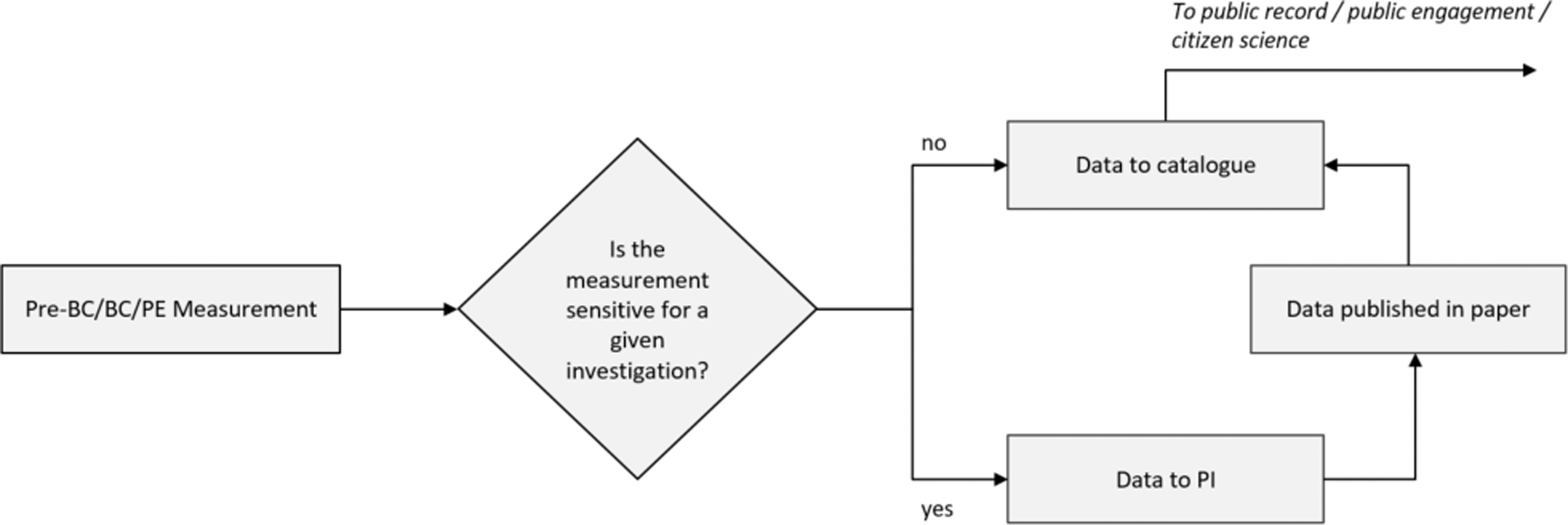
Decision tree to be applied to all measurements collected during the initial stages of sample interrogation. If the measurement is crucial to a given investigation and release could impact the ability to publish the study, it is first provided to the investigation PI for proprietary usage prior to entry into the public catalog.
As a living document, the catalog would be maintained as new information becomes available about a given sample. For example, higher order data products (e.g., CT scans that users can manipulate) may be added to the catalog after initial characterization is complete.
Treatment of any scientific data collected by MSR Program elements or via objective-driven investigations should be described clearly in their respective Rules of the Road document(s) (Section 4.2.1). The following data management considerations could be included by using the M2020 Science Team Guidelines as a model:
Publication rights
The approach to publication of scientific data from Program element efforts or from ground-based sample investigations will also be crucial to define clearly. As with science data considerations, policies and procedures should be defined explicitly with the respective Rules of the Road documents.
While the full details will be developed later, significant guidance can again be sought from the M2020 Science Team Guidelines, which state that publications may include conference abstracts, presentations, and peer-reviewed articles in scientific journals. Specific processes and procedures could include the following considerations:
Building from the Apollo model, initial publications from the objective-driven investigations could be held under embargo for a TBD period of time, nominally one year. At that stage, articles would be released simultaneously and considered contemporaneous, which would prevent inter- or intra-team competitiveness or “scoops” in racing to be the first results published.
MSR Science Program Schedule
Timing of opportunities relative to key decision points and milestones
Many elements of the proposed MSR Science Program are interdependent, as the decision to trigger certain bodies or activities depends on reaching key milestones throughout the MSR Campaign. Broadly, there are four categories of schedule dependencies, in that the timing of events is measured relative to the following:
A brief description of each is provided immediately below, with notional dates indicated in parentheses.
Activities relative to MSR Campaign commencement
Activities relative to M2020 operations milestones
Activities relative to MSR Program milestones
Activities relative to sample arrival at Earth
Integrated timeline
A graphical representation of the overall Science Program Timeline is presented in Figure 8, providing key information for:
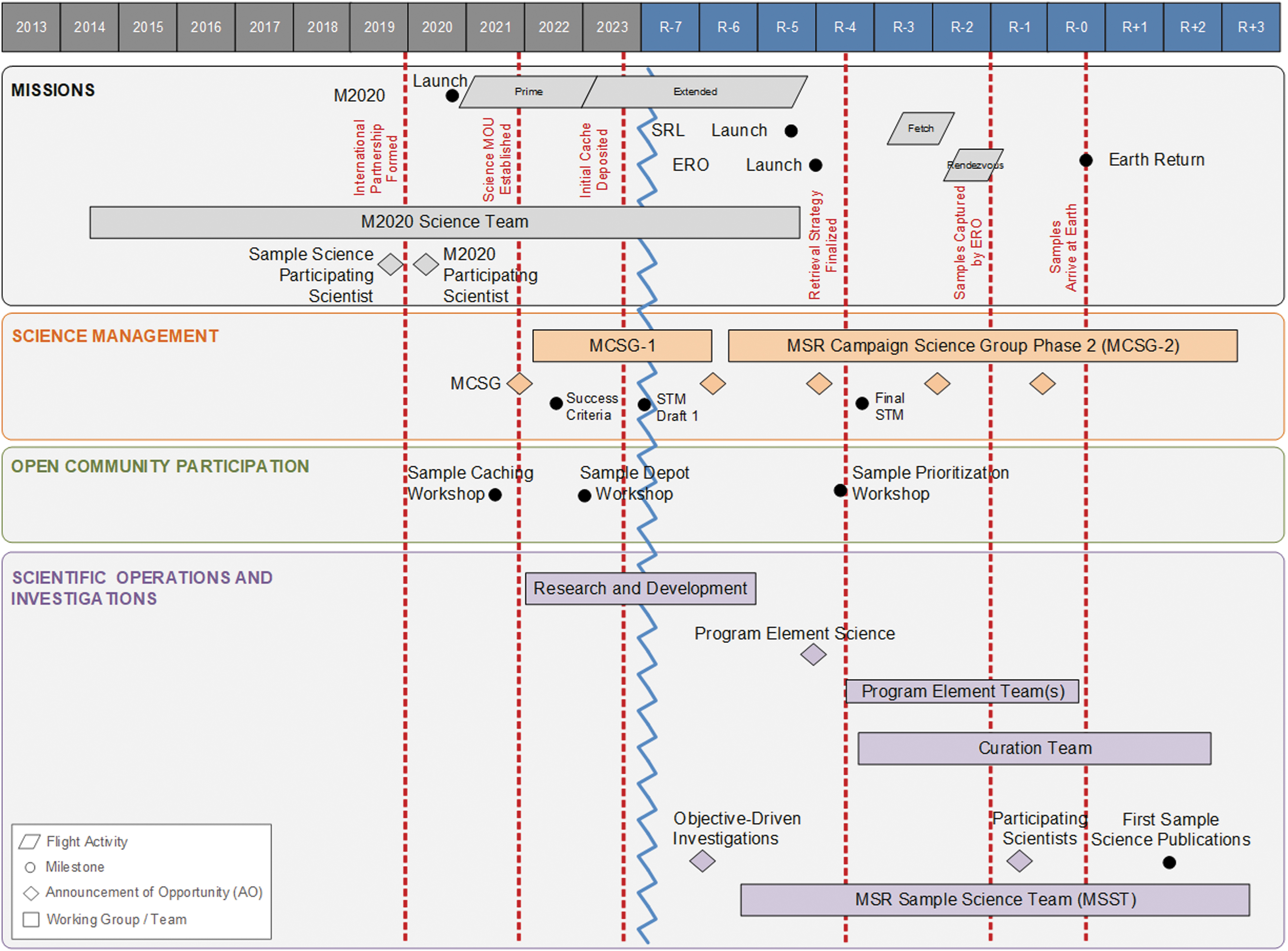
Integrated timeline of proposed MSR Science Program activities. Specific years are indicated up to 2023, after which years are measured relative to the year of the sample arrival at Earth (R-0).
The schedule is derived from the two master timelines from the work of Meyer et al. (2021). In both of those versions, most sample collection at Mars is presumed to take place in the period 2021 to ∼2026, but they differ in that samples arrive at Earth in 2031 and 2033, respectively. The analysis in the present report concludes that because some of the early MSR science planning constraints are driven by sampling activity and later activity by receiving-related activity, the timeline has an “accordion-like” aspect to it (see saw tooth line) that is driven by what is happening around it. As such, later years in the timeline are measured relative to the year of the sample receipt at Earth (R-0).
Summary of Findings
The key report findings are summarized below for the convenience of the reader.
Response to Statement of Task
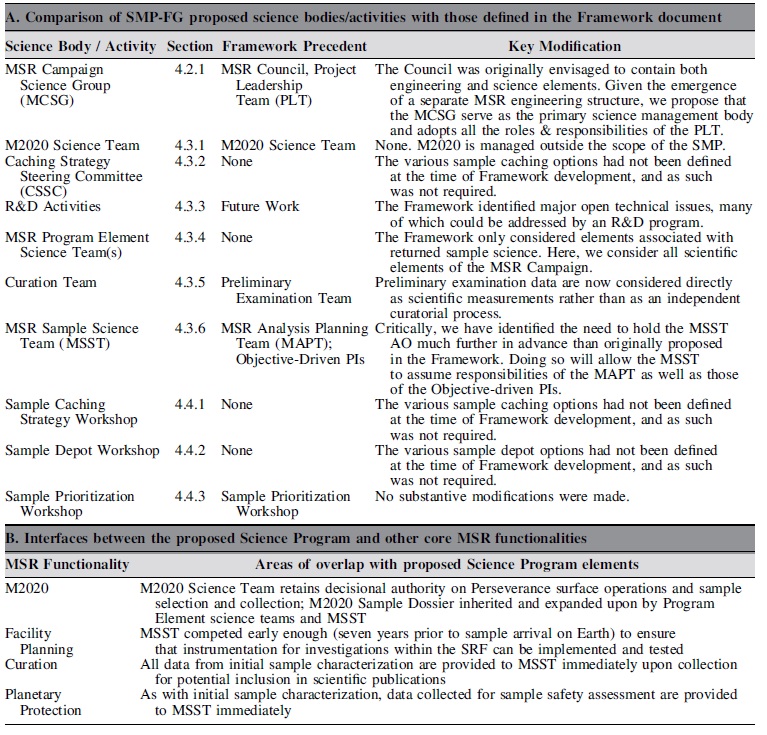
In providing inputs to an eventual MSR Science Management Plan, we were requested to either adopt or propose suitable alternatives to elements originally proposed in the MSPG Framework document (MSPG 2019c). We have tabled specific findings and proposals for the MSR Partners to now develop an integrated MSR Science Program, responding to our tasks as follows:
Response of MSPG-2 SMP-FG Work to its Statement of Task Described in Section 1.1: (A) Comparison of Proposed Science Bodies and Activities to Those Proposed in the MSPG Framework Document (MSPG, 2019c). The “Section” column Refers to the Section of this Report Where the Science Body or Activity is Described; (B) Identification of Potential Areas of Overlap Between the MSR Science Program Bodies and Other Key MSR Functionalities Managed Outside the Scope of an SMP
Response of MSPG-2 SMP-FG Work to its Statement of Task Described in Section 1.1: (A) Comparison of Proposed Science Bodies and Activities to Those Proposed in the MSPG Framework Document (MSPG, 2019c). The “Section” column Refers to the Section of this Report Where the Science Body or Activity is Described; (B) Identification of Potential Areas of Overlap Between the MSR Science Program Bodies and Other Key MSR Functionalities Managed Outside the Scope of an SMP
Noted in Section 3.2, three MSR IRB recommendations had direct bearing on our work. Where applicable, we have provided options for NASA and ESA management to provide responses to the recommendations through the following actions:
Adherence to guiding principles
The SMP-FG worked extremely hard to ensure that the proposed MSR Science Program is consistent with the guiding principles first outlined in the Framework:
Moving ahead, these principles lend themselves well to the development of both the Science MOU and the eventual SMP document itself. We offer them to ESA and NASA management for consideration and hope they can be used in the development and any subsequent modification of the Science Program documentation.
Scientific risk mitigation
The proposed Science Program outlined in this document represents a flexible structure that focuses on the samples themselves and on preserving the integrity and quality of work done on and with them. We have designed the plan to minimize the impact of certain risks as follows:
Moving forward, it will be crucial that NASA and ESA management develop a formal risk matrix for scientific elements of the Program that are tracked closely and mitigated.
The need for an integrated MSR Science Program
MSR is one of the most complex endeavors ever attempted by the international planetary exploration community. While this is certainly true from the scientific and technical standpoints, it is no less complex from a management perspective. Ensuring that all required scientific activities are properly designed, managed, and executed will require significant planning and coordination.
This report has listed a range of science functionalities required to satisfy the goals of MSR and has proposed bodies and activities that could be organized to do so. While we acknowledge that other end-to-end solutions may exist, it is evident that:
As a first step, formalizing the Science Program's management structure (via the MCSG) within the next year would ensure that shortly upcoming time-sensitive trades are conducted, and the resulting decisions are made with adequate scientific input. The MSR Campaign's engineering elements have already been sufficiently developed and funded; it is imperative that the same be achieved for science.
Footnotes
Acknowledgments
The decision to implement Mars Sample Return will not be finalized until NASA's completion of the National Environmental Policy Act (NEPA) process. This document is being made available for planning and information purposes only.
Disclosure Statement
No competing interests.
Funding Information
A portion of this work was funded by the National Aeronautics and Space Administration (NASA), the European Space Agency (ESA), and the Canadian Space Agency (CSA).
A portion of this work was carried out at the Jet Propulsion Laboratory, California Institute of Technology, under a contract with the National Aeronautics and Space Administration (80NM0018D0004).
This work has partly (H. B.) been carried out within the framework of the NCCR PlanetS supported by the Swiss National Science Foundation. M.A.V.'s participation in MSPG2 was supported in part by a sabbatical leave-of-absence from Michigan State University. M.-P.Z. was supported by projects PID2019-104205GB-C21 of Ministry of Science and Innovation and MDM-2017-0737 Unidad de Excelencia ‘Maria de Maeztu’- Centro de Astrobiología (CSIC-INTA) (Spain).
A portion of this work was carried out at the Jet Propulsion Laboratory, California Institute of Technology, under a contract with the National Aeronautics and Space Administration (80NM0018D0004).
The decision to implement Mars Sample Return will not be finalized until NASA's completion of the National Environmental Policy Act (NEPA) process. This document is being made available for planning and information purposes only.