






Abstract
The Tanpopo experiment was the first Japanese astrobiology mission on board the Japanese Experiment Module Exposed Facility on the International Space Station (ISS). The experiments were designed to address two important astrobiological topics, panspermia and the chemical evolution process toward the generation of life. These experiments also tested low-density aerogel and monitored the microdebris environment around low Earth orbit. The following six subthemes were identified to address these goals: (1) Capture of microbes in space: Estimation of the upper limit of microbe density in low Earth orbit; (2) Exposure of microbes in space: Estimation of the survival time course of microbes in the space environment; (3) Capture of cosmic dust on the ISS and analysis of organics: Detection of the possible presence of organic compounds in cosmic dust; (4) Alteration of organic compounds in space environments: Evaluation of decomposition time courses of organic compounds in space; (5) Space verification of the Tanpopo hyper-low-density aerogel: Durability and particle-capturing capability of aerogel; (6) Monitoring of the number of space debris: Time-dependent change in space debris environment. Subthemes 1 and 2 address the panspermia hypothesis, whereas 3 and 4 address the chemical evolution. The last two subthemes contribute to space technology development. Some of the results have been published previously or are included in this issue. This article summarizes the current status of the Tanpopo experiments.
Introduction
The Tanpopo experiment is the first Japanese astrobiology mission on board the Japanese Experiment Module (JEM, known as Kibo) Exposed Facility (EF) of the International Space Station (ISS). Tanpopo means dandelion in Japanese, whose seeds are distributed by winds, and is a metaphor for panspermia. The experiments were designed to address two important astrobiological questions, panspermia and the chemical evolution toward the origin of life. In addition, these experiments were designed to test low-density aerogel and monitor the microdebris environment around low Earth orbit. This review summarizes the objectives of the Tanpopo experiments, which consist of two types of experiments: exposure and capture. Exposure experiments included exposure of microbes to the space environment to test survival and exposure of organic compounds to test their stability in the space environment. Capture experiments used aerogel blocks to capture hypervelocity impacting particles. After an initial microscopic observation of the surface of the aerogel, each track was isolated as the aerogel block surrounding the track. Each aerogel block with a track was delivered to scientists for further analyses including inorganic analysis, organic analysis, and microscopic inspection of the microbes. In this article, we introduce the scientific objectives and the current status of the Tanpopo experiment, as well as the results obtained so far. The apparatuses and procedures of Tanpopo are reviewed in an accompanying article of this issue (Yamagishi et al., 2021).
1. Capture of Microbes in Space (Subtheme 1): Estimation of the Upper Limit of Microbe Density in Low Earth Orbit
There is a long history of microbe-collection experiments at high altitude. Microbes have been collected at altitudes from 3 to 78 km with balloons, aircraft, and meteorological rockets from 1936 to 1976 (Rogers and Meier, 1936; Bruch, 1967; Imshenetsky et al., 1976). Spore-forming fungi and bacilli, and micrococci have been isolated in these experiments. However, the experiments were done before the development of modern molecular biology, and only the taxonomic affiliation was analyzed on the isolates. The maximum altitude at which microbes can be located has still not been established.
Previously, we conducted microbe-sampling experiments on aircraft (Yang et al., 2008a). Microbes were isolated from the particles collected at altitudes from 0.8 to 12 km. The small subunit ribosomal RNA genes of the isolated microbes were analyzed, which revealed that the isolates belong to spore formers (Streptomyces, Bacillus, and Paenibacillus) and Deinococcus-related species, two of which were found to be new species; we named them D. aerius and D. aetherius (Yang et al., 2008a, 2009a, 2009b).
Deinococcus radiodurans is the species that is known to be most radioresistant. Subsequently, we analyzed the UV resistance of high-altitude isolates. Two of the high-atmosphere isolates, D. aerius and D. aetherius, showed UV resistance similar to or higher than that of Deinococcus radiodurans. The flux of UV light at high atmosphere is expected to be much higher than ground surface. Accordingly, it is reasonable that the microbes isolated at high atmosphere show high UV resistance (Yang et al., 2008a, 2009a, 2009b).
We also conducted microbe-sampling experiments using balloons. The sampling device consists of a vacuum pump and filtration system. The air was incorporated by a vacuum pump and passed through an ultra-membrane filter. About 10 m3 (corresponding mass at standard temperature and pressure) of air was sampled at altitudes from 20 to 35 km. Four strains of spore-forming bacteria were isolated from the balloon sampling experiments. The results have been published (Yang et al., 2008b).
To extend sampling at altitude, we proposed the microbe collection experiment on the ISS-JEM. The microbe/particle collection on the ISS required a completely different strategy. We used ultralow-density aerogel for the sampling experiments. If microbes are present at ISS altitude, most of them are expected to have Earth orbit velocity, because the particles with higher or lower velocity are expected to have shorter lifetimes in the orbit, either escaping from or falling down to Earth. The expected relative velocity of the microbes against aerogel on the ISS was up to 16 km/s depending on the direction of the microbe relative to the ISS movement.
Another point that had to be considered was the survival of microbes in the environment where the UV dose is high. The single cell of a microbe is not expected to survive under a high UV dose. However, if the microbes are present in mineral particles or in aggregated particles of microbial cells, there will be much higher possibility of survival (Horneck et al., 2001; Onofri et al., 2012; Panitz et al., 2015; Kawaguchi et al., 2020).
An ultralow-density silica aerogel is a dried SiO2 gel with an amorphous structure. Projectiles traveling at hypervelocity (on the order of km/s) are severely damaged when they hit most materials; however, ultralow-density silica aerogel offers the advantage that it does much less damage to an impacted projectile (reviewed in Burchell et al., 2006). When projectiles doped with Rhodococcus were used for a light-gas gun experiment, no impact crater surface yielded colonies of Rhodococcus (Burchell et al., 2001). However, for four shots of bacteria into rock (two on chalk and two on granite), the ejecta was afterward found to give colonies of Rhodococcus. Shots into aerogel were also carried out (two with clean projectiles and two with projectiles with Rhodococcus). No evidence for Rhodococcus growth was found from the projectiles captured in the aerogel from any of the four shots (Burchell et al., 2001). An investigation that involved firing bacteria-laden projectiles into semisolid nutrient medium targets confirmed the possibility of survival of the bacterial cells, with a survival rate of 1 per 3.5 million (Mann et al., 2004).
We tested the possible survival of microbes using clay particles containing microbial cells. The particles were accelerated to 4 km/s by a two-stage light-gas gun and targeted to aerogel. Aerogel blocks with impact tracks were stained with fluorescent pigment and inspected with a fluorescence microscope. Fluorescent particles were detected in the aerogel, suggesting that microbial DNA remained on the aerogel (Kawaguchi et al., 2014). Assuming a random distribution of the direction of microbe particles in the ISS orbit, about 17% of particles containing microbes are expected to be at a relative velocity of less than 4 km and would therefore have a chance to be detected after colliding with the aerogel.
During the Tanpopo experiments, we collected more than 300 hypervelocity impact tracks larger than 0.1 mm on aerogel blocks returned over 3 years. We are on the way to analyzing the hypervelocity impact tracks, and the results will be published elsewhere.
In this context, it is worth noting that the particles released from the ISS, intentionally or accidentally, have low relative velocity to aerogel and are not expected to form hypervelocity impact tracks. The surface of the aerogel is going to be analyzed as a reference.
2. Exposure of Microbes in Space (Subtheme 2): Estimation of the Survival Time Course of Microbes in the Space Environment
Various microbial space exposure experiments have been conducted to assess the potential for panspermia (Cottin et al., 2017). Those studies have revealed that microbes protected by a mixture of small pieces of rock, sugar, or clay thick enough to protect them from UV light survived for long periods of time in space (the “lithopanspermia” hypothesis) (Onofri et al., 2012). We also proposed the possibility of interplanetary transfer of submillimeter-scale cell aggregates to survive in the harsh space environment (the “massapanspermia” hypothesis) (Kawaguchi et al., 2013). The microbial space exposure experiment conducted by the Tanpopo experiment was performed to test whether massapanspermia of terrestrial microbes is possible and to estimate the survival time course of terrestrial microbes in outer space.
Very few preceding space exposure experiments of microbes have been conducted under the same exposure conditions with different exposure durations. BIORISK by a Russian group was the only preceding space exposure experiment that included parallel space exposure experiments with different exposure periods. However, the survival curves (time courses) of terrestrial organisms exposed in space have not been reported (Novikova et al., 2011).
The Tanpopo experiment was designed to estimate survival curves by conducting a series of microbial space exposure experiments of different durations (1, 2, and 3 years) in parallel for the species listed in Table 1 (Kawaguchi et al., 2016, 2020). This experiment design allowed us to obtain and extrapolate the survival curve to estimate the longer-term microbial survival in space. We designed two types of space exposure conditions using dried cells: (1) Full exposure and (2) Shaded from sunlight. We also prepared a series of samples with different thickness of desiccated cell aggregates for space exposure experiments, especially for Deinococcus spp. (Kawaguchi et al., 2016, 2020). Our objective was to estimate the effect of UV irradiation on microbial survival. In particular, by comparing survival curves of wild type and three DNA repair-deficient mutant strains of D. radiodurans (Table 2), we estimated which types of DNA repair systems are responsible for repairing DNA damage suffered during the space exposure experiment in the Tanpopo experiment (Kawaguchi et al., 2020).
List of Microbe Species and Strains Exposed in Tanpopo Experiment
Samples were exposed to sunlight under a MgF2 window (UV >110 nm) or SiO2 (quartz) window (UV >170 nm), or kept in the dark.
The mutant strain deficient in condensed nucleoid-dependent end joining pathway (CNDEJ) owing to a mutation in the pprA gene.
The mutant strain deficient in extended synthesis dependent strand annealing (ESDSA) process followed by homologous recombination (HR), owing to a mutation in the recA gene.
The mutant strain deficient in nucleotide excision repair (NER) and UV-damage excision repair (UVER), owing to mutations in uvrA and uvdE genes.
Detailed studies on the space exposure experiment will be published elsewhere.
Post-Exposure Analyses of Deinococcal Species in Tanpopo Experiment
Reported in Kawaguchi et al. (2020).
Reported in Fujiwara et al. (2021).
Reported in Ott et al. (2020).
Only first-year samples were analyzed (reported in Yamagishi et al., 2018).
In addition, we evaluated DNA damage under different space exposure conditions using various methods (Table 2): (1) Degree of double strand break of genomic DNA of deinococcal species was visualized by using pulsed field gel electrophoresis (PFGE) (Kawaguchi et al., 2020); (2) Copy numbers of intact rpoB gene (for RNA polymerase subunit β) in exposed cells were evaluated by quantitative polymerase chain reaction (qPCR) (Kawaguchi et al., 2020); and (3) The mutations of D. radiodurans R1 were evaluated by mutation analysis of the rpoB gene of rifampicin resistance (Fujiwara et al., 2021). Transcriptome and proteome analyses of the recovery phase of D. radiodurans R1 exposed to space were performed to clarify which genes (proteins) and biological pathways are important for the survival of space-exposed microbes (Ott et al., 2020).
Several results were obtained from the exposure experiment by using the deinococcal species. There were no apparent differences between survival rates nor the slopes of survival curves (plotted exponentially) of D. radiodurans strains between ground control samples and space exposure samples. The survival slopes of the DNA-deficient mutant strains were similar to each other, with the exception of D. radiodurans UVS78 that had an accelerated survival slope relative to other strains exposed to sunlight. This suggests that nucleotide excision repair (NER) and/or UV-damage excision repair (UVER) pathways, which are deficient in UV78 strain, are important to repair the damaged DNA suffered during space exposure under sunlight (Kawaguchi et al., 2020; Ott et al., 2020). Kawaguchi et al. (2020) also suggested that cell pellets with a diameter of 1 mm will be protected from UV light and were estimated to survive for 2–8 years in the space environment by extrapolating the survival curve and taking the lighting efficiency of the space experiments into account. This is long enough for the journey between Earth and Mars based on the shortest pathway (Kawaguchi et al., 2020).
The Nostoc sp. HK-01 cells dried on the aluminum sheets were also exposed to space (Table 1). Returned Nostoc sp. HK-01 cells were stained with 3'-, 6'-diacetyl-fluorescein (FDA). FDA is hydrolyzed to form fluorescein, which emits green fluorescence and can detect enzymatic activities of esterases and other enzymes (Arai et al., 2008). The survival tests and other studies on the Nostoc sp. HK-01 cells exposed to space will be described elsewhere.
3. Capture of Cosmic Dust on the ISS and Analysis of Organics (Subtheme 3): Detection of the Possible Presence of Organic Compounds in Cosmic Dust
Organic compounds likely accumulated on the surface of Earth before the emergence of life. In the 1950s through to the 1970s, a wide variety of laboratory simulation experiments were conducted; these suggested that various bioorganic compounds such as amino acids could be formed by thunderstorms and other energetic input if the terrestrial paleo-atmosphere was strongly reducing (i.e., contained a mixture of methane and ammonia as the major constituents) (e.g., Miller, 1953; Kobayashi et al., 2017). However, the primitive Earth atmosphere was considered to be less reducing (e.g., Catling and Kasting, 2017). Although some amino acids and nucleic acids could be formed in slightly reducing gas mixtures (e.g., a mixture of CO2, CO, N2, and H2O) by particle irradiation or in high-temperature plasma (Miyakawa et al., 2002), prebiotic formation of amino acids and other organic compounds would be more difficult than previously believed.
A wide variety of organic compounds have been found in such extraterrestrial bodies as meteorites (carbonaceous chondrites) and comets (e.g., Kvenvolden et al., 1970; Kissel and Krueger, 1987). Chyba and Sagan (1992) estimated that more than 100 kt of organic carbon had been delivered to Earth on extraterrestrial bodies including meteorites, comets, and interplanetary dust particles (IDPs). Amino acids have been detected in hot water extracts from carbonaceous chondrites, and more than 80 amino acids have been identified from the Murchison meteorite (Glavin et al., 2020). Amino acids found in carbonaceous chondrites were mostly racemic mixtures, but Cronin and Pizzarello (1997) found enantiomeric excesses of some amino acids in the Murchison meteorite, which suggested that extraterrestrial amino acids could have been seeds of homochirality of terrestrial amino acids; terrestrial organisms basically utilize only L-amino acids, whose origin has been a large enigma in the study of origins of life. Some laboratory experiments suggested that the enantiomeric excesses of meteoritic amino acids might have been generated by circularly polarized light irradiation in space (Takano et al., 2007; Modica et al., 2014).
Glycine, the simplest amino acid, was detected in coma particles returned by the Stardust mission (Elsila et al., 2010), and the presence of free glycine in the cometary atmosphere was suggested by in situ analysis by the mass spectrometer on board the Rosetta orbiter (Altwegg et al., 2016).
In addition to amino acids, presence of some nucleic acid bases (Martins et al., 2008) and sugars (Furukawa et al., 2019) in carbonaceous chondrites has been reported.
Among extraterrestrial bodies, IDPs were most promising carriers of organics to Earth, since more organic carbons could be delivered by IDPs than by comets and meteorites (Chyba and Sagan, 1992); and organic compounds in micrometer-sized IDPs could reach to Earth's surface without fatal destruction during landing. Recently, micrometeorites (MMs) with quite high carbon content were discovered in Antarctica ices, which were referred to as ultracarbonaceous Antarctic micrometeorites (UCAMMs) (Yabuta et al., 2017). Large comets and meteorites at or greater than 1 m in diameter would collide with Earth at high speeds (ca. 10 km/s), thereby destroying all organics unless the incidence angle was large enough (Pizzarello and Chyba, 1999).
However, we have less information on organics in IDPs (often referred to as micrometeorites [MMs] if they are sampled on Earth's surface) than meteorite organics. Matrajt et al. (2004) reported that α-aminoisobutyric acid, one of the nonprotein amino acids rarely found in the terrestrial biosphere, was detected in MMs recovered from Antarctic ices. Thus, we could say that IDPs (or MMs) could carry some amino acids to Earth. With respect to carbonaceous chondrites, such as CM2-type chondrites like the Murchison meteorite, about 0.1% of total organic carbons are in the form of amino acids, while the major organic compounds are insoluble organic matter (Kvenvolden et al., 2000). In the case of IDPs/MMs, however, it is quite difficult to estimate the amino acid fraction in the organic compounds, since IDPs were collected in terrestrial biospheres. Most MMs were recovered from Antarctic ice after thawing. Some amino acids might have dissolved in the water as it melted, or some amino acids present might reflect contamination from the environment.
Another problem is that tiny IDPs have been directly exposed to solar UV and cosmic rays, and subsequently the organic compounds may have decomposed before arriving to Earth. Organic compounds inside meteorites and comets are protected from the effects of solar UV and cosmic rays. This problem will be discussed in the next section.
We planned to collect IDPs out of the terrestrial biosphere and to analyze their organic compounds. For the analysis of organic compounds on IDPs, the major problem is how to collect IDPs with ultrahigh velocity. We developed ultralow-density (0.01 g cm−3) silica aerogel and planned to utilize it to collect dust in low Earth orbit (see Section 5). Prior to its application in the space experiments, we performed simulation experiments by using a two-stage light-gas gun at ISAS/JAXA. (R)-2-aminobutyric acid (D-aminobutyric acid; AABA) was adsorbed in porous silica gel particles, which were used as samples. AABA was chosen due to low possibility of accidental detection from contamination, since it is nonprotein amino acid and rarely found in living organisms. Porous silica gel powder was placed in a “sabot” made of polycarbonate, released from the sabot and targeted to the aerogel at 4 km/s. Amino acids in the aerogel with a track made by the impact were analyzed after digestion with 5 M HF–0.1 M HCl and acid-hydrolysis. These simulations showed that AABA could be recovered in the aerogel tracks (Yamagishi et al., 2011). Alteration of complex organics in meteorites during capture of Murchison meteorite powder with aerogel was also studied. It was shown that Murchison organics could be recovered without severe alteration to the compounds when the powders with a velocity of 4.4 km s−1 were impacted onto the aerogels (Kebukawa et al., 2019). These results suggested that the Tanpopo aerogel was a promising media to collect extraterrestrial organic compounds.
In the Tanpopo experiment, we have collected IDPs with aerogel. We identified more than 300 impacting tracks larger than 0.1 mm based on initial microscopic observation of the aerogel blocks. We are making progress in analyzing the tracks to find the particles, and the inorganic and organic characteristics of the particles under analysis. The results will be published in the near future.
4. Alteration of Organic Compounds in Space Environments (Subtheme 4): Evaluation of Denaturation of Organic Compounds in Space
There has been much controversy about the origin and mechanism of formation of organic compounds found in meteorites, comets, and IDPs. One of the most popular scenarios was proposed by Greenberg (Greenberg and Li, 1997), and it suggested that extreme cold (10–20 K) of a dense cloud (molecular cloud) caused most molecules (e.g., H2O, CO, CH3OH, and NH3) to freeze onto the surface of interstellar dust to form an ice mantle. This ice mantle becomes irradiated with galactic cosmic rays and ultraviolet light induced by galactic cosmic rays, subsequently leading to formation of complex organics. Another possibility is a reaction in the interior of the asteroids, where an aqueous solution containing formaldehyde and ammonia is formed by the radioactive decay energy of 26Al (Cody et al., 2011).
A number of laboratory simulation experiments have been performed to examine formation of organic compounds including amino acids in interstellar dust environments (Kobayashi et al, 1995; Kasamatsu et al., 1997; Bernstein et al., 2002; Muñoz Caro et al., 2002) and asteroid interior environments (Kebukawa et al., 2017). These results suggested that amino acid precursors, rather than free amino acids, were formed in extraterrestrial environments such as interstellar ice and the interior of asteroids. The fact that the concentration of amino acids in water extract from carbonaceous chondrites increases after acid hydration (Glavin et al., 2020) also indicates that amino acids in meteorites are at least partially in the form of precursors.
Although we have limited knowledge on amino acid precursors that are present in extraterrestrial bodies, there have been some contributions to this topic. Hydantoins, typical cyclic amino acid precursors, were found in carbonaceous chondrites (Shimoyama and Ogasawara, 2002). Complex organics containing amino acid precursors were also found. When a possible interstellar media (a mixture of CO, NH3, and H2O) was irradiated by proton irradiation, relatively complex organics with molecular weights 1000 Da or over were formed, and various amino acids were formed after acid-hydrolysis (Takano et al., 2004).
Organic molecules containing amino acids and/or amino acid precursors formed in dense clouds and the interior of asteroids would be incorporated in meteorites, comets, and/or IDPs, and could have been delivered to primitive Earth. Before delivery, they would have been altered by various energies in space. If organics formed in space were carried by IDPs, they would be directly exposed to cosmic rays, solar energetic particles, and the full spectrum of solar radiation before reaching Earth. Thus, it is important to evaluate the stability of organics exposed to these energies to test whether these compounds could have arrived on primitive Earth as seeds of life.
It is of interest to examine how organic compounds are altered in space environments. There have been a great number of experiments on radiochemical and photochemical alteration of organic compounds in ground laboratories. In these experiments, either a light source or a radiation source was used. In interplanetary space, IDPs are exposed to various radiation and solar radiation.
Since it is quite difficult to expose target molecules to various types of energies at once, organic compounds should be exposed in space environments. There have been a number of space experiments to examine the stability of organic compounds by utilizing satellites and space stations (Mir, ISS). For example, the AMINO experiment was conducted as a part of the EXPOSE-R from 2009 to 2011, where amino acids were exposed to space on the Russian exposure facility Zvezda on the ISS (Bertrand et al., 2015). The PROCESS experiment was performed at the EXPOSE-E from 2008 to 2009 on the European Technology Exposure Facility (EuTEF) platform on the ISS (Bertrand et al., 2012). In these experiments, free amino acids were deposited on MgF2 windows with or without meteorite powders and then were exposed to space. Recoveries of target molecules with meteorite powders were higher than those without meteorite powders.
We exposed amino acids and their precursors on the ISS-JEM Exposed Facility. Though free amino acids have already been exposed to space, amino acid precursors that could be present in IDPs in addition to amino acids have never been used in space exposure experiments. We chose glycine, the simplest and one of the most abundant amino acids, and isovaline, a nonprotein chiral amino acid frequently found in carbonaceous chondrites. Two types of amino acid precursors were also selected. The first group was hydantoins; hydantoin (Fig. 1A) is a precursor of glycine, and 5-ethyl-5-methylhydantoin (Fig. 1B) is a precursor of isovaline. The second type included complex organics, precursors of various amino acids, formed by proton irradiation of a mixture of CO, NH3, and H2O; these were referred to as CAW.
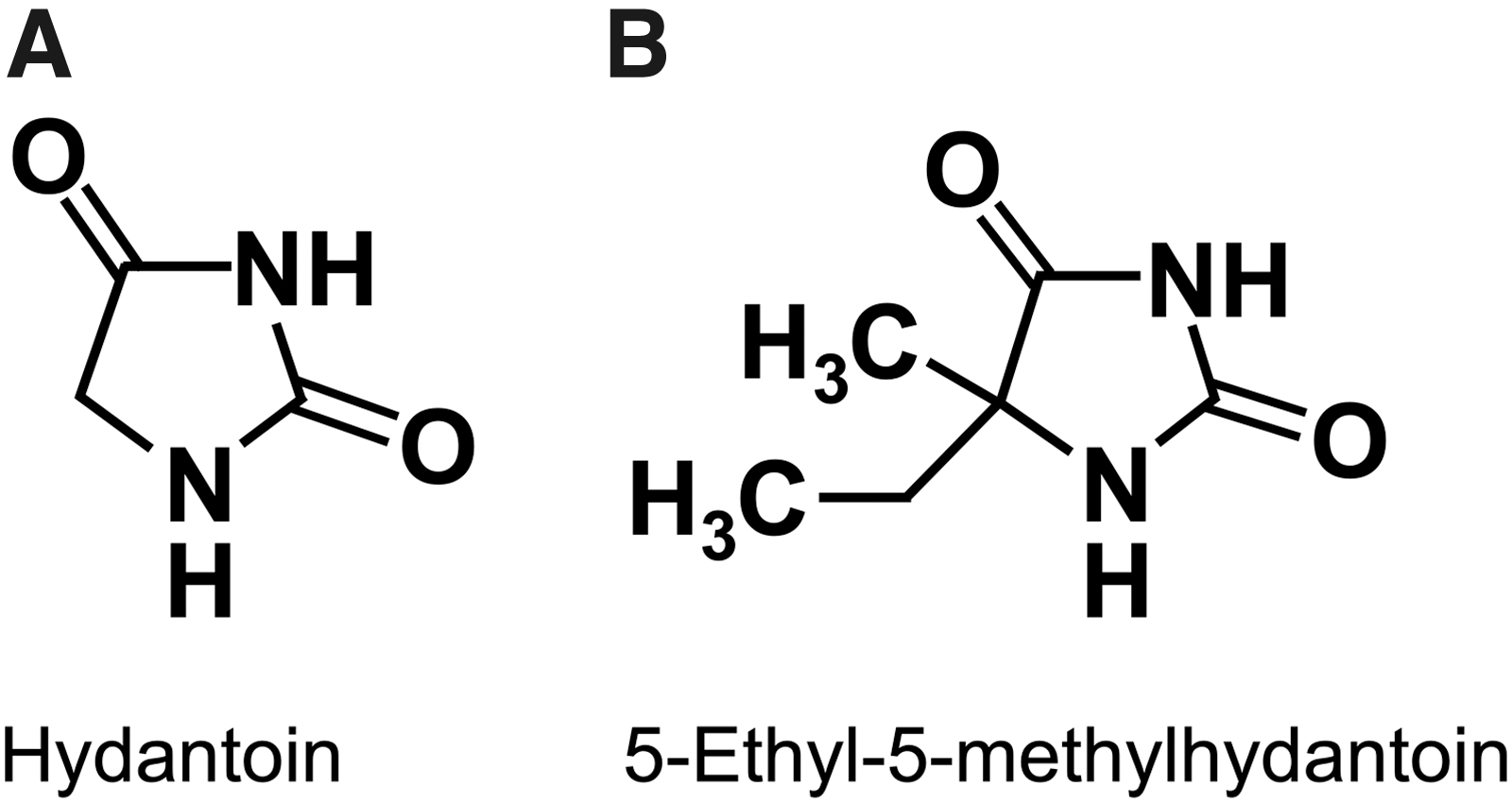
Hydantoins used in exposure experiments of Tanpopo experiment. IUPAC names:
Prior to the Tanpopo space exposure, these amino acids and amino acid precursors (hydantoins and CAW) were subjected to ground irradiation experiments (Kobayashi et al., 2014). They were irradiated with heavy ions, gamma-rays, X-rays, and vacuum ultraviolet light. The stability of these compounds at 100℃ was also examined. These stability tests showed that vacuum ultraviolet light was most fatal to these compounds, and amino acid precursors (hydantoins and CAW) had better stability than free amino acids.
Each compound was placed into pits on aluminum plates, dried, covered with hexatriacontane, and placed under a quartz or a MgF2 window in the exposure units. See the accompanying article about the detailed procedure and the apparatus (Yamagishi et al., 2021). The exposure units with organics were arranged on exposure panels, which were exposed in the space environment for 1, 2, and 3 years. The decomposition of these organic compounds was analyzed, and the results showed that the recovery of target molecules basically depended on their UV/VUV absorption spectra, but that the recovery of the complex amino acid precursors was higher than expected from their spectra. Some of these results are presented in an article in this issue (Kobayashi, et al., 2021).
5. Space Verification of the Tanpopo Hyper-Low-Density Aerogel (Subtheme 5): Durability and Particle-Capturing Capability of Aerogel
Test of space technology was included among the goals of the Tanpopo experiment. The aerogel used in the Tanpopo experiment was designed to serve in the central role of capturing and collecting IDPs and space debris in low Earth orbit. Capturing dust while keeping its composition intact as much as possible is directly connected to achieving the mission's objectives described in Sections 1, 3, and 6.
We have developed ultralow-density double-layer silica aerogel blocks with hydrophobic characteristics (Tabata et al., 2015). The aerogel block's surface layer was designed to have a density of 10 mg/cm3 (Tabata et al., 2010) and was positioned on the space-exposed surface side. The surface layer with a thickness of 10 mm at maximum is expected to capture dust as intact as possible by employing an aerogel with the lowest density ever used in previous space missions (e.g., Yano and McDonnell 1994; Tsou, 1995; Tsou et al., 2003; Brownlee et al., 2006; Noguchi et al., 2011; Westphal et al., 2014). The second layer with a density of 30 mg/cm3 formed a base under the 10 mg/cm3 layer. The robust base layer with a thickness of 7 mm helps mechanically support the fragile, lower-density surface layer throughout the operation period, including rocket launch and return to the ground. The base layer also ensures high-energy (large size or high velocity or both) dust particles that may penetrate the surface layer are stopped and captured. The two aerogel densities were clearly distinguished at the boundary, which facilitates ground-based calibration studies by hypervelocity impact simulation experiments (e.g., Kitazawa et al., 1999; Niimi et al., 2012), compared to gradient density aerogel blocks (Jones, 2007). We expect most incoming orbital dust would be trapped within the 10 mg/cm3 layer; thus, demonstrating the highest capture performance ever recorded is one of the multifaceted mission scopes.
Simultaneously, each density layer was chemically combined during the sol–gel synthesis process, forming a single aerogel block with a large area of 90 × 90 mm. The double-layer but monolithic aerogel block allowed for secure installation into an aluminum container Capture Panel (CP; see an accompanying article by Yamagishi et al., 2021). During the production process, the aerogel was rendered hydrophobic by surface chemical modification with trimethylsiloxy groups (Yokogawa and Yokoyama, 1995; Tabata et al., 2012); thus, the density increase due to moisture absorption is minimized during the long mission, including handling by astronauts inside the ISS pressurized module. Due to a dust particle's hypervelocity impact, an impact cavity (also called a track) is formed inside the aerogel. By analyzing the track shapes under an optical microscope, one can estimate physical parameters associated with the particle impact (e.g., the impact direction, velocity, particle diameter, density, and aggregation properties of dust grains) (for a review, see Burchell et al., 2006). These data are helpful to reveal the dust particle's origin in combination with direct chemical analyses of captured grains.
Our scientific and technological interests in the aerogel instrument span from physical to chemical aspects, including the dust capture performance investigation of the 10 mg/cm3 density, eligibility of the double-layered monolithic structural scheme for the orbital operations, and validity of the hydrophobic characteristic. These aerogel performances were evaluated by comprehensive analyses of both the aerogel and captured dust grains. All the returned aerogel blocks were subjected to quick evaluation during CP housing disintegration. No significant changes in the weight of the aerogel blocks were detected. No significant mechanical damage on the aerogel blocks interfering with the impact track analysis was observed: see below.
After transferring each aerogel block to a dedicated transparent holder, we took optical images of the aerogel surface exposed to space using an aerogel processor (Sasaki et al., 2019) equipped with a digital microscope. All features larger than 100 μm seen on the surface were recorded as candidates of hypervelocity-particle impact signatures. Serial images with different focal depth of the candidates were captured and used for identifying authentic impact tracks, which was allowed by the visible transparency of the silica-based aerogel. We identified 67 hypervelocity-particle impact-signatures in the eight aerogel blocks from the first return samples. Among them, 11 aerogel segments containing the impact cavities were cut by using the aerogel processor and manually extracted (Yano et al., 2017). These segments were subjected to microbial, organic, and mineralogical analyses in detail, and we are presently investigating the measurement results. Image recording and impact track processing of the aerogel samples returned in the second to fourth returns were also in progress, and the number of impact tracks identified exceeded 300. We plan to optically and physicochemically analyze the aerogel themselves to investigate a potential textural alternation in detail, which will be conducted after extracting major impact tracks to avoid unintended contamination to the collected particles. In conclusion, the Tanpopo aerogel functioned adequately to collect particles aboard the ISS and withstood the ground and orbital operations, including the ISS crews' handling in the pressurized module. The high capability of the aerogels used in the Tanpopo experiment for capturing hypervelocity-impacting particles will be investigated in more depth, combining the results from ground-based gas-gun calibration experiments, and the results will be published elsewhere.
6. Monitoring of the Number of Space Debris (Subtheme 6): Time-Dependent Change in Space Debris Environment
Space debris are human-made nonfunctional objects in Earth's orbit. The number of debris increases with expansion of the use of space. The size ranges from spacecraft size down to micrometer size. Even small debris can cause critical failure to spacecrafts, since the average debris impact velocity reaches 10 km/s in low Earth orbit. However, only large debris (greater than 1–10 cm) can be tracked by ground observation systems. Spacecraft cannot avoid smaller debris impacts. Therefore, spacecraft are designed based on consideration of small debris impact risks estimated from debris environment models. The purpose of this subtheme is to validate the debris environment model by evaluating debris impact craters on Capture Panels (CPs) returned from Tanpopo.
On the ground, hypervelocity impact experiments were designed for aluminum plates representing the same material as the frames of the CP. The crater shapes on the aluminum plates were investigated to confirm that crater volume had a strong correlation with debris impact energy. We developed an engineering equation for calculating debris impact energy using the volume of a crater on the frames of the CP (Takayanagi et al., 2014; Kurihara et al., 2015). The frames returned to the ground were analyzed with an optical microscope, and the volumes of craters larger than 0.05 mm in diameter were measured (Minakami et al., 2020).
Debris impact frequency on the CP was predicted by using MASTER-2009, which is a debris environment model developed by the European Space Agency. Among the debris fluxes crossing the ISS orbit, only the fluxes not shielded by the ISS structure can impact the CP. To consider this shielding effect, impact frequency was predicted with a debris impact risk analysis tool developed by JAXA (TURANDOT). A simplified ISS model was constructed in TURANDOT (Fig. 2), and the debris impact frequency on the CP was analyzed (Kurihara et al., 2015; Minakami et al., 2020).
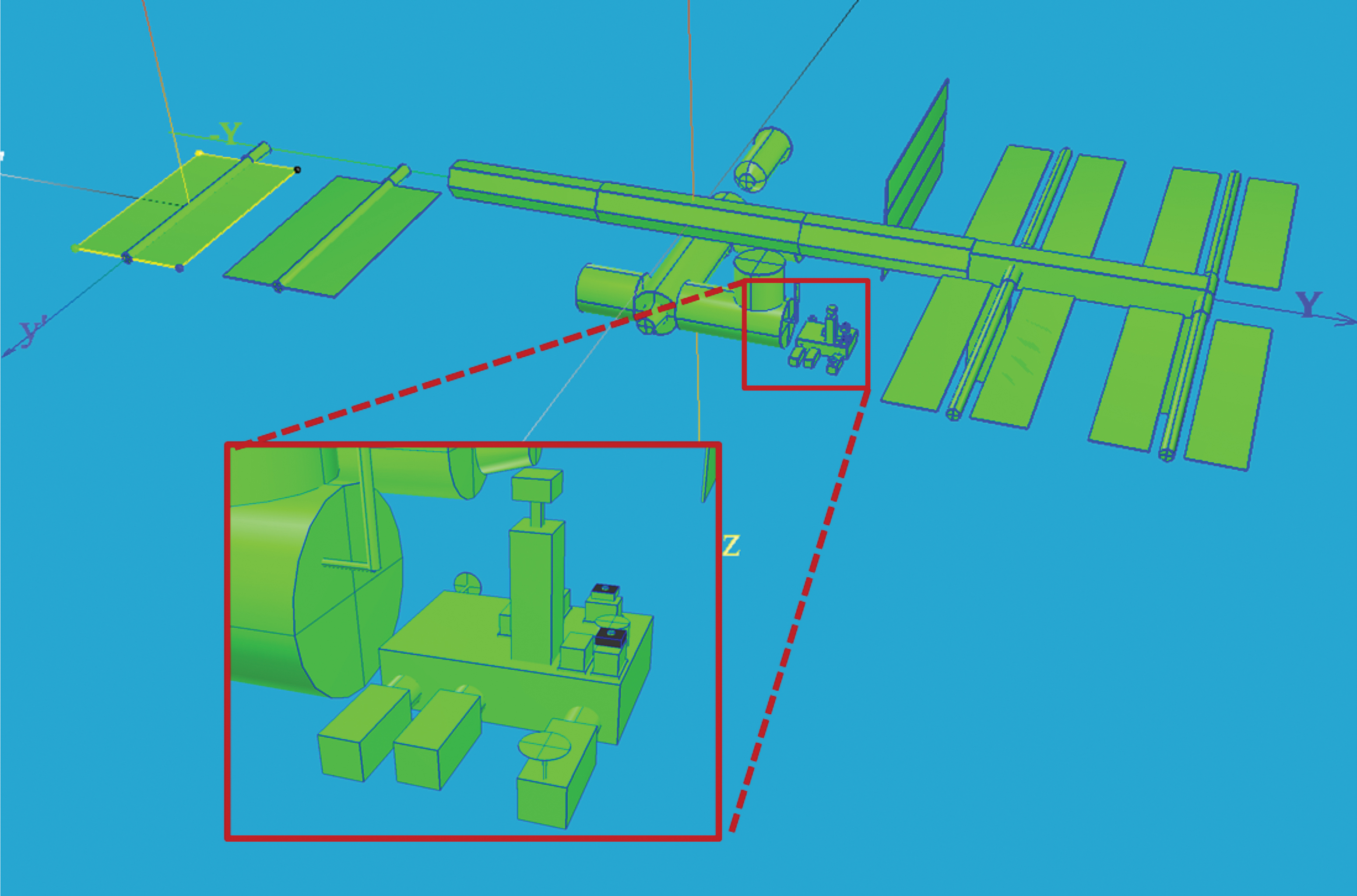
ISS and CP model in TURANDOT (Minakami et al., 2020). Color images are available online.
Figure 3 shows a comparison of impact frequency measured from the CP and that predicted by TURANDOT. The predicted frequencies showed a higher trend than measurement data, indicating that the debris environment model may overestimate the small debris impact risk. The annual frequency curves estimated from exposure data slightly varied every year; however, the predicted curves are almost the same. The results suggest that the current debris environment models need to be refined for the short-term variation (Minakami et al., 2020).
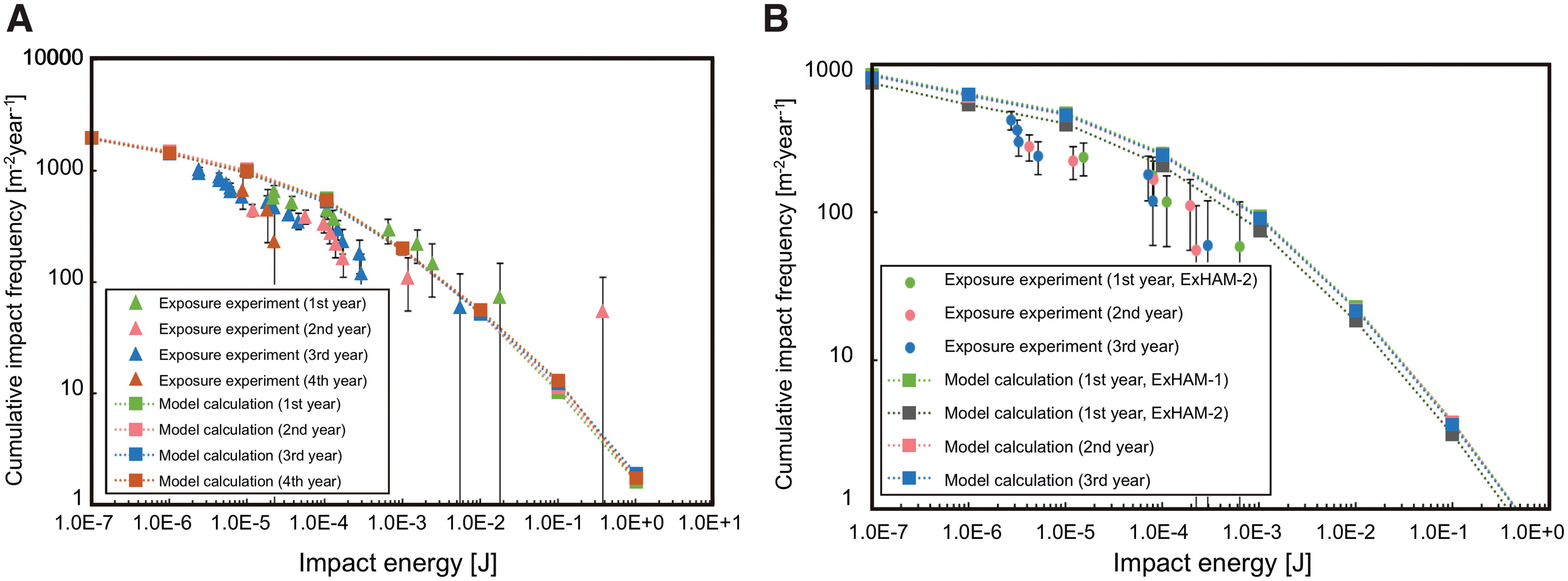
Comparison of the measured and the predicted impact frequencies (Minakami et al., 2020). (
Conclusion
This article provides a review and summary of the Tanpopo experiments done on the ISS from 2015 to 2019. Microbes and organic compounds were exposed to the space environment for 1, 2, and 3 years. The time-dependent survival of microbes and organic compounds was analyzed. Among others, D. radiodurans cell aggregates were expected to survive from 2 to 8 years in space when exposed to the Sun and 48 years shielded from sunlight. More than 300 high-velocity impact tracks were identified, and the tracks were distributed for the analysis of inorganic and organic compounds as well as microbes. Super-low-density aerogel developed and used in the Tanpopo experiment was found to be useful in space for capturing dust particles. Space debris numbers were estimated and may be a little less than expected.
Footnotes
Acknowledgments
We are grateful to JAXA and NASA for the excellent support during the space exposure experiment.
Authorship Confirmation Statement
A.Y., S.Y., K.K., H.M., H.Y., M.T., M.H., and H.Y. wrote the paper.
Funding Statement
The work was financially supported by JSPS KAKENHI Grant-in-Aid for Scientific Research (B) 16H04823, 20H02014. This work was also supported by the Astrobiology Center of National Institutes of Natural Sciences (AB282002, AB292002, AB302005, AB312006, and AB022002).
Authors' Disclosure Statement
The authors declare that the research was conducted in the absence of any commercial or financial relationships that could be construed as a potential conflict of interest.