






Abstract
The incarcerated population has little or no access to science education programs, STEM resources, or scientists. We explored the effects of a low-cost, potentially high-impact informal science education program that enabled NASA scientists to provide astrobiology lectures to adults inside 16 correctional institutions in three states. Post- versus pre-lecture surveys suggest that presentations significantly increased science content knowledge, positively shifted attitudes about science and scientists, increased a sense of science self-identity, and enhanced behavioral intentions about communicating science. These were significant across ethnicity, gender, education level, and institution type, size, location, and state. Men scored higher than women on pre-lecture survey questions. Among men, participants with greater levels of education and White non-Hispanics scored higher than those with less educational attainment and African American and other minority participants. Increases in science content knowledge were greater for women than men and, among men, for those with lower levels of education and African American participants. Women increased more in science identity than did men. Thus, even limited exposure to voluntary, non-credit science lectures delivered by scientists can be an effective way to broker a relationship to science for this underserved public group and can potentially serve as a step to broaden participation in science.
1. Introduction
Our nation's future prosperity relies on advancing the frontiers of science—and reaching our full potential requires including all Americans in that effort.
—France Cordova, National Science Foundation Director
T
However, one public group that has almost no exposure to the discipline of astrobiology, astrobiologists, or NASA's mission and discoveries in general are the over 2 million incarcerated adults and nearly 50,000 youth in federal and state prison, local jails, and juvenile detention centers in the United States (Minton and Zeng, 2015; Office of Juvenile Justice and Delinquency Prevention, 2017). Nationally, incarcerated populations have substantially lower literacy, numeracy, and educational attainment levels (defined as the last year of school completed) than non-incarcerated populations, and 30% lack a high school diploma or General Education Development (GED) equivalency (National Institute for Education Statistics, 2007; Rampey et al., 2016). In 2005, only 16% of the incarcerated population had attended a post-secondary institution, compared to 48% of the general population. These patterns make it challenging for the incarcerated to find employment and to participate as scientifically informed citizens in society after their release. Although some progress has been made on educational attainment in corrections institutions in the past decade, wide disparities remain (Schmalleger and Smykla, 2012; Rampey et al., 2016). Incarceration and recidivism levels have only slightly decreased over the past 5 years despite unprecedented spending on incarceration and other strategies aimed at criminal deterrence. Ethnic minorities (African Americans, Latinos, and Native Americans) continue to be disproportionately represented in this population; approximately 57% of prisoners are African American or Latino, although they make up only 29% of the population in the United States (U.S. Census Bureau, 2010; Carson, 2015).
A growing body of literature documents that providing pre-release education to incarcerated individuals supports a more successful return and reintegration into their communities (Porporino and Robinson, 1992; Vacca, 2004; Esperian, 2010). A comprehensive meta-analysis of 30 years of studies on correctional education commissioned by the Bureau of Justice Administration (including adult basic education, high school/GED, post-secondary education, and vocational training programs) documented strong positive outcomes following incarcerated people's exposure to education of any type (Davis et al., 2013; Bozick et al., 2018). Such exposure reduced the risk of recidivism by 13% and increased the probability of post-release employment by 13%. This pattern was echoed by reports in 2019, which showed that participation in college or post-secondary programs further reduces an individual's risk of recidivating. These reports provide solid evidence that correctional education programs are effective—and cost-effective—at improving employment outcomes for participants and at helping to keep formerly incarcerated individuals from returning to prison (Davis, 2019; Davis and Tolbert, 2019).
Despite generally low educational attainment, interest in education programs in incarcerated adults is high, with 42% having completed some level of education during their prison term. Of those not currently enrolled in an educational program, 79% reported an interest in doing so (Davis and Tolbert, 2019). About 90% of state and federal prisons and about 60% of local jails provide some access to educational programs (National Institute for Education Statistics, 2007; Schmalleger and Smykla, 2012). Higher education programs for the incarcerated have been available in prisons of 33 states (e.g., Bard Prison Initiative, University Beyond Bars, Freedom Education Program of Puget Sound, San Quentin Prison University Project, Illinois Prison Program, Pathways Initiative) (Karpowitz, 2005; Stephan, 2008; Davis and Tolbert, 2019). However, the most prevalent education programs focus on preparing for the GED (basic arithmetic and reading) (76% of state institutions) and vocational training (50% of state institutions) (Stephan, 2008). Therefore, the majority of the incarcerated have little or no contact with STEM education, STEM resources, or scientists.
Multiple factors constrain the expansion of formal correctional science education programs (those that provide credit-bearing courses that may lead to a formal degree or certification). First, these programs are difficult and time-consuming to initiate, maintain, and evaluate, especially in states where legislators find it politically inexpedient to expend state funds on education for people living in jails or prisons. Second, because most incarcerated students have little financial capacity to pay for tuition, they nearly always require substantial financial support from outside resources such as foundations or academic institutions. Third, incarcerated individuals are often transferred unpredictably between cellblocks and institutions, which makes the commitment to complete a required sequence of classes difficult. Finally, these activities must meet the administrative and logistical challenges of working with correctional institutions, whose missions typically mandate that they prioritize public safety over the long-term benefits that correctional STEM education might provide.
The approach of informal science education (ISE) may help reduce some of the barriers between STEM education and the incarcerated. Similar to other ISE programs (e.g., after-school science clubs, science museum visits), informal science instruction in correctional institutions may provide an appreciation for, understanding of, and inspiration to learn about and practice science (UNESCO, 2006). The goals of ISE—fostering changes in knowledge and understanding, and appreciation for critical thinking and scientific processes (McCallie, 2009; Bell et al., 2009)—are congruent with those of formal science education. However, ISE programs require far less administrative overhead and provide teaching opportunities that include researchers of any discipline, and so can be more nimble in their implementation and cost less in time and funding to maintain. In the last decade, a handful of academic institutions have implemented ISE programs that bridge the gaps between science and the incarcerated (Ulrich and Nadkarni, 2009; Nadkarni and Pacholke, 2013; LeRoy, 2015; Weber et al., 2015; Trivett et al., 2017; Nadkarni and Morris, 2018). Because of the constraints of obtaining human subjects' permissions to reduce risk to these vulnerable populations, very little quantitative evaluation has been carried out to determine the effects of these programs on science content learning, values of science, self-identity of participants, and behaviors about communicating what they learn to others.
Most of these ISE programs are implemented though universities and colleges. Government science agencies have been little involved in such activities, even though many of them have missions that include informing all members of the public about their activities, accomplishments, and discoveries. Here, we describe a program that brings STEM lectures and workshops presented by scientists affiliated with one major scientific agency, the National Aeronautics and Space Administration (NASA, 2015), to incarcerated adults inside correctional institutions in three states. We (a) characterized each institution and the incarcerated population residing in these institutions; (b) assessed the effects of astrobiology lectures on incarcerated individuals' content knowledge, attitudes about science and scientists, behavioral intentions to communicate what they learned from the lectures, and self-identity as science learners; (c) determined whether these effects varied by participant ethnicity, gender, or educational background, or institution size, type, or location; and (d) drew insights about how these findings might apply to other populations that have limited access to science education.
1.1. Program history
Two existing programs served as the foundation for this study: the Initiative to bring Science Programs to the Incarcerated (INSPIRE), which was established in Utah in 2014, and the Sustainability in Prisons Project (SPP), a partnership founded by The Evergreen State College and Washington Department of Corrections, established in 2003. Both programs bring science lectures, conservation projects, nature, and nature imagery to the incarcerated (Ulrich and Nadkarni, 2009; LeRoy, 2015).
In these programs, scientists provide monthly science lectures and workshops that provide incarcerated people with (1) access to science and scientists to inspire interest in, and a sense of connection to, the scientific enterprise; (2) knowledge of science content on a wide range of scientific topics and fields; (3) encouragement to communicate information about science to others; and (4) opportunities to shift their self-image from being “science-incapable” to being “science learners.” Participation in both programs is voluntary for incarcerated people and scientists and is not tied to any formal curriculum. Participation in INSPIRE's lecture series does not provide academic credit for the general prison population but does contribute to academic high school credit for those enrolled in South Park Academy (at the Utah State Prison) for GED programming. Participation in 20 of SPP's workshops can earn participants a post-release certification and college credit through the Certified Learning Program at The Evergreen State College.
In 2016, educators from NASA's Astrobiology Program approached INSPIRE about offering lectures in prisons. A collaboration of INSPIRE, NASA Astrobiology, and SPP founded the Astrobiology for the Incarcerated program (AfI), the mission of which is to bring the excitement and importance of research and discoveries in astrobiology (understanding our origins and searching for life elsewhere in the Universe) to people who are incarcerated across America. This is accomplished by scientists directly providing content knowledge to incarcerated people in the form of interactive lectures and workshops in corrections institutions, potentially inspiring them as science learners, which may lead them to contribute to a scientifically engaged future. The specific goals are to raise awareness and accessibility of NASA's cutting-edge science, make science education and scientists more accessible and approachable for those who have not connected with science, and inspire some of these individuals to see themselves as potential participants in the scientific enterprise.
2. Materials and Methods
The AfI partnership provided scientists, logistics, security clearances, human subjects review permissions, and access to incarcerated populations. Practicing astrobiologists and astrobiology educators prepared and presented lectures to incarcerated individuals as part of the lecture series at institutions that have existing science lecture series or as special events for institutions that do not have existing programs (Table S1). Incarcerated participants completed pre- and post-lecture surveys that were used to assess the impacts of the program with respect to gains in content knowledge, shifts in attitudes toward science, and self-identify as capable participants in a scientifically engaged future.
AfI partners identified correctional institutions in three states to participate in the astrobiology lecture and workshop series. The lectures were offered in 16 adult correctional institutions in three states as follows: Florida (six institutions), Ohio (five institutions), and Washington (five institutions) (Table S1). Each facility hosted one lecture. Demographic information from completed lecture surveys are summarized in Table S2.
2.1. Lecture content and delivery
The lecture varied minimally from state to state, changing only to highlight the research of each of the three astrobiologists (one per state) who co-delivered it with the NASA Astrobiology educator. Each lecture was given in three parts: A Story of Creation, A Story of Adaptation, and A Story of Exploration, woven into a narrative of the origin of life and the search for life elsewhere. Lectures included content knowledge on stellar evolution, planetary system formation, origins of life research, robotic planetary exploration, and exoplanet discovery research. They also served as a portal to themes of interconnectivity, relationality, adaptability in “extreme” conditions, and transformation, all of which are directly relevant in a prison environment. Additionally, because many incarcerated individuals are devout members of faith-based communities, the lectures emphasized that the questions of astrobiology (Where did we come from? Are we alone?) lie not solely in the purview of science but belong to all of humanity and have been addressed throughout history by many cultures, religions, and contemplative traditions. The presentations explicitly honored this and made space for all views on these topics to be welcome. Presenters addressed questions throughout the event and dedicated time to questions, answers, and discussion during breaks between the three parts and at the conclusion.
Lectures were announced to potential participants 1–14 days prior to their delivery, depending on protocols at each facility. Lectures were presented to incarcerated individuals and accompanying staff in common spaces (cellblocks, chapels, or classrooms). Audience size varied between 30 and 140 participants with a mean of 81 per session. Lectures were 2–3 hours long and were co-presented by the Education and Communications lead for NASA's Astrobiology Program and scientists active in astrobiology research. Lectures were accompanied by slide presentations. A custom 10-page handout reflecting the educational content of the slides and mirroring the presentation's three-part structure was provided, with extra copies available for participants to share with peers, staff, and family.
2.2. Lecture survey development
Because we lacked precedents to assess ISE science learning with this audience specific to the topic of astrobiology, we first piloted evaluation instruments to gauge the appropriate level of topic-specific terminology and concepts and understand the effectiveness of survey instruments and lecture content for participants. Preliminary surveys were based on those used in a previous study (Nadkarni and Morris, 2018). Presentations and surveys during this piloting phase were given at the Utah State Prison in Draper, Utah (one lecture, completed surveys for 22 men), and the Salt Lake County Jail in Salt Lake City, Utah (two lectures, completed surveys for 38 women and 28 men). Surveys included three response categories as follows: Science Content Knowledge, Relationship with Science, and Future Actions (Table S6). Questions were answered using a 5-item Likert-type scale from Strongly disagree to Strongly agree, with a neutral answer of Unsure. For Science Content Knowledge, three true/false questions were graded using Agree or Strongly agree as “true” and Disagree or Strongly disagree as “false.” For questions from the Relationship with Science and Future Actions categories, question construct factor scores were compared from pre- to post-lecture. Relationship with Science and Future Actions constructs were acceptably reliable, with Cronbach's alpha scores of α = .81 and α = .87, respectively. Data from these surveys were analyzed together using paired t-tests (Table S7).
Both pilot and final survey evaluation instruments were based in part on the theory of planned behavior and the theory of reasoned action (Ajzen and Fishbein, 1980; de Leeuw et al., 2015). Drawing from the pilot surveys, we created very short surveys with simple language because of time limitations of each lecture session and to allow broader participation given the low literacy and educational levels of some participants. Where possible, we used items from validated surveys, modified items as necessary, and developed our own questions when preexisting surveys did not apply. AfI partners contributed to survey design and in collaboration with Technology for Learning Consortium, Inc., and the Utah Education Policy Center.
Survey items on the final survey used in Florida, Ohio, and Washington were structured into four response categories (Table S3). The first category, Science Content Knowledge, included seven true/false questions on lecture content. The remaining categories (with Cronbach's alpha scores), Science Identity (α = .89), Value of Science (α = .90), and Future Actions (α = .86), included 11 total opinion-based questions answered using a Likert-type scale from 1 (Least) to 8 (Most) with no neutral answer option. Responses to these opinion-based questions were grouped into three separate constructs and analyzed using construct factor scores. As indicated by Cronbach's alpha scores, constructs were acceptably reliable. Questions on the actual surveys were randomly ordered but were reordered for analysis and to aid in interpretation.
We recognize three potential limitations of this study design. First, these surveys focused on short-duration experiences (1-hour lecture) and responses (surveys were administered immediately before and after the lecture), so it is not possible to make direct conclusions on the long-term impacts of this intervention. Second, the questions about Relationships toward Science are self-reported, so there is no “objective” standard by which these can be evaluated. Third, the questions about Future Actions describe projected (rather than actual) actions taken, and we did not carry out follow-up activities to verify whether or not such attitudes and actions were accomplished.
2.3. Statistical analyses
Pre- and post-lecture surveys were matched using identification numbers (issued by correctional institutions) that participants provided on surveys. Unmatched surveys were omitted from analysis. We included the following demographic and institutional variables in the analyses: gender identity (men or women), education (less than high school diploma, high school diploma or GED, or more than high school diploma), ethnicity (African American, White non-Hispanic, or other minorities), correctional institution state (Florida, Ohio, or Washington), institution type (main facility, camp facility, or other type of special facility), institution setting (suburban or rural), and institution size (≤1000 incarcerated residents or >1000 incarcerated residents). All surveys were de-identified after matching pre- and post-lecture surveys for individuals.
To determine if survey responses changed as a result of the lecture experience and to test for differences in responses among demographic variables, we compared survey responses between pre- and post-lecture survey data using two approaches. For Science Content Knowledge data, which are discrete counts of the number of questions answered correctly, we used generalized linear mixed models (GLMM) with a Poisson distribution and logarithmic link. For Science Identity, Value of Science, and Future Actions data, which are continuous values of question construct factor scores, we used linear mixed models (LMM).
For each question category, we first constructed a “full model” including the fixed effects of pre- or post-lecture survey (Pre/Post), demographic and institutional variables listed above, and all possible interactions; additionally, each model included the random effects of correctional institution and individual (nested within correctional institution). Then, a “best model” was selected based on the lowest corrected Akaike information criterion (AICc) score from all possible candidate models constructed by removing interaction terms and fixed effect variables. Lowest Bayesian information criterion (BIC) scores were used to distinguish the best model when a difference in AICc scores of candidate best models was <2. All candidate models included the Pre/Post fixed effect in order to directly test for a change in scores as a result of the lecture experience.
Because of limited data for women participants, we carried out two separate sets of tests. First, to test for differences between gender identities, we carried out analyses with gender identity as the only demographic variable (and without institutional or other participant demographic variables, given that we did not have data for women from all states or a large enough sample size for women from some demographic categories). Next, to test for differences between all other demographic and institutional variables, we carried out tests on men only. Analyses were carried out using in the R Statistical Programming Environment (R Development Core Team, 2016) using packages “lme4,” “lmerTest,” and “AICcmodavg” (Bates et al., 2015; Kuznetsova, 2017; Mazerolle, 2019).
2.4. Human Subject Review
The University of Utah's Institutional Review Board (IRB_00061095) provided ethical review and oversight and Human Subjects Review for activities in Utah and Florida. Oversight for Washington lectures was provided by the Washington State Institutional Review Board, and for Ohio by the Human Subjects Research Review Committee for Ohio Department of Rehabilitation and Correction.
3. Results
Our analysis included 1,076 matched pre- and post-lecture surveys from participants in Florida, Ohio, and Washington. Scores for all four question categories significantly increased from pre- to post-lecture (Fig. 1). Specifically, Science Content Knowledge questions answered correctly increased from 4.07 ± 1.74 to 5.45 ± 1.34 (GLMM, p < 0.001). Science Identity construct scores increased from 5.52 ± 2.22 to 6.71 ± 1.76 (LMM, p < 0.001), Value of Science construct scores increased from 5.62 ± 2.27 to 7.08 ± 1.76 (LMM, p < 0.001), and Future Actions construct scores increased from 5.07 ± 2.26 to 6.98 ± 1.67 (LMM, p < 0.001).
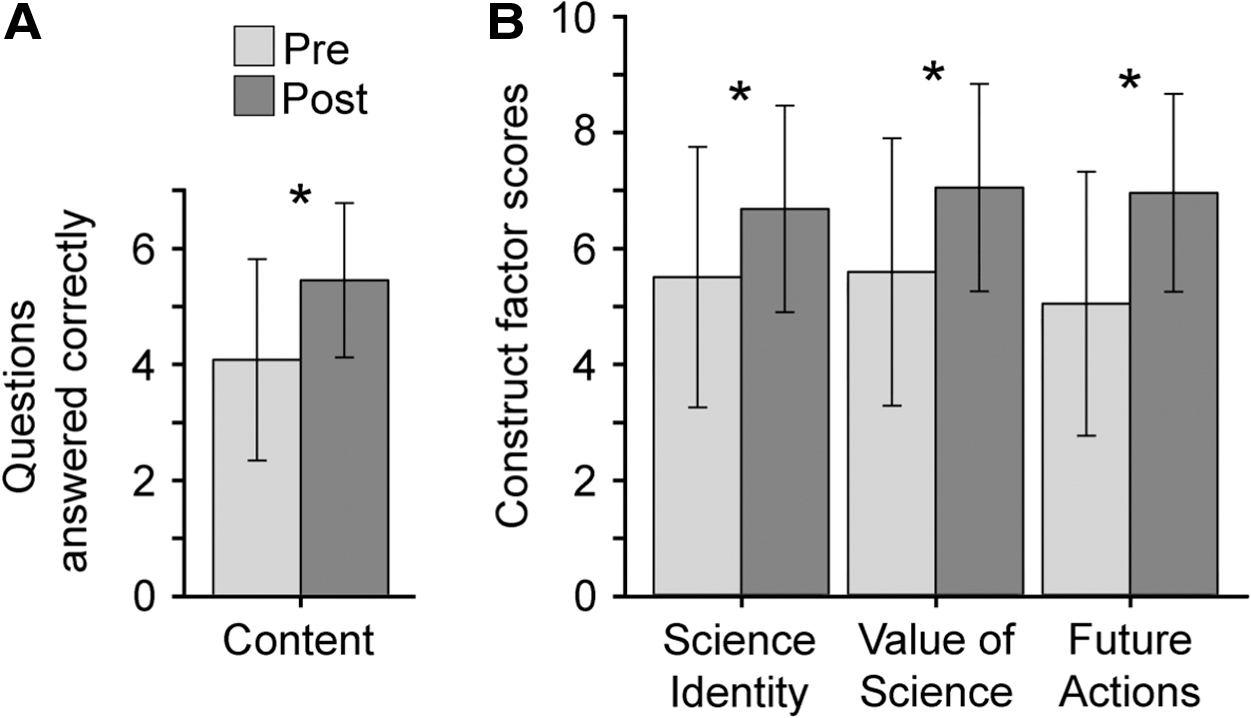
Means of lecture survey data before (Pre) and after (Post) astrobiology presentations. (
Our demographic analysis indicated that demographic-based differences in survey responses were primarily in the Science Content Knowledge question set, which we interpret to be a reflection of participants' educational background. Specifically, men scored higher on Science Content Knowledge pre-lecture survey questions than women, and, among men only, participants with greater levels of education and White non-Hispanics scored higher than African American and other minority participants (GLMM, all p < 0.05, Table 1). However, increases in Science Content Knowledge, which indicates the amount of scientific material that participants gained over the short-term, were greater in women than men. Among men only, participants with lower levels of education and African American participants had scores that increased more than other demographic groups (GLMM, all p < 0.05, Table 1).
Significant Differences in Survey Scores among Demographic Variables
GLMM and LMM analyses were used to compare data from demographic groups using factor scores for each survey construct. For gender, we compare self-identified men (♂) and women (♀). For ethnic background, we compare White, non-Hispanic (W); African American (B); and other minority groups (M) pooled. For education level, we compare those that have attained a GED or high school diploma (HS), those with less education (HS-), and those with more education (HS+). Differences shown only if significant (p < .05) using GLMM or LMM. See the Supplementary Material for full read-out of analyses.
For the opinion-based questions, men who self-reported more than a high school education scored higher than men from other education-level groups (high school diploma or GED, and less than high school education) in pre-survey scores for the Science Identity and Value of Science constructs (LMM, all p < 0.05, Table 1). For Science Identity questions, women increased to a greater degree from pre- to post-survey than men (LMM, p < 0.05, Table 1). No other differences were found in terms of the increase in scores from pre- to post-lecture surveys.
Differences in the state in which participants were incarcerated (data from men only) indicated that, on pre-lecture surveys, men in Washington scored higher on Science Content Knowledge questions than men in Florida, men in Ohio scored higher on Science Identity questions than men in the other two states and higher on Value of Science questions than men in Florida, and men in Ohio and Washington scored higher than men in Florida on Future Actions questions (GLMM or LMM, all p < 0.05, Table 1). The variables that explained little variance and were not retained in any best model (models for men only) included institution type, setting, and size. Detailed descriptive statistics and full readouts from GLMM and LMM analyses (best models) are in Tables S4 and S5, respectively.
4. Discussion
We found significant increases in all survey measures immediately following exposure to a single lecture about astrobiology for science content learning, science identity, value of science, and future actions toward science learning. However, science educators and corrections administrators are generally more interested in the long-term impacts of educational activities because their positive effects on choices to pursue higher education and science careers have been shown to largely take effect from longer-duration experiences (Bruce et al., 1997). Effects of short duration are usually viewed as being primarily affective (compared with other strategies such as long-term exposure to learning and training opportunities, where deeper learning can happen) (Laursen et al., 2007). However, short-duration intervention strategies can have indirect effects on long-term outcomes. These strategies are based on a change model with the premise that developing interest and enthusiasm around science, having positive experiences with science, meeting science role models, and learning about science careers will translate to participants pursuing further STEM education or training in the future (Seymour, 2002).
To place our results into a larger educational context, we draw on results of other short-term interventions by scientists in non-university venues, specifically, “scientist in the classroom” engagements in K–12 classrooms. This is a common science engagement mode that brings the content expertise and enthusiasm of practicing professional scientists to students inside schools (Laursen et al., 2007), similar to AfI bringing scientists to incarcerated people inside correctional institutions. Qualitative studies have shown that these scientists' visits generated authentic exchange, evoked interest in science, and created new views of science and scientists (Hood 1994; Swim, 1999; Woods-Townsend et al., 2016). These findings are consistent with those from studies of student outcomes for short-duration outreach programs that have used other methods (Bruce et al., 1997; Hodson, 2016). Thus, even short-term visits by scientists can stimulate student learning, interest in science, and consideration of science careers, all of which contribute to societal goals of raising science literacy and increasing the size and diversity of the STEM workforce (Alberts, 1991; Colwell and Kelly, 1999).
Additionally, our results corroborate those from another study on the impacts of short- to mid-term ISE interventions on incarcerated adults within correctional institutions. A quantitative analysis of the impacts of scientist-delivered monthly lectures in a single prison and jail in Utah (Nadkarni and Morris, 2018) revealed that after exposure to a monthly science lecture series (1–18 lectures), a majority of the incarcerated participants increased their science content knowledge, saw themselves as more interested in and capable of science, and were more enthusiastic about science and math education than before the lecture. More than half stated that they were fairly likely to seek out science media and talk with others about science (Nadkarni and Morris, 2018). A related study in the same prison documented that although the number of lectures attended was positively associated with increases in science content knowledge, self-perception as science-capable, and interest in science, inmates who attended even just one lecture significantly increased in all of these measures (J. Horns and N. Nadkarni, unpublished data). More generally, the cumulative consequences of early performance—small differences at an early stage can become magnified over time—help explain how relatively brief interventions, when given early, even in a threatening environment, can have long-term effects. This snowballing effect may be particularly important in learning science (Miyake et al., 2010).
Incarcerated populations have tended to be viewed as being disinterested in science instruction and having low capacity to participate or contribute to science. However, our results suggest that the majority of the incarcerated participants we encountered in a wide range of institutions and across demographic types were interested, capable, and desirous of science education. Thus, efforts with just one presentation per institution in 16 prisons in a range of correctional institutional types and sizes in states in different parts of the country appear to be generalized in many correctional situations. This uniformity of positive shifts in our measures across gender and demographic groups indicates that an ISE approach can broadly inspire and inform this science-underserved population.
Differences in responses across demographic groups were of deep interest to us. A large and diverse literature attests to the existence of significant and enduring gaps in gender and racial STEM achievement. These inequities have been documented between Black and White children and between male and female children, in both elementary and secondary school (Entwistle and Alexander, 1988; Bacharach et al., 2003). With few exceptions, these gaps persist through adulthood, as women lag behind men in exam scores, the number of STEM degrees granted, and general interest in the STEM fields (Pew Research Center, 2015; National Science Board, 2018). Other studies have shown that females generally have less interest in science and technology, less favorable attitudes toward science, and constitute a larger percentage of “science pessimists” than males (Hayes and Tariq, 2000). White and Asian students and college graduates also outperform Black, Hispanic, and Native American students in these three metrics. Historically, in the United States, STEM fields have had particularly low representation of women and members of racial and ethnic minority groups, both relative to the concentrations of these groups in other occupational or degree areas and relative to their overall representation in the general population (National Science Board, 2018). These gaps have been attributed to the quality of prior educational background, mode of instruction, presence or absence of values affirmation, and social-psychological processes (Steele, 1988; Oakford et al., 2019).
In our study and consistent with these studies, men had higher pre-lecture survey scores in Science Content Knowledge questions than women, Black men, and those with less education. However, the heart of our findings is that women, Black men, and those with less than a high school diploma/GED study showed greater gains in Science Content Knowledge than White men and/or those with higher than a high school diploma/GED. For Science Identity questions in particular, women increased to a greater degree from pre- to post-survey than men. Thus, the intervention of a single NASA lecture had a stronger effect on those who are female, Black, and/or less formally educated. Our findings suggest that populations having poorer educational backgrounds and/or potentially less interest in science can benefit from this type of intervention as much or more than White and/or more educated men.
Our results suggest that the AfI approach led to multiple positive impacts. First, for the incarcerated, our measure of content knowledge about the topic of the presentation increased, at least in the short term, which in other studies has been linked with higher post-release employment and reduced recidivism (e.g., Davis et al., 2013; Davis, 2019). Beyond content knowledge gains, participants also reported a stronger self-identity with science, in that they felt that they had something to contribute to science, that they could understand and learn science, and that they were interested in doing science. After their lecture experience, they were significantly more likely to want to learn more about astrobiology, look for more information about astrobiology, and discuss what they learned with others. If these positive shifts persist, then participants may be more apt to view themselves as being a part of the scientific enterprise, a first step in seeking and working to gain more information and exposure to opportunities concerning STEM. Even while incarcerated, this reinforced science identity may propel them to seek or take advantage of whatever science learning opportunities are accessible to them, including other correctional education programs or the corrections library. If this is reinforced, then these participants may be more apt to seek STEM higher education and/or employment in STEM after release.
The second impact is on corrections institutions and correctional education programs. Because educational offerings of the majority of correctional institutions do not go beyond basic education (high school, GED, vocational certificates, and higher education, mostly in the social sciences), lectures given by volunteer academic or agency scientists can augment both content and messaging about science and student capacity. Benefits for the corrections community include (1) reducing idleness and deflecting focus on incarcerated people's negative situation; (2) providing awareness of job skills needed in the STEM workforce after release; (3) through their partnership and investment in education, leveraging limited education resources; (4) creating better connections between prisons and the broader community; and (5) reducing costs through reduced recidivism (Oakford et al., 2019). A comparison of the direct costs of correctional education programs and the direct costs of incarceration suggests that every dollar invested in prison educational programs saves taxpayers, on average, between $4 and $5 in reincarceration costs (Davis, 2019).
The third impact concerns how this approach might generally improve the relationships between science and society, especially for populations that have been traditionally underserved in science and who feel disenfranchised from science. After their AfI experience, participants reported that they felt inspired to increase behaviors that include learning more about science and sharing this information with others. Participants also reported feeling that science helps them in their daily lives, that learning about astrobiology helped them feel more connected to everything in the Universe, that science has meaning in their lives, and that knowing science could help them earn a living. An increase in value of science perceived by participants elevates the overall levels of the appreciation of science in our society, especially in populations that are not typically perceived as valuing science.
Finally, this approach contributes to the overall societal goal to foster an educated public. The United Nations' Declaration of Universal Human Rights states that everyone has the right to education and that education shall be directed to the full development of the human personality and to the strengthening of respect for human rights and fundamental freedoms (United Nations Universal Declaration of Human Rights, 1948). Science, in its best light—especially the scientific exploration of our origins, our solar system, and the Cosmos itself—is a humanity-scale endeavor. Thus, NASA's dissemination of the discoveries, knowledge, and inspiration it generates helps fulfill this imperative, in which all humans, whether incarcerated or not, have the right to share. Because of these multiple positive impacts to individuals who are incarcerated and to society as a whole, education should be offered to incarcerated learners—and other populations that have limited access to traditional science education—free from the condition or expectation that it will lead to a reduction in recidivism and/or a career in a STEM field.
NASA's investment in the Astrobiology for the Incarcerated program has resulted in an emergent and growing network of correctional facilities desirous of STEM programming. Via discussions with correctional leaders and staff, we have ascertained the specific needs and capacities of these institutions. The potential is extremely high to expand beyond lecture-based programming for adults to include workshops for incarcerated youth, professional development for their teachers, and inclusive of multimedia assets—even beyond the bounds of NASA.
Future studies should document the impacts of this program over the longer term with respect to retention of content knowledge about science over time, continued actions of participants toward science, and changes in recidivism rates and post-release employment. Future work should also examine how insights from this study of ISE and the incarcerated might be applied to other populations that also have limited access to science education institutions, such as seniors in assisted living centers, people in refugee camps, and those in long-term medical care facilities. The investment in organizing and maintaining an ISE program that involves scientists providing presentations in the venues of these populations is relatively small but could have a potential high impact, as we found in the incarcerated populations we engaged.
Taken together, these impacts might also address a seemingly unrelated challenge that scientists and science educators face—to broaden participation in the awareness, appreciation, and implementation of science (Leshner, 2007; Holdren, 2008). Scientists tend to develop their questions and disseminate their work with people of similar cultures and education and who hold similar values and share common vocabularies. However, engaging those who have been traditionally underserved and underrepresented in science fields and from different racial and cultural groups and educational backgrounds can foster a diversity of thinking, problem solving, and ways of knowing that can serve as a critical driver of excellence in research and innovation in scientific disciplines (President's Council of Advisors on Science and Technology, 2012; Committee on Equal Opportunities in Science and Engineering, 2013). Agency and academic institution investments that provide authentic and effective links between scientists and the incarcerated such as those we describe may contribute to fostering a previously overlooked pool of citizens from nontraditional backgrounds who may wish to contribute to, understand, and appreciate science. Scientists from NASA and other agencies whose missions include education and outreach should consider ISE programs in corrections institutions as a mechanism to expand participation in science and enhance the future STEM workforce.
Footnotes
Author Contributions
N.N. and D.S. conceived and initiated the study and wrote most of the text; N.N. initiated contacts with prisons in UT and FL; J.M. carried out the statistical analysis and interpreted results; J.T. and K.B. initiated and implemented actions with prisons in WA and OH; A.A. and J.H. assisted with data logistics and interpretation; B.D. and H.D. carried out preliminary analyses. All authors edited drafts of the paper.
Acknowledgments
We acknowledge the collaboration of the Utah, Washington, and Florida Departments of Corrections, the Ohio Department of Rehabilitation and Corrections, the Salt Lake County Sheriff's Office, the University of Utah College of Science, and The Evergreen State College. We thank Matthew Whittaker, Stacy Eddings, Desi Bridges, Program Director Victor Kersey, Sheriffs Jim Winder and Rosie Rivera, Chief Deputies Pamela Lofgreen and Matt Dumont, Sgt. Shon Lance, Lt. Jennifer Stansfield, Megan Young, Secretary Stephen Sinclair, Associate Secretary Rob Herzog, Vasiliki Sherry-Georgoulas, Superintendents and staff at Airway Heights, Cedar Creek, and Mission Creek Corrections Centers and Monroe Correctional Complex, Jacqueline Langhals, Jenny Hildebrand, Kathleen Lamb, Wardens and staff of Franklin Medical Center and Grafton, London, and Noble Correctional Institutions for their help. We thank NASA scientists Jacqueline Goordial (Bigelow Laboratory for Ocean Sciences), Drew Gorman-Lewis (University of Washington), and Jamie Foster (University of Florida) for their presentations. Jamie Newberry and the staff at the Florida Department of Corrections provided critical logistical and institutional support. We acknowledge financial support from NASA's Astrobiology Program via cooperative agreement with Blue Marble Space Institute of Science (Federal Award # NNX16AP83G). The University of Utah's Institutional Review Board (IRB_00061095) provided oversight and Human Subjects Review for activities in Utah and Florida. Oversight for Washington lectures was provided by the Washington State Institutional Review Board, and for Ohio by the Human Subjects Research Review Committee for Ohio Department of Rehabilitation and Correction.
Disclosure Statement
For all authors, no competing financial interests exist.
Supplementary Material
Supplementary Table S1
Supplementary Table S2
Supplementary Table S3
Supplementary Table S4
Supplementary Table S5
Supplementary Table S6
Supplementary Table S7
Abbreviations Used
References
Supplementary Material
Please find the following supplemental material available below.
For Open Access articles published under a Creative Commons License, all supplemental material carries the same license as the article it is associated with.
For non-Open Access articles published, all supplemental material carries a non-exclusive license, and permission requests for re-use of supplemental material or any part of supplemental material shall be sent directly to the copyright owner as specified in the copyright notice associated with the article.
