






Abstract
The prospect of a future soft landing on the surface of Europa is enticing, as it would create science opportunities that could not be achieved through flyby or orbital remote sensing, with direct relevance to Europa's potential habitability. Here, we summarize the science of a Europa lander concept, as developed by our NASA-commissioned Science Definition Team. The science concept concentrates on observations that can best be achieved by in situ examination of Europa from its surface. We discuss the suggested science objectives and investigations for a Europa lander mission, along with a model planning payload of instruments that could address these objectives. The highest priority is active sampling of Europa's non-ice material from at least two different depths (0.5–2 cm and 5–10 cm) to understand its detailed composition and chemistry and the specific nature of salts, any organic materials, and other contaminants. A secondary focus is geophysical prospecting of Europa, through seismology and magnetometry, to probe the satellite's ice shell and ocean. Finally, the surface geology can be characterized in situ at a human scale. A Europa lander could take advantage of the complex radiation environment of the satellite, landing where modeling suggests that radiation is about an order of magnitude less intense than in other regions. However, to choose a landing site that is safe and would yield the maximum science return, thorough reconnaissance of Europa would be required prior to selecting a scientifically optimized landing site. Key Words: Mission—Planetary science—Ice—Europa—Icy moon. Astrobiology 13, 740–773.
1. Introduction: Science of a Europa Lander Mission
E
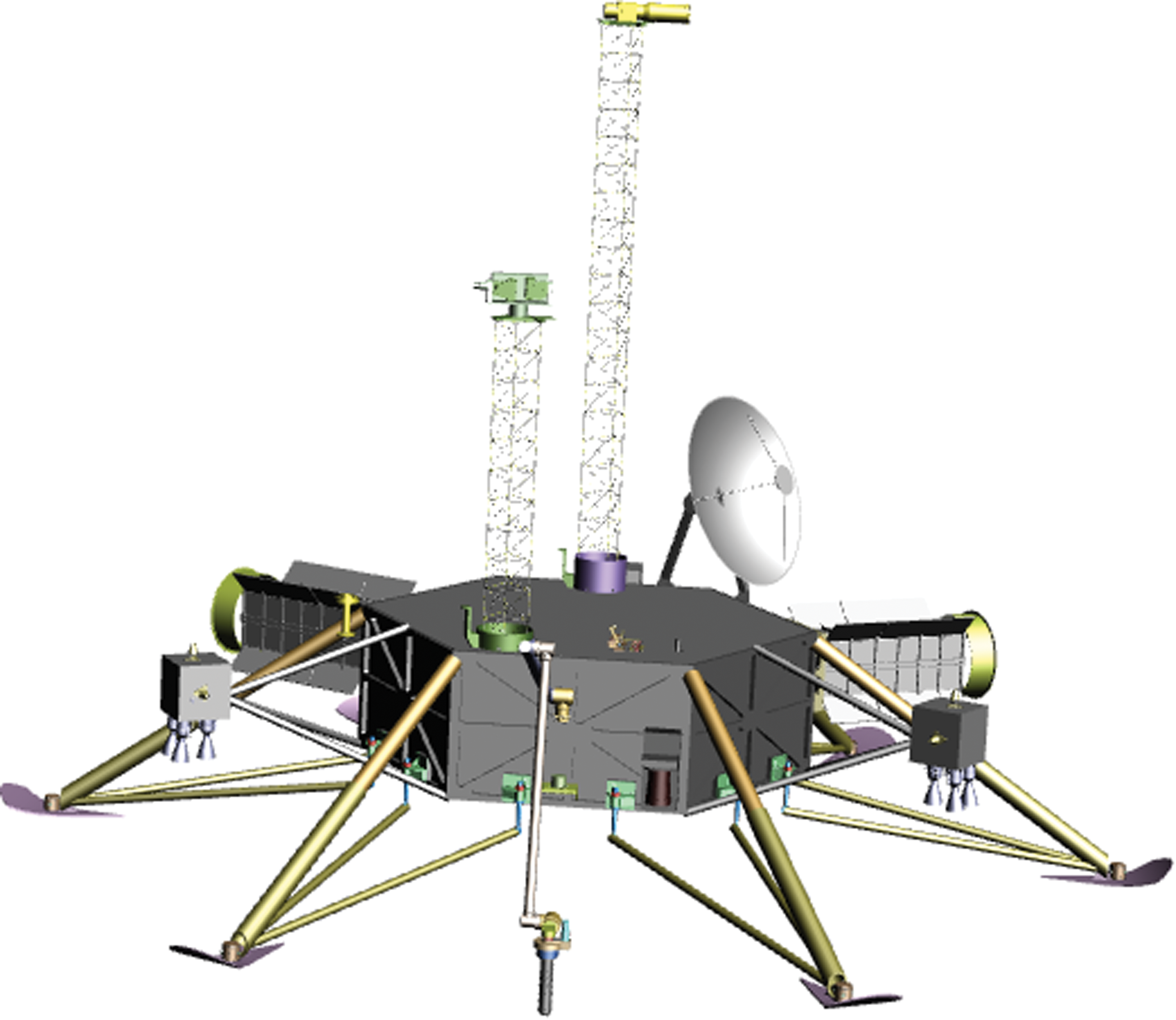
Depiction of the model lander implementation. Descriptions of the model payload are provided in the 2012 NASA lander study (Europa Study Team, 2012).
The 2003 Planetary Decadal Survey, New Frontiers in the Solar System: An Integrated Exploration Strategy (2003), and the 2011 Planetary Decadal Survey, Vision and Voyages for Planetary Science in the Decade 2013–2022, emphasize the importance of Europa exploration (Space Studies Board, 2003, 2011). Both Decadal Surveys discuss Europa's relevance to understanding issues of habitability in the solar system and stress that habitability is the motivation for Europa exploration. For example:
Because of this ocean's potential suitability for life, Europa is one of the most important targets in all of planetary science. (Space Studies Board, 2011)
Understanding Europa's habitability is intimately tied to understanding what are commonly referred to as the three ingredients for life: water, chemistry, and energy. All of these could be well addressed by a landed mission to Europa. Measurements obtained from Europa's surface would provide direct analysis of the satellite's chemistry and mineralogy through in situ investigations and measurements that are not possible to achieve remotely. Most important, a properly equipped lander could sample beneath the radiation-processed uppermost portion of Europa's icy shell to provide insights about its native composition and implications for life. A lander also provides an excellent platform from which to perform geophysical measurements to probe Europa's ice shell and subsurface ocean. Moreover, a landed mission could permit analyses of local surface geology at a scale inaccessible from space.
We describe here the science background most relevant to a potential Europa lander mission, as developed by a NASA-commissioned Science Definition Team. A model payload was formulated as part of this study with the aim of addressing Europa's habitability through analyses of the satellite's composition, ocean and ice shell, and geology. While this paper concentrates on the science of such a mission, further details of the technical implementation for the studied mission are available in the 2012 Europa Study Report (Europa Study Team, 2012).
The goal adopted by the study team for the Europa lander mission concept is as follows: Explore Europa to investigate its habitability. This goal implies understanding processes, origin, and evolution and testing the key science issues described below. “Investigate its habitability” recognizes the significance of Europa's astrobiological potential. Habitability includes investigating the ingredients for life.
The scientific rationale and lander objectives are linked to recommended scientific measurements and payload through a set of investigations. The model payload utilizes the strengths of each candidate technique and instrument to address key science issues.
1.1. Habitability of Europa
The potential habitability of an environment is dependent on the concurrent availability of three ingredients that, along with a suitably long-lived and clement physicochemical environment, are necessary for life as we know it: (1) A solvent capable of supporting complex biochemistry. For terrestrial life, the presence of liquid water at a chemical activity of about 0.65 or greater is an absolute requirement. For an ocean saturated with sea salt, the water activity would be about 0.72 or higher (Siegel, 1979; Marion et al., 2003). (2) A source of energy with which to create and maintain the complex molecules, structures, and pathways on which life depends. Life on Earth is known to use chemical and visible to near-infrared light energy and is thought to have discrete minimum requirements for both Gibbs free energy and flux of chemicals that sustain it (Hoehler, 2004). (3) Raw materials for biosynthesis. All life on Earth requires the elements C, H, N, O, P, and S, and also variously requires many micronutrients (typically transition metals) (Wackett et al., 2004).
These ingredients must be available within the context of physicochemical (environmental) conditions that allow for the assembly, stability, and function or interaction of complex structures and molecules. Life on Earth maintains activity over temperatures from below −20°C to over 120°C; pH from approximately 0 to 13; salinities from fresh to halite saturation; and pressures to at least 150 MPa and possibly much greater (see, e.g., Committee on the Limits of Organic Life in Planetary Systems, 2007). Electromagnetic or particle radiation capable of breaking biomolecular bonds can also limit habitability.
In assessing the astrobiological potential of Europa, the requirements for habitability as defined by life on Earth provide a framework in which to place our current understanding of Europa as a potentially habitable world and elucidate key areas for advancing this understanding by lander-enabled science.
1.2. Water on Europa
The presence of a global subsurface ocean of liquid water has driven decades-long interest in Europa's potential as an abode of life. Evidence for a contemporary global liquid water ocean on Europa is compelling, both empirically and on theoretical grounds (e.g., Spohn and Schubert, 2003; McKinnon et al., 2009). A subsurface ocean is consistent with Europa's broad range of geological features (Greeley et al., 2004), and formation of Europa's cycloid-shaped features requires the action of significant diurnal tides produced by orbital eccentricity along with the effects of spin pole obliquity, suggesting an ocean at the time of their formation (Hoppa et al., 1999; Hurford et al., 2009). Thermal modeling predicts an ocean beneath an ice shell of a few to a few tens of kilometers' thickness, depending on the tidal heating rates in the ice shell and rocky mantle (Ojakangas and Stevenson, 1989; Moore and Hussmann, 2009). Europa's global ocean may have persisted since the origin of the jovian system (Cassen et al., 1982).
The availability of liquid water is perhaps the best-resolved aspect of europan habitability; nonetheless, there remain important areas where this understanding can be improved. Determining the volume and depth of the ocean would help to constrain the chemical evolution of the ocean—for example, water-to-rock ratios and pressure-temperature constraints for thermodynamic and kinetic models of silicate-water interactions. Furthermore, determining the spatial distribution of liquid water within the ice shell (e.g., Schmidt et al., 2011), if any, would inform the possibility for transiently habitable regions beyond the ocean that could differ substantially in several aspects of their suitability for life.
1.3. Energy on Europa
Possible sources of energy for life on Europa have been identified, but considerable uncertainty exists as to whether, or at what rate, such energy is made available in the ocean. Spectroscopy of Europa's surface has revealed the presence of a variety of oxidized species (e.g., O2, H2O2, CO2, SO2, SO4) thought to result from radiation processing of the ice, a hypothesis supported by laboratory experiments (Carlson et al., 1999a, 1999b, 2009). Interaction of liquid water with mafic or ultramafic rocks, such as might occur at the base of the europan ocean, is expected to generate reduced species including hydrogen and, depending on the chemical composition of ocean fluids and the pressure and temperature of interaction, reduced forms of carbon (methane), sulfur (hydrogen sulfide), and nitrogen (ammonia) (McCollom, 1999; Zolotov and Shock, 2004; Vance et al., 2007). Life on Earth is capable of catalyzing the reaction of a variety of combinations of the surface oxidants observed on Europa with hypothetical subsurface reductants and coupling the liberated chemical energy to growth (Chyba, 2000; Hand et al., 2007). Thus, the surface and subsurface environments of Europa may constitute, in essence, a battery—stored chemical energy that could conceivably support life.
Biological potential depends critically on the rate at which energy can be accessed. Growth rates, and the amounts of standing biomass that can be supported, scale with energy flux, and some fluxes may simply be too low to support life. In this regard, several critical questions remain concerning the extent to which Europa's chemical disequilibrium exists and is tapped and replenished: (1) Delivery of reduced species to Europa's ocean depends on the extent and nature of reactions between water and rock. The inferred range of salinity of the ocean (Hand and Chyba, 2007) suggests that extensive reactions with silicates have affected its bulk properties, but the duration (including present occurrence), temperature, and other critical aspects of such reactions remain to be constrained (e.g., McKinnon and Zolensky, 2003). Thus, the strength and present availability of the reduced end-member relative to oxidants produced at Europa's surface are unclear. (2) From theory and observation it is apparent that oxidants exist in Europa's surface ice (with abundance constrained), but it is not clear whether or how fast these oxidants may be delivered to the ocean. Resurfacing on timescales less than 100 Ma is implied by crater counts and surface morphology (Zahnle et al., 2008), but it is not obvious how this may translate to mechanisms or rates of delivery of surface oxidants to the ocean (Hand et al., 2007; Greenberg, 2010; Pasek and Greenberg, 2012). Understanding Europa's geology through landing site reconnaissance and detailed landing site characterization would help us to infer the ways that Europa's ocean dynamics help or hinder the bringing together of interior reductants and surface oxidants (Vance and Goodman, 2009). (3) Beyond constraints imposed on biology by total energy flux, the mode of delivery may also be critical. For example, focused delivery of reduced fluids into an oxidized ocean (as with Earth's hydrothermal vents) would carry considerably different biological potential than diffusely distributed delivery of oxidants, for example, by melting of foundered surface ice, into a reduced ocean.
While limitations clearly exist in the capability to observe, characterize, and constrain the delivery of energy to the europan ocean, this is perhaps the most critical area for advancement in our understanding of the past and present habitability of this world.
1.4. Chemistry of Europa
1.4.1. Elemental raw materials in Europa's ocean
Qualitatively, the assumed chondritic origin of Europa (Kargel et al., 2000) combined with exogenous delivery of materials (Pierazzo and Chyba, 2002) should have provided Europa with the range of elements essential for Earth-like life. Hydrothermal activity, if present, would mobilize these elements from the silicate mantle and deliver them to the ocean. In quantitative terms, elemental availability at biologically meaningful levels would further depend on a variety of constraints, including the water-rock ratio during aqueous alteration of chondritic material (especially given the large water volume hypothesized for the europan ocean) and pH-Eh conditions that can markedly affect speciation of many elements into soluble versus insoluble forms. Beyond the bulk constraint imposed by bounds on ocean salinity (Hand and Chyba, 2007), these factors are essentially unknown.
1.4.2. The physicochemical context of Europa's ocean
Both modeling and empirical constraints suggest that temperature, pressure, pH, and salinity within the ocean likely fall within the limits known to be tolerated by extant terrestrial life (Nealson, 1997; Zolotov and Shock, 2001, 2004; Marion et al., 2003; Committee on the Limits of Organic Life in Planetary Systems, 2007; Hand et al., 2009). It should be borne in mind that the ability of life on Earth to tolerate such broad-ranging conditions derives from physical compartmentalization (e.g., cell membranes) and a capability to invest energy into biomolecular repair or maintenance of internal conditions that differ from those outside the organism. Hence, the range of conditions tolerated by extant europan life may be narrowed if the available energy flux is low. Moreover, the range of conditions conducive to origin-of-life chemistry is not well understood and may be narrower still. For example, it has been argued that life's emergence on Earth may have required relatively fresh water to sustain model cell membrane materials (Monnard et al., 2002) and thus that the high end of possible salinities for Europa's ocean may be limiting to the emergence of life (Hand and Chyba, 2007). That arguments favoring saline environments have also been made (Spitzer and Poolman, 2009) serves to underscore the uncertainty associated with origin-of-life chemistry even on Earth. Thus, while caution is always warranted in extrapolating a discussion of habitability from extant to emerging life, no aspect of the physics and chemistry of the europan ocean, as presently understood, would appear to disallow biology there.
Our current scientific understanding is that, qualitatively, Europa is likely habitable today and likely has been habitable for much of the history of the solar system. Further observation, particularly as enabled by landed science, will allow for advancement from qualitative to quantitative assessment of Europa's biological potential, including investigations that constrain inputs of energy and chemical evolution in the ocean.
Finally, though hypothesis-driven science is well served by measurements that can help constrain Europa's habitability, the importance of discovery-driven science should not be overlooked in the astrobiological exploration of Europa. Observation of plausibly prebiotic compounds, or complex organic molecules or structures consistent with biological origins, would greatly advance NASA's goal of determining whether or not life does exist beyond Earth (Des Marais et al., 2008; Space Studies Board, 2011).
1.5. Objectives summary
Europa lander mission objectives flow from the science issues identified in the sections above and below, and these objectives represent a key subset of Europa science that could be well accomplished by a landed Europa mission. We categorize and characterize these objectives, in priority order, as
Europa's Composition: Understand the habitability of Europa's ocean through composition and chemistry.
Europa's Ocean and Ice Shell: Characterize the local thickness, heterogeneity, and dynamics of any ice and water layers.
Europa's Geology: Characterize a locality of high scientific interest to understand the formation and evolution of the surface at local scales.
Traceability of these objectives to specific investigations is summarized in Fig. 2, and candidate measurements and model instruments that can address these investigations are discussed in Sections 2, 3, and 4. These investigations can be directly traced to the astrobiology themes of water, energy, and chemistry.
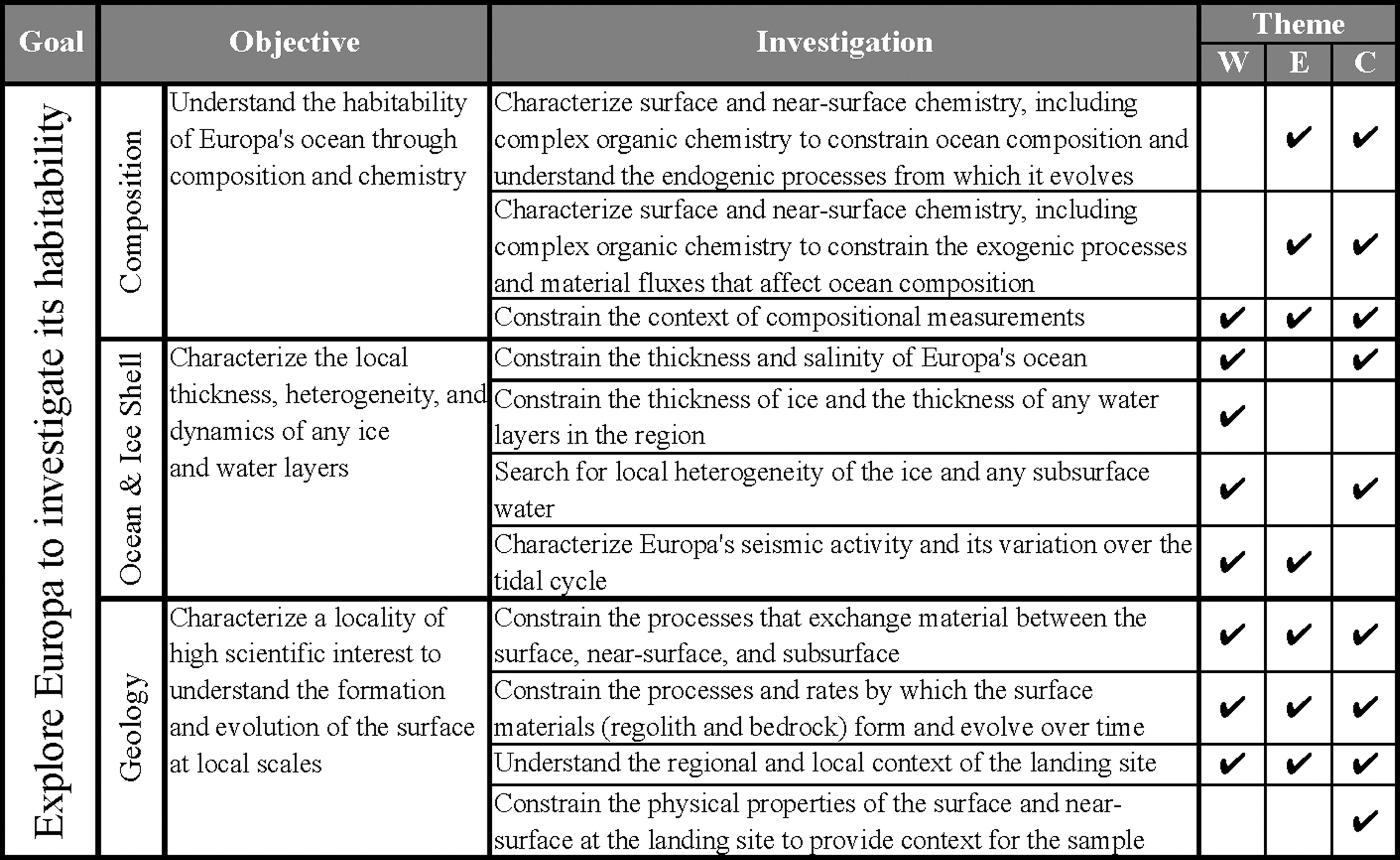
Proposed traceability for a Europa lander mission, from goal to objectives to investigations. These are in turn traced to the astrobiology themes of water (W), energy (E), and chemistry (C).
2. Composition
Europa's surface and near-surface compositions (inorganic and organic) provide a window into the habitability of its ocean. While not a direct match to the ocean, surface and near-surface compositions will provide evidence from compounds directly incorporated into the ice shell from the ocean or that result from crustal formation processes such as fractional crystallization of salt-rich brines (Zolotov and Shock, 2001). Europa's ice also records the history of exogenous materials delivered through impacts and dust, particularly material from neighboring Io (Zahnle et al., 2008; Carlson et al., 2009). Modification from the barrage of high-energy particles from Jupiter's magnetosphere complicates efforts to understand Europa's surface and the ocean beneath but provides insight into the production of oxidants (Hand et al., 2007; Carlson et al., 2009).
2.1. Icy and non-icy composition
Much of what is known about Europa's composition comes from spectroscopic observations in the visible to near-infrared. Earth-based telescopic observations, and data from the Voyager and Galileo spacecraft (see reviews by Alexander et al., 2009, and Carlson et al., 2009), show that the surface of Europa is primarily water ice in both crystalline and amorphous forms.
Dark, non-icy materials that mottle the rest of Europa's surface are linked to Europa's geological history, and determining their composition will elucidate their origin. Non-icy components include carbon dioxide (CO2), sulfur dioxide (SO2), hydrogen peroxide (H2O2), and molecular oxygen (O2), based on comparison of measured spectra with laboratory studies of the relevant compounds (Lane et al., 1981; Noll et al., 1995; Smythe et al., 1998; Carlson et al., 1999a, 1999b; Spencer and Calvin, 2002; Hansen and McCord, 2008). Spectral observations from the Galileo Near-Infrared Mapping Spectrometer (NIMS) reveal disrupted dark and chaotic terrains on Europa with distorted and asymmetric absorption features indicative of water bound in non-ice hydrates. Hydrated materials observed in regions of surface disruption have been interpreted as magnesium and sodium sulfate minerals that originate from subsurface ocean brines (McCord et al., 1998a, 1998b, 1999). Alternatively, these might be sulfuric acid hydrates created by radiolysis of sulfur from Io (Carlson et al., 1999b, 2002, 2005; Strazzulla, 2011) or a combination of hydrated salts and hydrated sulfuric acid (Dalton, 2000, 2007; McCord et al., 2001, 2002; Carlson et al., 2005; Dalton et al., 2005; Orlando et al., 2005). A main objective for Europa science is to resolve the compositions and origins of these hydrated materials (Fig. 3).
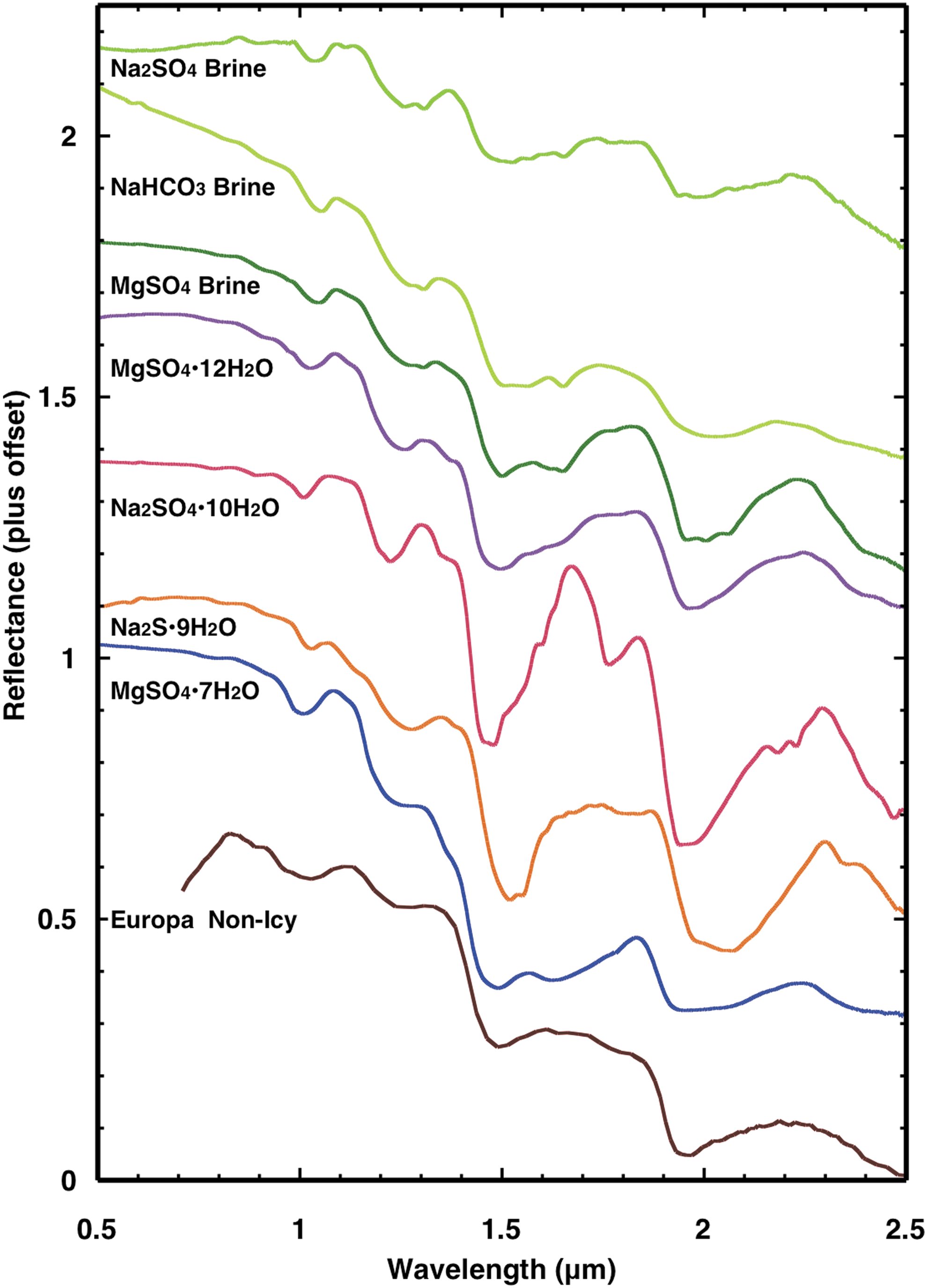
Cryogenic reflectance spectra of hydrated sulfates and brines, compared to Europa. Spectra of epsomite (MgSO4·7H2O), hexahydrite (MgSO4·6H2O), and bloedite (Na2Mg(SO4)2·4H2O) were measured at 100, 120, and 120 K, respectively (Dalton, 2000, 2003). Spectra of sodium sulfide nonahydrate (Na2S·9H2O); mirabilite (Na2SO4·10H2O); magnesium sulfate dodecahydrate (MgSO4·12H2O); and MgSO4, NaHCO3, and Na2SO4 brines were measured at 100 K (after Dalton et al., 2005).
A broad suite of additional compounds is predicted for Europa based on observations of other icy satellites, as well as from experimental studies of irradiated ices, theoretical simulations, and geochemical and cosmochemical arguments. Organic molecular groups, such as CH and CN, have been identified on the other icy Galilean satellites (McCord et al., 1997, 1998a), and their presence or absence on Europa is integral to understanding Europa's potential habitability. Other possible naturally occurring compounds that might be embedded in the ice and detectable by spectroscopic methods include H2S, OCS, O3, HCHO, H2CO3, SO3, MgSO4, H2SO4, H3O+, NaSO4, HCOOH, CH3OH, CH3COOH, and more-complex species (Moore, 1984; Delitsky and Lane, 1997, 1998; Moore and Hudson, 1998; Moore et al., 2007; Brunetto et al., 2005).
2.1.1. Organic molecules
The possible presence of abiogenic organic molecules has implications for Europa's ability to support life, as well as the processes responsible for the distribution of such materials in the solar system. These organic molecules are important as indicators for habitability, as they provide clues to inventory of potentially biological materials and the processes that created them.
However, habitability depends on environmental factors that may be conducive or hostile to the production and preservation of organic molecules either from biotic or abiotic sources. On Mars, for instance, nondetection of organic compounds in the Viking biological experiments revealed that the combination of high ultraviolet flux and an oxidant-rich soil acts to rapidly break down organic material. These discoveries led to a dimming of optimism about the habitability of Mars (e.g., Klein, 1979). Recent insights from the Phoenix lander—namely the discovery of highly oxidizing perchlorate salts (Hecht et al., 2009)—prompted a reinterpretation of the Viking experiments and the realization that the design of the experiments may have caused the destruction of sampled organic materials during processing for detection (Navarro-González et al., 2010).
Additionally, the distribution and types of organic molecules found in an environment can be an indicator of life. For instance, a single complex organic molecule may not be diagnostic of life, but a distribution of molecules could provide intriguing evidence for selective processes that are unlike abiotic catalysis (Hand et al., 2010).
The abundance of organic molecules (complex or otherwise) on Europa is currently unknown. The potential range of abundances can be estimated by comparison with terrestrial analogues (Hand et al., 2009). As shown in Table 1, diverse environments may have cell and biosignature abundances that vary by orders of magnitude. As with salts, secondary processes may also play a role in concentrating organic compounds (e.g., in sublimation lags) on Europa's surface. The total amount of organic material in Europa's ice shell that is derived from the ocean depends on the total dissolved organic compound concentration at the ice-ocean interface. Even on Earth the abundance of material can be highly variable depending on the productivity of the system (see Table 1). Therefore, it is critical that sensitivity to low levels of individual compounds be part of any investigation of Europa's organic composition.
From Table 3 of Hand et al. (2009), where “high” indicates the maximum of the range provided in that table.
Assumes no concentration mechanisms. After Hand et al. (2009), using 2.3×10⁻¹³ g/cell (Madigan et al., 2003).
Assumes the same ratio as in E. coli. Using the ratio of cell glycine/cell mass in McCollom and Amend (2005), comparable to results from Glavin et al. (2001), in which organic content is taken as 200 μg/g based on average for materials from sample containing E. coli in the amount of 1010 cells/g. Specific molecules (amounts in μg/g) are aspartic acid (187), glutamic acid (310), serine (117), glycine (298), alanine (222), and valine (102), representing 70% of the total inventory of amino acids and about 9% of the cell mass.
More-complex molecules have larger radiation cross sections, so they are more susceptible to alteration by radiation. Radiolysis and photolysis probably alter the original surface materials and produce highly oxidized species that react with other non-ice materials, forming a wide array of compounds. Given the intense radiation environment of Europa, complex organic molecules are not expected in older deposits or in those exposed to higher levels of irradiation (Johnson and Quickenden, 1997; Cooper et al., 2001). However, diagnostic molecular fragments and key carbon, nitrogen, and sulfur products might survive in regions of lesser radiation (e.g., the leading hemisphere) and sites of recent or current activity. Additionally, materials in the shallow subsurface are also protected from the bulk of this exogenic processing.
2.1.2. Salts
The salt composition of Europa's surface is a primary measure of the underlying ocean's composition and habitability (Zolotov and Shock, 2004). As with organic materials, the processes of radiation, exogenous mixing, and diagenetic alteration act on salts and their precursor fluids. Dissolved materials are expected to enter Europa's ocean through reactions between the ocean water and the underlying rocks (e.g., Kargel et al., 2000; Zolotov and Shock, 2001; McKinnon and Zolensky, 2003); the composition of Europa's ocean depends on the composition of the rocks and input fluids, as well as the temperatures, pressures, and durations of water-rock reactions. Predictions based on the assumption that the rocks have the same bulk composition as CV chondrites (e.g., Zolotov and Shock, 2001; Marion et al., 2003) indicate that the ocean on Europa would be enriched in sulfate relative to Earth's ocean and depleted in sodium, chloride, and potassium. Magnesium and calcium are predicted to be at similar abundances. Much depends on the assumptions made in these models. Differences in rock composition, water-rock ratio, and in the efficiency of elemental extraction can cause large differences in the composition of resulting ocean fluids (e.g., Zolotov and Shock, 2001).
A major reason that surface salts would differ from the underlying ocean composition is fractional crystallization during freezing and ascent of fluids from the ocean to the surface. As an example, for the predicted composition mentioned above, a series of salts would form as ocean water began to freeze on its ascent to the surface of the ice. As ice forms, it incorporates very little in the way of solutes from the water, causing concentrations in the coexisting brine to increase. Theoretical models (Zolotov and Shock, 2001) indicate that the order of precipitation of salts from the brine as temperature drops would be gypsum (CaSO4·2H2O), mirabolite (Na2SO4·10H2O), magnesium sulfate (MgSO4·10H2O), sylvite (KCl), and hydrohalite (NaCl·H2O). Magnesium sulfate is predicted to be the most abundant salt from the fractional freezing process, followed by mirabolite and gypsum. Sylvite would be more abundant than hydrohalite, but both would be 1–2 orders of magnitude less abundant than the sulfates. Again, differences in the composition of the underlying ocean could cause major changes in the order and abundance of salts formed, as could differences between the actual freezing process and the process modeled by the calculations.
Warm ice will sublimate at Europa's surface (Spencer, 1987; Moore et al., 1999), leading to lag deposits of salts. This will enhance the ability of a landed mission to detect salts. Many of the salts predicted to form initially through fractional freezing are extensively hydrated. Once exposed to surface conditions, these hydrated salts can incrementally dehydrate, and dehydration through sublimation would drive changes in salt mineralogy (Zolotov and Shock, 2001). So, the sublimation process that concentrates salts at the surface also alters the hydration state of those salts. The details of the effects of sublimation depend on relative stabilities of hydrated salts as the partial pressure of H2O changes in the salt lag deposits and the temperature at which the sublimation occurs. In addition, at an individual sample location, salts may have formed predominantly through fractional freezing of ocean water, or they may also have formed through freezing of residual brines generated by the fractional freezing process. The major consequence of these differences will be found in the proportion of sulfate salts relative to chloride salts. Gradients between surface and subsurface samples could be used to refine the mineralogy where differences in hydration state may be preserved in the subsurface. In addition to recombination of ions due to changes in hydration state of salt deposits, thermal processing of Europa's near surface may also lead to chemical decomposition and reformation (Loeffler et al., 2011).
2.1.3. Exogenic processes
Exogenic processes are a key part of Europa's composition story, but much remains to be learned about the types and sources of materials being implanted. Some surface constituents result directly from exogenic sources. For example, sulfur from Io is transported by Jupiter's magnetosphere and is implanted into Europa's ice. Ejecta from impacts on Io are predicted to reach Europa's surface in substantial amounts in the form of olivine, the presumed bulk composition of Io (Zahnle et al., 2008). Micrometeorites should also contribute organic and nonorganic compounds (Pierazzo and Chyba, 2002; Johnson et al., 2004; review by Carlson et al., 2009 and references therein). Thus, compositional variations with depth could help separate exogenic and endogenic material and associated processes. For example, comparison of the composition of a surface and subsurface sample could allow for the identification of gradients related to variations in radiation penetration and gardening depth, thus helping to unravel the chemical processes that led Europa to its present state.
Magnetic field measurements by Galileo of ion-cyclotron waves in the wake of Europa provide evidence of sputtered and recently ionized Cl, O2, SO2, and Na ions (Volwerk et al., 2001). As shown in Fig. 4, medium-energy ions (tens to hundreds of kiloelectronvolts) deposit energy in the topmost few tens of microns; heavier ions, such as oxygen and sulfur ions, have an even shorter depth of penetration; while megaelectronvolt electrons could penetrate and affect the ice to a depth of more than 1 m (Paranicas et al., 2002, 2009 and references therein). The energy of these particles breaks bonds to sputter water molecules, molecular oxygen, and any impurities within the ice (Cheng et al., 1986), producing the observed atmosphere and contributing to the erosion of surface features. Recent work (Patterson et al., 2012) shows that, for protected locations on the surface, penetration depths are expected to be only 1–3 cm. This would lead to a shallow near surface that has been processed and far more pristine materials slightly deeper (10–20 cm) that would have experienced little radiation processing.
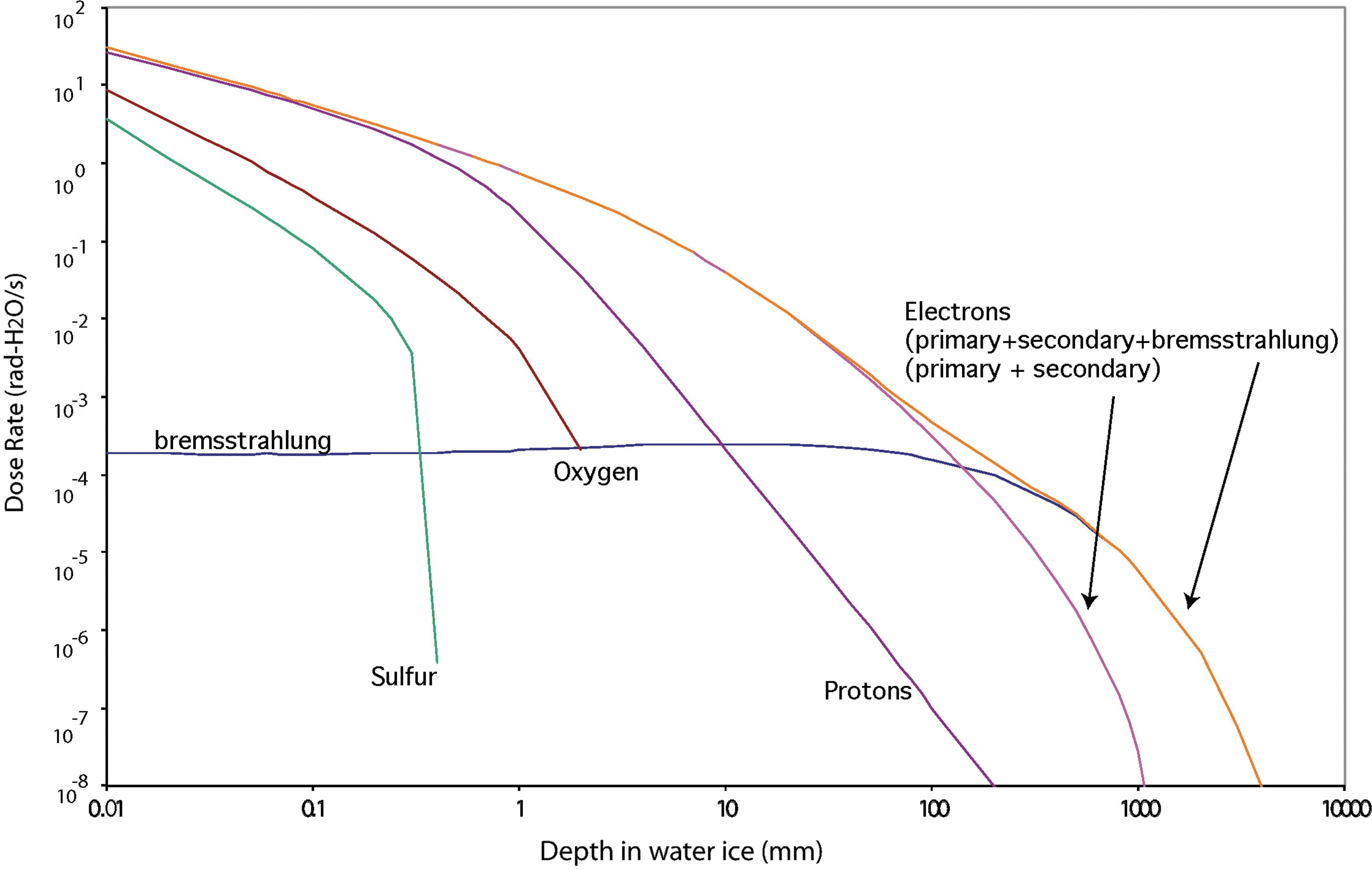
Assessed surface-averaged dose rates, in rad/s per molecule of water as a function of depth, for electrons, protons, oxygen, and sulfur in the vicinity of the trailing hemisphere equator. Modified from Paranicas et al. (2009).
As electrons bombard Europa's surface and slow down, they produce bremsstrahlung photons. It has been shown that these particles can penetrate up to a meter into Europa's surface (Paranicas et al., 2009). However, the number of bremsstrahlung photons produced decreases with the energy of the electrons, as does the range of possible photon energies (Agostinelli et al., 2003; Allison et al., 2006). In other words, the depth of penetration for such particles is related to the energy of the electron that produced them. This implies that, while the lower latitudes of Europa's trailing hemisphere will be radiolytically processed to depths of about 1 m (Paranicas et al., 2009), the leading hemisphere of the satellite and higher-latitude regions of the trailing hemisphere will only be affected to depths in the micron to centimeter range (Patterson et al., 2012).
Sulfur is the dominant material exported from Io to Europa, but a substantial mass of ionian rock is anticipated as well (Zahnle et al., 2008), with an additional contribution of rocky material transferred from Io as ejecta from cometary impacts (Alvarellos et al., 2008). Interplanetary dust particles and cometary materials may contain a host of organic and inorganic constituents. For example, the primitive chondritic Tagish Lake meteorite (Brown et al., 2000) was found to contain more than a characteristic array of elements representative of the early solar system's composition; it also contains mono- and dicarboxylic acids, dicarboximides, pyridine carboxylic acids, a sulfonic acid, and both aliphatic and aromatic hydrocarbons (Pizzarello et al., 2001). Silicates in particular would be a strong marker for an exogenic origin of materials on Europa because their solubility is low in Europa's ocean, even in models that quench the ocean's composition at a relatively high temperature (Zolotov and Kargel, 2009). The possibility for exogenous organic compounds and their irradiated by-products on Europa's surface underscores the need for compositional measurements both close to the surface and at some depth below.
Johnson et al. (2004) calculated that the globally averaged micrometeoroid flux for Europa, Ganymede, and Callisto is ∼1.5×10⁻¹⁶ g cm−2 s−1, which amounts to a total of ∼45 g s−1 of chondritic material to Europa's surface. For a chondritic composition of ∼6% sulfur and 3.4–24% carbon (Lodders, 2003), this leads to ∼2×10⁻³ g cm−2 sulfur and ∼1×10⁻³ to 7×10⁻³ g cm−2 carbon accumulated on Europa's surface per one thousand years. In other words, over relatively short geological timescales, carbon concentrations from exogenous delivery could reach the parts-per-million level for the upper centimeter of Europa's surface. As a result, if a surface scientific investigation seeks to distinguish exogenous from endogenous organic chemistry, it should target a young surface, collect samples from beneath the surface, and be able to characterize the structure and complexity of organic compounds in any samples collected (Hand et al., 2009, 2010).
2.2. Investigating composition
An ability to broadly characterize the composition of samples directly acquired from the surface and shallow subsurface of Europa would provide quantitative metrics and insight from which to assess the habitability of this world. Such capability also offers inherent discovery potential with respect to molecules or structures that could be consistent with biological origins.
Characterizing both organic and inorganic composition would provide complementary information about the habitability of the ocean. Inorganic composition would provide a snapshot of ocean chemical evolution as driven by the interaction of the hydrosphere and lithosphere, along with inputs of exogenic material. In addition to a bulk measure of the extent of hydrous alteration of the lithosphere, such information could also help to distinguish among differing modes and models of ocean chemical evolution. Inorganic composition can be used to constrain the availability of bioessential elements and, potentially, ocean redox and pH. These factors bear directly on the energy flux and physicochemical environmental aspects of habitability. Organic composition would reflect a combination of initial inventory, endogenic synthesis, and exogenic inputs, and could provide a direct and independent measure of whether organic compounds (and, as a subset, prebiotic or biological molecules) are stable under present europan ocean conditions. Broad-based organic compositional measurements also offer discovery potential for prebiotic or possibly biogenic molecules that is unique to landed science.
To the extent that the ocean and ice shell exchange material (see below), both ocean and surface composition can be expected to reflect a combination of endogenic and exogenic processes and inputs (Fig. 5). Deconvolving these inputs to the greatest extent possible will help provide an accurate picture of ocean composition and, by characterizing the purely exogenic end-member, provide tests of hypotheses about endogenic processes.
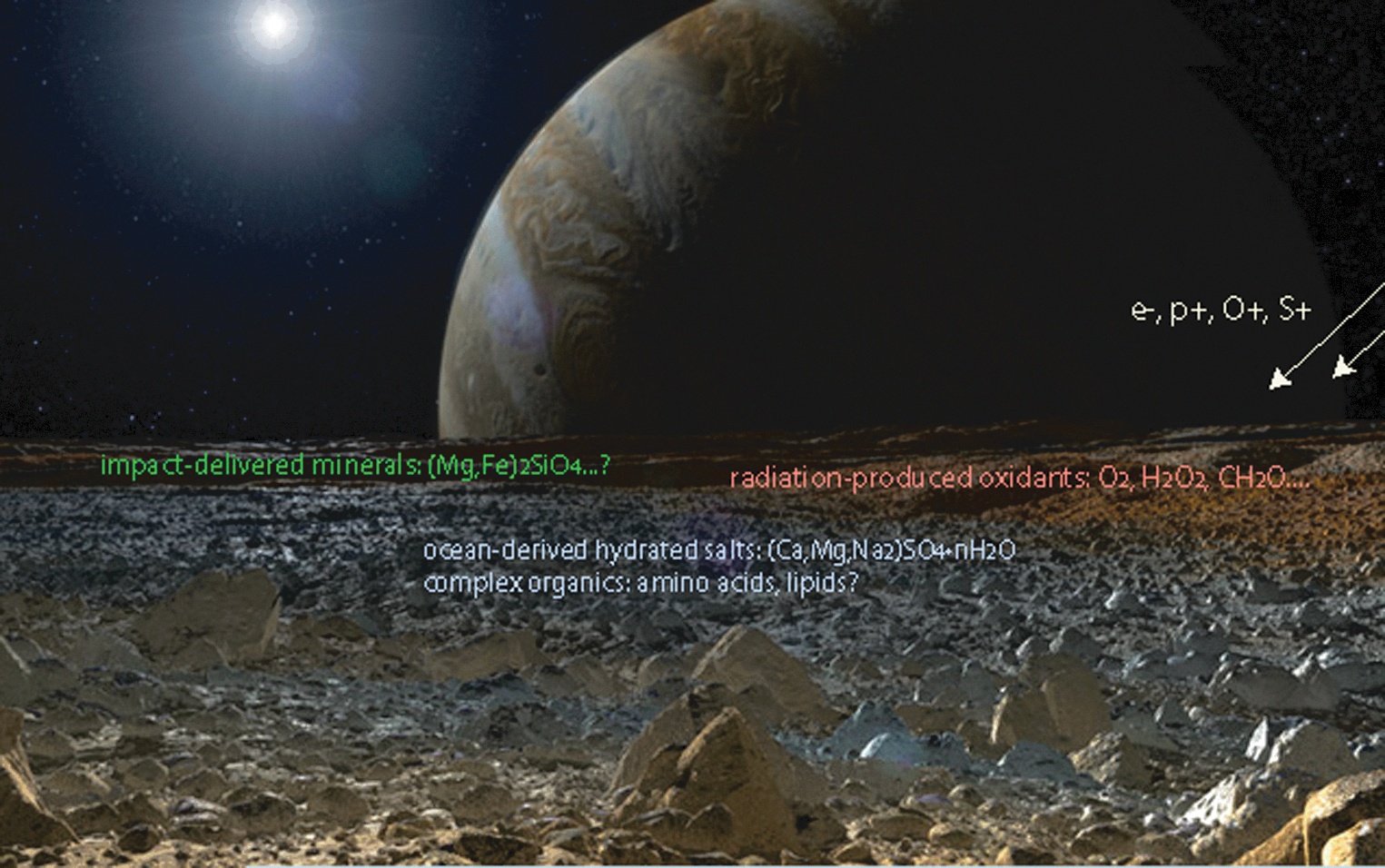
Europa's surface composition is derived from a mixture of endogenic and exogenic processes, which must be unraveled to understand the composition of the ocean below.
Assessing composition is critical to understanding Europa's potential for habitability. Such measurements can be well achieved by direct in situ analyses of surface materials. The highest-priority objective of the studied Europa lander mission is to “Understand the habitability of Europa's ocean through composition and chemistry.” From this objective flow the two chief composition investigations, and for each we recommend two associated measurement recommendations:
(1) Characterize surface and near-surface chemistry, including complex organic chemistry, to constrain ocean composition and understand the endogenic processes from which it evolves.
• Measure organic content (including complex organic compounds) of surface (0.5–2 cm depth) and near-surface (5–10 cm depth) materials to as low as 1 ppb concentration. • Measure mineralogy and volatile content of surface (0.5–2 cm depth) and near-surface (5–10 cm depth) materials to as low as 0.1 wt %.
(2) Characterize surface and near-surface chemistry, including complex organic chemistry, to constrain the exogenic processes and material fluxes that affect ocean composition.
• Measure organic content (including complex organic compounds) of surface (0.5–2 cm depth) and near-surface (5–10 cm depth) materials to as low as 1 ppb concentration. • >Measure mineralogy and volatile content of the surface (0.5–2 cm depth) and near-surface (5–10 cm depth) materials to as low as 0.1 wt %, including exogenous and processed constituents. A third investigation is dedicated to understanding the context of the samples:
(3) Constrain the context of compositional measurements.
• Image sampling area prior to sample collection to provide local and site-specific context. • Image collected samples at a resolution of better than 100 microns/pixel.
Measuring composition in situ does not directly determine the origin of the material, for example, from meteorites versus from Europa's ocean. Such interpretation must come from analysis of the data compared with expected chemical correlations and distributions, and in the context of data from other instruments. The composition investigations cannot be made independently but rather must be performed in an integrated manner.
Suggested composition measurements thus are formulated for identifying and quantifying relevant compounds and understanding the context in which they were deposited.
2.2.1. Separating endogenic and exogenic materials
Key to unraveling endogenic and exogenic materials is taking advantage of the different exogenic processing histories of surface and subsurface materials. Materials at the surface are likely to be more highly altered and gardened by radiation, while subsurface material compositions may be more strongly influenced by the ocean chemistry. The surface should be sampled from the first 0.5–2 cm to ensure that radiation effects are captured.
Landing on the surface of Europa will substantially alter the topmost layer both mechanically and chemically. Based on testing and experience from past landed Mars missions (e.g., Plemmons et al., 2008; Mehta et al., 2011; Metzger et al., 2011), hydrazine thrusters would significantly alter the topmost layer of the surface. Expected effects include the mobilization of unconsolidated material, thermal erosion of ice-rich material, and the chemical addition of thruster exhaust compounds dominated by ammonia (hydrazine by-product) plus small amounts of contaminants in the hydrazine including water and organic compounds. The spacecraft itself may be a source of outgassed and mobile volatiles and organic compounds.
Any contamination of the sample should be at or below the sensitivity suggested for the instrumentation: 1 ppb both for complex organic contaminants and for inorganic contaminants. This desired cleanliness level—for the samples and the sample handling system—is about an order of magnitude more stringent than that required of the sample handling equipment on the Mars Phoenix (<10 ppb) and Curiosity (<40 ppb) missions (Ming et al., 2008; Conrad et al., 2012).
A sample that meets the contamination requirement from a shallow depth (0.5–2 cm) is desired to understand near-surface implantation effects. To understand Europa's endogenic composition, that is, the composition most closely representing the ocean, a second sample should be selected from below the radiation-processed surface layer. Landing site selection requirements of young materials and a relatively low radiation environment imply that this second sample does not need to be selected from great depth. Depth of 5–10 cm should put the material below the radiation-damaged zone (e.g., Patterson et al., 2012). Thus, two samples are deemed sufficient for compositional measurements, and all relevant compositional measurements should be made on each of the two samples.
Because evolved volatiles are to be studied, heating of the sample above the maximum diurnal temperature of the landing site is to be avoided during acquisition and handling. This also prevents melting, which would combine exogenic and endogenic materials, making interpretation of the data difficult or impossible. To preserve volatiles in the ice (e.g., O2, CO, CO2), the sample bulk temperature should be less than 150 K, close to expected peak daytime heating temperature. Ideally, the entire sample should not experience temperatures above 150 K; however, the prime science results involve the relative abundances of species, so it is acceptable that only portions of a sample are heated. If diurnal temperatures are to be exceeded, the temperature limit for melting is lower than 273 K, as salts will lower the eutectic melt temperature. Sulfuric acid hydrate has the lowest eutectic melting temperature of the materials expected to be present on Europa, at 198.6 K (McCarthy et al., 2007).
2.2.2. Compositional measurements
Two categories of measurement emerge from the suggested compositional scientific investigations: organic content, and mineralogy and volatile content.
The low expected abundance of organic compounds at Europa based on terrestrial systems (Table 1) suggests that organic measurements will require high sensitivity relative to present technological capabilities. Assuming that the organic content of Europa is similar to biologically rich waters leads to setting limits for confident detection of organic species at about 1 ppb. This sensitivity suggests spacecraft contamination control of less than 1 ppb organic material in the sample transfer chain.
Non-icy materials on Europa are believed to be present at less than 1 wt % to tens of weight percent, depending on the species (Table 2). Recent work mapping the distribution of ice and salts (Shirley et al., 2010) shows that even on large spatial scales the composition can be highly variable. The mineralogical structures of sampled materials may be temperature-dependent, so they should be measured with minimal thermal processing. To prevent salts and other soluble materials from combining, melting should be avoided. Inorganic spacecraft contaminants should be controlled to less than 1 ppm.
While a variety of instruments could potentially make these measurements, this Europa lander study suggests a combination of a mass spectrometer and a Raman spectrometer. The mass spectrometer would be optimized to detect low-level organic compounds, while the Raman spectrometer would be focused on salt mineralogy and ice/volatile chemistry. To fully interpret the measurements, mass spectrometry and Raman spectroscopy measurements must be made on the same sample. Details of the suggested measurement approach are provided below.
2.2.2.1. Mass spectrometry
The method for measuring organic compounds on the Europa lander model payload is mass spectrometry, which has been used on numerous spacecraft missions, including Cassini, Phoenix, and Curiosity, and has been used in broad surveys of organic materials and for detecting organic compounds in low abundances (∼1 ppb). The study team considered many implementations of the instrument; the model payload instrument is based on that used on Mars Phoenix, with an optional “plus-up” of a gas chromatograph like that on Curiosity.
A mass spectrometer is also envisioned to address minimum measurements of salt mineralogy and volatiles if the second composition instrument for mineralogy (Raman, next section) cannot be accommodated, or as a backup in case of failure. The instrument needs a macroscopic (several gram) sample of consolidated or loosely consolidated ice matrix material, which is transferred to an oven for thermal processing. Monitoring of background and escaping volatiles (e.g., CH4, CO, CO2) begins immediately at ambient conditions in the hermetically sealed oven, with the sample pressure controlled via a gas split. The majority of the water ice is then sublimated away. To preserve the salt mineralogy and avoid mixing dissolved europan salts with implanted ions (e.g., H+, Na+), care must be taken not to melt the sample (i.e., the pressure is kept low). Once water ice is baked out, the sample is slowly heated to 400°C. The sample gas is split, with part going directly into the mass spectrometer and the other part being diverted to a low-temperature organic trap, in order to detect organic compounds at low abundances ∼1 ppb. (Potentially, the gas could then be transferred to a gas chromatograph, in order to distinguish among compounds that have the same molecular weight.) Continued heating of the sample, up to 1200°C, leads to the breakdown of salts, such as sulfates (e.g., gypsum) and other mineral species. Measurement of the volatiles released and the temperature of release can constrain the salt mineralogy. An example gas profile showing three selected species (H2O, SO2, and CO2) evolved from a mixture of calcite CaCO3 and melanterite FeSO4·7H2O, which was used to calibrate the Sample Analysis at Mars (SAM) mass spectrometer, is shown in Fig. 6a. The onset, peak position, and width of such temperature profiles are diagnostic of the particular mineral phases, and a full mass spectrum (Fig. 6b) is associated with each point in the temperature ramp, permitting identification of breakdown products of organic materials.
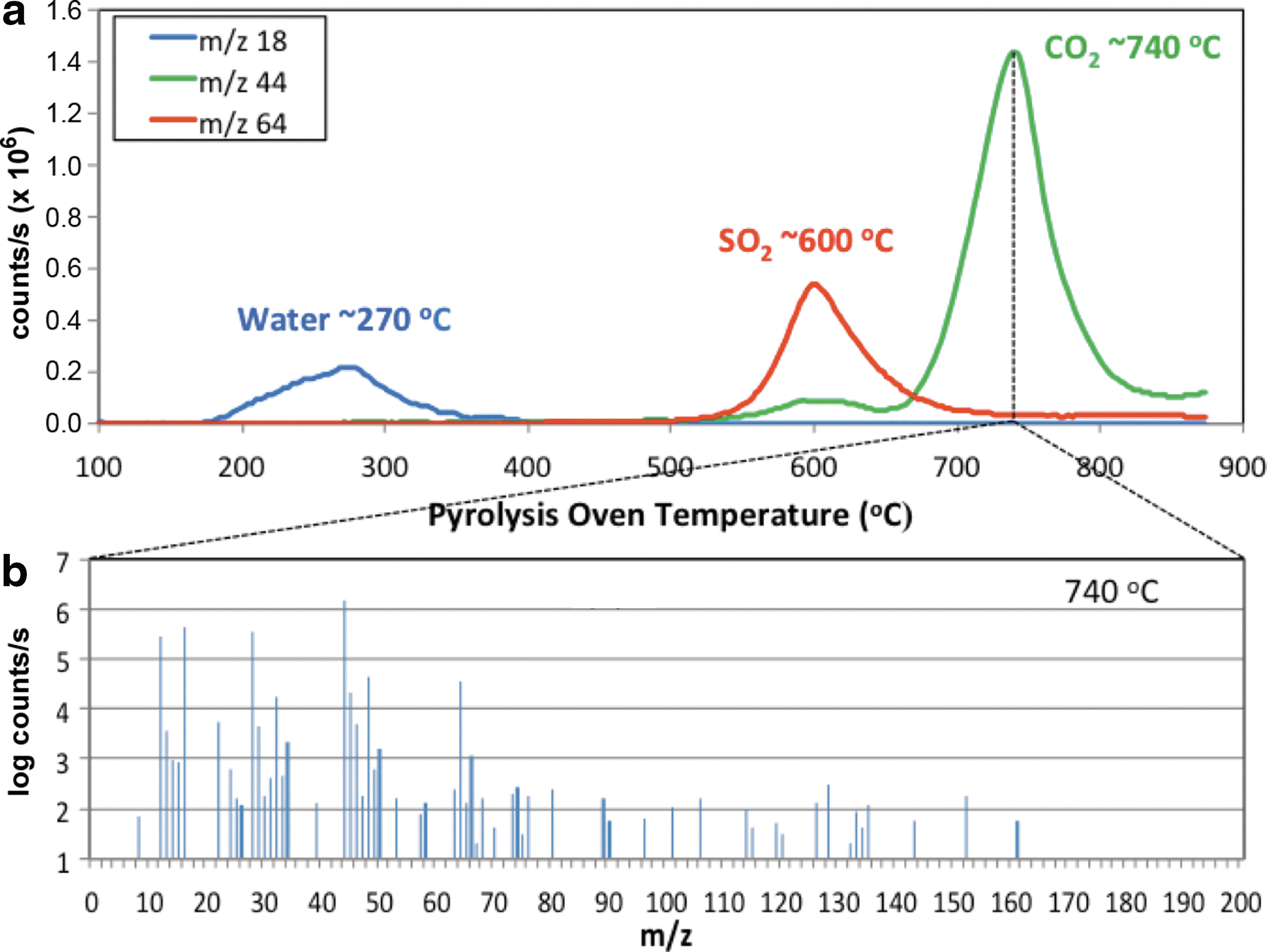
Evolved gas analysis of selected volatile compounds coupled with highly sensitive mass spectrometry enables organic and mineralogical analysis of solid samples. (
2.2.2.2. Raman spectroscopy
The secondary technique for determining composition is one that measures compositional structure (mineralogy) directly. We consider Raman spectroscopy as best addressing this. In Raman spectroscopy, laser light is focused on a sample and inelastically scattered. The shift in the wavelength of the scattered laser light due to vibrations in mineral structure is diagnostic of the material being probed. An infrared laser was selected as optimal for Raman at Europa's surface, because there is minimal unwanted mineral fluorescence in that range and because visible wavelength lasers can destroy organic compounds. Raman has the additional advantage that it is nondestructive, which allows the same sample to be measured in another way (e.g., a mass spectrometer), provides complementarity, and simplifies the sampling requirements and sample transfer train.
Raman spectroscopy can measure both the salt and volatile content of materials near the landing site. On Earth, Raman spectra of ice cores are used to study their volatile content (e.g., Pauer et al., 1996; Iizuka et al., 2008; Fall et al., 2011). The nondestructive nature of the technique makes it ideal for studying mineral phases that are unstable to increases in temperature. Raman can also be used to investigate salt mineralogy, addressing such issues as the nature of cations and the hydration state. As can be seen from the suite of sulfate minerals in Fig. 7, Raman spectra are highly sensitive and thus diagnostic of variation in the structure of minerals due to the inclusion of water in the matrix (Chaban et al., 2002; Wang et al., 2003; Chio et al., 2007).
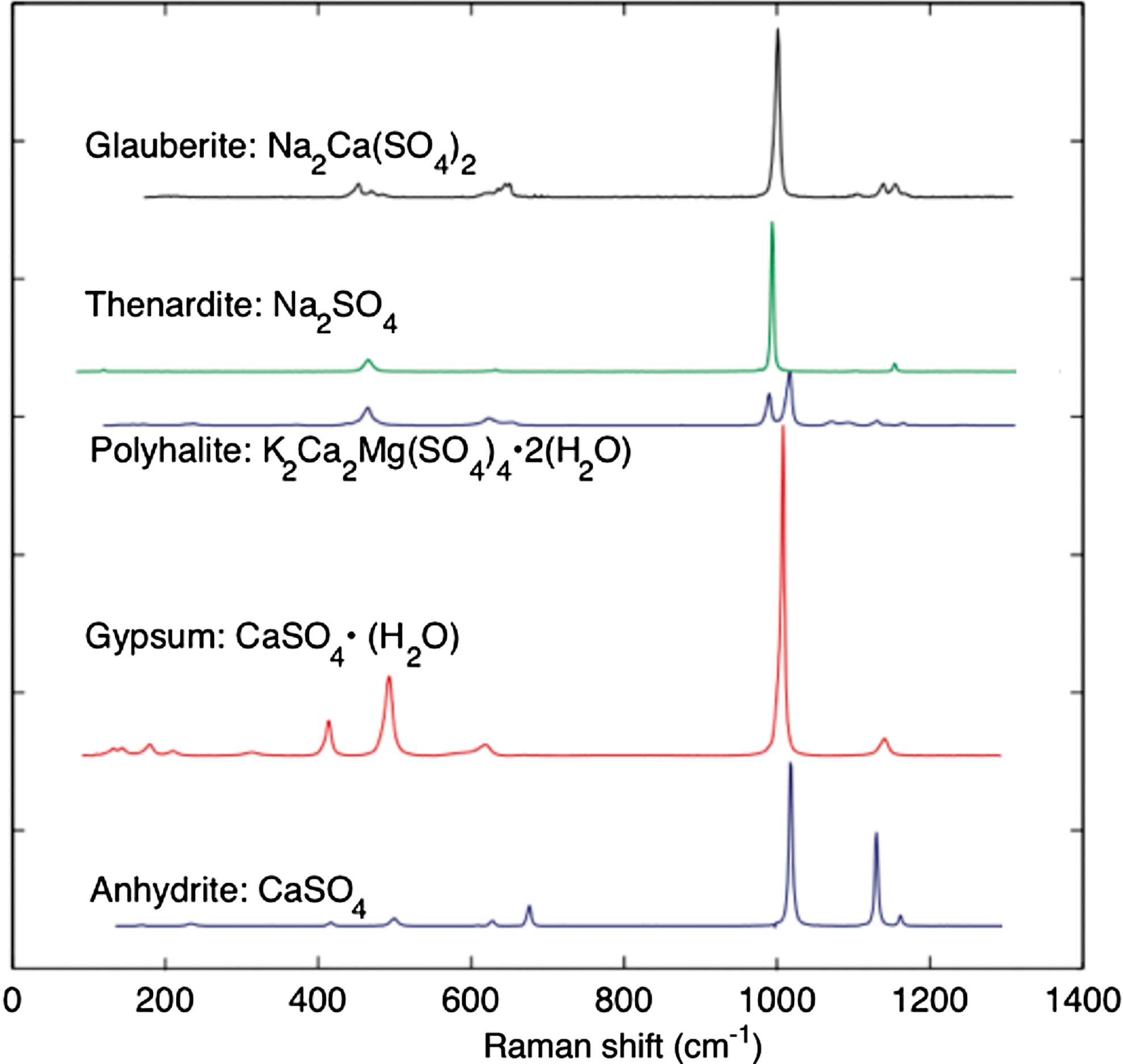
Example Raman spectra of Mg, K, Na, and Ca sulfates assembled from spectra in the RRUFF database (Downs, 2006).
2.2.3. Sample context
The need to distinguish between exogenic and endogenic processes on Europa means that sample context is critical to the interpretation of results. Findings at the spatial scale of the limited samples collected cannot be assumed generally true for all of Europa. For instance, a sample from a lag deposit created by sublimation would have a very different concentration of materials than a more ice-rich sample, which could influence the interpretation of habitability.
The primary method for deriving sample context is imaging. Context comes in two forms: geological context and sampling context. Geological context includes processes that created the landforms from which composition is measured. For instance, landing on the ejecta blanket of a small crater might imply material at the surface is actually from a greater depth. A chaotic feature or landform related to exposure of ocean material to the surface would be expected to contain a higher proportion of salts and possibly also of organic materials. Landing on the leading hemisphere would imply a lower concentration of irradiated materials created by electron impacts from particles corotating with Jupiter's magnetic field. Understanding the history of the surface is essential in tracing the derived compositions back to the ocean. To accomplish this, we suggest the sampling site to be imaged at better than 0.5 mm per pixel prior to sampling. Also, imaging the site after sampling would enable us to understand more about the sample collection process, for example by exposing albedo and morphological variation associated with depth.
Sampling context is primarily a microscopic measurement at spatial scales from 10 to 50 μm per pixel to look at the degree of homogeneity. Solid inclusions, for instance, might suggest the presence of impact-delivered solids or diagenesis of brines and ice grains prior to cooling of emplaced materials. While an intact sample would preserve structural relationships between elements, an estimate of sample heterogeneity can be made with a fragmented sample.
3. Ocean and Ice Shell
The habitability of Europa cannot be decoupled from processes associated with the evolution of its ocean and ice shell. Values of several key parameters are still quite uncertain, including the thickness of Europa's ice shell, the depth of the ocean, and the degree to which the surface is in communication with the subsurface (e.g., Carr et al., 1998; Greenberg et al., 1999; Kivelson et al., 1999, 2000; Pappalardo et al., 1999; Figueredo et al., 2003).
3.1. Ocean and ice shell background
At present, the strongest constraint on the existence and extent of Europa's ocean comes from Galileo's magnetometer investigations, which measured Europa's induced magnetic field. Results imply a global conducting layer, consistent with a salty ocean, within about 50 km of the surface (Khurana et al., 1998; Kivelson et al., 1999, 2000; Zimmer et al., 2000). The details of this signature depend upon the depth of the ocean, the thickness of the ice shell, and the salinity of the ocean (e.g., Zimmer et al., 2000; Hand and Chyba, 2007). Magnetometers can also be utilized to discern local sources, in addition to global fields, on landed or orbital platforms (e.g., Dyal et al., 1970; Hood et al., 1979, 2005; Acuña et al., 1999; Khurana et al., 2007). However, Galileo magnetometer measurements lacked both spatial and temporal resolution to detect whether a small intrinsic signature might exist.
Because Europa's measured magnetic field is induced by the 9.925 h rotation of Jupiter's magnetic field, the signal at Europa is time-varying with two dominant periods (Fig. 8). The shorter period is 11.23 h, which is the beat period between Europa's orbital motion and Jupiter's rotation. The longer period (85.228 h) is just that of Europa's orbital motion about Jupiter, in a slightly eccentric path. As described in Section 3.2 below, the magnetic field of Europa can be utilized to study oceanic processes as well as the deep interior, with a long baseline of observations across several jovian rotations.
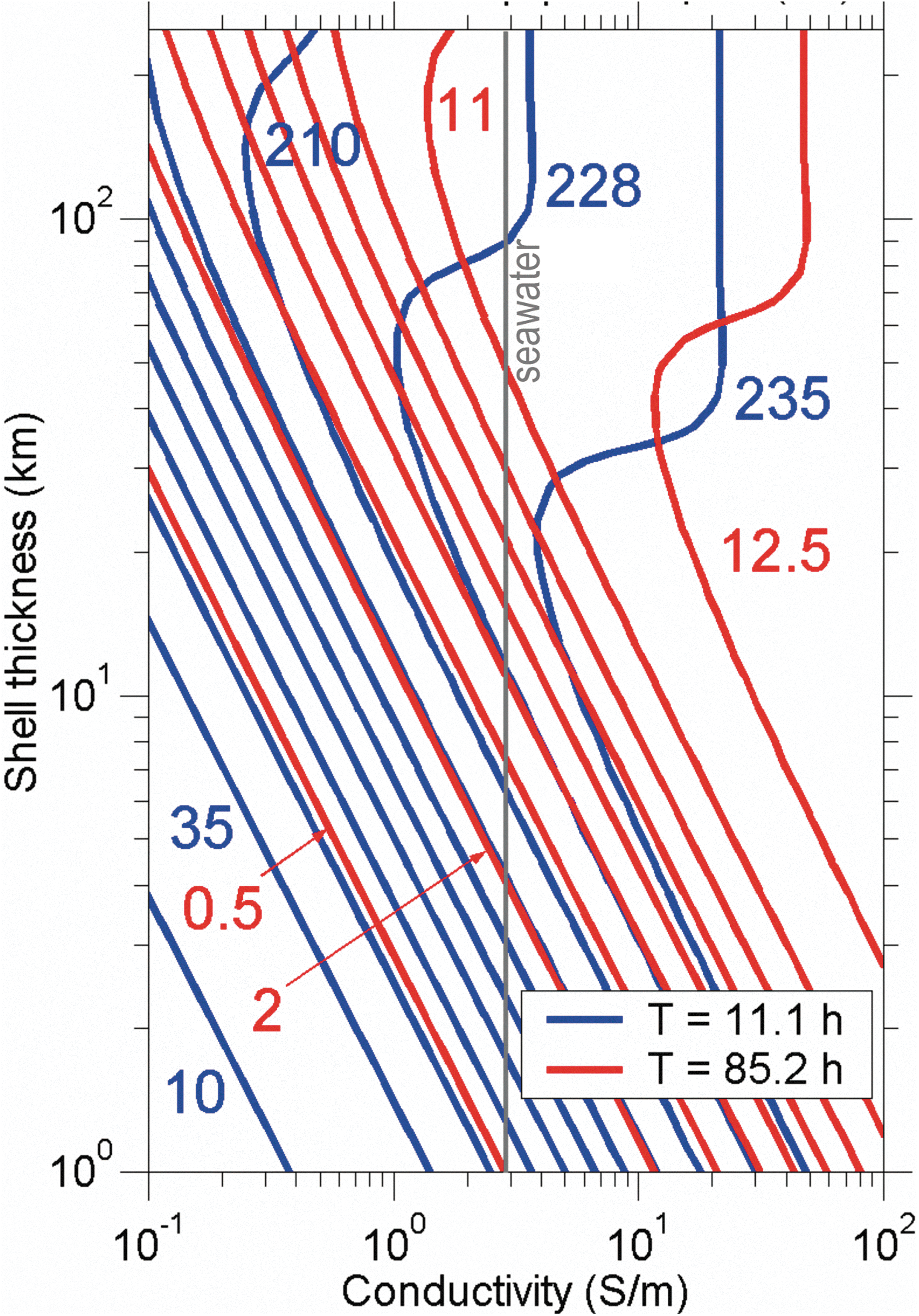
Contours of the induced magnetic field (in nT) generated at the surface of Europa, predicted at Europa's synodic period of 11.1 h (blue) and at Europa's orbital period of 85.2 h (red), as a function of ocean thickness and ocean conductivity. For relatively large values of ocean thickness and conductivity, the predicted induction curves intersect, permitting ocean thickness and conductivity to be uniquely determined from orbital measurements. After Khurana et al. (2002).
Central to the uncertainty about ice and ocean thickness is the geomorphology of the surface, including ridges, bands, and chaos terrains (see Section 4). Of these, chaos terrains in particular (Section 4.1.1) have been central to these issues, as the terrain possibly represents regions of material exchange between the surface and the ocean (Collins and Nimmo, 2009; Schmidt et al., 2011). Because such exchange is critical to the habitability of Europa, a dedicated lander mission should address and test hypotheses regarding ice shell thickness, ocean depth, and the mechanisms for exchange between the surface and subsurface, all of which complicate interpretation of surface geology. To address these hypotheses, observations should be made that sample the region surrounding the lander that have the potential to determine the three-dimensional structure of the ice shell. The best sources of energy for these observations are the seismic waves generated by cracking within Europa's ice shell. The depth and frequency of seismic events will be a function of the source of fracture events, themselves not independent from considerations such as shell thickness and structure, as described in detail below.
Geophysical models of Europa indicate that any ice shell beyond a thickness of ∼15 km must transfer heat through thermal convection of a mobile ice layer underlying a shallow brittle layer (e.g., McKinnon, 1999; Tobie et al., 2003; Showman and Han, 2005; Mitri and Showman, 2008; Han and Showman, 2010, 2011) or diapirism by which localized ice plumes rise through the ice shell (Rathbun et al., 1998; Pappalardo et al., 1999; Sotin et al., 2002; Pappalardo and Barr, 2004). These are consistent with observations of the morphology of Europa's surface (e.g., Pappalardo et al., 1998; Figueredo et al., 2003) and of its impact craters (Schenk, 2002). However, observations of cycloids and other surface features have been used to argue for a much thinner shell (e.g., Carr et al., 1998; Greenberg et al., 1999; Hoppa et al., 1999).
Cracking, ridge formation, and chaos formation will be appreciably different in a thin shell than in a thick shell and thus are not only potential sources of seismicity within the shell but also could be characterized utilizing seismic measurements. Cycloidal ridges are composed of chains of arcuate cusp ridge segments joined at acute angles, possibly indicative of progressive opening in the presence of a changing stress field as might be caused by diurnal tides called tidal-walking (e.g., Hoppa et al., 1999). However, tail-crack propagation initiated by diurnal forcing but occurring over much longer time periods may explain these features as well, with particularly good observational fit to inverted and paired cycloids (e.g., Marshall and Kattenhorn, 2005).
Both melt-through of a thin (less than 10 km) ice shell (e.g., Carr et al., 1998; Greenberg et al., 1999; O'Brien et al., 2002) and disruption of a thick shell (greater than 10 km) by diapirs that are the expression of convective upwelling (Pappalardo et al., 1998; Rathbun et al., 1998; McKinnon, 1999; Pappalardo and Barr, 2004; Sotin et al., 2002; Tobie et al., 2003; Showman and Han, 2004) have been suggested as the mechanisms that may form chaos terrains, because both models can produce much of the characteristic morphology of chaos terrain, including the appearance of floating icebergs within some of the terrain. In thick-shell scenarios, the survival of ascending warm plumes of ice into the shallow subsurface might produce small amounts of water via either localized partial melting of salty ice or focusing of tidal energy within the plume (e.g., Sotin et al., 2002; Pappalardo and Barr, 2004; Nimmo and Giese, 2005; Mitri and Showman, 2008). More recently, it has been suggested that chaos terrain forms by the collapse of the ice above large, liquid water lenses formed by melting in the ice shell, probably near the brittle-ductile transition (Schmidt et al., 2011). This model is consistent with the topography of chaos terrains not well reproduced by prior thick- or thin-shell models (Collins et al., 2000; Collins and Nimmo, 2009) and implies that some regions are active today (Schmidt et al., 2011). But independent of the model assumed, chaos terrains are likely sites of extant or former liquid water; tectonic activity; and exchange of material between Europa's surface, the ice shell, and the ocean. These characteristics make chaos terrains astrobiologically relevant for further study.
On Earth, seismological techniques are useful for understanding both the flow dynamics of ice sheets (e.g., Neave and Savage, 1970; Alley et al., 1986; Blankenship et al., 1986, 1987; Anandakrishnan and Alley, 1997; Winberry et al., 2009) and the dynamics and properties of floating ice shelves (e.g., Johnson and Smith, 1997; Bassis et al., 2005; Brajanovski et al., 2006; McMahon and Lackie, 2006; Lambrecht et al., 2007). Dynamic ice processes provide a range of seismic energy sources that allow characterization of both the source process and the ice properties between the source and receiver. Thus, seismic sources and techniques are compelling for the landed exploration of Europa (Kovach and Chyba, 2001; Lee et al., 2003; Cammarano et al., 2006), with the potential for characterizing not only dynamic rupture events from geological processes but also the thermal and structural properties and distribution of water within the ice below and near the lander.
Trapped waves known as Love waves have been suggested as useful for diagnosing ice shell thickness (Kovach and Chyba, 2001). However, Lee et al. (2003) showed that these waves, which are trapped within the shell, have diagnostic power only at distances that are large compared to the ice shell thickness. For an ice shell from a few to tens of kilometers thick, both Love and Rayleigh waves require powerful sources at known and large (>100 km) distances that are likely beyond the discrimination capabilities of a single landed receiver.
Body waves can be used to accomplish echo sounding based on comparing primary compressional (P) and secondary shear (S) wave arrivals, along with their reflections (PP and SS) and P-S wave conversions at a variety of interfaces (Fig. 9). Figure 10 shows various signal characteristics for direct, reflected, and converted waves traversing Europa's ice shell for source to receiver offset of 50 km, generated by a surface crack with a rupture depth of 250 m. This illustrates that body waves are particularly useful for studies of Europa's ice shell and underlying ocean (Lee et al., 2003).
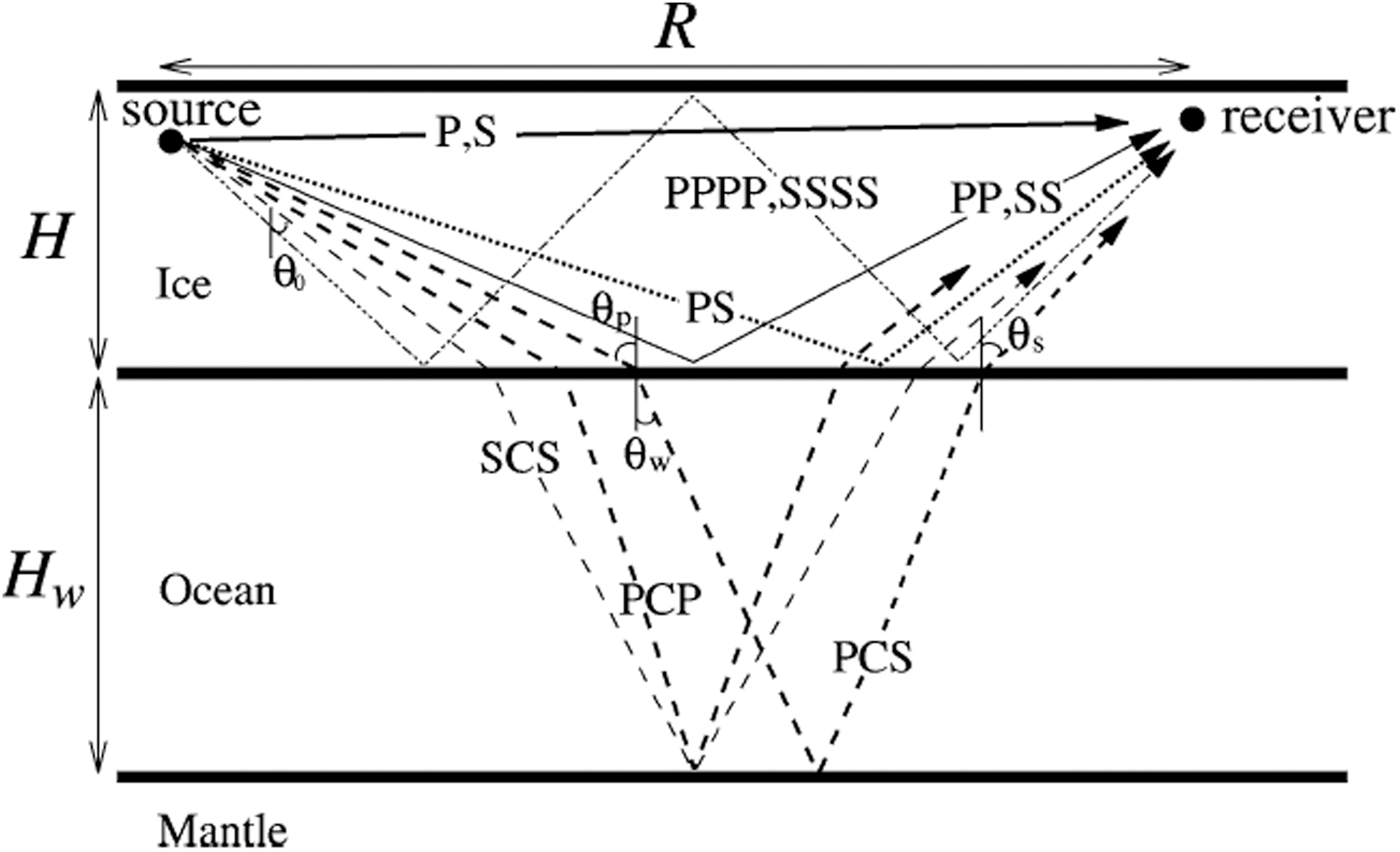
Ray paths of compressional (P) and shear (S) waves through Europa's ice shell and acoustic (C) waves through the ocean. PP, PS, SS waves are single reflections from the ice-water interface, while PCP, PCS, and SCS waves are single reflections from the water-mantle interface. Letters are added consecutively when it reflects from or transmits through an interface. From Lee et al. (2003).
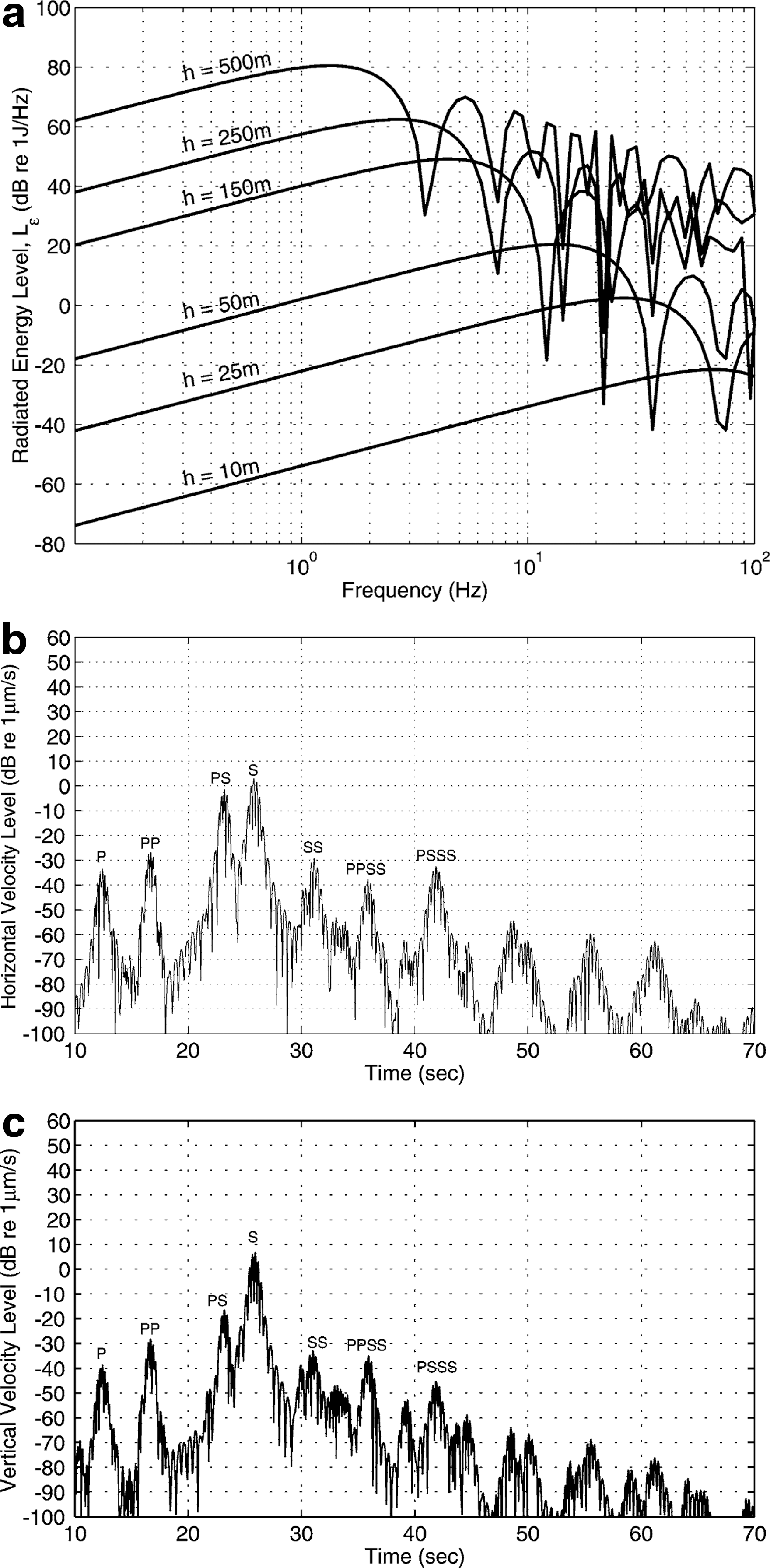
Cracking events and their detectability by seismic techniques (reproduced from Lee et al., 2003). (
To design a seismic experiment on the surface of Europa, we need some knowledge of likely source and noise characteristics. Current models are not well constrained and thus lead to a wide range of predicted source and noise parameters. Sources of seismic energy in Europa's ice shell have been assumed to be associated with fracture events from the near surface or the ice-ocean interface (Kovach and Chyba, 2001; Lee et al., 2003; Cammarano et al., 2006). These analyses generally assume crack propagation at ridges or cycloids to be the dominant source of seismic waves, and the initial work assumed that ridges and cycloidal cusps form as a release of energy within one tidal cycle (3.55 days, or one eurosol), akin to the tidal-walking model of cycloid formation (Hoppa et al., 1999).
Under this assumption, the ambient background noise from the formation of geographically distributed cracks of varying size is sufficiently high that only 100–250 m cracking events would be energetic enough to detect above the background (Lee et al., 2003). Alternatively, the buildup of stress over several diurnal cycles may be required to permit crack propagation (e.g., Marshall and Kattenhorn, 2005). Thus, the estimates of the rate of large events generating body waves of sufficient energy to sound the full ice shell (either thick or thin) and ocean advanced by Lee et al. (2003) and others are likely to be an overestimation by one to a few orders of magnitude. However, it is also true that the corresponding background seismic noise will also be much lower if cracks propagate more slowly or form less frequently. The ambient noise decreases by ∼20 dB for 2-order-of-magnitude lower source rates, implying that even at 50 km source-receiver range, 100 m deep cracking events will be of sufficient energy for both the ice-ocean interface and ocean floor to be detected above the noise, and energy from formation of 50 m cracks may also be detectable. Thus, regardless of crack source frequency, seismic techniques offer robust characterization of the ice shell and ocean.
The rupture and refreeze of ice above liquid lenses within a thick ice shell (e.g., Schmidt et al., 2011) could provide an additional source of seismic events to be quantified if the lander is located nearby (within tens of kilometers). Energetic seismic waves could be used to diagnose the thickness of a water lens and the ice shell above and below using body-wave analyses, akin to the 5 and 20 km ice shell scenarios envisioned by Lee et al. (2003).
Ultimately, the greatest unknown in our knowledge of the exchange processes that affect the potential habitability of Europa is the nature of ice-ocean exchange. Such implies upwelling of any material from the ocean into the shell and downwelling of the near-surface materials. In the context of the geophysical models described above, landed ocean and ice shell scientific investigations should address the following major questions: • How deep is the ocean, and how does it interact with the overlying ice to supply upwelling material and receive downwelling material? • Do shallow liquid bodies exist within the ice shell, and if so, how do they communicate with the surface and with the ocean below? • Is surface-ocean exchange active today? • Is geological activity coupled to the tidal cycle?
3.2. Ocean and ice shell investigations
A lander offers potential to understand the bulk properties of the ocean and a unique capability, afforded by direct contact with the surface, to understand the regional structure of the ice. Measurements of ocean salinity and thickness (and, by extrapolation, volume) can place first-order constraints on material inputs to the ocean. With a defined ocean volume, salinity provides a bulk measure of the amount of material that has been processed through water-rock reaction and thereby imposes a key boundary condition for models of ocean chemical evolution and the endogenic contribution to energy flux. Local to regional characterization of ice shell structure would provide a direct complement to this information. Specifically, an understanding of the internal structure of the ice—including cracks, phase transitions, and near-surface water bodies—would, in combination with surface geomorphology, provide insight into mechanisms of mass transport and ocean-ice exchange. These processes bear critically on understanding the energy flux contribution to the biological potential of Europa. Identification of discrete near-surface water (e.g., lakes within the ice shell) would open a new avenue in consideration of europan astrobiology—pockets of potential transient habitability that could differ from the global ocean with respect to the ingredients for life and their modes of material exchange with the accessible surface.
Geophysical techniques to probe Europa's ocean and ice shell are well-suited to a Europa lander. A significant objective for the studied Europa lander mission is
Characterize the local thickness, heterogeneity, and dynamics of any ice and water layers of the ice shell.
This leads to the four specific investigations described next.
1. Constrain the thickness and salinity of Europa's ocean. Magnetic fields interact with conducting matter at length scales ranging from atomic to galactic. Magnetic fields are produced when electrical charges flow and produce currents in response to electric potential differences between two regions. Many planets generate their own stable internal magnetic fields, in metallic cores or inner shells, through dynamos powered by convection from internal heat or gravitational settling of the interior. Still others have induced magnetic fields, which arise through interactions between externally imposed magnetic fields and their interiors. The imposed magnetic field causes a current to flow in a conductive layer of the planet, inducing a magnetic field equal in magnitude and opposite in direction to the imposed field. This secondary field is readily measured by a magnetometer located outside the conductor.
Galileo observations of Europa demonstrated that it possesses an induced magnetic field caused by its interactions with Jupiter (e.g., Khurana et al., 1998; Kivelson et al., 1999, 2000). Europa's induced field arises from the primary alternating magnetic field of Jupiter, because its rotation and magnetic dipole axes are not aligned. Europa's field must arise from interactions with a near-surface conductive layer (Khurana et al., 1998; Kivelson et al., 2000) and is most consistent with induction within a salty subsurface ocean. The measured signal was shown to remain in phase with the primary field of jovian origin (Kivelson et al., 2000), thus unambiguously proving that the perturbation signal is a response to Jupiter's field. While no intrinsic magnetic field was observed in the flybys by Galileo (Kivelson et al., 2000), an upper limit of 25 nT for a possible intrinsic component was derived (Schilling et al., 2004). Thus, a magnetometer may be used both to characterize the ocean of Europa and possibly its deeper interior.
Modeling of the measured induction signal, although clearly indicative of a europan ocean, suffers from nonuniqueness in the derived parameters because of the limited data. Individual flyby measurements, such as those obtained by the Galileo spacecraft, suffer from both temporal and geometric constraints, and that inhibits separation of higher-order field components. This is usually dealt with by assuming that the inducing signal is composed of a single frequency, corresponding to the synodic period of Europa with respect to Jupiter.
Geometric information from several flybys has been used to reconstruct some aspects of the field, but observations of how the field evolves in time, in response to external forcing or any internal source, were beyond the scope of Galileo's mission architecture. Unfortunately, single-frequency data cannot be inverted to determine independently both the ocean thickness and the conductivity. Nevertheless, the single-frequency analysis of Zimmer et al. (2000) revealed that the ocean must have a conductivity of at least 0.06 S/m. Recently, Schilling et al. (2004) determined that the ratio of induction field to primary field is 0.96±0.3, leading Hand and Chyba (2007) to infer that the ice shell is <15 km thick and the ocean water conductivity >6 S/m.
Clear delineation of an internal intrinsic field on Europa will require measurements of the magnetic field in situ over many jovian rotations and eurosols. To determine the ocean thickness and conductivity, magnetic sounding of the ocean at multiple frequencies is needed. The depth to which an electromagnetic wave penetrates is inversely proportional to the square root of its frequency. Thus, longer-period waves sound to larger depths and could provide information on the thickness of the ocean, and sufficiently long periods could even probe conductivity of the silicate mantle and possible metallic core. Electromagnetic sounding at multiple frequencies is routinely used to study Earth's mantle and core from surface magnetic data (Parkinson, 1983). Recently, Constable and Constable (2004) demonstrated that data from orbit can be used for electromagnetic induction sounding at multiple frequencies.
Multiple low-frequency variations are present at Europa. As introduced in Section 3.1, the dominant timescale over which Europa experiences magnetic variations is at 11 h, Europa's synodic period, and has an amplitude of 200–250 nT (Zimmer et al., 2000). The second period, at 85.2 h, occurs as Europa's eccentric orbit moves the moon closer to, and farther from, the planet, which varies the near-moon magnetic field by about 15 nT. The third variation is due to other magnetospheric effects and does not have a regular periodicity. Russell et al. (2001) found that the field strength in the jovian inner magnetosphere varied by about 30 nT over the course of the Galileo mission and could regularly change by 10 nT, comparable to the eccentricity-driven variation, between successive passes through the region.
Over a broad range of the relevant parameter space (ocean thickness and conductivity), the induction responses of Europa at the two dominant frequencies (those of its orbital period and Jupiter's rotation) will intersect (Fig. 8). In that range, the ocean thickness and conductivity may be determined uniquely. To sound the ocean at these two frequencies, continuous data are needed from low altitude over a long duration of observations; at least 1 month (8 eurosols) is preferred. A longer observation time would also better enable the removal of any variations noted by Russell et al. (2001) from the eccentricity-generated periodicity.
The periods and magnitudes of expected variations in the magnetic field and plasma environment dictate magnetometer specifications. While the short-term magnetospheric and orbital variations in the magnetic field strength are 10 and 15 nT, respectively, the orbital variation alone would create a signal at the lander of less than 7 nT. In the worst case, if the magnetospheric field varies such that the 15 nT is reduced to a difference of 5 nT over Europa's orbit due to interference between orbit-derived variations and those inherent to the jovian system, the magnitude of the expected contribution to the induced field would be a minimum of 2.5 nT. Observational precision of 0.03 nT would allow the magnetometer to measure about 1% of this minimum signal and thus still accurately quantify Europa's induced response to the orbital variation.
With data acquired while Galileo passed through Europa's wake, Volwerk et al. (2001) found magnetic field variations, with 20 nT peak-to-peak amplitude and frequencies below 0.2 Hz, that were associated with the ionization of heavy molecules, like O2. Although these observations were made downstream of Europa, the Galileo spacecraft was about three Europa radii away and could not determine whether waves were observed closer to the moon. If a magnetometer samples at a frequency comparable to plasma waves such as these, significant aliasing issues would affect the search for induction signals. The observed waves could, for instance, dwarf any 82.5 h signal. Protons, a product of the moon's water-ice surface, would generate the highest-frequency waves that would affect the proposed analysis. In the ∼400 nT field at Europa, the proton-generated waves would occur at frequencies between 6 and 7 Hz. The minimum sampling rate to avoid aliasing issues is twice that frequency; thus, sampling over a bandwidth of at least 16 Hz is recommended. To reduce data volumes, onboard averaging of the data by a factor of 2 to 4 could be employed.
Inversion of multifrequency magnetic field observations, as described above, is a well-established means of estimating ice shell thickness and conductivity of any underlying water body. Independent constraints on these inversions will significantly improve confidence in their critical salinity–thickness results. In addition, the relationship of the landed observation platform to water bodies other than the ocean that are below it or adjacent to it will complicate simple magnetic inversions for the vertical conductivity profile and possibly lead to significant uncertainties in thickness/conductivity estimates.
Seismic sounding of the ocean in parallel with magnetospheric observations would address the ambiguities inherent with a single technique. As described above and in detail for the investigations below (and shown in Fig. 9), seismic events (likely fracturing of the ice) within the ice shell provide a source of compressional (P) and shear (S) body waves that can be transmitted through the ice-ocean interface, reflect off the silicate interior, and reach the receiver with a characteristic travel time in the range of 110–160 s (Lee et al., 2003). Constraints on ocean thickness can be obtained via detection and recording of seismic body waves, with both travel times and some indication of the azimuth and inclination from which these waves are arriving. This seismic estimate of ocean thickness will be highly complementary to magnetic induction investigations and allow improved constraints on the salinity of Europa's ocean.
2. Constrain the thickness of ice and the thickness of any local water layers in the region.
Knowledge of the thickness of Europa's ice shell is critical if we are to test dynamic hypotheses that bound both the nature and rate of exchange of materials between Europa's surface and ocean. Similarly, knowledge of the thickness of any subsurface water bodies and the overlying ice would constrain estimates of the rate of potential large-scale mixing between the surface and subsurface including both the water itself and ultimately the ocean below. In addition, explicit knowledge of the interaction of the ocean and the overlying ice will establish the relative significance of upwelling and downwelling processes and their potential link to water inside the ice shell.
The geophysical measurements needed to constrain thickness of ice layers over either subsurface water lenses or the ocean itself are well known: much has been written about potential seismic investigation of Europa's ice shell using both reflected body waves (Section 3.1, Lee et al., 2003, Fig. 11) and Love waves trapped within the floating ice shell (Kovach and Chyba, 2001). In much of this literature the emphasis has been on establishing the thickness of the ice shell over the ocean. In some cases the long-period Rayleigh waves from excitement of the surface boundary by rupture below it have been advocated for inferring the thermal state of the underlying silicate mantle (Cammarano et al., 2006; Panning et al., 2006). As discussed in Section 3.1, both Love and Rayleigh waves are problematic for ice and ocean studies at Europa from a single landed site because of the requirements for long receiver-source separation and known source locations. Thus, seismic sounding via body waves is the preferred technique (Lee et al., 2003).
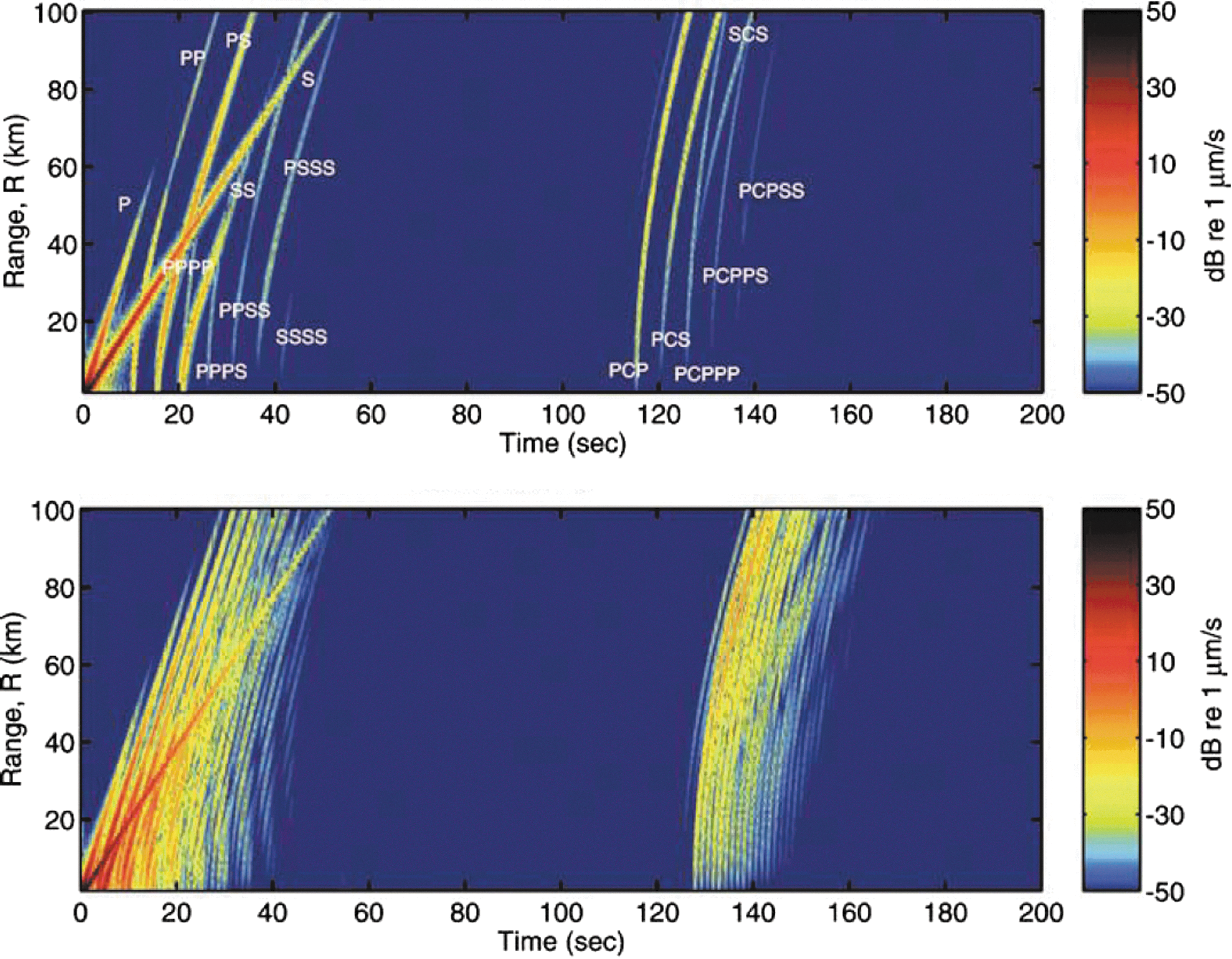
Observation design for detecting seismic events on Europa. Time-range plots for a (top) 20 km ice shell model and a (bottom) 5 km ice shell model. Colors indicate the horizontal velocity level in both panels. Note that for both models the ice-water interface reflections occur within 60 s, while the water-mantle interface reflections occur within 180 s, leading to the recommended data recording approach. From Lee et al. (2003).
From the terrestrial perspective, natural seismicity associated with ice dynamics has been used to establish the depth to sources both adjacent to and below an observation site (e.g., Blankenship et al., 1987; see Fig. 12). These studies are particularly powerful because of the elastic behavior of both primary compressional (P) and secondary shear (S) waves as a function of density and temperature in ice (Robin, 1958; Bentley, 1964; Roethlisberger, 1972), although ice can be significantly anisotropic.
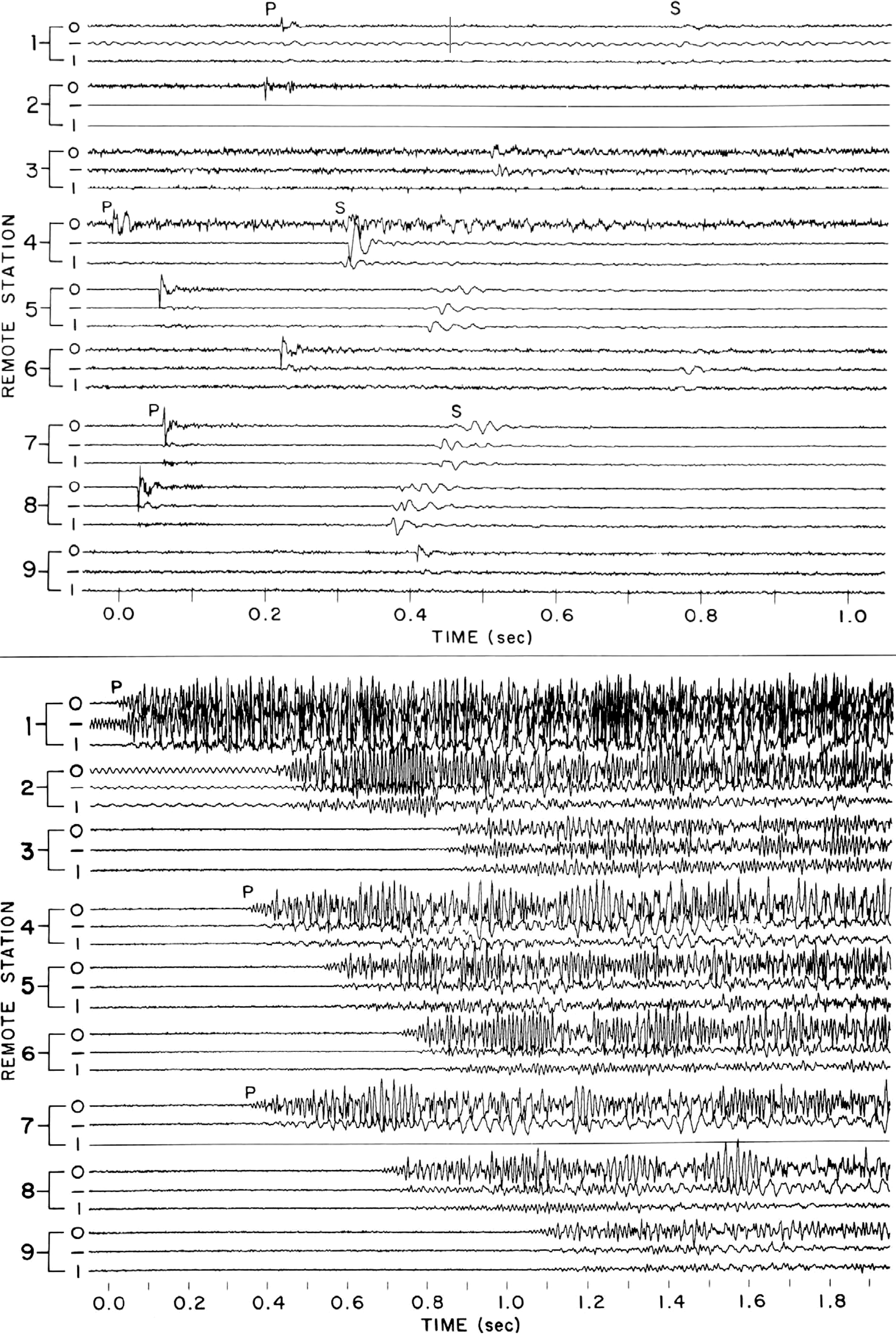
Examples of seismograms indicating the detection of P and S waves from ice microseismic events (reproduced from Blankenship et al., 1987). At top, detections from a thrust event at the base of Ice Stream B, West Antarctica. Cracking events on Europa are expected to have similar return structure. At bottom, events from shallow crevassing along the margins of Ice Stream B. Events occurring inside chaos matrix material or heavily crevassed areas of Europa's surface are likely to suffer from such clutter due to the complex scattering environment.
For this study, with its emphasis on Europa's habitability, seismic studies are recommended in which both refracted and reflected body waves are used to sample the ice shell and any subsurface water as well as the underlying ocean. The range to ice shell fracture events can be determined from direct observations of P and S waves for sources within a range of about 50 km to the lander (Figs. 10 and 1). To determine the ice shell thickness as well as the depth and thickness of any subsurface water lenses, observations must be recorded over the characteristic travel times of these reflected waves. To detect waves reflected off the ice-ocean interface, we suggest collecting seismic records of about 60 s duration over a frequency band of 0.1–50 Hz, whenever an event above an appropriate threshold is detected. Observations should occur over a timescale of at least 9 eurosols (∼1 month), considering the likelihood that several cracking events should occur over that period to ∼250 m depth, which would be expected to sound the full thickness of a ∼20 km ice shell and could sound the ocean depth as well if the background noise is sufficiently quiet (Lee et al., 2003).
Correlating seismic events with particular surface features and local geology requires knowledge of the direction from which seismic energy is propagating. In addition, the magnetic induction measurements described above for establishing the depth of the ocean are sensitive to a range of local electromagnetically conductive brine-rich targets such as water layers and lenses. Because of this, any seismic investigation must be focused not only on decreasing the uncertainty of the ocean salinity inversions (Section 3.1) but also on extending these inversions to understanding the thickness and conductivity of any intra-ice water lenses. This calls for assessment of whether any detected body waves have arrived from adjacent to, or beneath, the observation platform and from which direction, which emphasizes the need for some azimuthal sensitivity as well as the ability to discriminate sources with near-vertical inclinations. Azimuthal sensitivity requirements are not trivial, because any near-surface vertical velocity gradient will render azimuths from incident compressional wave displacements (or transverse or vertically polarized shear waves) as highly uncertain. At least three, three-component sensors are recommended, with good surface contact, with a baseline distance of at least several meters between them and with knowledge of their positions and orientations.
Because cold ice is only moderately attenuating (Kohnen, 1974), an alternative means for establishing azimuth is through the detection of energy from arrivals of sufficiently high-frequency content over intervals long enough (i.e., several seconds) to be statistically phase correlative (i.e., more than one sample offset) for direct waves across a small array that is roughly the dimension of the lander footprint (several meters between footpads or about 1–2 ms of travel time for P and S direct arrivals, respectively). Coupling these coarse (about 45° for 200 Hz arrivals) azimuthal estimates with those inferred from displacements is likely to be especially powerful for projecting body-wave arrivals back to their source by using P and S wave travel time differences. Given the broad frequency spectrum for tensile cracking of moderate dimension [i.e., tens to hundreds of meters (Lee et al., 2003, and Fig. 10)] this should be achievable. Most predictions of contemporary europan activity (e.g., Schmidt et al., 2011) imply that these sources should be numerous in Europa's ice.
Identifying the location of seismic sources at Europa by using direct body-wave arrivals is essential to using any succeeding near-vertical reflection to infer either the thickness of the shell (Lee et al., 2003) or intra-ice water lenses and associated ice lids.
3. Search for local heterogeneity of the ice and any shallow subsurface water.
As a potential indicator of Europa's habitability, the detection of porous ice, water-saturated ice, or any hydraulic connectivity between subsurface water bodies is of prime importance. The velocity of body waves in ice depends upon both temperature and porosity, with about 2 m/s of slowing for P waves for each one degree of warming (Kohnen, 1974) and a P wave velocity decreased by about half for an increase in porosity of about 30–40% (Blankenship, 1989; van den Broeke et al., 2008). In addition, the presence of water in any porous granular medium can have an intense impact on the ratio of P to S wave velocity, indicative of both porosity and effective pressure (e.g., Blankenship et al., 1986). Because of this, knowledge of both the mode and azimuth of incident body waves can be a powerful indicator of both horizontal and vertical heterogeneity in Europa's ice shell, making both porosity and water within the ice matrix potentially detectable.
For example, the balance between seismic velocity decrease as the ice temperature increases with depth and the velocity increase as porosity decreases with depth is likely to give rise to a pervasive waveguide at a depth where the two effects yield the highest velocity. This is a well-established phenomenon for terrestrial ice masses and a powerful scenario for inverting for vertical velocity structure (Grant and West, 1965), particularly of any europan near-surface megaregolith. Similarly, significant deviations in the P and S travel time ratios for reflected or refracted waves traversing water-saturated ice can be a direct indicator of relative water content both vertically and horizontally.
Seismic waves generated at the ice-ocean interface are expected to have a lower-frequency content than those originating from shallower sources associated with water lenses. In this ice-ocean interface case, any small array optimized for azimuthal sensitivity would act as a single detector with some capacity for establishing the limits for any body-wave arrivals from below. Once determined to be sufficiently vertical, the P to S wave travel-time differences of these arrivals can be used to establish the thickness of the total ice shell (Section 3.1), with an uncertainty governed only by the unknown temperature structure of the shell (Lee et al., 2003). As discussed above, this independent determination of shell thickness can be used to increase the conductivity resolution of the magnetic inversions.
4. Characterize Europa's seismic activity and its variation over the tidal cycle.
It is hypothesized that Europa exhibits tidally driven temporal variation in seismic activity associated with surface crack evolution (e.g., Greenberg et al., 1999; Hoppa et al., 1999). Similarly, the significant lateral and vertical heterogeneity of any active regions such as chaos should result in spatial variation of source distribution and frequency resulting from Europa's hypothesized tidal stresses. The ability to record and return to Earth in their entirety enough seismic records to statistically characterize this activity across the full width of the source spectrum is not really necessary to answer the question of tidal drivers for ice shell strain release. Continuous monitoring of seismic activity (in two bands) with return of selected events chosen through carefully designed trigger algorithms would yield a very comprehensive event catalog for each of these algorithms that can be utilized to establish the tidal correlation across a very broad source spectrum. Inclusion of event azimuth and inclination, and P to S time estimates, will allow these correlations to be spatially targeted to accommodate significant expected lateral heterogeneity.
4. Geology
Europa has a varied and complex geology (Fig. 13), the principal expression of the moon's past and present processes. The potential habitability of Europa is intimately tied to the satellite's geological evolution. A better knowledge of Europa's geology also allows us to gather clues about geological processes on other icy satellites, such as Miranda, Triton, and Enceladus.
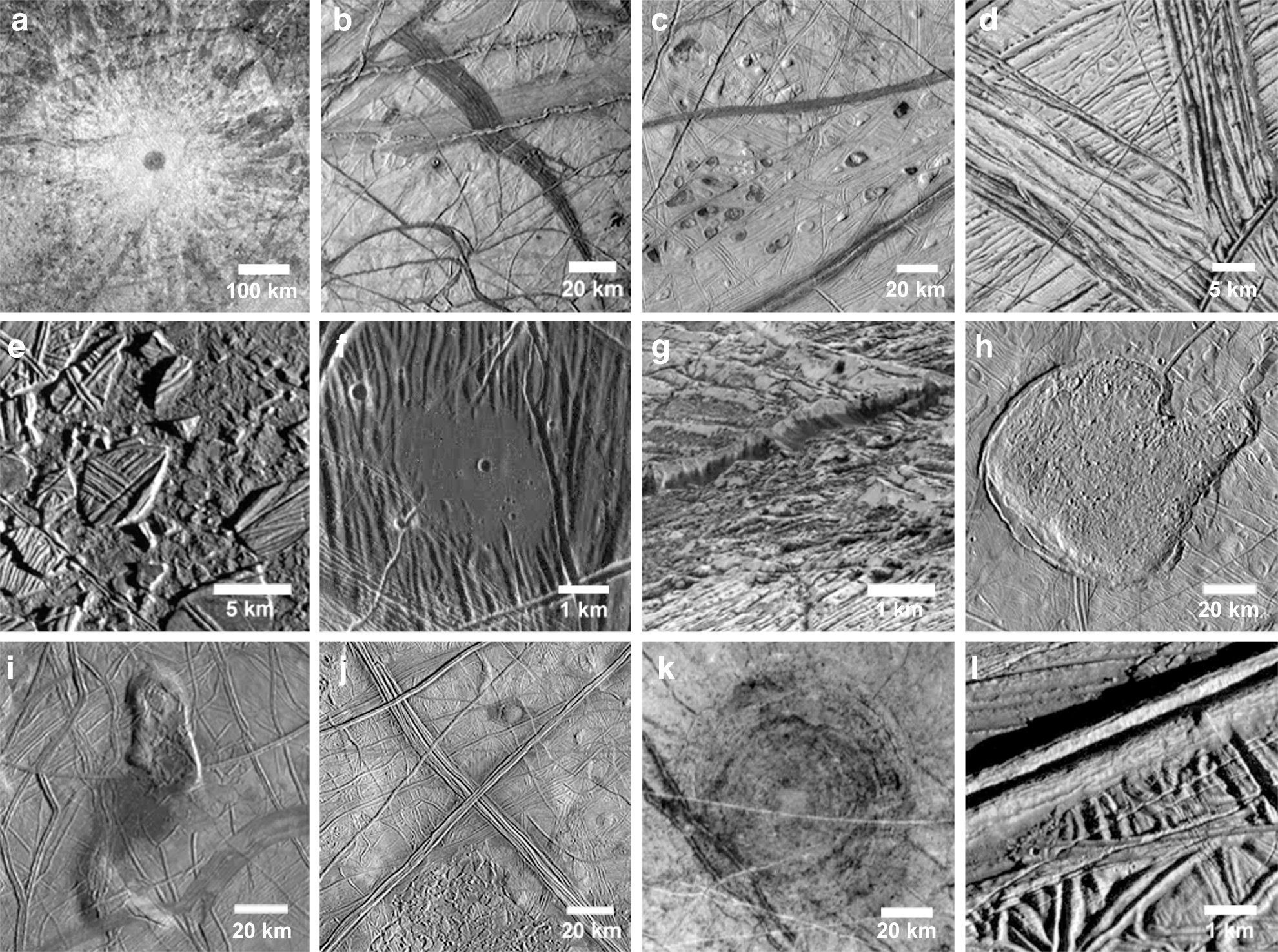
Europa is a geological wonderland, with a wide variety of surface features. While much was learned from Galileo observations, it is still not understood how most of these features form, or their implications for Europa's evolution. Shown here are (
4.1. Geology background
The relative youth of Europa's surface is inherently linked to the ocean and the effects of gravitational tides, which trigger processes that include cracking of the ice shell, resurfacing, and possibly release of materials from the interior (e.g., Pappalardo et al., 1999; Doggett et al., 2009; Schmidt et al., 2011). Clues to these and other processes are provided by spectacular surface features such as chaotic terrain, lenticulae, smooth plains, impact craters, and linear fractures and ridges.
4.1.1. Chaotic terrain, lenticulae, and smooth plains
Of particular interest to assessing Europa's habitability is access to material from the ocean that has recently been transported to the surface. Probably the prime candidate terrain type where such material might be found is chaotic terrain.
Europa's surface has been disrupted to form regions of chaotic terrain, such as subcircular features termed lenticulae and irregularly shaped, generally larger chaos zones (Collins and Nimmo, 2009). Lenticulae include pits, spots of dark material, and domes where the surface is upwarped and commonly broken (Fig. 13c and 3f). Chaos is generally characterized by fractured plates of ice that have been shifted into new positions within a background matrix (Fig. 13e). Much like a jigsaw puzzle, many plates could be fit back together, and some ice blocks appear to have disaggregated and foundered into the surrounding finer-textured matrix (Spaun et al., 1998). Some chaos areas stand higher than the surrounding terrain (Fig. 13h and 3i).
Pappalardo et al. (1998, 1999) argued that chaos features possibly formed by upwelling of compositionally or thermally buoyant ice diapirs through the ice shell. In such a case, onset of convection would imply an ice shell thickness of at least 10–20 km at the time of formation. Models of chaos formation suggest whole or partial melting of the ice shell, perhaps enhanced by local pockets of brine (Head and Pappalardo, 1999). Downward and upward doming forms have been interpreted to correlate with recently formed chaos regions created through subsurface brine mobilization and through subsequent freezing, respectively; based on this model, at least one chaotic region, Thera Macula, might be actively forming today (Schmidt et al., 2011). An alternative model suggests that chaotic terrain formed through direct material exchange (by melting) between the ocean and surface (Carr et al., 1998; Greenberg et al., 1999).
Chaos features are stratigraphically young (Figueredo and Greeley, 2004), possibly indicating a geologically recent increase in internal heating in Europa. Chaos and lenticulae commonly are dark and reddish, thought to be material derived from the subsurface ocean. Schmidt et al. (2011) concluded that chaos terrains form above liquid water lenses perched within the ice shell as shallow as 3 km, proposing that ice-water interactions and freeze-out give rise to the diverse morphologies and topography of chaos terrains. They suggest that the sunken topography of Thera Macula (Fig. 14) indicates that Europa is actively resurfacing over a lens comparable in volume to the Great Lakes in North America.
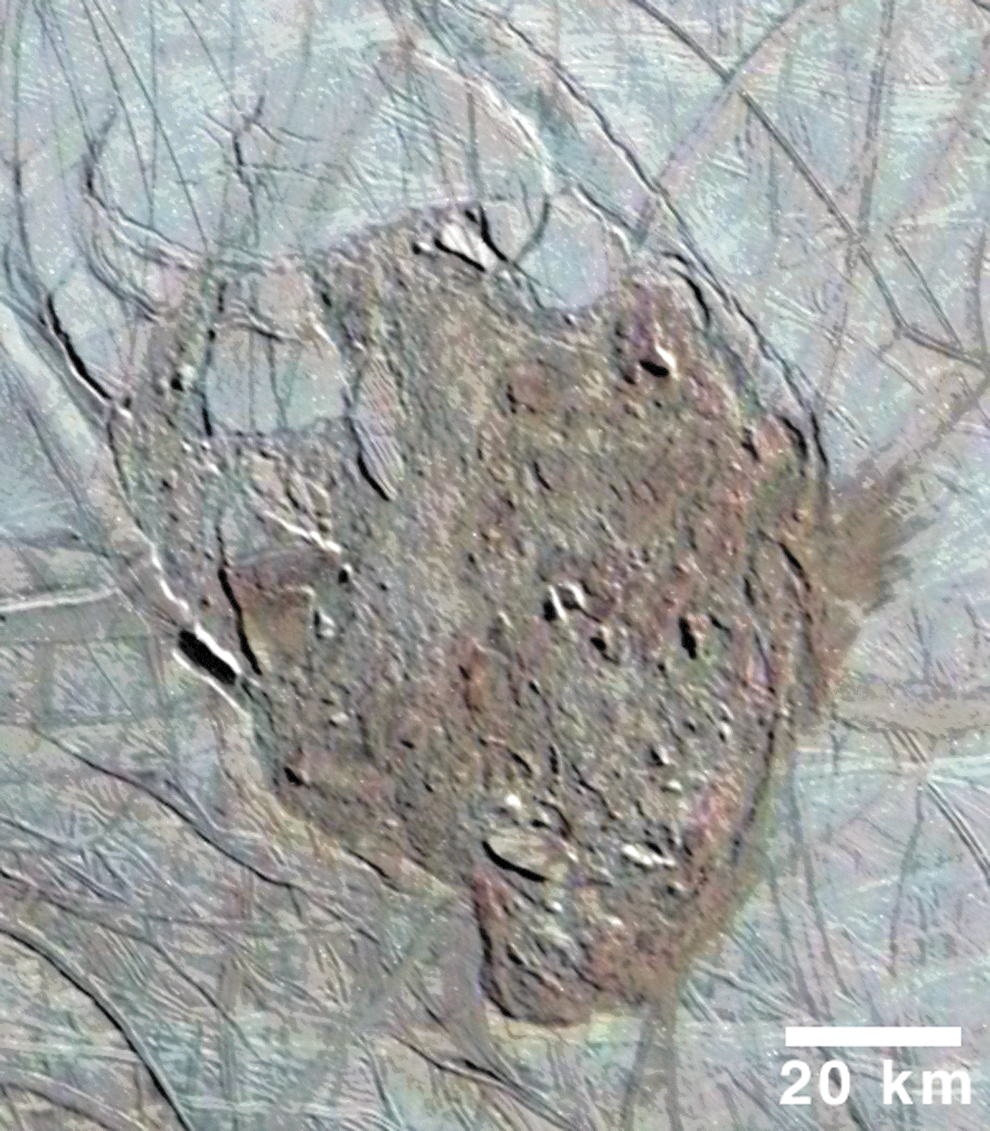
Thera Macula may be a region of active chaos formation above a large liquid water lens. Topographic data indicates that Thera is low-lying, suggesting subsurface water today. Galileo image at 220 m/pixel resolution.
There are small (few kilometers wide) occurrences of smooth, level, commonly dark plains (Fig. 13f) that may be associated with chaos and lenticulae. These features are plausibly explained by the release of low-viscosity fluid at the surface (Fagents, 2003). Typically, these features consist of smooth, low-albedo surfaces that occupy topographic lows, may embay surrounding ridged terrain, are apparently confined by topographic features such as ridges, and can exhibit lobate morphology (Greeley et al., 2000). Galileo color images show that low-albedo surfaces tend to be reddish-brown (Clark et al., 1998; Geissler et al., 1998). These units may be associated with small- or large-scale disruptions of the surface and range in size from a few to tens of kilometers. For example, Fig. 13f shows a small, smooth, low-albedo pondlike feature lying in a depression in ridged plains near 6°N, 327°W. This feature has been interpreted as a small-volume (0.5 km3) fluid effusion (Head et al., 1999).
4.1.2. Impact features
A large, recent impact event could potentially transport material from the ocean to the surface and vice versa. Hence, such sites could be potential locations for in situ sampling of ocean-derived material. Only 24 impact craters ≥10 km have been identified on Europa (Schenk and Pappalardo, 2004), reflecting the youth of the surface. This is remarkable in comparison to Earth's moon, which is only slightly larger than Europa but far more heavily cratered. The youngest large europan crater is the 24 km diameter Pwyll (Fig. 13a), which still retains its bright rays and likely formed less than 5 million years ago (Zahnle et al., 1998; Bierhaus et al., 2009).
Crater morphology and topography provide insight into ice layer thickness at the time of the impact. Morphologies vary from bowl-shaped depressions with crisp rims to shallow depressions with smaller depth-to-diameter ratios. Craters up to 25–30 km in diameter have morphologies consistent with formation in a warm but solid ice shell, while the two largest impacts [Tyre (Fig. 13k) and Callanish] might have punched through brittle ice about 20 km deep into a liquid zone (Moore et al., 1998, 2001; Schenk, 2002; Schenk and Turtle, 2009).
4.1.3. Linear features
Europa's unusual surface is dominated by tectonic features in the form of linear ridges, bands, and fractures. The class of linear features includes simple troughs and scarps (e.g., Fig. 13g), double ridges separated by an axial trough, and intertwining ridge complexes. Whether these represent different processes or stages of the same process is uncertain. Ridges are the most common feature type on Europa and appear to have formed throughout the satellite's visible history (Fig. 13j and 3l). They range from 0.1 to >500 km long, are as wide as 2 km, and can be several hundred meters high. Cycloidal ridges are similar to double ridges but form chains of linked arcs as viewed from above.
Most models for the formation of Europa's linear features involve fracturing in response to processes within the ice shell (Greeley et al., 2004; Kattenhorn and Hurford, 2009; Prockter and Patterson, 2009). Some models suggest that liquid oceanic material or warm mobile subsurface ice squeezes through fractures to form a ridge, while others suggest that ridges form by frictional heating and possibly melting along a shear zone. Thus, ridges might represent regions of material exchange between the surface, ice shell, and ocean, providing a means for surface oxidants to enter the ocean.
Bands reflect fracturing and lithospheric separation, potentially like seafloor spreading on Earth, and most display bilateral symmetry (e.g., Sullivan et al., 1998; Fig. 13b and 3d). Their surfaces vary from relatively smooth to heavily fractured. The youngest bands tend to be dark, while older bands are bright, suggesting that they brighten with time. Geometric reconstruction of bands suggests a spreading model, indicating extension in these areas and possible contact with the ocean (Tufts et al., 2000; Prockter et al., 2002).
Fractures are narrow (from hundreds of meters to the ∼10 m limit of Galileo image resolution), and some exceed 1000 km in length. Some fractures cut across nearly all surface features, indicating that the ice shell is subject to deformation on the most recent timescales. The youngest ridges and fractures could be active today in response to tidal flexing. Young ridges might be places where there has been material exchange between the ocean and the surface.
4.1.4. Small-scale features
The greatest uncertainty facing in situ investigations on Europa's surface is the lack of knowledge as to the nature of the landscape at scales smaller than a decameter (Fig. 15). This uncertainty has both substantial scientific and engineering-operational implications (Europa Study Team, 2012). Many potential high-science-interest targets, such as chaos terrain, have a substantial chance of extreme roughness at the decameter to decimeter scales. The processes potentially responsible for these roughness elements are uncertain, but candidates are mass-wasting occurring both during and after ice or water emplacement; sublimation erosion and local ice segregation; textures formed by freezing and chemical exsolution; and perhaps to a lesser extent impact gardening and sputtering.
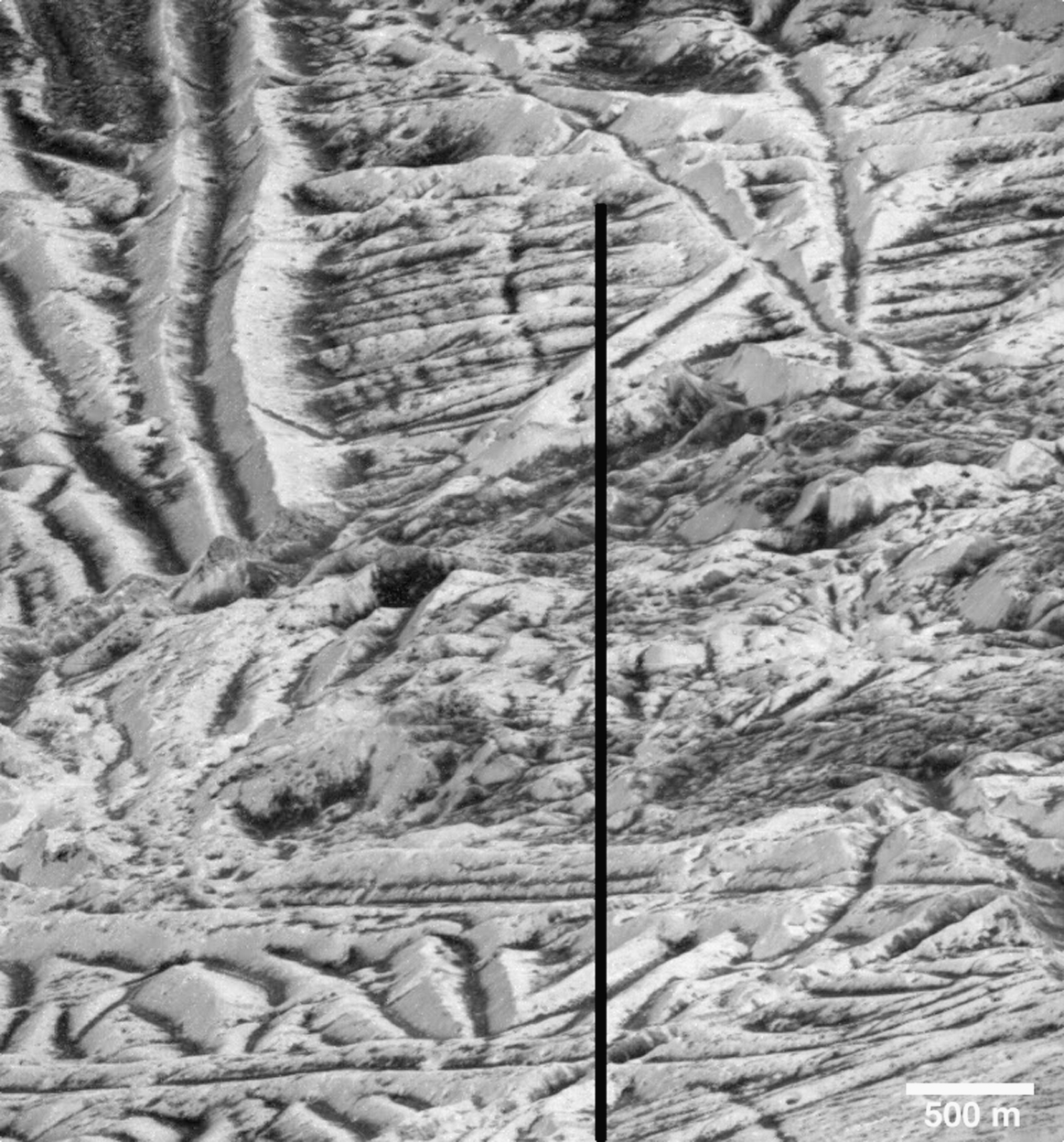
Europa's surface at the highest resolution available. This oblique image was acquired by Galileo at 6 m/pixel in the horizontal direction. The image is not re-projected but is presented as it was taken by the spacecraft, as if one were looking out of an aircraft window from 600 km above Europa's surface. Ridged regions are in the foreground and background here, with chaotic terrain in between. The darker areas appear smooth in context imaging at regional (∼200 m) resolution.
4.2. Geology investigations
Europa's geological landforms are enigmatic, and a wide variety of hypotheses have been offered for their formation. Characterization of sites of most recent geological activity is especially significant for understanding the formation of surface features, including whether and how liquid water is involved in their formation. Moreover, the formation processes of surface landforms control how material is transported between the surface and the subsurface; thus, they are key to understanding whether and how surface oxidants could be transported to the ocean, potentially providing chemical energy for life, and how oceanic material can be transported to the surface. In these ways, geology is directly pertinent to the potential habitability of Europa.
Thus, an objective for a Europa lander is to characterize the processes responsible for fine-scale (decameter and smaller) geological features at the selected landing site, especially those features that reveal the details of material recently derived from the ocean:
Characterize a locality of high scientific interest to understand the formation and evolution of the surface at local scales.
From this objective flow three key investigations, described next.
1. Constrain the processes that exchange material between the surface, near-surface, and subsurface.
Europa's incessant tidal activity leads to consideration that some landforms might be actively forming today and are the most likely locations for near-surface water. The most promising regions for current activity are regions of chaos or cracks that have recently formed in response to tidal stresses. Low-albedo smooth plains associated with some chaotic terrains might be composed of subsurface materials, such as brines, that have been emplaced onto the surface (Collins and Nimmo, 2009; Schmidt et al., 2011). These recently active regions might therefore represent sites of high scientific interest. Recently or currently active regions are expected to best illustrate the processes involved in the formation of some surface landforms, showing pristine morphologies and distinct geological relationships and perhaps exhibiting associated plume activity analogous to that seen on Enceladus (Spitale and Porco, 2007).
High-resolution Galileo images of Europa (e.g., Figs. 13g and 5) show abundant evidence for very young materials exposed by mass wasting of faces and scarps (Sullivan et al., 1998). These postformational modification processes have likely affected many surfaces to expose fresh materials that are less altered than their surroundings. Given the decameter/pixel limit of the best-resolution existing images of Europa, it will be essential to have higher-resolution images of the landing site from above (either obtained from orbital reconnaissance or from a descent imager) to place in situ measurements into their geological context and relate landforms of the types currently recognized from orbital images (Fig. 13) to features and materials of high scientific interest to be studied in situ from a lander. Moreover, in situ images should be obtained down to the scale of millimeters per pixel and in stereo in order to constrain formation processes of local landforms and small-scale features.
To accomplish a comprehensive survey of the landscape around the lander, it will be necessary to obtain panoramic stereo images at 1 mm/pixel from 3 m distance in at least three filters (RGB). The Mars Exploration Rover mast cameras (Pancam), for instance, have 1 mm/pixel resolution in the near field and in stereo, which approximates the 20/20 vision of a field geologist. Panoramic coverage is necessary because planetary landscapes are heterogeneous on a variety of scales. Moreover, many processes only reveal themselves at the smallest scales, from the statistics derived from particle shapes, sizes, and distributions. The scene around the lander should be in stereo to ensure that the true shapes and sizes of local features can be unambiguously characterized. Likewise, three-color imaging allows unambiguous discrimination of composition variations in the area, as distinguished from merely textural variations. This is especially critical in mapping the ice versus non-ice components of local materials.
2. Constrain the processes and rates by which the surface materials (regolith and bedrock) form and evolve over time.
Following surface emplacement (e.g., tectonism or volcanism), progressive modification processes have likely affected many surfaces (e.g., from sublimation and mass wasting), potentially exposing fresh materials that are less altered than their surroundings. Unambiguous characterization of landforms to understand surface processes at a local scale implies millimeter-scale imaging resolution, like the Mars Exploration Rover Pancam. A minimum of three colors is necessary to differentiate compositional variation (e.g., ice from non-ice) from shading effects at these resolutions. It is valuable to be able to characterize ice grains and non-ice materials within the sample to understand sample heterogeneity, ice history (ice morphology, inclusions), and the context of non-ice materials (size, shape, and texture). It will be necessary to characterize particle size, sintering, and thickness variations at landing site scales (decameter to submillimeter) to understand history and evolution of the regolith. This can be achieved by imaging samples of surface and subsurface materials at resolutions of better than 50 microns. These needs are based on terrestrial, Mars Exploration Rover, and Phoenix experience.
3. Understand the regional and local context of the landing site.
Of primary importance is the detailed characterization of surface features—especially their distribution, morphologies, textures, local slopes and shapes, and associated embedded or loose fine-grained components—at a variety of scales to understand the processes by which they formed. The measurements needed to accomplish this investigation, and the rationale for these measurements, are those that constrain geological processes. Identifying the landing site from orbit following a successful landing will provide crucial geological context for in situ panoramic images, as demonstrated by the suite of lunar and martian landers and rovers.
4. Constrain the physical properties of the surface and near surface at the landing site to provide context for the sample.
As part of the assessment of compositional heterogeneity of the local environment around the lander at millimeter scales, it is valuable to characterize ice grains and non-ice materials within samples through microscopic imaging to understand sample heterogeneity, ice history (morphology and inclusions), and the context of non-ice materials.
Part of this characterization requires an understanding of the physical properties of local terrain, including information on porosity, density, and cohesion of the samples and the local environment. This information can come from engineering data associated with the landing system as it touches down and from motor currents of the sampling system that provide information on torques and forces associated with contacting the surface. Much knowledge was gained about the physical properties of the martian surface from similar approaches (e.g., Moore et al., 1982).
The probably fine-scale heterogeneity of the surface within a sampling arm workspace necessitates that this work space be thoroughly characterized from lander imaging, that is to say, at ∼1 mm/pixel, in stereo, and in at least three colors. This would allow sample spots to be identified and prioritized, based on the likelihood that size, shape, color, texture, and so on will indicate where the best ocean-derived material can be analyzed following landing. A microscope with a resolution of ∼10 μm/pixel would permit the recognition of compositional variation of materials within the samples analyzed by the mass spectrometer and Raman spectrometer.
5. Selection of a Landing Site
Landing on Europa for the first time represents a considerable challenge that can be met only by careful consideration of the scientific and engineering constraints involved. This section concentrates on the science issues involved. Investigating Europa's astrobiological potential requires the chemistry of its subsurface ocean, the structure of its icy shell, and the ice shell's formation and transport processes. Because the thickness of the ice shell precludes direct sampling of the ocean, the surface must be sampled at regions that are expected to provide windows to the subsurface. These regions are prioritized on criteria including surface concentration of non-ice materials and evidence that materials were transported from the subsurface (e.g., Figueredo et al., 2003; Ivanov et al., 2011). One critical consideration is how these materials have been affected by Europa's radiation environment, given that radiolysis of surface materials presents a significant obstacle to preserving potential biosignatures (Hand et al., 2009 and references therein).
The science objectives described above can be best met by carefully choosing landing sites that meet a specific set of criteria. These sites have been determined by considering the implications of each Europa lander science objective and by selecting candidate sites that meet all the science criteria without subjecting a landed spacecraft to undue risk. Here, we describe how each of the science objectives flows into the selection of a landing site and present some potential candidate sites.
5.1. Composition considerations
The highest-priority objective for a landed mission to Europa is to understand the habitability of the ocean through composition and chemistry. This involves characterizing the surface and near-surface chemistry to (1) constrain the ocean composition and understand the endogenic processes from which it evolves, (2) constrain the effects of exogenic processes, such as sputtering and radiolysis, and (3) understand the context of the compositional measurements. Spectral measurements have shown that low-albedo, disrupted areas on Europa's surface are comprised of non-ice components including hydrated materials. Therefore, a major objective for Europa science is to resolve the compositions and origins of these hydrated materials and additional compounds, which makes these dark, disrupted areas a focus for compositional measurements. To choose the best locations for compositional measurements, however, other factors must be taken into account, including the likely genesis of the features, their relative age, degree of radiolytic weathering, and whether or not they have exchanged material with the subsurface.
The composition of Europa's surface and near-surface materials is expected to vary with the amount of exposure to Jupiter's radiation environment (Cooper et al., 2001; Johnson et al., 2004; Paranicas et al., 2009; Patterson et al., 2012). The lower latitudes of Europa's trailing hemisphere will be radiolytically processed to depths of at least several centimeters and, considering the effects of bremsstrahlung photons, may be processed at up to meter depths. However, the leading hemisphere of the satellite, and higher-latitude regions of the trailing hemisphere, may only be affected to depths in the micron to centimeter range. Although the average age of the surface is relatively young (∼60 Ma, Schenk et al., 2004), stratigraphic mapping has shown that Europa's landforms are of different relative age (e.g., Greeley et al., 2004); and certain classes of feature—specifically chaos features—appear to be among the youngest landforms on the surface (Prockter et al., 2002; Figueredo and Greeley, 2004; Doggett et al., 2009) and so are probably less radiolytically processed. Revealed by cross-cutting relationships, most geological features appear to have a low albedo when newly formed, then to gradually brighten with age, ultimately reaching a relatively uniform high-albedo brightness (Geissler et al., 1998). Although the exact mechanism for this process is not well understood, it is likely related to radiation processing and/or the deposition of frost (e.g., Geissler et al., 1998). This brightening correlates with relative age, such that the youngest features on the surface are typically the darkest, while intermediate-aged features appear to be gray, and the oldest features are bright and largely indistinguishable in brightness from each other (e.g., Prockter et al., 2002). Shirley et al. (2010) used spectral data from the Galileo NIMS instrument to show that there is a distinct gradient in composition across the leading-trailing hemisphere boundary, verifying suspicions that the composition of surface units is altered by radiation processing (Carlson et al., 2009 and references within). Thus, the best compositional targets for a landed mission are the youngest, least radiation-processed materials, which also tend to be the lowest in albedo.
A second requirement to meet the compositional objective is to seek areas in which subsurface material (which may be derived from the ocean) has been exchanged with the surface in recent geological times. Studies of pull-apart bands suggest that they formed when Europa's lithosphere may have been thinner and more mobile. Bands also have shallower topographic slopes than other europan landforms (Schenk, 2009). Although they are clearly regions in which subsurface material has been brought to the surface, and therefore might appear to be good potential landing sites, they are generally older than chaos terrain (Figueredo and Greeley, 2004; Doggett et al., 2009); and many are of intermediate albedo, also suggesting they are not particularly youthful.
Ridges (Section 4.1.3) are ubiquitous on Europa and appear to have formed throughout its history. Many ridges crosscut bands and chaos, so they are thought to be quite young (e.g., Kattenhorn and Hurford, 2009 and references therein). However, they are not ideal landing sites, because the mechanism of ridge formation is not well understood, and it is not known whether the surface and subsurface exchange material at ridges. It is likely that the ridge margins are composed of crushed ice formed through tectonic or volcanic mechanisms. Many ridges have dark material associated with their margins (e.g., Belton et al., 1996), which may be of interest to compositional studies; but given the uncertainties about their genesis, it is difficult to make a case for ridges as candidate landing sites.
Chaos regions and smooth plains deposits within lenticulae (Section 4.1.1) appear to have generally disrupted and/or embayed the preexisting terrain, implying that they are relatively young and they at least partially consist of material that has been brought up from the subsurface (Carr et al., 1998; Pappalardo et al., 1998). Thought to have formed from diapiric upwellings (e.g., Collins and Nimmo, 2009 and references therein), these features may have entrained subsurface material, and the briny deposits associated with chaos may represent subsurface ocean water or lenses of water (Schmidt et al., 2011). Thus chaos regions, especially those associated with smooth, dark plains deposits, are of particular interest for compositional measurements.
5.2. Ocean and ice shell considerations
The geophysics objective for a landed mission is to characterize the local thickness, heterogeneity, and dynamics of any ice and water layers of the ice shell. This characterization involves (1) investigating the heterogeneity and thickness of ice and water within Europa's shell, (2) determining the ocean salinity and thickness, and (3) characterizing how the satellite's seismic activity varies over its tidal cycle. To meet these objectives, a landed payload must be positioned such that it can detect signals from seismic sources, determine the conductivity of ice, and constrain the salinity of subsurface water bodies.
Europa's surface is disrupted by tectonic features and chaos over most of the imaged regions (e.g., Doggett et al., 2009), and models of tidal straining predict that significant stresses and concomitant cracking should occur across the globe (e.g., Greenberg et al., 1998). Figure 16 illustrates the maximum tension predicted across Europa's globe during its diurnal tidal cycle, illustrating that every point on the surface experiences significant tidal stress at some time during Europa's 3.55-day orbital period. This ubiquity means that seismic measurements can be made from essentially anywhere on the surface, and it is likely that good results will be returned. Ideally, a seismometer would be positioned within a few tens of kilometers of a feature of interest, such as around the margin of a chaos region, in order to best characterize seismic effects from that region. We estimate the range to ice shell fracture events can be determined from direct observations of P and S waves for sources within a range of about 50 km from a lander (Figs. 9 and 1).
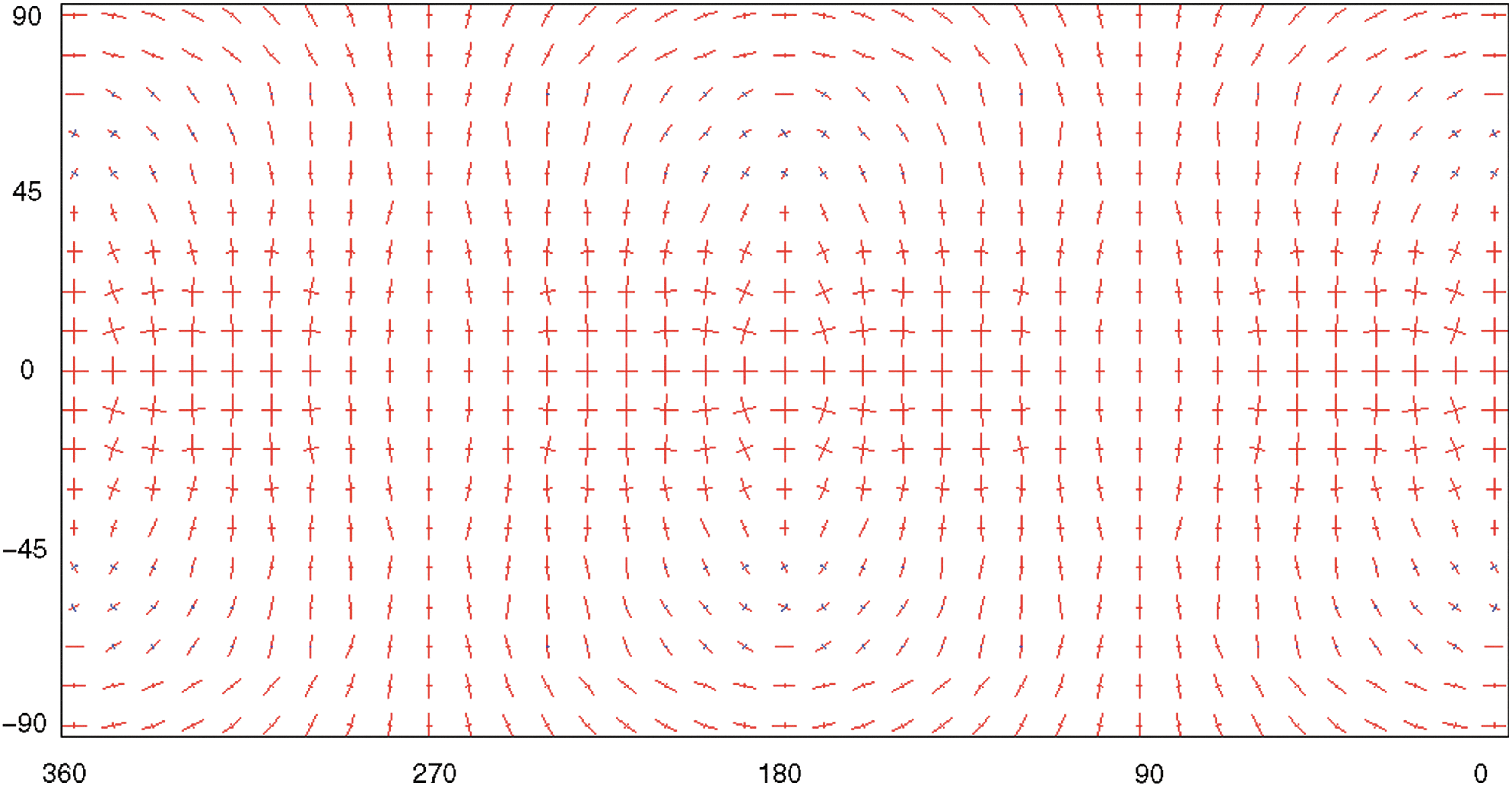
Maximum tensile principal stresses over Europa's surface during the course of the satellite's orbit. At each point, magnitude (red tensile, blue compressive) and orientation of stress vectors are shown for the point in the diurnal tidal cycle when tensile stress is maximized at that point. Maximum magnitude is about 100 kPa. This map illustrates that the entire surface experiences significant diurnal tidal stress at some point during Europa's 3.55-day tidal cycle. Courtesy of Z. Selvans.
The magnetic induction experiment recommended to characterize Europa's ocean is relatively insensitive to lander location. We note that, if there were a very high-conductivity layer within the ice shell (e.g., a saturated brine lens) immediately below the lander, it would dominate the higher-frequency (11.2 h) response but not significantly affect the lower-frequency (85.2 h) response.
5.3. Geology considerations
The primary geological objective for a Europa lander involves characterizing a locality of high scientific interest in order to understand how the surface has formed and evolved at local scales. This involves characterizing the surface to (1) constrain the processes that exchange material between the surface and subsurface, (2) constrain the processes and rates by which surface materials form and evolve over time, (3) understand the regional and local context of the landing site, and (4) constrain the physical properties of the surface and near surface at the landing site. Some of these observations are essential for understanding the geological context of any samples and fully interpreting measurements from the surface. Although many exchange processes are regional in scale and are best characterized from an orbital or flyby platform, studies of local processes can yield abundant information about the history and evolution of Europa's landforms and the extent to which Europa's regolith is processed. The mechanical properties of a surface can be investigated, and ice grains and non-ice materials can be imaged to complement compositional measurements. Nearby landforms can be imaged to understand their slopes, regolith characteristics, and erosion and formation processes.
None of these measurements needs to be made at a specific location on the surface; the scale of the lander is so much smaller than the scale of any known landforms on Europa that it is probable that only the local lander-scale characteristics of the surface can be investigated. Investigation of regolith processes might yield more information in older terrains, where the surface has been modified by micrometeorite bombardment and radiolytic processing over longer timescales.
5.4. Characteristics of potential landing sites
To meet the scientific requirements, the candidate landing sites need to meet certain criteria that cannot be mutually exclusive. In considering the composition objective, inferences about relative age suggest that the most compositionally interesting (darkest) features are also the youngest and probably least radiolytically processed; therefore, it is desirable to conduct compositional measurements in such regions. Regions of older (brightened) materials could be targeted, but this would necessitate the sampling of materials from below the radiation-processed layer [tens of centimeters below the surface (Section 2.1.3)], which would place additional constraints on the lander.
Therefore, candidate landing sites have been selected in regions of lower radiation, primarily outside lower latitudes of the trailing hemisphere (Fig. 17). To meet the compositional need to sample material that has been most recently derived from the interior, Europa's chaos regions provide the most likely targets, on the basis of their young age and inferred formation mechanism. Furthermore, several of the margins of chaos regions are associated with dark, relatively flat plains material that has embayed its surroundings. These places appear to be frozen fluid that has extruded from the subsurface, so they are attractive candidate landing sites. Recent work by Schmidt et al. (2011) suggests that Thera Macula (Fig. 14), a large chaos region in Europa's southern hemisphere, may be actively forming today; thus, Thera Macula is a promising candidate landing site.
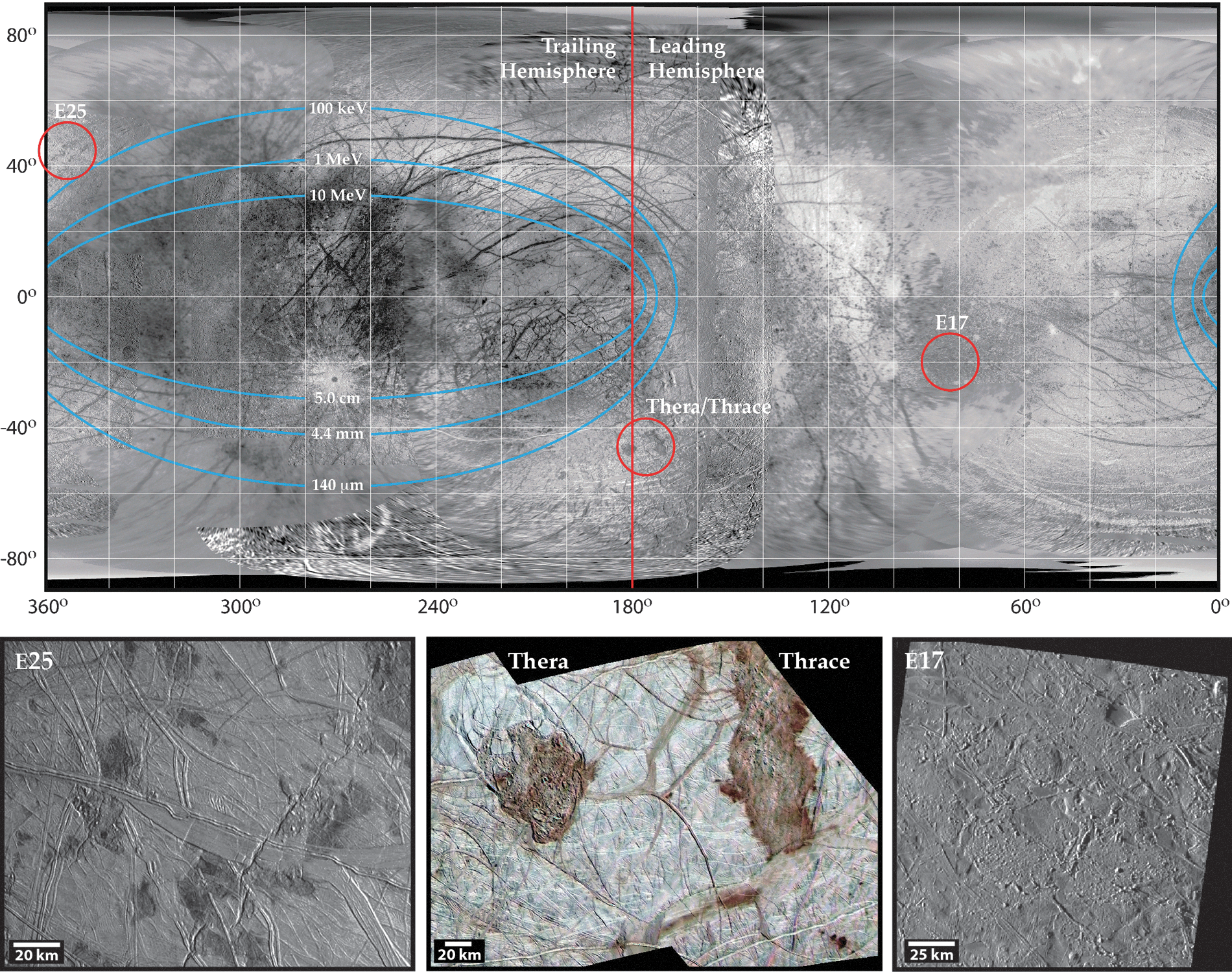
Candidate landing sites on Europa. Top: Blue contours show radiation intensity on Europa's surface, as labeled with the geographic extent to which electrons of a given energy affect the surface and how deeply they penetrate (excluding the effects of secondary particles) [from Patterson et al. (2012) and C. Paranicas personal communication]. Candidate landing sites are indicated by red circles on the global map and shown in regional scale images at bottom. Left: Dark plains associated with chaos in the Galileo E25 region. Center: The chaos terrains Thera and Thrace Maculae. Right: Dark chaotic terrain in the Galileo E17 regional mosaic. Each candidate site satisfies the criteria of low-albedo, youthful material that appears to have originated from the subsurface and is outside the most intense radiation regions on the satellite. Thera and Thrace Maculae present very attractive targets for exploration on the basis of their low albedo, relatively young age (they have disrupted the preexisting terrain), and likely endogenic origin. It has been suggested that water may exist beneath Thera Macula today.
The geophysical measurements can be made almost anywhere on the surface but ideally are acquired close to a region that is potentially active and has interesting subsurface structure. For this reason, a seismic instrument would best be situated within a few tens of kilometers from the edge of a tectonically active landform.
For the geological objective for a Europa lander, there is no preferred region on the surface, although for studies of regolith processes, older terrains are preferred. However, it is expected that useful scientific data could be collected anywhere on the surface, and the geology objective is of lower priority than the composition or geophysics objectives, so geology does not drive the selection of a landing site.
In light of the science objectives determined for characterizing Europa's habitability, candidate landing sites on or near chaotic terrain are deemed to be the most likely to yield fruitful results. Several candidate landing sites have been selected on the basis of the criteria described above and are shown in Fig. 17. Our primary suggested landing site is Thera Macula, which has a low albedo, relatively young age (it has disrupted the preexisting terrain), and likely endogenic origin; it has been suggested that water may exist beneath Thera Macula today (Schmidt et al., 2011).
5.5. Reconnaissance of potential landing sites
The highest-resolution images of Europa's surface currently available are the handful acquired by the Galileo spacecraft with resolutions that range from 6 to 12 m/pixel. These show a surface that is rough down to the pixel level, containing fractures, slopes, and scarps. Most daunting are plates and matrix material resulting from chaos formation (Figs. 13e and 4), although these are scientifically very attractive places to explore. Imaging with resolution of 4 m/pixel of very young and active terrain on Saturn's satellite Enceladus—in a portion of Enceladus that resembles Europa's surface at comparable (tens of meters) resolution—reveals a landscape with many large ice boulders down to the resolution limit (Fig. 18).
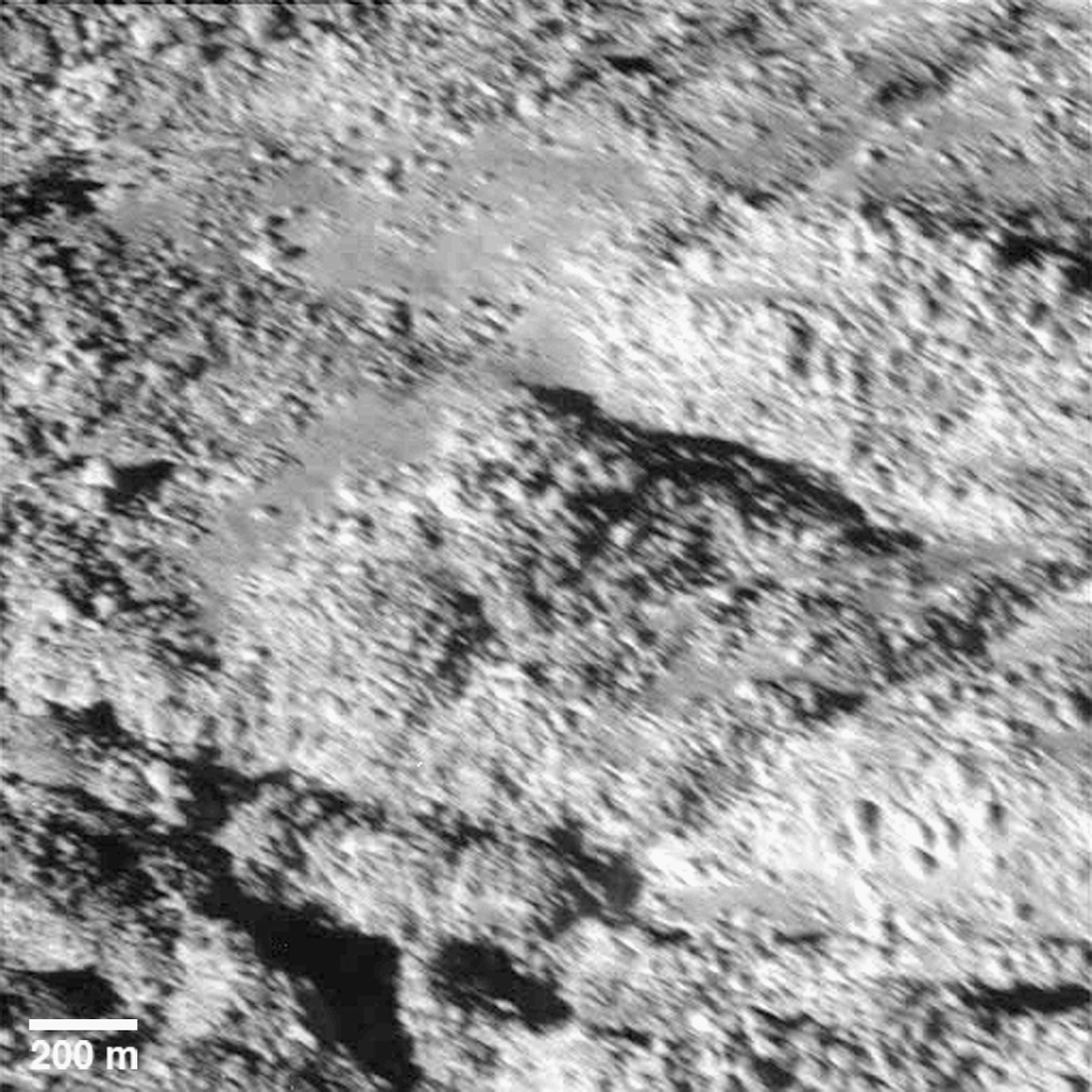
At the highest resolution obtained by Cassini at Enceladus (4 m/pixel), that satellite's active tiger stripe region near the south pole is strewn with boulders tens of meters across, along with some intervening smooth patches. Spacecraft motion has caused minor smearing of the image. (PIA06252, NASA/JPL/SSI.) A lander would fit within a single pixel of this image.
It is impossible to be certain of the character of Europa's surface at lander scales without additional reconnaissance data, either prior to a lander mission or concurrent with it (preceding lander release). Based on existing slope data (Schenk, 2009), we can expect that Europa's surface will continue to be rough, even in places that appear smooth at larger scale (tens to hundreds of meters per pixel).
The primary purpose of reconnaissance imaging of a landing site would be to ensure safe landing. It is expected that several candidate landing sites, such as Thera Macula, would be imaged prior to deployment of a lander at Europa. Today there are enough unknowns about Europa's composition, ice shell, and geology that such reconnaissance is much more a requirement for engineering safety rather than for scientific analysis of potential landing sites. To choose the landing site on Europa that would truly yield the maximum science return, thorough reconnaissance of Europa would be required prior to selecting a scientifically optimized landing site.
6. Instrument Considerations
A landed suite of instruments would offer unique and valuable possibilities to advance our understanding of the biological potential of Europa. Instruments that take full advantage of physical contact with the surface, direct compositional measurements on surface and subsurface samples, and the potential for high-resolution imaging would maximize the astrobiology science yield of a lander mission. Table 3 lists a suggested model payload for a landed mission, designed to maximize this potential.
The choice of instruments for a scientific payload is driven by the need for specific types of measurements that trace from the overarching goal of Europa's habitability. Details of these model instruments and measurement objectives are discussed in the Europa Study 2012 Report (Europa Study Team, 2012), which also discusses a detailed concept of operations for such a payload. That report describes the Raman spectrometer and the microscopic imager as part of the baseline model payload but not the floor model payload, implying that they could be descoped from the mission concept if resource limitations were to require it.
Measurements by landed instruments should focus on areas of the organic and inorganic composition of Europa's surface and near-surface materials, the scale of the ocean and thickness of the overlying ice shell, and the history of active exchange between the subsurface ocean and the observed surface. These fundamental measurements drive the recommendation of model instruments. These include direct measurements (such as composition or ocean bulk salinity), along with indirect measurements (such as context imaging or sample heterogeneity) that are needed to best interpret the direct measurements.
Two additional instruments are regarded as very attractive to enhance the science return of the mission but were not deemed necessary to meet the fundamental science objectives: a thermal radiometer (which could provide surface temperature measurements from observations of the emitted thermal infrared radiation from different areas around the landing site) and a charged particle detector (which could provide direct measurements of the local radiation environment at the landing site). Moreover, many different and complementary technologies are available that might be employed to evaluate Europa's surface composition, and the suite of technologies for compositional analysis adopted here is one of many possible options for addressing the composition objective of the lander concept. Otherwise available techniques include tunable laser absorption, X-ray diffraction, ultraviolet and infrared spectroscopy, and gas and high-pressure liquid chromatography.
Coordination and integration of observations and measurements acquired by different instruments are central to determining Europa's habitability. Spatially or temporally coordinated observations greatly enhance the scientific value of the mission. For example, interpreting in situ surface composition as representing the composition of the sub-ice ocean requires knowledge of sample context, heterogeneity of ice and non-ice components, the geological history of the sample, and independent estimates of the bulk salinity of the ocean. Understanding the geological history of the landing site reaches beyond panoramic imaging, calling for knowledge of the proximity of water as well as regional surface and ice shell structure such as faults and fractures as pathways for the exchange of water with the surface. Interpreting the environmental conditions and habitability within the ocean implies combining observations of the depth distribution of water and ice with measurements of organic and inorganic compounds dissolved within ocean-derived material that presently survives on the surface. Thus, the suite of instruments integrates to address the broader questions of habitability in a way that cannot be accomplished by each instrument alone.
A key part of a landed mission is to obtain and analyze samples of the surface ice to determine the organic and inorganic content of ocean water, which either extruded onto the surface and froze or was mechanically/tectonically driven to the surface. However, the radiation environment at the surface of Europa is harsh, and these non-ice molecules residing at, or very near, the surface are continually bombarded with high-energy electrons and heavy ions (Johnson et al., 2009; Paranicas et al., 2009). Over time, the composition of the surface ice is modified by fragmenting and sputtering larger molecules and by emplacement of ions from space such as sulfur (Carlson et al., 2009). Thus, samples acquired from the very surface will not compositionally represent the ocean. Depending on the type and geographic location, this radiation damage is expected to reach depths of several centimeters (Patterson et al., 2012), and obtaining samples from as deep as 10 cm becomes necessary. Additionally, obtaining a near-surface sample (from 0.5–2 cm depth) and a deeper sample (5–10 cm depth) would provide an in situ assessment of the effects of radiation on composition. Therefore, the suggested strategy is to drill into the surface up to a depth of 10 cm, obtaining samples from at least two different depths.
7. Conclusions
A future Europa lander mission would present great science opportunities for the astrobiological exploration of Europa. Our NASA-commissioned Science Definition Team has considered science objectives and investigations for a Europa soft lander. The developed concept would address three key objectives for Europa: • Composition: Understand the habitability of Europa's ocean through composition and chemistry;
• Ocean and Ice Shell: Characterize the local thickness, heterogeneity, and dynamics of any ice and water layers;
• Geology: Characterize one or more localities of high scientific interest to understand the formation and evolution of the surface at local scales.
Active surface sampling is implied to address composition objectives, with a suggested strategy of drilling into the surface up to a depth of 10 cm and obtaining samples from at least two different depths. A near-surface sample (from 0.5 to 2 cm depth) and a deeper sample (5–10 cm depth) would provide an in situ assessment of the effects of radiation on composition.
These objectives flow to key suggested investigations and measurements and a suggested model payload consisting of a seven-instrument suite: mass spectrometer, Raman spectrometer, magnetometer, multiband seismometer package, site imaging system, microscopic imager, and reconnaissance imager. This model payload is meant as a proof of concept representing the range of possible instruments that could be used to investigate Europa in situ.
A Europa lander could take advantage of the complex radiation environment of the satellite, landing in regions where modeling suggests that radiation is about an order of magnitude less intense than in other regions. However, very little is currently known about the surface of Europa at the very small scale of a lander. To choose a landing site that is safe and would yield the maximum science return, thorough reconnaissance of Europa would be required prior to selecting a scientifically optimized landing site.
Footnotes
Acknowledgments
We thank the entire Europa lander technical team for its dedication and effort in accomplishing this study, and Chris McKay for a helpful review of this paper. A significant portion of this work was carried out at the Jet Propulsion Laboratory, California Institute of Technology, under a contract with the National Aeronautics and Space Administration.
Author Disclosure Statement
No competing financial interests exist.