






Abstract
Aims:
Alzheimer’s disease (AD) is the most prevalent neurodegenerative disorder among the elderly. Uric acid (UA), the end product of purine metabolism, functions as a potent free radical scavenger and helps mitigate oxidative stress. Several epidemiological studies revealed that serum UA levels are negatively correlated with the risk of AD; however, the molecular mechanisms remain unclear. Notably, β-amyloid (Aβ) deposition is implicated in the disruption of mitophagy, leading to neuronal apoptosis. In this study, we aim to elucidate the link between UA and AD and explore the underlying mechanisms.
Results:
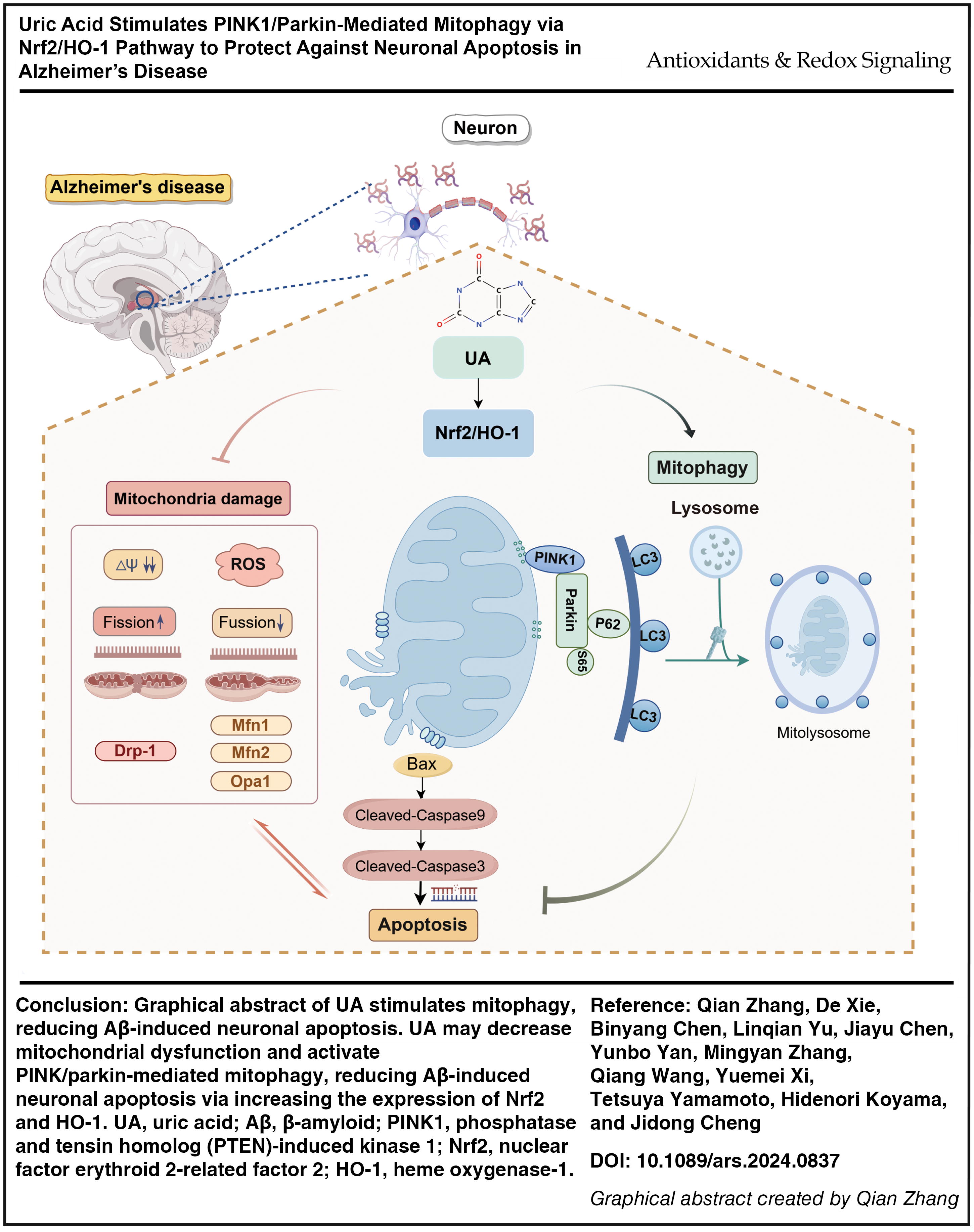
We demonstrated that UA improved cognitive impairment in 5×FAD mice and reduced neuronal apoptosis both in vivo and in vitro. UA reversed the expression of phosphatase and tensin homolog (PTEN)-induced kinase 1 (PINK1), p-ParkinS65, parkin, microtubule-associated protein 1 light chain 3 II/I, and p62 proteins inhibited by Aβ treatment, alleviated Aβ induced mitochondrial dysfunction, and disturbed dynamics. We found that UA activated nuclear factor erythroid 2-related factor 2 (Nrf2)/heme oxygenase-1(HO-1) signaling both in vivo and in vitro. Furthermore, ML385, a Nrf2-specific inhibitor, reversed the increase in mitochondrial membrane potential and mitophagy promoted by UA and increased neuronal apoptosis in HT22 cells. The antiapoptotic effects of UA in HT22 cells were prevented by treatment with small interfering RNAs targeting PINK1.
Conclusions and Innovation:
These data suggest that UA stimulates PINK1/parkin-mediated mitophagy reducing Aβ-induced neuronal apoptosis through the Nrf2/HO-1 pathway, which plays a neuroprotective role in AD. Our findings confirmed that UA effectively reduces neuronal damage and cognitive impairment, highlighting its potential clinical applications in the treatment of AD. Antioxid. Redox Signal. 43, 381–399.
Get full access to this article
View all access options for this article.
References
Supplementary Material
Please find the following supplemental material available below.
For Open Access articles published under a Creative Commons License, all supplemental material carries the same license as the article it is associated with.
For non-Open Access articles published, all supplemental material carries a non-exclusive license, and permission requests for re-use of supplemental material or any part of supplemental material shall be sent directly to the copyright owner as specified in the copyright notice associated with the article.
