






Abstract
Aims:
Succinate, a metabolite in the tricarboxylic acid cycle, is increasingly recognized to play essential roles in inflammation by functioning either as an intracellular or extracellular signaling molecule. However, the role and mechanisms of succinate in inflammation remain elusive. Here, we investigated the mechanism underlying the effects of succinate on neuroinflammation in intracerebral hemorrhage (ICH) models.
Results:
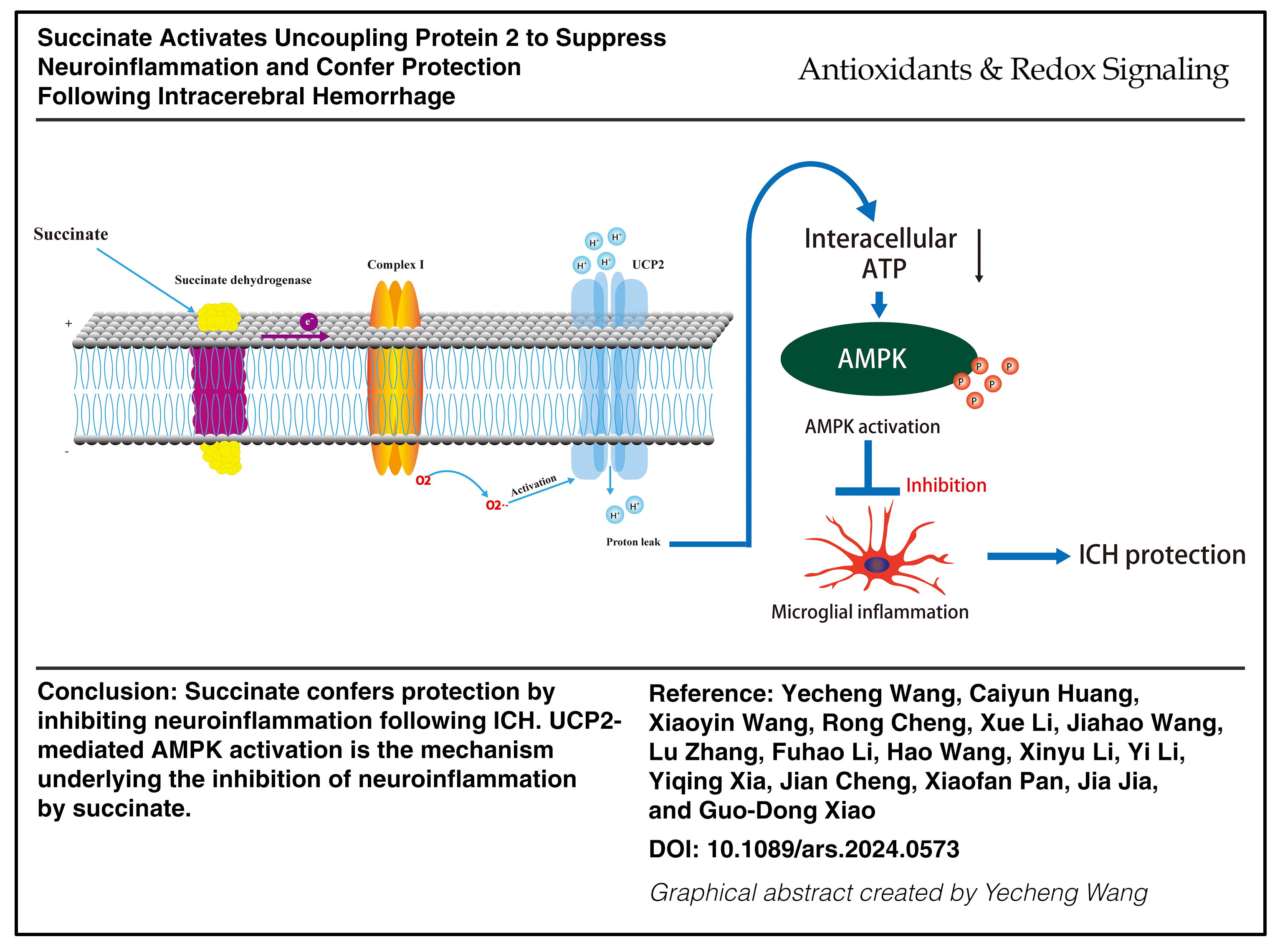
We unexpectedly found that succinate robustly inhibited neuroinflammation and conferred protection following ICH. Mechanistically, the oxidation of succinate by succinate dehydrogenase (SDH) drove reverse electron transport (RET) at mitochondrial complex I, leading to mitochondrial superoxide production in microglia. Complex I-derived superoxides, in turn, activated uncoupling protein 2 (UCP2). By using mice with specific deletion of UCP2 in microglia/macrophages, we showed that UCP2 was needed for succinate to inhibit neuroinflammation, confer protection, and activate downstream 5′-adenosine monophosphate-activated protein kinase (AMPK) following ICH. Moreover, knockdown of SDH, complex I, or AMPK abolished the therapeutic effects of succinate following ICH.
Innovation and Conclusion:
We provide evidence that driving complex I RET to activate UCP2 is a novel mechanism of succinate-mediated intracellular signaling and a mechanism underlying the inhibition of neuroinflammation by succinate. Antioxid. Redox Signal. 42, 687–710.
Get full access to this article
View all access options for this article.
References
Supplementary Material
Please find the following supplemental material available below.
For Open Access articles published under a Creative Commons License, all supplemental material carries the same license as the article it is associated with.
For non-Open Access articles published, all supplemental material carries a non-exclusive license, and permission requests for re-use of supplemental material or any part of supplemental material shall be sent directly to the copyright owner as specified in the copyright notice associated with the article.
