






Abstract
Aims:
Endothelial inflammation is crucial in the initiation and progression of atherosclerosis, whereas cholesterol crystals (CCs) play a key role in atherogenesis. However, the effects and origination of CCs on endothelial inflammation are not well understood.
Results:
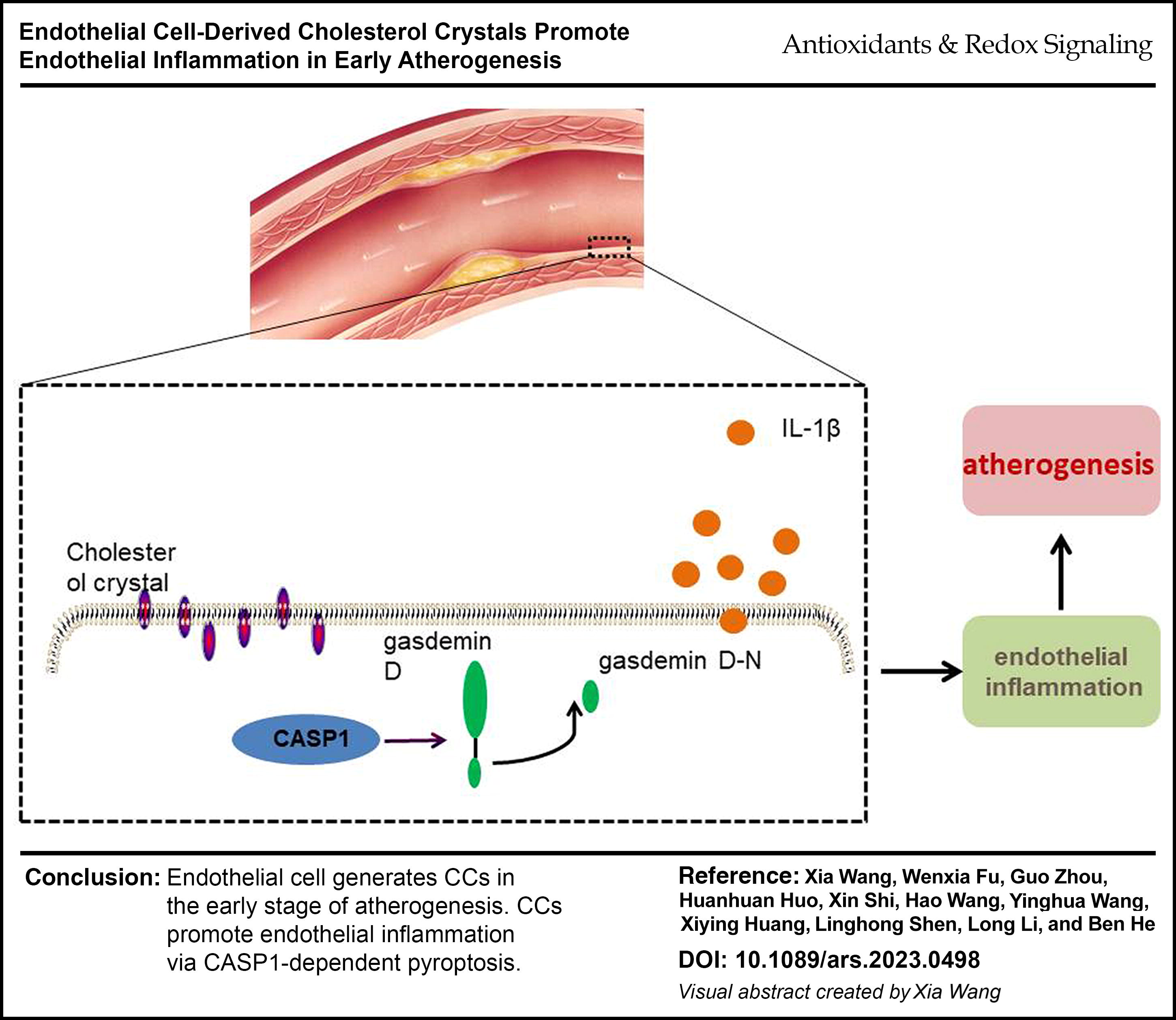
In the present study, we found that CCs appeared in the subendothelial space of the partially ligated carotid artery only 1 week after Western diet feeding, which was before immune cell infiltration. In vitro, CCs were generated by human aortic endothelial cells (HAECs) upon low-density lipoprotein treatment. These endothelial cell (EC)-derived CCs increased the expression of intercellular cell adhesion molecule-1 (ICAM1) and vascular cell adhesion molecule-1 (VCAM1). Mechanistic studies demonstrated that CC-induced pyroptosis was critical for endothelial inflammation. Knockdown of gasdermin D (GSDMD) inhibited CC-induced endothelial inflammation, attenuated plaque progression, and decreased macrophage content. Accordingly, the inhibition of GSDMD reduced the CC-induced increase of VCAM1 and ICAM1 in HAECs. Furthermore, CC-mediated pyroptosis was found to be caspase-1 (CASP1)-dependent. Inhibition of CASP1 also reduced endothelial inflammation and attenuated plaque progression. The expression of GSDMD was increased in human atherosclerotic plaques. These findings identify that EC-derived CCs may be an important driving force in the pathogenesis of atherosclerosis.
Innovation:
This study uncovered a new understanding that CC-induced pyroptosis contributes to endothelial inflammation in early atherogenesis.
Conclusion:
Targeting endothelial GSDMD or CASP1 contributes to the repression of vascular inflammation and atherogenesis. Antioxid. Redox Signal. 41, 201–215.
Get full access to this article
View all access options for this article.
References
Supplementary Material
Please find the following supplemental material available below.
For Open Access articles published under a Creative Commons License, all supplemental material carries the same license as the article it is associated with.
For non-Open Access articles published, all supplemental material carries a non-exclusive license, and permission requests for re-use of supplemental material or any part of supplemental material shall be sent directly to the copyright owner as specified in the copyright notice associated with the article.
