






Abstract
Aims:
S-nitrosylation of proteins is the main mechanism through which nitric oxide (NO) regulates cellular function and likely represents the archetype redox-based signaling system across aerobic and anaerobic organisms. How NO generated by different nitric oxide synthase (NOS) isoforms leads to specificity of S-nitrosylation remains incompletely understood. This study aimed to identify proteins interacting with, and whose S-nitrosylation is mediated by, human NOS isoforms in the same cellular system, thereby illuminating the contribution of individual NOSs to specificity.
Results:
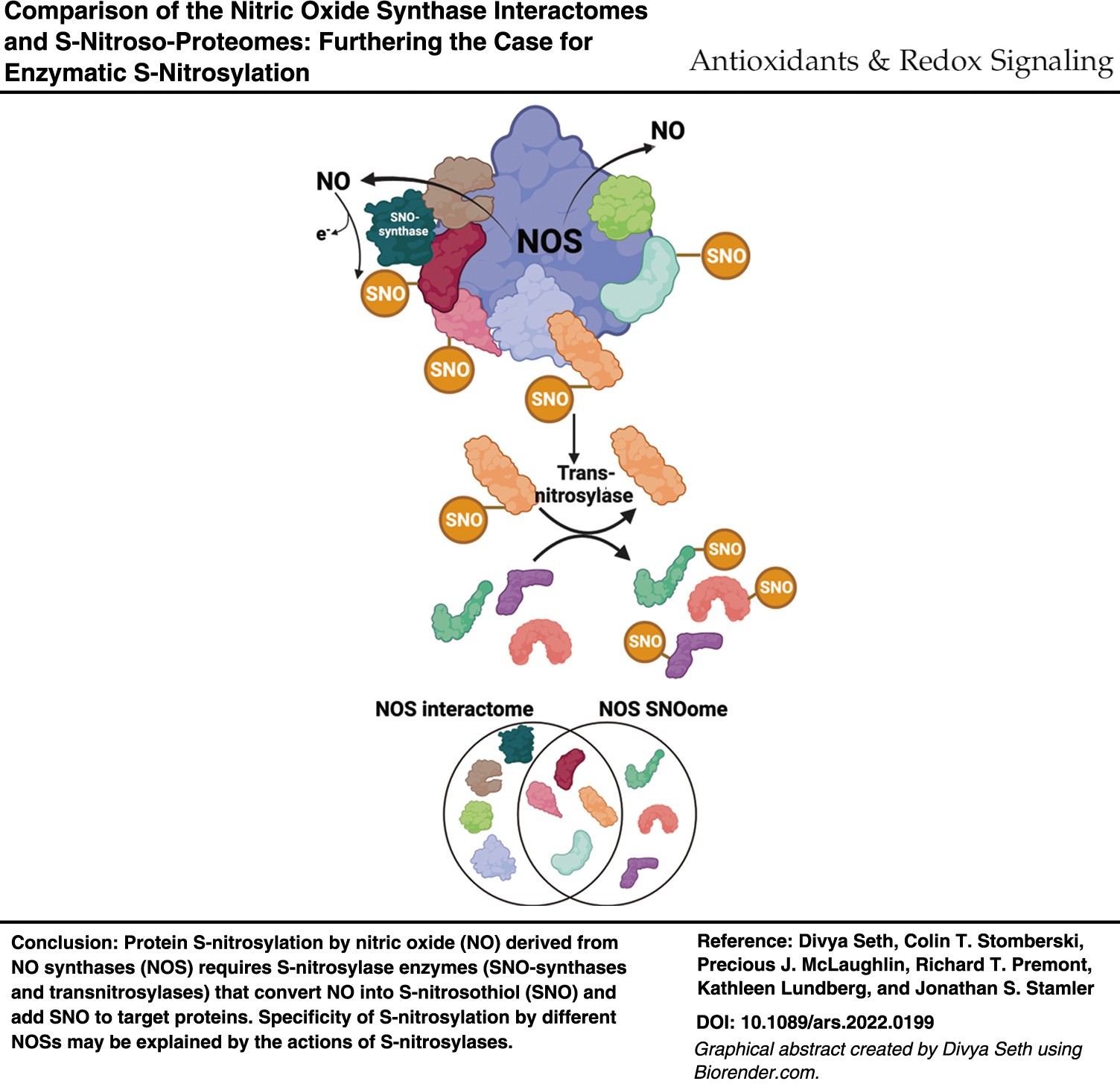
Of the hundreds of proteins interacting with each NOS, many were also S-nitrosylated. However, a large proportion of S-nitrosylated proteins (SNO-proteins) did not associate with NOS. Moreover, most NOS interactors and SNO-proteins were unique to each isoform. The amount of NO produced by each NOS isoform was unrelated to the numbers of SNO-proteins. Thus, NOSs promoted S-nitrosylation of largely distinct sets of target proteins. Different signaling pathways were enriched downstream of each NOS.
Innovation and Conclusion:
The interactomes and SNOomes of individual NOS isoforms were largely distinct. Only a small fraction of SNO-proteins interacted with their respective NOS. Amounts of S-nitrosylation were unrelated to the amount of NO generated by NOSs. These data argue against free diffusion of NO or NOS interactions as being necessary or sufficient for S-nitrosylation and favor roles for additional enzymes and/or regulatory elements in imparting SNO-protein specificity. Antioxid. Redox Signal. 39, 621–634.
Get full access to this article
View all access options for this article.
References
Supplementary Material
Please find the following supplemental material available below.
For Open Access articles published under a Creative Commons License, all supplemental material carries the same license as the article it is associated with.
For non-Open Access articles published, all supplemental material carries a non-exclusive license, and permission requests for re-use of supplemental material or any part of supplemental material shall be sent directly to the copyright owner as specified in the copyright notice associated with the article.
