






Abstract
Significance:
Increased plasma concentrations of total homocysteine (tHcy; mild-moderate hyperhomocysteinemia: 15–50 μM tHcy) are considered an independent risk factor for the onset/progression of various diseases, but it is not known about how the increase in tHcy causes pathological conditions.
Recent Advances:
Reduced homocysteine (HSH ∼1% of tHcy) is presumed to be toxic, unlike homocystine (∼9%) and mixed disulfide between homocysteine and albumin (HSS-ALB; homocysteine [Hcy]-albumin mixed disulfide, ∼90%). This and other notions make it difficult to explain the pathogenicity of Hcy because: (i) lowering tHcy does not improve pathological outcomes; (ii) damage due to HSH usually emerges at supraphysiological doses; and (iii) it is not known why tiny increments in plasma concentrations of HSH can be pathological.
Critical Issues:
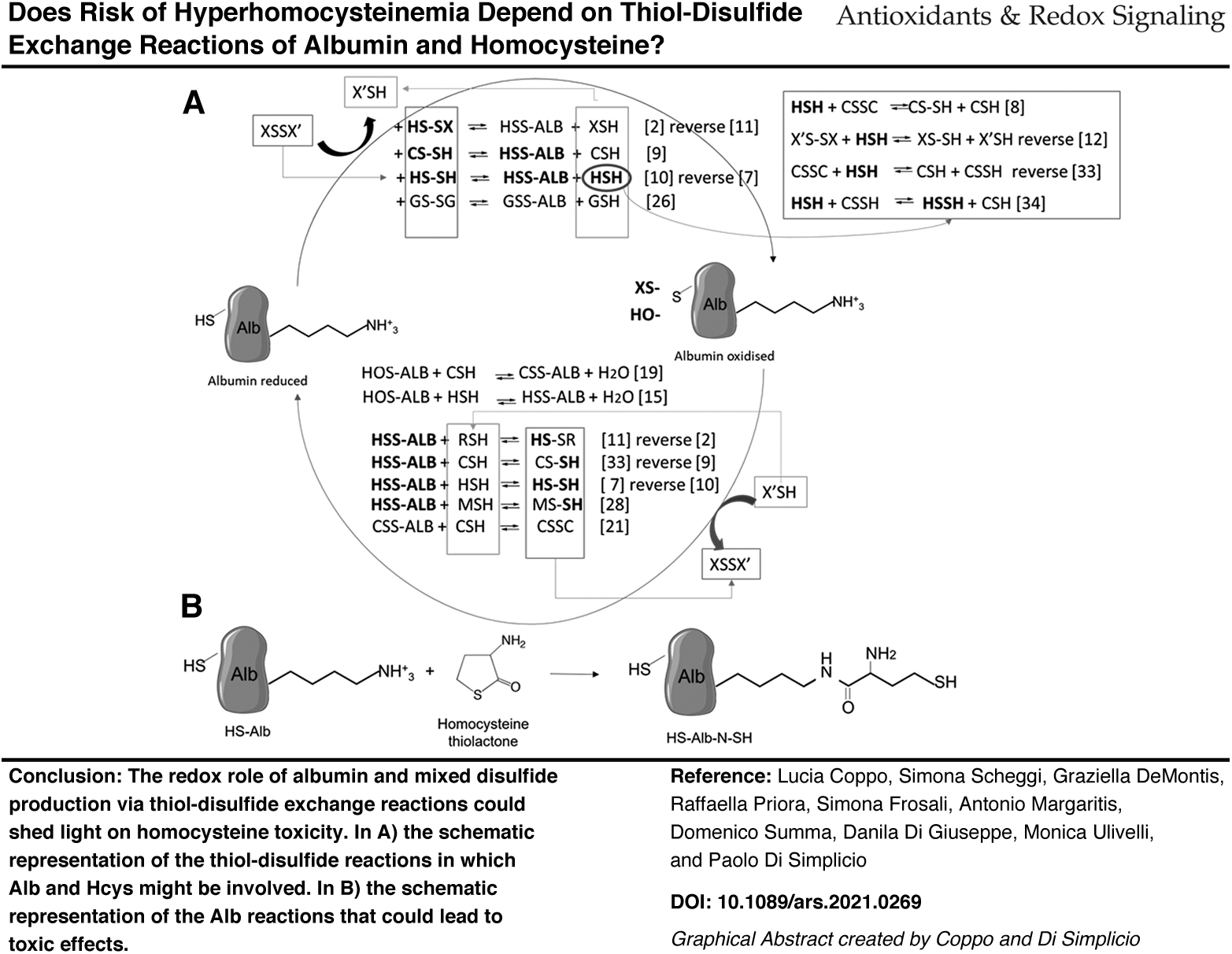
Albumin may have a role in Hcy toxicity, because HSS-ALB could release toxic HSH via thiol-disulfide (SH/SS) exchange reactions in cells. Similarly, thiol-disulfide exchange processes of reduced albumin (albumin with free SH group of Cys34 [HS-ALB]) or N-homocysteinylated albumin are plausible alternatives for initiating Hcy pathological events. Adverse effects of albumin and other data reviewed here suggest the hypothesis of a role of albumin in Hcy toxicity.
Future Directions:
HSS-ALB might be involved in disruption of the antioxidant/oxidant balance in critical tissues (brain, liver, kidney). Since homocysteine-albumin mixed disulfide is a possible intermediate of thiol-disulfide exchange reactions, we suggest that homocysteinylated albumin could be a new pathological factor, and that studies on the redox role of albumin and mixed disulfide production via thiol-disulfide exchange reactions could offer new therapeutic insights for reducing Hcy toxicity.
Get full access to this article
View all access options for this article.
References
Supplementary Material
Please find the following supplemental material available below.
For Open Access articles published under a Creative Commons License, all supplemental material carries the same license as the article it is associated with.
For non-Open Access articles published, all supplemental material carries a non-exclusive license, and permission requests for re-use of supplemental material or any part of supplemental material shall be sent directly to the copyright owner as specified in the copyright notice associated with the article.
