






Abstract
Introduction:
Foot and mouth disease (FMD) is a highly contagious infection of cloven-hoofed animals. The Biosafety Research Road Map reviewed scientific literature regarding the foot and mouth disease virus (FMDV). This project aims to identify gaps in the data required to conduct evidence-based biorisk assessments, as described by Blacksell et al., and strengthen control measures appropriate for local and national laboratories.
Methods:
A literature search was conducted to identify potential gaps in biosafety and focused on five main sections: the route of inoculation/modes of transmission, infectious dose, laboratory-acquired infections, containment releases, and disinfection and decontamination strategies.
Results:
The available data regarding biosafety knowledge gaps and existing evidence have been collated. Some gaps include the need for more scientific data that identify the specific safety contribution of engineering controls, support requirements for showering out after in vitro laboratory work, and whether a 3- to 5-day quarantine period should be applied to individuals conducting in vitro versus in vivo work. Addressing these gaps will contribute to the remediation and improvement of biosafety and biosecurity systems when working with FMDV.
Introduction
The World Organisation for Animal Health (WOAH, formerly OIE), the World Health Organization (WHO), and Chatham House are currently collaborating to improve the sustainable implementation of laboratory biological risk management, particularly in low-resource settings under the banner of the Biosafety Research Road Map (BRM) project. The BRM project aims to improve laboratory sustainability by providing an evidence base for biosafety measures (including engineering controls) and evidence-based biosafety options for low-resource settings. This will inform strategic decisions on global health security and investments in laboratory systems. This work involves assessing the current evidence base required for implementing laboratory biological risk management, aiming to provide better access to evidence, identifying research and capability gaps that need to be addressed, and providing recommendations on how an evidence-based biorisk management approach can support biosafety and biosecurity in low-resource settings.
This article presents the characteristics of the foot and mouth disease virus (FMDV), the current biosafety, biosecurity, and biocontainment evidence, and the available information regarding laboratory-acquired infections and laboratory releases.
Materials and Methods
A 15-member technical working group (TWG) was formed to develop a BRM to support the application of laboratory biological risk management and improve laboratory sustainability by providing an evidence base for biosafety measures. The TWG conducted a gap analysis for a selected list of priority pathogens on procedures related to diagnostic testing and associated research for those pathogens, including but not limited to sample processing, testing, animal models, tissue processing, necropsy, culture, storage, waste disposal, and decontamination. The TWG screened databases, websites, publications, reviews, articles, and reference libraries for relevant data to achieve this. The main research domains used to perform the literature searches were the ABSA database, Belgian Biosafety Server, CDC reports, WHO reports, PubMed, and internet searches for terms related to biosafety matters, including, for example, inactivation, decontamination, laboratory-acquired infections, laboratory releases, and modes of transmission.
The summary of evidence and potential gaps in biosafety was divided into five main sections: route of inoculation/modes of transmission, infectious dose, laboratory-acquired infections, containment releases, and disinfection and decontamination strategies. Blacksell et al. 1 described the materials and methods and explains why the gap analysis was performed.
General Characteristics
Foot and mouth disease (FMD) is a highly infectious viral disease caused by the FMDV belonging to the Picornaviridae family, a positive-sense, single-stranded RNA virus. FMDV primarily infects cloven-hoofed animals and is transmissible by aerosols and droplets,2–4 and indirect (fomites) or direct contact. 5
There are seven immunologically distinct FMDV serotypes (O, A, Asia-1, C, SAT-1, SAT-2, and SAT-3), of which six of the seven serotypes (O, A, C, SAT-1, SAT-2, and SAT-3) have occurred in Africa. In comparison, Asia has four serotypes (O, A, Asia-1, and C, with the three former serotypes dominating), and South America with only three (O, A, and C).6,7 The Progressive Control Pathway for FMD,
8
one of the core tools of the Global FMD Control Strategy, emphasizes the importance of implementing effective biosecurity practices, hygiene, cleaning, and disinfection routines. Most FMD control guidelines focus on facilities in countries where FMD is exotic, which results in highly stringent containment requirements with the primary objective2–4
of preventing the release of the virus into the environment. In non-endemic settings, FMDV is classified as a risk group 4 in the European Union (EU),9,10 a 3Ag in the United States [
In FMD containment infrastructures, the following activities have to be considered:
In vitro laboratory activities (diagnostic, FMD contingency laboratories, research) with primary containment devices (e.g., biological safety cabinet) and dedicated personal protective equipment (PPE), usually small virus quantities In vivo activities (e.g., housed large animals) where the room is considered the primary barrier Large-scale facilities (e.g., vaccine production) that mainly use closed vessels with large amounts of infectious FMDV
Local/National FMD Situation
Biosafety and biosecurity standards should be proportionate to the disease situation in the country or zone of the facility location. The EU-FMD Minimum Biorisk Management Standards for laboratories working with FMDV 10 distinguish between four tiers of biorisk, depending on the local/national FMD situation. Guidelines for Tier D and Tier C laboratories have been published.
Tier A: General diagnostic laboratories in FMD-endemic countries
Tier B: Laboratories working with infectious FMDV in FMD-endemic countries
Tier C: Laboratories undertaking diagnostic investigations for FMDV in the framework of a national contingency plan in FMD-free countries
Tier D: (Inter)national FMDV reference laboratories working with infectious FMDV in FMD-free countries
The spread of FMD in a region or country and the economic situation are important factors that must be considered in the risk assessment.
Treatment and Prophylaxis
Prophylaxis and control of FMD are achieved via vaccination in endemic countries.3,13 The vaccine must be effective against the viral serotype and subgroup causing the outbreak, as there are 7 known types and more than 60 subtypes of FMDV. Immunity to one type does not protect an animal against other types or subtypes. 14 In countries where FMD is exotic, slaughter and ring vaccination may be used to stamp out the disease. However, this will be dependent on the regulations of the individual jurisdiction.
Diagnostics
Laboratory procedures for diagnosing FMD include indirect double-antibody sandwich antigen detection enzyme-linked immunosorbent assay (ELISA), virus isolation/identification, and real-time polymerase chain reaction (RT-PCR). 15 Until recently, antigen detection ELISA was widely used as it was relatively simple to perform, reasonably rapid (∼2–3 h), and could provide a diagnosis to the serotype level. However, specificity and reagent supply problems have increased the application of RT-PCR. Virus isolation is not routinely performed for diagnostic purposes, however, may be required for vaccine selection/matching purposes. All tissue grinding at the initial stages of the diagnostic process is performed in a class II biological safety cabinet to minimize the spread of aerosols.
Biosafety Evidence
Modes of Transmission
In animal-to-animal transmission, the most common mechanism of spread of FMDV is by direct contact initiated by the deposition of droplets or droplet nuclei (aerosols) in the respiratory tract or by the mechanical transfer of virus from infected to susceptible animals and subsequent virus entry through cuts or abrasions in the skin or mucosae. Transmission of the virus may also occur indirectly via any contaminated surface or product (adapted from Alexandersen and Mowat 16 ). The virus is considered highly pathogenic as it can survive in the environment without animal hosts.17,18 Potential virus reservoirs include the excretions and secretions of infected livestock and contaminated inanimate objects or fomites.2,19,20 Humans acting as vectors can also be vital in spreading FMDV.21–28
Under specific epidemiological, climatic, and meteorological conditions, short-distance aerosol transmission, which, as mentioned above, is a highly efficient route of infection of ruminants, may be extended to airborne transmission over a significant distance. This is mainly a risk when large numbers of pigs are infected because pigs excrete large quantities of airborne virus (up to 105.6–108.6 50% tissue culture infectious doses [TCID50] per pig per day). Ruminants excrete less virus in their breath (104–105 TCID50 per day) 16 but, in contrast to pigs, are highly susceptible to infection by inhaled virus.4,29,30
Humans can transmit FMDV to susceptible animals via fomites (e.g., via contaminated clothing, footwear). Typically, in many facilities, no or only minimal PPE is used when handling large animals infected with FMDV. The room is considered primary containment in these animal units, and personnel working inside these rooms are exposed to FMDV. There is evidence that hygiene measures such as changing clothes and shoes, handwashing, or showering prevent the transmission of FMDV to other animals.21,26–28,33 It has also been shown that the virus can survive up to 24–48 h in the nose of persons handling infected animals.21,26,27,33
Infectious Dose
It has been established that ruminants can be infected experimentally by airborne exposure to only 10 TCID50, whereas to infect pigs by this route, more than 103 TCID50 are required, and infection only occurs if the virus is delivered at a high concentration29–32 (adapted from Alexandersen and Mowat 16 ).
Human Susceptibility and Laboratory-Acquired Infections
Human susceptibility to FMDV has been debated for many years; however, the virus has been isolated and typed (type O, followed by type C and rarely A) in more than 40 human cases. 34 FMD infection in humans appears rare, and predisposing factors, including proximity, wounds, and a high exposure intensity, play a crucial part in initiating clinical signs. 35 In the review of human FMDV infections by Hyslop, 35 numerous cases were reported, with 1 report from 1834 of 3 veterinarians acquiring FMD after deliberately drinking raw milk from infected cows and another 22 cases following the consumption of infected milk.
Another human FMD case was reported following a hand wound from a broken vial containing FMDV during an animal experiment at a research facility in Germany in 1921 (Table 1). 36 Occupational FMD was also reported from a butcher's table in Poland in 1938 (Table 1). 24 In the 196637 and 201123 UK-FMD outbreaks, humans near FMD animal cases developed FMD-like symptoms; however, the infections were not laboratory confirmed. Human cases after exposure to sick animals have been reported, although many are historical reports with no information about comorbidities.22,24,38
Detailed pathogen biosafety evidence for foot and mouth disease virus
IU, infectious units; LAIs, laboratory-acquired infections; OPF, oropharyngeal fluid; RH, relative humidity.
Disinfection and Decontamination
Chemical
FMDV is sensitive to acid and alkaline pH conditions. NaOH or sodium carbonate (Na2CO3) or other alkaline treatment at pH 12 for at least 10 h is sufficient to inactivate FMDV. 13 Recommended chemical disinfectants include 4% sodium carbonate or 10% washing soda (Na2CO3 dehydrate), 0.5% caustic soda (NaOH), 0.2% citric acid, 4% formaldehyde, or equivalent with other aldehydes, for example, glutaraldehyde. 13 Krug et al. demonstrated FMDV dried on steel and plastic surfaces and exposed to 1000 ppm sodium hypochlorite and 1% citric acid was completely inactivated. 39 The U.S. Department of Agriculture recognizes products containing a mixture of alkyl dimethyl benzyl ammonium chloride, didecyl dimethylammonium chloride, octyl decyl dimethyl ammonium chloride, and dioctyl dimethyl ammonium chloride (i.e., Lonza 101 and Maquat MQ615-AS), and those containing sodium chloride and potassium peroxymonosulfate (i.e., Virkon™ S) as being effective disinfectants that can be used in farm settings. 40
Thermal and autoclaving
FMDV is sensitive to heat. Numerous studies have examined the thermal inactivation of FMDV.41–45 Exposure of materials to 100°C for 1 h or an equivalent heat effect is sufficient to inactivate FMDV in the effluent so that no residual infectivity can be detected. 13 Sterilization by steam using an autoclave at least 115°C for 30 min is also effective for solid and liquid waste, although the system should be validated before use. 13
Gaseous decontamination
Animal facilities and laboratories where FMDV work is performed are usually fumigated by gaseous decontamination before maintenance or decommissioning. Formaldehyde has been the method of choice for room and equipment fumigation for several decades46,47 to decontaminate FMDV animal facilities. 13 Concentrations recommended for effective gaseous decontamination are as follows: formaldehyde at 10 g/m3 at 70% relative humidity for at least 10 min or 3 g/m3 for 24 h or equivalent with other aldehydes (e.g., glutaraldehyde) or ethylene oxide for 0.8 g/L at 50°C for 1.5 h. 13 Due to its carcinogenicity, formaldehyde is increasingly replaced by alternative systems, particularly those based on vaporized hydrogen peroxide, an effective disinfectant against FMDV.48–50
Evidence regarding the route of inoculation/modes of transmission, infectious dose, laboratory-acquired infections, and disinfection and decontamination strategies is provided in Table 1.
Knowledge Gaps
Engineering Controls
Each facility handling FMDV is unique regarding engineering systems (design of ventilation, directional airflow, air exchange rate, humidity, etc.). Since the various experimental test parameters were precise in the studies mentioned above that described FMDV transmission or containment (e.g., exposure time, animal, proximity to animals, activity), the results are difficult to compare. There is little information about the contribution of specific technical measures to safety (e.g., directional airflow in a laboratory vs. animal room, air exchange rate). Is it a combination of all measures or are specific individual measures more critical than others? What minimum technical standards are required for laboratories or animal facilities to operate in a country where FMD is exotic? Which system works in which environments? How many safety layers are needed to mitigate the risks associated with an FMDV activity?
Requirement for a Shower
Many laboratories that work with FMDV mandate showering out of the facility. It has been demonstrated that showering out of an animal unit where FMDV-infected animals are kept prevents transmission to the outside environment. 21 The same result was achieved if a change of clothing was combined with additional hygiene measures (hand hygiene, etc.).21,33 It should be highlighted that the scientific evidence is available only for in vivo animal work, and no scientific data exist that support showering out after in vitro laboratory work. No evidence demonstrates the requirement for a shower when leaving an FMDV vaccine production facility under normal conditions. However, in the case of large-scale spills and subsequent worker contamination of boots and clothing, it would be expected that decontamination, including personnel showering, is warranted; however, the evidence for the showering parameters (i.e., duration and use of soap/chemicals) needs to be defined.
Human Nasal Transmission Route Under Experimental Conditions
While not strictly a knowledge gap, only one instance of human nasal transmission of FMDV from infected humans to noninfected animals was recorded by Sellers et al. 27 under experimental conditions. It is worth noting that this was an artificial infection where FMDV-exposed staff sneezed and coughed at the nostrils of animals for 30 s to induce infection, significantly decreasing the possibility of occurring under natural conditions.17,51 There remains no evidence of infection of susceptible animals by humans following in vitro laboratory work with FMDV.
Use of Respirators or Masks to Prevent Human Transmission
There has been a lively debate on the use of face masks in field conditions.51–55 The evidence is inconclusive regarding the effect of respiratory PPE (i.e., surgical mask, FFP2, FFP3, N95) on virus uptake by humans after handling FMDV-infected animals. Further work on the effect of nose blowing and washing nostrils to prevent inadvertent transmission is also required.
Organizational Measures
The EU-FMD guidelines and many facilities have implemented a quarantine period of 3–5 days after working with FMDV in the laboratory; however, there is no specification on whether this should be applied to both in vivo and in vitro work. The 3-day quarantine rule is based on studies with FMDV-infected large animals during which personnel exposure is most significant and using primary containment is practically impossible. 26
Risk Assessment
Many FMDV (and other livestock diseases) facilities are still being built based on the specifications of U.S., Australian, Canadian, or EU guidelines where the FMD is exotic and hence a heightened threat to the domestic livestock industries. Such facilities are costly to construct, provide services such as water and electricity, and maintain general backup and redundancies in case of service failures. This issue is exacerbated as the facility ages and requires increased maintenance and repairs.
Each facility should establish a risk assessment framework to determine the risk mitigation measures. These measures should be proportionate to the risks encountered in a facility and reflect the local, regional, or national situation. The risk pyramid (Figure 1) demonstrates the different types of facilities where FMDV activities are performed, highlighting that large-scale and large animal facilities involve the most significant risks, and those performing in vitro or diagnostic contingency are of lower risk. Further guidance on risk assessment is required for different FMDV facilities that consider local/regional/national circumstances. Advantages, disadvantages, challenges, and pitfalls of the various mitigation measures on the technical, organizational, and PPE level should be evaluated against each other at the planning stages of a new laboratory facility.
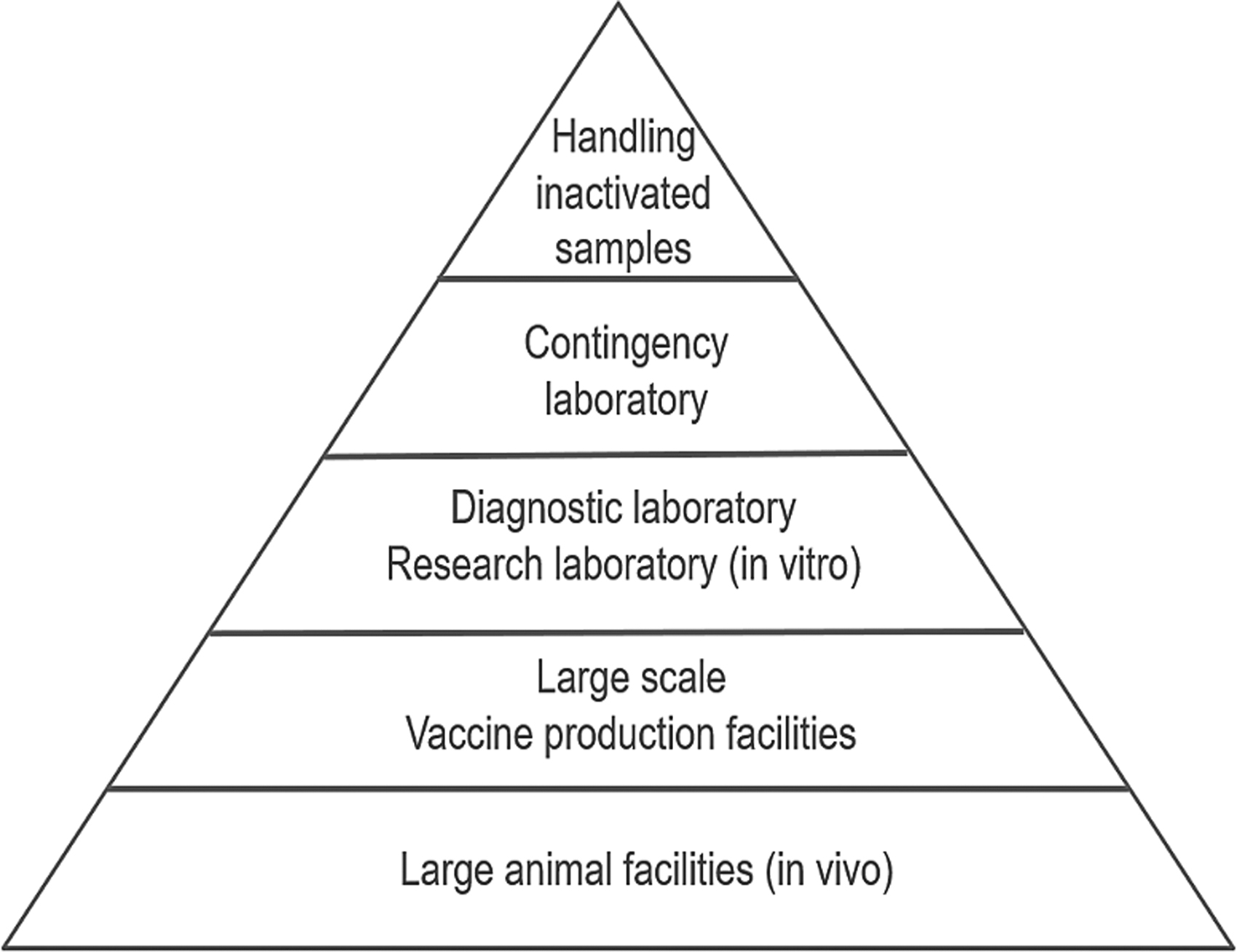
The risk pyramid for the different types of facilities where FMD activities are performed. FMD, foot and mouth disease.
Disinfection and Decontamination
Fumigation
Animal facilities and laboratories where FMDV work is ongoing are usually fumigated before maintenance or decommissioning. Formaldehyde has been the method of choice for room and equipment fumigation for decades 46 due to its effectiveness and relative simplicity. Still, due to concerns regarding the carcinogenic nature of formaldehyde, relevant publications have demonstrated that fumigation with alternative chemicals, such as vaporized hydrogen peroxide, is an effective disinfectant against FMDV.48,49 Nevertheless, further studies comparing the different strains of FMDV are still required. In addition, there are still many gaps in how facilities, including all engineering systems, are decontaminated and/or decommissioned to be safe for further use.
Conclusions
Due to the highly contagious nature of FMDV and the severe economic consequences of incursions into FMD-free regions, most countries opt for highly engineered biocontainment facilities when performing in vitro or in vivo FMDV laboratory activities. Taking a “belt and suspenders” approach may appear prudent; however, without thoroughly examining the actual risks involved with laboratory activities can result in an overly complex system that is technically complex and financially unsustainable. However, handling FMDV in an endemic country may not represent the same risk profile as in a country where the disease is exotic and depends on the nature of the activities performed (i.e., PCR diagnostics,
Footnotes
Acknowledgments
The authors wish to thank Ben Wakefield, The Royal Institute of International Affairs, Chatham House, United Kingdom, for providing administrative support to this project, and David Elliott, United Kingdom International Biosecurity Programme, Defence Science and Technology Laboratory, Porton Down, United Kingdom.
Authors' Disclosure Statement
No competing financial interests exist.
Funding Information
This study was supported by the Weapons Threat Reduction Program of Global Affairs Canada. This research was funded in whole, or in part, by the Wellcome Trust [220211]. For the purpose of Open Access, the author has applied a CC BY public copyright license to any Author Accepted Manuscript version arising from this submission.