






Abstract
Introduction:
The health and safety issues encountered by biosafety professionals in the daily conduct of their work is rarely limited solely to potentially infectious pathogens. A basic understanding of the other types of hazards inherent to laboratories is necessary. As such, management of the health and safety program at an academic health institution sought to ensure crosscutting competency for its technical staff, including staff members within the biosafety program.
Methods:
Using a focus group approach, a team of safety professionals from a variety of specialties developed a list of 50 basic health and safety items that any safety specialist should know, inclusive of basic but important information about biosafety that was considered imperative for staff members to understand. This list was used as the basis for a formal cross-training effort.
Results:
Staff responded positively to the approach and the associated cross-training, and overall compliance with an array of health and safety expectations was experienced across the institution. Subsequently, the list of questions has been shared broadly with other organizations for their own consideration and use.
Discussion/Conclusion:
The codification of the basic knowledge expectations for technical staff within a health and safety program at an academic health institution, which includes the biosafety program technical staff, was warmly received and helped establish what information was expected to be known and what issues warranted input from other specialty areas. The cross-training expectations served to expand the health and safety services provided despite resource limitations and organizational growth.
Introduction
Biological safety professionals rarely operate in an environment where the sole risks present are pathogenic agents. In most laboratory settings the risk of fire, physical hazards, chemical hazards, perhaps radiological hazards, along with other risks exist. Biosafety professionals may have some knowledge of the management of some of these risks, but the extent of that knowledge may not be codified, thus resulting in uncertainty, confusion, and possibly risks that remain unmitigated. This situation can become exacerbated when understaffing exists within either the biosafety program or the entire safety program as a whole. This condition can result in some hazards potentially being left unrecognized or unattended.
The University of Texas Health Science Center at Houston (UTHealth Houston) addressed this situation through the development of a finite set of clear knowledge expectations for all safety department staff (inclusive of the biosafety program staff) so that safety personnel resources could be optimized to effectively manage as many risks as possible. The codified list of knowledge expectations became colloquially known as “the fifty (50) questions every safety professional should be able to answer” and has become a popular tool used by many safety programs across the country and around the world.
Program Description
UTHealth Houston is a public academic health science center located in Houston's Texas Medical Center, the largest medical center in the world and eighth largest business district in the United States. 1 The university comprises ∼18,000 individuals, including students, faculty, and staff, and consists of six graduate schools, the nation's largest inpatient psychiatric care facility, and >130 ambulatory care clinics located in a geographic region roughly equivalent to the size of Connecticut. 2
Inherent to its advanced biomedical teaching, research, and service missions, UTHealth Houston conducts activities that often involve a broad spectrum of hazardous agents or conditions that may be biological, radiological, chemical, or physical in nature. 3 These risks are managed by the Office of Safety, Health, Environment, and Risk Management (SHERM). SHERM is organized into three primary units: environmental health and safety (EHS), risk management and insurance, and occupational (employee) health (OH). 4 The Biological Safety Program resides within EHS, along with the Radiation Safety, Chemical Safety, Occupational Safety & Fire Prevention, Hospital & Clinic Safety, and Environmental Protection Programs.
Given the size and scope of the university, it is imperative that SHERM ensures that all safety staff are cross-trained on at least the basic aspects of each hazard area so that, as part of routine safety surveillance activities, basic safety issues can be identified and appropriately resolved to prevent accidents, injuries, and exposures. This approach was originally derived from an effort initiated in 1995 where all UTHealth Houston radiation safety staff were cross-trained on a finite set of basic safety aspects from other domains. 5 During the subsequent 1-year period after training, 55% of the deficiencies noted as part of the required radiation safety inspections were identified as not directly related to radiation safety, demonstrating that SHERM's overall performance could be positively impacted through formalized cross-training. It was upon these data and feedback that SHERM leadership decided to embark upon the creation of the codified list of knowledge expectations.
Methods
To establish a baseline level of knowledge expectations for all SHERM staff, the office's management team was challenged with a simple question: what basic things would you want every staff member in this department to be knowledgeable about regarding your specialty area while they are completing their assigned tasks? Department leadership provided high-level administrative items and information that they expect everyone to understand to maximize their understanding of the mission of the organization and the “customers” they serve across the campus.
Managers overseeing the disciplines of biosafety, radiation safety, chemical safety, employee health safety and fire safety, hospital and clinic safety, and environmental protection (inclusive of hazardous waste management) all provided their input. Their responses were collated, screened, and discussed. After deliberation, some were discarded because they were deemed too complicated for someone outside a particular specialty area to fully understand and master. Others were set aside because they were not considered prevalent issues in the existing work setting. For example, in the area of biosafety, the following four items selected as basic questions that any SHERM staff member should be able to answer:
What are the two main elements of a biosafety level and what is the main driver for the assignment of these levels? How is a biosafety cabinet different from a chemical fume hood or a clean air bench? How should a bloodborne pathogen exposure, such as a needlestick or other contaminated sharps injury, be handled? What is the most common disinfectant used, including the concentration and recommended contact time, for effectively cleaning up most spills or leaks of potentially infectious agents?
The consensus opinion among the departmental leaders is that it would be reasonable to expect any staff member to know these issues regarding biosafety, and they would also know when more complex issues arise to reach out to the biosafety specialists that reside within the department for further information and/or ownership.
Some items identified during the group discussions, particularly those administrative in nature, were added and expanded because they were considered to be crucial to the overall understanding of the university and its operations. The value and importance of each item were repeatedly discussed and sometimes heatedly debated, until finally, a resultant compiled list of 50 questions was derived (Table 1). Note that although we have colloquially called this list “the 50 questions every safety professional should be able to answer,” over the course of time several items have been added to various topical areas that has resulted in a list that has exceeded 50 total questions. For example, additional questions specifically covering security considerations for EHS staff to consider when providing routine services have been importantly included. Interestingly, each of the questions fell into categories that mimicked the organization of the SHERM department technical programs, and were therefore grouped accordingly by programmatic heading.
The questions and answers provided in this table for UTHealth Houston are intended to serve as an example for other organizations to consider and adopt for their own staff cross-training purposes. Note the additional security-related questions (indicated by *) that have been added as a best practice for the EHS personnel to consider when performing routine services.
ACM, asbestos containing materials; BBP, bloodborne pathogens; EHS, environmental health and safety; EM, experience modifier; EPA, US Environmental Protection Agency; GM, Geiger Muller; HOOP, Handbook of Operating Procedures; HVAC, heating, ventilation and air conditioning; IAQ, indoor air quality; IDLH, immediately dangerous to life or health; KPIs, key performance indicators; OSFP, Occupational Safety and Fire Prevention; RMI, risk management and insurance; RQs, reportable quantities; SDS, safety data sheet; SHERM, Safety, Health, Environment, and Risk Management; SQG, small quantity generator; TIV, total insured value; TVOC, total volatile organic chemicals; TX, Texas; UT, The University of Texas; VSQG, very small quantity generator; WC, workers' compensation; WCI EM, workers' compensation insurance experience modifier.
Once assembled, the management team then undertook the task of crafting cogent answers to each of the questions—in essence, the 50 things that the staff were expected to know. Those answers were then peer reviewed by the department leadership team. The 50 questions list was then provided to the entire SHERM staff, and for the next several weeks, 1 h training sessions were conducted, explaining each of the 50 questions, the associated answer (including its importance to our organization), and the rationale for their inclusion in the list. In many instances, the rationale for inclusion was the frequency with which the item was encountered in day-to-day operations or during the safety surveillance program.
For example, objects placed in an exit corridor creating obstructions, materials stacked too high in the laboratory impeding fire sprinkler operations or electrical panels, and chemicals without appropriate secondary containment or labeling were commonly identified issues during routine safety surveillance. The expectation was then set that each staff member should be able to answer any of the 50 questions if asked by department management. It was made clear that the staff could carry the list of the questions with the answers specific to UTHealth Houston with them at all times if they so choose. As long as they could address the question and managed the issue, or understood the appropriate resource or party to address the identified issue, the overall intent of the exercise was achieved.
Interestingly, during the staff training sessions an unexpected aspect emerged. Multiple staff mentioned that they felt more comfortable in addressing a safety issue outside of their primary domain once they were armed with this clear list of what they were expected to understand, as well as what was deemed beyond their scope and thus warranted the involvement of a specialist within the particular area. This notion of codification of the expected knowledge emerged as being reassuring and confidence building to the staff.
Independent Assessment
While the SHERM staff has embarked on the use of the 50 questions in their daily activities, a unique opportunity presented itself to test the approach with a set of safety professionals from outside of UTHealth Houston. In 1993, SHERM first developed a novel week-long course originally entitled the “EHS Academy,” which has been successfully provided at least annually since its first offering. The course has now hosted more than a 1000 participants from around the world to teach them about how universities work and how to successfully implement a safety program within the unique work environment colleges and universities represent.
In 2005, the EHS Academy course consisted of 16 participants. With their permission, we conducted a simple assessment. We provided each attendee with the 50 questions list (without the answers) and asked two basic questions: (1) could you answer this question for your institution? and (2) do you think it would be useful to you to know this information? The results of the simple inquiries are shown in Figure 1a–c.
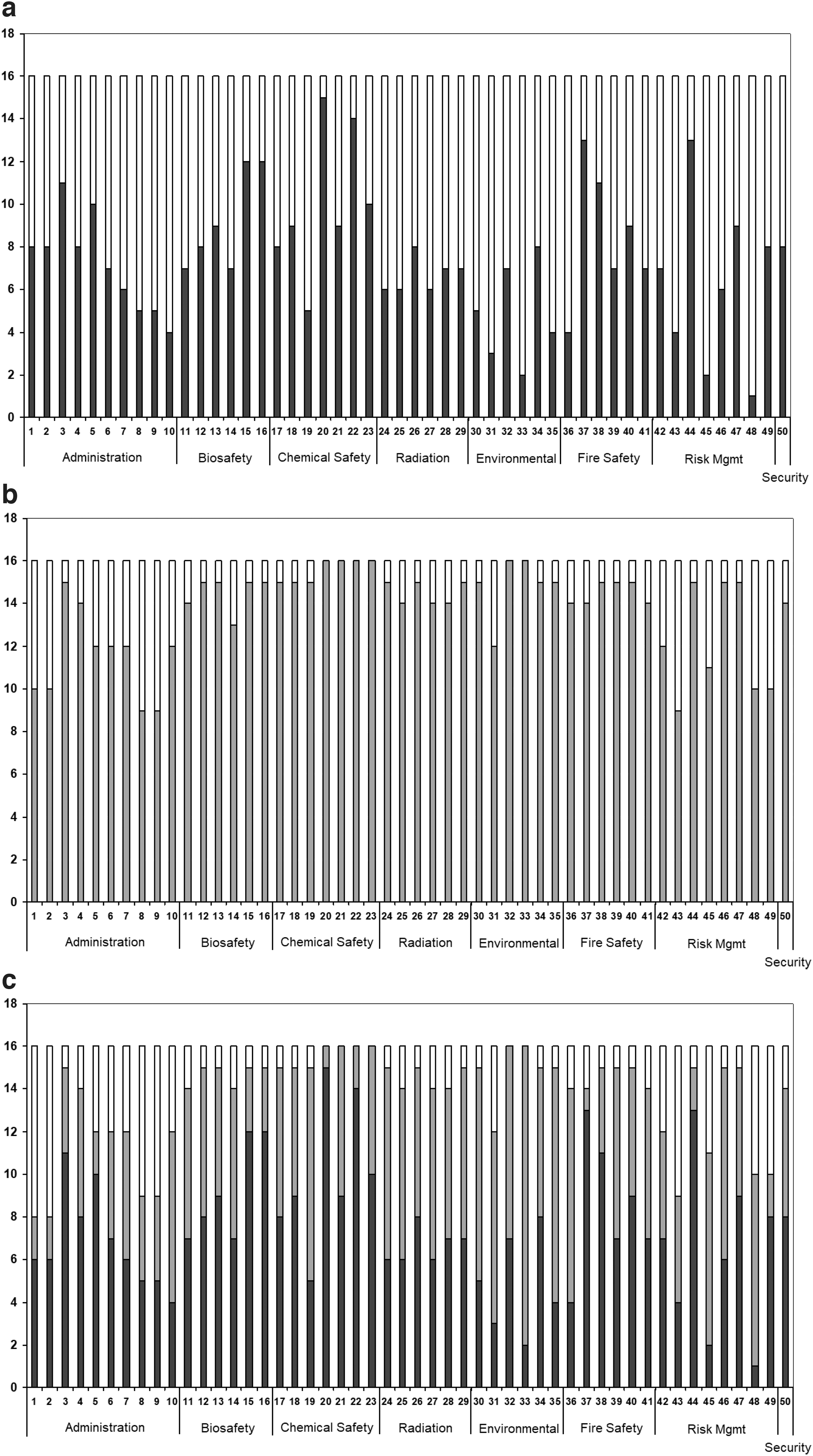
Figure 1a provides, in a quick glance, the items the participants felt they could honestly answer for their respective institutions. For example, question 20 addresses access to chemical Safety Data Sheets. Question 22 addresses the most common causes of indoor air quality complaints, and question 37 addresses the basic steps involved with how to respond to a fire alarm. Conversely, the figure also reflects questions the participants felt they could not answer, such has question 10, which is the size of their institutional measured by total net assignable square footage and their assigned research square footage; question 33 regarding reportable quantities (RQs) of petroleum products that might be spilled; and question 48 that addresses the number of tort liability or premises liability claims experienced over the previous year.
The questions that reflected low scores on the ability to answer were included for specific reasons. Knowledge of the institution's net assignable square footage is crucial as it has been shown to be the predominant statistically significant predictor of safety program staff and resourcing. 6 The question about RQs is important because if a spill or leak occurs and is not promptly reported to the appropriate authority significant compliance issues can arise. In addition, knowledge of the number of tort or premises liability claims is important because that information captures injuries or exposures to individuals outside the normal purview of students, faculty, and staff. Such data are important to understand the status of the entire population at risk for the institution, which is sound epidemiological practice.
Figure 1b reflects the responses to the question “do you feel you would benefit from knowing the answer to this question for your institution?” The results were dramatically different, and when overlaid as shown in Figure 1c, the self-identified knowledge gap becomes readily apparent.
The findings from this simple exercise were significant. It made apparent to us how impactful the 50 questions approach to cross-training could be and how important the codification of the knowledge expectations was for the staff from various specialty areas that support safety programs. Subsequent assessments have been performed in other EHS Academy courses with very similar results, reaffirming our observations so much that the 50 questions have become a core element for the EHS Academy course, where at the end of each section participants answer the associated 50 questions for their respective institutions.
Feedback for course participants has been consistently positive. Another completely unexpected outcome was the diversification of safety staff from one discipline to another, both within our own organization and others. Some staff became intrigued by the area that they had been previously not familiar with, and pursued further training and education in that field and actually changed disciplines. This cross-pollination has proved to be quite beneficial as it provides a broader understanding of an array of considerations with limited human resources.
Discussion
The overall intent of the 50 questions endeavor was to enhance the protection of the safety, health, and well-being our institution while supporting its key missions of teaching, research, and service. The obvious question from many is “has it worked?” The data collected over the years show improvements in several key areas that we believe can be attributed in part to the effort.
To gauge the overall performance of the health and safety at UTHealth Houston, SHERM has identified four key performance indicators (KPIs). These include, in rank order:
losses (in the form of number of individuals of any type reporting injuries or illness, and amount of property damage),
compliance (the results of inspections by external agencies and the items detected during internal routine safety surveillance activities),
costs (in the form of SHERM departmental budget and any associated cost avoidance or revenue generation), and
measured client satisfaction (both from the clients served and the SHERM departmental staff).
Through various professional interactions, these four KPIs have been widely shared and accepted by university colleagues across the globe to provide some indication of the overall performance of their respective safety programs. The UTHealth Houston SHERM annual report is constructed around these four KPIs. The current and previous year's reports are available on the SHERM website. 4 UTHealth Houston's biosafety program's operations (and other programs) are captured within these KPIs through the number of any injuries or illnesses experienced in the laboratory setting, laboratory damage, compliance inspections, program costs, and measured client satisfaction.
UTHealth Houston's reported injury and illness rates are very low compared with national data for both the university (North American Industrial Classification System [NAICS] code 6113) and hospital work settings (NAICS code 622). These rates, which reflect employee data only, are regularly tracked and reported to the UTHealth Houston Safety Council. Additional information about the types of injury or exposure events reported and the subsequent interventions by SHERM are also presented. As part of this reporting, the setting in which the incident occurred is included, such as a laboratory, so that focused and appropriate interventions can be applied.
SHERM's regulatory compliance record has been exemplary, especially given the number and variety of inspections that are conducted annually by various regulatory agencies. The aggressive routine surveillance efforts carried out by the SHERM staff, armed with the knowledge of the 50 questions, has shown steady improvement in overall laboratory safety compliance.7,8 SHERM's financial standing has been solid as the costs to support operations have been closely tied to the size of the institution (net assignable square footage) and its complexity (net assignable research square footage).
In addition to the injury and illness outcomes, compliance findings, and financial standing, SHERM conducts an annual client satisfaction survey directed to a specifically targeted audience. For example, one year a client satisfaction survey was directed to those individuals involved with the use of radiation sources. Another year a survey targeted those with exposure to potentially infectious agents. SHERM has also surveyed the major service units that support the university, such as police, facilities management, animal care, and auxiliary services. The results of the surveys are also shared with the Safety Council and have been consistently positive, suggesting that these populations feel their concerns are considered and addressed. The results of these surveys represent a tangible indication of SHERM's institutional “goodwill value.” 9
The student body also has an opportunity to provide feedback during a triennial “student perception survey,” conducted for the purposes of institutional accreditation and which includes consideration of the safety services provided. Again, the feedback garnered from this effort is shared with the Safety Council and has been consistently positive, suggesting that SHERM is attentive to the needs of the student body, and any issues are communicated and tracked to resolution.
Finally, the 50 questions continue to shape the weekly continuing education curriculum for the SHERM department. Each week, the entire department gathers to conduct a continuing education session that focuses on ensuring the 50 questions are routinely reviewed and refreshed for technical staff's awareness and knowledge. These sessions challenge technical staff who are content experts to remain sharp by requiring them to provide a technical presentation on the specific topics in their area of responsibility, and of course it allows for ongoing staff cross-training.
Taken together, SHERM's KPIs suggest that the 50 questions approach has been a contributor to the overall strong status of the health and well-being at UTHealth Houston. The initiative continues to evolve and it is likely the list will continue to be modified and possibly further expanded in length to include additional or different questions in the future. Others who wish to adopt this approach are encouraged to modify the question list to fit their institution's respective needs. In the future, a comparison of various 50 questions lists developed by different organizations could be not only intriguing but very beneficial for the entire profession.
Footnotes
Acknowledgments
The 50 questions list has been created and refined by numerous members of the UTHealth Houston Office of Safety, Health, Environment, and Risk Management (SHERM) staff, both past and present, over the course of time. Their input and suggestions, along with input from those outside of UTHealth Houston who have adopted the approach, have made this a valuable tool and their efforts are all truly appreciated.
Authors' Contributions
All authors contributed equally to the creation, writing, and revision of this article.
Authors' Disclosure Statement
No competing financial interests exist.
Funding Information
No funding was received for this article.