






Abstract
Introduction:
The 6th edition of the Biosafety in Microbiological and Biomedical Laboratories includes Appendix L on sustainability that describes a series of considerations for biocontainment facilities. But many biosafety practitioners may not be familiar with sustainability options that are available, feasible, and safe for laboratory settings as training in this realm is not common.
Methods:
With a particular focus on consumable products used in containment laboratory operations, a comparative assessment was made regarding sustainability activities employed in the healthcare setting, where significant advances have been achieved.
Results:
Table 1 has been created that describes various consumables that result in waste as part of normal laboratory operations, and the biosafety and infection prevention considerations have been highlighted along with options regarding waste elimination or minimization that have been successfully employed.
Conclusion:
Even if a containment laboratory has already been designed, constructed, and is in operation, sustainability opportunities exist for the reduction of environmental impacts without compromising safety.
Introduction
Among the modifications and upgrades included in the 6th edition of the Biosafety in Microbiological and Biomedical Laboratories (BMBL) is Appendix L that addresses sustainability. 1 The BMBL defines sustainability as “the ability to satisfy current needs without depleting resources needed for the future”. 1 Appendix L describes a series of sustainability considerations for the various life cycle phases of a biocontainment facility, ranging from programming, design, construction, operations, as well as annual maintenance and certification.
Examples are given regarding construction materials, energy use and conservation, and automated controls that adjust depending on facility usage, occupancy, and activity. All these considerations are described within the context of possible implementation without impacting the safety of both the laboratory staff and the surrounding community. However, many biosafety practitioners may not be familiar with sustainability options that are available, feasible, and safe for the laboratory settings and activities they support, as training in this realm is not common for most biosafety professionals.
In addition, it may be that a particular biosafety practitioner did not participate in the planning, construction, or renovation of the laboratory to provide input on sustainability features and their feasibility or safety. Within the context of these possible limitations, the ability to characterize and manage the consumables used in containment laboratory operations represents a ready opportunity for all biosafety practitioners to assess their operations for possible near-term improvement opportunities. Consumables in microbiological and biomedical laboratories include but are not limited to gloves, gowns, other personal protective equipment (PPE), pipette tips, plates, filters, swabs, sterile packaging, and so forth.
It is important to note that these types of consumables are also encountered in the healthcare setting, where great strides have been made regarding sustainability. Since both the biosafety and infection prevention professions are focused on disease transmission, lessons learned from the healthcare sector may be applicable in the containment laboratory setting as well for consideration and safe implementation of sustainability features regarding consumables.
Life Cycle for a Biocontainment Facility
Merrick and Company is an internationally known corporation that focuses on biocontainment facility design and construction, inclusive of sustainability aspects where feasible. 2 Figure 1 reflects the life cycle of a biocontainment facility as defined by Merrick and Company.
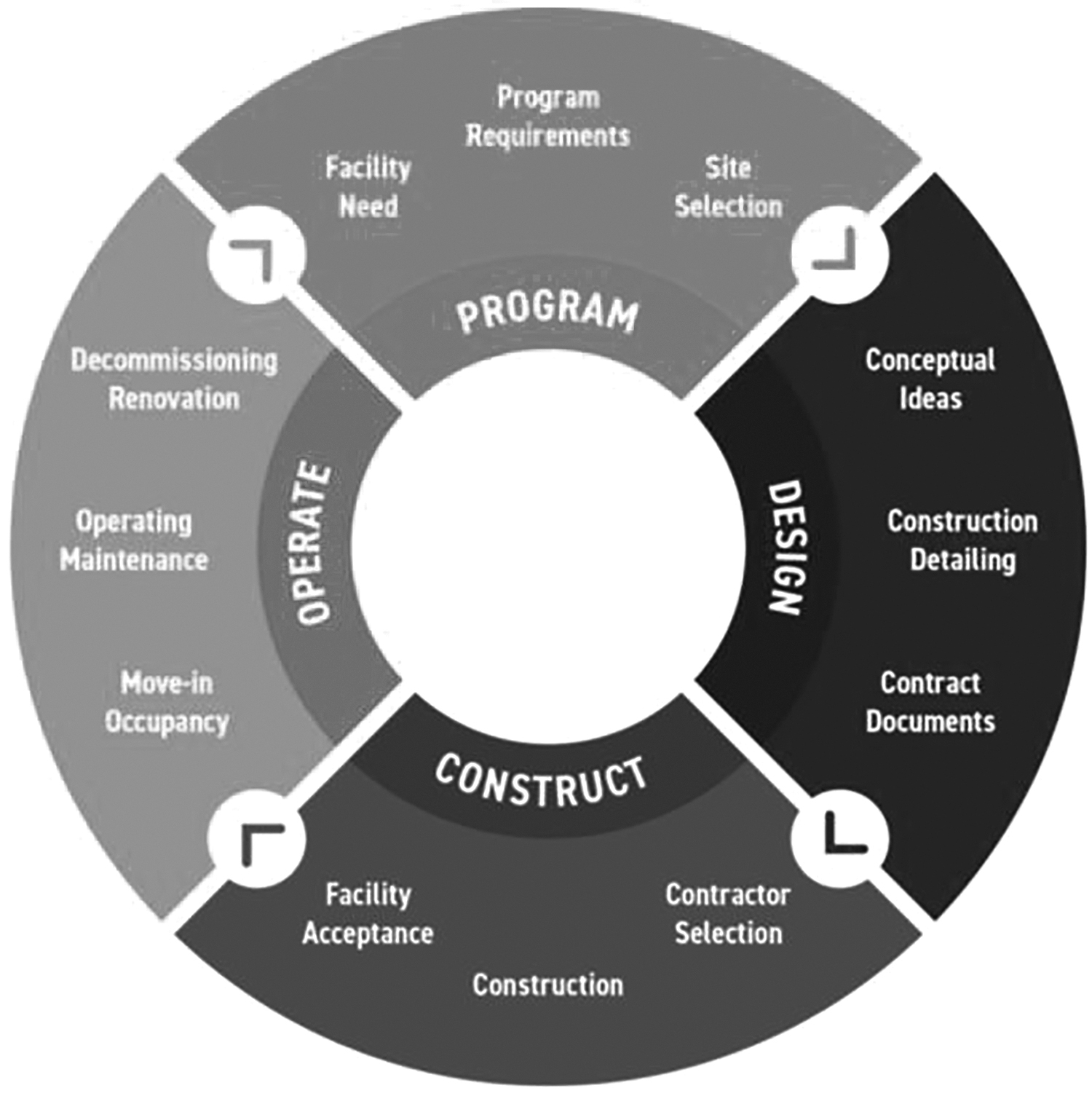
Graphical representation of building and sustainability as outlined by Merrick and Company. Reprinted with permission.
The first effort toward sustainability when building a biocontainment facility is the “Program.” This initial step includes the definition of facility needs, program requirements, and site selection. Each of these considerations carries a sustainability aspect. Examples may include building location and configuration, or laboratory location and configuration within a building, laboratory size and type, expected energy demands, etc. Selection of architects and engineers that prioritize and value sustainability to be involved with the project is important during the program phase. A sustainability consultant may also be engaged and involved during programming.
The next phase on the life cycle is the “design” factor. This design step plays an important role in fulfilling conceptual ideas, construction detail, and contract documents: all of which exhibit a sustainable dimension. For example, the selection of building materials to be used, heating, ventilation, and air conditioning systems to be installed, etc. is important regarding their sustainability considerations. A system to consider in the building process would be leadership in energy and environmental design (LEED) as it is the world's leading green building rating system. LEED focuses on green building strategies in five different aspects of the building process including sustainable sites, water efficiency, energy and atmosphere, materials, and resources, and indoor environmental quality. 3
The next phase is “construct.” After finding a sustainable area to start building and ruling out the nonsustainable efforts in the building design, the construct portion takes place for facility acceptance, construction, and contractor selection that will provide a sustainable design.
Finally is the “operate” phase that we will specifically address in this commentary. The operate phase is focused on move-in occupancy, operation, maintenance, and decommissioning renovation. This operation phase is where laboratory work and production must be addressed and where sustainability efforts regarding consumable items can be applied.
The life cycle diagram provided by Merrick and Company can be considered within the context of the well-known National Institute for Occupational Safety and Health (NIOSH)'s hierarchy of controls diagram. 4 The largest portion of NIOSH's hierarchy is elimination, where the “operate” phase of the life cycle for biocontainment facilities best correlates. When implementing sustainability features in a laboratory, the most effective efforts would align with elimination. Elimination involves physically removing a hazard that can include but is not limited to toxic chemicals, excess materials, and waste.
So, the elimination of consumable items altogether helps to reduce the overall carbon footprint of the laboratory's operations and the creation of waste. Substitution is the next tier of the hierarchy diagram and includes replacing an existing hazard. Considerable efforts in substitution can include use of “green chemistry” products in place of toxic chemicals. According to the U.S. Environmental Protection Agency (U.S. EPA), “green chemistry” consists of chemical products designed and processed to reduce and eliminate the use of hazardous or toxic chemicals. 5 However, such considerations must be carefully considered regarding known efficacy of the product for the pathogens being handled.
Practice Greenhealth is a membership and networking organization focused on transforming healthcare to reduce its environmental footprint and become an anchor for sustainability and a leader in the global movement for environmental health and justice. 6 One focus of Practice Greenhealth is directed to green chemistry products. One of their studies introduces replacing traditional cleaning products that contain ingredients that are linked to occupational asthma. Hospitals can maintain optimal infection prevention and reduce exposure to harmful chemicals present in most traditional cleaners; green chemicals can be used in place of the more hazardous solutions.
Practice Greenhealth recommends “Green Seal” or “UL ECOLOGO” that includes products for general cleaners, bathroom cleaners, floor and carpet cleaners, upholstery cleaners, window and glass cleaners, and laundry and dish soaps. 7 Not only can the use of green products benefit in efforts or eliminating toxic chemicals, but it can also be used when considering sustainable and waste products, including but not limited to solid waste, liquid waste, and infectious waste.
Administrative controls are the next tier of the hierarchy controls and can be directly related to the “operate” part of the life cycle. The least effective, according to the hierarchy of controls, is PPE. Although the use of PPE may be considered the least effective means of personal protection, its use is essential in biocontainment operations, hence the opportunity for the management of such consumables to reduce waste but maintain safety.
By implementing sustainability initiatives into the healthcare sector, Practice Greenhealth was able to help member hospitals save $68 million in 2018. Over 300 million kBTUs of energy, 146,750 tons of solid waste, and 182,370 metric tons of carbon emissions, also known as the carbon footprint, were reduced through various projects. 6 When the United States Department of Health and Human Services joined the United Nations Climate Change Conference in the fall of 2021, the stated goal was to reduce the carbon footprint of U.S. healthcare facilities, which accounts for 8.5% of the nation's total annual emissions. The United Nation provides 17 goals toward National Sustainable Development of which 5 can be intuitively applied to the laboratory setting. 8
Consumables
Hospitals face challenges in the complexity of waste in healthcare and in reducing/recycling with management options. Practice Greenhealth plays a role in developing tools and resources that can help guide healthcare workers with a baseline, goals, and strategies to be more effective in sustainable waste in terms of efficient sorting, waste prevention, robust recycling, single-use device reprocessing, etc. to reduce the cost and environmental impacts of healthcare-generated waste. 7 Similarly, Practice Greenhealth offers sustainability considerations with stringent consideration of safety impacts. Therefore, this is an important reference for consideration of consumables in the laboratory setting.
The BMBL introduces methods for both new and renovated laboratories, as well as efforts of sustainability when consumables are used. Some examples provided are donating unneeded equipment instead of sending it to the landfill (although the concept of e-waste recycling is not mentioned, this could also be considered), turning off fume hoods and autoclaves when not in use, using fewer toxic chemicals and selecting green chemistry options when feasible or eliminating chemicals altogether when possible, incorporating automatic lighting, etc. 1
Consumables are encountered in the healthcare setting every day. Practice Greenhealth has made great strides to encourage member hospitals to reduce these types of wastes. 7 Table 1 showcases various types of consumables and what Practice Greenhealth recommends in terms of sustainability. Practice Greenhealth has also produced a helpful webinar that can be found on their website that includes reviews and demos based on the detailed cost of ownership with consumable/reusable goods. 9 Listed hereunder are consumables used in laboratories daily. Some considerations for sustainability are mentioned by the BMBL and by Practice Greenhealth.
BMBL, Biosafety in Microbiological and Biomedical Laboratories; PPE, personal protective equipment.
Summary
Inherent to their main operational missions, laboratories and hospitals generate a massive amount of consumable waste and consume significant amounts of energy. The BMBL and Practice GreenHealth provide sustainable options for brand new laboratories and options for remodeling existing laboratories to better the environment in terms of excess energy and waste being used. Steps toward sustainability mentioned include reducing the excess number of consumables used, substituting toxic chemicals with green chemistry, useful efforts in engineering models for reducing the amount of electricity used and waste produced, and recycling or reusing equipment to prevent excess waste.
Sustainability options exist for reducing the environmental impact of consumables such as cardboard, plastic packaging, and single-use plastic disposable labware. This may provide a feasible economical option and will ultimately help in lowering the overall environmental impact of these important operations.
Footnotes
Authors' Disclosure Statement
No competing financial interests exist.
Funding Information
No funding was received for this article.