





Abstract
Introduction:
Yale University designed and constructed a temporary field hospital for 100 COVID-19 symptomatic patients. Conservative biocontainment decisions were made in design and operational practices. Objectives of the field hospital included the safe flow of patients, staff, equipment and supplies, and obtaining approval by the Connecticut Department of Public Health (CT DPH) for opening as a field hospital.
Methods:
The CT DPH regulations for mobile hospitals were used as primary guidance for the design, equipment, and protocols. References for BSL-3 and ABSL-3 design from the National Institutes of Health (NIH) and Tuberculosis isolation rooms from the United States Centers for Disease Control and Prevention (CDC) were also utilized. The final design involved an array of experts throughout the university.
Results and Conclusion:
Vendors tested and certified all High Efficiency Particulate Air (HEPA) filters and balanced the airflows inside the field hospital. Yale Facilities designed and constructed positive pressure access and exit tents within the field hospital, established appropriate pressure relationships between zones, and added Minimum Efficiency Reporting Value 16 exhaust filters. The BioQuell ProteQ Hydrogen Peroxide decontamination unit was validated with biological spores in the rear sealed section of the biowaste tent. A ClorDiSys Flashbox UV-C Disinfection Chamber was also validated. Visual indicators were placed the doors of the pressurized tents and spaced throughout the facility to verify airflows. The plans created to design, construct and operate the field hospital provide a blueprint for recreating and reopening a field hospital in the future if ever needed at Yale University.
Background
On January 13, 2020, the Yale New Haven Health system issued a Situation, Background, Assessment and Recommendations (SBAR) reporting an outbreak of pneumonia in China related to a novel coronavirus. 1 The report identified an acute respiratory tract infection and required airborne precautions and a negative pressure room for any patients meeting the SBAR case description. This SBAR and pre-existing knowledge of aerosols, including creation, terminal settling velocity, and deposition in the respiratory tract, led to our decision to explore the development of additional barriers to protect workers during the pandemic.2–4
In February 2020, in response to the COVID-19 pandemic, overwhelming numbers of hospital admissions, and high acuity intensive care patients, the University prepared for an alternative care site in the event a large volume of students and members of the Yale community required isolation and low acuity medical care. Although the field hospital was never used, it passed numerous inspections by the State of Connecticut Department of Public Health (CT-DPH) and was certified for patient occupancy. Environmental Health and Safety (EHS) had never been associated with the design and construction of a field hospital before the COVID-19 pandemic.
There was also an exigency associated with the timeline for getting the hospital ready for opening so the references utilized by EHS were those provided by the State of CT-DPH for mobile hospitals, those related to routes of exposure for biohazards, and other core biosafety references that were part of the genesis of the biosafety profession.5–18 The EHS relied heavily on those references that focused on biocontainment, aerosol creation and control, BSL-3 facilities and patient isolation rooms, and other key biosafety elements in the design of the field hospital.19–22 Facilities relied heavily on information provided by ASHRAE on the control of infectious aerosols, which were published as a comprehensive reference in April 2020. 23 During the height of the pandemic, hospitals in New Haven were overwhelmed with COVID-19 patients and as a result, the Lanman Center Gym at Yale was set up as a potential inpatient field hospital that was constructed to be under negative pressure to surrounding spaces.
This project involved protecting health care and related staff who would be providing emergency services at the COVID-19 field hospital created in a large open Yale campus gymnasium. As this was a large open space that would house up to 75–100 symptomatic patients who would not be wearing masks while they were housed, the University's challenge focused on the protection of staff who would be working in an environment with continuous exposure to aerosols and contaminated surfaces. In addition to the design of the field hospital, protocols were needed for entry and exit to the hospital, personal protective equipment (PPE) donning and doffing, delivery of food and other clean supplies, collection, storage, and removal of contaminated linens and biowaste, patient discharge, and the delivery of aerosolized medical treatments (e.g., nebulization).
More information can be found in Supplementary Appendices 1–3. The field hospital also required the development of a means for onsite reprocessing of PPE, such as N-95s and other devices (where applicable) utilizing vaporized hydrogen peroxide. Additional physical barriers were needed to minimize the number of individuals with potential exposure within the field hospital, and to provide segregation between clean and contaminated areas and procedures.
The field hospital was needed in the event of a significant increase in symptomatic cases. Yale Health, the University's health clinic, had limited capacity for admissions with only small numbers of negative pressure patient care isolation bedded rooms. Yale Health clinical operations in collaboration with the Yale's Emergency Operations Committee was charged with creating a field hospital. Key stakeholders representing EHS, Facilities, Emergency Operations Center, and Yale Health were able to utilize a full-size indoor basketball center with numerous access and egress points, including a raised running track that ran the full circumference of the space. Additional levels of access supported the ability to create staging and triage areas that could be partitioned off to create positive pressure access spaces.
The entire indoor basketball court (which consisted of four full court basketball courts side by side) was balanced to be under negative pressure to all surrounding spaces. Emphasis was placed on staff and patient safety. This included focus on comprehensive training of PPE for all employee roles, as well as vendors who would be required to access the field hospital.
Staffing of the field hospital would include skilled nurses, administrative staff, pharmacy, lab, and related personnel needed to provide clinical care for patients admitted to the field hospital. The EHS staff would serve inside the field hospital to support operations within and outside the field hospital to provide training for any new personnel assigned to work there who had not been initially trained. A contractor was hired to perform custodial services operations inside and outside of the field hospital. They had a variety of required trainings already (emergency response, bloodborne pathogens, chemical safety, respiratory protection, and other PPE), were already cleared to wear a respirator, and were accustomed to wearing Tyvek protective suits for their normal work.
These staff members would clean all restrooms and assist with any other cleaning requested, waste collection and removal, and would also help respond to any blood or body fluid spills within the field hospital. They were provided training on biomedical waste collection and packaging by EHS. This procedure is found in Supplementary Appendix 3. These employees also would operate a 3′ × 3′ × 7′ misting booth located near the main entry to the positive pressure exit tents for men and women leaving the facility. The booth was used to mist the exterior of a staff member's personal protective clothing before their exit from the field hospital with a goal of suppressing aerosols once protective clothing and equipment was removed in the first zone of the positive pressure exit tent as seen in Supplementary Appendix 4.
Initial access for patients was designed as a one-way directional flow with patients entering through a single door, where triage/assessment was conducted by clinical teams in an area that was balanced as negative pressure to surrounding non-field hospital areas and the outdoors, but positive to the field hospital zone. This led to an admission staging area, where patients would be processed, assigned a bed and care team, and escorted to a location for their stay. Each bed was 6 feet apart and had individual supplies/lighting. Pods of 25 beds for a total capacity of 100 were envisioned. The running track allowed for storage of supplies and bulk items for immediate inventory to the field hospital. The facility was flanked by outdoor parking and floor level doors that allowed easy access in one door for ambulance and emergency personnel and exit from a different door, avoiding impact on negative pressure airflow. A negative pressure treatment room was built on the bedded floor space to support aerosolizing treatments such as nebulizers for patient care.
Additional augmentation to the gym area housing patients were added by Facilities. Sinks were installed along the gym wall for use by health care staff. Their installation required drilling through concrete walls to access a water source. These access ports were covered up when the gym reopened but remain in place for future use if needed. All doors within the field hospital were converted to hands-free operation by the installation of sensors or elbow-operated buttons. All sinks were converted to hands-free operation, and sensors were added to all toilets for automatic flushing on exit of the stall. Many additional electrical lines and outlets were created to support the field hospital and were safely installed and covered to protect those in the field hospital. The mechanical space was balanced to operate under positive pressure to the field hospital and included a separate entrance dedicated to Facilities personnel managing the ventilation system.
TSI, Inc., room pressure monitors were installed at the entry doors to the mechanical space for this group to verify that airflow and pressures were operating correctly before their entrance. This eliminated the need for additional PPE by Facilities staff. As the basketball center was one of the more recent additions to the gym, it had its own Heating Ventilation and Air Conditioning (HVAC) system and controls to support it. This allowed Facilities to balance the field hospital to the maximum negative pressure setting, which directed air from surrounding spaces, including from the outdoors inward to the field hospital at all times. Plastic filament visual indicators, or sheets of plastic over the mesh part of screen doors on the anteroom tents were installed so that staff entering and working in the field hospital could gauge airflow direction at any time.
Patient discharge was out a rear egress location stairwell that supported the one-way directional patient flow. Staff and employees entered through a separate entrance that funneled through to a door in the admitting staging area. All staff were required to don their PPE in their entry anteroom, which had two zones before entering the field hospital area. The first was for donning, the second was an access zone before entering the facility and people were only allowed to exit through a one-directional exit door that housed a shower and doffing section, expressly designed for removal of PPE and decontamination. Waste was to be placed in a specific section at the rear of the facility, and vendor pick up and removal out from a specific exit only was planned.
Meals and other vendors, such as lab collection and linens, were provided or collected through a separate positive pressure entrance anteroom at the main entrance level of the field hospital. Staff and professionals delivering supplies (meals, medication, linens, and other needed supplies) would enter through two positive pressure zones with respect to the field hospital. The first two doors were a gym entry. A large positive pressurized tent anteroom was added after the second entry door from the outside to create a safe delivery space for staff, professionals, and vendors delivering or picking up supplies.
A self-closing screen door was installed at the entry to this positive pressure anteroom room tent and was also equipped with a white plastic visual indicator to show that air was coming from inside the tent to the inside the field hospital. Staff using the delivery anteroom were trained on the directional airflow visual indicators. Two specimen transfer boxes were installed for outgoing clinical specimens and for incoming medications for hands-free transfer of items going in each direction. Staff working within the field hospital had standard operating procedures (SOPs) and were trained on the disinfection of items before placement in the transfer boxes.
The custodial services vendor also was trained to utilize a disinfection SOPs for returning any contaminated reusable items such as meal carts through this supply tent. The protocol involved moving the items inside the tent, disinfecting them, the walls and ceilings of the tent by misting with disinfectant, and then mopping the floors with disinfectant. This was coordinated for only designated times to allow dissipation of the disinfectant and sufficient contact time before their collection by staff removing them. The support custodial staff would also disinfect the floors within the positive pressure supply delivery anteroom after each entrance by staff to retrieve clean supplies for use in the field hospital.
A specific section was located on the floor for incident command that housed computers and mobile phones for oversight of the bedded floor. Floor captains and shift supervisors would report to the incident command for updates and guidance. Communication was planned using mobile phones, and a new field hospital context was created within the electronical medical record (EMR) already in use by Yale Health. Facilities planned for two 12-h shifts with several days off between shifts to allow for staff respite and recovery.
Overview of the Facility
Four pressurized containment zones were customized and built specifically for this facility to ensure the highest possible level of safety:
A large triage section at the main entry was constructed and balanced to be negative pressure to the outdoors and positive pressure to the field hospital area. Triage, assessment, and testing was to be performed in this space. It was designed as an Acute Care walk-in section with appropriate equipment/registration/allergy banding and other critical components of triage. A negative pressure isolation tent that included an anteroom was built and placed on the patient care floor in the bedded section to support the need for nebulizer or other aerosol-producing procedures. Three large tested and certified exhaust fans with High Efficiency Particulate Air (HEPA) filters were used to create negative pressure for this isolation treatment tent and discharge clean air back to the field hospital. As it was on continuously during the operation of the field hospital, it also served as a constant source of air cleaning for the field hospital as it was constantly recirculating air within the facility through the tent. The unit was large enough to support several treatments, but optimally, treatment should be done one at a time. Additional PPE as described in the attachment of SOPs, was recommended within this unit while performing these procedures. All HEPA filters were tested and certified by a professional testing company before placement in the field hospital. All HEPA filters were placed on an annual testing schedule. Visual indicators were part of every anteroom and strategically placed in designated areas within the field hospital so that staff could continuously verify that airflow was moving in the appropriate direction. The large visual indicators were also helpful in training staff who were not familiar with infectious disease isolation rooms or BSL-3 laboratories. A large staff exit positive pressure egress tent was built for all staff and employees to safely remove PPE and exit the patient facility and enter to the staff-only/non-patient section. This exit also provided access to break areas for respite, recovery, and staff meals. Extensive measures were taken to provide a facility to support exemplary doffing procedures, including showers. Again, one-directional flow was required. A large positive pressure tent was created at the rear of the field hospital patient care area. This customized unit was built to accommodate several needs for the field hospital and was divided into three zones. The rear zone was capable of being sealed for the decontamination of PPE for potential reuse. The front zone of this tent also served as storage for all waste from the facility, including food debris and used PPE. All waste generated within the field hospital would be collected as regulated biomedical waste and shipped offsite for incineration by a licensed vendor. It was also where contaminated linens were collected and transferred to a separate vendor for decontamination, cleaning, and return to the field hospital. The middle section of this tent was used for storage of items needed to support custodial and EHS activities within the field hospital. There was a single egress out to the street level for all waste through this negative pressure space. Patient discharge was also coordinated to occur through this containment unit and escorted up the rear stairwell and out into the street area for pick up.
A schematic of the field hospital is included in the Yale University Facilities plan included as an attachment to this article. More information can be found in Table 1.
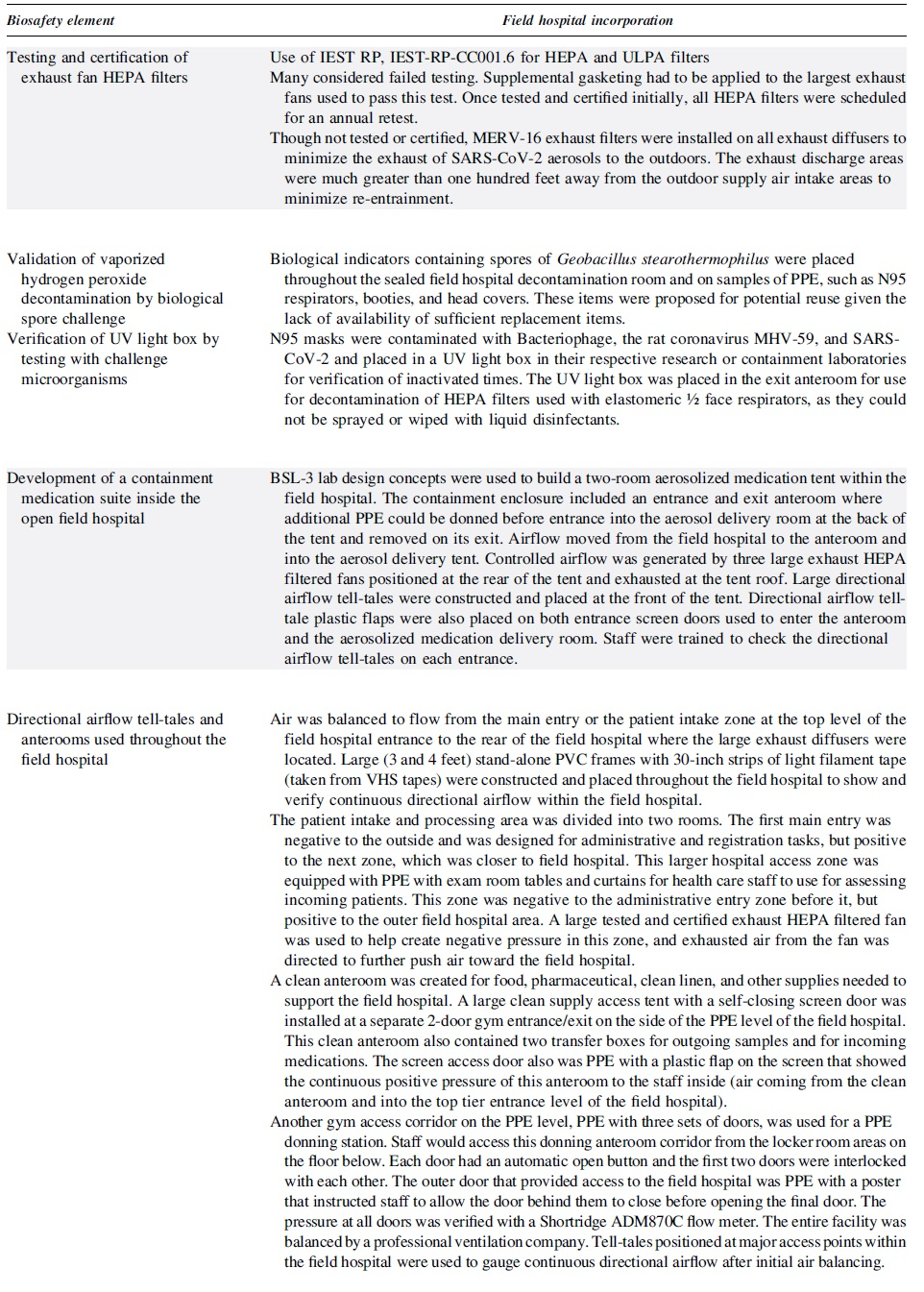
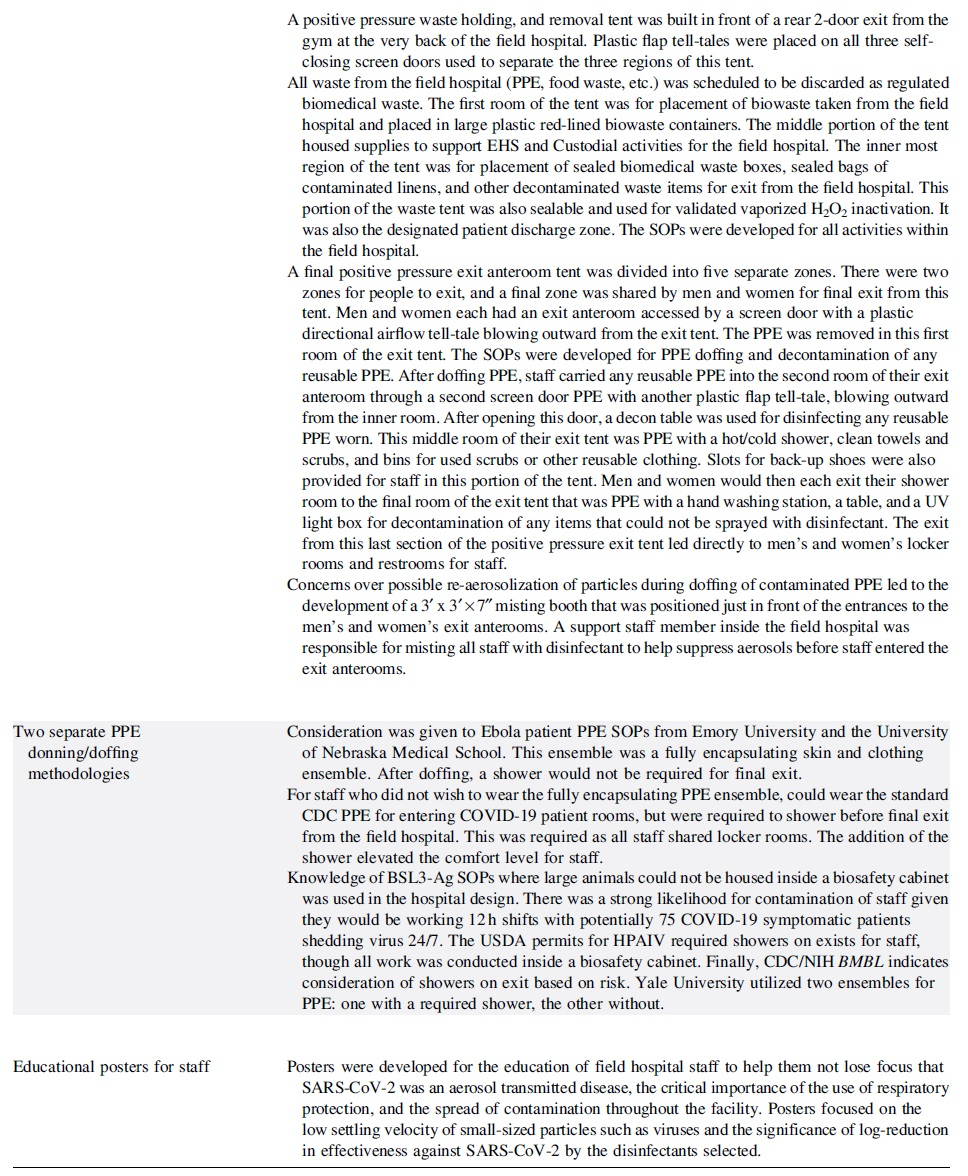
BMBL, Biosafety in Microbiological and Biomedical Laboratories; CDC, Centers for Disease Control and Prevention; EHS, Environmental Health and Safety; HEPA, High Efficiency Particulate Air; HPAIV, highly pathogenic avian influenza virus; IEST, Institute of Environmental Sciences and Technology; MERV-16, Minimum Efficiency Reporting Value 16; PPE, personal protective equipment; PVC, polyvinyl chloride; RP, recommended practice; SOP, standard operating procedure; ULPA, ultra-low particulate air; USDA, United States Department of Agriculture; VHS, video home system; NIH, National Institutes of Health.
The facility included:
A patient entrance.
A large triage/assessment section.
Admission staging area.
Ambulance entrance.
Staff entrance separate from patients.
A staging platform for receiving all clean deliveries daily, including food, linens, medical supplies, and lab support.
An elevator from admission/clean delivery to lower level.
A large, bedded floor space housing 75–100 beds with individual lamps and power.
An additional 25 beds may be available without individual power/lamps.
Several nursing care stations associated with each pod of 25 beds.
A pharmacy Pyxis unit that stores medications.
A locked cabinet to store additional medications.
Fully connected computer workstations, laptops throughout the care units.
Hard-wired landline telephones in each section, as well as mobile cell phones for staff internal communications.
An Epic context has been designed for access of EMR and documentation of care.
Oxygen concentrators, IV poles, wheelchairs, and all medical supplies for supportive care.
Patient bathrooms.
Staff bathrooms.
Staff lounge, lockers, showers, and respite section, including dining for staff only.
Positive pressure donning and doffing zones (positive in respect to patient areas).
Nebulizer treatment negative pressure containment tent with an anteroom.
Decontamination/waste removal negative pressure containment tent.
24/7 Security and Police support stationed at entry and exit areas to the field hospital.
Parking.
First Layer of Containment
A part of the Yale Payne Whitney Gymnasium (PWG), named the Lanman Center, housed four full basketball courts and an indoor track two levels above. This space was targeted for an emergency field hospital designed for up to 75–100 moderately ill COVID-19 patients (those who would not need intensive care or ventilator assistance). The Lanman Gym Field Hospital provided 10,709 square feet of space and had a dedicated HVAC system. Yale Facilities was able to set the gym to a maximum negative pressure compared with the rest of the gym facility. Minimum Efficiency Reporting Value 16 (MERV-16) filters were also installed on all exhaust discharge ducts on the gym, providing the best exhaust filtration system available. 24
The strong negative pressure established in the gym was utilized to set up barriers to segregate clean deliveries, collection of waste supply, entry and exit of personnel working inside the field hospital, and patient discharge. An additional barrier was established for the delivery of aerosolized medication via nebulization. As this was deemed to elicit more significant aerosols, containment was also created for this activity. Thirteen large tested and certified exhaust HEPA filtered fans were strategically placed and used within the field hospital. These fans provided a source of air cleaning within the facility, as they were scheduled to be on permanently during the operation of the field hospital.
Fans were also used to help augment pressure relationships and airflows for the positive pressure access tents that were constructed. Multiple contractors, including an asbestos abatement company with experience in building soft-walled enclosures, were recruited to assist Yale Facilities in the construction of the field hospital. Many additional electrical and plumbing upgrades were required for the additional medical equipment and the number of sinks needed for the temporary hospital.
Positive Pressure Clean Delivery Zone
The first positive pressure zone was built to create a double-door entrance into the gym for the delivery of clean linens, all meals (with all disposable trays, dishes, and flatware), medications, and any other supplies needed for the field hospital. Home exterior screen doors were utilized for entry doors, with the screening providing a location for visible indicators to visualize directional airflow. Through the wall, double-door specimen pass-through transport boxes were added to this tent for collection of samples by associated laboratories. The SOPs were developed for entry and exit of the tent and for the decontamination of any reusable carts back to Yale Hospitality Services.
Staff Entry
Although the main gym was closed during the pandemic, extensive signage placed throughout served as reminders that access to the Lanman Center was for authorized persons only. Security and police were assigned to monitor field hospital access and egress points 24 h a day. All staff entered the building and proceeded to men's and women's locker rooms located outside of the Lanman Center, but within the main gym facility. Staff were required to change into scrubs. No personal clothing would be allowed in the field hospital. Staff were required to identify two pair of sneakers or clogs to use while in the facility.
After donning scrubs, staff would proceed to a clean PPE donning corridor that had double-door access to the staff entry to the upper level of the field hospital. Both rooms were positively pressurized in relation to the field hospital. Signage indicated that only one door could be opened at any one time to maintain proper air flows.
Two PPE ensembles were established for staff entering the field hospital. The PPE after showering consisted of gloves, back-fastening gowns, an N95 respirator or PAPR with HEPA filter, booties that extended to the mid-calf, and a face shield. The assumption was that every part of the scrubs or body would have the potential to be contaminated with SARS-CoV-2 aerosols. With a capacity of up to 100 COVID-19 patients who would not be masked for prolonged periods of time inside the open floor hospital, the continuous risk of aerosol exposure and likely extensive contamination of all surfaces within the field hospital was prominent in all biorisk management decisions.
Therefore, this PPE ensemble would require a shower out at the personnel exit tents that are described in the Staff Exit Positive Pressure Zone section. The other ensemble deployed Tyvek coveralls, gloves, full-hooded HEPA filtered PAPRs, and the same mid-calf length booties. This ensemble would cover all scrub and skin surfaces, which would eliminate the requirement for a shower upon exit. These two protocols were developed to address discomfort of staff working in the hospital and help ensure that every effort was taken to prevent the dissemination of contamination from within the field hospital to designated clean spaces (staff locker areas, restrooms, and break rooms).
All the PPE needed for the two separate ensembles were placed in the clean positive-pressurized staff access corridor. The SOPs were written for donning and doffing, whereas posters were also created to further conceptualize these processes. The posters included photographs as well as helpful hints and instructions for donning PPE. Mirrors were present to ensure that staff could check their PPE against that was shown on the posters. This access corridor also served as a just-in-time training site. As biosafety professionals, EHS needed to reinforce the message that health care workers would effectively be working in an environment where COVID-19 patients would be continuously shedding virus in a wide-open room.
Information regarding aerosol behavior, transmission, and risks were stressed to this population and to support the stringent PPE requirements developed for work inside the field hospital. In addition to PPE ensemble posters, posters on effectiveness of disinfectants, the difference between droplets and aerosols, and other relevant safety information were included.25–27 Once dressed, staff would leave the donning area and enter a positive pressure anteroom that opens to the upper entrance to the field hospital.
Due to the aerosol-borne route of exposure and the unprecedented challenges faced by a novel virus, it was important to reinforce to staff entering this facility that this was a unique experience. Proper donning and doffing of PPE were always critical but even more so in this challenging environment. Doffing was especially challenging and as such, staff were reminded to use the rest room before entering and donning. Waterproof bandages, which are always important to wear under gloves if small open wounds are present, were provided in the donning area with reminder notes posted in the training corridor. More information about signage and SOPs can be found in Supplementary Appendix 1.
Staff Exit Positive Pressure Zone
To safely leave the field hospital, separate men's and women's exit doffing and shower out positively pressurized tents were constructed. Just before exiting or entering the doffing men's and women's shower tents, two disinfectant misting enclosures were constructed and placed in front of these exits. Staff were instructed to enter the 3′ × 3′ × 7′ misting tent to be lightly sprayed down with EPA-approved disinfectant, which was Virex, Oxivir, PurTabs, Microchem 5%, or 70–85% Ethanol. After the mist disinfection with appropriate contact time, staff were instructed to remove one bootie and then step over the threshold into the next doffing zone. This was to ensure that booties were removed before entry and that booties never touched the floor on the doffing station. The doffing tent was divided into zones, each of which had extensive directions for what items to doff.
The main point of emphasis was that hand hygiene on gloved hands was to be performed between every step to prevent inadvertent self-contamination. Staff were provided with instructions to sequentially remove PPE, leaving their N95 or PAPR until the very end of doffing. If PAPRs were worn, there needed to be an effective means of doffing Tyvek suits or gowns while still wearing the PAPR. The IV bag poles were provided to hang the PAPR on while continuing to doff remaining PPE. Posters on PPE removal and, where applicable, PAPR or other elastomeric respirator decontamination were provided in these anterooms. Detailed information about doffing can be found in Supplementary Appendix 2.
At the beginning of the pandemic, there was a plan to collect N95s for decontamination and reuse as the supply chain was significantly strained for disposable N95s. N95 collection bins were placed inside the exit doffing anterooms. In the event of massive supply chain disruptions, there was also the capability of decontaminating Tyvek suits. More information about N95 reuse and decontamination can be found in Supplementary Appendix 3.
The attendants running the misting station were responsible for periodically disinfecting the chairs and surfaces in the exit doffing anteroom. They also were responsible for providing cleaning and custodial services for the bathrooms, showers, and open hospital facility. Further, this group was assigned the tasks for waste collection and packaging, along with any emergency response spill clean-up needed within the hospital area.
After leaving the doffing anteroom, staff entered the shower area where scrubs were placed in dirty linen bins if using the shower-out PPE ensemble. Clean towels and clean scrubs were also provided in this location. Staff could maintain a second pair of shoes in this location if they wished, though not required if the full cover booties were used. After showering, new scrubs were donned and towels placed in the dirty linen bins. For staff who used the fully covered PPE ensemble, showers were not required. After exiting the shower zone, with or without a decontaminated PAPR, staff used the exit hand washing station to wash their hands before exiting to the clean staff locker, restroom, and break areas.
This area contained a table, and a ClorDiSys Flashbox along with a hand washing sink with soap and paper towels. This UV Light Box was for the HEPA filters for the elastomeric respirators that could not be decontaminated with liquid disinfectants. The ClorDiSys Flashbox was also validated in three separate laboratories at the University, testing its ability to inactivate microorganisms on the filter media of N95 respirators if needed within the field hospital. Guidance from the University of Nebraska Medical School and other resources were used in moving forward with the use of UV light in the field hospital.28–30 Bacteriophage, the rat coronavirus MHV-A59, and SARS-CoV-2 were used to provide evidence for the selection of time cycles for the UV light box within the exit anteroom. These data are provided in the attached Supplementary Appendix 5.
Medical Delivery Negative Pressure Tent with Anteroom
The field hospital included an aerosolized medicine delivery tent that was constructed like a basic BSL-3 laboratory. This containment tent was divided into two portions, a smaller anteroom that opened into the larger medical delivery room at the rear of this medical delivery tent. Three tested and certified large HEPA filtered exhaust fans were used to make this tent negative to the outer field hospital. Exterior screen doors were utilized for entry and exit doors to this structure. Visual indicators were placed in front of the tent and on the screen doors so that staff could verify that air was flowing into the anteroom and into the medicine delivery room before each entry.
The entrance anteroom contained the additional PPE (outer gloves, additional booties, and back-fastening gowns) that were required for entry to the medicine delivery room. Posters showing the required PPE ensemble for this aerosolized medical delivery tent were present in the anteroom. This anteroom also had biowaste bins for removal of this additional PPE before exiting the medicine delivery room, then entering the anteroom for exit.
Waste Collection Positive Pressure Tent
The last and largest tent structure that was constructed was a waste collection, storage, decontamination, and exit tent. It was divided into three portions, and each portion was divided by the exterior screen doors. This entire tented area was also positively pressured to the exterior field hospital and airflow direction moved from the inner most room, to the middle room, to the waste collection room, and then out to the field hospital. Visual indicators were placed in front of the waste tent's front entry door and on each door within the tent. The first section of the waste tent was reserved for multiple biowaste containers that would be used to collect all waste and linens generated within the facility into their designated collection bags.
Once bags were filled, they were sprayed with disinfectant and moved to the very rear section of the tent, where they were placed within clean biomedical waste bags and boxes and taped and labeled for pick-up and removal. Linen bags were also placed in their secondary bags in this room after being disinfected. These activities were coordinated with the biowaste and linen vendors or Yale employees, so that these now disinfected or clean items could be collected from the rear room or moved up one floor via a stairwell to an area where they could be delivered to trucks just outside the gym exit located there or stored in portable storage containers in the gym parking lots. More information about the waste collection SOP can be found in Supplementary Appendix 4.
In addition, the rear waste pick-up area was utilized as a decontamination room using a BioQuell ProteQ vaporized hydrogen peroxide disinfection machine. Biological spore testing was conducted to validate the use of this disinfection system for the decontamination of N95 respirators and related PPE in the event of a supply shortage, and reuse was the only remaining option. Any large items or reusable PPE items such as N95s that needed to be disinfected could be decontaminated in this rear area of the waste exit tent. This procedure is found in Supplementary Appendix 6. During validation tests, any leaks were resealed and retested to ensure there was no breakthrough during the run.
For emergency response measures, the middle area of the waste exit tent, which was designated for storage of supplies needed for the waste, linens, and cleaning supplies, was equipped with emergency exhaust fans. These large exhaust fans were exhausted to the exterior of the gym and would be turned on if leakage from a vaporized hydrogen peroxide run was detected and the run had to be aborted. Although filters for helping to remove H2O2 vapor were in place in the tent, the exhaust fans would assist in the rapid removal of elevated levels of this chemical from the tent and would remain on until the filters and the fans lowered the H2O2 concentration to a safe level, which was less than 1ppm as checked by handheld hydrogen peroxide monitors.
Patient Discharge Via the Rear Section of the Waste Tent
An SOP was created for using the waste exit tent for patient discharge. The patient's contacts were to be notified to arrive at the rear gym exit on the day and time of their discharge. Patients leaving the hospital would be moved to the middle part of the tent and handed a bag that contained clean scrubs, a towel, antiseptic wipes, slippers, a linen bag, and a biowaste bag. The attendant who accompanied the patient opened the door to the clean exit door with these items and the instructions for discharge. Once inside the final zone of the tent, the patients were asked to remove their clothing and place it in a linen bag, including their shoes. They were instructed to wipe down all skin surfaces with the antiseptic wipes and place them in a biohazard waste bag.
Hands were wiped with antiseptic wipes before opening the bag of clean scrubs and slippers, which were then donned. At this point in the SOP, the patient notifies the attendant that they are ready for departure. The attendant informs the patient that they may open the exit door at the rear of the tent, where an employee from the clean side escorts them to their contacts. Their clothing may be decontaminated by the cleaning vendor, who followed their own SOP, and could be picked up in 1 week from a designated clean portion of the hospital facility. The attendant collected the biowaste bag, sealed it, disinfected it, and mopped the floor of the room with disinfectant before leaving.
Conclusion
Although there were numerous challenges and lessons learned about safety, patient and staff flow, air balancing, and room pressurization, there are extraordinary lessons to take away about bringing interdisciplinary units and divisions across a university together to share expertise and collectively align for a shared mission. Each division came together bringing subject matter expertise and worked collaboratively to create a fully operational 75–100 bed Field Hospital in a university gymnasium that was reviewed and met regulatory requirements from the Connecticut Department of Health. The field hospital passed two separate inspections by the State of CT-DPH (one for Yale University and one for the local city hospital) and was certified for occupancy. It also passed a similar inspection by the state for opening as a COVID-19 vaccine clinic when immunizations became available.
The field hospital was never opened for its intended purpose, as the infection control and prevention measures established throughout Yale University kept the number of cases during the early waves to a manageable level. Two dedicated dorms for positive and symptomatic students were the interim isolation measure, and the threshold for opening the field hospital was never reached. The field hospital was subsequently taken over by the local city hospital for their emergency use if needed, but they also never had to open the facility. The field hospital was ultimately utilized as a location for health care activities associated with COVID-19 clinical trials and as a COVID-19 vaccination center, using some of the protocols created for the field hospital.
The COVID-19 field hospital was a huge effort based on the knowledge available to the authors in the spring of 2020. As there were still many questions regarding SARS-CoV-2 at that time, such as the role of contaminated surfaces in transmission, both the temporary hospital and the protocols created for use during its operation were very conservative. In most cases, minimum Centers for Disease Control and Prevention requirements for health care worker protection were exceeded. Our collective goal was to do everything possible to minimize exposure and prevent infections to staff. The start of the pandemic was a time of great concern, and our project team had one principal goal, which was to do everything possible to enhance the comfort for all who were to work in the field hospital. If the field hospital were opened today, it is likely that less conservative approaches to PPE and decontamination would be utilized.
Yale University has a blueprint for rebuilding a field hospital with significant biosafety and biocontainment elements, as described earlier, if needed in the future. It was constructed, ready for use with all operational protocols developed, staff trained, and all equipment and supplies positioned for opening. The information provided here may also be helpful to others who may need to open or create a related emergency medical overflow care facility. The hospital took about 1 month from set-up to CT-DPH approval.
Footnotes
Acknowledgments
The construction of the field hospital utilized representatives from Yale's Pandemic Operations Group, the Health Center, Departments of Emergency Management, Facilities, Hospitality, Police, Fire, Security, Custodial Services, Instructional Technology, Transfer Receiving and Stores, contractors, Yale New Haven Hospital, and Yale EHS.
Authors' Disclosure Statement
All authors are employees of Yale University.
Funding Information
No funding was received for this article.

References
Supplementary Material
Please find the following supplemental material available below.
For Open Access articles published under a Creative Commons License, all supplemental material carries the same license as the article it is associated with.
For non-Open Access articles published, all supplemental material carries a non-exclusive license, and permission requests for re-use of supplemental material or any part of supplemental material shall be sent directly to the copyright owner as specified in the copyright notice associated with the article.
