






Abstract
Introduction:
Industry-specific safety climate scales that measure safety status have been published, however, nothing specific to biological laboratories has ever been established.
Objective:
This study aimed to develop and validate a biosafety climate (BSCL) scale unique for research professionals (RPs) and biosafety professionals (BPs) at teaching and research biological laboratories affiliated to public universities in the United States.
Methods:
BSCL scale was developed from literature review. In study 1, 15-item biosafety climate (BSCL-15) scale with 15 items and 5 factors was pretested with n = 9 RPs and n = 7 BPs to perform reliability, content, and face validity analyses. In study 2, revised 17-item biosafety climate (BSCL-17) scale with 17 items and 5 factors was pilot tested with n = 91 RPs and n = 88 BPs. Correlation tests, Kaiser–Mayer–Olkin, Bartlett's test of sphericity, Cronbach's alpha, and exploratory factor analysis (EFA) were conducted to validate the BSCL-17 scale.
Results:
EFA resulted in a 3-factor 17-item BSCL scale for both RPs and BPs. Internal consistency of the scale was > 0.8 for the BSCL scale and the underlying three factors, indicating high reliability. The factors identified for RPs are 1) management priority, communication and participation, 2) group norms, and 3) supervisor commitment. The factors identified for BPs are 1) management priority and communication, 2) group norms and participation, and 3) supervisor commitment.
Discussion:
A valid and reliable BSCL scale to measure safety climate and quantify safety culture in biological laboratories has been presented. It can be used as a key performance indicator and aid in targeted interventions as part of process improvement of biological safety programs.
Introduction
Biological laboratory safety or biosafety is the discipline addressing practices, procedures, and use of equipment for safe handling and containment of pathogenic microorganisms and hazardous biological materials in laboratories utilizing principles of risk assessment and containment. 1 Ensuring safe handling of hazardous biological materials is crucial for protecting not only those who work in biological laboratories but also the public and the environment.1–3 Infectious exposures and/or outbreaks at research4–8 and teaching9,10 institutions underscore the risk involved in biological research. Laboratory-acquired infections (LAIs) and accidental exposures in biological laboratories could be minimized by improving biosafety programs as reported by Byers and Wooley. 11
Experts recognized the need for a stronger safety culture in biological laboratories to address deficiencies. 12 Interest in application of safety culture concepts in biosafety has been expressed by the biosafety professional (BP) community during symposiums, webinars, professional discussions, and in the literature.13,14 There is a need for identifying key performance indicators, client satisfaction, and program drivers in biosafety programs. 15 Emery et al. highlighted the need to benchmark performance indicators that track biosafety program outcomes to advance the biosafety profession.15,16 Trevan argued that lessons can be learned from other fields that also focus on prevention and safety culture to improve biosafety. 13
The U.K. nuclear safety panel first defined safety culture as “the product of individual and group values, attitudes, perceptions, competencies, and patterns of behavior that can determine commitment to, and the style and proficiency of an organization's health and safety management system.” 17 Safety climate is considered to be a measurable aspect of safety culture as it provides a “snapshot” of culture at a given time.18,19 Zohar defined safety climate as the perceptions of employees on policies, procedures, and practices about safety within the organization. 20 Safety status is reflected by safety climate, a multidimensional construct that evaluates management and workers' attitudes and safety commitment.20–22 Over the years, safety climate has been recognized to evaluate the link between an organization's characteristics and safety at work. 22
Often, lagging (retrospective) indicators 23 of safety such as data on exposures, incidents, and LAIs are not readily available making it difficult to assess the safety status of biological laboratories. Safety climate can be used as a leading (prospective) indicator of safety without the need for analyzing negative safety outcomes.23,24 This highlights the potential of safety climate as a useful tool to evaluate safety status in biological laboratories. There are few studies on safety climate in chemical laboratories 25 and higher education institutions26–28 but nothing specific to biological laboratories. However, the ability of safety climate to predict safety behavior and safety outcomes has long been established in various fields such as vineyards, manufacturing, construction, transport, rail, and other industries.19,22,29,30 Therefore, safety climate literature from other fields can also inform biosafety. In 2012, a Danish study on how work environments influence health concluded that higher number of safety climate problems was associated with increased odds for experiencing accidents in the general working population of Denmark. 22 In a study of residential roofers, safety promotion increased safety behavior indicated by both an increase in use of personal protective equipment and decrease in injuries, indicating positive association of safety climate with better workplace safey. 31
Research instruments such as measurement scales are utilized to measure theoretical constructs. 32 De Vellis defined scales as “collections of items combined into a composite score intended to reveal levels of theoretical variables not readily observable by direct means.” 33 Scales can be unidimensional with a single underlying dimension or multidimensional with two or more underlying dimensions (factors). 33 The number of dimensions in a construct might increase with the abstractness of the construct. 33 A multidimensional scale is made up of subscales that represent one composite score of the construct. 33 A construct can thus be quantified through a scale with items (questions) that can measure a set of factors (dimensions).19,34
Literature on existing safety climate scales has identified different factors important to improve safety outcomes. Bronkhorst et al. utilized a safety climate scale to collect and analyze data from healthcare workers to study the effectiveness of a multifaceted intervention on safety climate perceptions and safety behavior. 21 They identified three factors in improving safety climate and safety behaviors. These include leadership priority for safety, supervisor commitment, and co(workers) norms in relation to safety. 21 A safety climate scale developed for utility industry identified that organizational and managerial aspects can be a strong indicator of safe behavior and safety outcomes. 18 Safety climate perceptions among laboratory users were found to be important in improving safety conditions in college chemical laboratories. 25 To identify novel and context-dependent indicators of safety climate perceptions within respective industries, safety climate scales that are industry specific rather than universal are encouraged.18,34,35 This study aims to develop a safety climate scale to measure factors affecting workplace environment, behaviors, and perceptions specific to biological laboratories. It specifically focuses on research and teaching laboratories at public universities in the United States, as they function under similar guidelines and regulations set at Federal, state, and institutional levels.
Rationale and Purpose of the Study
This study's objective is to develop an industry-specific biosafety climate (BSCL) scale to measure perceptions of safety in biological and biomedical science laboratories at public universities in the United States and validate it using qualitative and quantitative methods. Research professionals (RPs) and biosafety professionals (BPs) represent two groups with distinct roles. RPs directly work with potentially infectious microorganisms and hazardous biological materials utilizing biosafety practices in laboratories. In contrast, BPs facilitate implementation of biosafety practices and policies in the laboratories by providing on-site policy compliance, guidance, and administrative support. Although RPs and BPs have distinct roles, they share a common goal of ensuring safety in biological laboratories. Hence, our study proposes to develop and validate a BSCL scale that is unique to each group.
Methods
Literature on scale development recommends theoretical and empirical assessments for a thorough and satisfactory validation of a scale,32,33 which were employed in this study. The methods consisted of literature review, item identification, feedback from experts, survey administration, and data analyses. The study design and protocols have been approved by the institutional review board of University of Louisville (UofL). The study participants did not receive any form of compensation and their identity was kept anonymous. The development and validation process have been outlined in Supplementary Figure S1.
A literature review on instrumentation process, scale development, validation methods,27,33,34,36–40 and existing safety climate scales across various fields such as utility, 18 vineyard, 19 chemical laboratory, 25 manufacturing, 41 and rail 30 was conducted. The factors (dimensions) and items (questions) important to BSCL construct were identified. The five factors identified were (1) senior management priority, (2) supervisor commitment, (3) communication, (4) safety participation, and (5) group norms. Senior management (or university administration) priority is considered a main influencer of safety climate for its role in establishing organizational priorities and resource allocation.21,42,43
Supervisor commitment is regarded as the building blocks of safety climate given the daily interaction between management and employee. 21 Communication is considered an important factor for its link to safety promotion and motivation.21,44 Safety participation plays an important role as it contributes to an environment that supports safety. 21 Group norms are considered important due to the influence of coworkers on safety behavior.21,38 Items important to measure the factors were identified by reviewing safety climate scales developed for Australian workplaces and Italian manufacturing companies.21,37,38 First, items were examined for face validity, and those that were not appropriate for biological laboratories were removed. Second, the original items were modified to make them specific to biological laboratories. Example: employee health and safety were changed to safety; workplace was changed to laboratory. A 15-item biosafety climate (BSCL-15) scale consisting of five factors with three items each was developed. Supplementary Table S1, BSCL-15 RP and BSCL-15 BP provide details on the original items that were identified and adapted in development of BSCL-15 scale.
The Flesch–Kincaid Grade Level (FKGL), a readability test that determines the comprehension difficulty of written material,45,46 was performed using an online tool 47 to assess the readability of the scale. An FKGL indicates the U.S. academic grade level required to comprehend the written material. Example: a score of 10 reflects a grade level appropriate for someone who completed 10th grade education. A readability rating of 8 is recommended, whereas a rating of 12 is considered difficult. 46
Assessment of psychometric properties (reliability and validity) ensures that the scale measures (1) the intended construct and (2) the construct's consistency and precision. Cronbach's coefficient alpha is commonly used for reliability analyses to measure internal consistency of a scale.48,49 Content validity measure assesses whether the objectives of the study match with the contents of the items in the scale.32,50 All statistical analyses performed in this study utilized IBM SPSS version 27.
Study 1: Development of BSCL Scale
Methods
Participants
The study participants consisted of RPs and BPs. RPs engaged in biological research activities at UofL were identified by the authors. The RPs consisted of students, principal investigators, and institutional biosafety committee (IBC) members. BPs participating in biosafety matters at public universities in the United States, who attended the Midwest Area Biosafety Network's (MABioN) annual biosafety symposium in 2018, were contacted to participate in the study.
Survey administration
A BSCL questionnaire was administered to RPs and BPs through SurveyMonkey® in September 2019. The questionnaire consisted of BSCL-15 scale as well as questions on background information such as age, gender, educational level, trainings, type of work conducted, and work environment. All the items were positive, optional to respond, and measured on a 5-point Likert scale, ranging from 1 (strongly disagree) to 5 (strongly agree).
Data management and analysis
The survey data collected were exported into Microsoft Excel for data cleaning and management. Surveys with at least 85% or more completed responses on the 15 items were included in the analyses. Any surveys completed by participants who identified their roles as other or both RPs and BPs were excluded from the analysis. Readability analysis of the scale was conducted using FKGL test. Descriptive statistics was employed to describe the individual characteristics of the survey participants. The items were assessed for internal consistency using Cronbach's alpha. Content validity was validated through feedback from the study participants on issues of clarity, ambiguity, general syntax, semantics, and relevance of the item to the BSCL scale.
Results
The BSCL questionnaire was sent out to 30 RPs and 13 BPs who agreed to participate. After 3 weeks of data collection in September 2019, nine RPs, seven BPs, and one respondent who identified as both RP and BP completed the survey. Sample size requirements were met as a sample of >5 to 100 is acceptable for pretest. 33 The response rate was 30% for RPs and 53.8% for BPs. The average time to respond to the questionnaire was 13.5 min. Only two item responses were missing that was addressed by substituting the missing value with three (neither agree nor disagree) to enable quantitative analyses. Table 1 reports the characteristics of the study participants. Most respondents of the RP survey were male, had a role as principal investigator, had doctoral level of education, and worked in biosafety laboratory (BSL) level 2 settings that utilize risk group (RG) 2 and 3 agents. The gender for respondents of BP survey was uniformly distributed between male and female. Most respondents of the BP survey had a role as assistant biosafety officers, had master's level of education, and worked in universities with mostly BSL-3 or lower settings utilizing RG-3 or lower agents.
Characteristics of study 1 and study 2 participants
Study 1 and study 2, RPs at University of Louisville (UofL).
Study 1 and study 2, BPs at public universities in the United States.
BPs, biosafety professionals; BSL, biosafety laboratory; RPs, research professionals; GRA, graduate research assistants; TA, teaching assistants.
The readability of the BSCL-15 scale had an FKGL score of 12.3 for RPs and 12.5 for BPs. The feedback received from the study participants was organized in Microsoft Excel and reviewed by the authors. Feedback was received on the questionnaire such as having the need for an introduction page, definitions, revise phrases for clarity, and the need for additional questions to evaluate researchers' participation and group behavior in the laboratory. The Cronbach's alpha scores range from 0 to 1, where 0.7 and above indicates good, 0.80 and above indicates better, and 0.90 and above indicates best.48,49 The overall scale alpha score was 0.928, implying the scale is highly reliable in measuring safety climate. The alpha values for factors on university administration priority, supervisor commitment, and communication were acceptable ranging from 0.7 to 0.98. However, factors on participation and group norms had alpha values <0.7, indicating the items were not consistent. Low alpha score indicates poor correlation between items, 51 underlining the need to revise the items. Cronbach alpha scores are presented in Table 2.
Cronbach's alpha coefficients of proposed and revised biosafety climate scale and factors in study 1
Factors 1 to 5 are represented as F1, F2, F3, F4 and F5 respectively. Study 1 proposed BSCL scale consisted of 15 items and 5 factors for research professionals (RP) and biosafety professionals (BP). Revised BSCL-17 scale consisted of revised 15 items from BSCL-15 and one additional item in each of factor 4 and 5. The italicized values show improvement in alpha values.
BSCL, biosafety climate; BSCL-15, 15-item biosafety climate; BSCL-17, 17-item biosafety climate.
Based on the results of reliability and content validity analysis, the authors revised the 15 items and added 1 additional item each to participation and group norms factors, resulting in a revised 17-item biosafety climate (BSCL-17) scale for both RPs and BPs. Changes were made to items, for example, senior management was changed to university administration (Supplementary Table S1). Items 4, 14, 15, 16, and 17 in BSCL-17 for RPs are based on perceptions at the laboratory level, whereas in BSCL-17 for BPs, they are based on perceptions at the university level. The proposed BSCL-17 scale for both RPs and BPs is reported in Table 3 and the item development process is elaborated in Supplementary Table S1, BSCL-17 RP, and BSCL-17 BP. The proposed BSCL-17 scale was assessed for reliability to verify whether alpha score improved. The average means of participation and group norm factors were substituted as the average mean of the two newly added items, respectively, to conduct reliability analysis. The revised BSCL scale showed alpha values >0.7 for participation and group norms indicating improved reliability of the items, as shown in Table 2.
Biosafety climate scale
BSCL-17 scale to measure safety perceptions at biological science laboratories. For items 4 and 14 to 17, the phrase “in the laboratory” is used in the scale for RPs, whereas for BPs the phrase, “at my institution” is used to imply their respective work settings. BSCL-17 is a 5-point Likert scale with score ranging from 17 to 85.
Study 2: Validation of BSCL Scale
Methods
Participants
The study participants consisted of RPs and BPs. RPs included principal investigators, IBC members, research associates, students, graduate research assistants, laboratory personnel, and equivalent positions at UofL. BPs consisted of biosafety officers, training specialists, responsible officials, or equivalent positions with responsibilities in biosafety administration and management at public universities in the United States. The biosafety administration at UofL provided a list of individuals engaged in biological research activities at UofL in 2019. A list of individuals involved in biosafety matters was compiled by reviewing the Association for Biosafety and Biosecurity (ABSA International) directory available online in 2019. 52
Survey administration
The BSCL questionnaire was shared with RPs and BPs through REDCap™ from November 19, 2019, to March 17, 2020. The survey consisted of BSCL-17 scale and questions on background information such as age, gender, educational level, training, type of work conducted, and work environment. To complete the survey, answers to the 17 items were mandatory, whereas other questions were optional. All the items were positive and measured on a 5-point Likert scale, ranging from 1 (strongly disagree) to 5 (strongly agree).
Data management and analysis
The data collected through REDCap were exported into Microsoft Excel for data cleaning and management. Surveys completed by RPs and BPs were included in the analysis. Any surveys completed by participants who identified their role as both BPs and RPs, or other role were excluded from the analysis. The BSCL-17 scale's readability was assessed using the FKGL readability test. Internal consistency test was performed using Cronbach's alpha analysis.
Statistical Analysis
Exploratory factor analysis (EFA) is routinely employed for developing and validating a new scale. 36 EFA procedures identify correlations among the variables, common variance between variables, number of factors, and pattern of factor loadings in a scale.32,33,53–55 To evaluate the suitability of EFA in a study, sample size requirements,33,56 correlations, 53 communalities, 33 Kaiser–Mayer–Olkin (KMO) measure of sampling adequacy and Bartlett's test of sphericity33,36,57 are examined before conducting EFA. Correlation coefficients between items are used to estimate communalities and factor loading. 53 Communality is the total proportion of variance of an item accounted for by the extracted factors. 33 Maximum likelihood (ML) is recommended as a data extraction method, wherein a certain number of components are initially formed by putting the variables together based on their mutual correlations and then combined.33–48 To improve the interpretability of the extraction procedure, rotations are utilized along with extraction procedure, 36 such as promax when factors are correlated with each other.58,59 The correlation between the original item and factors extracted in EFA is interpreted by means of factor loadings. 36 Higher values of factor loadings are desirable to show that the item measures the factor, with 0.32 factor loading considered minimum. 36 Supplementary Table S2 provides an outline of the measures utilized in BSCL scale development and validation.
EFA was used to assess the validity of the proposed BSCL construct and assess whether the proposed underlying five-factor structure was validated in the BSCL-17 scale for RPs and BPs. Before conducting EFA, the suitability of using EFA in this study was evaluated by examining correlations, KMO, and Bartlett's test of sphericity. EFA was conducted using ML extraction with promax rotation. The number of factors to extract was determined by examining the eigenvalues and scree plots.33,60
Results
The BSCL questionnaire with BSCL-17 scale was shared with 1055 RPs and 410 BPs. A total of 377 responses were received. Of these 377 responses, 229 (91 RPs, 88 BPs, 4 RPs and BPs, 46 other role) were completed responses and 148 were incomplete. Only the completed responses, that is, 91 RPs and 88 BPs were included in data analysis. Sample size requirements were met. In a scale, a 5:1 ratio of participants to number of variables in a scale is acceptable33,56 The characteristics of study participants are presented in Table 1. Most respondents of RP survey were male, had a role as principal investigator or professor, had doctoral level of education and worked in BSCL-1 and BSCL-2 settings that utilize RG-1 and RG-2 agents. The gender for respondents of the BP survey was uniformly distributed between male and female. Most respondents of the BP survey had a role as biosafety officers, had either masters or doctoral level of education, and worked in universities with mostly BSCL-2 or BSCL-2+ or lower settings that utilize RG-1 and RG-2 agents.
The readability of the BSCL-17 scale had an FKGL of 12.6 for RPs and 12.5 for BPs. Correlation coefficients for both RP and BP data sets were found to be >0.30 within the acceptable range of 0.30–0.70.33,36,53 Communalities for both RP and BP data sets ranged from 0.52 to 0.93, which were acceptable. Communalities can range from 0 to 1, with 0.40 to 0.70 considered acceptable in social sciences.33,36,53 KMO measure of sampling adequacy was 0.898 for the RP data set and 0.896 for the BP data set. The KMO values can range from 0.6 or higher to be accepted, with values >0.9 considered to be marvelous.33,37,57 The Bartlett's test of sphericity was significant (p < 0.001) for both BP and RP data sets, which was within the acceptable range of
Exploratory factor analysis results for study 2
Three factors have been identified for RPs and BPs. aThe 3 factors for BSCL for RP are represented as Management Priority, Communication & Participation (F1), Group Norms (F2) and Supervisor Commitment (F3). bThe 3 factors for BSCL for BP are represented as Management Priority, Communication & Participation (F1), Group Norms & Participation (F2) and Supervisor Commitment (F3). Bold values indicate highest factor loading appropriate for each factor. Extraction and Rotation Method used: Maximum Likelihood and Promax with Kaiser Normalization.
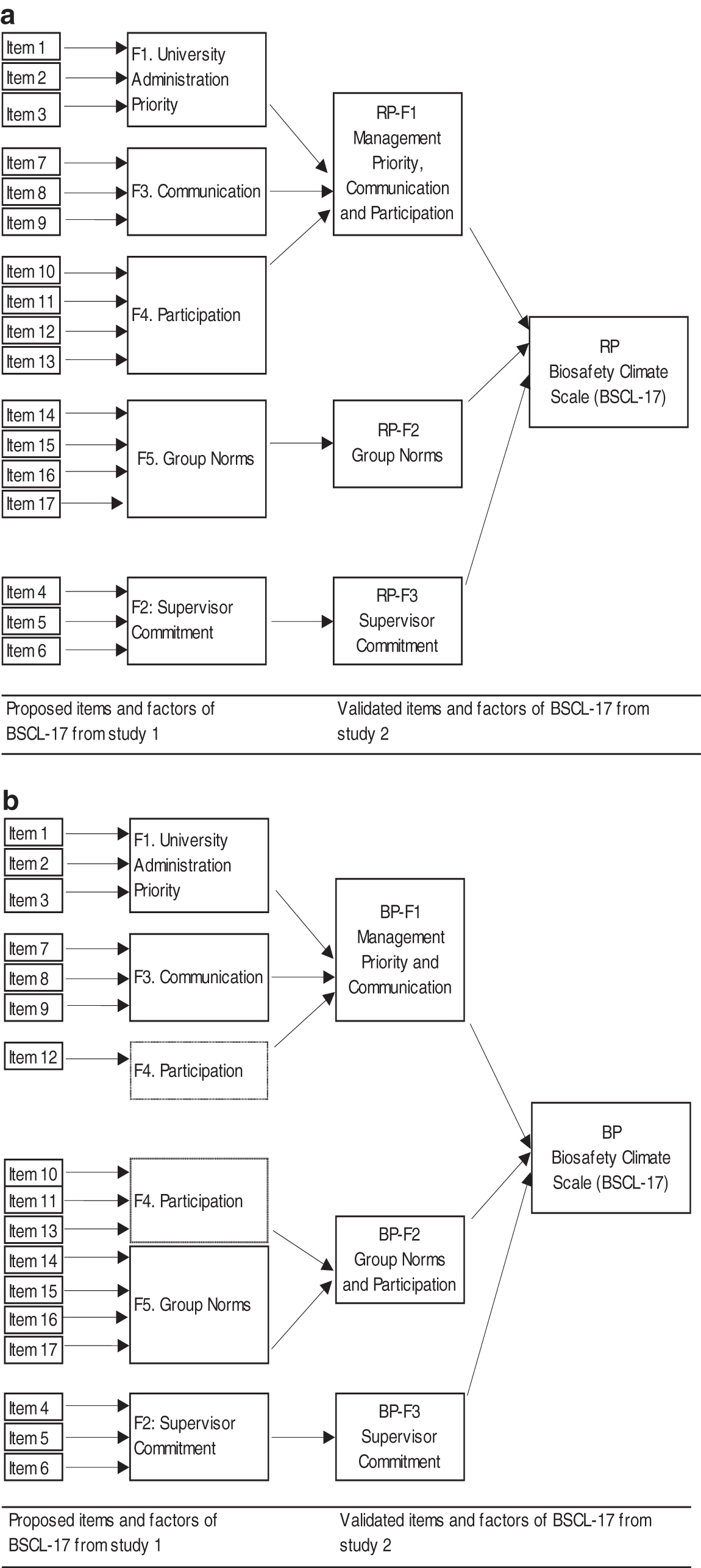
In RP BSCL-17 scale, the first extracted factor (RP-F1) combined the three proposed factors of university administration priority, communication, and participation that can be explained as items that reflect initiatives taken at the university level. The second factor (RP-F2) and third factor (RP-F3) consisted of proposed group norms and supervisor commitment, respectively, corresponding to the factors envisioned by Bronkhorst et al.22,38,44 RP-F2 can be explained as items that indicate initiatives taken at the laboratory level. RP-F3 is reflective of initiatives taken at department or laboratory level.
In the BP BSCL-17 scale, the first factor (BP-F1) combined the two proposed factors of university administration priority and communication along with item-12 from the participation factor. BP-F1 like RP-F1 can be explained as items that reflect initiatives taken at the university level. The second factor (BP-F2) combined the proposed items of group norms as well as items 10, 11, and 13 of participation that can be interpreted as activities that influence safety at laboratory level. The third factor (BP-F3) consisted of proposed supervisor commitment like the factor envisioned by Bronkhorst et al.,22,38,44 which are indicative of activities taken at department level. The validated 17 items of the BSCL-17 scale and its underlying structure for both RPs and BPs are shown in Figure 1a and b, respectively. The alpha values were used to assess the reliability of the BSCL-17 scale and underlying three factors; it was acceptable at 0.88 or higher as shown in Table 5.
Cronbach's alpha coefficients of validated BSCL-17 scale and factors in study 2
The validated BSCL scale for RPs in study 2 consisted of three factors: RP-F1 with items 1, 2, 3, 7, 8, 9, 10, 11, 12, and 13; RP-F2 with items 14, 15, 16, and 17; and RP-F3 with items 4, 5, and 6.
The validated BSCL scale for BPs in study 2 consisted of three factors: BP-F1 with items 1, 2, 3, 7, 8, 9, and 12; BP-F2 with items 10, 11, 13, 14, 15, 16, and 17; and BP-F3 with items 4, 5, and 6.
Discussion
The objective to develop and validate a scale for measuring safety perceptions at academic biological and biomedical science laboratories in the United States was accomplished. During scale development, it is recommended that research should include at least (1) literature review, (2) qualitative research, (3) feedback from experts, and (4) pretest of the scale factors and items, 33 which were all done in this study along with (5) analyses of reliability and validity of underlying factors and items.
BSCL-15 scale with 15 items and 5 factors for RPs and BPs was proposed based on existing safety climate scales, Supplementary Table S1. The number of items and perceptions measured in the BSCL-15 scale is similar for both RPs and BPs except for item 4. Item 4 in BSCL-15 for RP measured perceptions at laboratory level, whereas in BSCL-15 for BPs it measured at institution level.
BSCL-15 scale was pretested on a small sample of RPs and BPs. Feedback from the experts, analysis of preliminary data, reliability, and validity analysis pointed out concerns with participation and group norm factors. To address this, items were revised that resulted in a BSCL-17 scale with 17 items, as shown in Supplementary Table S1. The number of items and perceptions measured in the BSCL scale is similar for both RPs and BPs. Items 4, 14, 15, 16, and 17 in the BSCL-17 scale measured perceptions at laboratory level for RPs, whereas for BPs it measured at university level to imply their respective work settings, as shown in Table 3.
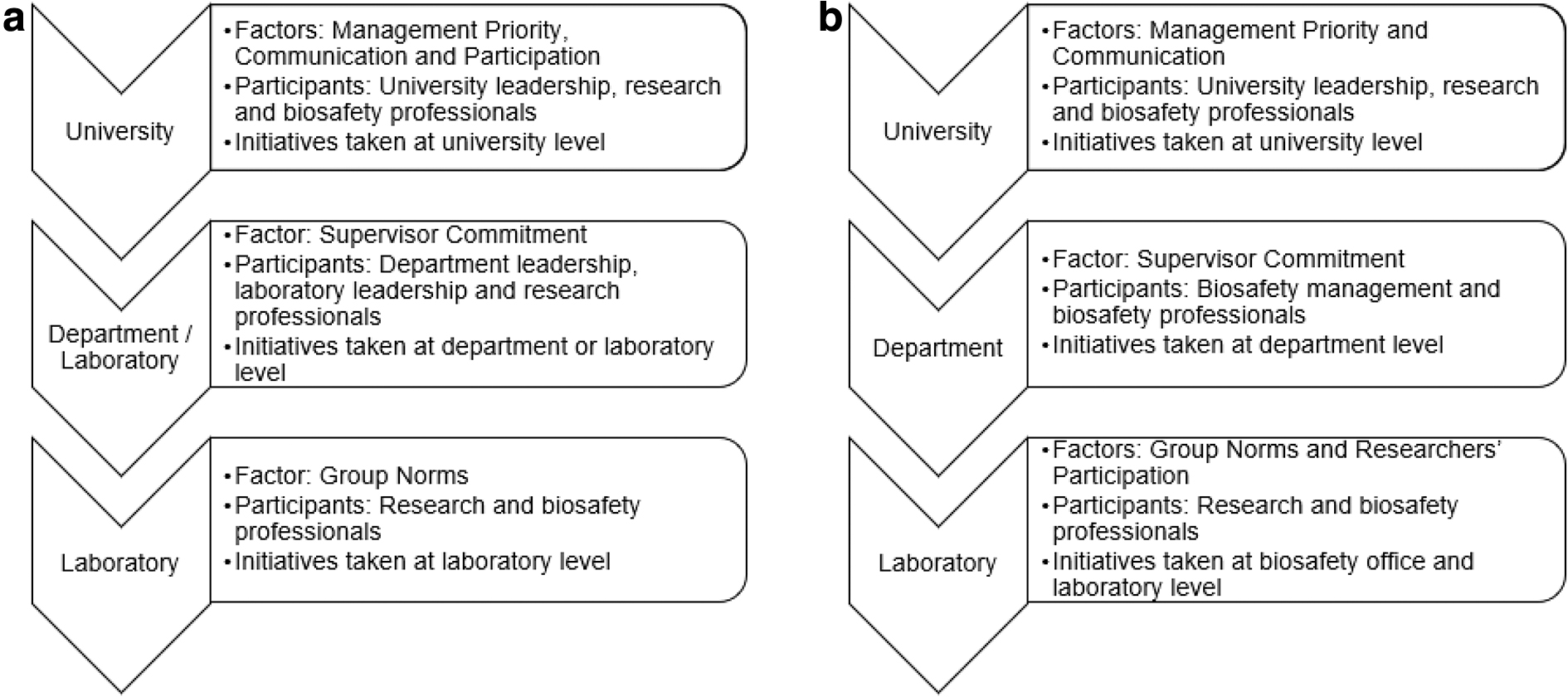
To validate the BSCL-17 scale and identify the underlying structure, EFA was conducted for both RP and BP data sets, Table 4. Factors were extracted based on evaluation of scree plots and eigenvalues. For the RP BSCL-17 scale, EFA identified a three-factor structure that explained 79.18% of variance with factor loadings >0.53 on all the 17 items. For the BP BSCL-17 scale, EFA identified a three-factor structure, which explained 69.03% of variance with factor loadings >0.33 on all the 17 items. The themes identified in BSCL for RPs and BPs in the BSCL scale are shown in Figure 2a and b, respectively. The three factors in the BSCL-17 scale for RPs can be interpreted as (1) management priority, communication, and participation that indicate safety perceptions at university level, (2) supervisor commitment that indicates safety perceptions at department or laboratory level, and (3) group norms that indicate safety perceptions of (co)workers at laboratory level. The three factors in the BSCL-17 scale for BPs can be interpreted as (1) management priority and communication that indicate safety perceptions at university level, (2) supervisor commitment that indicates safety perceptions at department level, and (3) group norms and participation that indicate safety perceptions of (co/workers) and participation by researchers at laboratory level. Three items (10, 11, and 13) of the four items initially proposed to assess the participation factor load along with the items in the group norms factor for BPs, whereas they load in the management and communication factor for RPs. This could be explained as the items 10 to 13 of the BP BSCL-17 scale measure participation of researchers, which directly effects the safety perceptions at the laboratory level. It should be noted that item 9 for RPs and items 10 and 11 for BPs cross-loaded with a loading of <0.32 on more than one factor. Taking theoretical and practical aspects into consideration, these items were loaded into the factor in which they had the greatest loading score, Table 4. The FKGL was ∼12 for the BSCL scales for both RPs and BPs, which implies that the scale is targeted toward those who have at least high school education.
This study identified all the 17 items as appropriate and an underlying 3-factor structure to evaluate BSCL. The item groupings identified through EFA are indicative of the three underlying factors in the BSCL-17 scale for both RPs and BPs. The themes of management priority, group norms, and supervisor commitment that were identified as important to BSCL in this study are consistent with the finding of previous studies.22,48 Given the preliminary nature of this study, more studies are recommended to confirm the underlying factor structure before considering factor scoring. However, the 17 items in the BSCL scale have been validated and can be used to quantify safety climate with scores ranging from 17 to 85, higher scores indicating better safety climate. Preliminary findings at UofL have shown positive association of leading indicator (BSCL) and negative association of lagging indicator (incidence risk), with safety status in biological laboratories. However, additional correlation studies are encouraged to examine the relationship between BSCL and safety status in biological laboratories.
There are a few limitations to this study. As a study based on self-reported survey data, it is prone to implicit bias in responses. Researchers from only one public university were included in the survey, warranting caution when generalizing the study findings to other public, private, research, and diagnostic laboratories across the country or countries. However, there are considerable strengths of the study as well. A process to develop an instrument to measure occupational safety perceptions specific to biological laboratories affiliated with public universities has been established. This study adds on to the literature of safety climate scale targeted for university laboratories. The gap in lack of safety climate scales specific to biological laboratories has been addressed by this study.
There are several theoretical and practical implications of this study. The scale is simple with only 17 items and consequently does not require a lot of time from the respondents and survey administrators. There are numerous applications of a BSCL scale. These include prospective indicator of safety, risk assessment tool, quantify current safety status at a specific laboratory or university, identify areas that can be improved, develop targeted interventions, measure change in safety status pre- and postintervention, use as a standardized scale across different universities, and compare perceptions of RPs and BPs. The BSCL-17 scale can be used to quantify safety culture within a biological laboratory. By evaluating BSCL and safety culture within an organization, shortcomings in safety programs can be addressed proactively. The results from the BSCL scale can be used as part of process improvement in biological safety programs. The BSCL scale can be utilized before and after the implementation of any new biological safety programs to study its impact on safety outcomes.
Further studies to cross-validate the BSCL-17 scale and underlying factor structure across universities in the United States and other countries can be taken up. The BSCL-17 scale can be retested at a later point at UofL to verify reliability. Additional studies on associations between BSCL and safety-related outcomes, that is, decreased exposure to biological hazards, fewer LAIs or near misses, increased participation, resource awareness, and university administrations' priority are recommended. Further research to determine variables that might contribute to safety climate such as laboratory settings, type of agents, experience, mode of training, and inspections are encouraged.
Conclusion
The study was conducted to address the lack of in-depth literature on safety climate measures specifically designed for the field of biological laboratory safety. A thorough discussion on the steps to develop and validate a scale has been provided to aid interested scholars in understanding and utilizing scale development concepts. The BSCL-17 scale can be a beneficial risk assessment tool to personnel involved in research activities, biosafety management, university administration, and occupational safety matters. It can be used as a key performance indicator of biosafety programs and aid in developing targeted interventions to improve safety climate. Our hope is that the BSCL-17 scale developed in our study could serve as a benchmark for evaluating BSCL status across institutions conducting biological research.
Data Availability
The data that support the findings of this study are available on request from the corresponding author. The data have not been shared publicly as the data could compromise the privacy of study participants.
Footnotes
Authors' Contributions
S.M. generated the idea for the article, research design, data collection, analyses, and wrote the article. T.A.H. supervised the study. R.M. supervised statistical analyses. S.M., T.A.H., and R.M. approved the final article.
Acknowledgments
We thank Gary Hoyle for his expert guidance and Cheri Hildreth for her encouragement in supporting our research at University of Louisville.
Author Disclosure Statement
No competing financial interests exist.
Funding Information
No funding was received for this article.

References
Supplementary Material
Please find the following supplemental material available below.
For Open Access articles published under a Creative Commons License, all supplemental material carries the same license as the article it is associated with.
For non-Open Access articles published, all supplemental material carries a non-exclusive license, and permission requests for re-use of supplemental material or any part of supplemental material shall be sent directly to the copyright owner as specified in the copyright notice associated with the article.
