






Abstract
Introduction:
The emergence of biological threats that can potentially affect millions emphasizes the need to develop a policy framework in the Philippines that can mount an adequate and well-coordinated response. The objective of the study was to assess, strengthen, and harmonize efforts in biorisk management through the development of a National Biorisk Management Framework.
Methods:
The development of the National Biorisk Management Framework was carried out in two phases: (1) assessment of the current biosafety and biosecurity landscape and (2) framework development.
Results:
This study identified policy gaps in the incorporation of biosafety in course curricula, professional development, and organizational twinning. The desired policy outcomes focus on increasing the capacity and quality of facilities, and the development of the biosafety officer profession. The tabletop exercises revealed weak implementation of existing protocols and unclear coordination mechanisms for emergency response. Based on these, a framework was drafted composed of eight key areas in biosafety and biosecurity, and four key contexts in risk reduction and management.
Discussion and Conclusion:
Reforms in biosafety and biosecurity policies are expected to improve coordination, ensure sustainability, capacitate facilities, and professionalize biosafety officers. Because of the complexity of reforms necessary, success will require a consistent and coherent policy framework that (1) provides well-coordinated mechanisms toward harmonized risk reduction and management, (2) establishes and enforces guidelines on biosafety, biosecurity, and biorisk management, (3) regulates facilities essential for occupational safety and public health, and (4) is financed by the General Appropriations Act as part of the national budget.
Introduction
The Philippines is the first country in Southeast Asia to adapt a national biosafety guideline. The guideline, published in 1991, focuses on genetic engineering and other activities that require the importation, introduction, field release, and breeding of nonindigenous organisms. 1 The country signed into the Cartagena Protocol on Biosafety to the Convention on Biological Diversity in 2000. The protocol aims to “ensure an adequate level of protection in the field of the safe transfer, handling, and use of living modified organisms resulting from modern biotechnology that may have adverse effects on the conservation and sustainable use of biological diversity, taking also into account risks to human health, and specifically focusing on transboundary movements.” 2 After this, a national biosafety framework was developed in 2004 and formally established through executive order (EO) 514 in 2006. The framework applies to products of biotechnology and exotic and invasive alien species, with focus on their research, development, handling, use, transboundary movement, release into the environment, and management. 3
Despite the progress made in the mentioned areas, there are issues included within the field of biosafety and biosecurity that needs to be given attention in the Philippines similar to how they are considered in other countries. In developed countries, this involves the regulation of dual use of research concern (DURC). 4 Scientific research has benefited the world population through the development of health, agriculture, and environment technologies.5,6 However, there continues to be a concern regarding the potential of biological research to be misused. Research with high misuse potential include those that (1) manipulate pathogenicity or virulence; (2) synthesize pathogens and toxins without cultivation of microorganisms; (3) identify new mechanisms to disrupt the healthy functioning of humans, animals, or plants; and (4) develop novel means of biological agents and toxins delivery. 7 Management approaches to DURC have focused on policies that govern research mechanisms, funding agencies, journal publishers, codes of conduct and ethics, and education initiatives for a wide range of audiences.7–13
In the Asia–Pacific region, the idea of biosafety and biosecurity holds stronger ties to agricultural security, biodiversity, and public health over national security concerns such as biological warfare or terrorism. In particular, outbreaks of zoonotic viruses over the past two decades have given way for governments to prioritize the public health aspect of biosafety and biosecurity through the lens of agricultural and animal farming practices. 14 The quick spread of these outbreaks (severe acute respiratory syndrome [SARS] in 2003, Influenza A virus subtype H5N1 [H5N1] in 2005, Influenza A virus subtype H1N1 [H1N1] in 2009, and coronavirus disease 2019 [COVID-19] in 2020) has highlighted the need to consider biosafety and biosecurity as a national and even global issue.15–18
As the bioscience and laboratory industry grows in Asia, so does the need to consider the industry's role in national biosafety, biosecurity, and the larger global health security. 19 Handling pathogenic organisms requires good laboratory practices, risk assessments, and biorisk measures to prevent accidental or deliberate infection. 20 Between 1982 and 2016, 27 laboratory-acquired infections (LAIs) were published in the Asia–Pacific. Fifty-two percent of the LAIs occurred in research laboratories. 20 These LAIs occurred amid an ongoing lack of specialist-level training for biosafety and biosecurity protocols in the region. In a 2010 survey of 197 life science degree courses from 58 Asian universities, it was found that only 2% had biosecurity modules, 18% had biosafety modules, and 10% had topics on the dual use of science. 14 It is important to note that 78% of the reported LAIs in Asia–Pacific were from developed countries, who likely report LAIs as part of both national and international standards compliance. 20
In addition, the perceived weakest link among developing countries in biosafety is that many facilities that handle infectious agents were built >10 years ago and designed with limited consideration for biosafety and security. 4 A 2007 survey on bioscience research practices in Asia found that 20% of scientists do not use personal protective equipment, 50% of facilities do not have an autoclave, 50% do not restrict laboratory access at all times, and up to 33% lack training on biosafety protocols. 21
The emergence of biological threats that can potentially affect millions emphasizes the need to develop a policy framework that can mount an adequate and well-coordinated response. The objective of the study was to assess, strengthen, and harmonize efforts in biorisk management through the development of a National Biorisk Management Framework.
Methodology
This initiative was funded by University of the Philippines Manila National Institutes of Health and U.S. Defense Threat Reduction Agency-Biological Threat Reduction Program. This study did not require ethics approval as it did not involve any studies with human or animal subjects. The development of the National Biorisk Management Framework was carried out in two phases (Figure 1): (1) assessment of the current biosafety and biosecurity landscape and (2) framework development.
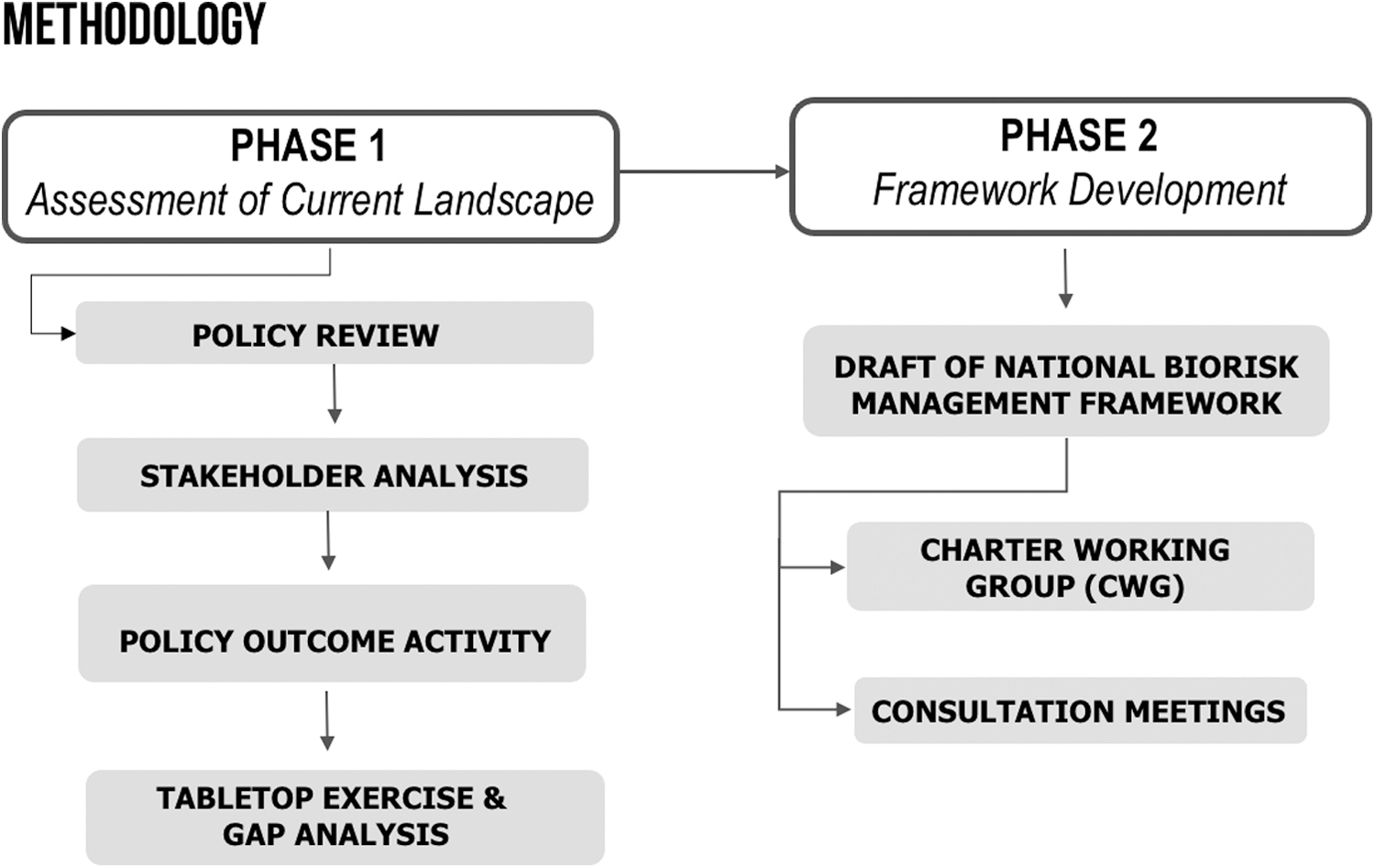
Methodology process.
Phase 1: Assessment of the Current Landscape
Policy review
This step entailed a rapid scan and review of existing policies related to biosafety and biosecurity in the Philippines. Policies were searched in the laws and policies databases of six concerned government institutions. After retrieval of policies, a data extraction table was made to map the policies. Data extracted from the policies included title of policy, entity or subject covered by the policy, date published, type of policy, agency that published the policy, and its objectives.
The review and analysis of the policies were anchored to the nine categories for developing sustainable capacity for biosafety and biosecurity in low-resource countries: (1) country-/region-specific regulatory framework and guidelines or standards, (2) biosafety and biosecurity awareness, (3) infrastructure, (4) equipment, reagents, and services, (5) management and administrative controls, (6) biosafety curricula, (7) training, (8) biosafety associations, professional competency, and credentialing, and (9) individual mentoring and organizational twinning. 22
Stakeholder analysis
Stakeholder analysis is “a process of systematically gathering and analyzing information to determine whose interests should be taken into account when developing and/or implementing a policy or program.” 23 This analysis is conducted before policy is implemented for policymakers to detect and act to prevent potential misunderstandings about and/or opposition to the policy or program.
Forty-six participants were involved in the stakeholder analysis activity. The participants, majority of whom are biosafety officers, were divided into seven groups categorized as academe (3), clinical (2), research (1), and associations and private sector (1). Each group was first asked to identify stakeholders with the following guide questions
24
:
Who will be affected? Will the impact be local, national, or international? Who has the power to influence the outcome? Who are the potential allies and opponents? Are there people whose voices or interests in the issue may not be heard? Who will be responsible for managing the outcome? Who can contribute financial or technical resources?
After stakeholder identification, each group was tasked to fill in a stakeholder analysis table designed to provide the following information:
Stakeholder involved
Ideal roles of the stakeholder
Basis of each ideal role
Resources available to stakeholder
Adequacy of resources available to the stakeholder
Possible reaction of the stakeholder to a biosafety framework for nongenetically modified organism (GMO) facilities
Groups presented their outputs to the plenary, followed by a synthesis to verify, consolidate, and agree upon the identified stakeholders, and their roles, resources, and reactions to the policy framework being developed.
Policy outcome activity
Policy outcomes are short- or long-term changes after policy implementation and the extent to which those changes can be attributed to the policy. 25 As part of the policy process, early identification of desired outcomes and its evaluation may inform and improve policy development, adaption, implementation, effectiveness, and build evidence for policy interventions. 26
Thirty-eight participants were involved in the activity. The participants, majority of whom are biosafety officers, were divided into six groups: academe (3), clinical (2), and research, associations, and private sector (1).
Each group was tasked to come up with a list of their desired policy outcomes with this question in mind: “What does success look like for this policy framework?” The lists were collected and synthesized by the moderator then presented to the plenary for validation. As a plenary, the pros and cons of each desired policy outcome were identified.
To identify the top three desired policy outcomes, each participant was allotted three votes. Participants could distribute their three votes equally to their top three choices, limit themselves to two choices by preferring one over another, or give all their three votes to one desired policy outcome. A secret ballot method was used to ensure anonymity of choices by the participants. The casting of votes by each participant was overseen by two moderators to ensure each participant did not exceed their three-vote limit.
Tabletop exercise and gap analysis
A tabletop exercise makes use of the participatory approach and calls on key emergency response personnel to discuss a given simulated emergency situation. Participants usually discuss which specific steps to take and what roles are assigned at each stage of the emergency. 27 Tabletop exercises provide insights into the strengths and weaknesses of public health emergency preparedness and address these gaps by assessing capabilities, training staff, and forging relationships. 28
Fifteen participants in total were involved in the tabletop exercise, representing government agencies and academe. Two groups were formed, one group with eight members and another with seven members. Both groups were tasked to discuss existing response mechanisms activated and communications required in all phases and subevents in a scenario involving a suspected disease outbreak of African swine fever in a setting similar to the Philippines (Table 1). Discussions were facilitated within each group as each phase of the biological incident was presented. If a capability or communication was considered a necessity by the circumstances outlined in the scenario but was not a real-world capability, it was thus identified as a gap.
ASF, African swine fever; RADDL, Regional Animal Disease Diagnostic Laboratory.
Phase 2: Framework Development
Key assessment results from Phase 1 were used to draft the National Biorisk Management Framework. A Charter Working Group (CWG) was formed to aid in framework development. Representatives were rigorously chosen based on their authority and expertise in the field of agriculture, health, laboratories, industry, and security.
Three consultations were held on November 5, November 28, and December 3, 2018. During the series of meetings, the CWG members were presented the draft biorisk management framework and asked to investigate the framework in detail, provide feedback, identify key issues, and provide valuable technical input relevant to their area of expertise.
Results
Policy Review
The search strategy yielded a total of 41 issuances composed of 22 administrative orders, 6 republic acts, 7 guidelines, 2 department circulars, 2 EOs, 1 manual, and 1 United Nations Resolution. Biosafety and biosecurity in the Philippines is mainly anchored on four policies (Table 2).
EO, executive order.
The policies and issuances scoped cover 27 regulatory subjects, which include health products, facilities, animals, plants, and drugs, among others. Issuances covering each regulatory subject were analyzed according to the nine categories for developing sustainable capacity for biosafety and biosecurity in low-resource countries (Table 3). 22
Heckert et al. 22
EVD, Ebola virus disease; GMOs, genetically modified organisms; HFMD, hand, foot, and mouth disease; MERS-COV, Middle East respiratory syndrome coronavirus; TB, tuberculosis.
Country-/region-specific regulatory framework and guidelines or standards
Seventeen of the 27 entities follow a specific regulatory framework, guideline, or standard. These are determined by a government agency, a committee or board, or follow existing international guidelines. The frameworks are usually concerned with regulation of an entity and include establishment of standards, practices, and monitoring and evaluation plan.
Biosafety awareness
Three out of the 27 entities have policies that discuss awareness. It includes mandates on biosafety promotion, participation, and development of advocacy materials and risk communication plans. It also states the need for policymakers to be aware and provided with sufficient and current information on biosafety.
Infrastructure
Sixteen of 27 entities have policies related to infrastructure. The level of detail provided in the guidelines for infrastructure varies between entities. Some entities, such as animal facilities and clinical laboratories, are provided with broad guidelines. Conversely, guidelines for GMOs provide detailed information for physical containment according to four biosafety levels.
Management processes and administrative controls
Nineteen of the 27 entities are provided with governance mechanisms through a policy. A government agency, a network of agencies, or a committee created through an issuance oversees the implementation of a policy framework, guidelines, or standards. These policies also outline the responsibilities of municipal, city, and regional counterparts of national offices, when applicable.
Training
Eight of 27 entities are provided with training guidelines in their handling, transport, and use for staff. The policies outline capacity-building programs, continuing education programs, and minimum training and skill requirements for staff.
No mandates were found for the following categories: biosafety curricula; biosafety association, professional competency, and credentialing; and individual mentoring and organizational twinning.
Stakeholder Analysis
A total of 28 stakeholders were identified by the participants. Twenty-two of the 28 identified stakeholders were government institutions. Six stakeholders identified include academic institutions, training centers, associations, and civil society organizations. Identified stakeholders were further analyzed according to ideal roles, basis for ideal role, resources available and adequacy, and reaction to framework.
Ideal roles and basis for ideal role
Ideal roles identified by the participants closely follow current functions that the various stakeholders already perform. Most roles are concerned with the integration or strengthening of existing rules and regulations for biosafety and biosecurity. Twenty-four out of 28 stakeholders have a legal mandate as basis for the roles identified to them by the participants (Table 4).
BMC, biological materials of concern.
Resources available and adequacy
Commonly identified resources available to the stakeholders were legislation, funding, capacity building, manpower, and facility/technology/machinery (Table 5).
Possible reaction of stakeholder to being included in proposed policy framework
Participants strongly linked receptiveness with the ideal roles identified to the stakeholders. Stakeholders who are currently performing their ideal roles or have the resources to perform them were perceived to be more receptive. Stakeholders with unfamiliar functions or mandates to participants were less likely to be perceived as receptive (Table 6).
Policy Outcome Activity
A total of 114 votes were cast by 38 participants (Table 7). The top three desired policy outcomes were (1) capacitating existing facilities to comply with the proposed policy, (2) professionalization of biosafety officer/creation of plantilla (a government-approved regular position), and (3) enhancing quality of laboratories.
ABOT, Advanced Biosafety Officer Training; CPD, Continuing Professional Development.
The desired policy outcomes were concerned with improving responsiveness and equity of facilities. This is manifested in the identified pros and cons of the outcomes. Pros include improved quality, increased client satisfaction, conduct of safe research, and increased employee satisfaction and retention. Cons identified include lack of budget, unrealistic timelines, lack of accountability, decreased access to facilities due to shutdowns, worker fatigue, and lack of manpower.
Tabletop Exercise and Gap Analysis
Based on the discussions, current response mechanisms are initiated with (1) an investigation and preparation of a case report by the lead veterinarian, (2) handling and transport of samples to the designated Regional Animal Disease Diagnostic Laboratory, (3) coordination between animal and human health response, (4) activation of reporting mechanisms to the local government unit and other concerned agencies, (5) monitoring and surveillance of other farms in surrounding areas, (6) quarantine efforts, (7) interagency coordination at the local level, (8) channeling of information from local to national actors, and (9) media and press relations.
Across the existing response mechanisms already mentioned above, the following common gaps were revealed (Table 8): weak implementation or noncompliance to existing standards and protocols, unclear coordination mechanisms for emergency response, lack of training and education, and limitations in human resources and infrastructure.
HR, human resource; SOPs, standard operating protocols.
Framework Development
Discussions in the three CWG meetings resulted to feedback on (1) framework design and (2) political strategy. Key recommendations are described hereunder.
To reconsider the formation of a new agency
Early drafts of the framework incorporated the establishment of the Biorisk Management Coordinating Agency, but the CWG advised against putting up a new agency, as it creates more bureaucratic processes. Instead, clarifying roles, capacitating existing institutions, and harmonizing existing efforts were recommended.
To anchor on key functions in biosafety and biosecurity
The design must be based on functions that need to be fulfilled in terms of biosafety and biosecurity, adopting a bottom-up approach, and incorporating inputs from frontline actors. These functions form the key areas of the framework in its current form.
To incorporate the four pillars of disaster risk reduction and management in the context of biohazards
Early drafts of the framework lacked proper emphasis on disaster risk reduction and management. The CWG advised the incorporation of the four pillars of disaster risk reduction and management, namely prevention and mitigation, preparedness, response, and rehabilitation and recovery, as the key contexts of the framework in its current form.
To consider the pivotal role of the Office of Civil Defense under the Department of National Defense
As the secretariat of the National Disaster Risk Reduction and Management Council, the Office of Civil Defense has the power to direct various agencies when facing a threat. Thus, it was discussed as strategic to house biosafety and biosecurity functions under this office.
To consider the better policy route
The framework may be passed into law through a senate bill, house bill, or an EO signed by the president. It was agreed upon by the CWG that an EO would be the most strategic pursuit for this policy.
To address funding gaps in policy and implementation
There is a possibility that the bill may be passed into law, but not funded and thus, not properly implemented. The CWG emphasized the importance of stating clear funding mechanisms in the document.
Based on these results of the Phase 1 assessment and recommendations of the CWG, a National Biorisk Management Framework was formulated (Figure 2). The proposed framework is composed of eight key areas in biosafety and biosecurity and four key contexts in risk reduction and management.
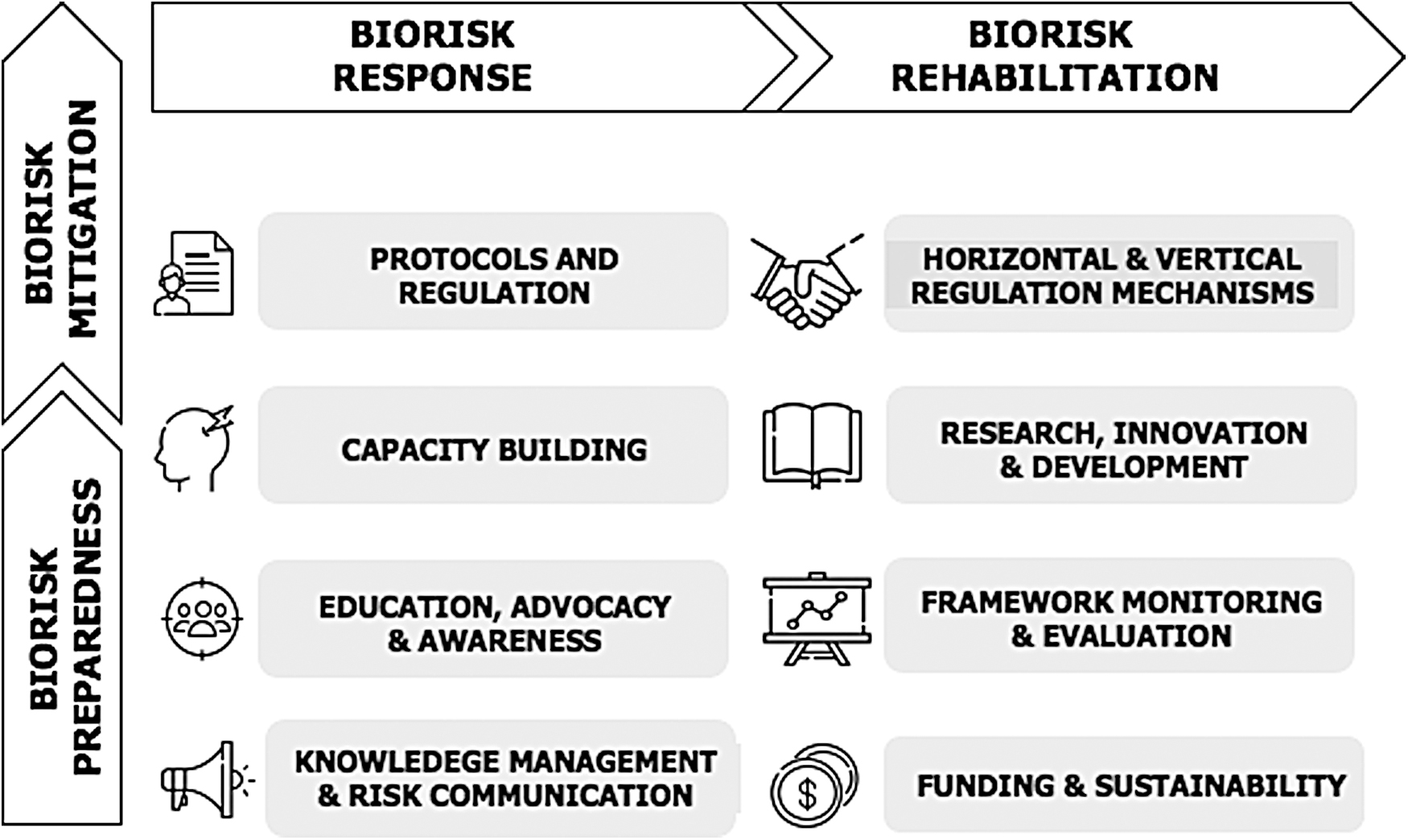
Proposed National Biorisk Management Framework.
Discussion
In an increasingly connected world, emerging or re-emerging diseases and the deliberate or undeliberate release of infectious agents hold greater potential to affect populations across borders. 29 Global experience with SARS (2003), H1N1 (2009), and COVID-19 (2019) shows that pandemics have extensive health, social, and economic impact that has made the importance of biosafety and biosecurity preparedness more evident.30–34 Advances in biotechnology has also leaped the application of biological sciences in the fields of health, agriculture, and environment, among others. However, this advancement comes with an increased risk for DURCs.35,36 Although there are obvious benefits to biological research, the increased DURC risk has created a moral and ethical dilemma for the life sciences: do the benefits of the research outweigh the risks? 37 Creating a biosafety and biosecurity framework, therefore, presents the challenge of striking a balance between protecting public health while creating a sound regulatory environment necessary for research and innovation.32,38
Expanding the Concepts of Biosafety and Biosecurity
The current Philippine National Biosafety Framework, EO 514, was part of a UN Environment Programme-Global Environment Facility initiative to assist countries in developing a national framework after the ratification of the Cartagena Protocol on Biosafety. The Philippines EO 514 definition of biosafety suggests that biosafety policies may apply to multiple sectors related to biosafety. However, the scope of the framework is limited to products of modern biotechnology, exotic species, and invasive alien species, leaning heavily toward the agriculture and environment sector.
This concern was also raised by participants during the stakeholder analysis. First, established policies that have already defined “biosafety” may mean that a different terminology should be used in the framework being proposed that encompasses all activities related to biosafety, extending to public health, laboratory management, and outbreak response. Second, the current definition in EO 514 focuses on the potential harm of regulated articles. However, there is a growing recognition that access to information, processes, practices, and equipment is equally important as having access to a biological or hazardous material. 39 An expanded concept may be necessary that balances the perspectives of science, security, prevention, and preparedness beyond laboratory work. 15
Adopting Principles of Disaster Risk Reduction and Management
Consistent with the definitional limitation, the current policy framework lacks emphasis on risk reduction and management functions in response to the rise of complex biological threats, regardless of the cause. The integration of biosafety and biosecurity efforts to prepare for and respond to these threats should be found at the heart of biorisk management, broadly defined as the assessment of risks, identification of measures to reduce risks, and development of processes to implement and review risk-reduction measures. 40 Although existing regulatory processes already form a significant part of risk prevention and mitigation, there should be improvement in how these functions tie up alongside other efforts in the country's overall disaster risk reduction and management framework, particularly in risk preparedness, response, rehabilitation, and recovery.
Limited Institutional Capacity and Sustainability for Regulatory Systems
The debate on whether regulation impedes innovation persists today as new technologies, particularly in the field of biological sciences, generate calls for application of the precautionary principle. 41 The precautionary principle is an approach to innovations with potential for causing harm when extensive scientific knowledge is lacking. 42 The relationship between regulation and innovation is complex and different regulatory instruments have varying effects on technological progress. 41 Although international legal frameworks for biosafety and biosecurity exist, these provide limited guidance on what constitutes a functional national regulatory framework. It is the responsibility of national governments to produce and implement evidence-based policies that apply the precautionary principle emphasized by the Cartagena Protocol on Biosafety. 36
Spearheaded by the National Committee on Biosafety of the Philippines, the implementation of policies related to biosafety is a task shared by four government agencies. The Department of Agriculture, Department of Environment and Natural Resources, Department of Health, and Department of Science and Technology have multifaceted roles that involve biosafety and biosecurity policy development, accountability, and capacity building. This current system utilizes a combination of network and traditional command and control regulation. These agencies regulate overall biosafety activities in the country while also being the sole regulatory arm of entities under their mandate.
Results of our policy review shows that the four agencies have developed policies to regulate biosafety through enforcing guidelines and standards (Table 2). Although these policies have been implemented, stakeholder analysis results show limited capacity of regulators to maintain this (Table 5). Insufficient institutional capacity manifests in the limited training of regulatory personnel and variations in the level of detail between and within biosafety policies of different agencies. Current policies in training refer to continuing education for facility workers in relation to biosafety but do not include regulatory personnel. This is consistent with stakeholder analysis findings, wherein participants noted that some agencies should but do not currently have the technical expertise to develop or implement policies on biosafety and biosecurity.
The lack of consensus for some agencies also shows the need to determine their structure, current competencies, and how regulators are regulated. In appointing a regulator, there should be consideration that the regulator should be as informed as the regulatees. The question of “Who regulates the regulators?” must examine which external bodies or individuals have the authority to reconsider the decisions made by the regulators. 43
Responsive regulation maintains that regulators are more likely to succeed by using mechanisms that are responsive to the context, conduct, and culture of those being regulated. 44 A command and control approach, as is currently applied in the Philippines, is an appropriate form of regulation when all parties agree to minimum standards of quality. 45 However, there is currently little involvement of the general public in regulatory functions. The Philippine National Biosafety Framework limits public participation to information related to biosafety decisions and begins only from the time an application is received. There is still a need for collaboration in disseminating regulatory standards and establishing the state's authority as a regulatory body.
Coordination Mechanisms for Emergency Response at the Local Level
The gap analysis shows that at the local level, there are existing scenario-based protocols at each phase of the emergency response to potential disease outbreaks, but harmonization is lacking. Based on the findings of the tabletop exercise, efforts in the implementation of protocols in laboratory testing and operations; monitoring and surveillance; quarantine response; veterinary and clinical disease investigation; waste disposal and decontamination, media, and; law enforcement are concrete but uncoordinated.
In an ideal setting, these mechanisms are implemented by local responders from the Bureau of Fire Protection and Philippine National Police. However, clear coordination mechanisms required to bridge the gap between public health and national security are either lacking or slow in activation. To set up a robust response strategy, multidisciplinary networks with diagnostic capabilities in law enforcement and public health, including environmental, agricultural, food, veterinary, and clinical institutions, are necessary to handle both intentional and unintentional biorisk incidents. 46
A common framework for biosafety and biosecurity must be created to accurately assess the risks posed by biological threats and ensure understanding of multidisciplinary strategies needed to mitigate them. This can be achieved by considering four key points 40 : (1) difficulty in estimating likelihood and consequences of a biological threat, (2) the need for broad and comprehensive definitions of biosafety and biosecurity to bridge the gap between national security, life sciences, and public health communities, (3) inaccurate perception of risk and its implications in the response, and (4) synergy in research and formulation of policy.
Conclusions and Recommendations
Reforms in biosafety and biosecurity policies are expected to improve coordination, ensure sustainability, capacitate facilities, and professionalize biosafety officers. Because of the complexity of reforms necessary, success will require a consistent and coherent policy framework that (1) provides well-coordinated mechanisms for multidisciplinary and multilevel communication and interaction toward harmonized risk reduction and management; (2) establishes, benchmarks, develops, implements, and enforces guidelines on biosafety, biosecurity, and biorisk management; (3) regulate facilities where implementation of such guidelines is considered essential for occupational safety and the health of the public; and (4) is financed by the General Appropriations Act as part of the national budget.
The COVID-19 pandemic has manifested the gaps identified in this study. Policies and support mechanisms that focus on workforce development, particularly on trainings and workshops, provide a low-investment but high-impact solution in reaching the reform goals. An effective training program provides a cost-efficient longer term solution for lower to middle-income economies as heavy reliance on infrastructure and engineering safeguards involves overhead costs being accrued over time, impeding local acceptance and sustainability. Awareness-level trainings to policymakers also provide a common language among stakeholders and start an avenue for collaborative discussions. These introductory trainings allow engaging champions from various sectors, increasing the likelihood of program sustainability and accelerating simultaneous capacity building among stakeholders. The multidisciplinary approach enables collaboration and linkage among agencies and other concerned entities to prepare for and respond to a biological event of any scale in a timely and consistent manner.
Footnotes
Acknowledgments
The project team would like to thank the contribution of the following: Dr. Anna Gibson, Black & Veatch, Endec Inc., and SciLore LLC.
Author Disclosure Statement
No competing financial interests exist.
Funding Information
This study was funded by the University of the Philippines-National Institutes of Health and the U.S. Defense Threat Reduction Agency-Biological Threat Reduction Program.