






Abstract
Introduction:
Bacillus anthracis, the etiological agent of anthrax, produces long-lived spores, which are resistant to heat, cold, pH, desiccation, and chemical agents. The spores maintain their ability to produce viable bacteria even after decades, and when inhaled can cause fatal disease in over half of the clinical cases. Owing to these characteristics, anthrax has been repeatedly selected for both bioweapon and bioterrorism use. In the event of a bioterrorism attack, surfaces in the vicinity of the attack will be contaminated, and recovering from such an event requires rapid and effective decontamination. Previous decontamination method development has focused mainly on temperatures >0°C, and have shown poor efficacy at subzero temperatures.
Methods:
In this study, we demonstrate the use of calcium chloride (CaCl2) as a freezing point depression agent for pH-adjusted sodium hypochlorite (NaOCl) for the effective and rapid decontamination of B. anthracis Sterne strain spores at subzero temperatures.
Results:
We show the complete decontamination of 106 B. anthracis Sterne strain spores at temperatures as low as −20°C within 2.5 min by submersion in solution containing 25% (w/v) CaCl2, 0.50% NaOCl, and 0.40% (v/v) acetic acid. We also demonstrate significant reduction in number of spores at −28°C.
Conclusions:
The results show promise for rapidly decontaminating equipment and materials used in the response to bioterrorism events using readily available consumer chemicals. Future study should examine the efficacy of these results on complex surfaces.
Introduction
Bacillus anthracis, the etiological agent of anthrax, is a Gram-positive bacterium found primarily in the soil, which alternates between vegetative growth and long-lived spore cycles. 1 These spores are resistant to environmental stresses such as heat, cold, pH, desiccation, and chemical agents. The spores maintain their ability to produce viable bacteria even after decades, and possibly centuries, of dormancy. 2 Human disease is caused by exposure to B. anthracis spores, and manifests itself in three ways: the cutaneous form, which causes a localized area of dead tissue 3 ; the gastrointestinal form that causes lesions from the mouth to the cecum, and can cause hemorrhaging with the possibility of death by shock or sepsis 4 ; and the inhalation form, which is the most lethal and causes flu-like symptoms due to the bacteria multiplying in the tracheobronchial lymph nodes, potentially leading to septicemia and has a case fatality rate >90% for untreated cases, and 50% for treated cases.5,6
Anthrax is found worldwide and is endemic in herbivores of warmer regions, but rarely results in the inhalation form of the disease in humans through natural contact; it is through processing of hides, wool, or other animal products in which the spores are aerosolized that the most severe form of the disease occurs. 7 Owing to the high mortality rate from infection and robustness of the spores, anthrax has been repeatedly selected for both bioweapon 8 and bioterrorism use. 9
Cases of inhalation anthrax are estimated to have an infectious dose anywhere between a few hundred to a few thousand spores.5,10 In the case of a bioterrorism attack, these spores will be distributed and contaminate the environment in the vicinity of the attack, which may lead to further cases of the disease.11,12 Recovering from a bioterrorism event includes not only evacuating and preventing access to the site, but also rapid and effective decontamination of materials and equipment, which can be extremely costly; the 2001 Amerithrax cleanup costs are estimated in the hundreds of millions of dollars, and some facilities were closed for years after the attacks.13,14
Numerous studies have examined effective decontamination formulations of anthrax spores. These include formaldehyde, hydrogen peroxide-based sporicides (Decon Green, EasyDECON 200 [EFT Holdings, Inc.]), peracetic acid, mixtures of peroxide and peracetic acid (Spor-Klenz RTU [STERIS Corporation], Peridox RTU [CET, LLC]), hypochlorite-based products (household bleach, Dichlor, Trichlor, CASCAD surface decontamination foam [SDF] [Allen-Vanguard]), chlorine dioxide, Virkon, Oxone, and others.15–19 In 2010 the U.S. Environmental Protection Agency (EPA) performed comprehensive testing of 10 materials (5 porous and 5 nonporous) experimentally contaminated with B. anthracis Ames spores and the decontaminating agents of pH-amended bleach, CASCAD SDF, Decon Green, EasyDEACON 200, Spor-Klenz, RTU, and Peridox RTU. 20 They found that only CASCAD SDF completely inactivated spores on all materials tested, whereas pH-amended bleach achieved complete inactivation of spores on all smooth surfaces, but not on concrete, asphalt paving, or treated wood after a contact time of 60 min, and spray-on application.
Although these decontaminants have been well tested indoors, very few had been tested outdoors, or in freezing temperatures, which led Environment and Climate Change Canada (ECCC) to identify the best candidates for such use. This study by Blinov et al.21,22 suggested the use of pH-amended bleach, and tested both sodium chloride and calcium chloride (CaCl2) and freezing-point depression agents.
Using the redox potential of a solution as a predictor of sporicidal ability, the solution with the predicted lowest active temperature and highest redox potential was a 0.5% sodium hypochlorite (NaOCl) solution with 25% (w/v) CaCl2 and 0.40% acetic acid (CH3COOH). 22 The solution provided freezing-point depression to −32°C, and a redox potential of 1320 mV. Solutions with higher redox potentials may release chlorine gas from solution, which is toxic to humans and undesirable; lower redox potentials have reduced oxidizing strength, and thus potentially less sporicidal activity.
This and other amended bleach formulations provided by ECCC were tested in 2017 by the EPA for effectiveness at decontaminating the anthrax surrogate, Bacillus atrophaeus var. globigii, on concrete and glass surfaces using a spray-on application of the decontamination solutions for 20 and 60 min. 23 Despite the previous theoretical study, none of the solutions provided more than a 3-log reduction in spore count of the B. atrophaeus var. globigii spores using the spray-based application of decontamination solutions at subzero temperatures.
The amended bleach formations developed by ECCC have not previously been tested on B. anthracis spores at subzero temperatures. We have previously examined the effectiveness of disinfectants in food grease containing anthrax spores. 24 In this study we examined the decontamination efficacy of the ECCC decontamination solution formulations on B. anthracis strain Sterne spores through immersion at subzero temperatures. Results of this study could be used for the rapid decontamination of materials and equipment after a bioterrorism event, or by those needing routine decontamination at subzero temperatures of wastes or materials amenable to submersion.
Methods
Spore Preparation
B. anthracis Sterne spores were prepared as previously described. 24 Aliquots of 1 mL containing ∼1.08 × 10⁹ spores from this preparation were stored at −20°C until needed.
Decontaminant Formulations
Decontaminant solutions were as described by ECCC.21,22 Stock solutions of decontaminants were prepared in 25 mL batches. The constant final concentration (w/v) of 25% CaCl2 was prepared by dissolving 7.73 g of solid CaCl2 into 20 mL of cold distilled water with agitation until completely dissolved. NaOCl solutions were prepared at concentrations (v/v) of 0.10%, 0.20%, and 0.50%, respectively, by adding the appropriate volumes of household bleach and stirring through agitation. CH3COOH in the form of household vinegar was subsequently added to bring the solutions to final concentrations (v/v) of 0.02%, 0.31%, and 0.40% CH3COOH and mixed through agitation, with the final solution brought to a volume of 25 mL through addition of dH2O (Solutions 1–4; Table 1).
CaCl2, calcium chloride; CH3COOH, acetic acid; NaOCl, sodium hypochlorite.
Decontamination Protocol
In total, 250 μL of room temperature decontamination solution was added to a 1.5 mL microcentrifuge tube and equilibrated to the experimental temperature of −5°C, −15°C, −20°C, or −28°C. After equilibration, 10 μL of solution, containing ∼1 × 10⁶ spores, was added and incubated for 2.5, 5, 10, 15, or 20 min. Each experiment was stopped by adding 250 μL of neutralizer, which consisted of 6% sodium thiosulfate (Na2O3S2), 1% Tween 20, and 25% CaCl2, and vortexing. Decontamination efficacy was determined by plating 100 μL of the neutralized experiment on blood agar, incubating overnight at 37°C, and counting the recovered colonies.
Comparison of Spore Recovery
Student's two-tailed t-test assuming equal variance among samples was used as a significance test to compare the spore recovery at each temperature and time point. Test conditions that exhibited a spore reduction with a p-value <0.05 were deemed “significant” and are denoted in the figure captions as such. For all conditions where complete inactivation of the spores was not observed, the exact p-value for spore reduction is given.
Evaluation of Steel Disk Corrosion
Steel disks (0.75 mm thick, 1 cm in diameter; Muzeen and Blythe, Winnipeg, Manitoba, Canada) were incubated in Solution 1 (0.4% CH3COOH; Table 1) at −20°C for 24 h, and photographed at time points of 0, 0.17, 0.5, 1, 1.5, 3, and 24 h. Visual inspection of the solution was used to determine color change associated with corrosion of the steel.
Results
Decontamination Solution Selection
Based on the previous study of Blinov et al., 22 we confirmed the efficacy of 0.50% NaOCl at room temperature to prevent the growth of all spores after inoculation of the solution with 1 × 10⁶ B. anthracis spores. As shown in Figure 1, solutions of NaOCl from 0.05% to 0.40% reduced the number of recovered spores, but only 0.50% led to no viable spores. Based on this result, a 0.50% NaOCl solution was used for all subsequent decontamination experiments.
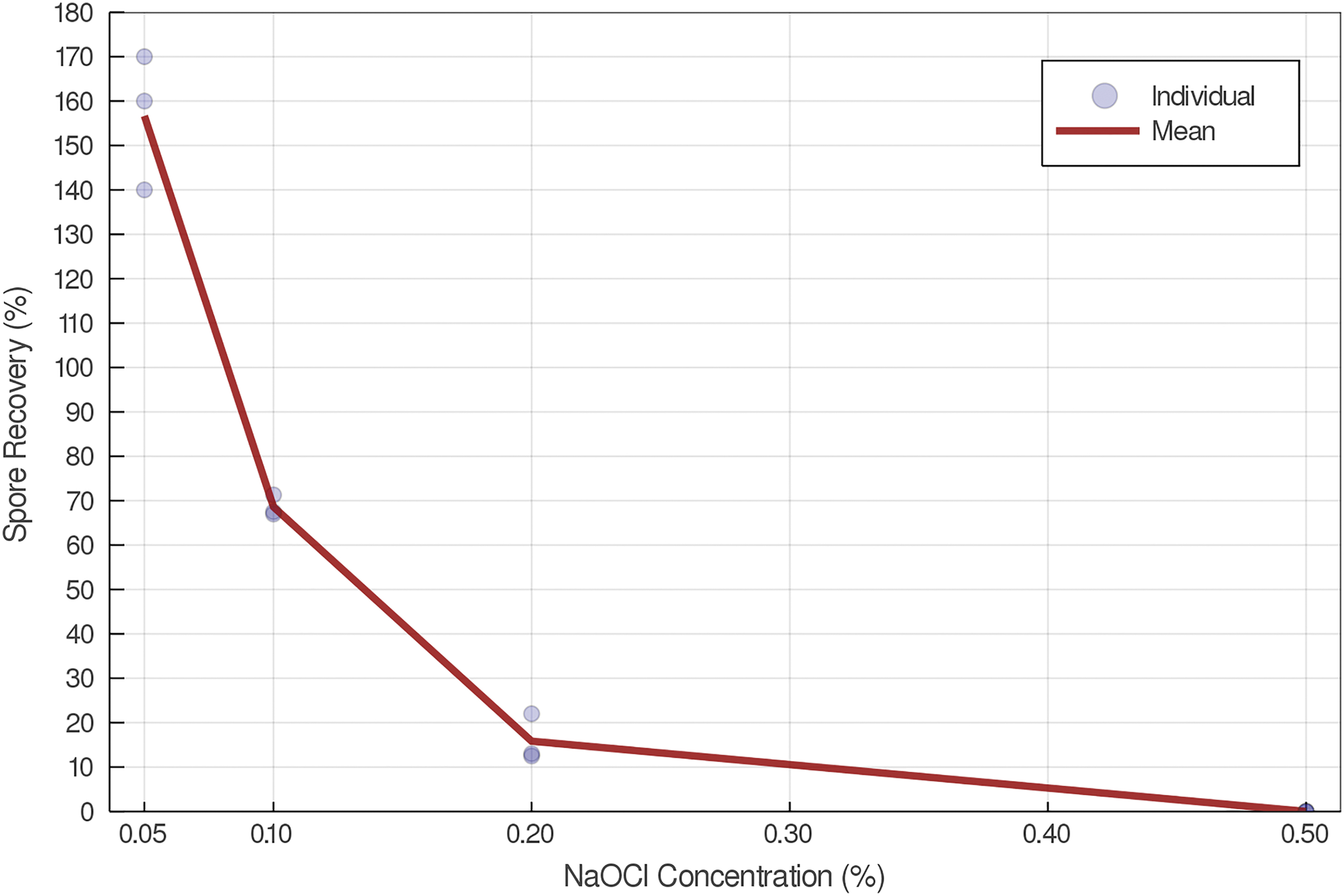
Average percentage recovery of Bacillus anthracis Sterne strain spores after application of decontamination solutions containing 25% (w/v) CaCl2 and NaOCl concentrations (v/v) of 0.05%, 0.10%, 0.20%, and 0.50% for 10 min. Three experimental replicates were conducted for each of the NaOCl concentrations: blue circles indicate individual replicate values, while the red line indicates the arithmetic mean of the individual replicates. CaCl2, calcium chloride; NaOCl, sodium hypochlorite.
The effect of CH3COOH on the sporicidal ability of the 0.50% NaOCl solution was tested at three separate concentrations of CH3COOH at −20°C for 20 min, across 15 experimental replicates. As shown in Figure 2, Solutions 1 and 2, containing 0.40% and 0.31% of CH3COOH, respectively, showed the greatest decontamination efficacy. Solution 1 had only one replicate with spore growth, whereas Solution 2 had two replicates with spore growth. Solutions 3 and 4, containing 0.02% CH3COOH and no CH3COOH, respectively, showed spore recovery that was not significantly different from the neutralizer solution only negative control. The number of spores recovered from the negative control itself was not significantly different than the number of spores (1 × 10⁶) added to the reaction tube. The negative control consisted only of neutralizer solution. Based on these results, Solution 1 was selected for all subsequent decontamination experiments.
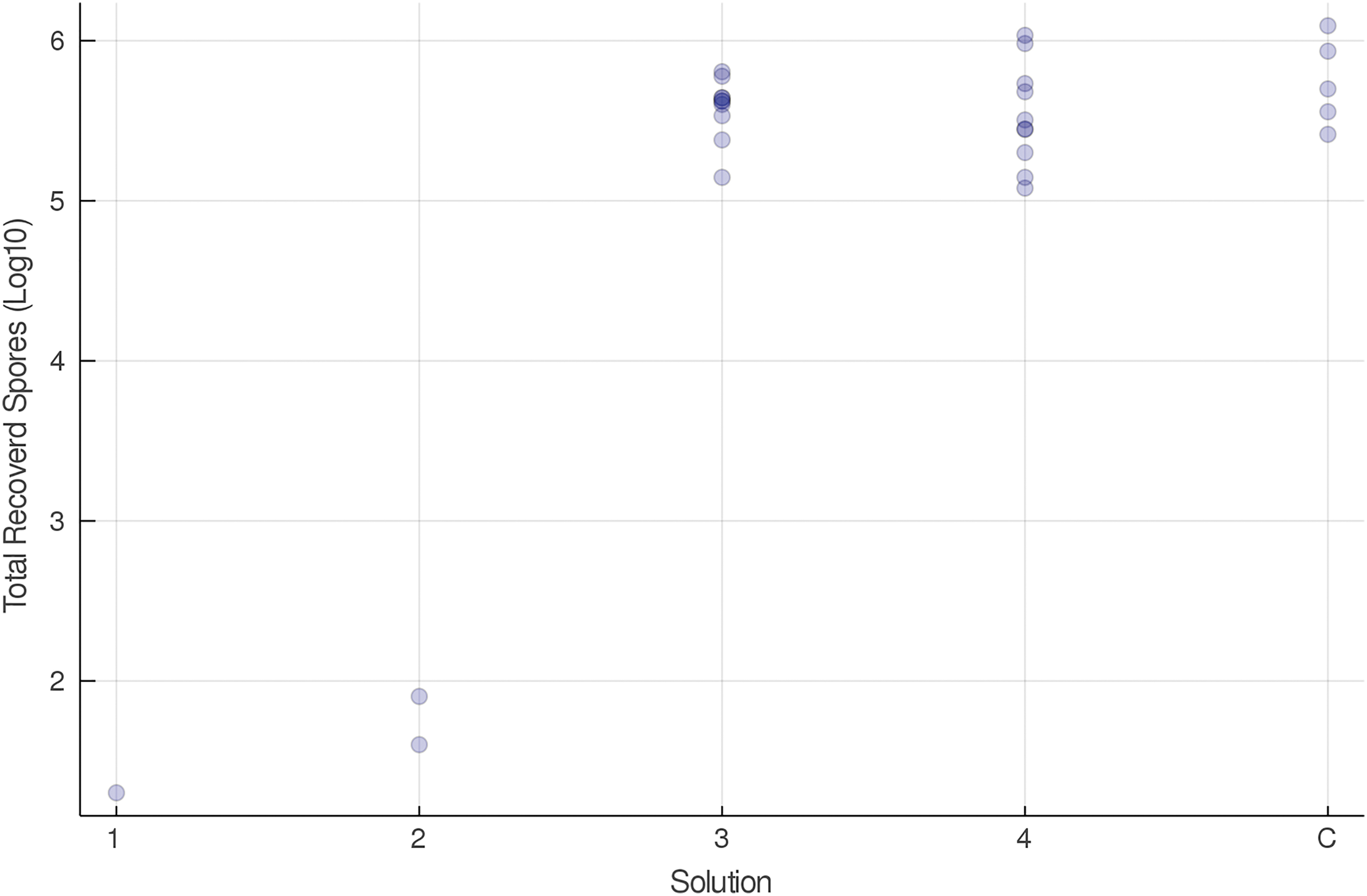
Total recovery of Bacillus anthracis Sterne strain spores after 20 min at −20°C from solutions containing 25% (w/v) CaCl2, 0.50% NaOCl, and the following CH3COOH concentrations (v/v): (1) 0.40% (N = 15), (2) 0.31% (N = 15), (3) 0.02% (N = 10), and (4) 0.00% (N = 10), and the neutralizer only, no decontamination control (N = 5).
Decontamination Efficacy at Subzero Temperatures
In tests after the selection of Solution 1, its application was 100% effective at decontaminating B. anthracis Sterne spores at temperatures of −5°C, −15°C, and −20°C, after 5, 10, 15, and 20 min; in addition it was 100% effective after 2.5 min of contact at −20°C (Figure 3). Decontamination efficacy was unstable at −28°C, and did not correlate with exposure time; however, all time points showed significant spore reduction at this temperature (2.5 min p = 3.43 × 10⁻¹¹; 5 min p = 1.17 × 10⁻⁵; 10 min p = 8.85 × 10⁻²⁴; 15 min p = 9.80 × 10⁻¹²; 20 min p = 1.21 × 10⁻⁵).
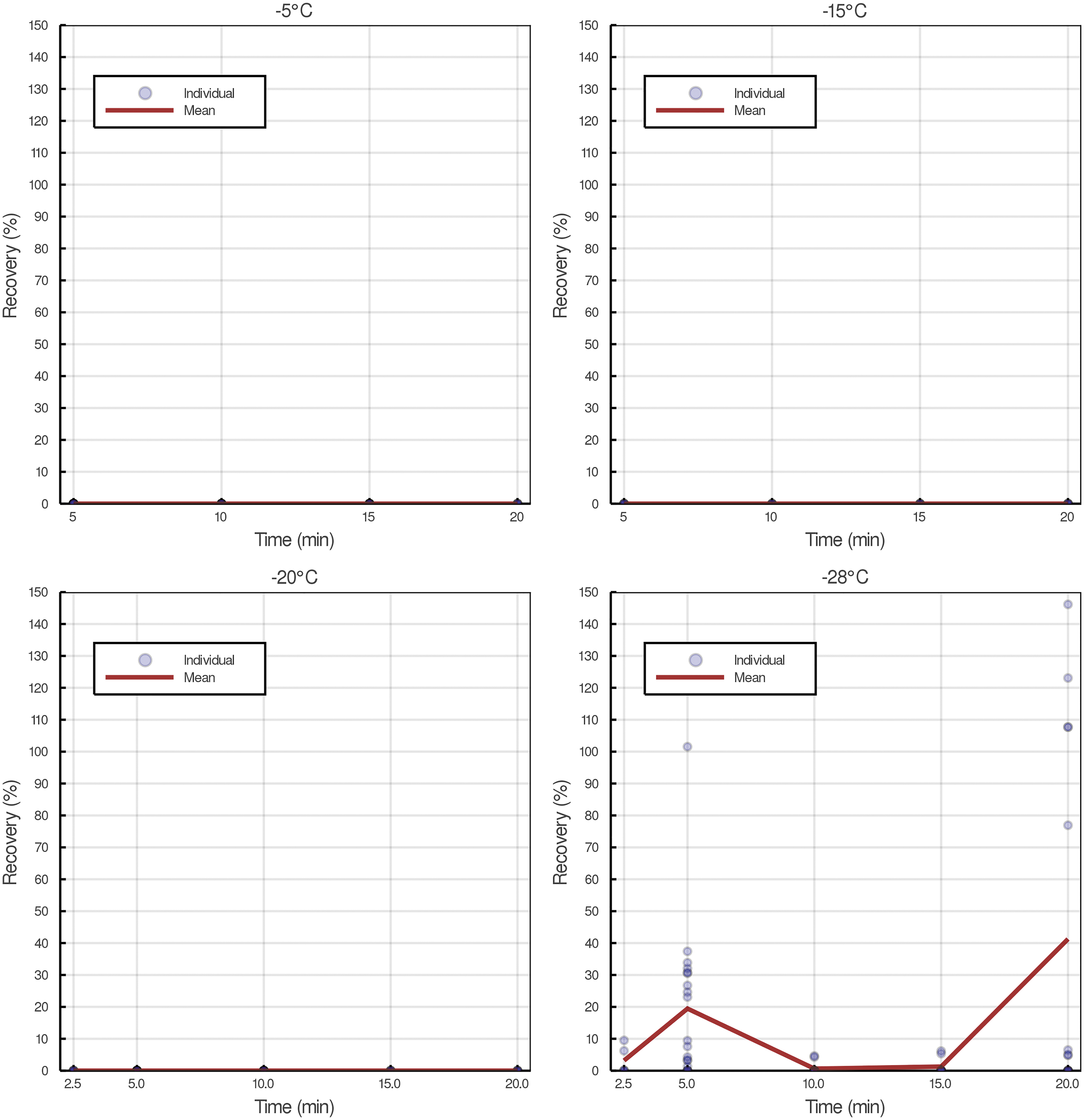
Average percentage recovery of Bacillus anthracis Sterne strain spores after application of decontamination Solution 1 [25% (w/v) CaCl2, 0.50% NaOCl, 0.40% (v/v) CH3COOH] at temperatures of −5°C, −15°C, −20°C, and −28°C, for 5, 10, 15, and 20 min; in addition 2.5 min at −20°C was tested. Each combination of time and temperature was replicated experimentally at least five times: blue circles indicate individual replicate values, while the red line indicates the arithmetic mean of the individual replicates. No spores were recovered at any time points across any temperature, except for −28°C, which exhibited significant reduction of spores at all time points (2.5 min p = 3.43 × 10⁻¹¹; 5 min p = 1.17 × 10⁻⁵; 10 min p = 8.85 × 10⁻²⁴; 15 min p = 9.80 × 10⁻¹²; 20 min p = 1.21 × 10⁻⁵).
Steel Disk Corrosion
As shown in Figure 4, Solution 1 had no color change associated with the corrosion of the steel disk, as measured by visual assessment, until 3 h of exposure, and extensive color change associated with corrosion after 24 h of exposure.
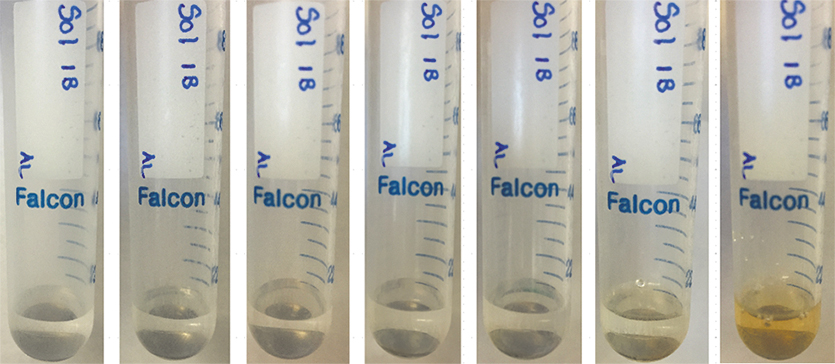
The visible damage to steel disks caused by application of decontamination Solution 1 (25% (w/v) CaCl2, 0.50% NaOCl, 0.40% (v/v) CH3COOH) for 0, 0.17, 0.5, 1, 1.5, 3, and 24 h.
Decontamination Solution Stability
As shown in Figure 5, the efficacy of Solution 1 dropped significantly (p = 1.14 × 10⁻²) after the first 24 h, and continued to decline over subsequent days. By the 7th day after preparation, the solution was ineffective at reducing spore counts.
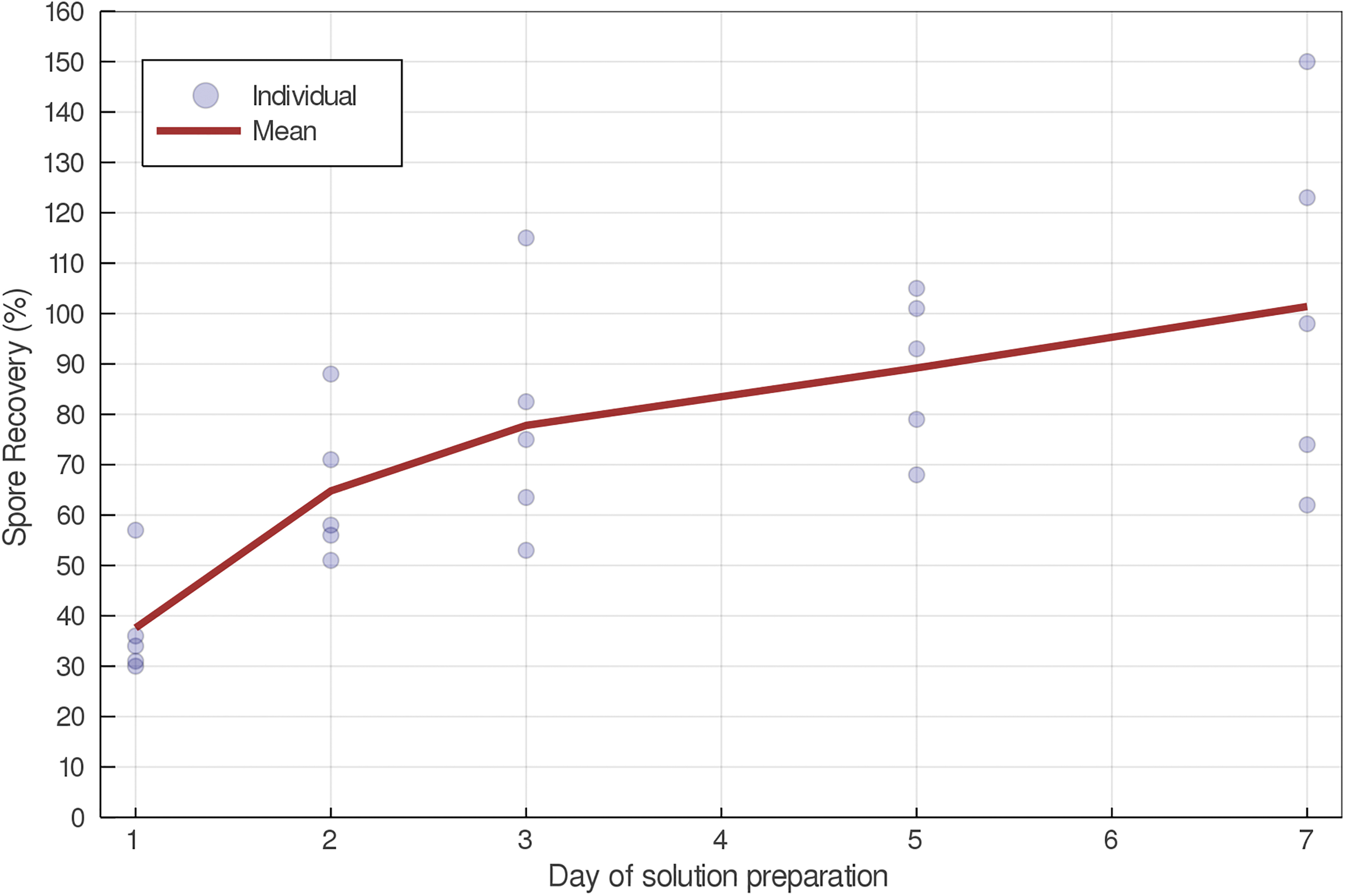
The efficacy of decontamination Solution 1 [25% (w/v) CaCl2, 0.50% NaOCl, 0.40% (v/v) CH3COOH] conducted on 7 consecutive days, showing the average percentage recovery of Bacillus anthracis Sterne strain spores. Five experimental replicates were conducted for each day using the same solution preparation: blue circles indicate individual replicate values, while the red line indicates the arithmetic mean of the individual replicates.
Discussion
Efficacy of Solution 1 at Subzero Temperatures
A minimum duration of 2.5 min was required for complete decontamination of 106 spores at temperatures as low as −20°C. Although complete spore reduction was not achieved at −28°C, there was a significant reduction in the number of viable spores at all of the time points tested.
This same decontamination solution and other amended bleach formulations provided by ECCC were tested in 2017 by the EPA for effectiveness at decontaminating the anthrax surrogate, B. atrophaeus var. globigii, on concrete and glass surfaces using a spray-on application of the decontamination solutions for 20, and 60 min. 23 Despite the previous theoretical study of Blinov et al., 22 none of the tested solutions provided more than a 3-log reduction in spore count of the B. atrophaeus var. globigii spores. At −10°C, the EPA found up to a 5.9-log reduction in Bacillus spores, and up to a 3-log reduction in spores at −25°C.
Our current study tested B. anthracis spores, rather than a surrogate, and used immersion of the spores in the decontamination solution, rather than a spray-on application. Our results suggest that Solution 1 could be used for rapid decontamination of materials or equipment capable of being immersed in the solution. The results of the EPA suggest that the spray-on application is capable of spore reduction, and dislodging spores, it does not provide complete inactivation of all spores. In contrast, spray-on application is more versatile and useful for the decontamination of surfaces, large machinery, and does not require larger volumes of decontamination solution required for immersion of items.
The results of this study are consistent with those of our previous study in the decontamination of anthrax spores at temperatures above freezing. We have shown that 0.615% NaOCl consistently inactivated all anthrax spores within 5 min at room temperature in the absence of interfering substances such as food grease. 24
The efficacy of NaOCl increases as a function of temperature; for example, a 100 × increase in efficacy between 20°C and 45°C against Enterococcus feacalis, 25 and a 6-log reduction in the number of B. anthracis spores in milk in <60 s at 80°C. 26 It is, therefore, heartening to see that the efficacy of NaOCl is not reduced until temperatures below −20°C when used in the presence of the freezing point depression agent CaCl2.
Another study using spray-on decontamination solutions undertaken by Guan et al. 27 examined real-world cold-weather decontamination of vehicle and equipment surfaces, where spore reduction of Geobacillus stearothermophilus was used as a surrogate for B. anthracis. 27 It was found that in temperatures slightly below freezing (−2°C), significant spore reduction was achieved, and that the presence of soil on the vehicle and equipment surfaces hindered effective decontamination of spores.
The presence of organic materials and its negative effect on decontamination efficacy have been echoed in other studies, with more porous surfaces and organic materials correlating with a decrease in decontamination efficacy of tested sporicides.15,28
In a previous study examining the effect of temperature and organic load, Guan et al. 28 showed that using propylene glycol as the antifreeze agent resulted in less than a 2-log reduction in spores of G. stearothermophilus after 24 h at −20°C. 28 This was in contrast to earlier study that showed effective use of propylene glycol as an antifreeze agent in conjunction with NaOCl at pH 7.2 on the successful inactivation of B. subtilis spores after 9 h at temperatures as low as −40°C, although not in the presence of organic matter. 29 As mentioned by Guan et al., this could be due to the higher temperature tolerance of G. stearothermophilus, or increased resistance to sporicides in comparison with B. subtilis. 28
After the anthrax attacks of 2001, the conclusion of the risk assessment, and the policy of the EPA, was a requirement for no growth of any anthrax spores after decontamination and remediation of an area. 30 As previously mentioned, study by the EPA initiated work to meet this challenge at subzero temperatures, and demonstrated the reduction of viable spores at subzero temperatures on both concrete and glass surfaces using spray-on application of decontaminant. This study achieved the complete reduction of viable spores at temperatures as low as −20°C in as little as 2.5 min; however, it required the submersion of spores in the decontamination solution. Future study still needs to be done to identify a spray-on decontaminant capable of complete spore inactivation in various environments, at subzero temperatures.
Damage to Surfaces During Decontamination
NaOCl is effective in decontaminating Bacillus spores by disrupting the exosporium, the multilayer spore coat, and the underlying cortex peptidoglycan.31,32 Although NaOCl can cause extensive damage to human internal organs, the concentrations commonly used for surface decontamination of anthrax spores usually cause little more than skin irritation; however, NaOCl was found to be more than two orders of magnitude more toxic to human skin keratinocyte cultures after 1 h of exposure than alternative decontaminants such as chlorine dioxide.33–35
In this study, we found no visible damage to steel disks until after 3 h of contact with the NaOCl decontaminant solution; however, in a real-world scenario, it is likely that the application of a decontaminant would remain well past this time. As such, although it may be possible to effectively decontaminate steel surfaces, damage to materials must be taken into account during the decontamination process.
Decontamination Solution Efficacy Over Time
Although 5% household bleach at alkaline pH has been shown to be stable at 4°C for up to 200 days, its efficacy decreases more quickly at room temperature, when diluted with water, and when exposed to light.36,37 The current results show that using Solution 1 [25% (w/v) CaCl2, 0.50% NaOCl, 0.40% (v/v) CH3COOH] requires fresh daily preparation, as there was a continuous decline in efficacy, with essentially no spore reduction after 7 days.
Our results confirm what was previously observed by ECCC, where they measured the change in pH, redox potential, and free available chlorine of Solution 1 over a 24-h period. 22 They found the pH increased by 5.4%, the redox potential decreased by 5.4%, and the free available chlorine decreased by 33.0%, concluding that the solution should be used on the day of preparation.
Conclusions
In this study, the first to test B. anthracis spores, and not a surrogate, for decontamination at subzero temperatures, we demonstrated the complete decontamination of 106 B. anthracis Sterne strain spores at temperatures as low as −20°C within 2.5 min by submersion in solution containing 25% (w/v) CaCl2, 0.50% NaOCl, and 0.40% (v/v) CH3COOH. We also demonstrated significant reduction in number of spores at −28°C. The results are promising, and present an opportunity for rapid subzero decontamination of equipment and materials that are capable of being submerged. Such capability would significantly decrease the time required for decontamination in response to a bioterrorism event. Future study should examine the rapid decontamination of complex surfaces such as concrete and wood, and the effect of organic material such as soil on the decontamination process. The ultimate goal for future study is a spray-based decontamination solution capable of rapidly, and completely, inactivating all B. anthracis spores present, at subzero temperatures.
Footnotes
Acknowledgments
We acknowledge the contributions of cooperative education students Alvin Lee and Sydney Postmus.
Author Disclosure Statement
No competing financial interests exist.
Funding Information
We thank the Canadian Safety and Security Program project CSSP-2013-CD-1059 of the Department of Defense Research and Development Canada for the funding and supporting this project.