






Abstract
Introduction:
This study attempts to understand the demographics and salaries of the biosafety workforce worldwide. It builds upon previous surveys of biosafety professionals.
Methods:
Using multiple regression, this study explored what factors significantly predict salary. Moreover, this study examined whether significant differences existed regarding salary. These differences were analyzed in isolation (i.e., the variable itself) and while controlling for the variables that predicted salary.
Results:
In this article, eight factors significantly predicted salary: right-to-work state first, biosafety certifications, place of employment, data entry responsibilities, percentage of biosafety job responsibilities, number of direct reports, level of education, and finally the cumulative years of experience in the field.
Discussion:
This study highlighted certain trends that have remained consistent and new trends that have emerged over time. This research had increased international participation as compared with previous studies.
Introduction
With the recent discovery of severe acute respiratory syndrome coronavirus 2, biosafety practitioners are being challenged to think outside the box and develop innovative and timely solutions to real-world problems in addition to providing insight into research challenges. Many biosafety professionals are being asked to take on new duties, such as coordinating testing operations for reopening their institutions; decontaminating personal protective equipment (PPE) to address shortages 1 formulating biosafety guidelines for reopening institutions, cities, and states2–5 ; recommending PPE to reduce the risk of infection to front-line medical professionals6–9 ; developing operating procedures to safely conduct testing of patients10,11; reviewing research protocols to ensure laboratory experiments are performed safely; and considering how to inactivate large volumes of biohazardous waste being generated in the fight against this novel infectious disease.12–14 The field of biosafety is in the spotlight in a way it has never been before; principles of biosafety, such as frequent hand washing and controlling the infection at the source (wearing face coverings), have become essential commonplace activities to prevent the spread of the virus around the world.15,16
This dynamic field comprises professionals from various walks of life, with different educational and experiential backgrounds, from botanists to chemists to toxicologists to virologists. 17 With such a broad range of biosafety practitioners in critical roles, it is important to try and develop a foundational understanding of the makeup and composition of the biosafety workforce within the United States and internationally. This insight will help governments and institutions to better discern the needs and challenges of the individuals working in this profession and it could serve as a guide for recruiting, nurturing, and retaining talent in this field of global importance.
Past research into the biosafety workforce has revealed several key factors that influence the value institutions place on biosafety expertise. Specifically, data from previous surveys demonstrate that a few but significant number of characteristics determine the salaries of biosafety professionals. 18 In a 2013 study, the most significant factors included years of experience, number of direct reports, gender, oversight of recombinant and synthetic nucleic acids, and working in a right-to-work state. 19 A 2016 study revealed that individuals with biosafety credentials, including the registered biosafety professional (RBP) credential and the certified biological safety professional (CBSP) credential, earned more income than those without these credentials. 20 A follow-up survey of the biosafety community was conducted to determine whether these factors remained the same over time or whether new indicators have emerged in recent years.
Methods
Procedure
A survey of biosafety professionals was conducted from April 29, 2020, through May 15, 2020. In total, 1747 individuals affiliated with the American Biological Safety Association International (ABSA International) or individuals listed as Institutional Biosafety Committee contacts in accordance with the National Institutes of Health Office of Science Policy were sent a 38-question survey. Of these individuals, 734 respondents clicked the submit button at the end of the survey. An additional 228 respondents provided partial responses to the survey. This survey includes data from both the partial and complete responses, representing 962 individuals with unique identifiers. Participation in the survey was optional and voluntary. Because respondents were not required to complete every question, and respondents could skip or select “I prefer not to disclose” for certain questions, the total number of responses for each question varied. Only aggregate data and summarized results were used in the research for this article with data analysis conducted using IBM SPSS analytic software. 21 All research complied with relevant Federal guidelines and institutional policies related to human subjects research. The institutional review board (IRB) at Arizona State University (IRB no. 00011881) approved the research.
Respondents
There were a total of 962 survey respondents of whom 714 (74.4%) worked in the United States. The median salary of all respondents was $82,000.00 (SD = 53,437.23) with the mean salary 87,258.40. The World Bank income level (WBIL) was reported as 2.1% (n = 20) for low income, 8.1% (n = 78) for lower middle income, 5.4% (n = 52) for upper middle income, and 81.4% (n = 783) for high income.
Of the respondents who worked in the United States, 247 were male (34.6%) and 295 were female (41.3%), the remaining 24.1% of respondents (n = 172) chose not to respond or disclose. The majority of respondents had a doctoral degree (33.1%; n = 222) or a master's degree (31.0%; n = 221), then bachelor's degree (19.0%; n = 136), and finally a high school, trade, associate's degree, or some college (3.0%; n = 18). The respondents were members of public academic institutions (31.2%, n = 233), private academic institutions (13.9%, n = 99), Federal government (10.1%, n = 72), health care (7.0%, n = 50), nonprofit (5.3%, n = 38), pharmaceutical (4.2%, n = 30), corporate or commercial for-profit (3.6%, n = 26), consultant (3.6%, n = 26), state government (2.7%, n = 19), public health laboratory (2.1%, n = 15), other government (1.1%, n = 8), and biotechnology startup (1.0%, n = 7). Respondents varied in years of experience: 19.3% had 5–9 years (n = 138), 19.2% had 10–14 years (n = 137), 15.4% had <4 years (n = 93), 12.7% had ≥15 years of experience (n = 91), 10.4% had >25 years (n = 74), and 9.7% had 20–24 years of experience (n = 69). Respondents were also diversified in age such that 24.9% of respondents were 41–50 years (n = 178), with 20.3% being 51–60 years (n = 145), followed by 19.0% aged 31–40 years (n = 138), then 10.8% were 61–70 years (n = 77), 2.5% were 21–30 years (n = 18), and finally 1.3% were aged >71 years (n = 9). The majority of respondents were white (61.6%, n = 440), followed by Asian (5.0%, n = 36), black (2.5%, n = 18), Other (1.3%, n = 9), American Indian (0.4%, n = 3), and Hawaiian (0.3%, n = 2). In the Unites States, the average salary was $102,766.93 (SD = 44,207.56), the median salary was $94,000, and the range was <$10,800 to $300,000.
Measures
The survey questions were designed to gain insights into the factors that impacted the salary of biosafety professionals while also gathering demographic data such as age, gender, race, and sexual orientation. Specifically, we were interested assessing whether past trends held true and, therefore, included many of the questions from previous surveys regarding current biosafety responsibilities, number of biosafety personnel at the institution, number direct reports, select agent responsibilities, oversight of recombinant and synthetic nucleic acids, biosafety credentials, education, and cumulative years of experience, for example. If individuals worked in the United States, they were also asked to provide the name of the state in which they work. This information was used to determine whether their state was a right-to-work state.
Data Analysis
Results were explored two ways: the first where each variable was analyzed independently and compared with salary using t-test or analysis of variance (ANOVA) and the second where key factors found in the regression were used as covariates to understand how each variable compared with salary using analysis of covariance (ANCOVA). Linear regression was used to determine which independent variables could predict the dependent variable salary. For all analyses, the standard alpha of 0.05 was utilized.
Results
Differences Explored Independently
The following are key findings with details that can be found in Table 1.
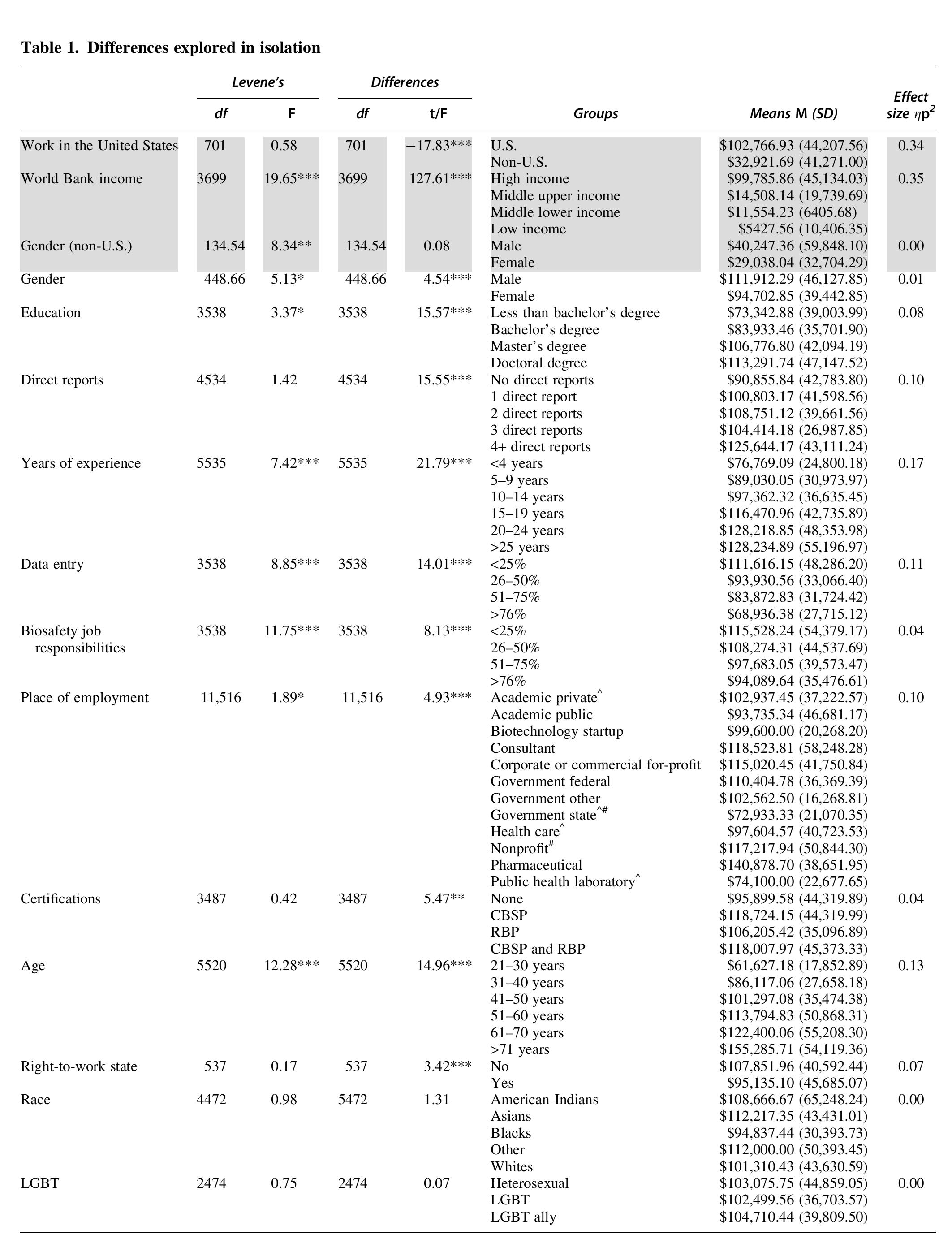
p < 0.05, ** p < 0.01, ***p < 0.001. Any place of employment with an ^significantly differs from pharmaceutical. Any place of employment with #significantly differs from the other. The gray is the data from the international versus national analyses, while the non-gray is the data from the analyses on the United States only.
CBSP, certified biological safety professional; LGBT, lesbian, gay, bisexual, or transgender; RBP, registered biosafety professional.
Differences Explored Independently Using U.S. and Non-U.S. Respondents
The following list contains key differences found for U.S. and non-U.S. respondents.
The results of an independent samples t-test indicated, on average, U.S. biosafety professionals made more money than biosafety professionals in other countries around the world.
The results of a one-way ANOVA indicated a significant difference between the WBILs of high income, middle upper income, middle lower income, and low income. Given the directional nature of the prediction, a planned contrast was run using the −2, −1, 1, and 2, respectively, for low income to high income. The contrast coefficients were significant, t(60.69) = 25.44, p < 0.001, revealing that those reporting a higher WBIL also report a higher salary.
The results of an independent samples t-test when excluding U.S. respondents did not indicate gender differences between men and women in terms of salary.
Differences Explored Independently Using U.S. Respondents Only
The list hereunder contains important findings for U.S. respondents only
The results of an independent samples t-test indicated, on average, men made more money than women.
The results of a one-way ANOVA indicated a significant difference between educational degrees. Given the directional nature of the prediction, a planned contrast was run using the −2, −1, 1, 2, respectively, for less than bachelor's degree to a doctoral degree. The contrast coefficients were significant, t(22.26) = 5.00, p < 0.001, revealing that biosafety professionals with higher degrees report a higher salary.
The results of a one-way ANOVA indicated a significant difference between number of direct reports. Given the directional nature of the prediction, a planned contrast was run using the −3, −2, −1, 2, 4, respectively, for individuals with no direct reports to those with four or more direct reports. The contrast coefficients were significant, t(534) = 5.03, p < 0.001, revealing that biosafety professionals who had more direct reports have a higher salary.
The results of a one-way ANOVA indicated a significant difference between years of experience. Given the directional nature of the prediction, a planned contrast was run using the −3, −2, −1, 1, 2, 3, for individuals with <4 years of experience to those with ≥25 years of experience, respectively. The contrast coefficients were significant, t(175.97) = 9.02, p < 0.001, revealing that biosafety professionals who had more years of experience have a higher salary.
The results of a one-way ANOVA indicated a significant difference between individuals with data entry responsibilities. Given the directional nature of the prediction, a planned contrast was run using the 2, 1, −1, −2, respectively, for individuals with <25% data entry responsibilities to those with 75% to 100% data entry responsibilities. The contrast coefficients were significant, t(37.74) = −6.67, p < 0.001, revealing that biosafety professionals with fewer data entry responsibilities report a higher salary.
The results of a one-way ANOVA indicated a significant difference between biosafety job responsibilities. Given the directional nature of the prediction, a planned contrast was run using the 2, 1, −1, −2, for individuals with <25% biosafety job responsibilities to those with 75 to 100% biosafety job responsibilities, respectively. The contrast coefficients were significant, t(360.01) = 4.45, p < 0.001, revealing that biosafety professionals with fewer biosafety job responsibilities report a higher salary.
The results of a one-way ANOVA indicated a significant difference between places of employment. Tukey post hoc tests revealed significant differences were found between those working in pharmaceuticals and private academia, public academia, state government, health care, and public health, and between state government and nonprofit.
The results of a one-way ANOVA indicated a significant difference between certifications. Given the directional nature of the prediction, a planned contrast was run using the −4, 1, 1, 2, for those with no credentials, CBSP only, RBP only, and both CBSP and RBP, respectively. The contrast coefficients were not significant, t(487) = 3.91, p < 0.001, revealing that those with both CBSP and RBP credentials make more money than those with only CBSP or RBP credentials, who, in turn, make more money than those with no credentials at all.
The results of a one-way ANOVA indicated a significant difference between ages. Given the directional nature of the expectation, a planned contrast was run using the −3, −2, −1, 1, 2, and 3, respectively, for individuals aged 21–30 years to those aged >71 years. The contrast coefficients were significant, t(7.35) = 5.67, p < 0.01, revealing that older adults have a higher salary.
The results of an independent samples t-test indicated, on average, those not in a right-to-work state made more money than those in a right-to-work state.
The results of a one-way ANOVA did not indicate a significant difference between American Indians, Asians, blacks, Other, and whites.
The results of a one-way ANOVA did not indicate a significant difference between a heterosexual person, a lesbian, gay, bisexual, or transgender (LGBT) person, and an LGBT ally.
Regression to Predict Salary
To determine what factors predict salary for biosafety employees, a linear regression was computed with the statistically significant variables already noted entered in one block as the predictor and salary as the outcome. The overall model accounted for 34.6% of the variance (R 2 = 0.36, adjusted R2 = 0.35) and produced a significant F-test, F(10,447) = 25.17, p < 0.001. Beta coefficients were examined to determine which variables significantly contributed to the model. Gender (p = 0.12) and age (p = 0.85) did not significantly contribute to the model. Thus, the model was rerun without those variables. The second model accounted for 33.4% of the variance (R 2 = 0.35, adjusted R2 = 0.33) and produced a significant F-test (8,461) = 30.37, p < 0.001. Beta coefficients were again examined to determine which variables significantly contributed to the model. Place of employment significantly predicted salary, B = 0.13, p < 0.01; years of experience significantly predicted salary, such that having more experience predicted a higher salary, B = 0.33, p < 0.001; number of direct reports significantly predicted salary, such that having greater direct reports equated with a higher salary, B = 0.161, p < 0.001; data entry responsibilities significantly predicted salary, such that fewer data entry responsibilities predicted a higher salary, B = −0.13, p < 0.01; educational degree significantly predicted salary, such that the higher the degree the higher the salary, B = 0.23, p < 0.001; percentage of job biosafety responsibilities significantly predicted salary, such that those with fewer responsibilities predicted a higher salary, B = −0.14, p < 0.01; right-to-work state significantly predicted salary, such that those not in a right-to-work state predicted a higher salary, B = −0.09, p < 0.05; and certifications significantly predicted salary, such that those with certifications predicted a higher salary, B = −0.11, p < 0.05.
Using the size of effect each variable contributed to the model, the enter method was again used with each variable being entered in a separate block—right-to-work state first, then certifications, then place of employment, then data entry, then biosafety responsibilities, then direct reports, then level of education, and finally years of experience. Each block was significant with an increase in variance explained occurring at each block (see Table 2 for the significant F and R2 changes). The overall final model accounted for 32.9% of the variance (R 2 = 0.34, adjusted R2 = 0.33) and produced a significant F-test, F(1,461) = 63.50, p < 0.001.
Block 1: right-to-work; block 2: addition of certifications; block 3: addition of place of employment; block 4: addition of data entry responsibilities; block 5: addition of percentage of job biosafety responsibilities; block 6: addition of direct reports; block 7: addition of level of education; block 8: addition of years of experience.
**p < 0.01, ***p < 0.001.
Differences Explored in Conjunction with Other Variables
Given the differences that were found for the mentioned variables, we thought it would be prudent to conduct the same analyses while controlling for certain variables to attain a clearer picture of the impact on salary. By doing this, we are able to determine whether the differences in groups truly exist and the meaningfulness of those differences. Thus, ANCOVAs were run to test for differences in the mentioned variables—gender, education, direct reports, years of experience, data entry responsibilities, biosafety responsibilities, place of employment, certifications, age, right-to-work state, race, and LGBT—whereas controlling for the critical factors found in the regression when they are not the independent variable—education, years of experience, place of employment, direct reports, data entry, biosafety job responsibilities, certifications, and right-to-work state. See Table 3 for more details on the results.
p < 0.05, **p < 0.01, ***p < 0.001.
An ANCOVA was run for gender differences while controlling for years of experience, education, data entry, place of employment, direct reports, biosafety job responsibilities, certifications, and right-to-work state. The results indicated a significant difference between genders. Owing to the expected direction, a simple contrast was run revealing that men made more money than women (p < 05).
Education differences were explored using an ANCOVA controlling for years of experience, data entry, place of employment, direct reports, biosafety job responsibilities, certifications, and right-to-work state. The results found a significant difference between educational degrees. Owing to the expected direction, a simple contrast was run revealing that those with a doctoral degree made significantly more money than the masters (p < 0.01), bachelor's (p < 0.001), and less than a bachelor's degree (p < 0.001).
An ANCOVA was run for direct reports using education, years of experience, place of employment, data entry, biosafety job responsibilities, certifications, and right-to-work state as covariates. The results revealed a significant difference between the direct report groups. Owing to the expected direction, a simple contrast was run revealing that those with four or more direct reports did not make more money than those with three (p = 0.26) or two (p = 0.12) direct reports, but did make more money than those with one (p < 0.05) and no (p < 0.001) direct reports.
Years of experience was examined using an ANCOVA with education, place of employment, direct reports, data entry, biosafety job responsibilities, certifications, and right-to-work state as covariates. The results indicated a significant difference between years of experience. Owing to the expected direction, a simple contrast was run revealing that those with ≥25 years of experience did not make more money than those with 20 to 25 years of experience (p = 0.21), but did make more money than those with 15 to 19 years of experience (p < 0.05), 10 to 14 years of experience (p < 0.001), 5 to 9 years of experience (p < 0.001), and <4 years of experience (p < 0.001).
An ANCOVA was run for data entry responsibilities using education, years of experience, place of employment, direct reports, biosafety job responsibilities, certifications, and right-to-work state for covariates. The results revealed a significant difference between the data entry responsibility groups. Owing to the expected direction, a simple contrast was run revealing that those with <25% of data entry responsibilities made more money than those with 26–50% (p < 0.01), 51–75% (p < 0.01), and 76–100% of data entry responsibilities (p < 0.01).
Biosafety job responsibilities was analyzed using an ANCOVA with education, years of experience, place of employment, direct reports, data entry, certifications, and right-to-work state as covariates. The results found a significant difference between the biosafety responsibility groups. Owing to the expected direction, a simple contrast was run revealing that those with <25% of biosafety job responsibilities did not make more money than those with 26–50% (p = 0.07) biosafety job responsibilities, but did make more money than those with 51–75% (p < 0.05) and 76–100% (p < 0.01) biosafety job responsibilities.
An ANCOVA was run for place of employment using education, years of experience, direct reports, data entry, biosafety job responsibilities, certifications, and right-to-work state for covariates. The results indicated a significant difference between places of employment. Tukey post hoc tests revealed significant differences; see Table 4 for details.
Mean differences shown. 1, academic private; 2, academic public; 3, biotechnology startup; 4, consultant; 5, corporate or commercial for-profit; 6, government Federal; 7, government other; 8, government state; 9, health care; 10, nonprofit; 11, pharmaceuticals; 12, public health laboratory.
p < 0.05, ** p < 0.01, ***p < 0.001.
Certifications was explored using an ANCOVA with education, years of experience, direct reports, data entry, biosafety job responsibilities, place of employment, and right-to-work state as covariates. The results found a significant difference between the certification groups. Owing to the expected direction, a simple contrast was run revealing that those with no credentials made less money than those with CBSP only (p < 0.05), with an RBP only (p < 0.05), and both CBSP and RBP (p < 0.05).
An ANCOVA was run for age using education, years of experience, direct reports, data entry, biosafety job responsibilities, place of employment, certifications, and right-to-work state for covariates. The results did not indicate a significant difference between the different age groups.
Right-to-work state was examined using an ANCOVA with education, years of experience, direct reports, data entry, biosafety job responsibilities, and place of employment as covariates. The results revealed a significant difference. Owing to the expected direction, a simple contrast was run revealing that those not in a right-to-work state made more money than those in a right-to-work state (p < 01).
An ANCOVA was run for race using education, years of experience, direct reports, data entry, biosafety job responsibilities, place of employment, certifications, and right-to-work state for covariates. The results did not find a significant difference.
An ANCOVA was run for LGBT using education, years of experience, direct reports, data entry, biosafety job responsibilities, place of employment, certifications, and right-to-work state for covariates. The results did not indicate a significant difference.
Discussion
This research differs from previous biosafety assessments in many ways, including increased global participation, more detailed demographic survey questions (including race, ethnicity, and sexual orientation), and analyses of individual contributing factors as well as covariates. Specifically, this study looked at group differences for each variable in isolation and for each variable while controlling for the variables that statistically significantly explained salary. Examining the variables in isolation is similar to prior studies of biosafety professionals' salary, while conducting the analyses and controlling for certain variables are new. This was done because no single variable determines salary, and analyzing the variables in conjunction with one another will more accurately reflect reality. Linear regression found the following variables explained 33% of the variance in salary for individuals working in the United States—right-to-work state, certifications, place of employment, data entry responsibilities, percentage of job biosafety responsibilities, direct reports, level of education, and years of experience—with years of experience contributing the most at 9%. These variables are similar to previously referenced studies by Gillum et al., although additional research is necessary to compare each factor study side-by-side.
Differences Observed in U.S. and Non-U.S. Respondents
Non-U.S. participation accounted for ∼25% of all responses, which is far greater than all other known salary studies of the biosafety community. Table 5 provides additional information regarding U.S. and non-U.S. participation. To compare compensation on a global scale, the WBIL was used to differentiate economies. 22 This survey had participation from individuals from all four of the WBIL categories: low, lower middle, upper middle, and high (Table 6). Not surprisingly, the results from this study are in alignment with the WBIL, wherein income increases, respectively, from low-income country to high-income country. Survey results show that, on average, respondents in high-income countries make substantially more than those in low-, lower middle-, and upper middle-income countries (Figure 1). For example, the high-income country median income was calculated to be $99,785.86, which is $85,277.72 more than the upper middle-income category, with a median income of $14,508.14.
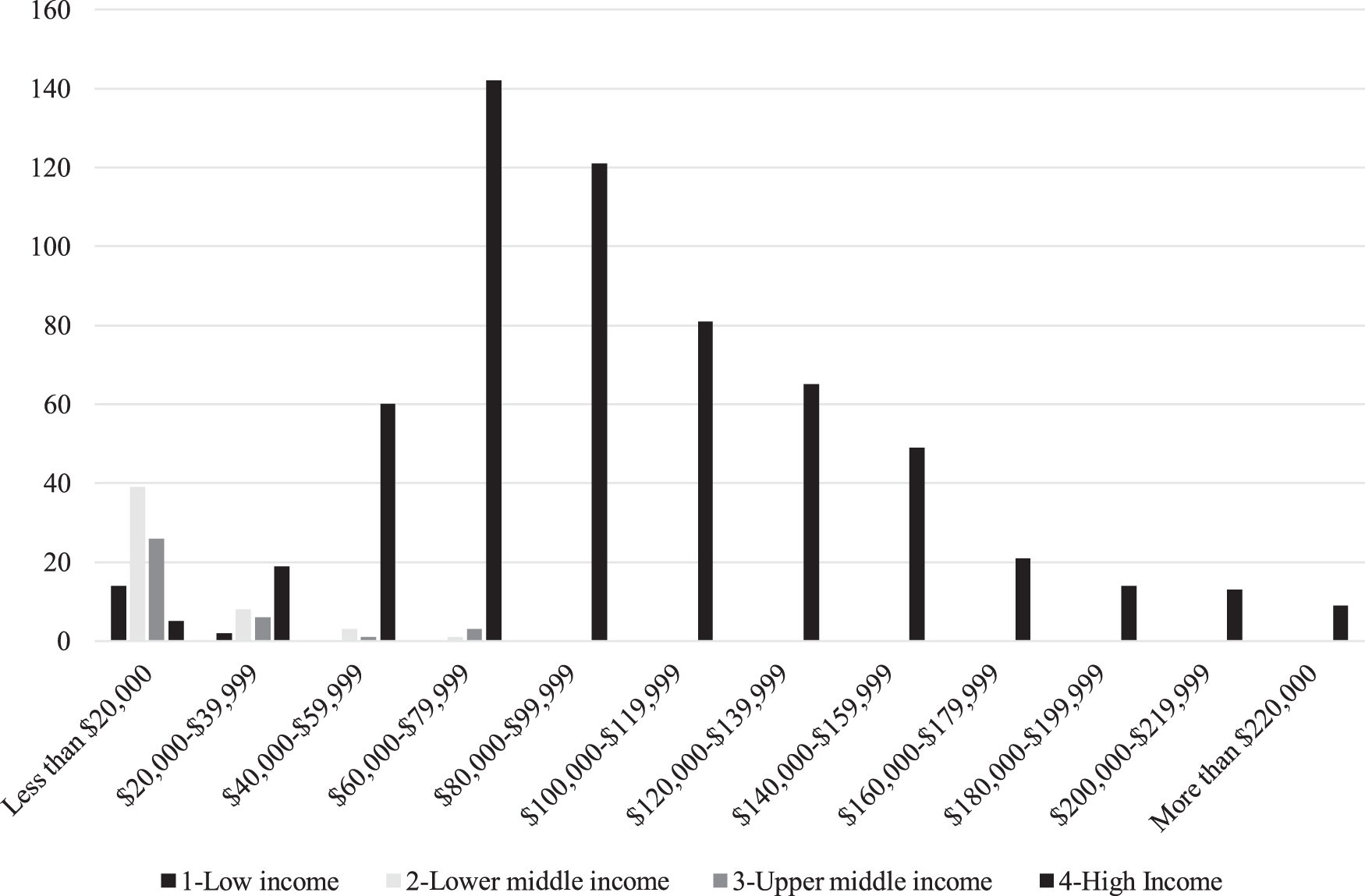
Biosafety salaries by World Bank income category.
There were no statistically significant differences in gender at the international level. To further examine this issue, we removed all U.S. respondents and explored gender differences in salary and there remained no statistically significant differences. In comparison, there were differences in gender in U.S. respondents, but only when examined in isolation.
Differences Observed in the United States
The most significant predictor of salary when analyzed with linear regression, and in terms of effect sizes for all variables, was years of experience. As an individual accumulates more years of experience, the more their salary increased. Individuals who had ≥20 years of experience made, on average, $50,000 more than those with <4 years of experience.
Place of employment also revealed significant differences in salary. Individuals who worked in the pharmaceutical industry made significantly more money than those working in government, especially state government and public health laboratories, with the difference between the two ends of the spectrum being ∼$70,000. In addition, pharmaceutical biosafety employees made significantly more money than all other places of employment, whereas public health laboratories and state government employees made significantly less than nearly all other places.
The level of an individual's education continued to be an important factor in determining salary. As education increased, so did annual income, with individuals with doctoral degrees earning the most. When compared in isolation, the range from a bachelor's degree to a doctoral degree was ∼$40,000. When assessed using linear regression, education was the second largest predictor; it is also one of the largest in terms of effect size when analyzing the group differences, only to be exceeded by years of experience and then place of employment.
Previous research demonstrated that individuals with RBP and CBSP credentials make more money than those with no biosafety credentials. 20 The results from this study were consistent with past analyses, revealing that those with no credentials made less money than those with CBSP only, with an RBP only, and both CBSP and RBP. The benefit of having these two credentials equated to, on average, $10,000–$20,000 of additional annual income for respondents.
Three variables—right-to-work, managing direct reports, and data entry responsibilities—showed significant differences in explaining salary when in isolation. When explored in conjunction with the other variables, however, these variables were still statistically significant, but had a much smaller effect size, which indicated that they were less important to salary. In previous research, being from a right-to-work state played a factor in an individual's salary. Individuals working in a right-to-work state made, on average, <$10,000 per year than those who do not. Similarly, previous research found that the number of direct reports significantly impacted salary. This study found the same: individuals reporting no direct reports made ∼$35,000 less than someone with four or more direct reports. Performing data entry continued to be an indicator of salary as found in prior research; individuals with fewer data entry responsibilities (<25%) made more money than those who performed more data entry as part of their job. As an example, an individual performing 75–100% data entry averaged $40,000 less than someone with little to no data entry responsibilities.
Two variables—gender and age—revealed significant differences when analyzed in isolation; however, when explored in conjunction with other factors, both gender and age dropped out as being important—meaning other variables (i.e., right-to-work state, credentials, place of employment, data entry responsibilities, biosafety responsibilities, direct reports, level of education, and years of experience) were more important when salary is determined. When viewed in isolation, men made >$17,000 per year than women. This is consistent with previously referenced studies. Similarly, age was a significant factor in salary, when considered in isolation, with older age indicating higher salary. Neither variable was statistically significant, though, when assessed with the other covariates noted previously. This means that other variables are more important when determining salary.
Although not as important of a predictor of salary, individuals who performed fewer biosafety responsibilities as part of their job earned more money than their counterparts with greater biosafety responsibilities. If an individual had 0–25% biosafety responsibilities, they made ∼$21,000 more than someone with 75–100% biosafety responsibilities. One possible explanation for this finding is that individuals performing managerial functions may spend less time on biosafety work, while having additional direct reports or other duties, such as being a responsible official, and make more money for their leadership roles.
Finally, no significant differences were found in salary due to an individual's race or whether they are part of the LGBT community or not. Although we hoped to not find differences in salary with these two factors, it was important to analyze them to be certain.
Conclusions and Future Research
This study explored the factors that influence the salary of biosafety professionals in isolation and in conjunction with each other; however, it is not without limitations. First, Levene's homogeneity of variance test was problematic for some variables, but it does not mean the results are not valid. The sample size is well >30, and the variables that had a significant Levene's result still had good skew and kurtosis. In addition, non-normal data for t- or F-tests do not have a significant impact on validity. 21 Second, although the overall survey resulted in a good response rate (55%), nonresponse bias could be an issue. The survey may have been e-mailed into spam folder, some people may not want to share their salary information, or certain respondents may have been more inclined to respond, for example, those proud of their salary. Third, most of the respondents in this study responded as being white and although this likely represents the U.S. biosafety workforce, future research should encourage the participation of biosafety professionals from all races to ensure full representation.
The longer biosafety professionals work in the field, the more experience they gain and, as a result, have the opportunity to apply for biosafety certifications. An individual's years of experience is one of the criteria in application for the CBSP credential, for example. In addition, they have a greater likelihood of advancing their careers by taking on additional responsibilities within their organization and broadening their skill set, often leading to managerial position. Therefore, it is reasonable to extrapolate that an individual will earn more while having less biosafety and data entry responsibilities, more years of experience, additional direct reports, and biosafety credentials.
This study identified that members of the international biosafety workforce from low-, lower middle-, and upper middle-income countries earn salaries that are significantly lower than their counterparts in high-income countries. Combining this with limited access to biosafety resources and rare opportunities to network with colleagues in the biosafety community puts these individuals at a disadvantage. In an effort to make biosafety more accessible to the international workforce, biosafety organizations from well-resourced countries (ABSA International, European Biosafety Association, Canadian Association for Biological Safety, etc.) should consider reducing their barriers to international participation, focusing on areas such as membership fees, credentialing costs and requirements, costs of professional development, and training courses. ABSA International, for example, has created an affordable membership category for individuals from WBIL low-income countries. Based on findings in this article, consideration should be given to providing less expensive options for lower middle- and upper middle-income countries as well. There should also be consideration for the scheduling of events when offering live webinars and conducting committee meetings to enable participation from international members.
In response to the COVID-19 pandemic, several organizations have moved their annual conferences to a virtual platform. These types of events are prime opportunities to consider the needs of the international membership and make available live events at times that are conducive to members from various time zones across the world as well as have available recorded sessions for asynchronous learning opportunities for all members. The reality of low-income levels in the international biosafety community and wage gap between resource-rich and resource-poor countries must be tackled by providing scholarships, fellowships, or other supplemental resources for international members to help them gain educational, networking, and collaboration opportunities.
We may never fully understand all of the reasons for why an individual's salary is the amount it is or what variables specifically impacted the final compensate package. We can, however, use this research to draw conclusions and understand some of the general conditions affecting salary differences in the biosafety community. Although much of the findings align with the previous research done on salary, future research should continue to explore international populations, U.S. versus non-U.S. differences, and study what factors cause salary indicators to change over time.
Footnotes
Author Disclosure Statement
No competing financial interests exist.
Funding Information
No funding was received for this research.