






Abstract
Objectives:
This study was designed to answer the question: Does the contact of the human organism with the Earth via a copper conductor affect physiologic processes?
Subjects and experiments:
Five (5) experiments are presented: experiment 1—effect of earthing on calcium–phosphate homeostasis and serum concentrations of iron (N = 84 participants); experiment 2—effect of earthing on serum concentrations of electrolytes (N = 28); experiment 3—effect of earthing on thyroid function (N = 12); experiment 4—effect of earthing on glucose concentration (N = 12); experiment 5—effect of earthing on immune response to vaccine (N = 32). Subjects were divided into two groups. One (1) group of people was earthed, while the second group remained without contact with the Earth. Blood and urine samples were examined.
Results:
Earthing of an electrically insulated human organism during night rest causes lowering of serum concentrations of iron, ionized calcium, inorganic phosphorus, and reduction of renal excretion of calcium and phosphorus. Earthing during night rest decreases free tri-iodothyronine and increases free thyroxine and thyroid-stimulating hormone. The continuous earthing of the human body decreases blood glucose in patients with diabetes. Earthing decreases sodium, potassium, magnesium, iron, total protein, and albumin concentrations while the levels of transferrin, ferritin, and globulins α1, α2, β, and γ increase. These results are statistically significant.
Conclusions:
Earthing the human body influences human physiologic processes. This influence is observed during night relaxation and during physical activity. Effect of the earthing on calcium–phosphate homeostasis is the opposite of that which occurs in states of weightlessness. It also increases the activity of catabolic processes. It may be the primary factor regulating endocrine and nervous systems.
Introduction
This study was designed to answer the question: Does the contact with the earth affect calcium–phosphate homeostasis, concentration of electrolytes, glucose, proteins, and thyroid function? Similar studies were recently published and showed beneficial effects of grounding. 1 –4 Dynamics of changes in measured parameters depends on several factors (e.g., disease and age of individuals, conditions of insulation of human body, the weather, body motion with longitudinal compression of skeleton, the period of grounding, the time of meals, and applied therapy). To eliminate the majority of these factors in experiments, the grounding has been done during night rest in a homogeneous group of people, however, in different time and weather conditions.
Materials and Methods
Experiment 1: Effect of earthing of the human body on calcium–phosphate homeostasis and serum concentrations of iron during night-time sleep
Subjects and clinical experiments
Eighty-four (84) people (30 women, 54 men) 20–64 years old comprised the study group. Selection of the tested people was based on the following conditions: They did not require pharmacological treatment, the investigations were continued for 2 days, during the day before and during the experiment every subject managed to sustain a similar physical activity, diet, and fluid intake. The subjects were instructed to avoid contact with anything that might ground them. The evening meal was consumed at 6:00
Instrumentation
The grounding was made of a cooper plate (30 mm × 80 mm) placed on the lower part of the leg attached with a strip so that it would not come off as the subjects moved during the night. The plate was connected to an insulated cooper conductor (diameter of 1 mm) to the second plate (60 mm × 250 mm, the size of the average foot) placed on a moistened earth outdoors. The temperature was of 3°C–12deg;C near the surface of the earth.
Experimental procedure
A double-blind technique was applied (Fig. 1). On the first day, the blood samples were drawn at 6:00
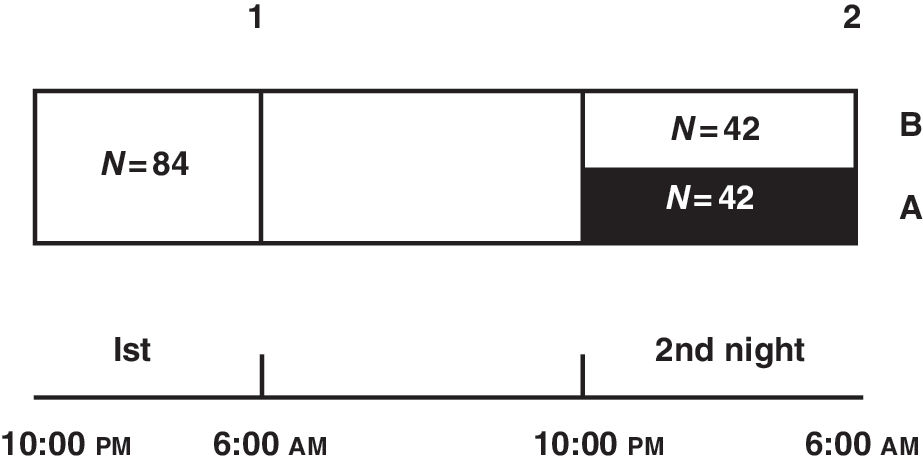
Hourly timetable and plan of the first experiment. A, Group of individuals grounded from 10:00
Analytical procedures
Blood serum ionized calcium concentrations were determined ion selectively using the Corning 288 analyzer. Total calcium, inorganic phosphorus, and iron concentrations were measured by means of Bio-Merieux sets (Lyon, France, 1996) using a Technicon RAXT analyzer. Alkaline phosphatase was assayed with a standarized kit (Bio-Merieux).
Statistical analysis
Data were analyzed using program Origin Version 3.73 of Microcal Software Inc. Means, variance, and standard error of the mean (SEM) were calculated. Between-group comparison of mean values was performed using Student‘s unpaired t test.
Results
Means values and SEM are presented in Table 1 and p values in Table 2.
SEM, standard error of the mean; Ca, calcium; u, urine; IP, inorganic phosphorus; T Ca, total calcium; s, blood serum; AP, alkaline phosphatase.
Ca u, calcium in urine; IP u, inorganic phosphorus in urine; T Ca s, total calcium in blood serum; Ca ions, ionized calcium in blood serum; IP s, inorganic phosphorus in blood serum; AP s, alkaline phosphatase in blood serum; Iron s, iron in blood serum.
Eight (8)-hour earthing of the human body during night-time sleep (value 2A) causes the lowering of serum concentrations (mean ± SEM) of iron in μmol/L (from 19.8 ± 7.14 to 15.04 ± 5.5), ionized calcium in mmol/L (from 1.19 ± 0.09 to 1.08 ± 0.08), total calcium in mmol/L (from 2.43 ± 0.20 to 2.31 ± 0.15), inorganic phosphorus in mmol/L (from 1.48 ± 0.22 to 1.37 ± 0.19) and the reduction of alkaline phosphatase in International Units/L (from 123.4 ± 22.5 to 114.6 ± 14.0). Earthing of the human body during a sleep period causes the reduction of renal excretion in mmol/8 hours of calcium (from 2.14 ± 0.82 to 1.12 ± 0.34) and phosphorus (from 16.8 ± 5.8 to 10.7 ± 3.8). All of these results were statistically significant.
Experiment 2: Effect of earthing on serum concentrations of electrolytes
The investigations were carried out on 28 people (10 women, 18 men), aged 20–52 years in the Department of Internal Medicine. The subjects did not require pharmacological treatment. The investigations were continued for 2 days. During the day before and during the experiment, every subject managed to sustain a similar physical effort and diet. The evening meal was consumed at 7:00
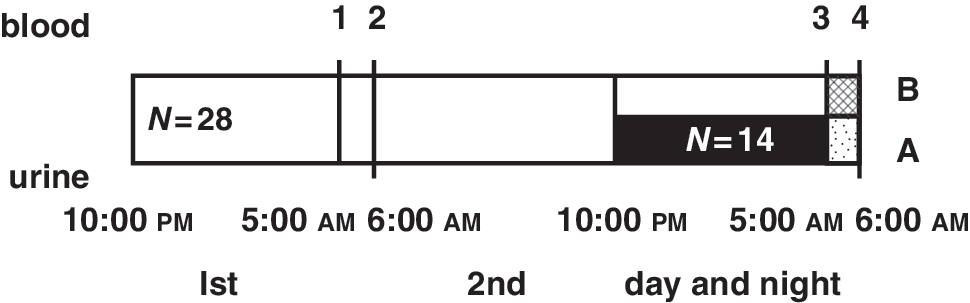
Hourly timetable and plan of the second experiment. 1A, 7-hour period without earthing (N = 28) 1st day; 2A, 1-hour period without earthing (N = 28) 1st day; 3A, 7-hour period with earthing (N = 14) 2nd day; 4A, 1-hour period without earthing (N = 14) 2nd day; 3B, 7-hour period without earthing (N = 14) 2nd day; 4B, 1-hour period with earthing (N = 14) 2nd day.
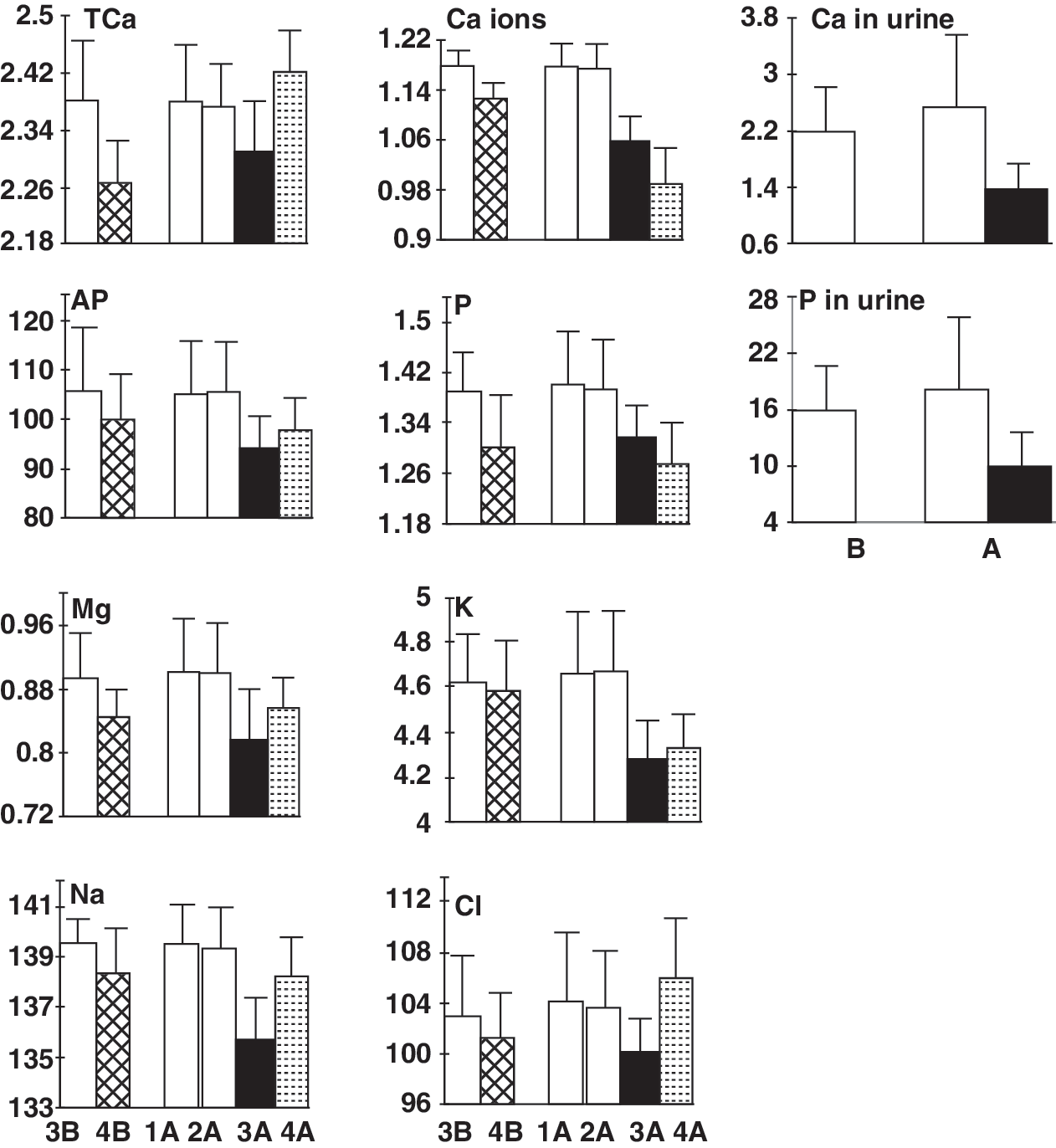
Diagrams showing the dynamics of changes in concentrations of selected electrolytes and alkaline phosphatase in the second experiment. 1A, 7-hour period without earthing (N = 28) 1st day; 2A, 1-hour period without earthing (N = 28) 1st day; 3A, 7-hour period with earthing (N = 14) 2nd day; 4A, 1-hour period without earthing (N = 14) 2nd day; 3B, 7-hour period without earthing (N = 14) 2nd day; 4B, 1-hour period with earthing (N = 14) 2nd day; A, urine collection in earthed subjects during 2nd night (N = 14); B, urine collection in unearthed subjects (N = 14).
Results
The effect of earthing on concentrations of electrolytes (including calcium, phosphates) is presented in Figure 3 and Table 3. The double-blind trial proved that the only a real contact with the Earth is responsible for registered alterations (Table 4).
TCa, total calcium; iCa, ionized calcium; IP, inorganic phosphorus; AP, alkaline phosphatase; Mg, magnesium; K, potassium; Na, sodium; Cl, chloride; electrolytes in blood serum.
Selected electrolytes (Ca, calcium; IP, inorganic phosphorus; K, potassium; Mg, magnesium; Na, sodium; Cl, chloride) and alkaline phosphatase (AP) concentrations in blood serum.
1A, 7-hour period without earthing (N = 28) 1st day; 2A, 1-hour period without earthing (N = 28) 1st day; 3A, 7-hour period with earthing (N = 14) 2nd day; 4A, 1-hour period without earthing (N = 14) 2nd day; 3B, 7-hour period without earthing (N = 14) 2nd day; 4B, 1-hour period with earthing (N = 14) 2nd day.
Seven (7)-hour and even 1-hour contact with earthing in a fasting state causes the lowering of serum concentrations of total calcium, ironized calcium, inorganic phosphorus, and alkaline phosphatase activity. A 1-hour break of contact following overnight rest in contact causes total calcium and alkaline phosphatase concentrations to rise, with an accompanying decrease in the concentrations of ionized calcium and inorganic phosphorus. A decrease in inorganic phosphorus and ionized calcium after the interruption of contact with the Earth, with concomitant rising of sodium, magnesium, and chloride concentrations, could indicate an exchange of these ions with the intracellular environment. Earthing of a body during a sleep period has an effect on the reduction of renal excretion of calcium and phosphates.
Seven (7)-hour contact with the Earth of a subject at rest significantly decreases the serum sodium (p = 0.00), potassium (p = 0.00), and magnesium levels (p = 0.00). A 1-hour interruption of contact increases the sodium (p = 0.00), chloride (p = 0.06) and magnesium concentration (p = 0.00).
Experiment 3: Effect on thyroid function of earthing of the human organism during night relaxation
Subjects
There were 12 patients (6 women, 6 men), who were 34–60 years old. Their body–mass index (BMI) was 25–28 kg/m2 body surface. The patients who had no clinical symptoms of thyroid disorders did not require pharmacological treatment.
Experimental procedure and instrumentation
See Experiment 1 and Figure 1.
Analytical procedures
Thyroid-stimulating hormone (TSH), free tri-iodothyronine (T3), and thyroxine (T4) were measured by means of Bio-Merieux sets (Lyon 1996). Precision value for the analytical methods for TSH, free T3, and free T4 was 4.3%.
Statistical analysis
Data were analyzed using program Origin Version 3.73 of Microcal Software Inc. Means and SEM were calculated.
Results
Results are presented in Table 5. Comparison of groups 2A and 2B was conducted. 2A is an active group of grounded subjects; 2B is a control group of ungrounded subjects. Earthing of the human body during the night increases concentrations of free T4 and TSH (p < 0.05), and diminishes the level of free T3 (p < 0.05).
2A is an active group of grounded subjects; 2B is a control group of ungrounded subjects.
Means and standard error of the mean of free tri-iodothyronine (fT3), free thyroxine (fT4) in pmol/L, and thyroid-stimulating hormone (TSH) in mUI/mL.
Experiment 4: Effect of earthing of the human organism on glucose concentration in serum
Subjects
Twelve (12) patients with non-insulin-dependent diabetes mellitus (NIDDM) had been well controlled with glibenclamide, which is an antidiabetic drug, for about ≥6 months, but at the time of study had unsatisfactory glycemic control (fasting plasma glucose >10 mmol/L) despite dietary and exercise advice and glibenclamide doses 10 mg/day. These patients were studied in the Department of Internal Medicine (for conditions see Experiment 1). All patients were on an isocaloric diet consisting of ≈25% fat, 29% proteins, and 55% carbohydrate. Characteristics of patients were the following: age 42–58 years (mean 52 years), sex 6 women and 6 men, mean BMI >28, concomitant medication of angiotensin-converting enzyme (ACE) inhibitors: 2 individuals from the group of grounded people and 2 from the ungrounded group.
Experimental procedure
Double-blind technique was applied. One (1) group was continuously grounded during 72 hours, while the second one remained without contact with earth potential (EP). In the first group of grounded people after 24 hours, glibenclamide and ACE inhibitor were discontinued.
Analytical procedures
Glucose concentration was measured by means of Bio-Merieux sets (Lyon 1996). Precision value for the analytical method for glucose was 2.2%.
Statistical analysis
Data were analyzed using the program Origin Version 3.73 of Microcal Software Inc. Means and SEM were calculated. Results in Table 6.
Values are mean ± standard error of the mean in mmol/L.
In the grounded group, glibenclamide and ACE inhibitors were discontinued.
Results
Earthing of the human organism has a direct, beneficial effect on the regulation of blood glucose in NIDDM, which is expressed by the decrease of fasting glucose concentrations (means ± SEM: from 10.6 ± 1.2 to 7.4 ± 0.8 mmol/L) (p < 0.05).
Experiment 5: Effect of earthing of the human organism on immune response to vaccine
Experimental procedures
The investigations were carried out on 32 volunteer men, 19–23 years old, who were accommodated in the same conditions and fed with the same food. On the first day, the tested subjects received a dose of typhoid vaccine and tetanus toxoid 0.5 mL subcutaneously (Biomed-Warsaw). The investigations were continued for 4 days. Every subject managed to sustain a similar physical effort and diet, but all the people performed everyday activities wearing insulated shoes. All the people were instructed to avoid contact with grounding. They relaxed on insulated beds in their rooms on the third floor at a temperature of 21°C and atmospheric pressure of 1014 kPa. Construction of the building was of reinforced concrete. The evening meal was consumed at 7:00
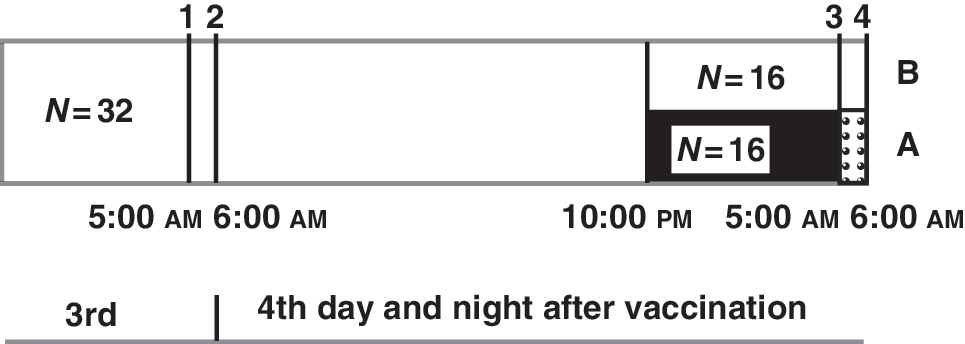
Timetable of the fifth experiment. A, group of individuals grounded from 10:00
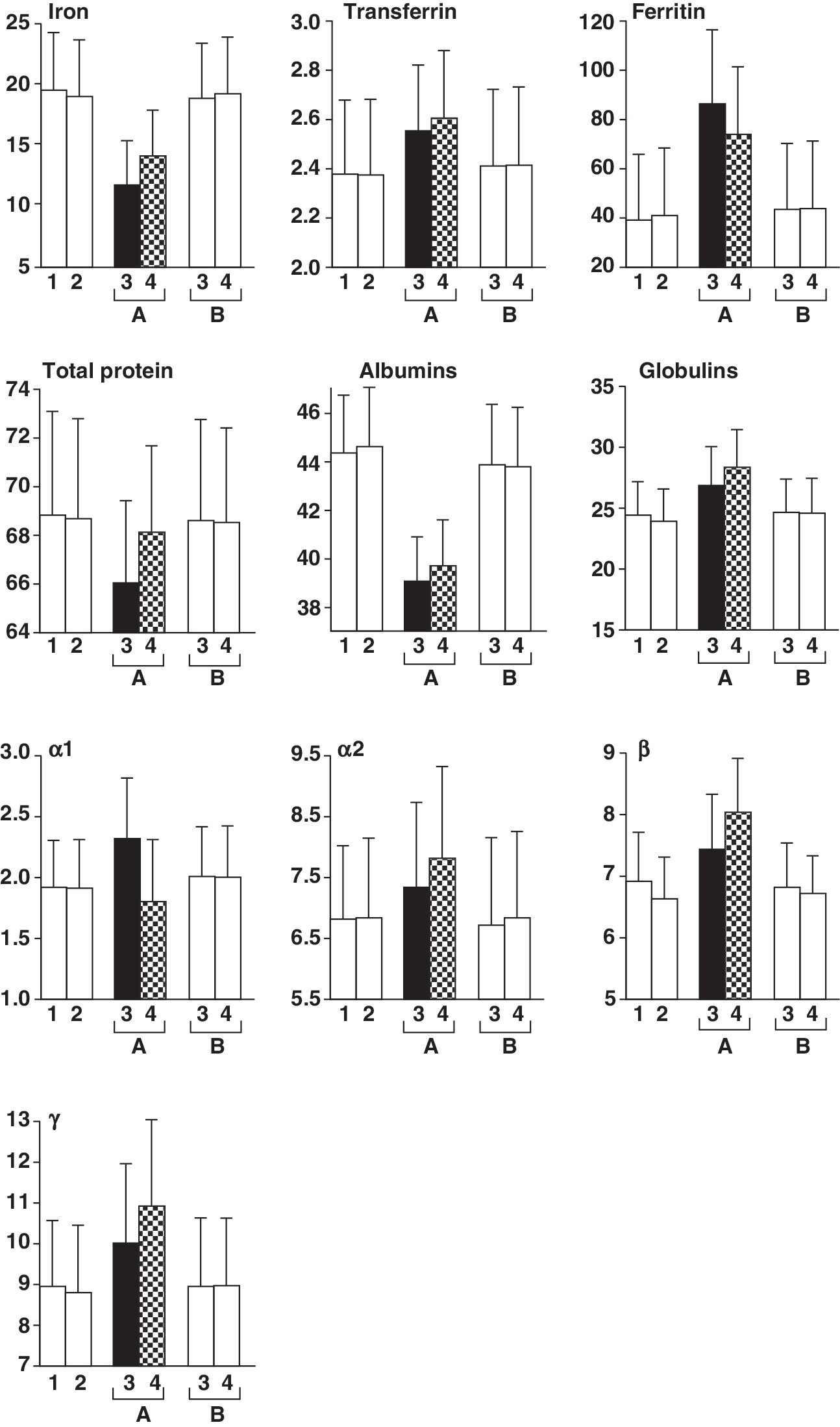
Values 3A present effect of 7-hour earthing during night rest–active group. Values 1 and 3B show effect of 7-hour insulation during night rest–control group. Values of concentrations of iron are in μmol/L and of ferritin are in μg/L. Transferrin, total protein, albumins, and globulins are in g/L.
Results
Seven (7)-hour (3A in Fig. 4) earthing in a night rest causes the lowering of serum concentrations of iron, total protein, and albumins, while the levels of transferrin, ferritin, globulins α1, α2, β, and γ increase (p < 0.05). A 1-hour break of contact with the Earth following overnight rest in contact, in a fasting state (4A in Fig. 4) causes iron, total protein, and globulins α2, β, and γ concentrations to rise, with an accompanying decrease in concentrations of ferritin and globulins αl (p < 0.05). p-values are presented in Table 7.
All data are p-values.
1A, 7-hour period without earthing (N = 32) 1st day; 2A, 1-hour period without earthing (N = 32) 1st day; 3A, 7-hour period with earthing (N = 16) 2nd day; 4A, 1-hour period without earthing (N = 16) 2nd day; 3B, 7-hour period without earthing (N = 16) 2nd day; 4B, 1-hour period with earthing (N = 16) 2nd day.
Discussion
Our experiments have shown that contact of the human body with moistened surface of the Earth via a copper conductor can influence calcium–phosphate homeostasis. The effect of earthing of the human body in a recumbent position on calcium–phosphate homeostasis is opposite to that which occurs in states of weightlessness. It shows that contact with the Earth in a recumbent position leads to effects that have been noted during rhythmic, longitudinal compression of the skeleton in immobilized patients. 5 The reduction of renal excretion of calcium and phosphorus, and the lowering of serum concentrations of total calcium, ionized calcium, and phosphorus can indicate that they are stored in the skeleton. This pool of calcium ions is readily exchangeable because it is in physicochemical equilibrium with extracellular fluid. The pool consists of calcium phosphate salts and provides an immediate reserve for sudden decreases of calcium ions in blood. 6 In the state of normocalcemia, the excitation–secretion processes of parathyroid glands are sensitive and immediate. 5 Minimal changes of concentrations of calcium ions in the blood modulate the activity of nervous and endocrine systems.
Dynamics of changes in concentrations of ions (sodium, potassium, and chloride) could indicate an exchange of these ions with the intracellular environment. The contact of human organism with the Earth may change the conditions of intestinal absorption and excretion, renal excretion, and storage and transmission of ions through the cellular membrane.
Results of presented studies have shown that earthing from the defined surface of the Earth transmitted via a copper conductor onto the surface of an insulated human body is responsible for changes of iron and proteins in serum concentrations.
Earthing the human body during relaxation and during physical activity is responsible for the increasing glucose utilization by the cells in NIDDM. Lack of contact with the Earth may cause opposite effects and may be the reason for several disorders (diabetes, obesity, and hypertension). 7
Seven (7)–hour earthing of an insulated human body causes the decrease of serum concentrations of iron, total protein, and albumins while it increases the concentration of globulins, whereas 1-hour interruption of human contact with Earth causes the increase of iron, total protein, and globulins concentrations. Increase in concentrations of γ-globulins indicates that the immune response to vaccine and toxoid can be potentiated and accelerated by grounding of the human body. It suggests that contact with the Earth can affect regulation of immune response. 2,3
Earthing the human body during night-time sleep influences thyroid function: it increases concentrations of free T4 and TSH and diminishes the level of free T3. The increase in basal metabolic rate accounts for the thermogenic effect of thyroid hormone that could be expressed in elevated utilization of free T3. The rate of respiration of mitochondria can be controlled by the concentration of adenosine diphosphate because oxidation and phosphorylation are tightly coupled. In mitochondria, respiration (i.e., electron transport) may occur unaccompanied by oxidative phosphorylation. Free energy may be still released as the electrons are transferred down the transport chain; however, this energy is not trapped as adenosine triphosphate but appears instead as heat. 8 This mechanism may occur in the grounded organism during night relaxation. Membranes compartmentalize and segregate intracellular events, separate cells from one another, and segregate organ function. Mitochondria are double-membrane organelles that convert energy to forms that can be used by the cell. 9 The greatest source of H+ is the CO2 produced as one of the end products of the oxidation of glucose and fatty acids during aerobic metabolism. In aerobic organism, the ultimate acceptor of electrons derived from fuel molecules is molecular oxygen. The electrons are first transferred from the fuel molecules to a specialized electron carrier. Electrons from the carrier reach molecular oxygen via the mitochondrial electron transport system. Molecular oxygen requires four electrons for reduction to water, and four electrons can be supplied in a single step only by the terminal cytochrome C oxidase in the mitochondria. 10 In converting molecular oxygen into active oxygen species, there are several possible modes by which iron can be redox active in biologic systems. Free radical reactions are initiated continuously in vivo by both enzymatic and nonenzymatic reactions. 11 Anabolic processes involved in the biosynthesis of fatty acid from acetyl coenzyme A (acetyl-CoA) are confined to the cytosal fraction. The catabolic processes concerned with the oxidation of fatty acids to acetyl-CoA are contained within mitochondrial matrix. 8 The stabilization of the hydrogen bonds in mitochondrial membranes and supply of electrons to terminal cytochrome C oxidase in the mitochondria may play critical role in bioenergetic processes during night relaxation. Dynamics of changes of concentrations of TSH, free T4, and free T3 indicate that earthing of the human body can affect processes described above.
Conclusions
Earthing the human body influences human physiologic processes through the aqueous environment of the Earth and the aqueous environment of the human organism via a copper conductor in a building with reinforced concrete construction. This influence is observed during night relaxation and during physical activity. The effect of earthing the human body on calcium–phosphate homeostasis is the opposite of that which occurs in states of weightlessness. It also increases the activity of catabolic processes. It may be the primary factor regulating the endocrine and nervous systems.
Footnotes
Disclosure Statement
No competing financial interests exist.