




Abstract
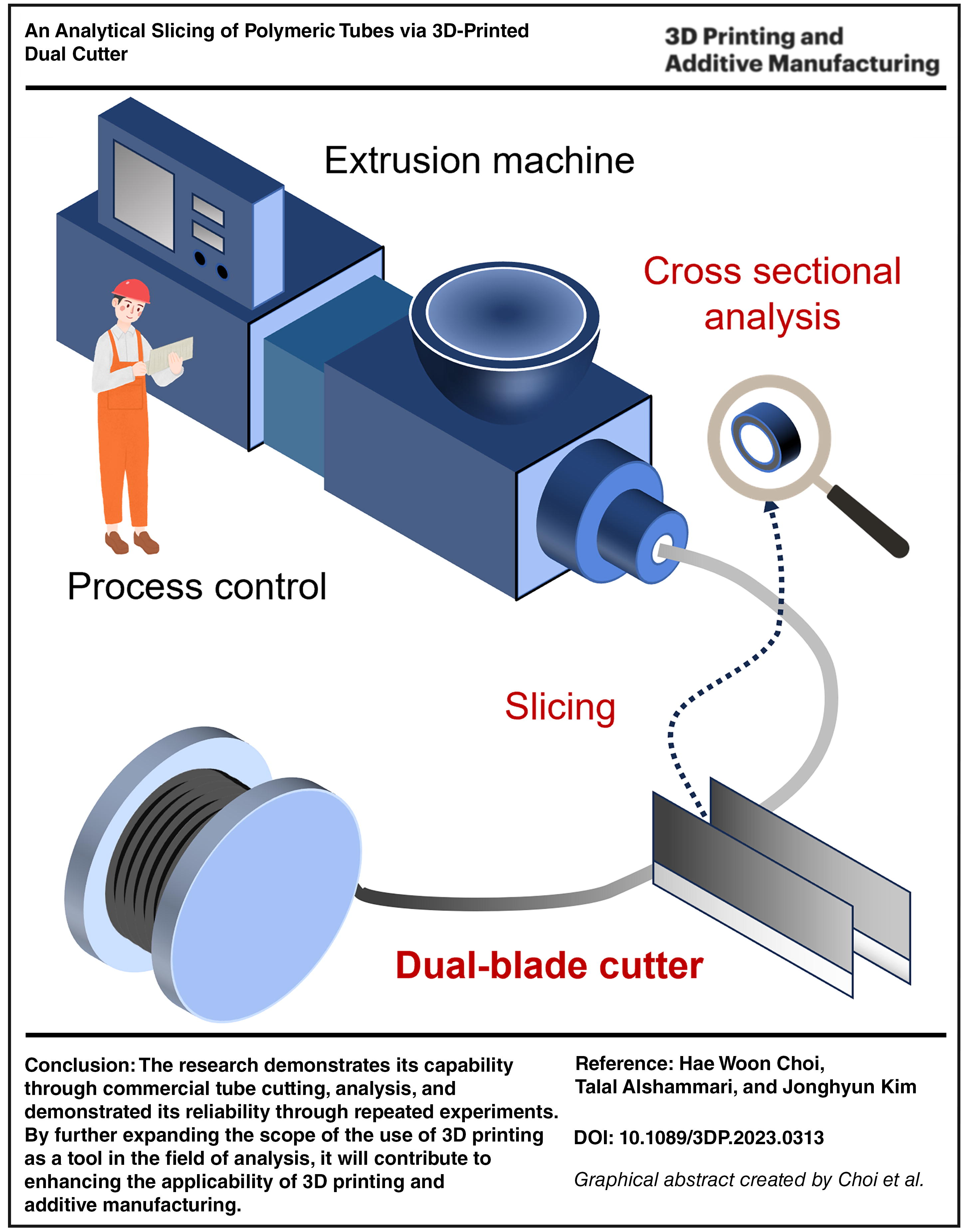
Polymeric tubing has played a crucial role in various industries. Manufacturing industries have traditionally used cutting methods for quality control, failure analysis, or to gain deeper insight into the device’s internal structure. A cross-sectional analysis of the tubes is required to control the manufacturing process of tubes produced by an extrusion process. However, small-scale factories and academic laboratories have so far used conventional hand cutters. Here, this study introduces a simple and novel analytical capability by fabricating and producing a dual-blade cutter tailored to the characteristics of the tubes. The dual-blade cutter, utilizing computer-aided design and three-dimensional (3D) printing, ensures low-cost parts, easy handling, and precise cutting. Through experiments, the cutting capability is verified by commercial polymer tubes. The dual-blade cutter is durable, allowing for an even distribution of cutting force. When cutting the outer diameter of the tube from 4 mm to 6 mm, the parallel angle deviation of the cut surface was 6–11%, demonstrating the ability to suppress surface roughness and burrs that may occur on the cut surface. It clamps the flexible tube effectively, minimizing tube deformation during cutting and increasing stability. As a result, the deformation of the tube can be quantified by ovality, and the values for hand-cut and cutter-cut are 11.5% and 4.3%, respectively. These suggested advantages could provide an inspiration for small factories and research institutes to reproduce our ideas or develop more efficient mechanisms. As additive manufacturing continues to advance, it is expected to significantly impact the prospective future of manufacturing processes, with expanded 3D printing capabilities via proposed practical application.
Get full access to this article
View all access options for this article.