






Abstract
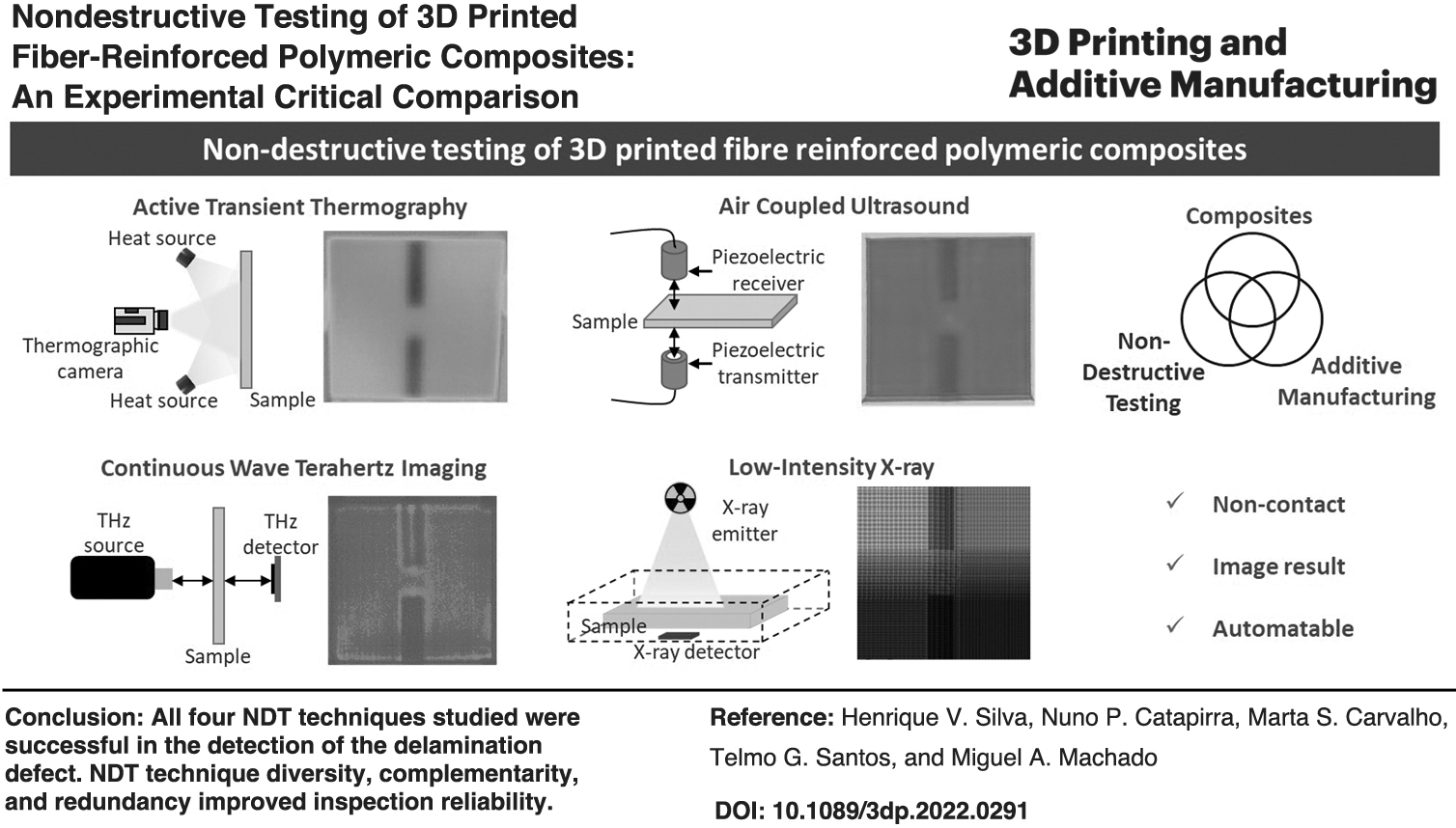
Polymer matrix composite (PMC) materials produced by additive manufacturing are a promising solution with several applications in industry. The presence of defects due to fabrication could undermine the performance of the component structure. PMC performance has been extensively studied using destructive tests, but reliable nondestructive testing (NDT) techniques are essential. In this study, PMC with unidirectional fibers were 3D printed with an adapted conventional fused filament fabrication printer. The matrix material was polylactic acid, and three different reinforcement fibers were used: Kevlar®, carbon, and glass fibers. The samples were 3D printed with artificial defects, to simulate delamination's 0.5 mm thick. Four NDT techniques were explored, benchmarking the inspection of PMC envisaging an automated noncontact imaging inspection for easier result interpretation. Active pulse thermography, air-coupled ultrasounds, continuous wave terahertz, and digital X-ray were the techniques chosen, and a critical comparison is presented, evaluating the performance of each technique in the detection of defects. NDT technique diversity, complementarity, and redundancy improve inspection reliability, as there is not a single inspection technique that can cover all material defects or characteristics.
Get full access to this article
View all access options for this article.
References
Supplementary Material
Please find the following supplemental material available below.
For Open Access articles published under a Creative Commons License, all supplemental material carries the same license as the article it is associated with.
For non-Open Access articles published, all supplemental material carries a non-exclusive license, and permission requests for re-use of supplemental material or any part of supplemental material shall be sent directly to the copyright owner as specified in the copyright notice associated with the article.
