






Abstract
The objective of this paper is to address the empirical basis and forensic application of a bimodal theory of violence. The definitions of affective and predatory violence, the relevant animal and clinical research, and the current empirical evidence in neurochemistry, neuropsychology and psychophysiology are reviewed. Forensic evidence for the relevance of this bimodal theory is investigated. An appropriate methodology for data gathering, and two observational measures along with one self-report measure are explicated. Integration of this bimodal theory into forensic practice is suggested. Affective and predatory modes of violence represent an empirically valid bimodal theory of violence, find application in forensic psychiatry, and scientifically deepen the understanding of discrete violent acts for both retrospective and prospective psychiatric and psychological investigations. This bimodal theory of violence should have a place in forensic psychiatric practice.
Although violence in its myriad forms is a rather stable behaviour in certain members of our species, the exact nature and causes of violence continue to beguile researchers and clinicians throughout the world. Violent behaviour – an intentional act of physical aggression against another human being that is likely to cause physical injury [1] – is, moreover, a fact of professional life in forensic psychiatry and psychology. Its measurement and prediction are dependent upon our keen observation and careful application of the scientific method.
Violent behaviour is no longer conceptualized as a generic, homogeneous phenomenon. It varies in frequency according to the social, psychological and biological determinants that are in play at the time of the violent act. The nature of the violence also varies, and recent advances in the study of violence and aggression have confirmed the usefulness of classifying violent behaviour as either affective or predatory, a tradition that reaches back over 50 years. This study will briefly review the definitions, history and empirical evidence for this bimodal classification of violence, and will then spell out its application to forensic psychiatry and psychology.
Definitions
Affective violence is preceded by high levels of autonomic (sympathetic) arousal, is characterized by the emotions of anger and/or fear, and is a response to a perceived imminent threat [2]. Other researchers refer to affective violence as impulsive [3], reactive [4], hostile [5], emotional [6] or expressive [7]. Its evolutionary basis is self-protection. Predatory violence is not preceded by autonomic arousal, is characterized by the absence of emotion and threat, and is cognitively planned. Other researchers refer to predatory violence as instrumental [5], premeditated [8], proactive [9] or cold blooded [10]. Its evolutionary basis is hunting for food. The terms that are preferred in this study – affective and predatory – are chosen for their historical provenance in mammalian research, both animals and humans, and their relatively distinctive psychobiological parameters [11, 12]. Although instrumental is more widely used in the research and clinical literature than predatory because of the inference that it is goal-directed behaviour, it suggests that affective violence is not goal-directed, which is mistaken. The goal of affective violence is to successfully defend against a perceived danger through the use of aggression.
The relationship between these two modes of violence, however, continues to be debated. Some have argued that the distinction has outlived its usefulness [5] because it has become a rigid dichotomy and has impeded further research – a claim that is difficult to defend given the dramatic advances in the research concerning this scheme in the past decade [3, 4, 6, 8, 10]. Others have more plausibly argued that the two modes of violence may be theoretically important, but should be recognized as prototypes that seldom occur in nature in a pure form [13]. There is also the measurement question as to whether or not such manifestations of violence can be scaled on one dimension or two [7]. It is probably wise at this point to conceive of affective and predatory violence as dimensional rather than categorical, with most violent acts being primarily one or the other, and some violent acts containing elements of both; hence, the suggestion of a bimodal distribution. However, violent acts that appear to be ‘mixed’ may, in fact, be a sequencing of one mode of violence to another within one event [2]. Heilbrun et al. [14] noted that the determination of the mode of violence may be one of the most important criteria in assessing future violence risk and treatment prognosis in criminal offenders.
History
Two excellent recent reviews of affective and predatory violence [11, 12] describe in detail the animal, clinical and forensic research which provides the historical database for classifying violence and aggression in this manner. Early investigations focused upon animal models to categorize observable behaviour and suggested both anatomical and neurotransmitter correlates [15, 16]. Hess and Brugger coined the terms ‘affective defensive behaviour’ and ‘quiet biting attack’ in 1943 when they described the arousal pattern in a cat following stimulation of the hypothalamus [17]. Twenty years later the work of Flynn et al. established the anatomical substrates of affective and predatory aggression in felines [18–23]. Reis further clarified these distinctive modes of violence when he noted the differential sympathetic arousal patterns despite some shared limbic structures [24, 25], including the ventral and dorsal hippocampus, septal area, amygdala, and portions of the prefrontal cortex, cingulate gyrus and periaqueductal grey matter. Neurotransmitters implicated in the animal research included acetylcholine, gamma-aminobutyric acid (GABA), serotonin, norepinephrine and dopamine, with different effects of some chemicals on the elicitation or suppression of predatory or affective violence [12]. The prototype of affective violence in the cat is the behaviour in the midst of a threat, usually another animal: arched back, piloerection, vocalization, display of teeth and claws, pupil dilation and ears tilted backward. This mode of violence has also been clearly described in mice, rats, dogs and primates [11]. The prototype of predatory violence in the cat is the stalking of a wounded bird: behavioural alerting and focusing upon the target, the absence of any sound and the absence of any sympathetic arousal other than pupil dilation. The cat will move quietly and directly towards the target with ears tilted forward, and there is no display of teeth or claws until the attack is executed [2, 12].
Notwithstanding the differences between animal and human subjects, the bridge between the feline research and classification of aggression and violence in humans was constructed by Eichelman in a series of studies which explored their different neuroanatomical and neurochemical basis and potential pharmacological interventions in psychiatric treatment settings [26–29]. Information generated from the animal research has promulgated the widespread use of certain medications, such as beta-blockers, selective serotonin re-uptake inhibitors and anticonvulsants to successfully treat assaultive patients. GABAergic and serotonergic systems appear to inhibit both affective and predatory aggression, while the noradrenergic and dopaminergic systems facilitate affective aggression [12,26–29].
Contemporary empirical evidence
Recent research in neurochemistry, neuropsychology and psychophysiology has continued to confirm neurobiological differences between affective and predatory violence [11, 12, 30].
Neurochemistry
During the past decade Siegel et al. [31–33] have provided evidence that opioid, cholecystokinin and substance P receptor activation or blockade differentially affect these two modes of aggression. In particular, the differential effects of peptidergic receptor activation may have important treatment implications in psychiatry settings [11]. Miczek has shown that dopamine facilitates affective aggression and cholinergic stimulation facilitates predatory aggression [34]. Gamma-aminobutyric acid inhibits affective aggression [34]. The serotonergic system has been extensively studied and is primarily associated with the inhibition of affective aggression or violence. Houston et al. have reviewed the various research strategies that have demonstrated this relationship [30], including the measurement of serotonin metabolites, platelet binding, prolactin response, pharmacological treatment and regional metabolic activity in response to the serotonin agonist m-CPP. The effect of the dopaminergic system on affective aggression is mixed. Some studies have demonstrated inhibition of affective aggression through the use of dopamine agonists, while most research indicates that dopamine levels and affective aggression positively correlate [12]. Barratt et al. [35] and Stanford et al. [36] have demonstrated the differential effect of phenytoin in reducing affective aggression while not altering patterns of predatory aggression in incarcerated and hospitalized male adults.
Neuropsychology
While meager in number, neuropsychological studies comparing modes of violence have established a correlation between increased affective aggression and decreased executive functioning, while few cognitive deficits have been found in those who are predatory or premeditated in their violent behaviour [30]. Most recently, Barratt et al. showed a negative correlation between affective aggression and verbal skills [37]; and Villemarette-Pittman et al. found that verbal deficiencies varied according to executive demands of the task in a sample of affectively aggressive college students [38]. In the first study to compare premeditated or predatory subjects with controls on a variety of neuropsychological tests, Stanford et al. found no significant differences except for a single subscale of the Wisconsin Card Sorting Task [39].
Psychophysiology
Studies which have directly compared the psychophysiology of those who engage in affective and predatory violence, although few in number, are promising. Children who are classified as reactive in their aggression accelerated their heart rates during a challenging task, while the proactive aggressive children did not [40]. Gottman et al. [6], in a study which is rapidly becoming a classic, found that a subgroup of male domestic batterers, when subjected to a conflict situation in a laboratory with their spouses, showed heart rate deceleration; while the majority of the subjects (84%) showed increased heart rate as conflict became more apparent. The former group had more generalized antisocial histories and were more sadistic (predatory), while the latter group were more emotional, angry and volatile (affective). Although not directly measured, psychopathy in the decelerators was strongly suggested, and would be consistent with the greater frequency of predatory violence among psychopaths [10].
EEG abnormalities are also ubiquitous among those who engage in affective violence, including abnormalities in P1 amplitude, decreased P1-N1-P2 latency, reduced P3 amplitude, and increased P3 latency, inferring sensory, information, and emotional processing dysfunction [30]. Subjects who engage in predatory aggression show fewer differences from non-aggressive controls, including P3 amplitude and latency [37, 39].
Although neuroimaging offers a host of measurement possibilities, only one study to date has compared predatorily and affectively violent individuals. Raine et al. compared a sample of predatory murderers, affective murderers and controls using PET following a continuous performance task [41]. The affective murderers showed significantly reduced lateral and medial prefrontal activation (although no performance difference) when compared with the controls. The predatory murderers did not significantly differ from the controls in lateral prefrontal activation. Right subcortical measures, however, were significantly greater in both groups of murderers when compared with the controls. Effect sizes were large (1.07–1.27) for differences between affective murderers and controls. The researchers theorized that despite the negative emotionality of the predatory murderers, their executive function facilitated premeditation and planning of their killings (a portion of these individuals were serial murderers); while the negative emotionality of the affective murderers was not effectively managed because of their hypofrontality, resulting in impulsive killing. Another PET study [42] compared impulsive aggressors with controls in response to a serotonin agonist. The controls showed anterior cingulate activation and posterior cingulate deactivation, while the impulsive subjects showed the opposite effect. A third earlier PET study showed that affectively violent psychiatric inpatients had lower relative metabolism in their medial and prefrontal cortices than a normal comparison group [43]. There are no published fMRI studies comparing affective and predatory subjects, although its higher resolution and non-invasive technology when compared with PET strongly invites such work.
Forensic applications
Are there sufficient data to justify the application of affective and predatory modes of violence to forensic psychiatry and psychology? The answer is yes, and the data are emerging in three applied areas of forensic research.
Domestic violence
As already noted, Gottman et al. were the first researchers to measure a physiological difference among spousal batterers [6]; moreover, their research was consistent with the clinical knowledge of three general types of batterers: the over-contolled dependent, the impulsive borderline, and the instrumental antisocial [44]. The first group's violence is much less frequent and they tend to exhibit less obvious psychopathology, but the latter two groups appear to demarcate along the lines of affective and predatory violence respectively. In a comparison of these two groups, Tweed and Dutton found that the instrumental batterers scored lower on all measures of affect, but reported higher violence scores [3]. Other researchers have suggested that these men are preoccupied with dominating and controlling their partner [44]; and Babcock et al. [45] have shown that they are most likely to be violent towards their partner when she attempts to verbally confront his behaviour. The impulsive borderline group of batterers are most likely to be violent when the spouse attempts to withdraw from the argument, suggesting fury at the threat of abandonment [45]. The instrumental (predatory) batterers in Tweed and Dutton's study [3] also did not report a traumatic history, while the impulsive (affective) batterers did – including symptoms of strong negative affect, anger, dysphoria and anxiety. A traumatic history in instrumental batterers would not be consistent with their general autonomic hyporeactivity. Dutton wrote, ‘the impulsive group appears to represent a pure sample of… the “abusive personality” whose abusiveness is intimacy-specific and is generated by a cognitive pattern that blames the intimate partner for characterological dysphoria’ (6:227). The instrumental (predatory) batterers produced a mean Millon Clinical Multiaxial Inventory III profile prototypic of antisocial personality disorder.
Psychopathy
There is a growing body of research that psychopathic criminals engage in more predatory and affective violence than non-psychopathic criminals [4, 46]. Meloy theorized that a predisposition to engage in predatory violence in psychopaths would be due to their low levels of autonomic arousal and reactivity, their disidentification with the victim, their perceived malevolence in others, their emotional detachment and their lack of empathy [2]. He speculated that they may be hard-wired to be the consummate predators. Subsequent research has supported this theorizing, including the quite new findings that psychopaths are more likely to commit instrumental (predatory) rather than impulsive (affective) homicides [10], and individuals who commit sexual homicides are likely to be moderately to severely psychopathic, kill stranger women, and engage in more gratuitous and sadistic violence [47]. Meloy and Meloy found in a large survey of mental health and criminal justice professionals that the majority autonomically responded to being in the presence of a psychopathic individual, and interpreted these data as an evolved visceral reaction which signaled the potential danger of an intraspecies predator [48]. Although it is theorized that all human beings have an evolved capacity for both predatory and affective violence, psychopathy provides the most ideal psychobiological architecture for the behavioural manifestation of predatory violence.
The research on psychopathy and predatory violence is burgeoning, primarily because of the reliable and valid measure of psychopathy using the Psychopathy Checklist-Revised [49], a standardized and normed observational instrument utilizing a comprehensive record review and clinical interview. Psychopathic personality is a more severe and biologically predisposed variant of the Diagnostic and Statistical Manual of Mental Disorders (DSM)-IV-TR antisocial personality disorder diagnosis [50].
Stalking
The research on both male and female stalkers has demonstrated a relatively frequent incidence of physical violence, typically ranging between 25% and 35% [51]. Violence frequencies of stalkers of prior sexual intimates typically exceed 50% [52]. Meloy studied the nature and frequency of violence among stalkers when grouped according to victims: the first group were composed of stalkers of public figures – typically politicians and celebrities – and the second group were composed of stalkers of prior intimates and acquaintances [53]. These ‘public’ and ‘private’ stalkers had strikingly contrasting violence patterns. The private stalkers would verbally threaten their victims, and when they assaulted, they would push, choke, punch, fondle, shove, slap, or hair pull, usually in response to a rejection or humiliation. Weapons were typically not used, and medical treatment was usually unnecessary. The violence of the private stalkers across a number of studies exhibited behaviours quite consistent with an affective mode. When stalkers of public figures were violent, they would typically plan their approach and attack for days, weeks, or months; the majority used a weapon, usually a firearm; and in 90% of the cases studied they would not communicate a direct threat to the target or law enforcement before their attack [54]. They often evidenced a downward spiral in their personal lives in the year before the attack, and had a variety of motivations [55]. The violence of the public stalkers exhibited behaviours quite consistent with a predatory mode.
Methods of data collection
The determination of the presence of affective or predatory violence in a subject's history is dependent upon several assumptions: (i) there may be both affective and predatory violence in any one individual's history, and the presence of one mode should not exclude the possibility of the other mode of violence at another time; (ii) there may be a sequencing of the two modes of violence in any one discrete event, for example, the psychopathic armed robber who carefully plans his crimes in convenience stores, and then in the course of one robbery is suddenly confronted by the store owner, and angrily kills her for disrupting his course of action; (iii) it is the author's experience that many incarcerated individuals will attempt to redefine their predatory act of violence as an affective act of violence to mitigate responsibility for their behaviour; and (iv) it is also the author's experience that criminal defence attorneys would like every act of violence to be affective, while prosecuting attorneys are convinced that most acts of violence are predatory. The truth must be discerned through the careful sifting of data.
There are numerous methods of information gathering to determine the mode of violence, some better than others. Monahan et al. found that three sources of data gathering, when used concurrently, all contributed to a more reliable and valid assessment of violent behaviour: interview of the subject concerning his violence, review of official records and interview of collateral contacts (individuals who may have witnessed the violence) [56]. It is these combined methods of data gathering that are most effective in retrospectively determining the mode of violence in a subject.
Measurement
There are two observational measures and one selfreport measure that hold promise for the determination of affective or predatory violence.
Applied forensic criteria
Meloy developed for forensic practice 10 criteria for distinguishing between affective and predatory violence [2, 57, 58]. These criteria are listed in Table 1, and were used in an abbreviated form in Raine et al. [41] with good interrater reliability (Kappa = 0.86). Although the definitions and details of these criteria are available elsewhere [2, 57, 58], further elaboration of some of the items is warranted. The presence or absence of intense autonomic arousal (item 1) has emerged as a very important empirical discriminator between affective and predatory violence subsequent to the initial publication of these criteria in 1988 [10, 37, 39]. There is an acute awareness of anger or fear (item 2) in affective violence, but during events where the intensity of the affect is extreme, it may be dissociated or split off from consciousness. This is often clinically apparent in the subject reporting symptoms of dissociation during the violence and/or partial amnesia. Crime scene evidence, moreover, will confirm the intensity of the emotion at the time of the violence, occasionally manifest as ‘overkill’ of the victim in a homicide [59]. The reactive violence (item 3) in the affective mode most closely resembles the psychopathology of ‘episodic dyscontrol’ identified by Monroe [60] and currently diagnosed as ‘intermittent explosive disorder’ in the DSM-IV-TR [50]. Unfortunately, the DSM series makes no reference to differentiating between affective and predatory violence, although it does list aggressive behaviour as a clinical indicator in at least 11 Axis I diagnoses [30]. Imminent perceived threats (item 4) may be either internal (e.g. psychotic symptoms, acute anxiety) or external (an actual physical attack), and the presence or absence of an imminent threat is usually an initial, accurate marker for differentiating between the two modes of violence. The public posturing in affective violence (item 8) is often instinctual, and in all mammals is most frequently loud vocalization. Humans will also often fist clench, jaw clench, posture, stare and expand their thorax as a prelude to affective violence: evolutionarily adaptive behaviours that serve as an ‘early warning system’ to the threat. The reduction or elimination of the threat is the simple goal of affective violence (item 5), although if the threat is internal, such as symptoms of delusional jealousy, it may not be readily apparent to the forensic examiner. The sequence of events, however, is relatively immutable: perceived threat > sympathetic arousal > consciously felt anger or fear > behavioural posturing to ward off the threat and prepare for violence > affective violence to eliminate the threat. Rapid displacement of aggression (item 6) in affective violence is of great concern, particularly in institutional settings when staff attempt interventions between physically assaultive patients or inmates. In one example from the author's experience, inmates at a maximum security prison at times would consciously feign affectively violent incidents to lure the correctional guard or officer into the fracas and then predatorily attack him. The presence or absence of a major mental disorder or psychosis is independent of the determination of affective violence; although it may determine the perception of an imminent threat, and therefore precipitate the cascading sequence noted above.
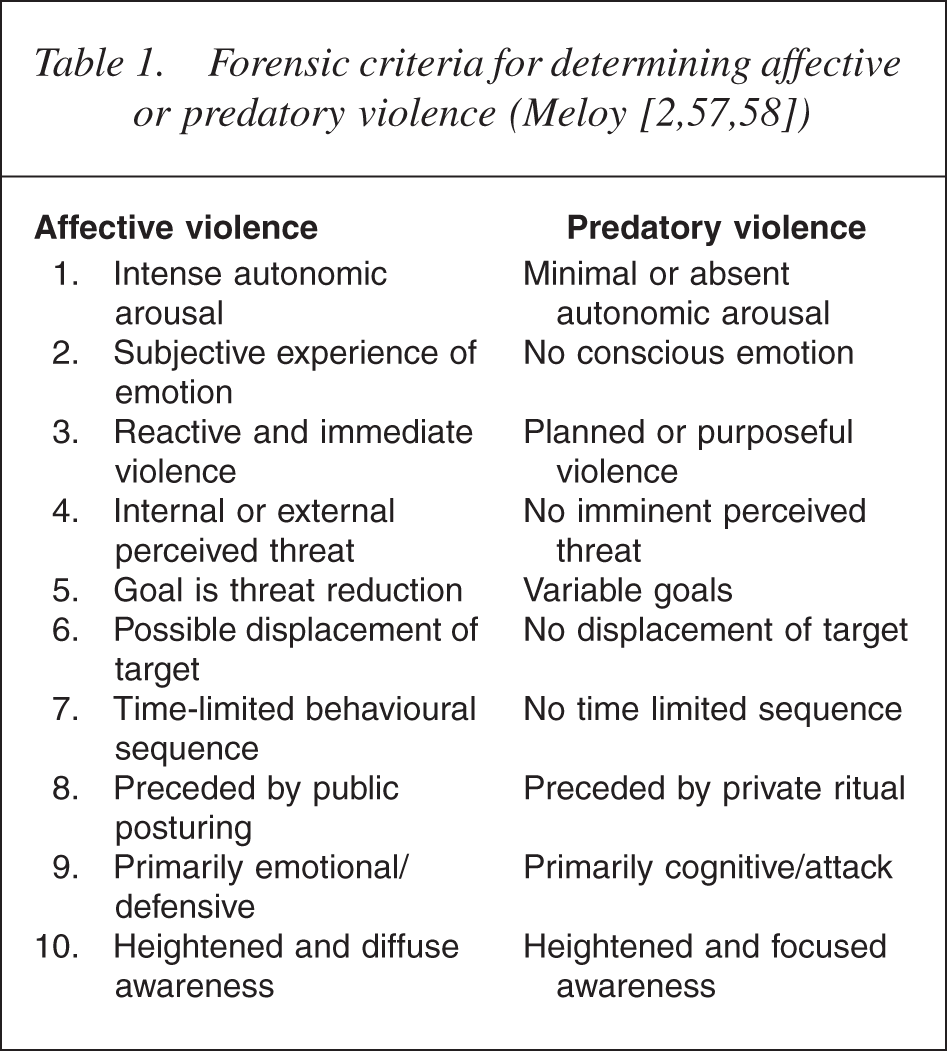
In predatory violence autonomic (sympathetic) arousal is minimal or absent, consistent with other mammals (item 1) and indicative of the primarily cognitive, and at times fantasy-based nature of predation. The absence of conscious emotion (item 2) likewise facilitates a successful predatory attack, since both heightened states of autonomic arousal and intense emotion would signal to the target an impending attack and enable its escape. It is speculated that emotion is psychobiologically dampened, muted, or functionally disconnected in predation, an evolved characteristic whose neurochemical basis is unknown at present, but has served our species well as our ancestors successfully hunted to survive another day, reproduce, and raise their young. It is ubiquitous in criminal forensic cases that predatory individuals will report the complete absence of emotion during the commission of their violent act. If any emotion is felt, it is anticipation of the predation, and exhilaration or dysphoria (for those with conscience) in its aftermath [2]. The initial planning of the predatory violence is often reported by subjects to be accompanied by a complete dissipation of anger or fear, and in their place, a resolute calmness.
Predatory violence is no longer necessary for food gathering for most individuals, but in our species is now commonly used to gratify desires for money, power, dominance, territorial control, sex and revenge. The multiple goals of this mode of violence sharply contrast with the simple goal of affective violence, to reduce a threat. Instead of public posturing, private rituals (item 8) play a dominant role in predatory violence. Such rituals serve to enhance the narcissism of the predator, and may range from certain repetitive grooming behaviours to the selection of certain items of clothing, amulets, other concrete symbols, or weapons [2, 61]. Such private rituals may practically increase the likelihood of a successful attack, but often serve more symbolic psychological goals, such as heightening the sense of omnipotent control over the foreseen victim [2]. In predatorily violent crimes, such as serial rape or murder, such rituals may emerge as signatures at the crime scene that eventually link cases for forensic investigators [62]. The absence of displacement of the target of aggression (item 6) and the selective suppression of other sensory input (item 10), although not yet empirically measured in human subjects, may eventually be understood as psychobiologically evolved behaviours that have contributed over the generations to the focused awareness and success of any one predatory act.
Research forensic criteria
Woodworth and Porter conceptualized and empirically tested a coding scheme in their study of homicide and its relationship to psychopathy [10]. They devised a 4-point rating scale according to degree of instrumentality (predatory) or reactivity (affective) for each homicide. Purely reactive (rated 1) indicated strong evidence for a high level of spontaneity/impulsivity and a lack of planning surrounding the commission of the offence. There was typically evidence for a rapid and powerful affective reaction and no external goal other than to injure the victim. Reactive/instrumental (rated 2) showed evidence of both reactivity and instrumentality, but the primary factor leading to death was reactivity. Instrumental/reactive (rated 3) showed evidence of both modes, but the primary factor leading to death was instrumental. Purely instrumental (rated 4) indicated a homicide which was goal-orientated, and without evidence of emotional or situational provocation. It was intentional, premeditated, and not preceded by a strong affective reaction.
Instrumental was further classified as either primary or secondary, the former referring to a homicide in which the primary goal was to inflict harm on the victim. The latter referred to a homicide in which the killing was a means to another goal, such as money or drugs. All of the cases were also scored for the dimensions of instrumental gain, impulsivity, and level of antecedent affective arousal.
Interrater reliability for the homicide coding using 21 randomly selected files was K = 0.81, p < 0.001. Nineteen randomly selected cases were used to determine interrater reliability for the three dimensions: instrumental gain (ICC = 0.90), impulsivity (ICC = 0.95) and affective arousal (ICC = 0.88). All three dimensions contributed in a meaningful way to the coding scheme. Although initially developed for research purposes, the practicality and reliability of the Woodworth and Porter [10] coding scheme shows promise for use in applied forensic work.
Self-report
Although caution is warranted in the applied forensic use of self-report measures to determine the mode of violence due to subject distortion and fabrication, such measures may provide a standardized point of reference against which to evaluate other sources of data in a case. For example, an individual charged with homicide may portray himself as only affectively violent, yet the crime scene characteristics indicate the absence of emotionality and threat, and the presence of careful planning.
Suris et al. [63] reviewed over 40 measures of aggression and violence, but found very few which differentiated between mode of violence. The most promising appears to be the Impulsive/Premeditated Aggression Scale (IPAS) developed by Stanford et al. [64], a 30-item self-report questionnaire, each item scored on a 5-point Likert Scale. Half of the items describe impulsive aggression and half the items describe premeditated aggression. For example, ‘when angry I reacted without thinking’, and ‘I felt I lost control of my temper during the acts’ (scored impulsive [affective]). And further, ‘the acts led to power over others or improved social status for me’ and ‘I planned when and where my anger was expressed’ (scored premeditated [predatory]). Initial testing of the instrument [64] indicated that the two factors accounted for 30% of the variance. Those subjects who clustered on the impulsive factor showed a broad range of emotional and cognitive impairments; those who clustered on the premeditated factor showed a greater inclination for aggression and antisocial behaviour. In a recent study of 85 male and female forensic patients [65] admitted to a state hospital with both violent and non-violent felony charges, the IPAS achieved alpha coefficients for the premeditated aggression scale of 0.72 and for the impulsive aggression scale of 0.81, indicating homogeneity of the scale items. The scales correlated 0.40 (p < 0.01), suggesting that the modes of violence are not independent of one another when subjects are asked to describe their violence over the previous 6 months. Forty per cent of the sample were predominately premeditated (predatory) in their self-reported aggression. The two aggression factors emerged once again, accounting for 33% of the variance of the instrument. The IPAS has been used in other studies [36, 38, 39, 66] as both an independent and dependent variable to study treatment non-response and non-compliance, as well as other correlates of the two modes of violence.
Integration
The integration of data on mode of violence in forensic psychiatric and psychological evaluations provides a systematic, psychobiologically based description of a specific act of criminal violence, or a historical predisposition to such acts. In risk assessments, such data can be combined with actuarial measures of the likely frequency of future violence risk, such as the Violence Risk Appraisal Guide [67], to individualize each case. Although actuarial measures are empirically impressive, they only give us a probability estimate of large groups of individuals within which a particular subject may fit. They do not specify the probability of risk for a particular subject, nor do they tell us anything about the nature of the violence the subject is likely to commit in the future. For example, a psychopathic individual who has an extensive history of predatory violence and fits into a group which has a 35% probability of future violence over the next 5 years has a very different risk management profile than a non-psychopathic individual with an extensive history of affective violence who also has a 35% probability of future violence over the next 5 years. In the former case, treatment non-response and noncompliance are likely, and an individual who is predatory would be considered much more dangerous than a predominantly affective individual for three reasons: (i) his violence is planned and deliberate; (ii) there are no behavioural signs that foretell his violence; and (iii) predatory violence is often associated with severe character pathology, such as psychopathy.
For the subject who is predominantly affectively violent with the same probability of future violence, risk management is much more feasible because of the greater likelihood of treatment response and compliance, and the ability to foresee affective violence if the subject is placed in emotionally arousing, provocative, or threatening situations. In both cases without a careful delineation of mode of violence, risk management would only be informed by actuarial probabilities, a rather anaemic approach to a complex and demanding task.
Integration of mode of violence into the reconstruction of a violent event for determination of sanity is also quite useful. Review of all evidence in a case, including interviews, witness accounts and crime scene data, will usually lead to a reasonably medically certain opinion that the act was affective or predatory. However, both affective and predatory violence may be motivated by a psychosis, and it is conceivable that a carefully planned and emotionless act of violence may meet jurisdictional criteria for insanity, such as lack of knowledge of wrongfulness [2]. In some cases the presence of delusion brings a resolve to an act of predation that would otherwise be absent [68].
Conclusion
Affective and predatory violence is an empirically established, psychobiologically based, bimodal phenomenon in mammals that has demonstrable relevance to forensic psychiatry and psychology. It is the author's hope that this study has been persuasive, and the analysis and integration of mode of violence will find its way into the lexicon of forensic psychiatric practice.
Footnotes
Acknowledgements
This study was funded by a grant from Forensis, Inc.