



Abstract
The discovery and development of world-class Lithium–Caesium–Tantalum (LCT) spodumene-bearing pegmatites in Western Australia underpins growth of a significant new sector of its mining industry. Recently, several new spodumene discoveries have been delineated in the Yilgarn and Pilbara Cratons. Contrary to exploration narratives that new economic mineral discoveries will generally be made at increasingly greater depths, beneath barren cover rocks, or in remote geological environments, all new lithium discoveries have clear surface expressions in relatively ‘mature’ greenstone belts. The exploration implication is that the search space for pegmatite-hosted spodumene deposits in Western Australia remains immature. These recently discovered LCT pegmatites have geological features relevant to exploration including their age, amphibolite-facies metamorphic setting and syn-metamorphic timing, and 3D geometry, particularly their typically gentle dips, that match other such world-class pegmatites globally. Further spodumene discoveries within pegmatites at or near surface are likely in the Archean terranes of Western Australia based on these consistent exploration criteria and supportive capital market conditions.
Keywords
Introduction
Lithium mineralisation hosted by spodumene-bearing pegmatites has long been known in Western Australia, notably at the giant Greenbushes deposit in the State's south-west which has a long history of production dating back to 1888 (Partington et al. 1995), first for tin and tantalum, and now lithium. Similarly, lithium-bearing pegmatites discovered at Wodgina in the Pilbara Craton (Sweetapple and Collins 2002) and at Kathleen Valley and Mount Marion in the Yilgarn Craton predate the recent emergence of the lithium sector as a significant new contributor to Western Australia's mining industry. Smaller lithium deposits at Bald Hill, Mount Cattlin (Sweetapple et al. 2019), and Mt Hope also predate the recent rise in exploration interest for lithium.
In this paper, the lithium market is briefly described to provide a business perspective on the current economic importance of spodumene pegmatites. A brief overview of the nature of the hosting LCT pegmatites is followed by a review of the exploration histories and geological features of major new spodumene-bearing pegmatite discoveries at Pilgangoora in the Pilbara Craton and at Earl Grey/Mt Holland, Kathleen Valley, Buldania (Anna), the Pioneer Dome North Lithium Project, Mt Ida, and Manna in the Yilgarn Craton (Figure 1). The characteristics of the recently discovered Western Australian pegmatites are then compared to those of economic lithium deposits worldwide to assess global exploration parameters for those pegmatites that are likely to be economic sources of lithium under current and future market conditions.
Simplified Archean geology of Western Australia, with locations of spodumene-bearing pegmatites. Geology adapted from Geological Survey of Western Australia (2015), lithium occurrence from references within the text.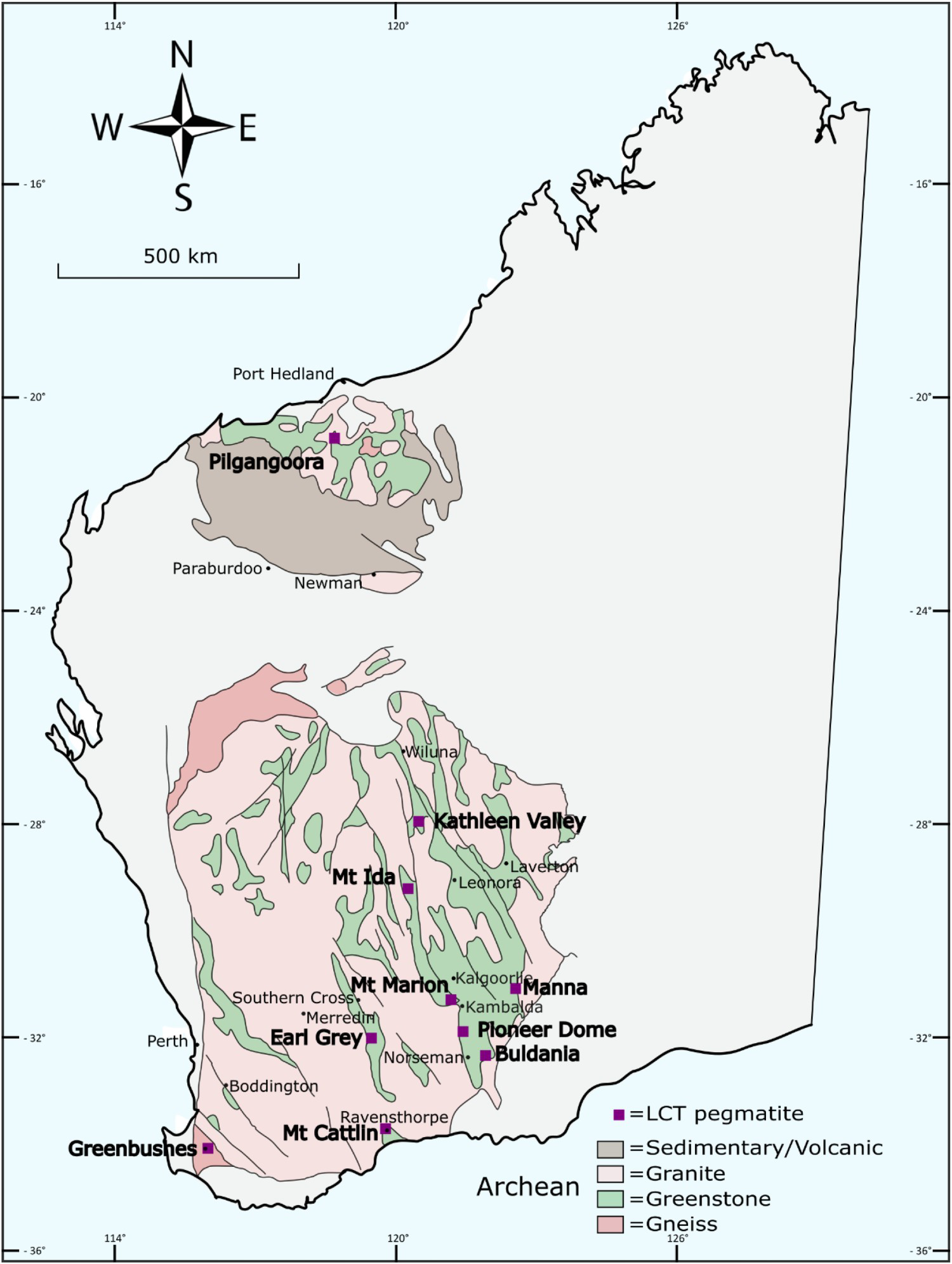
The lithium market
Spodumene, as a naturally occurring compound source of lithium, is a critical raw material in the production of lithium-ion batteries. Lithium is pivotal to the proposed transition from fossil fuel to low carbon energy generation, with 71% of its use within lithium-ion batteries, although lithium is also used in ceramics (14%), lubricating greases (4%) and polymer production (2%) (USGS 2021). Global reserves are ∼83 Mt, increasing substantially from global reserves of 13.5 Mt in 2015, due to increased interest as lithium has become a critical metal (USGS 2015, 2021). Chile and Australia have a dominant share of known lithium reserves, 9.2 and 2.8 Mt, respectively (USGS 2021), with lithium sourced from brine deposits and hard rock pegmatites. Hardrock production of lithium can be achieved through the development of projects for which the mineral processing pathway to a lithium-bearing spodumene concentrate (typically 6%) is now well established (Aghamirian et al. 2012; Welham et al. 2017) and then further towards downstream Lithium Carbonate and Lithium Hydroxide value-added products.
Production in Australia alone has increased 11 times to 99, 500 t LCE (Lithium Carbonate Equivalent) between 1995 and 2017, becoming the leading global producer of lithium from 2017 to 2020 (Maxwell and Mora 2020; USGS 2021). Lithium prices have increased from USD$8980/t for Lithium Carbonate in November 2018, to USD$30, 400/t for Lithium Carbonate in November 2021 (Trading Economics 2021). It is estimated that an average annual production of 1.7 Mt LCE will be required in the future, with sales of lithium estimated to reach USD$3 billion by 2025 if growth rates increase by 7% annually (Krane and Idel 2021).
Characteristics of LCT spodumene pegmatites
LCT pegmatites are normally intruded during the latter stages of tectonic activity in geodynamic environments related to plate convergence. In these settings, they may be emplaced both during deformation and regional metamorphism or after these events (Bradley et al. 2010). Proterozoic and Phanerozoic LCT pegmatites are normally considered to have formed through the fractional crystallization of S-type peraluminous granites and the partial melting of crustal rocks (Steiner 2019), although Archean examples in Western Australia are commonly associated with I-type granites (Sweetapple and Collins 2002).
The peak of LCT pegmatite emplacement occurs at the end of the Archean and into the Palaeozoic, with all deposits studied in this paper emplaced during the Archean (London 2018). Within Western Australia, LCT pegmatite deposits occur dominantly within Archean greenstone belts, as en échelon dykes or sills, exterior to more widespread granite (used sensu lato throughout) batholiths.
In pegmatite provinces, including those in Western Australia (Duuring 2020), there are commonly several generations of pegmatites, with only some representing LCT spodumene-bearing pegmatites. However, there are normally few details on variations within these provinces globally, including the recently discovered LCT pegmatite provinces and districts in Western Australia. A major exception is provided for the pegmatite province of the northern Pilbara Craton where Sweetapple and Collins (2002) provide an overview of the complex distribution of Sn, Sn–Nb–REE, Nb–Ta–Be, Be, Ta–Li–Sn (now major Li sources), and K-feldspar pegmatite deposits. Sweetapple and Collins (2002) broadly subdivide these into two categories of LCT and NYF (Niobium–Yttrium–Fluorine) pegmatites with some intermediate types. Both LCT and NYF pegmatites are structurally controlled, largely by shear zones or faults, but the LCT pegmatites including Pilgangoora are normally within the greenstone belts whereas the NYF pegmatites are commonly hosted by granite intrusions (Duuring 2020). This aspect is not pursued further here because of the lack of similar context for the recently discovered LCT pegmatites elsewhere in Western Australia.
Although the structure is important from the lithosphere to crustal scale, and shear and fault zones control the location of LCT pegmatites in the mineral system (Duuring 2020), there are few detailed studies of structural controls for individual spodumene pegmatite deposits (Bradley and McCauley 2013). In addition, as most of the recently discovered LCT pegmatites in Western Australia are described only in company websites, there is little definitive structural information available for these deposits. The most comprehensibly studied LCT pegmatites for which there are structural data are Greenbushes in the Yilgarn Craton and Pilgangoora in the Pilbara Craton where shear zones play a critical role in the location of pegmatite swarms. At Greenbushes, Partington (1990), Partington et al. (1995) and Partington (2017) demonstrate that the giant LCT pegmatite complex was emplaced during the D2 event in a D1 to D4 deformation sequence that was coincident with the M2 amphibolite-facies metamorphic event. The pegmatites are strongly controlled by major shear zones with syn-shearing pegmatite melt emplacement resulting in the anomalous zonal geometry of Li, K, and Na zones in the dilating sinistral shear zone. In the Pilgangoora and other pegmatite districts in the Pilbara Craton, Sweetapple and Collins (2002) and Sweetapple et al. (2017) demonstrate that the pegmatite swarms are related to major lineaments on a province scale and to shear zones on a district to orebody scale. In this case, the pegmatites were emplaced syn-D3 during metamorphism in a D1–D4 deformation sequence and locally occupy hydraulic fractures that cut D2 faults. Both compressional/transpressional and extensional/dilational controls result in the complex geometry of the pegmatites.
Within the deposits explored in this paper, spodumene (LiAlSi2O6) is the dominant economic mineral with secondary lepidolite (KLi2Al(Al, Si)3O10(F, OH)2) and petalite (LiAlSi4O10) also present in the Earl Grey deposit. As outlined by Černy and Ercit (2005), the spodumene subtype with dominant Quartz + K-Feldspar + Albite + Muscovite mineral assemblages is the most common of the complex rare earth element (REE) pegmatite category and is interpreted to have crystallized at high pressures (∼3–4 kbar). The pegmatites are almost inevitably zoned (Černy and Ercit 2005).
Pathfinders and issues in exploration
Due to the weak magnetic and conductive properties of LCT pegmatites, geophysical surveys cannot readily distinguish between pegmatite and adjacent granite intrusions, although geophysics can be used to determine appropriate geo-tectonic settings (Steiner 2019). Therefore, the use of district-scale geological surface mapping must be used to identify targets. It is key to note that pegmatite dykes can extend kilometres from the original parental magma, and therefore there is no consistent spatial association with potentially related granite intrusions.
Anomalies in incompatible elements (Li, Be, B, K, Cu, Rb, Zr, Nb, Sn, Cs, Hf, Ta, and W) in soil, stream and rock chip sampling are currently used as pathfinder elements. However, there are issues with the use of aqua regia in analytical procedures by governmental surveys which significantly lowers concentrations of these pathfinder elements (Steiner 2019). Portable XRF does not test for Li nor Cs, and whereas in-situ analysis of Sn, Ta, Wand K/Rb has proven as a valid technique for investigation, one of the main difficulties in in-situ exploration is visually identifying Li-bearing minerals (Steiner 2019).
Western Australian spodumene discoveries
The new Western Australian spodumene pegmatite discoveries are described below, ordered by current deposit resource, and shown together with previously known deposits in Figure 1. All information is obtained from company ASX announcements except for Pilgangoora, where the deposit and its mineralogy are well described by Sweetapple et al. (2017 and references therein).
Pilgangoora
The Pilgangoora pegmatite deposit is located ∼82 km SSE of Port Hedland, in the Archean Pilbara Craton, Western Australia (−21.06°, 188.91°). A series of pegmatite dykes, which intrude into tholeiitic metabasalts with metasedimentary interbeds, is located SE of the Carlindi Batholith, comprising metamonzogranite, in the East Strelley and Pilgangoora greenstone belts (Pilbara Minerals 2021a). There are four pegmatite groups: Eastern, Western, Central, and the previous ALO deposit in the south. The enveloping surface of the deposit extends 5800 m (north to south) by 50–1500 m (east to west) to depths of 590 m (−370 to 220 m RL (AMSL)). Unlike Earl Grey and Kathleen Valley, the geology and mineralogy of the Pilgangoora pegmatites has been published in journals by Sweetapple (2000), Sweetapple and Collins (2002), Jacobson et al. (2007), and Sweetapple et al. (2017). Pilgangoora pegmatites have consistent grades of Li2O, with randomly orientated spodumene crystals in a groundmass of dominantly quartz and albite (Figure 2; Sweetapple et al. 2017).
Lithium, Nb, Sn and Ta assays from a diamond drill hole through a Pilgangoora pegmatite. Consistent grades >1.5 wt-% Li2O (spodumene) are present, with higher grades located near the core of the pegmatite and lower grades near the contacts. Figure from Sweetapple et al. (2017).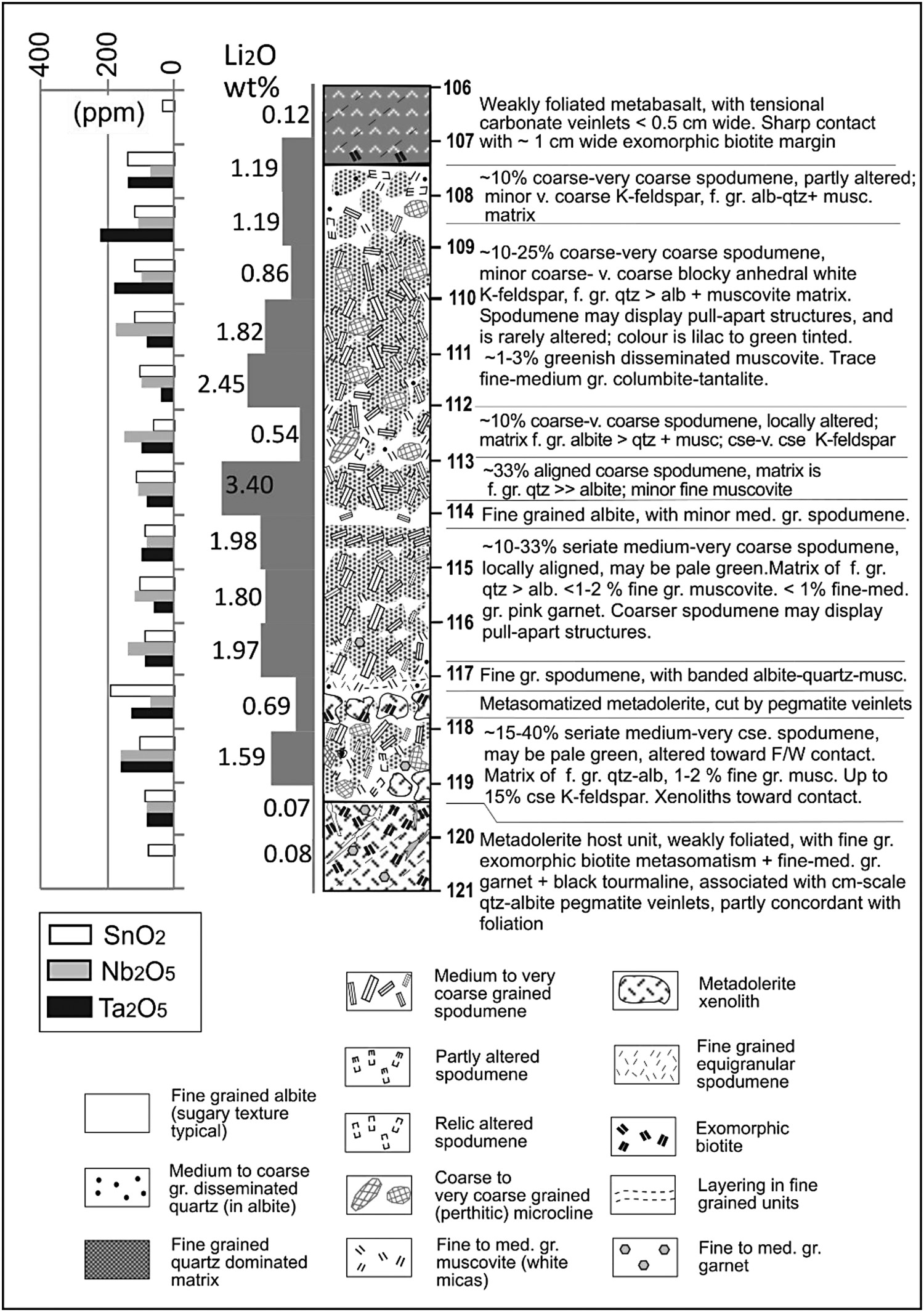
Unlike the other deposits studied, the Pilgangoora pegmatites were explored for lithium historically in the 1960s, and for tantalum from 2007 to 2012 (Sweetapple et al. 2017). The initial pegmatite field comprised 45–60° east-dipping fractionated pegmatite dykes with individual outcropping pegmatites 20–30 m apart (Pilbara Minerals 2014).
Preliminary exploration using RC drilling identified high-grade tantalum lenses and spodumene zones discovered from a 2010–2012 drilling programme. The 112 holes for a total of 10, 348 m in the RC drilling programme were used to infill the 2014 JORC Mineral Resource estimate from historical RC drill data over a 3.2 km strike, and to delineate the deposit along strike, to the north and south of the previously known extent of the pegmatites. In September 2021, Pilbara Minerals (2021) published a total resource of 308.9 mt at 1.14% Li2O for approximately 3.5 mt Li2O.
Earl Grey
The Earl Grey/Mt Holland Lithium Project is located 105 km SSE of Southern Cross (−31.97°, 119.77°). The deposit is hosted in steeply dipping mafic rocks, bounded and intruded by widespread Yilgarn granites, in the N–S trending Archean Forrestania greenstone belt (Figure 1). The deposit comprises a gently dipping (∼15° NW) main body, 30–90 m thick, with hangingwall and footwall splays up to 30 m thick (Figure 3). Currently, the Earl Grey deposit extends for at least 1.4 km down dip (NW) and 900 m along strike (E–W). Spodumene is the dominant Li mineral with secondary petalite (LiAlSi4O10) along the western and eastern margins of the deposit (Kidman Resources 2019).
Typical cross section of the Earl Grey pegmatite, with LiO2 grades. Modified from Kidman Resources (2018).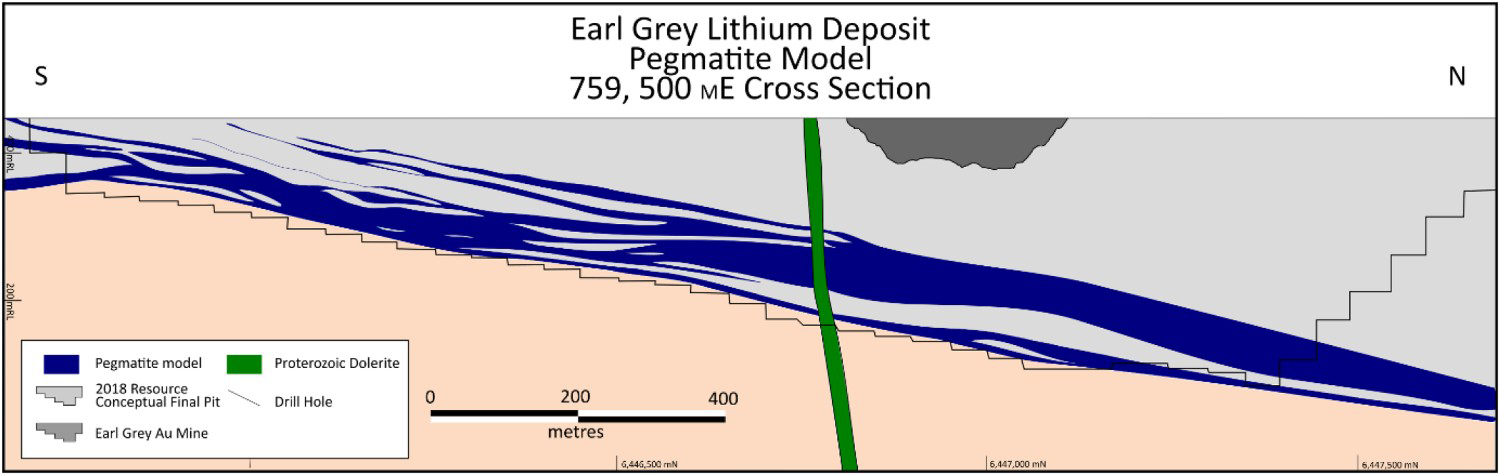
The Earl Grey deposit was originally a gold mine in the 1990s, but its lithium potential was confirmed through re-assaying historical drill core for Li and Ta. Interest in lithium rights in the area arose at, and east of, the historical Bounty gold mine from the presence of mapped outcropping spodumene-bearing pegmatites containing cesstibtantite, stibiotantalite, and lepidolite, all of which are characteristic of LCT pegmatites, that extended for 6 km along strike (Kidman Resources 2016).
Subsequent regional exploration programmes targeted along strike and locally down dip extensions of the Bounty pegmatite and pegmatite in the Earl Grey pit. This was followed by an extensive regional soil sampling programme targeting anomalous Li, Be, Ga, Rb, Cs, and Ta together with a localised soil programme at the Earl Grey pit to delineate the surface expression of the known pegmatite (Figure 4; Kidman Resources 2019).
Regional soil mapping programme to delineate lithium anomalies with 14, 000 samples collected. Image from Kidman Resources (2019).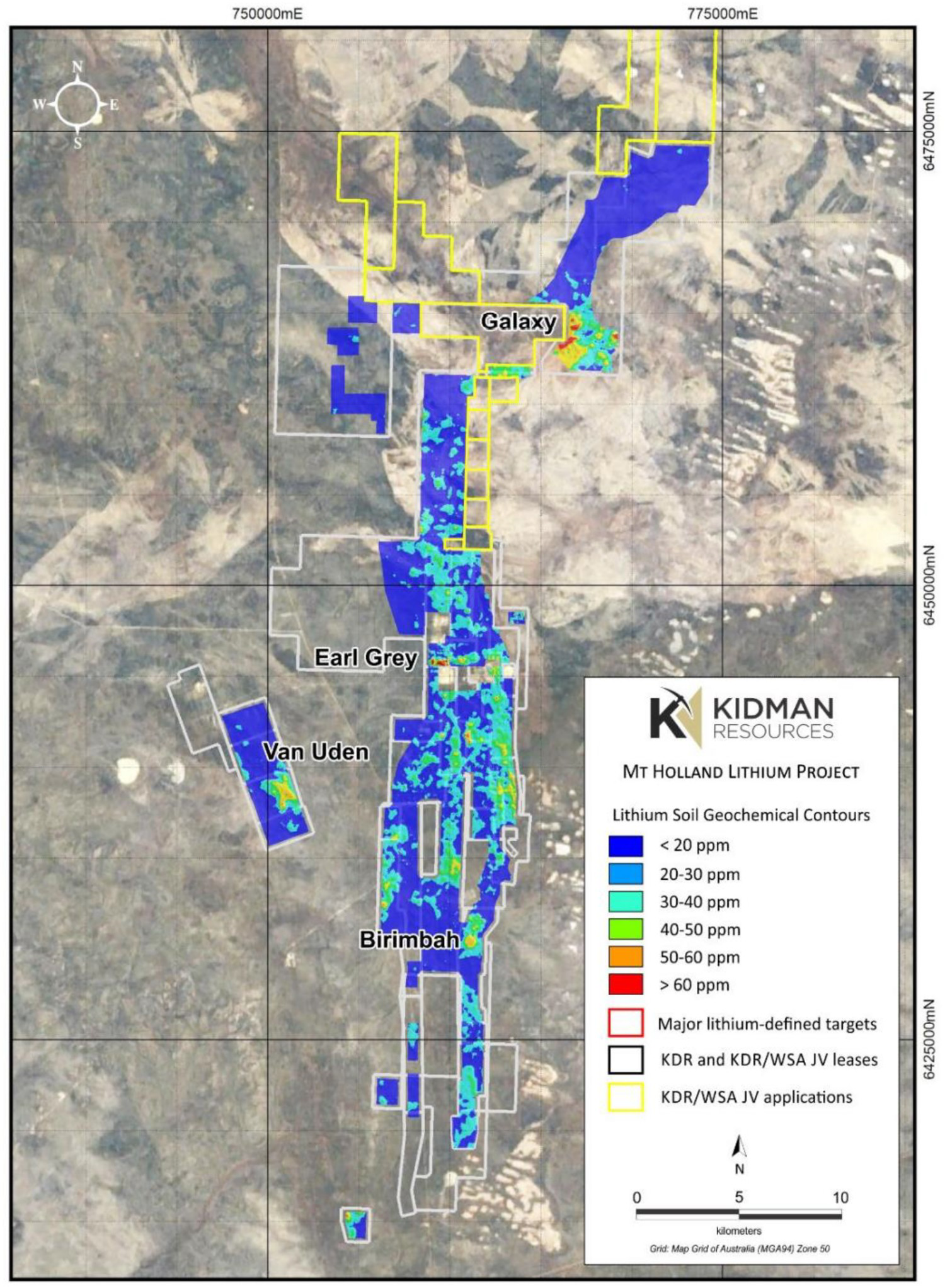
Kathleen Valley
Kathleen Valley is located within the Yilgarn Craton ∼45 km NNW of Leinster, Western Australia (−27.47°, 120.56°). The deposit is hosted in a package of ultramafic and mafic volcanic rocks on the western edge of the Archean Norseman-Wiluna greenstone belt which is spatially associated with Yilgarn granite intrusions (Figure 1; Liontown Resources 2021a). The Kathleen Valley deposit encompasses, as of April 2021, 20 mineralised LCT spodumene pegmatites, trending NE–SW, to a depth of 640 m, and is referenced as two separate locations: Mt Mann and Kathleen's Corner (dimensions Table 1; location Figure 5). Pegmatites at these locations coalesce at 300–400 m depth, forming a single, 35–75 m thick body, which remains open with the current extent of 600–700 m down dip (Liontown Resources 2021a).
Kathleen Valley pegmatite and drill hole locations at Mt Mann and Kathleen Corner. From Liontown Resources (2020).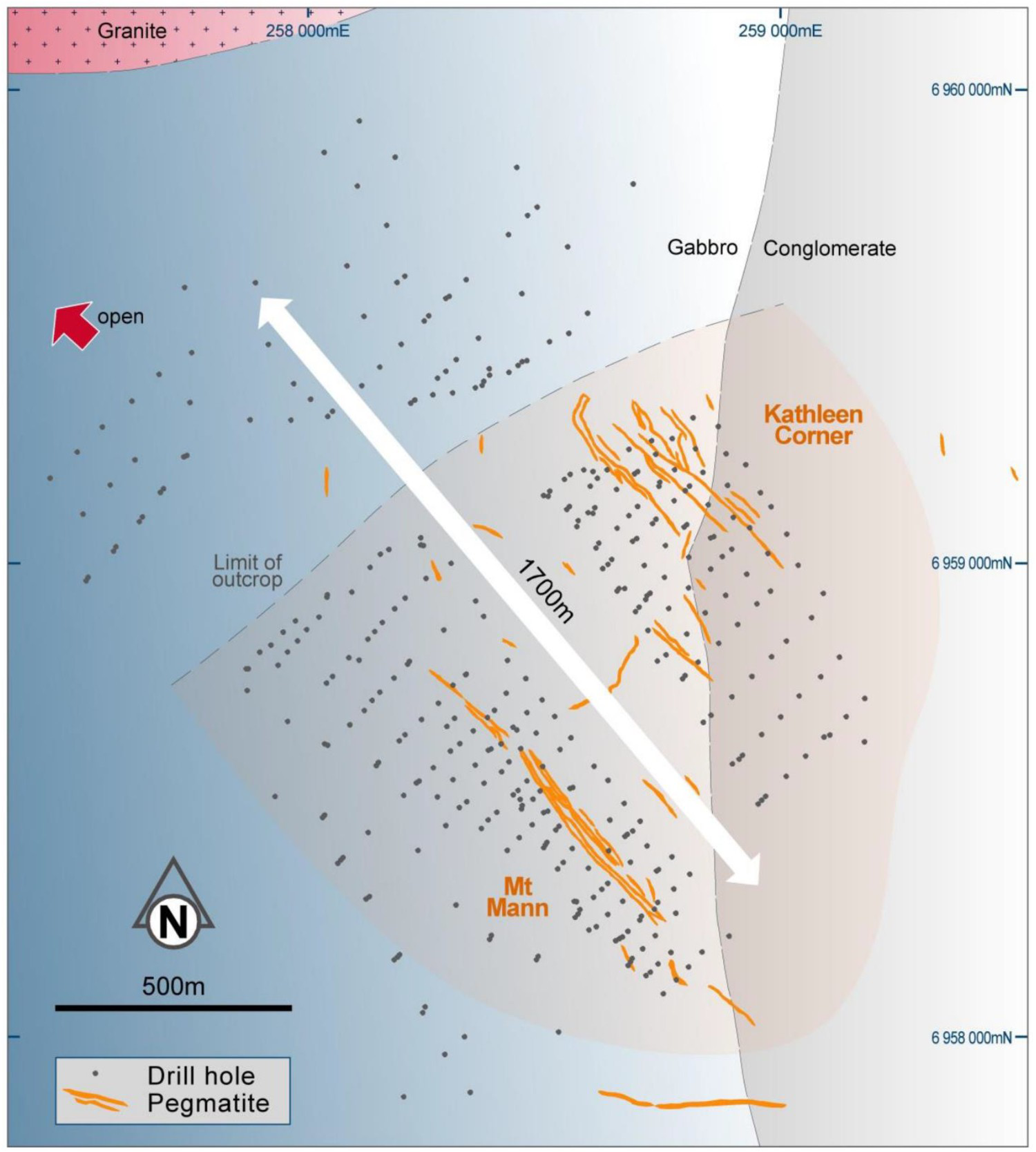
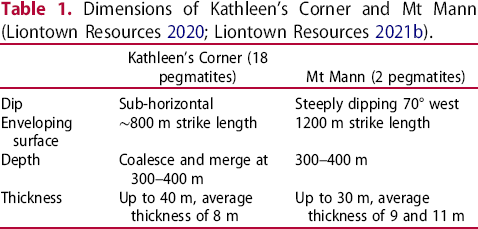
Prior to 2016, no previous drill testing for Li or Ta had been undertaken, with exploration principally targeting Au and Ni. Although geological mapping, in conjunction with a broad soil and rock chip sampling programme of the outcropping pegmatites had been undertaken historically, there is no record of methods, results, or procedures. Initial exploration targeted the previously mapped Mt Mann pegmatites with rock chip sampling and reverse circulation (RC) drilling, which delineated Mt Mann and Kathleen's Corner as two different targets and, using traditional mapping methods, doubled the strike length of the collective zone of pegmatites to >1.4 km. Unlike at the Earl Grey pegmatite deposit, no soil sampling programme targeting Li or pathfinder elements has yet been reported for further local or regional exploration.
Follow-up drilling along strike of the spodumene mineralisation defined by the initial 2017 RC drill programme and beneath outcrops with high-grade rock-chip samples was undertaken. The Kathleen Valley pegmatite swarm remains open down dip and along strike with drilling targeting NE extensions along strike and SW down dip. As of November 2021, Liontown Resources (2021b) provide a resource estimate of 156 mt at 1.4% Li2O.
Buldania
The Buldania project is located ∼170 km southeast of Kalgoorlie (−32.07°, 122.09°) where the pegmatite deposit is hosted in a sequence of komatiite, dolerite, and carbonaceous shale in the Archean Norseman-Wiluna greenstone belt in a granite-dominated terrane (Figure 1). The Anna pegmatite group comprises eight pegmatites, striking NE and dipping 0° to −10° NW, but steepening to −65° in the southeast, over a total area of 1300 by 380 m. Pegmatites extend to a depth of 300 m and have a combined average thickness of 26 m (Liontown Resources 2021c).
With no previous exploration for Li prior to 2017, exploration, based on historical geological mapping and petrological analysis, commenced to define the extent of the spodumene-bearing pegmatite swarm previously outlined during Ni and Au exploration drilling in the 1970s and 1990s (Liontown Resources 2017). Rock sampling and further mapping defined targets for the initial RC drill programme, which then delineated the Anna deposit.
Further exploration, utilising a soil sampling programme, delineated three NE/SW trending anomalies adjacent to the Anna pegmatite deposit. Future exploration at Buldania is projected to extend the soil sampling programme NE of the known anomalies (Figure 6; Liontown Resource 2021c).
Lithium soil sampling results defining three new NE–SW trending areas of interest, which are consistent with the strike of known pegmatites within the Anna resource area. Figure from Liontown Resources (2021c).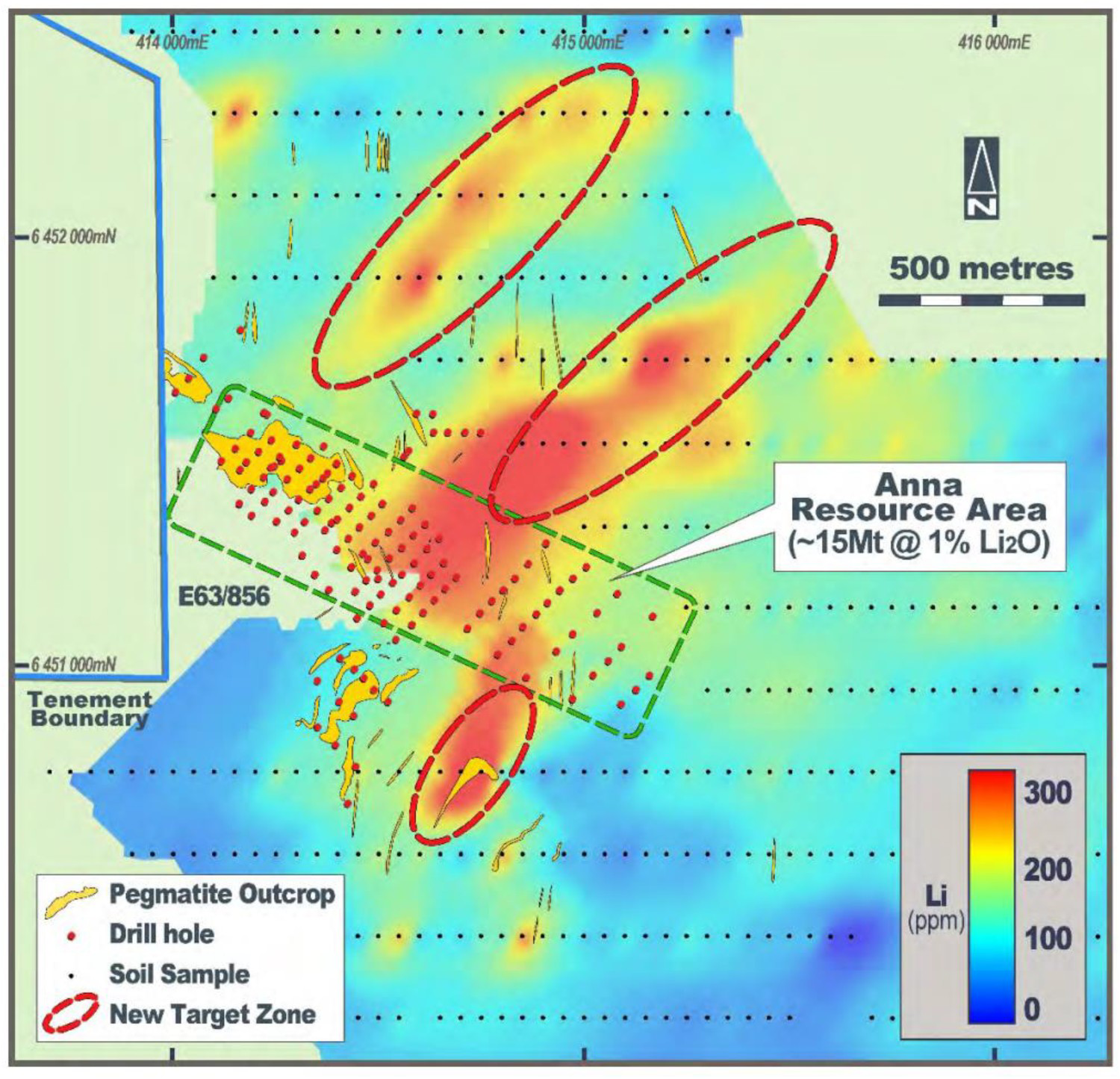
Pioneer Dome North
The Pioneer Dome North Project is located in the Eastern Goldfields ∼130 km south of Kalgoorlie (−31.75°, 121.60°). Three spodumene-bearing pegmatite deposits (Cade, Davy, and Heller), located within 2 km of each other, are hosted in metasedimentary rocks and metamorphosed felsic volcaniclastic rocks, dipping moderately to the east. Cade, the largest deposit, consists of two NNW-trending pegmatites that have been identified both in the oxidised zone and fresh rock and which dip to the east.
Pegmatites had been mapped and drilled, but not assayed for Li (and associated elements) since the 1970s around the Pioneer Dome (see for example, Marston 1984).
The discovery of the Sinclair pollucite deposit highlighted the presence of highly fractionated LCT pegmatites of economic significance in the Pioneer area (Batt et al. 2021). Drilling for nickel mineralisation at Pioneer first intersected pegmatites in the 1960s and 1970s ‘Nickel Boom’ and once again during drilling programmes between 2003 and 2013. Following the 2016 ‘Lithium Boom’, soil sampling highlighted the Li potential of the pegmatites and follow-up drilling identified intersections of high-grade caesium (6 m at 27.7 wt-% Cs2O) but with no significant spodumene (Batt et al. 2021). However, follow-on exploration activity involving detailed mapping and RC drilling programmes led to the discovery of the Northern Dome Lithium Project in 2019.
Future exploration is designed to investigate the zone between the Cade and Davy deposits, focusing on unexplained elevated lithium anomalies in the oxidised zone generated from RC and aircore drilling, and also to investigate along strike, NE to the Heller deposit.
Mt Ida
The Mt Ida deposit is located 100 km northwest of Menzies, in the Eastern Goldfields of the Yilgarn Craton (−29.10°, 120.46°). Pegmatites are hosted in mafic and ultramafic sequences, which are intruded by late-stage granites within the Mt Ida/Ularring greenstone belt (Figure 1). Pegmatites are spodumene-bearing, but their dimensions are currently undefined (Red Dirt Metals 2021).
Mt Ida had no targeted Li exploration, but cores from previous drill programmes for Au/Cu exploration were additionally assayed for Li and Ta. Near the Timoni gold mine, an aeromagnetic survey confirmed the presence of an adjacent granite intrusion, with associated geological mapping uncovering outcropping pegmatites at five locations over a 4 km strike (Red Dirt Metals 2021).
As of 2022, the exploration area extends 5 km north along strike from the current mapped outcropping pegmatite to target the eastern and western margins of the granite.
Manna
The Manna deposit, located 100 km east of Kalgoorlie (−30.87°, 122.54°), consists of stacked pegmatites hosted in a series of mafic and ultramafic rocks in the Norseman-Wiluna greenstone belt (Figure 1). Drilling has delineated two target areas that define two swarms of pegmatites dykes that extend over 8 km: Manna 1 (750 m by 130 m) and Manna 2 (undefined), with thicknesses of individual spodumene-bearing pegmatites of up to 15 m (Breaker Resources 2021a).
Lithium potential was indicated during gold exploration, with the discovery of an outcropping pegmatite. Subsequent mapping defined the five spodumene-bearing pegmatites which were targeted with an RC drill programme in 2018, followed by a soil sampling programme which highlighted Li–Rb–Sn–Be anomalies in a soil sampling programme implemented in 2019 (Breaker Resources 2021b).
As of November 2021, all known spodumene mineralised pegmatites are open along strike and depth.
Genesis of LCT pegmatites
Proterozoic and Phanerozoic pegmatites normally originate from an S-type peraluminous parental magma and occupy the roof zone of a granite pluton (London 2018). For most pegmatite provinces, melts are proposed to derive from the anatexis of juvenile accretionary sedimentary rocks during compressional orogenic events (London 2018). However, within the Archean Yilgarn and Pilbara cratons, pegmatites are associated with fractionated I-type granites, with rare elements suggested to be sourced from the progressive partial melting of trondhjemite-tonalite-granodiorite and fluids transported through regional structures such as shear zones (Sweetapple and Collins 2002).
Although spatial associations of LCT pegmatites with parent granite intrusions are stressed in the literature, there is no consensus that there is a specific connection to a particular granite magma series, with both S-type and I-type associations implicated as summarised by Bradley and McCauley (2013) and more specifically peraluminous granites implicated by others (Wilde et al. 2021). Although there may be overlap in age ranges of granite intrusions and pegmatite swarms in some provinces such as in the Pilbara Craton (Sweetapple and Collins 2002), the regional granites and LCT pegmatites may be of different ages where detailed geochronology is available as at Greenbushes (Partington et al. 1995) or modelling may negate a genetic relationship (Barros and Menuge 2016). In these cases, at least, anatexis of basement rocks or partial remelting of earlier emplaced granites (Sweetapple and Collins 2002) must be considered as a logical option (Simmons et al. 2016). As there are clear examples where direct relationships to granite intrusions are negated, direct derivation of LCT pegmatite melts from low-degree, incompatible-enriched, anatectic melts (London 2018) must be strongly considered if a universal model is adopted. Unfortunately, this cannot be tested for the recently discovered but poorly documented LCT pegmatite deposits in Western Australia because there are no relevant academic studies of granites in the pegmatite districts. However, this is clearly a fertile area for future research.
The dimensions and shape of pegmatite deposits are dependent upon the competency of the host rock. Pegmatite dykes emplaced in competent rocks, such as gneiss, amphibolite, and igneous intrusions, normally form as planar and extensive bodies, whereas pegmatites emplaced in less competent, more ductile host rocks such as schists commonly form isolated, ellipsoidal bodies (Cerny 1991; London 2018).
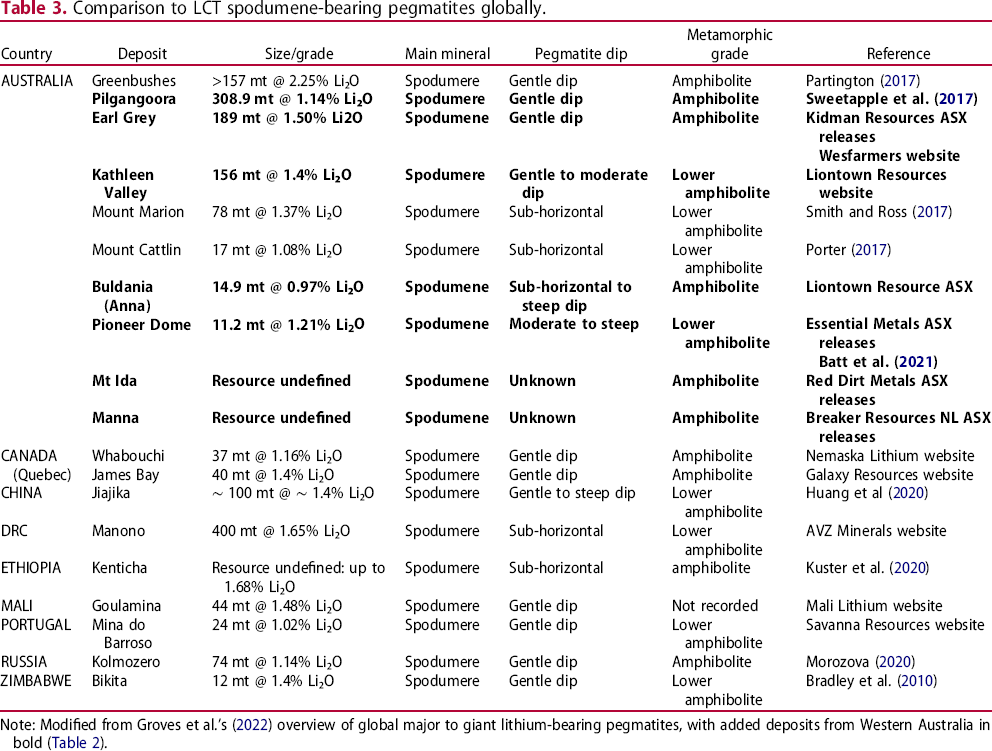
Groves et al. (2022) demonstrate that globally a critical characteristic of economic spodumene pegmatites bodies is a gentle to sub-horizontal dip. This is consistent with the model of emplacement in dilation zones in compressional and transpressional settings, with multiple pulses of Li-rich melt controlled by the near-vertical orientation of minimum stress – sigma 3 (Figure 7). Horizontal emplacement, unlike the near-vertical emplacement of more common, normally barren, or poorly mineralised pegmatites, increases the efficiency of vertical differentiation of melts, enriches the melt with volatiles, and increases thickness and enrichment in rare elements (Li, B, Rb, and Cs) in late fractionated melts (London 2018; Groves et al. 2022).
Model of sub-horizontal pegmatite emplacement into flat dilation zones due to vertical sigma 3. Figure from Groves et al. (2022). (a) Initial melt pulse, (b) emplacement of second melt with further differentiation of the melt. (c) Thick late melt injection producing a thick upper lithium zone.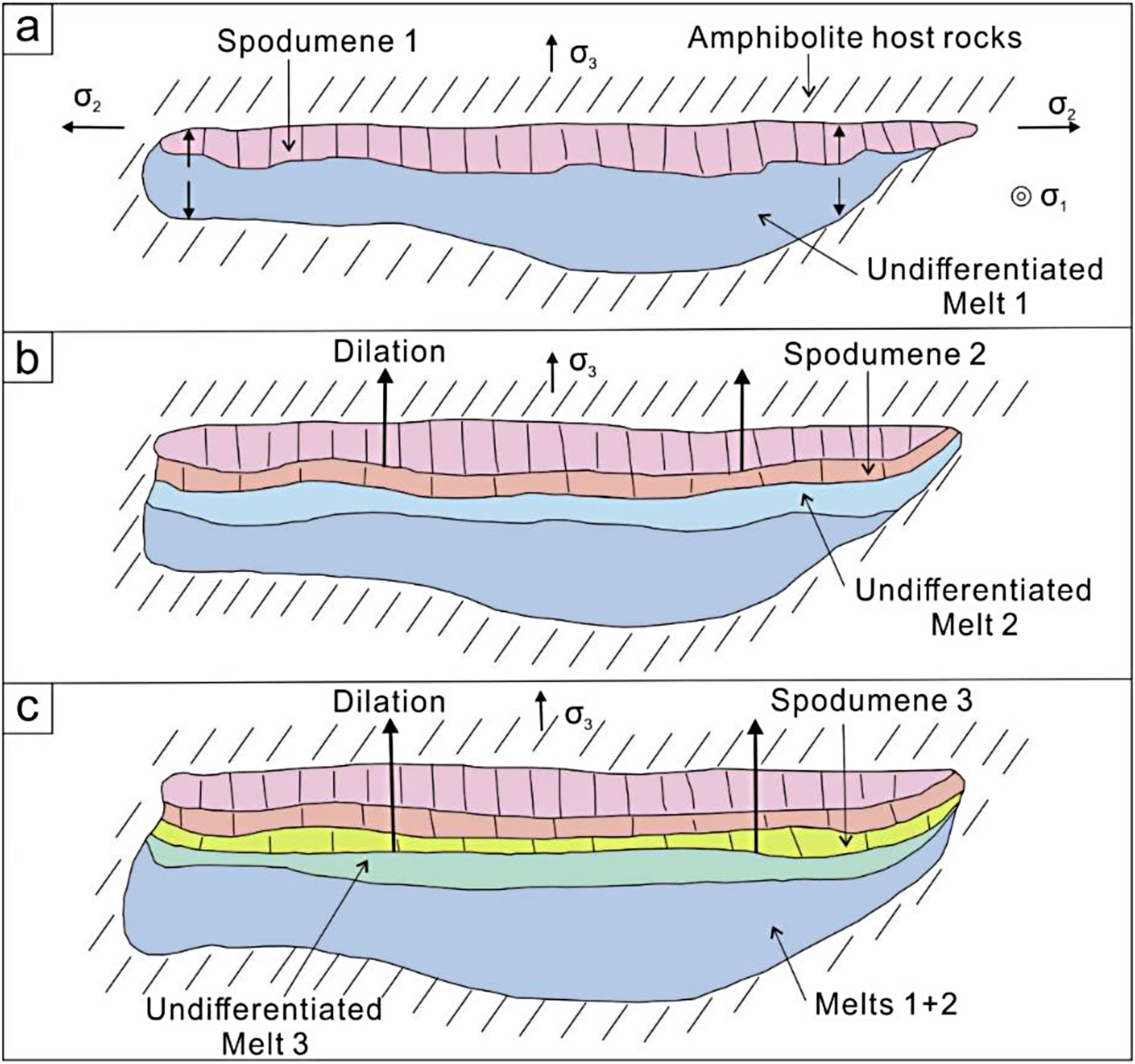
From this genetic model, exploration strategies can be tailored at a district scale to determine the geological and tectonic setting of economic LCT pegmatites. Crucially, competent high-temperature host rocks such as upper greenschist to amphibolite-facies metamorphic rocks are ideal for the emplacement of pegmatite melts in a compressional or transpressional stress field. The nature and source of the pegmatites appears to vary between the Archean and subsequent eras from available fragmented information.
Exploration insights
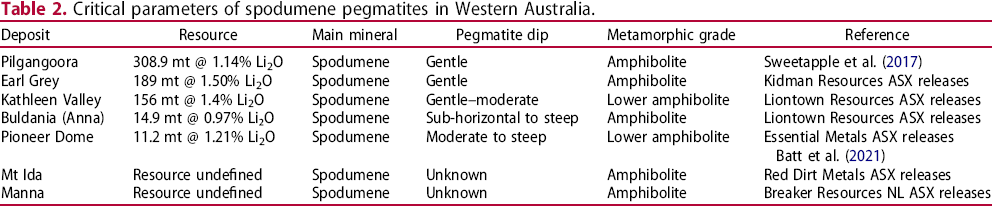
Critical parameters of spodumene pegmatites in Western Australia.
Comparison to LCT spodumene-bearing pegmatites globally.
Steiner's (2019) workflow for grassroot LCT pegmatite target generation follows similar pathways to exploration for other deposit types: desk-top study, regional surveys, and geological mapping, followed by targeted drilling. Through researching the exploration strategies of companies exploring for spodumene pegmatites in Western Australia, additional methods to constrain the targeting of pegmatites, such as re-assaying historical gold or base–metal exploration drill core and implementing regional-scale soil sampling can be identified.
Critical shared characteristics of economically significant LCT pegmatite deposits (Table 3) correspond in terms of tectonic and metamorphic environments to those of orogenic gold deposits and more rarely komatiite-associated Ni–Cu deposits or volcanogenic massive sulphide Cu–Zn deposits (Robert et al. 2005). Several of the deposits studied here are in goldfields, in places close to gold mine sites (Earl Grey, Mt Ida, Manna, Kathleen Valley), where there is a historical drill core. Exploration for Li at the Earl Grey, Mt Ida, and Manna deposits commenced with the re-assaying of historical drill core from gold and/or nickel exploration after discovery of the presence of pegmatites through a desk-top study and/or geological mapping. Re-assaying core for Li and Ta, in historical Western Australian goldfields where I-type fractionated granites occur in upper greenschist to amphibolite-facies metamorphic domains, would be a cheap and effective method to determine the potential for an economic Li project, and to constrain locations of LCT pegmatites that may not have a prominent surface expression.
If the exploration area is obscured by dense vegetation and/or thick regolith plus residual soils, the use of soil mapping and soil geochemistry can be advantageous where geological mapping is impossible. Soil mapping and geochemistry can indicate strike extensions and repeats of pegmatite bodies, as demonstrated at the Buldania Lithium Project, and highlight further areas of lithium prospectivity (Figure 6). Pathfinder elements, as described above, are resistant to conventional acid-digest techniques such that data from previous publicly available regional soil sample data from areas in Western Australia might be non-definitive. Another difficulty in employing a soil sampling programme is that pathfinder elements are relatively immobile in the soil, leading to a lack of widespread element dispersion and thus a requirement for closer spaced, more expensive sampling grids.
Much of Western Australia is covered by thick and complex regolith. The intensive research on geochemical exploration, particularly for gold and nickel deposits, in this regolith (Anand and Butt 2010) predated the growth of lithium exploration, specifically for LCT pegmatites, in Western Australia. A study of the Greenbushes pegmatite, before spodumene was the sought commodity, by Smith et al. (1987) did however show that up to 100 ppm Li was retained in pisolitic laterite above the pegmatite, together with up to 1150 ppm As, 500 ppm B, 60 ppm Be, 75 ppm Nb, 75 ppm Sb, 4200 ppm Sn, 75 ppm Ta, and 30 ppm W. Coincident highs of B, Nb, and Ta defined a 5 km by 1 km anomaly centre within a broader 20 km by 12 km anomalous zone defined by As, Be, Sb, and Sn. This indicates the potential for laterite geochemistry as an exploration tool for large LCT pegmatites under cover. Although not specifically related to LCT pegmatites, some studies (e.g. Millot et al. 2010) show that under weathering Li in the solution can be incorporated into clay minerals, showing the potential for incorporation into saprolite horizons in weathering profiles below surficial laterites in Western Australia.
In terms of lithium exploration, Wise et al. (2022) stress the value of handheld LIBS (Laser-induced breakdown spectroscopy) as a new tool to measure the Li content of micas exposed at the surface or in drill core, as a guide to the degree of fractionation of pegmatites and their potential to host spodumene deposits.
Conclusions
As the world transitions to a ‘green-clean’ energy era, the demand for batteries for energy storage and to power electric vehicles has soared. Lithium has rapidly become a critical element with increasing demand and associated price rise and consequent exploration activity. Lithium-bearing brines in the salars of South America are a major resource but there are technical issues to overcome. Meanwhile, more traditional mineral exploration has focussed on LCT pegmatites as a currently extractable source of lithium.
As globally important metallogenic provinces, the Archean Pilbara and Yilgarn Cratons of Western Australia have witnessed intense exploration for LCT pegmatites to supplement and eventually replace lithium production from the giant Greenbushes LCT pegmatite deposit with its historical Sn and Ta and current Li resources. This has produced several recent discoveries including Pilgangoora in the Pilbara Craton and Earl Grey, Kathleen Valley, Mount Marion, Mount Cattlin, the North Dome Lithium Project, Buldania (Anna), and Manna in the Yilgarn Craton. All discovered lithium pegmatite deposits are sited in greenstone belts, some with associated I-type granite intrusions. All occur in relatively competent mafic rocks in upper greenschist to amphibolite-facies metamorphic domains with spodumene as the major lithium mineral in syn- to late-kinematic, normally gently dipping pegmatite swarms, mimicking the critical characteristics of Archean spodumene pegmatites globally. Although spatial associations with parent granite intrusions are stressed in the literature, there are no obvious consistent spatial relationships for Western Australian deposits. The broadly syn-metamorphic timing allows the intruded pegmatites to cool slowly, allowing greater fractionation of volatiles and incompatible elements like Li, while the gentle dip of the pegmatites in a syn-kinematic environment with vertical extension allows progressive inflation and growth of the lithium-enriched pegmatites. The resultant pegmatites are thus both anomalously enriched in Li with a pegmatite geometry most suitable for open pit mining over extensive strike lengths.
The consistent geological parameters of the spodumene pegmatites in Western Australia and globally allow focus of exploration on mafic-ultramafic rocks in spatially relatively restricted amphibolite-facies domains of Archean greenstone belts worldwide. Where exposure is poor, soil or regolith geochemical surveys for Li and indicator elements can be employed with the proviso that dispersion may be limited. In existing gold, nickel, or base–metal mining districts, re-logging and re-assaying of existing exploration drill core can be an additional tool to locate sub-surface spodumene pegmatites.
Footnotes
Acknowledgements
David Groves wishes to acknowledge Dr Marcus Sweetapple for provision of a high-quality Figure from Sweetapple et al. (2017) that is reproduced here as  .
.
Disclosure statement
No potential conflict of interest was reported by the author(s).