Abstract

Wikipedia defines scientific modelling as ‘a scientific activity, the aim of which is to make a particular part or feature of the world easier to understand, define, quantify, visualise or simulate by referencing it to existing and usually commonly accepted knowledge’. Modelling has become an essential part of metallurgical processes, with an objective to understand the intricacies of a given process so that production can be optimised. In earlier days, a process model could be an empirical description of a process that would be specific to a particular plant practice. With the advancement of scientific understanding, the models are getting less and less empirical.
Modelling of a metallurgical or mineral beneficiation process is an attempt to reproduce the description of the process as close to the reality as possible. If attempts are made to develop models based on theories only, even if they are sound, such descriptions can only be termed as Idealized Models. These can be far removed from the real process practised in industry as the latter often does not have the idealised conditions.
However, with systematic attempts to improve the idealised model, by deeper scientific description and artificial intelligence (AI), the gap between the idealised and real process descriptions can be narrowed.
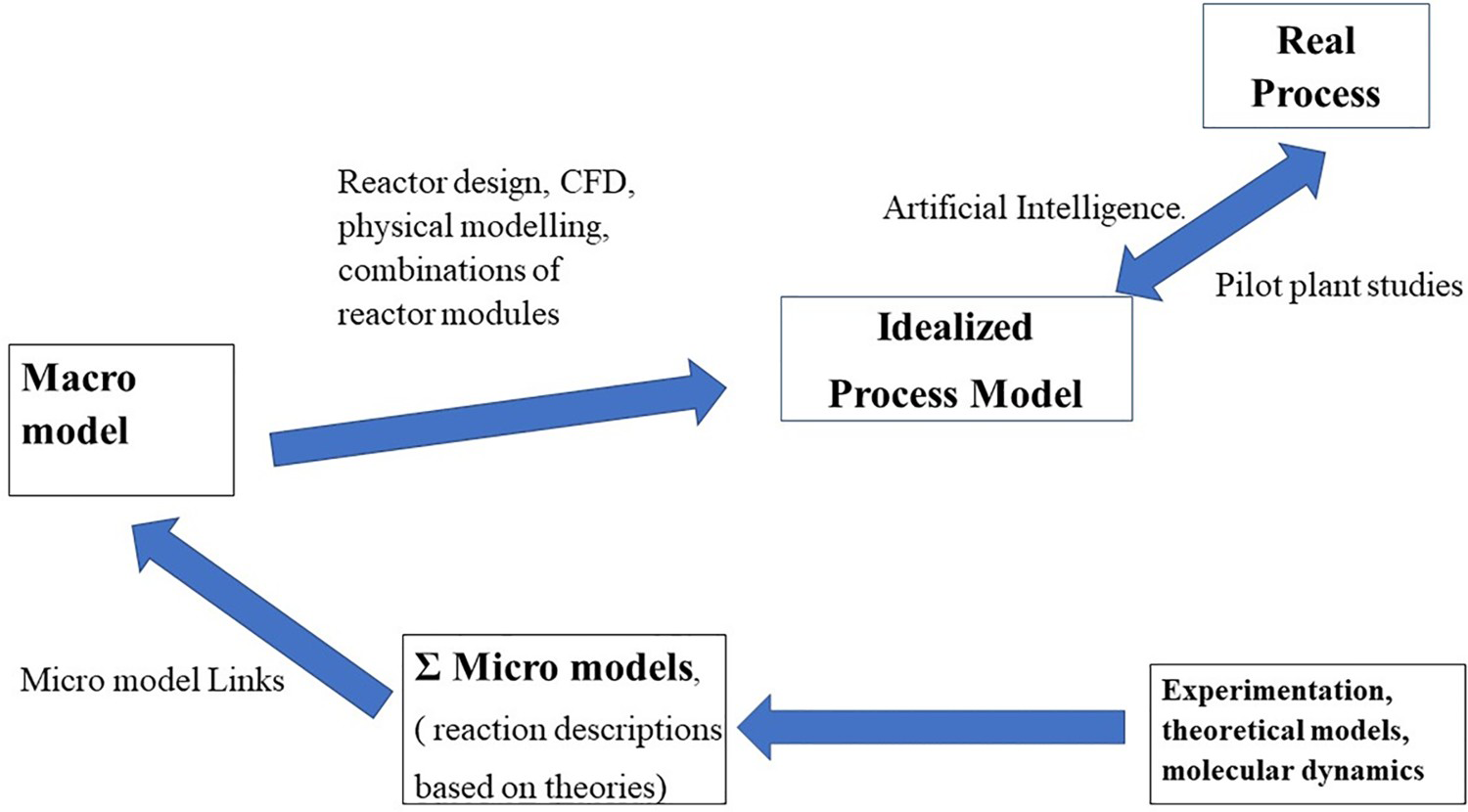
Any metallurgical or mineral beneficiation process consists of a number of unit operations. Each operation has an underlying mechanism. If each of these mechanisms can be modelled on the basis of thermodynamic principles and reaction kinetics including the transport phenomena involved, each of these models, termed micro models, can be suitable building blocks for a macro model. Suitable ‘cements’ or links have to be applied so that the building blocks can be held together to form a macro model. The structure built out of these blocks (micro models) have to be incorporated in reactor vessel. An optimum reactor design for a given part of a process needs to be chosen; for example, a shaft reactor for gas–solid reaction. Here, the concepts of CFD need be suitably utilised. These reactor models/modules can then be coupled to provide a complete process description; for example, a blast furnace model can conceivably be built by mounting a shaft module on top of a smelter module.
If models are developed in this way, this could provide a way to realise an idealised process model which would be applicable under similar conditions, thus minimising empirical formulations. This may also enable new process designs. The concept is illustrated in the figure.
In the description in the figure, experimentation at different scales (laboratory studies, physical modelling as well as pilot scale studies) along with artificial intelligence form integral parts of any description of a real process. With scientific advancement, the empiricism becomes less and less involved, thereby minimising the uncertain factors.
With respect to thermodynamic data, there are excellent and reliable commercial databases available today. There are kinetic modules available as well as very efficient CFD codes. What is needed is to get modellers around the world to put together their ideas for achieving the best descriptions of industrial processes.
The present themed issue aims at bringing together the modellers of different processes from different parts of the world. A unique idea is that most of the contributions are authored by scientists from different countries so that the different schools of thought are fused together. This issue presents modelling of a wide variety of areas such as blast furnace modelling, CFD-based modelling of mineral processes, inclusion modelling, ferroalloy production, and modelling of environmental issues. The last example is unique, as model description of environmental optimisation is rarely attempted. The lead paper in this issue, written by Professor Sohn, deals with the intricacies of modelling. The various authors have been invited on the basis of their deep knowledge and vast experience. Thus, this themed issue is intended to provide a unique picture of modelling of metallurgical and mineral beneficiation processes. It is hoped that this issue will enthuse younger modellers to develop models with scientific depth and practical applications.
My sincere thanks to the Transactions of IMM for giving me the opportunity to bring forth this themed issue. My special thanks to Mr. Narasimhan Vaithiyanathan of Trans. IMM for the excellent support.
A conceptual description of metallurgical process modelling.